Principles of Treatment for Impaired
Motor Performance
Learning Objectives
• Define resistance exercise and describe physiological adaptations.
• Discuss determinants of resistance exercise.
• Identify different types of resistance exercise.
• Explain precautions and contraindications of resistance exercise
Treatment for Impaired Motor Performance
Always relate back to FUNCTION, MOVEMENT and PATIENT GOALS!
Muscle Performance
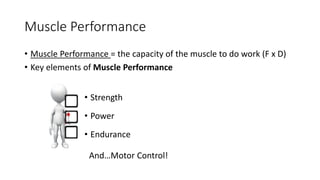
• Muscle Performance = the capacity of the muscle to do work (F x D)
• Key elements of Muscle Performance
• Strength
• Power
• Endurance
And…Motor Control!
Treatment for Impaired Motor Performance-
Resistance Exercise
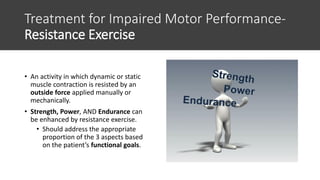
• An activity in which dynamic or static
muscle contraction is resisted by an
outside force applied manually or
mechanically.
• Strength, Power, AND Endurance can
be enhanced by resistance exercise.
• Should address the appropriate
proportion of the 3 aspects based
on the patient’s functional goals.
Strength
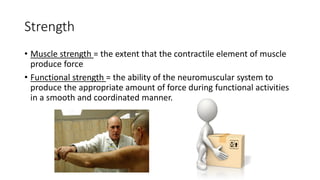
• Muscle strength = the extent that the contractile element of muscle
produce force
• Functional strength = the ability of the neuromuscular system to
produce the appropriate amount of force during functional activities
in a smooth and coordinated manner.
Treatment for Strength Deficits-
Strength Training
• The practice of using muscle force to raise, lower or control heavy
external loads for a relatively low number of reps.
• Adaptations:
• Increase in maximum force-producing capacity of the muscle
• Neural adaptations
• Muscle fiber size
Power
• Muscle Power = the work produced by a
muscle per unit of time
(Force x Distance)/Time
• Can be produced over a short (high
jump) or long period of time (climbing a
flight of stairs)
Treatment for Power Deficits-
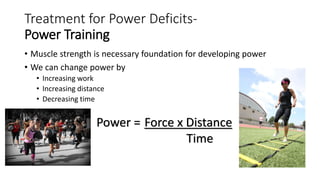
Power Training
• Muscle strength is necessary foundation for developing power
• We can change power by
• Increasing work
• Increasing distance
• Decreasing time
Power = Force x Distance
Time
Endurance
• The ability to perform repetitive or sustained activities over a
prolonged period of time
• Cardiopulmonary endurance: repetitive activities that use large
muscles of the body (walking, running, swimming, etc)
• Muscle endurance: the ability of a muscle to contract repeatedly
against an external load, generate and sustain tension, and resist
fatigue over an extended period of time.
Treatment for Impaired Endurance-
Endurance Training
• Using muscle force to raise, lower and control a light external load for
many repetitions over an extended period of time
• Adaptations:
• Increase in oxidative and metabolic capacities
Motor Control
• The ability to regulate
or direct the
mechanisms essential
to movement
Treatment for Impaired Motor Control
• Intrinsic vs Extrinsic
• Schedule
• Intensity
• Form of Feedback
Feedback
• Mass vs Distributed
• Variability
• Practice Conditions
• Practice Strategies
Practice
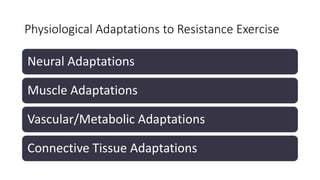
Physiological Adaptations to Resistance Exercise
Neural Adaptations
Muscle Adaptations
Vascular/Metabolic Adaptations
Connective Tissue Adaptations
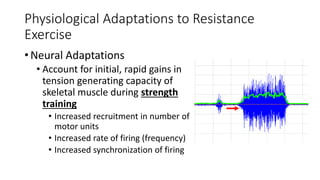
Physiological Adaptations to Resistance
Exercise
•Neural Adaptations
• Account for initial, rapid gains in
tension generating capacity of
skeletal muscle during strength
training
• Increased recruitment in number of
motor units
• Increased rate of firing (frequency)
• Increased synchronization of firing
Physiological Adaptations to
Resistance Exercise
• Muscle Adaptations
• Hypertrophy = increase in the side of an individual
muscle fiber
• Usually occurs 4-8 weeks after mod-high
resistance training
• Due to increased myofibril volume
• Greatest association with high-volume moderate
resistance eccentric exercises
• Greatest in Type IIB fibers
Physiological Adaptations to Resistance
Exercise
• Muscle Adaptations
• Hyperplasia = an increase number of muscle fibers (due to fiber
splitting)
• Not well supported by the literature
• Muscle Fiber Type Adaptation
• Type IIB Type IIA common with endurance exercise and early phase
of heavy resistance training
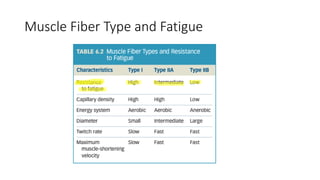
• Makes type II more resistant to fatigue
• Type I Type II
• In denervated limbs of lab animals, humans with spinal cord injury and after space
flight.
Physiological Adaptations to Resistance
Exercise
• Vascular/Metabolic Adaptations
• Decrease in capillary bed density with muscle hypertrophy from resistance
training
• Increase in capillary bed density with endurance or light resistance training
• Mitochondrial adaptations
• Adaptations of connective tissue
• Increase tensile strength of tendons, ligaments and bone
• Improve bone mineral density (weight bearing exercise)
Benefits of Resistance Exercise
• Improve muscle strength, power and endurance
• Increase strength of connective tissue (tendons, ligaments, etc)
• Increase bone density
• Decrease joint stress
• Reduce risk of soft tissue injury
• Improved capacity for repair and healing of damaged soft tissue
• Improved balance
• Enhanced daily living
• Improved body composition
• Enhanced feeling of physical well-being
• Positive perception of disability and quality of life
Factors that Influence Muscle Performance
(Tension Generation)
• Cross- sectional size
• Muscle architecture
• Fiber type
• Type I
• Type II
• Length-tension relationship
• Moment arm between muscle force vector and axis of joint rotation
• Recruitment of motor units
• Rate of motor unit firing
• Type of muscle contraction
• Speed of muscle contraction (force-velocity relationship)
Factors that Influence Tension Generation in
Muscles
Additional Factors:
• Energy stores
• Blood supply
• Fatigue
Fatigue
• Muscle (local) Fatigue
• Acute physiological response to exercise
• Gradual decline in force-producing capacity
• Normal and reversible
• Diminished contractile response caused by:
• Decrease in energy stores
• Insufficient oxygen
• Reduced sensitivity and availability of intracellular calcium
• Build up of H+
• Reduced excitability of the neuromuscular junction
• Inhibitory influence of the CNS
Muscle Fiber Type and Fatigue
Clinical Signs of Muscle Fatigue
• Uncomfortable sensation in muscle, pain, cramping
• Shaking/trembling of muscle
• Slowing of contraction velocity
• Jerky/inconsistent motion
• Inability to complete full range of motion
• Substitute motions
• Inability to continue low intensity physical activity
• Decline in peak torque during isokinetic testing
Fatigue
• Cardiopulmonary Fatigue
• Systemic diminished response of an individual to a stimulus as the result of
prolonged activity
Recovery from Exercise
• Force-producing capacity to return to 90-95%
• 3-4 minutes (greatest gains in 1st minute)
• Lactate removed from muscle and blood
• 1 hour after exercise
• Glycogen stores replaced
• Over several days
• Light exercise during recovery phase causes more rapid recovery
• Muscle performance will NOT improve if patient is given inadequate recovery
time
Exercise Prescription
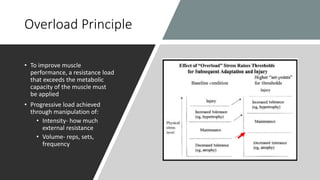
Overload Principle
• To improve muscle
performance, a resistance load
that exceeds the metabolic
capacity of the muscle must
be applied
• Progressive load achieved
through manipulation of:
• Intensity- how much
external resistance
• Volume- reps, sets,
frequency
Specific Adaptation to Imposed Demands
(SAID) Principle
• To improve muscle performance, the resistance program should be
matched to requirements of the activity.
• SAID principle should guide PTs to determine the exercise parameters
that will create specific training effects to best meet the patient’s
functional needs and goals.
SAID Principle
• Specificity of Training
• The adaptive effects of training are specific to the training methods employed
• Endurance vs strength
• Type of exercise
• Velocity of exercise
• Joint position
• Movement patterns
• Transfer of Training
• Carryover of training effects from one variation of exercise or task to another
• Exercised limb to non-exercised limb
• Strength training moderately improves endurance
Keep in mind, effects of carryover are small!
Reversibility Principle
• Detraining = reductions in muscle performance
• Begins 1-2 weeks after cessation of resistance
exercises
• Strength/endurance should be incorporated into
daily activities
• Maintenance programs
Determinants of Resistance Exercise
• FITT (Frequency, Intensity, Time, Type)- key determinants of resistance
training according to ACSM
• Frequency
• Intensity
• Time (Time under tension = Volume)
• Type
• Aerobic
• Resistance Exercise
• Power Training
• Neuromuscular Re-education
• Etc.
Determinants of Resistance Exercise
Other Determinants of Resistance Exercise:
• Duration of exercise program (periodization)
• Alignment
• Stabilization
• Mode of Exercise
• Type of contraction
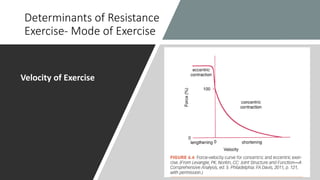
• Velocity of exercise
• Static vs dynamic
• Type of resistance
• Integration to Function
Determinants of Resistance Exercise-
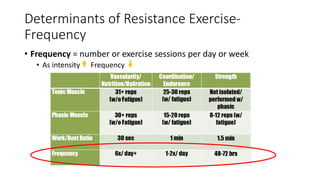
Frequency
• Frequency = number or exercise sessions per day or week
• As intensity Frequency
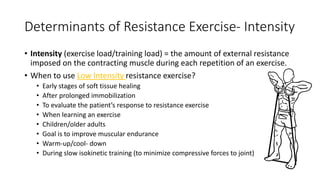
Determinants of Resistance Exercise- Intensity
• Intensity (exercise load/training load) = the amount of external resistance
imposed on the contracting muscle during each repetition of an exercise.
• When to use Low Intensity resistance exercise?
• Early stages of soft tissue healing
• After prolonged immobilization
• To evaluate the patient’s response to resistance exercise
• When learning an exercise
• Children/older adults
• Goal is to improve muscular endurance
• Warm-up/cool- down
• During slow isokinetic training (to minimize compressive forces to joint)
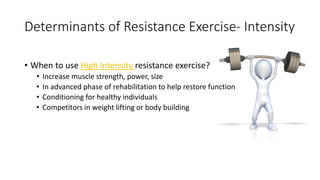
Determinants of Resistance Exercise- Intensity
• When to use High Intensity resistance exercise?
• Increase muscle strength, power, size
• In advanced phase of rehabilitation to help restore function
• Conditioning for healthy individuals
• Competitors in weight lifting or body building
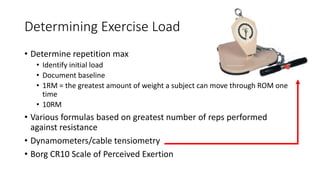
Determining Exercise Load
• Determine repetition max
• Identify initial load
• Document baseline
• 1RM = the greatest amount of weight a subject can move through ROM one
time
• 10RM
• Various formulas based on greatest number of reps performed
against resistance
• Dynamometers/cable tensiometry
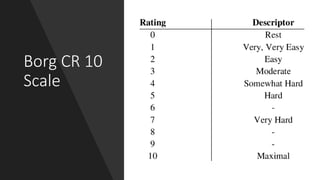
• Borg CR10 Scale of Perceived Exertion
Borg CR 10
Scale
Determinants of Resistance
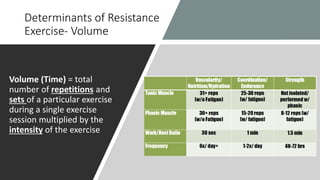
Exercise- Volume
Volume (Time) = total
number of repetitions and
sets of a particular exercise
during a single exercise
session multiplied by the
intensity of the exercise
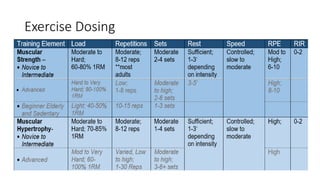
Exercise Dosing
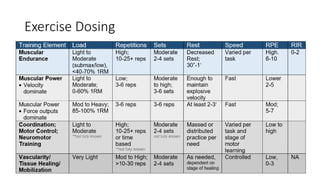
Exercise Dosing
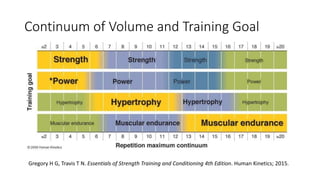
Continuum of Volume and Training Goal
Gregory H G, Travis T N. Essentials of Strength Training and Conditioning 4th Edition. Human Kinetics; 2015.
Determinants of Resistance
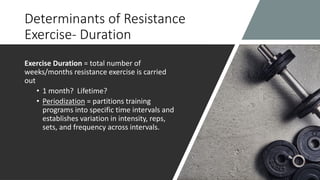
Exercise- Duration
Exercise Duration = total number of
weeks/months resistance exercise is carried
out
• 1 month? Lifetime?
• Periodization = partitions training
programs into specific time intervals and
establishes variation in intensity, reps,
sets, and frequency across intervals.
Determinants of Resistance
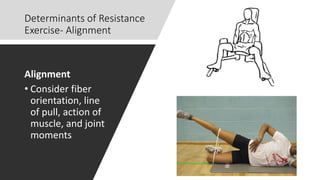
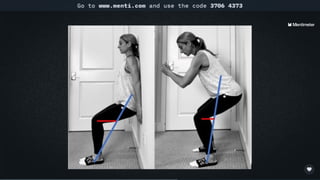
Exercise- Alignment
Alignment
• Consider fiber
orientation, line
of pull, action of
muscle, and joint
moments
Determinants of Resistance Exercise-
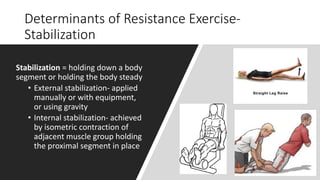
Stabilization
Stabilization = holding down a body
segment or holding the body steady
• External stabilization- applied
manually or with equipment,
or using gravity
• Internal stabilization- achieved
by isometric contraction of
adjacent muscle group holding
the proximal segment in place
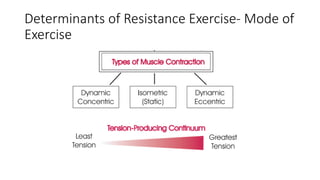
Determinants of Resistance Exercise- Mode of
Exercise
Determinants of Resistance Exercise- Mode
of Exercise
Type of contraction
• Isometric
• Muscle setting, stabilization exercises, multi-angle isometrics (resistance/no
resistance)
• Rationale:
• Can improve strength even while immobilized
• Improve neuromuscular control
• Postural and joint stability/isolate points within the range to strengthen
• Can use even when joint motion causes pain or instability
• Gentle muscle setting can be used in the acute phase of healing
• To gain strength: must exceed 60% of MVC
• 10 second hold (2 second rise, 6 second hold, 2 second fall)
Determinants of Resistance Exercise- Mode
of Exercise
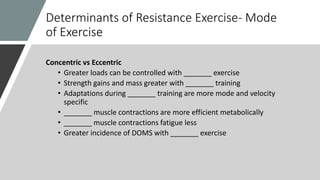
Concentric vs Eccentric
• Greater loads can be controlled with _______ exercise
• Strength gains and mass greater with _______ training
• Adaptations during _______ training are more mode and velocity
specific
• _______ muscle contractions are more efficient metabolically
• _______ muscle contractions fatigue less
• Greater incidence of DOMS with _______ exercise
Determinants of Resistance Exercise- Mode
of Exercise
Concentric vs Eccentric
• Greater loads can be controlled with eccentric exercise
• Strength gains and mass greater with eccentric training
• Adaptations during eccentric training are more mode and velocity
specific
• Eccentric muscle contractions are more efficient metabolically
• Eccentric muscle contractions fatigue less
• Greater incidence of DOMS with eccentric exercise
Determinants of
Resistance
Exercise- Mode of
Exercise
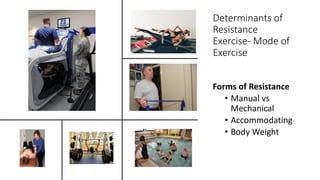
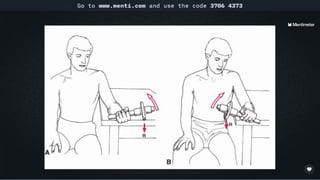
Forms of Resistance
• Manual vs
Mechanical
• Accommodating
• Body Weight
Determinants of Resistance
Exercise- Mode of Exercise
Velocity of Exercise
Determinants of
Resistance Exercise-
Mode of Exercise
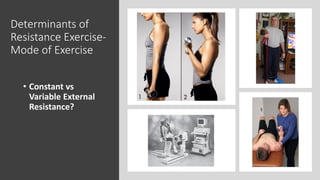
• Constant vs
Variable External
Resistance?
Determinants of
Resistance Exercise-
Mode of Exercise
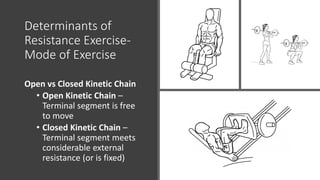
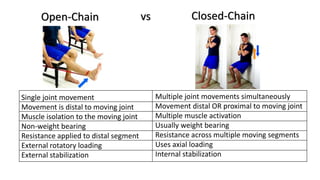
Open vs Closed Kinetic Chain
• Open Kinetic Chain –
Terminal segment is free
to move
• Closed Kinetic Chain –
Terminal segment meets
considerable external
resistance (or is fixed)
Closed-Chain
Open-Chain
Single joint movement
Movement is distal to moving joint
Muscle isolation to the moving joint
Non-weight bearing
Resistance applied to distal segment
External rotatory loading
External stabilization
Multiple joint movements simultaneously
Movement distal OR proximal to moving joint
Multiple muscle activation
Usually weight bearing
Resistance across multiple moving segments
Uses axial loading
Internal stabilization
vs
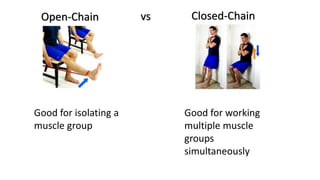
Closed-Chain
Open-Chain vs
Good for isolating a
muscle group
Good for working
multiple muscle
groups
simultaneously
Determinants of Resistance
Exercise- Integration to
Function
• Functional movement require neuromuscular
control
• Interaction between stability and mobility
• Appropriate timing and order of muscle
contractions
• Functional tasks often require motor strength,
power, endurance, AND control
• Resistance exercise should be incorporated
into task specific movements!!!
• Simulate functional movements that the
patient is working towards!
• SAID Principle
This Photo by Unknown Author is licensed under CC BY-SA
Remember your motor control principles!
This Photo by Unknown Author is licensed under CC BY This Photo by Unknown Author is licensed under CC BY-NC-ND
Precautions for Resistance Exercise
• Valsalva Maneuver
• Substitutions
• Overtraining
• Decline in physical performance in healthy individuals participating
in high-intensity, high-volume strength/endurance programs.
• Overwork
• Progressive deterioration of strength in muscles already weakened
by non-progressive neuromuscular disease.
Precautions for Resistance Exercise
• Muscle Soreness
• Acute muscle soreness- during or immediately after exercise
• Inadequate blood flow and oxygenation, lactic acid and potassium build up
• Lactic acid -> lactate + H+
• Delated Onset Muscle Soreness (DOMS)
• Underlying mechanisms are unclear
• Linked to contraction-induced, mechanical disruption or microtrauma of the
muscle and connective tissue fibers
• “Repeated bout effect”- a bout of eccentric exercise protects against damage
from repeated bouts
• Treatment? Massage? Ice? Electrical stimulation? Supplements?
• Pathological Fractures
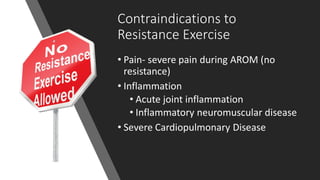
Contraindications to
Resistance Exercise
• Pain- severe pain during AROM (no
resistance)
• Inflammation
• Acute joint inflammation
• Inflammatory neuromuscular disease
• Severe Cardiopulmonary Disease

Unit 7 Lecture.pdf

  • 1.
    Principles of Treatmentfor Impaired Motor Performance
  • 2.
    Learning Objectives • Defineresistance exercise and describe physiological adaptations. • Discuss determinants of resistance exercise. • Identify different types of resistance exercise. • Explain precautions and contraindications of resistance exercise
  • 3.
    Treatment for ImpairedMotor Performance Always relate back to FUNCTION, MOVEMENT and PATIENT GOALS!
  • 5.
    Muscle Performance • MusclePerformance = the capacity of the muscle to do work (F x D) • Key elements of Muscle Performance • Strength • Power • Endurance And…Motor Control!
  • 6.
    Treatment for ImpairedMotor Performance- Resistance Exercise • An activity in which dynamic or static muscle contraction is resisted by an outside force applied manually or mechanically. • Strength, Power, AND Endurance can be enhanced by resistance exercise. • Should address the appropriate proportion of the 3 aspects based on the patient’s functional goals.
  • 7.
    Strength • Muscle strength= the extent that the contractile element of muscle produce force • Functional strength = the ability of the neuromuscular system to produce the appropriate amount of force during functional activities in a smooth and coordinated manner.
  • 8.
    Treatment for StrengthDeficits- Strength Training • The practice of using muscle force to raise, lower or control heavy external loads for a relatively low number of reps. • Adaptations: • Increase in maximum force-producing capacity of the muscle • Neural adaptations • Muscle fiber size
  • 9.
    Power • Muscle Power= the work produced by a muscle per unit of time (Force x Distance)/Time • Can be produced over a short (high jump) or long period of time (climbing a flight of stairs)
  • 10.
    Treatment for PowerDeficits- Power Training • Muscle strength is necessary foundation for developing power • We can change power by • Increasing work • Increasing distance • Decreasing time Power = Force x Distance Time
  • 11.
    Endurance • The abilityto perform repetitive or sustained activities over a prolonged period of time • Cardiopulmonary endurance: repetitive activities that use large muscles of the body (walking, running, swimming, etc) • Muscle endurance: the ability of a muscle to contract repeatedly against an external load, generate and sustain tension, and resist fatigue over an extended period of time.
  • 12.
    Treatment for ImpairedEndurance- Endurance Training • Using muscle force to raise, lower and control a light external load for many repetitions over an extended period of time • Adaptations: • Increase in oxidative and metabolic capacities
  • 13.
    Motor Control • Theability to regulate or direct the mechanisms essential to movement
  • 14.
    Treatment for ImpairedMotor Control • Intrinsic vs Extrinsic • Schedule • Intensity • Form of Feedback Feedback • Mass vs Distributed • Variability • Practice Conditions • Practice Strategies Practice
  • 15.
    Physiological Adaptations toResistance Exercise Neural Adaptations Muscle Adaptations Vascular/Metabolic Adaptations Connective Tissue Adaptations
  • 16.
    Physiological Adaptations toResistance Exercise •Neural Adaptations • Account for initial, rapid gains in tension generating capacity of skeletal muscle during strength training • Increased recruitment in number of motor units • Increased rate of firing (frequency) • Increased synchronization of firing
  • 17.
    Physiological Adaptations to ResistanceExercise • Muscle Adaptations • Hypertrophy = increase in the side of an individual muscle fiber • Usually occurs 4-8 weeks after mod-high resistance training • Due to increased myofibril volume • Greatest association with high-volume moderate resistance eccentric exercises • Greatest in Type IIB fibers
  • 18.
    Physiological Adaptations toResistance Exercise • Muscle Adaptations • Hyperplasia = an increase number of muscle fibers (due to fiber splitting) • Not well supported by the literature • Muscle Fiber Type Adaptation • Type IIB Type IIA common with endurance exercise and early phase of heavy resistance training • Makes type II more resistant to fatigue • Type I Type II • In denervated limbs of lab animals, humans with spinal cord injury and after space flight.
  • 19.
    Physiological Adaptations toResistance Exercise • Vascular/Metabolic Adaptations • Decrease in capillary bed density with muscle hypertrophy from resistance training • Increase in capillary bed density with endurance or light resistance training • Mitochondrial adaptations • Adaptations of connective tissue • Increase tensile strength of tendons, ligaments and bone • Improve bone mineral density (weight bearing exercise)
  • 20.
    Benefits of ResistanceExercise • Improve muscle strength, power and endurance • Increase strength of connective tissue (tendons, ligaments, etc) • Increase bone density • Decrease joint stress • Reduce risk of soft tissue injury • Improved capacity for repair and healing of damaged soft tissue • Improved balance • Enhanced daily living • Improved body composition • Enhanced feeling of physical well-being • Positive perception of disability and quality of life
  • 21.
    Factors that InfluenceMuscle Performance (Tension Generation) • Cross- sectional size • Muscle architecture • Fiber type • Type I • Type II • Length-tension relationship • Moment arm between muscle force vector and axis of joint rotation • Recruitment of motor units • Rate of motor unit firing • Type of muscle contraction • Speed of muscle contraction (force-velocity relationship)
  • 22.
    Factors that InfluenceTension Generation in Muscles Additional Factors: • Energy stores • Blood supply • Fatigue
  • 23.
    Fatigue • Muscle (local)Fatigue • Acute physiological response to exercise • Gradual decline in force-producing capacity • Normal and reversible • Diminished contractile response caused by: • Decrease in energy stores • Insufficient oxygen • Reduced sensitivity and availability of intracellular calcium • Build up of H+ • Reduced excitability of the neuromuscular junction • Inhibitory influence of the CNS
  • 24.
    Muscle Fiber Typeand Fatigue
  • 25.
    Clinical Signs ofMuscle Fatigue • Uncomfortable sensation in muscle, pain, cramping • Shaking/trembling of muscle • Slowing of contraction velocity • Jerky/inconsistent motion • Inability to complete full range of motion • Substitute motions • Inability to continue low intensity physical activity • Decline in peak torque during isokinetic testing
  • 26.
    Fatigue • Cardiopulmonary Fatigue •Systemic diminished response of an individual to a stimulus as the result of prolonged activity
  • 27.
    Recovery from Exercise •Force-producing capacity to return to 90-95% • 3-4 minutes (greatest gains in 1st minute) • Lactate removed from muscle and blood • 1 hour after exercise • Glycogen stores replaced • Over several days • Light exercise during recovery phase causes more rapid recovery • Muscle performance will NOT improve if patient is given inadequate recovery time
  • 28.
  • 29.
    Overload Principle • Toimprove muscle performance, a resistance load that exceeds the metabolic capacity of the muscle must be applied • Progressive load achieved through manipulation of: • Intensity- how much external resistance • Volume- reps, sets, frequency
  • 30.
    Specific Adaptation toImposed Demands (SAID) Principle • To improve muscle performance, the resistance program should be matched to requirements of the activity. • SAID principle should guide PTs to determine the exercise parameters that will create specific training effects to best meet the patient’s functional needs and goals.
  • 31.
    SAID Principle • Specificityof Training • The adaptive effects of training are specific to the training methods employed • Endurance vs strength • Type of exercise • Velocity of exercise • Joint position • Movement patterns • Transfer of Training • Carryover of training effects from one variation of exercise or task to another • Exercised limb to non-exercised limb • Strength training moderately improves endurance Keep in mind, effects of carryover are small!
  • 32.
    Reversibility Principle • Detraining= reductions in muscle performance • Begins 1-2 weeks after cessation of resistance exercises • Strength/endurance should be incorporated into daily activities • Maintenance programs
  • 33.
    Determinants of ResistanceExercise • FITT (Frequency, Intensity, Time, Type)- key determinants of resistance training according to ACSM • Frequency • Intensity • Time (Time under tension = Volume) • Type • Aerobic • Resistance Exercise • Power Training • Neuromuscular Re-education • Etc.
  • 34.
    Determinants of ResistanceExercise Other Determinants of Resistance Exercise: • Duration of exercise program (periodization) • Alignment • Stabilization • Mode of Exercise • Type of contraction • Velocity of exercise • Static vs dynamic • Type of resistance • Integration to Function
  • 35.
    Determinants of ResistanceExercise- Frequency • Frequency = number or exercise sessions per day or week • As intensity Frequency
  • 36.
    Determinants of ResistanceExercise- Intensity • Intensity (exercise load/training load) = the amount of external resistance imposed on the contracting muscle during each repetition of an exercise. • When to use Low Intensity resistance exercise? • Early stages of soft tissue healing • After prolonged immobilization • To evaluate the patient’s response to resistance exercise • When learning an exercise • Children/older adults • Goal is to improve muscular endurance • Warm-up/cool- down • During slow isokinetic training (to minimize compressive forces to joint)
  • 37.
    Determinants of ResistanceExercise- Intensity • When to use High Intensity resistance exercise? • Increase muscle strength, power, size • In advanced phase of rehabilitation to help restore function • Conditioning for healthy individuals • Competitors in weight lifting or body building
  • 38.
    Determining Exercise Load •Determine repetition max • Identify initial load • Document baseline • 1RM = the greatest amount of weight a subject can move through ROM one time • 10RM • Various formulas based on greatest number of reps performed against resistance • Dynamometers/cable tensiometry • Borg CR10 Scale of Perceived Exertion
  • 39.
  • 40.
    Determinants of Resistance Exercise-Volume Volume (Time) = total number of repetitions and sets of a particular exercise during a single exercise session multiplied by the intensity of the exercise
  • 41.
  • 42.
  • 43.
    Continuum of Volumeand Training Goal Gregory H G, Travis T N. Essentials of Strength Training and Conditioning 4th Edition. Human Kinetics; 2015.
  • 44.
    Determinants of Resistance Exercise-Duration Exercise Duration = total number of weeks/months resistance exercise is carried out • 1 month? Lifetime? • Periodization = partitions training programs into specific time intervals and establishes variation in intensity, reps, sets, and frequency across intervals.
  • 45.
    Determinants of Resistance Exercise-Alignment Alignment • Consider fiber orientation, line of pull, action of muscle, and joint moments
  • 48.
    Determinants of ResistanceExercise- Stabilization Stabilization = holding down a body segment or holding the body steady • External stabilization- applied manually or with equipment, or using gravity • Internal stabilization- achieved by isometric contraction of adjacent muscle group holding the proximal segment in place
  • 49.
    Determinants of ResistanceExercise- Mode of Exercise
  • 50.
    Determinants of ResistanceExercise- Mode of Exercise Type of contraction • Isometric • Muscle setting, stabilization exercises, multi-angle isometrics (resistance/no resistance) • Rationale: • Can improve strength even while immobilized • Improve neuromuscular control • Postural and joint stability/isolate points within the range to strengthen • Can use even when joint motion causes pain or instability • Gentle muscle setting can be used in the acute phase of healing • To gain strength: must exceed 60% of MVC • 10 second hold (2 second rise, 6 second hold, 2 second fall)
  • 51.
    Determinants of ResistanceExercise- Mode of Exercise Concentric vs Eccentric • Greater loads can be controlled with _______ exercise • Strength gains and mass greater with _______ training • Adaptations during _______ training are more mode and velocity specific • _______ muscle contractions are more efficient metabolically • _______ muscle contractions fatigue less • Greater incidence of DOMS with _______ exercise
  • 52.
    Determinants of ResistanceExercise- Mode of Exercise Concentric vs Eccentric • Greater loads can be controlled with eccentric exercise • Strength gains and mass greater with eccentric training • Adaptations during eccentric training are more mode and velocity specific • Eccentric muscle contractions are more efficient metabolically • Eccentric muscle contractions fatigue less • Greater incidence of DOMS with eccentric exercise
  • 53.
    Determinants of Resistance Exercise- Modeof Exercise Forms of Resistance • Manual vs Mechanical • Accommodating • Body Weight
  • 54.
    Determinants of Resistance Exercise-Mode of Exercise Velocity of Exercise
  • 55.
    Determinants of Resistance Exercise- Modeof Exercise • Constant vs Variable External Resistance?
  • 56.
    Determinants of Resistance Exercise- Modeof Exercise Open vs Closed Kinetic Chain • Open Kinetic Chain – Terminal segment is free to move • Closed Kinetic Chain – Terminal segment meets considerable external resistance (or is fixed)
  • 57.
    Closed-Chain Open-Chain Single joint movement Movementis distal to moving joint Muscle isolation to the moving joint Non-weight bearing Resistance applied to distal segment External rotatory loading External stabilization Multiple joint movements simultaneously Movement distal OR proximal to moving joint Multiple muscle activation Usually weight bearing Resistance across multiple moving segments Uses axial loading Internal stabilization vs
  • 58.
    Closed-Chain Open-Chain vs Good forisolating a muscle group Good for working multiple muscle groups simultaneously
  • 65.
    Determinants of Resistance Exercise-Integration to Function • Functional movement require neuromuscular control • Interaction between stability and mobility • Appropriate timing and order of muscle contractions • Functional tasks often require motor strength, power, endurance, AND control • Resistance exercise should be incorporated into task specific movements!!! • Simulate functional movements that the patient is working towards! • SAID Principle This Photo by Unknown Author is licensed under CC BY-SA
  • 66.
    Remember your motorcontrol principles! This Photo by Unknown Author is licensed under CC BY This Photo by Unknown Author is licensed under CC BY-NC-ND
  • 67.
    Precautions for ResistanceExercise • Valsalva Maneuver • Substitutions • Overtraining • Decline in physical performance in healthy individuals participating in high-intensity, high-volume strength/endurance programs. • Overwork • Progressive deterioration of strength in muscles already weakened by non-progressive neuromuscular disease.
  • 68.
    Precautions for ResistanceExercise • Muscle Soreness • Acute muscle soreness- during or immediately after exercise • Inadequate blood flow and oxygenation, lactic acid and potassium build up • Lactic acid -> lactate + H+ • Delated Onset Muscle Soreness (DOMS) • Underlying mechanisms are unclear • Linked to contraction-induced, mechanical disruption or microtrauma of the muscle and connective tissue fibers • “Repeated bout effect”- a bout of eccentric exercise protects against damage from repeated bouts • Treatment? Massage? Ice? Electrical stimulation? Supplements? • Pathological Fractures
  • 69.
    Contraindications to Resistance Exercise •Pain- severe pain during AROM (no resistance) • Inflammation • Acute joint inflammation • Inflammatory neuromuscular disease • Severe Cardiopulmonary Disease