Diaspora
Presentation
By
Ali Rahmat
Overview of the
Presentation
1) Diaspora?
2) Diasporic Writing?
3) What is Temporal and Spatial
Move in diasporic literature?
4) Diasporic authors and their books.
5) Features and themes of Diasporic
Culture/Literature .
6) Them of Nostalgia, memory,
Imaginary homelands with
example, lost home has two main
forms in diasporic literature.
(i) ‘Home’ and the poetics of ‘return’
(ii) Dislocation, relocation, memo-
realization
The word Diaspora derives
from the Greek word meaning
“to disperse”. Diaspora is
simply the displacement of a
community/culture into another
geographical and cultural
region.
Robin Cohen defines:
Diaspora as “communities living
together in one country who
acknowledge that the old country
– a nation often buried deep in
language, religion custom or
folklore- always has some claim
on their loyalty and emotion … a
member’s adherence to a
diasporic community is
demonstrated by an acceptance of
an inescapable link with their
pass migration history and a
sense of co-ethnicity with others
of similar background”
Diaspora?
2. Spatial Move?
The spatial move involves
two things: de-territorialization
(the loss of territory. It is both
geographical and cultural)
and a re-teritorialization
(restructuring of a place or
territory that has experienced
de-territorialization
1. Temporal Move?
The temporal move is looking
back at the past (analepsis)
and looking forward at the
future (prolepsis).
Meena Alexander defines as;
“writing in search of a
homeland”
Diasporic writing
 Two main moves in
diasporic writing;
Diasporic authors
and
their books
An Area of Darkness (Naipaul)
 The Rainbow (Hanif Kurishi)
The Famished Road
(Ben Okri),
The Nowhere Man
(Markandaya)
 Brick Lane (Monica Ali)
 The House of a Thousand
Doors (Alexander)
 The Calcutta Chromosome
(Ghosh).
Features of Diasporic
Culture/Literature would
Include:
The shift, Contrast, and
relation between centre and
periphery
The memory - details of
childhood landscapes,
historical events, people
The sense of alienation in new
society/culture/land
Features of homeland- language
/rituals, forms of behavior
Reclamation of history of the
homeland and childhood
spaces
Ambivalence between seeking
acceptance/assimilation in
the new cultures
The previous features
and themes can be
reorganized following
three themes:
1) Nostalgia, memory,
Imaginary homelands
2) Hybridities and new
identities
3) Globalization and
cosmopolitanism
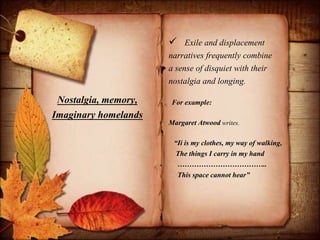
Nostalgia, memory,
Imaginary homelands
 Exile and displacement
narratives frequently combine
a sense of disquiet with their
nostalgia and longing.
For example:
Margaret Atwood writes.
“Ii is my clothes, my way of walking,
The things I carry in my hand
………………………………..
This space cannot hear”
(i)‘Home’ and the
poetics of ‘return’
Meena Alexander writes in
Manhattan Music (1997)
‘She [Sandhya] kept returning to
her childhood home, a house
with a red-tiled roof and a
sandy courtyard where the
mulberry bloomed’
“Did my uncles ride on camels?.. Did my
cousins, so like me in other ways, squat
down in the sand like little Mowglis,
half-naked and eating with their fingers?
.... Sories to help me see my place in
world and give me a sense the past
which could go into making a life in the
present and the future.
Hanif Kurishi mentions in his essay
‘The Ranbow’ as;
Hanif KurishiMeena Alexander

Diaspora

  • 1.
  • 2.
    Overview of the Presentation 1)Diaspora? 2) Diasporic Writing? 3) What is Temporal and Spatial Move in diasporic literature? 4) Diasporic authors and their books. 5) Features and themes of Diasporic Culture/Literature . 6) Them of Nostalgia, memory, Imaginary homelands with example, lost home has two main forms in diasporic literature. (i) ‘Home’ and the poetics of ‘return’ (ii) Dislocation, relocation, memo- realization
  • 3.
    The word Diasporaderives from the Greek word meaning “to disperse”. Diaspora is simply the displacement of a community/culture into another geographical and cultural region. Robin Cohen defines: Diaspora as “communities living together in one country who acknowledge that the old country – a nation often buried deep in language, religion custom or folklore- always has some claim on their loyalty and emotion … a member’s adherence to a diasporic community is demonstrated by an acceptance of an inescapable link with their pass migration history and a sense of co-ethnicity with others of similar background” Diaspora?
  • 4.
    2. Spatial Move? Thespatial move involves two things: de-territorialization (the loss of territory. It is both geographical and cultural) and a re-teritorialization (restructuring of a place or territory that has experienced de-territorialization 1. Temporal Move? The temporal move is looking back at the past (analepsis) and looking forward at the future (prolepsis). Meena Alexander defines as; “writing in search of a homeland” Diasporic writing  Two main moves in diasporic writing;
  • 5.
    Diasporic authors and their books AnArea of Darkness (Naipaul)  The Rainbow (Hanif Kurishi) The Famished Road (Ben Okri), The Nowhere Man (Markandaya)  Brick Lane (Monica Ali)  The House of a Thousand Doors (Alexander)  The Calcutta Chromosome (Ghosh).
  • 6.
    Features of Diasporic Culture/Literaturewould Include: The shift, Contrast, and relation between centre and periphery The memory - details of childhood landscapes, historical events, people The sense of alienation in new society/culture/land Features of homeland- language /rituals, forms of behavior Reclamation of history of the homeland and childhood spaces Ambivalence between seeking acceptance/assimilation in the new cultures
  • 7.
    The previous features andthemes can be reorganized following three themes: 1) Nostalgia, memory, Imaginary homelands 2) Hybridities and new identities 3) Globalization and cosmopolitanism
  • 8.
    Nostalgia, memory, Imaginary homelands Exile and displacement narratives frequently combine a sense of disquiet with their nostalgia and longing. For example: Margaret Atwood writes. “Ii is my clothes, my way of walking, The things I carry in my hand ……………………………….. This space cannot hear”
  • 9.
    (i)‘Home’ and the poeticsof ‘return’ Meena Alexander writes in Manhattan Music (1997) ‘She [Sandhya] kept returning to her childhood home, a house with a red-tiled roof and a sandy courtyard where the mulberry bloomed’ “Did my uncles ride on camels?.. Did my cousins, so like me in other ways, squat down in the sand like little Mowglis, half-naked and eating with their fingers? .... Sories to help me see my place in world and give me a sense the past which could go into making a life in the present and the future. Hanif Kurishi mentions in his essay ‘The Ranbow’ as; Hanif KurishiMeena Alexander