RESIN NABEELA JABEEN
INDEX
•Introduction of Resin
•Classification of Resin
•Active constituents of Resin
•Pharmacological uses of Resins
RESIN
Resin are amorphous products with a complex chemical nature
The term resin is applied to more or less solid or amorphous
products of complex chemical nature
On heating they are soften and finally melt
They are soluble in water and insoluble in petroleum ether ,
alcohol and chloroform
Chemically, resins are complex mixtures of resin acids, resin
alcohol (resinols), resin phenol (resinotannols), esters and
chemically inert compound known as “Resenes”
Oleoresins, in which resin are associated with volatile oil
Gum resins, in which resin are associated with gum
Oils & gums are oleo-gum resin
Resin may also combined in glycosidal manner with sugar, as in
the convolvulaceae
Those resins or oleo-resins which contain benzoic or cinnamic
acid either free or combined are commonly known as “ Balsam”
e.g. benzoin, balsam of tolu, balsam of peru & storax
PRINCIPAL CONSTITUENTS
Resin Acid
•It contain the large proportion of oxyacids, usually combining the
properties of carboxylic acids and phenols
•They both occur in the free state and as esters
•They are soluble in aqueous alkali solutions or colloidal suspension
CLASSIFICATION OF RESIN
Pharmaceutic Resin Extraction
Pharmaceutic resins are usually obtained
1.by the extracting the drug with alcohol and precipitating the resin
in water, as with resin of jalap and podophyllum
2. By separating the oil from oleoresin by distillation, as with resin
from turpentine and copaivic resin from the copaiba or
3. by collecting the natural product that has exuded as oleoresin from
the plant through natural or oleoresin from the plant through natural
or artificial punctures and from the natural oil has partially
evaporated into the atmosphere as mastic
JALAP
Jalap or Jalap root is the dried, tuberous root of “Exogonium purga”
Family Convolvulaceae
Jalap yields not less then 9% resin
The plant is a perennial, twining herb indigenous to the mountains of
mexico and cultivated in mexico
The plant possesses thin, horizontal, underground runners
CHEMICAL CONSTITUENT
Volatile oil
Starch
Gums
Sugar
Number of glycosides, such ipurganol, jalapin, mixture of acidic
glycosides
Beta-methyl esculetin and palmitate and stearic acids
USES
Cathartic
Hydragogue
Drastic purgative
Turpentine
•Turpentine, gum turpentine, or gum thus is the concrete oleoresin
obtained from Pinus palustris family Pinaceae
•Turpentine is collected from the long leaf oine that grow in north and south
califorina, Georgia and north florida
•The tree from the vast forest and present a characteristics apperaence
owning to the face of cut surface
Secretion from tree
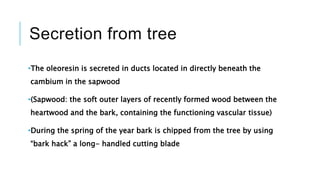
•The oleoresin is secreted in ducts located in directly beneath the
cambium in the sapwood
•(Sapwood: the soft outer layers of recently formed wood between the
heartwood and the bark, containing the functioning vascular tissue)
•During the spring of the year bark is chipped from the tree by using
“bark hack” a long- handled cutting blade
•Following removal of the rounded chip, a spray of 50% solution of
sulfuric acid is applied to the freshly cut surface
•As the sap flows, it is guided by metal gutters into containers
attached directly to the tree trunk
•The liquid that collected is removed periodically and taken to the
turpentine still
Benefit of acid treatment
•The acid treatment collapse the thin walled parenchyma cells
that line the resin duct
•This allow the duct channel to become larger, providing the
more flow of oleoresin
•Reducing the channel hardened secretions blocking the oulet
Chemical constituents
Volatile oil
Resin
Foreign organic matter
Uses
•Topically it has been used for abrasions and wounds,
as a treatment for lice
• when mixed with animal fat it has been used as a chest rub, or
inhaler for nasal and throat ailments.
•Many modern chest rubs, such as the Vicks variety
•Counteriritant
BENZOIN
• benzoin is the balsamic resin
obtained from Styrax benzoin
family styraceae
•Styrax is the acient greek name
of storax applied to a sweet-
scented gum and to the tree
producing it
Benzoin is from the Arabic ben,
meaning fragant, or the Hebrew
ben, meaning the juice of the
branch, and zoa, an exudation
meaning the juice of the branch
•After about 2 month, the exuding balsamic resin become sticky and
firm enough to collect
• Chemical constituents:
• cinnamic acid
•Benzoic acid
•Triterpene aicds
•Siaresinol
USES
Antiseptic
Stimulant
Expectorant
Diuretic
Benzoin tincture, topical protectant
ROSIN
Rosin, also called colophony is a solid form of resin obtained
from pines and some other plants
Mostly conifers, produced by heating fresh liquid resin to vaporize
the volatile liquid terpene components.
It is semi-transparent and varies in color from yellow to black.
At room temperature rosin is brittle, but it melts at stove-top
temperature.
It chiefly consists of various resin acids, especially abietic acid.
The term "colophony" comes from colophonia resina, Latin for "resin
from Colophon," an ancient Ionic city.
•The commerical grades of resin vary in colour from light amber to
almost black
•The latter is used principally for destructive distillation
•Only light colored rosin are used as medicinally
•Rosin usually sharp, shiny, angular fragments that are translucent
amber colored and often covered with yellowish dust
•Rosin is hard, brittle and easily pulverized
•Its fracture is shallow-conchoidal
•Its odor and taste are faintly terebinthinate
•Rosin are soluble in alcohol ether, benzol, carbon disulfide, acetic
acid fixed and volatile and in solution ;of potassium or sodium
hydroxide
•The alcoholic solution of rosin becomes milky white when added to
water
•When fragments of rosin are heated in water
•When fragments of rosin are heated in water, they melt, flow together
and form a sticky mass
Chemical constituents
•Rosin contain 80-90% of the anhydride of abietic acid (which on
treatment with alcohol, are changed into crystalline abietic acid),
•Sylvic acid
•Sapnic acid
•Pimaric acid
•Resenes
USES
•Stiffening agent in cerates, plasters and ointment
•Veterinary medicine as diuretics
•Rosin is used in the manufacture in the varnishes, varnish, paint
dryers, printing ink, soap, sealing wax, floor covering
PODOPHYLLUM
•Podophyllum consist of the dried rhizome and roots of podophyllum
peltatum, family Berberidaceae
•It is also known as mayapple or mandrake
•The generic name is Greek and means footlike leaf; peltatum means
shieldlike
•The plant is a perennial herb that has a long, jointed and branching
rhizome
Chemical constituents
•3.5-6% resin, lignans
•Podophyllotoxin
•Alpha peltatin
•Beta peltatin
Uses
• antimitotic
•Purgative activity due to lactone ring
•Picropodophyllum inactive isomer
•Podophyllum active isomer
CANNABIS
•Cannabis sativa, also known as hemp, is a species of
the Cannabinaceae family of plants.
•Cannabis is also known as Ganja, grass, Hashish, Hemp, Indian hemp,
marijuana, Pot, reefer, weed.
•Cannabis contains the chemical compound THC (delta-9
tetrahydrocannabinol), which is believed to be responsible for most of the
characteristic psychoactive effects of cannabis.
•The dried leaves and flowers of the cannabis plant are known as
marijuana, which can be smoked (through a pipe or bong or hand-
rolled into a joint) or taken orally with food (baked in cookies).
•The resinous secretions of the plant are known as hashish, which can
be smoked or eaten.
•The fiber of the cannabis plant is cultivated as industrial hemp with
uses in textile manufacturing.
2 TYPES OF CANNABIS GENETIC
Chemical constituents
•THC (Delta-9-tetra hydrocanabinol)
•cannabinol
MEDICINAL USES
There are eight medical conditions for which patients can use
cannabis:
Cancer
Glaucoma
HIV/AIDS
Muscle sasms
Seizures
Severe pain
Severe nausea
Cachexia (weakness and wasting of the body due to severe chronic
illness.)or dramatic weight loss and muscle atrophy (wasting
ASAFOETIDA
•Asafoetida is the dried latex (gum oleoresin) exuded from
the rhizome or tap root of several species of Ferula, a perennial herb that
grows 1 to 1.5 m (3.3 to 4.9 ft) tall.
• The species is native to the deserts of Iran and mountains
of Afghanistan and is mainly cultivated in nearby India.
•As its name suggests, asafoetida has a fetid smell, but in cooked dishes, it
delivers a smooth flavour reminiscent of leeks.
Chemical constituents
•Typical asafoetida contains about 40–64% resin, 25% endogeneous gum, 10–
17% volatile oil, and 1.5–10% ash.
•The resin portion is known to contain asaresinotannols 'A' and 'B', ferulic
acid, umbelliferone and four unidentified compounds.
USES
•Antiflatulance
•Antimicrobial
•Add in digestion
•Contraceptive / abortificent
•Antiepiletic
Ipomea
•Ipomoea is the largest genus in the flowering
plant family Convolvulaceae,
•with over 500 species.
•with common names including
• morning glory, water convolvulus
•Ipomea carnea is the botanical name
Chemical constituents
ergoline alkaloids
indolizidine alkaloids
nortropane alkaloids
phenolics compounds
coumarins
norisoprenoids,
diterpene, isocoumarin
benzenoids flavonoids and antocianosides ,glycolipids, lignan and triterpenes.
Uses
•Antifungal
•Antimicrobial
•Aphrodisac
•Aromatic
•Sedative
•Stimulant
Myrrh (Kankars )
•Myrrh is a natural gum or resin extracted from a number of small, thorny
tree species of the genus Commiphora.
•Myrrh resin has been used throughout history as a perfume, incense, and
medicine. Myrrh mixed with wine can also be ingested.
•Commiphora myrrha is native to parts of Saud
Arabia, Oman, Yemen, Somalia, Eritrea and eastern Ethiopia.
Chemical composition
•a-pinene,
•cadinene,
•limonene,
•cuminaldehyde,
•eugenol, m-cresol,
•heerabolene,
•acetic acid,
•formic acid and other sesquiterpenes
Uses
•Antiseptic in mouthwashes, gargles, and toothpastes.
•Myrrh is currently used in some linaments and healing salves that may be
applied to abrasions and other minor skin ailments.
• Analgesic for toothaches and can be used in linament for bruises, aches,
and sprains.
•Myrrh gum is used for indigestion, ulcers, colds, cough, asthma, lung
congestion, arthritis pain, and cancer.[
Balsam
•Balsam is the resinous exudate (or sap), which forms on certain kinds of
trees and shrubs.
•Balsam is a solution of plant-specific resins in plant
specific solvents (essential oils).
• Such resins can include resin acids, esters, or alcohols.
•The exudate is a mobile to highly viscous liquid and often contains
crystallized resin particles.
•Over time and as a result of other influences the exudate loses its liquidizing
components or gets chemically converted into a solid material
Balsams contain benzoic or cinnamic acid or their esters.
Plant resins are sometimes classified according to other plant
constituents in the mixture, for example as
• pure resins (guaiac, hashish),
• gum-resins (containing gums/polysaccharides),
• oleo-gum-resins (a mixture of gums, resins and essential oils),
• oleo-resins (a mixture of resins and essential oils, e. g. capsicum, ginger and aspidinol),
• balsams (resinous mixtures that contain cinnamic and/or benzoic acid or their esters),
• glycoresins (podophyllin, jalap, kava kava),
• fossil resins (amber, asphaltite, Utah resin).
Balsams
•Storax
•Peruvian balsam
•Tolu balsam
•Benzoin
•(detail will be study from Tylor )

resins

  • 1.
  • 2.
    INDEX •Introduction of Resin •Classificationof Resin •Active constituents of Resin •Pharmacological uses of Resins
  • 3.
    RESIN Resin are amorphousproducts with a complex chemical nature The term resin is applied to more or less solid or amorphous products of complex chemical nature On heating they are soften and finally melt They are soluble in water and insoluble in petroleum ether , alcohol and chloroform
  • 4.
    Chemically, resins arecomplex mixtures of resin acids, resin alcohol (resinols), resin phenol (resinotannols), esters and chemically inert compound known as “Resenes” Oleoresins, in which resin are associated with volatile oil Gum resins, in which resin are associated with gum Oils & gums are oleo-gum resin
  • 5.
    Resin may alsocombined in glycosidal manner with sugar, as in the convolvulaceae Those resins or oleo-resins which contain benzoic or cinnamic acid either free or combined are commonly known as “ Balsam” e.g. benzoin, balsam of tolu, balsam of peru & storax
  • 6.
    PRINCIPAL CONSTITUENTS Resin Acid •Itcontain the large proportion of oxyacids, usually combining the properties of carboxylic acids and phenols •They both occur in the free state and as esters •They are soluble in aqueous alkali solutions or colloidal suspension
  • 7.
  • 8.
    Pharmaceutic Resin Extraction Pharmaceuticresins are usually obtained 1.by the extracting the drug with alcohol and precipitating the resin in water, as with resin of jalap and podophyllum 2. By separating the oil from oleoresin by distillation, as with resin from turpentine and copaivic resin from the copaiba or 3. by collecting the natural product that has exuded as oleoresin from the plant through natural or oleoresin from the plant through natural or artificial punctures and from the natural oil has partially evaporated into the atmosphere as mastic
  • 9.
    JALAP Jalap or Jalaproot is the dried, tuberous root of “Exogonium purga” Family Convolvulaceae Jalap yields not less then 9% resin The plant is a perennial, twining herb indigenous to the mountains of mexico and cultivated in mexico The plant possesses thin, horizontal, underground runners
  • 10.
    CHEMICAL CONSTITUENT Volatile oil Starch Gums Sugar Numberof glycosides, such ipurganol, jalapin, mixture of acidic glycosides Beta-methyl esculetin and palmitate and stearic acids
  • 11.
  • 12.
    Turpentine •Turpentine, gum turpentine,or gum thus is the concrete oleoresin obtained from Pinus palustris family Pinaceae •Turpentine is collected from the long leaf oine that grow in north and south califorina, Georgia and north florida •The tree from the vast forest and present a characteristics apperaence owning to the face of cut surface
  • 13.
    Secretion from tree •Theoleoresin is secreted in ducts located in directly beneath the cambium in the sapwood •(Sapwood: the soft outer layers of recently formed wood between the heartwood and the bark, containing the functioning vascular tissue) •During the spring of the year bark is chipped from the tree by using “bark hack” a long- handled cutting blade
  • 14.
    •Following removal ofthe rounded chip, a spray of 50% solution of sulfuric acid is applied to the freshly cut surface •As the sap flows, it is guided by metal gutters into containers attached directly to the tree trunk •The liquid that collected is removed periodically and taken to the turpentine still
  • 15.
    Benefit of acidtreatment •The acid treatment collapse the thin walled parenchyma cells that line the resin duct •This allow the duct channel to become larger, providing the more flow of oleoresin •Reducing the channel hardened secretions blocking the oulet
  • 16.
  • 17.
    Uses •Topically it hasbeen used for abrasions and wounds, as a treatment for lice • when mixed with animal fat it has been used as a chest rub, or inhaler for nasal and throat ailments. •Many modern chest rubs, such as the Vicks variety •Counteriritant
  • 18.
    BENZOIN • benzoin isthe balsamic resin obtained from Styrax benzoin family styraceae •Styrax is the acient greek name of storax applied to a sweet- scented gum and to the tree producing it
  • 19.
    Benzoin is fromthe Arabic ben, meaning fragant, or the Hebrew ben, meaning the juice of the branch, and zoa, an exudation meaning the juice of the branch
  • 20.
    •After about 2month, the exuding balsamic resin become sticky and firm enough to collect • Chemical constituents: • cinnamic acid •Benzoic acid •Triterpene aicds •Siaresinol
  • 21.
  • 22.
    ROSIN Rosin, also calledcolophony is a solid form of resin obtained from pines and some other plants Mostly conifers, produced by heating fresh liquid resin to vaporize the volatile liquid terpene components. It is semi-transparent and varies in color from yellow to black.
  • 23.
    At room temperaturerosin is brittle, but it melts at stove-top temperature. It chiefly consists of various resin acids, especially abietic acid. The term "colophony" comes from colophonia resina, Latin for "resin from Colophon," an ancient Ionic city.
  • 24.
    •The commerical gradesof resin vary in colour from light amber to almost black •The latter is used principally for destructive distillation •Only light colored rosin are used as medicinally •Rosin usually sharp, shiny, angular fragments that are translucent amber colored and often covered with yellowish dust
  • 25.
    •Rosin is hard,brittle and easily pulverized •Its fracture is shallow-conchoidal •Its odor and taste are faintly terebinthinate •Rosin are soluble in alcohol ether, benzol, carbon disulfide, acetic acid fixed and volatile and in solution ;of potassium or sodium hydroxide
  • 26.
    •The alcoholic solutionof rosin becomes milky white when added to water •When fragments of rosin are heated in water •When fragments of rosin are heated in water, they melt, flow together and form a sticky mass
  • 27.
    Chemical constituents •Rosin contain80-90% of the anhydride of abietic acid (which on treatment with alcohol, are changed into crystalline abietic acid), •Sylvic acid •Sapnic acid •Pimaric acid •Resenes
  • 28.
    USES •Stiffening agent incerates, plasters and ointment •Veterinary medicine as diuretics •Rosin is used in the manufacture in the varnishes, varnish, paint dryers, printing ink, soap, sealing wax, floor covering
  • 29.
    PODOPHYLLUM •Podophyllum consist ofthe dried rhizome and roots of podophyllum peltatum, family Berberidaceae •It is also known as mayapple or mandrake •The generic name is Greek and means footlike leaf; peltatum means shieldlike •The plant is a perennial herb that has a long, jointed and branching rhizome
  • 30.
    Chemical constituents •3.5-6% resin,lignans •Podophyllotoxin •Alpha peltatin •Beta peltatin
  • 31.
    Uses • antimitotic •Purgative activitydue to lactone ring •Picropodophyllum inactive isomer •Podophyllum active isomer
  • 32.
    CANNABIS •Cannabis sativa, alsoknown as hemp, is a species of the Cannabinaceae family of plants. •Cannabis is also known as Ganja, grass, Hashish, Hemp, Indian hemp, marijuana, Pot, reefer, weed. •Cannabis contains the chemical compound THC (delta-9 tetrahydrocannabinol), which is believed to be responsible for most of the characteristic psychoactive effects of cannabis.
  • 33.
    •The dried leavesand flowers of the cannabis plant are known as marijuana, which can be smoked (through a pipe or bong or hand- rolled into a joint) or taken orally with food (baked in cookies). •The resinous secretions of the plant are known as hashish, which can be smoked or eaten. •The fiber of the cannabis plant is cultivated as industrial hemp with uses in textile manufacturing.
  • 34.
    2 TYPES OFCANNABIS GENETIC
  • 35.
    Chemical constituents •THC (Delta-9-tetrahydrocanabinol) •cannabinol
  • 36.
    MEDICINAL USES There areeight medical conditions for which patients can use cannabis: Cancer Glaucoma HIV/AIDS Muscle sasms Seizures Severe pain Severe nausea Cachexia (weakness and wasting of the body due to severe chronic illness.)or dramatic weight loss and muscle atrophy (wasting
  • 37.
    ASAFOETIDA •Asafoetida is thedried latex (gum oleoresin) exuded from the rhizome or tap root of several species of Ferula, a perennial herb that grows 1 to 1.5 m (3.3 to 4.9 ft) tall. • The species is native to the deserts of Iran and mountains of Afghanistan and is mainly cultivated in nearby India. •As its name suggests, asafoetida has a fetid smell, but in cooked dishes, it delivers a smooth flavour reminiscent of leeks.
  • 38.
    Chemical constituents •Typical asafoetidacontains about 40–64% resin, 25% endogeneous gum, 10– 17% volatile oil, and 1.5–10% ash. •The resin portion is known to contain asaresinotannols 'A' and 'B', ferulic acid, umbelliferone and four unidentified compounds.
  • 39.
  • 40.
    Ipomea •Ipomoea is thelargest genus in the flowering plant family Convolvulaceae, •with over 500 species. •with common names including • morning glory, water convolvulus •Ipomea carnea is the botanical name
  • 41.
    Chemical constituents ergoline alkaloids indolizidinealkaloids nortropane alkaloids phenolics compounds coumarins norisoprenoids, diterpene, isocoumarin benzenoids flavonoids and antocianosides ,glycolipids, lignan and triterpenes.
  • 42.
  • 43.
    Myrrh (Kankars ) •Myrrhis a natural gum or resin extracted from a number of small, thorny tree species of the genus Commiphora. •Myrrh resin has been used throughout history as a perfume, incense, and medicine. Myrrh mixed with wine can also be ingested. •Commiphora myrrha is native to parts of Saud Arabia, Oman, Yemen, Somalia, Eritrea and eastern Ethiopia.
  • 44.
  • 45.
    Uses •Antiseptic in mouthwashes,gargles, and toothpastes. •Myrrh is currently used in some linaments and healing salves that may be applied to abrasions and other minor skin ailments. • Analgesic for toothaches and can be used in linament for bruises, aches, and sprains. •Myrrh gum is used for indigestion, ulcers, colds, cough, asthma, lung congestion, arthritis pain, and cancer.[
  • 46.
    Balsam •Balsam is theresinous exudate (or sap), which forms on certain kinds of trees and shrubs. •Balsam is a solution of plant-specific resins in plant specific solvents (essential oils). • Such resins can include resin acids, esters, or alcohols.
  • 47.
    •The exudate isa mobile to highly viscous liquid and often contains crystallized resin particles. •Over time and as a result of other influences the exudate loses its liquidizing components or gets chemically converted into a solid material
  • 48.
    Balsams contain benzoicor cinnamic acid or their esters. Plant resins are sometimes classified according to other plant constituents in the mixture, for example as • pure resins (guaiac, hashish), • gum-resins (containing gums/polysaccharides), • oleo-gum-resins (a mixture of gums, resins and essential oils), • oleo-resins (a mixture of resins and essential oils, e. g. capsicum, ginger and aspidinol), • balsams (resinous mixtures that contain cinnamic and/or benzoic acid or their esters), • glycoresins (podophyllin, jalap, kava kava), • fossil resins (amber, asphaltite, Utah resin).
  • 49.