RESIN
TRANSFER
MOLDING
Submitted By:-Pankaj Kumar Das
Roll NO :-1308023
B.Tech Polymer Science (2nd year)
CONTENT
 History
 Material Used
 RTM SET UP
 Working Procedure
 Advantage & Disadvantage
 Application
 Reference
HISTORY
 Developed by a US navy contract for the development of 28-ft long
personal boat in 1946 .
 Fully developed for general aerospace applications in the 1980s.
MATERIAL USED
 Matrix:-
Epoxy, Methyl Methacrylate, polyester, polyvinyl ester, phenolic
resin.
 desired resin characteristics
 must remain liquid as it is held in the reservoir prior to
injection.
 must impregnate fiber preform quickly and uniformly without
voids.
 must gel as quickly as possible once impregnation occurs
(fast cycle time).
 must possess sufficient hardness to be demolded without
distortion.
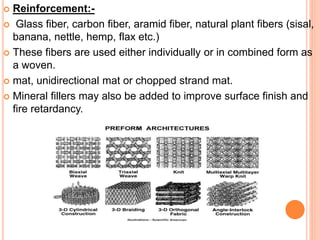
 Reinforcement:-
 Glass fiber, carbon fiber, aramid fiber, natural plant fibers (sisal,
banana, nettle, hemp, flax etc.)
 These fibers are used either individually or in combined form as
a woven.
 mat, unidirectional mat or chopped strand mat.
 Mineral fillers may also be added to improve surface finish and
fire retardancy.
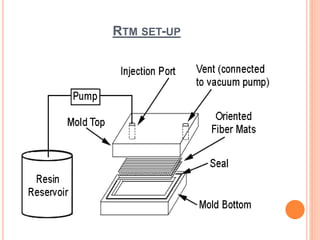
RTM SET-UP
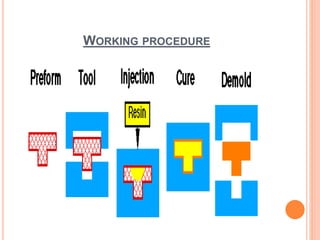
WORKING PROCEDURE
ADVANTAGE
 Good surface quality
 Wide range of reinforcements
 Large, complex shapes
 Low capital investment
 Less material wastage
 Tooling flexibility
 Low environmental impact
 Labor savings
 Zero air entrapment within the product.
DISADVANTAGE
 Mold cavity limits the size of the composite.
 High tooling cost.
 There is limitation on reinforcing materials due to
the flow and resin saturation of fibers.
APPLICATION
 Truck panels
 Boat hulls
 Wind turbine blades
 Aerospace and automobile parts
 Medical composites
 Bathroom fixtures, car body, helmet, etc.
REFERENCE
 Google Image
 Wikipedia
 http://www.moldedfiberglass.com/processes/processes/closed
-molding-processes/resin-transfer-molding
Resin tm

Resin tm

  • 1.
    RESIN TRANSFER MOLDING Submitted By:-Pankaj KumarDas Roll NO :-1308023 B.Tech Polymer Science (2nd year)
  • 2.
    CONTENT  History  MaterialUsed  RTM SET UP  Working Procedure  Advantage & Disadvantage  Application  Reference
  • 3.
    HISTORY  Developed bya US navy contract for the development of 28-ft long personal boat in 1946 .  Fully developed for general aerospace applications in the 1980s.
  • 4.
    MATERIAL USED  Matrix:- Epoxy,Methyl Methacrylate, polyester, polyvinyl ester, phenolic resin.  desired resin characteristics  must remain liquid as it is held in the reservoir prior to injection.  must impregnate fiber preform quickly and uniformly without voids.  must gel as quickly as possible once impregnation occurs (fast cycle time).  must possess sufficient hardness to be demolded without distortion.
  • 5.
     Reinforcement:-  Glassfiber, carbon fiber, aramid fiber, natural plant fibers (sisal, banana, nettle, hemp, flax etc.)  These fibers are used either individually or in combined form as a woven.  mat, unidirectional mat or chopped strand mat.  Mineral fillers may also be added to improve surface finish and fire retardancy.
  • 6.
  • 7.
  • 8.
    ADVANTAGE  Good surfacequality  Wide range of reinforcements  Large, complex shapes  Low capital investment  Less material wastage  Tooling flexibility  Low environmental impact  Labor savings  Zero air entrapment within the product.
  • 9.
    DISADVANTAGE  Mold cavitylimits the size of the composite.  High tooling cost.  There is limitation on reinforcing materials due to the flow and resin saturation of fibers.
  • 10.
    APPLICATION  Truck panels Boat hulls  Wind turbine blades  Aerospace and automobile parts  Medical composites  Bathroom fixtures, car body, helmet, etc.
  • 11.
    REFERENCE  Google Image Wikipedia  http://www.moldedfiberglass.com/processes/processes/closed -molding-processes/resin-transfer-molding