BASIC SCIENCE
RESEARCH I
Definition,
Aims,
Objectives,
Goals, and
Importance
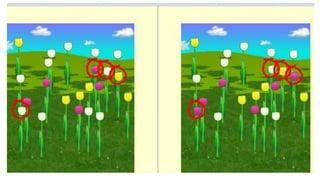
FIND
4
DIFFERENCES
http://www.spotthedifference.com/explorer.asp?g=1
I. DEFINITION
OF
RESEARCH
DEFINE:
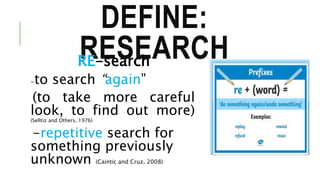
RESEARCHRE-search
-to search “again”
(to take more careful
look, to find out more)
(Selltiz and Others, 1976)
-repetitive search for
something previously
unknown (Caintic and Cruz, 2008)
DEFINE: RESEARCH
“a process of gathering
data or information to
solve a particular or
specific problem in a
scientific manner”
(Manuel and Medel, 1976)
DEFINE: RESEARCH
“a systematic study or
investigation of
something for the
purpose of answering
questions posed by the
researcher” (Sanchez, 1980)
DEFINE: RESEARCH
“an attempt to gain
solutions to problems;
more precisely, it is the
collection of data in a
rigorously controlled
situation for the
purpose of prediction
or explanation”
DEFINE: RESEARCH
“careful, critical, disciplined
inquiry, varying in technique
and method according to the
nature and conditions of the
problem identified, directed
toward the clarification or
resolution (or both) of a
problem”
DEFINE: RESEARCH
“simply, the systematic search for
pertinent information on a specific
topic or problem. After a careful,
systematic search for pertinent
information or data on a specific
topic or problem, and after the
researcher worker has analyzed and
interpreted the data, he eventually
faces another essential task-that of

preparing the research report” (Aquino
DEFINE: RESEARCH
“a purposive, systematic and scientific
process of gathering, analyzing,
classifying, organizing, presenting and
interpreting data for the solution of a
problem, for prediction, for invention,
for the discovery of truth or for the
expansion or verification of existing
knowledge, all for the preservation and
improvement of the quality of human
life” (Calderon and Gonzales, 1993)
DEFINE: RESEARCH
(LATEST)
“a process of steps used to collect and analyze
information to increase our understanding of a
topic or issue”. It consists of three steps: Pose a
question, collect data to answer the question,
and present an answer to the question” (Creswell,
2008)
“any gathering of data, information and facts for
the advancement of knowledge” (Shuttleworth,
2008)
“creative work undertaken on a systematic basis
in order to increase the stock of knowledge,
including knowledge of man, culture and society,
SEATWORK:
DEFINE RESEARCH USING YOUR OWN
WORDS.
(INDIVIDUAL-NB)
What I
Learned!
K W L
II. PURPOSES
OF
RESEARCH
(Importance, Objectives,
Goals, Aims)
FORTUNE TELLING….
3 Reasons why am I in MakSci…
3 Goals I want to achieve as grade 7 student….
Where am I and what am I doing 10 years from
now… (be specific)
PURPOSE
Research is
PURPOSIVE.
“preservation and
improvement of the
quality of human life”
“to serve man”
(Good and Scates, 1972)
PURPOSE
“ To satisfy man’s craving for
more understanding, to
improve his judgment, to add
to his power, to reduce the
burden of work, to relieve
suffering, and to increase
satisfactions in multitudinous
ways-these are the large and
fundamental goals of
research”
SPECIFIC PURPOSE (TREECE AND
TREECE JR, 1977)
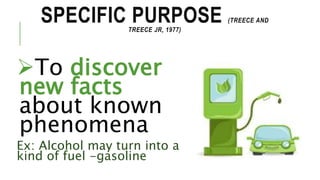
To discover
new facts
about known
phenomena
Ex: Alcohol may turn into a
kind of fuel -gasoline
SPECIFIC PURPOSE (TREECE AND
TREECE JR, 1977)
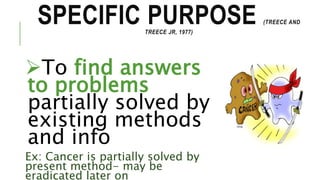
To find answers
to problems
partially solved by
existing methods
and info
Ex: Cancer is partially solved by
present method- may be
eradicated later on
SPECIFIC PURPOSE (TREECE AND
TREECE JR, 1977)
To improve
existing
techniques and
develop new
instruments or
products
Ex: Invention of new gadgets,
machines, food products and
SPECIFIC PURPOSE (TREECE AND
TREECE JR, 1977)
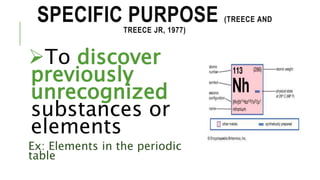
To discover
previously
unrecognized
substances or
elements
Ex: Elements in the periodic
table
SPECIFIC PURPOSE (TREECE AND
TREECE JR, 1977)
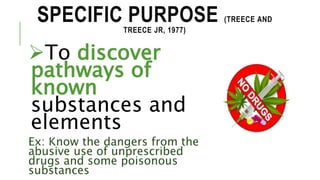
To discover
pathways of
known
substances and
elements
Ex: Know the dangers from the
abusive use of unprescribed
drugs and some poisonous
substances
SPECIFIC PURPOSE (SANCHEZ,
1980)
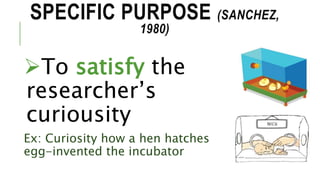
To satisfy the
researcher’s
curiousity
Ex: Curiosity how a hen hatches
egg-invented the incubator
SPECIFIC PURPOSE
To find
answers to
queries by
means of
scientific
method
SPECIFIC PURPOSE
To acquire better
and deeper
understanding
about a
phenomenon
Ex: research why women are
SPECIFIC PURPOSE (RELATED TO 2ND AND
3RD)
To improve
educational
practice
Ex: Revision of curricula,
instructional innovations
SPECIFIC PURPOSE (RELATED TO 2ND AND
3RD)
To promote
health and
prolong life
Ex: pharmaceutical,
nutritional, medical
research
SPECIFIC PURPOSE (RELATED TO 2ND AND
3RD)
To provide
man with
more of his
basic needs
Ex: more and better food,
SPECIFIC PURPOSE (RELATED TO 2ND AND
3RD)
To make work,
travel, and
communication
faster, easier and
more
comfortable
Ex: airplanes, land vehicles,
machines, improved radio/tv-
news, electricity
(1 WHOLE-INDIVIDUAL)
How could you benefit
from Research?
Determine10 specific
situations.
Explain each thoroughly.

Research-Definition and Purpose

  • 1.
  • 2.
  • 11.
  • 12.
    DEFINE: RESEARCHRE-search -to search “again” (totake more careful look, to find out more) (Selltiz and Others, 1976) -repetitive search for something previously unknown (Caintic and Cruz, 2008)
  • 13.
    DEFINE: RESEARCH “a processof gathering data or information to solve a particular or specific problem in a scientific manner” (Manuel and Medel, 1976)
  • 14.
    DEFINE: RESEARCH “a systematicstudy or investigation of something for the purpose of answering questions posed by the researcher” (Sanchez, 1980)
  • 15.
    DEFINE: RESEARCH “an attemptto gain solutions to problems; more precisely, it is the collection of data in a rigorously controlled situation for the purpose of prediction or explanation”
  • 16.
    DEFINE: RESEARCH “careful, critical,disciplined inquiry, varying in technique and method according to the nature and conditions of the problem identified, directed toward the clarification or resolution (or both) of a problem”
  • 17.
    DEFINE: RESEARCH “simply, thesystematic search for pertinent information on a specific topic or problem. After a careful, systematic search for pertinent information or data on a specific topic or problem, and after the researcher worker has analyzed and interpreted the data, he eventually faces another essential task-that of preparing the research report” (Aquino
  • 18.
    DEFINE: RESEARCH “a purposive,systematic and scientific process of gathering, analyzing, classifying, organizing, presenting and interpreting data for the solution of a problem, for prediction, for invention, for the discovery of truth or for the expansion or verification of existing knowledge, all for the preservation and improvement of the quality of human life” (Calderon and Gonzales, 1993)
  • 19.
    DEFINE: RESEARCH (LATEST) “a processof steps used to collect and analyze information to increase our understanding of a topic or issue”. It consists of three steps: Pose a question, collect data to answer the question, and present an answer to the question” (Creswell, 2008) “any gathering of data, information and facts for the advancement of knowledge” (Shuttleworth, 2008) “creative work undertaken on a systematic basis in order to increase the stock of knowledge, including knowledge of man, culture and society,
  • 20.
    SEATWORK: DEFINE RESEARCH USINGYOUR OWN WORDS. (INDIVIDUAL-NB) What I Learned! K W L
  • 21.
  • 22.
    FORTUNE TELLING…. 3 Reasonswhy am I in MakSci… 3 Goals I want to achieve as grade 7 student…. Where am I and what am I doing 10 years from now… (be specific)
  • 23.
    PURPOSE Research is PURPOSIVE. “preservation and improvementof the quality of human life” “to serve man” (Good and Scates, 1972)
  • 24.
    PURPOSE “ To satisfyman’s craving for more understanding, to improve his judgment, to add to his power, to reduce the burden of work, to relieve suffering, and to increase satisfactions in multitudinous ways-these are the large and fundamental goals of research”
  • 25.
    SPECIFIC PURPOSE (TREECEAND TREECE JR, 1977) To discover new facts about known phenomena Ex: Alcohol may turn into a kind of fuel -gasoline
  • 26.
    SPECIFIC PURPOSE (TREECEAND TREECE JR, 1977) To find answers to problems partially solved by existing methods and info Ex: Cancer is partially solved by present method- may be eradicated later on
  • 27.
    SPECIFIC PURPOSE (TREECEAND TREECE JR, 1977) To improve existing techniques and develop new instruments or products Ex: Invention of new gadgets, machines, food products and
  • 28.
    SPECIFIC PURPOSE (TREECEAND TREECE JR, 1977) To discover previously unrecognized substances or elements Ex: Elements in the periodic table
  • 29.
    SPECIFIC PURPOSE (TREECEAND TREECE JR, 1977) To discover pathways of known substances and elements Ex: Know the dangers from the abusive use of unprescribed drugs and some poisonous substances
  • 30.
    SPECIFIC PURPOSE (SANCHEZ, 1980) Tosatisfy the researcher’s curiousity Ex: Curiosity how a hen hatches egg-invented the incubator
  • 31.
    SPECIFIC PURPOSE To find answersto queries by means of scientific method
  • 32.
    SPECIFIC PURPOSE To acquirebetter and deeper understanding about a phenomenon Ex: research why women are
  • 33.
    SPECIFIC PURPOSE (RELATEDTO 2ND AND 3RD) To improve educational practice Ex: Revision of curricula, instructional innovations
  • 34.
    SPECIFIC PURPOSE (RELATEDTO 2ND AND 3RD) To promote health and prolong life Ex: pharmaceutical, nutritional, medical research
  • 35.
    SPECIFIC PURPOSE (RELATEDTO 2ND AND 3RD) To provide man with more of his basic needs Ex: more and better food,
  • 36.
    SPECIFIC PURPOSE (RELATEDTO 2ND AND 3RD) To make work, travel, and communication faster, easier and more comfortable Ex: airplanes, land vehicles, machines, improved radio/tv- news, electricity
  • 37.
    (1 WHOLE-INDIVIDUAL) How couldyou benefit from Research? Determine10 specific situations. Explain each thoroughly.

Editor's Notes