WHAT IS “RESEARCH”
ITS AIMS
OBJECTIVES
SIGNIFICANCE
WHAT IS “RESEARCH”
 “Research is the process of looking for a specific question in
an organized, objective, reliable way.”
 “Research is a pursuit of trust with the help of study,
observation, comparison and experiment, the search for
knowledge through objective and systematic method of
finding solutions to a problem.”
RESEARCH AIMS
 Your research aims are the answer to the question: ‘what are you doing?’.
 You need to clearly describe what your intentions are and what you hope to
achieve. These are your aims.
 Achievement of research aim provides answer to the research question
 Research aim specifies WHAT needs to be studied.
 You aims may be to test theory in a new empirical setting, derive new theory
entirely, construct a new data-set, replicate an existing study.
RESEARCH OBJECTIVES
 The objectives are the answer to the question ‘how are you doing it’.
 Research objectives refer to the goals or steps that you will take to
achieve your aims.
 Research objectives divide research aim into several parts and address
each part separately.
 Research objectives comprise a number of steps that address HOW
research aim will be achieved.
 Be SMART while writing research objectives.
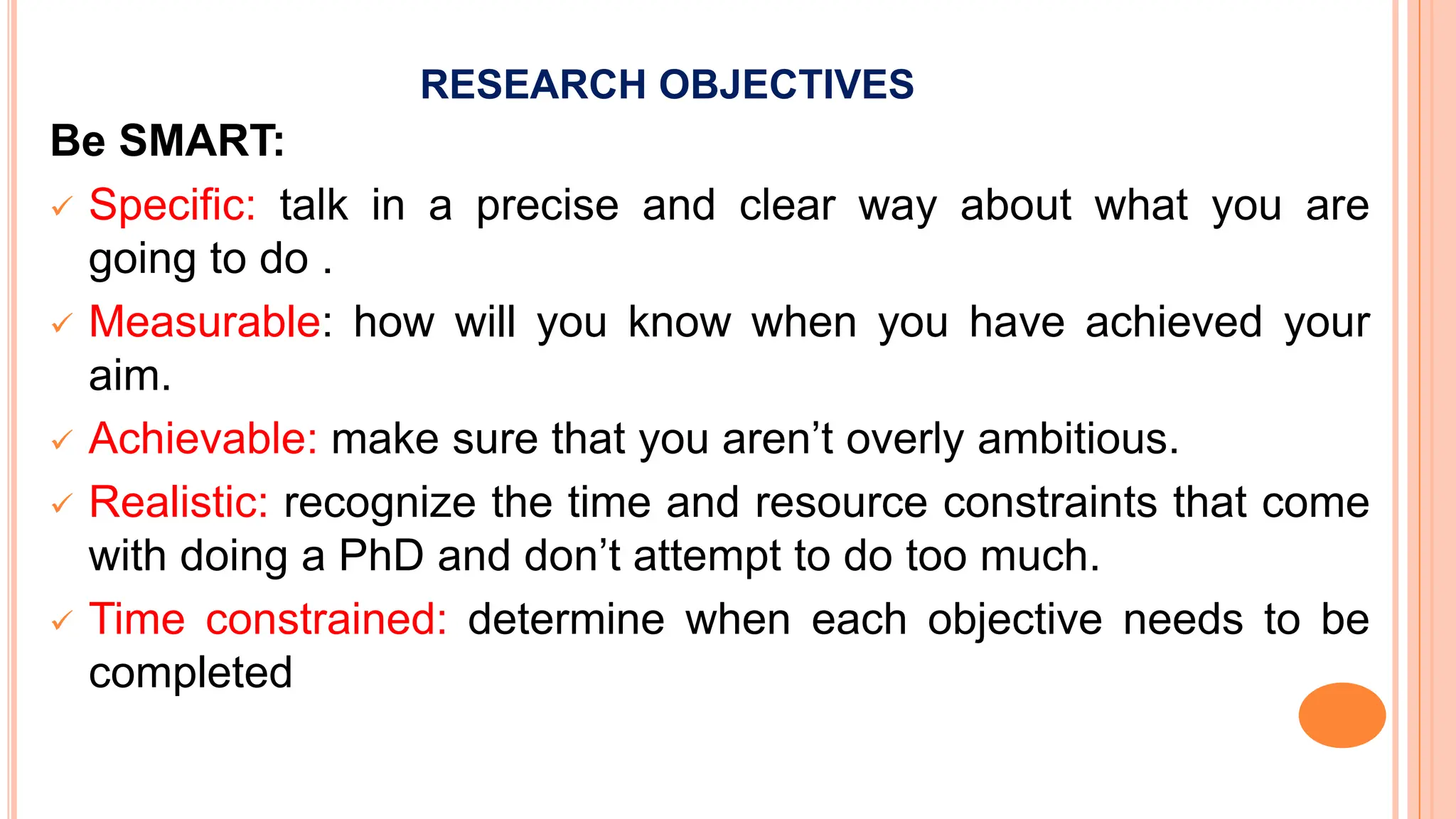
RESEARCH OBJECTIVES
Be SMART:
 Specific: talk in a precise and clear way about what you are
going to do .
 Measurable: how will you know when you have achieved your
aim.
 Achievable: make sure that you aren’t overly ambitious.
 Realistic: recognize the time and resource constraints that come
with doing a PhD and don’t attempt to do too much.
 Time constrained: determine when each objective needs to be
completed
IMPORTANCE OF AIMS & OBJECTIVES WITH EXAMPLE
 If you build a house without foundations it is pretty obvious what will happen. It will
collapse.
 Your thesis is the same; fail to build the foundations and your thesis just won’t work.
 If you write your aims and objectives clearly then you will make your reader’s life easier.
A lot of students fail to clearly articulate their aims and objectives because they are not
sure themselves what they actually are.
 The truth is that if you struggle to explain in simple terms what your research is on
and why it matters, you may need to refine your aims and objectives to make them
more concise.
IMPORTANCE/ SIGNIFICANCE OF RESEARCH
 A Tool for Building Knowledge and for Facilitating Learning.
 Means to Understand Various Issues and Increase Public Awareness.
 A Way to Prove Lies and to Support Truths.
 Means to Find, Gauge, and Seize Opportunities
 Nourishment and Exercise for the Mind.
 It is a self-learning experience.
 A Seed to Love Reading, Writing, Analyzing, and Sharing Valuable
Information
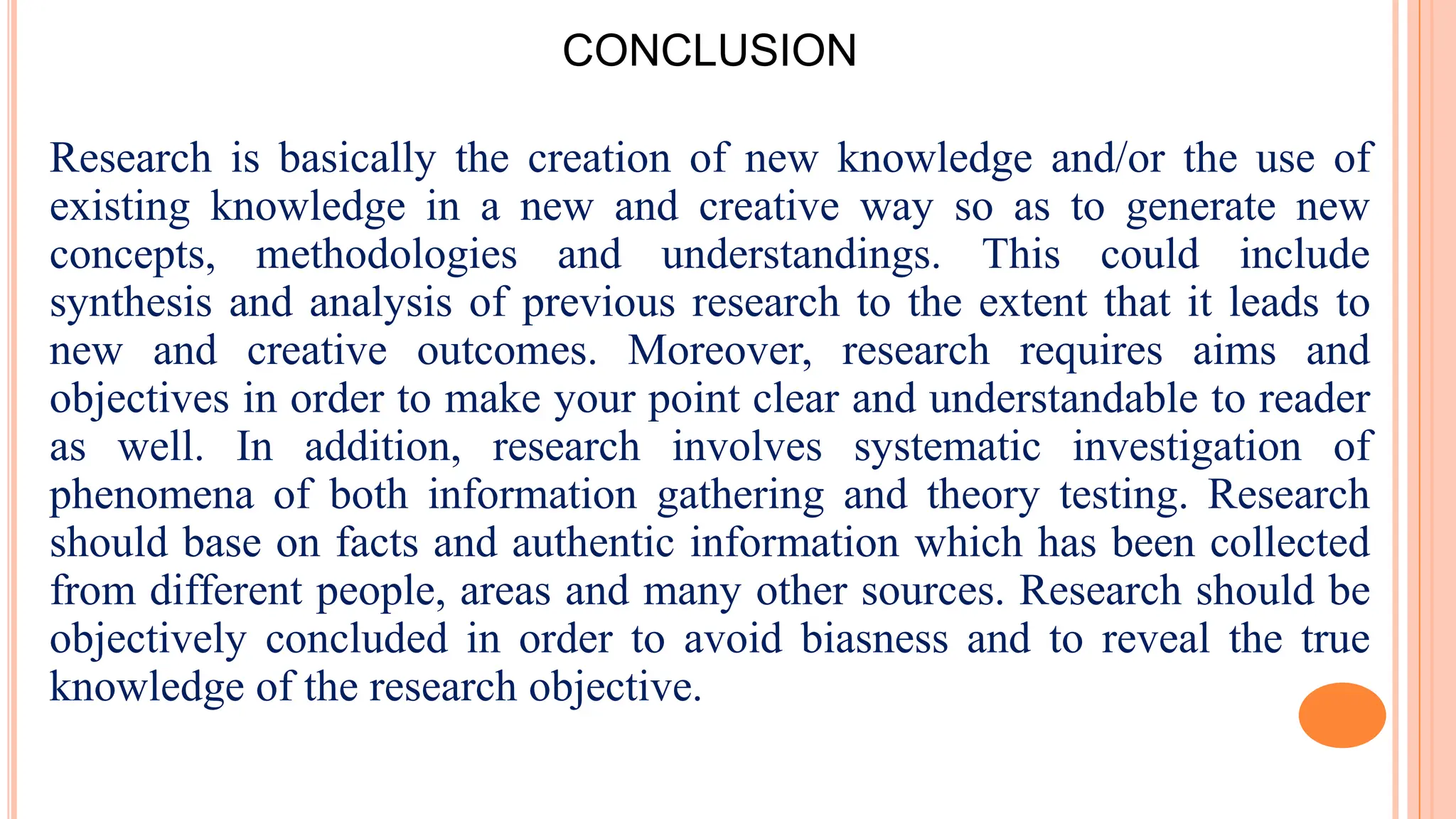
CONCLUSION
Research is basically the creation of new knowledge and/or the use of
existing knowledge in a new and creative way so as to generate new
concepts, methodologies and understandings. This could include
synthesis and analysis of previous research to the extent that it leads to
new and creative outcomes. Moreover, research requires aims and
objectives in order to make your point clear and understandable to reader
as well. In addition, research involves systematic investigation of
phenomena of both information gathering and theory testing. Research
should base on facts and authentic information which has been collected
from different people, areas and many other sources. Research should be
objectively concluded in order to avoid biasness and to reveal the true
knowledge of the research objective.
THANK YOU!

WHAT IS RESEARCH.AIMS,OBJECTIVE & SIGNIFICANCE.pptx

  • 1.
    WHAT IS “RESEARCH” ITSAIMS OBJECTIVES SIGNIFICANCE
  • 2.
    WHAT IS “RESEARCH” “Research is the process of looking for a specific question in an organized, objective, reliable way.”  “Research is a pursuit of trust with the help of study, observation, comparison and experiment, the search for knowledge through objective and systematic method of finding solutions to a problem.”
  • 3.
    RESEARCH AIMS  Yourresearch aims are the answer to the question: ‘what are you doing?’.  You need to clearly describe what your intentions are and what you hope to achieve. These are your aims.  Achievement of research aim provides answer to the research question  Research aim specifies WHAT needs to be studied.  You aims may be to test theory in a new empirical setting, derive new theory entirely, construct a new data-set, replicate an existing study.
  • 4.
    RESEARCH OBJECTIVES  Theobjectives are the answer to the question ‘how are you doing it’.  Research objectives refer to the goals or steps that you will take to achieve your aims.  Research objectives divide research aim into several parts and address each part separately.  Research objectives comprise a number of steps that address HOW research aim will be achieved.  Be SMART while writing research objectives.
  • 5.
    RESEARCH OBJECTIVES Be SMART: Specific: talk in a precise and clear way about what you are going to do .  Measurable: how will you know when you have achieved your aim.  Achievable: make sure that you aren’t overly ambitious.  Realistic: recognize the time and resource constraints that come with doing a PhD and don’t attempt to do too much.  Time constrained: determine when each objective needs to be completed
  • 6.
    IMPORTANCE OF AIMS& OBJECTIVES WITH EXAMPLE  If you build a house without foundations it is pretty obvious what will happen. It will collapse.  Your thesis is the same; fail to build the foundations and your thesis just won’t work.  If you write your aims and objectives clearly then you will make your reader’s life easier. A lot of students fail to clearly articulate their aims and objectives because they are not sure themselves what they actually are.  The truth is that if you struggle to explain in simple terms what your research is on and why it matters, you may need to refine your aims and objectives to make them more concise.
  • 7.
    IMPORTANCE/ SIGNIFICANCE OFRESEARCH  A Tool for Building Knowledge and for Facilitating Learning.  Means to Understand Various Issues and Increase Public Awareness.  A Way to Prove Lies and to Support Truths.  Means to Find, Gauge, and Seize Opportunities  Nourishment and Exercise for the Mind.  It is a self-learning experience.  A Seed to Love Reading, Writing, Analyzing, and Sharing Valuable Information
  • 8.
    CONCLUSION Research is basicallythe creation of new knowledge and/or the use of existing knowledge in a new and creative way so as to generate new concepts, methodologies and understandings. This could include synthesis and analysis of previous research to the extent that it leads to new and creative outcomes. Moreover, research requires aims and objectives in order to make your point clear and understandable to reader as well. In addition, research involves systematic investigation of phenomena of both information gathering and theory testing. Research should base on facts and authentic information which has been collected from different people, areas and many other sources. Research should be objectively concluded in order to avoid biasness and to reveal the true knowledge of the research objective.
  • 9.