Research
Methods
Basic Concepts &Methods
www.SlideShare.net/AhmedRefat 1
LearningObjectives
Bytheendofthispresentationyouwillableto:
1 Defineandexplaintheconceptofscientificresearch,deductionandinduction
reasoning,theory
,hypothesisandempiricism.
2 ClarifytheSourcesofknowledge/truth
different
3-Identifyandexplainthefeaturesandapplicationofcategoriesandsub-
categoriesofresearchmethods
4 Characteristicsofgoodtopic.
5 Stepsinconductingaresearch.
6-Applicationandexercises(identificationoftheresearchtype).
www.SlideShare.net/AhmedRefat 2
Basic Conceptsand
Terms
www.SlideShare.net/AhmedRefat 3
DefinitionofResearch
Research is ascientificway of
answeringquestionsand testing
hypothesis
www.SlideShare.net/AhmedRefat 4
DefinitionofResearch
Researchis thesystematicand objective
analysisandrecordingof controlled
observationsthatmaylead tothedevelopment
ofgeneralizations, principles,ortheories,
resultingin predictionandpossiblecontrolof
events.
www.SlideShare.net/AhmedRefat 5
DefinitionofScientificResearch
KeyWords
Systematic, Controlled,
Empirical, ,CriticalInvestigation
Hypothetical Propositions
PresumedRelations, ObservedPhenomena
www.SlideShare.net/AhmedRefat 6
Approaches toKnowledge
Five sources of evidence in the pursuit of
truth:
1. Authority
2. Custom andtradition
3. Personal experience
4. Deductive reasoning
5. Scientific inquiry
www.SlideShare.net/AhmedRefat 7
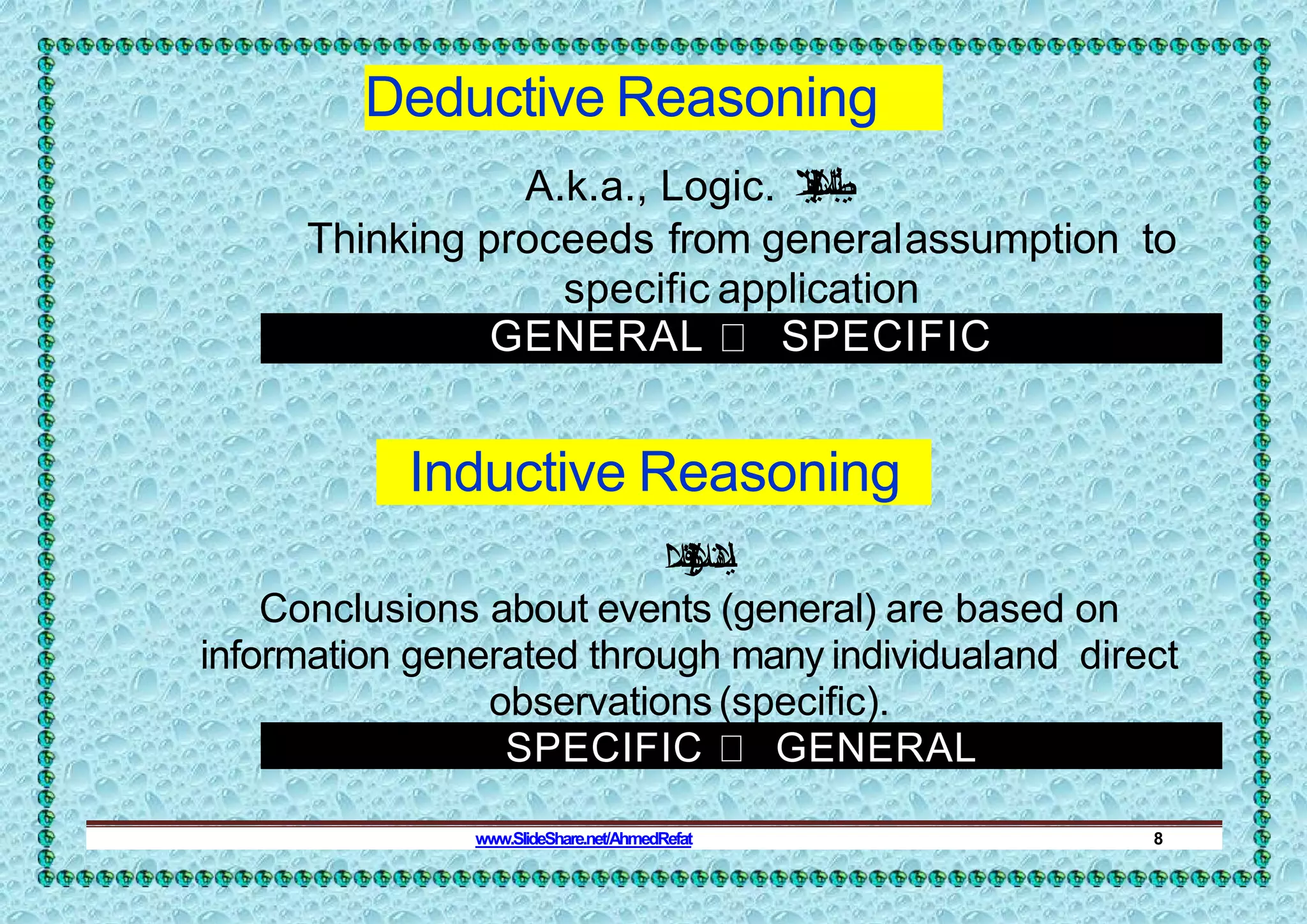
Deductive Reasoning
A.k.a., Logic. ‫ال‬
‫ق‬
‫ي‬
‫ا‬
‫س‬
‫ي‬
/
‫ا‬
‫ال‬
‫س‬
‫ت‬
‫ن‬
‫ب‬
‫ا‬
‫ط‬
‫ي‬
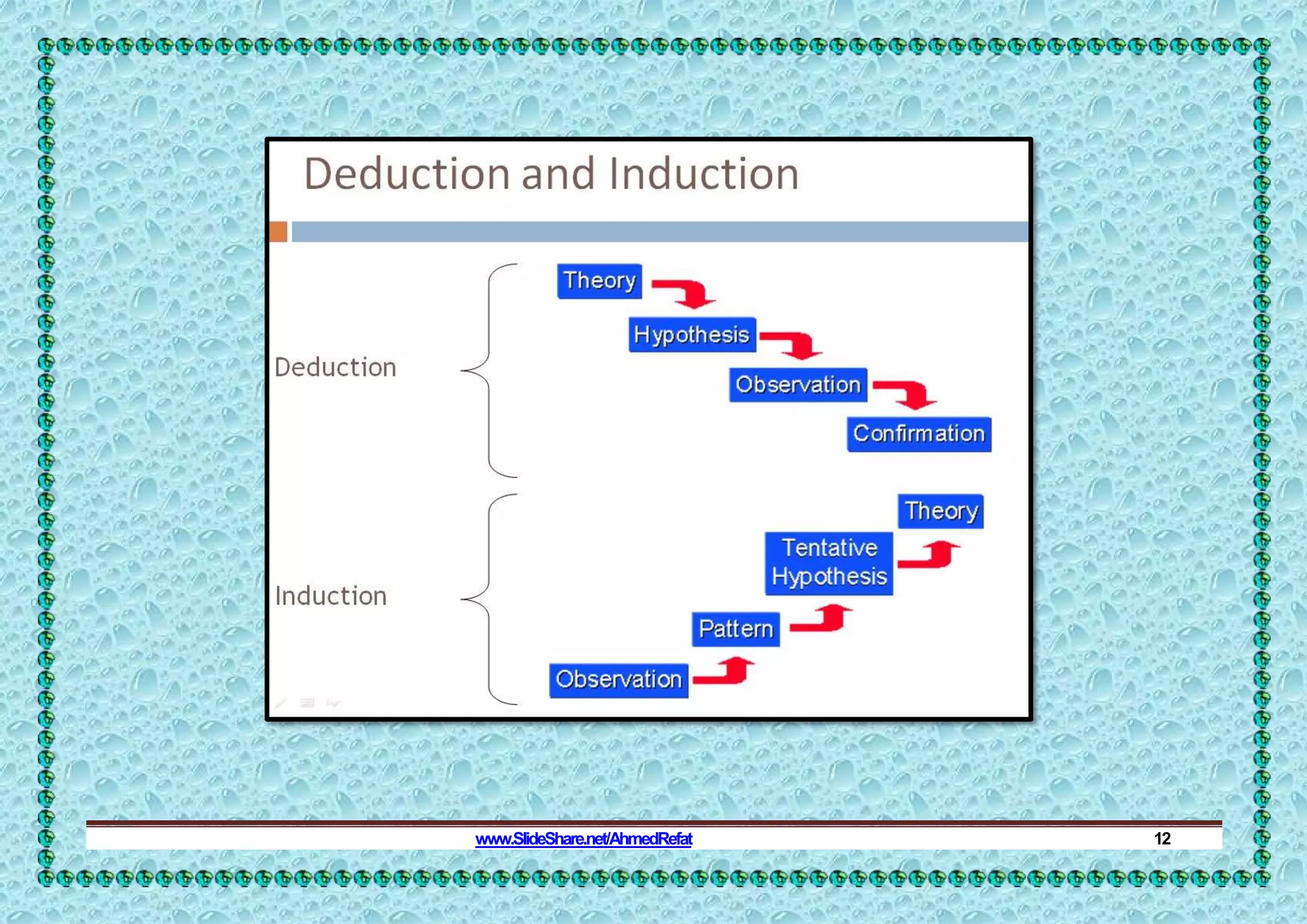
Thinking proceeds from generalassumption to
specific application
GENERAL SPECIFIC
Inductive Reasoning
‫ا‬
‫ال‬
‫س‬
‫ت‬
‫ق‬
‫ر‬
‫ا‬
‫ئ‬
‫ي‬
/
‫ا‬
‫ال‬
‫س‬
‫ت‬
‫د‬
‫ال‬
‫ل‬
‫ي‬
Conclusions about events (general) are based on
information generated through many individualand direct
observations(specific).
SPECIFIC GENERAL
www.SlideShare.net/AhmedRefat 8
Inductive Reasoning
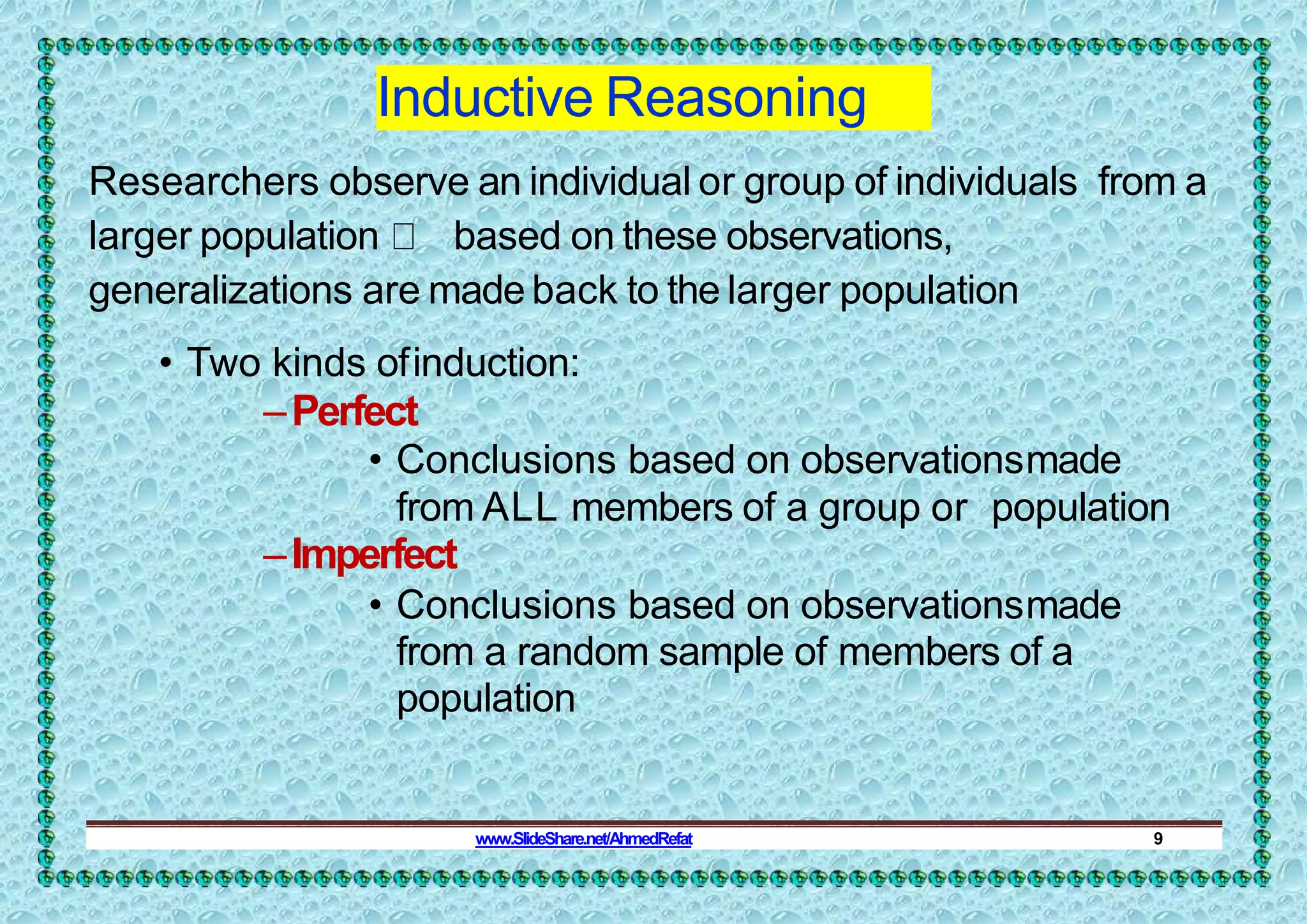
Researchers observe an individual or group of individuals from a
larger population based on these observations,
generalizations are made back to the larger population
• Two kinds ofinduction:
–Perfect
• Conclusions based on observationsmade
from ALL members of a group or population
–Imperfect
• Conclusions based on observationsmade
from a random sample of members of a
population
www.SlideShare.net/AhmedRefat 9
Deductivevs.Inductive
Reasoning
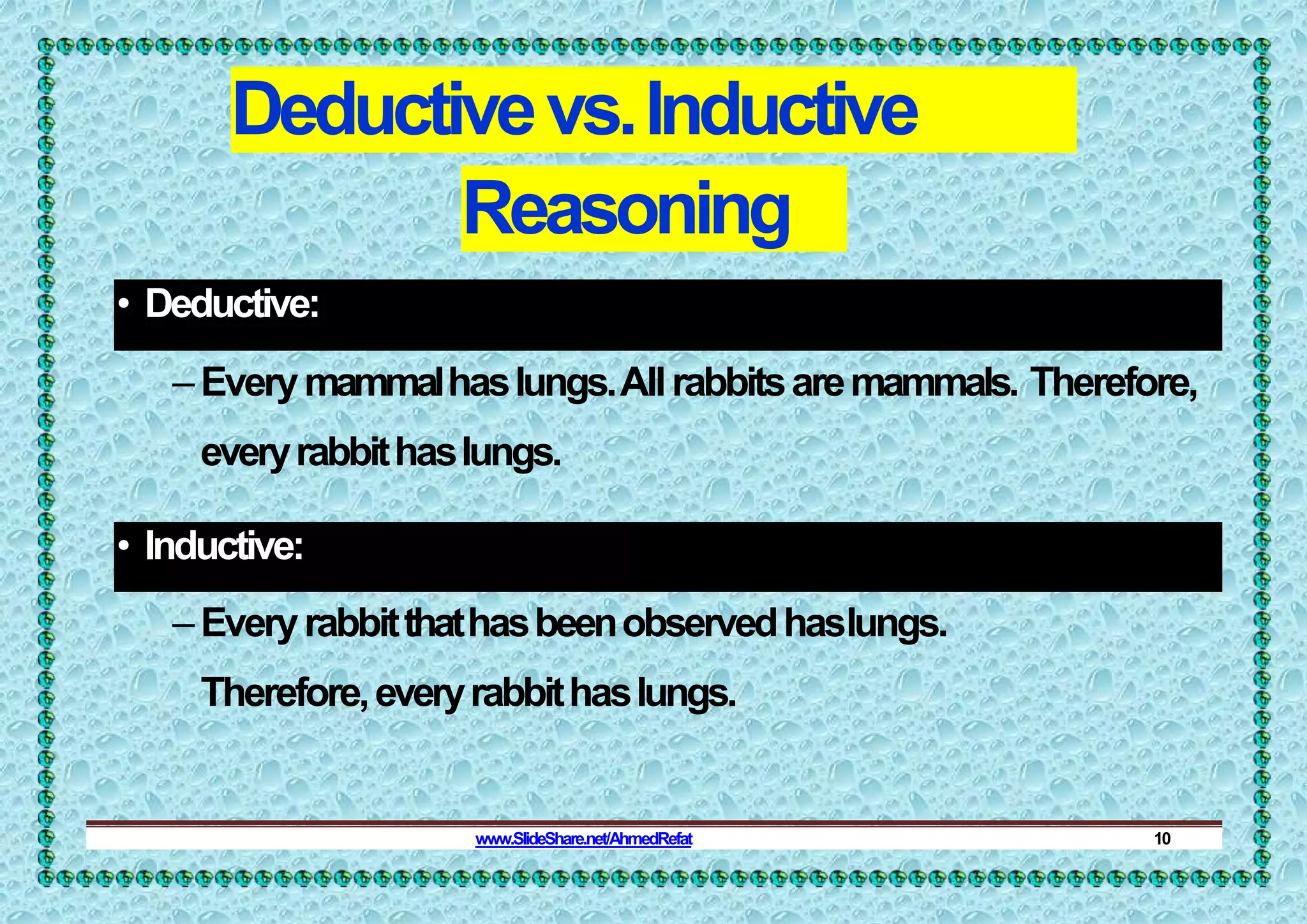
• Deductive:
–Everymammalhaslungs.Allrabbitsaremammals. Therefore,
everyrabbithaslungs.
• Inductive:
–Everyrabbitthathasbeenobservedhaslungs.
Therefore,everyrabbithaslungs.
www.SlideShare.net/AhmedRefat 10
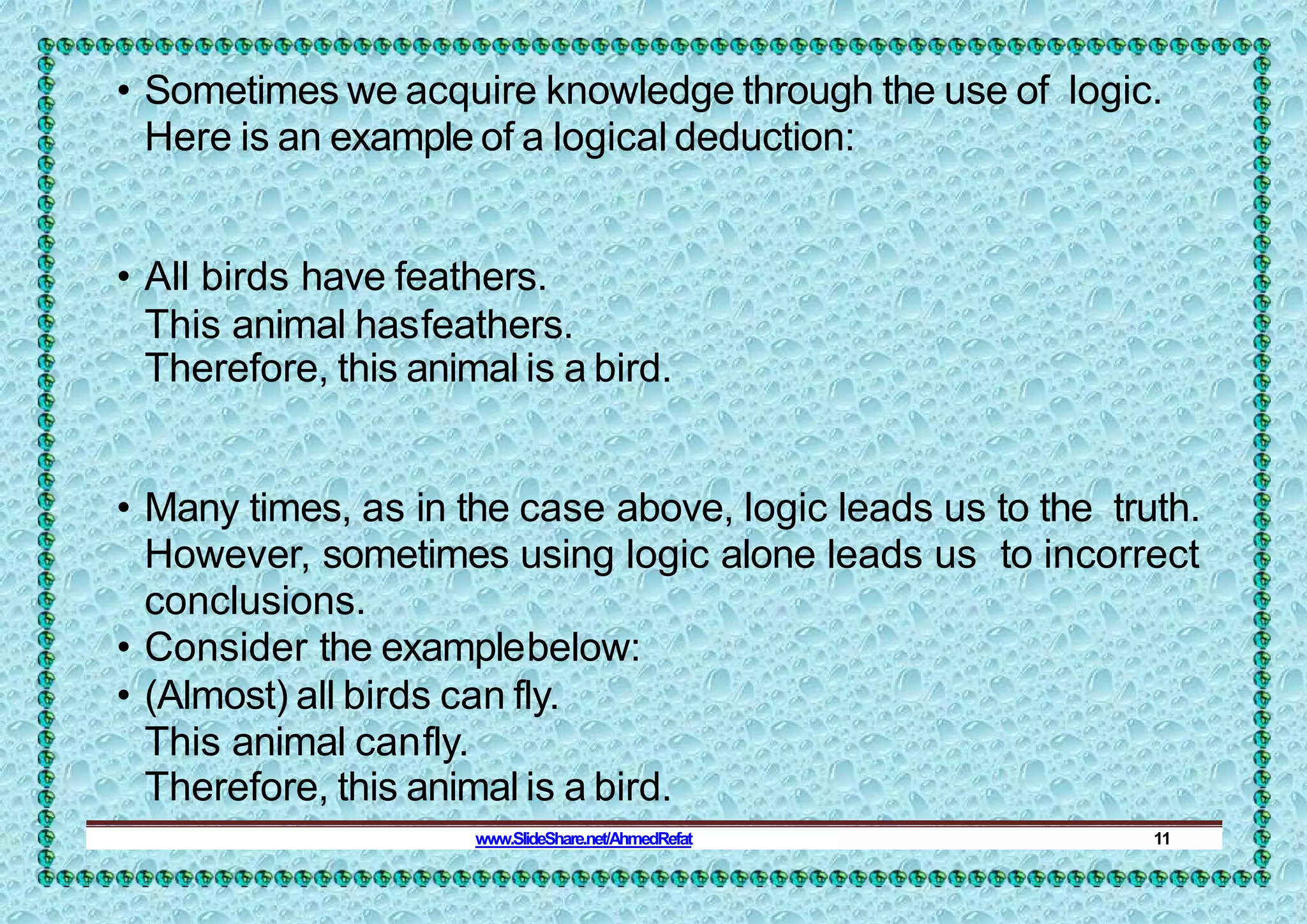
• Sometimes we acquire knowledge through the use of logic.
Here is an example of a logical deduction:
• All birds have feathers.
This animal hasfeathers.
Therefore, this animal is a bird.
• Many times, as in the case above, logic leads us to the truth.
However, sometimes using logic alone leads us to incorrect
conclusions.
• Consider the examplebelow:
• (Almost) all birds can fly.
This animal canfly.
Therefore, this animal is a bird.
www.SlideShare.net/AhmedRefat 11
www.SlideShare.net/AhmedRefat 12
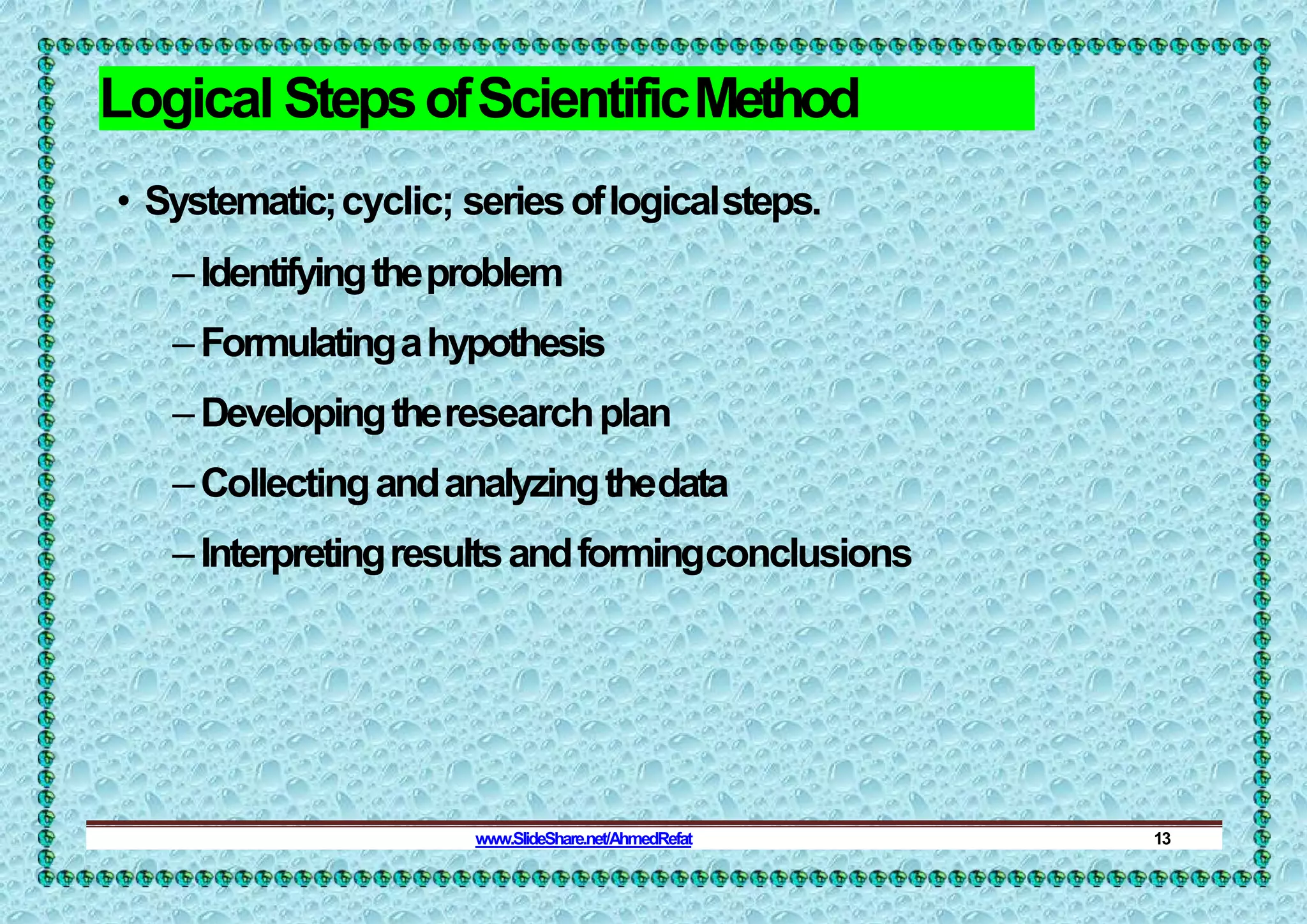
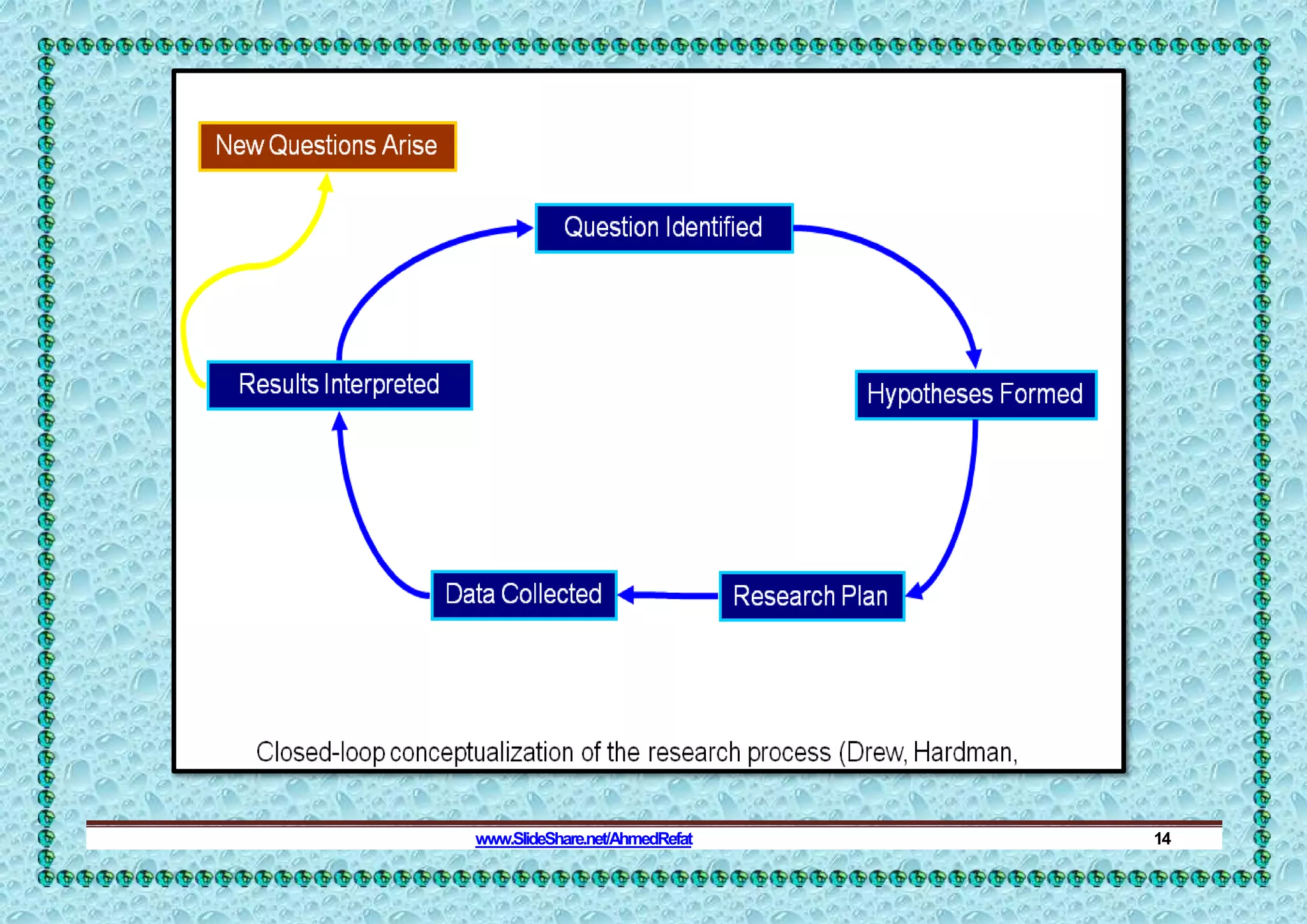
Logical StepsofScientificMethod
• Systematic;cyclic; seriesoflogicalsteps.
–Identifyingtheproblem
–Formulatingahypothesis
–Developingtheresearchplan
–Collectingandanalyzingthedata
–Interpretingresultsandformingconclusions
www.SlideShare.net/AhmedRefat 13
www.SlideShare.net/AhmedRefat 14
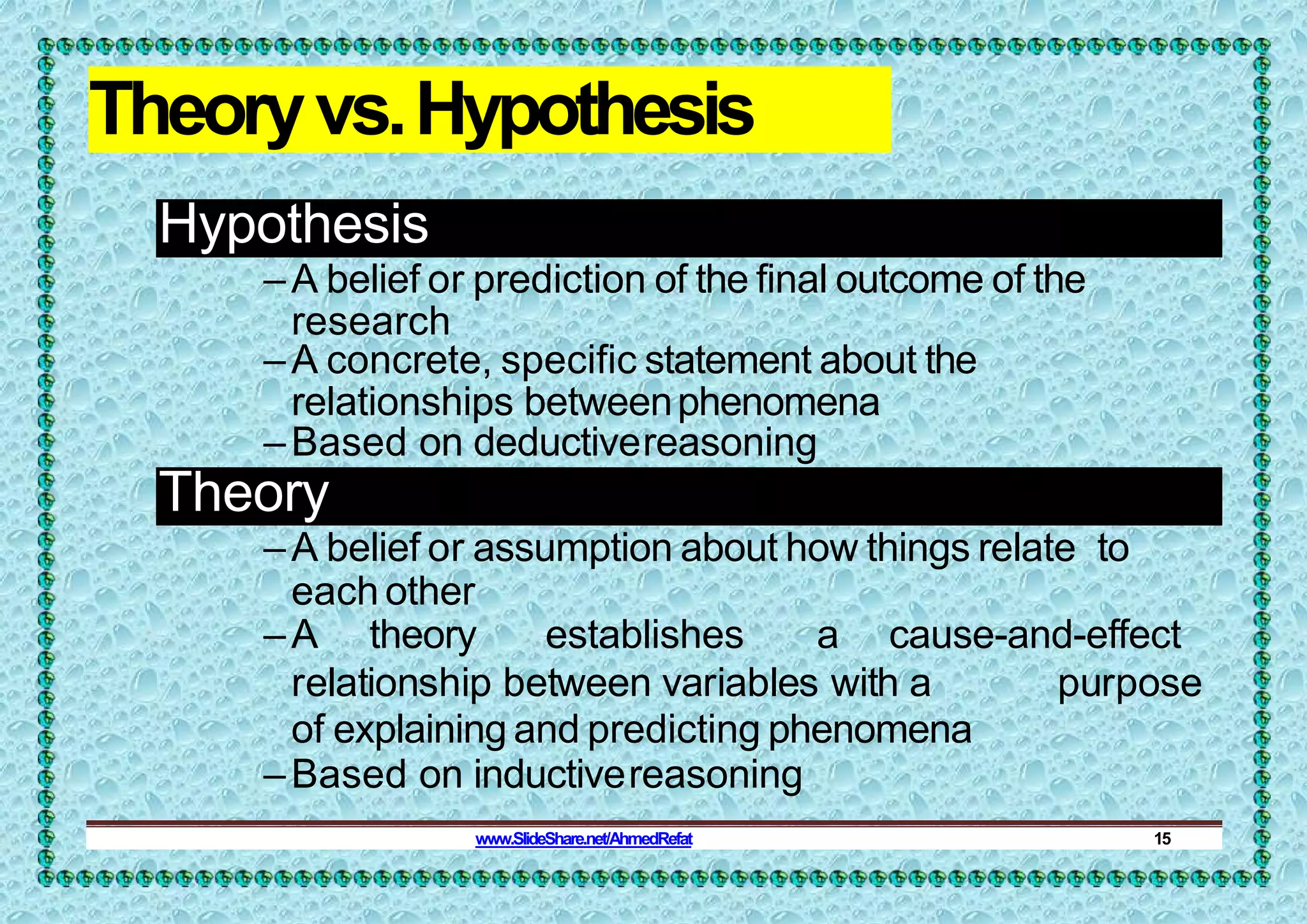
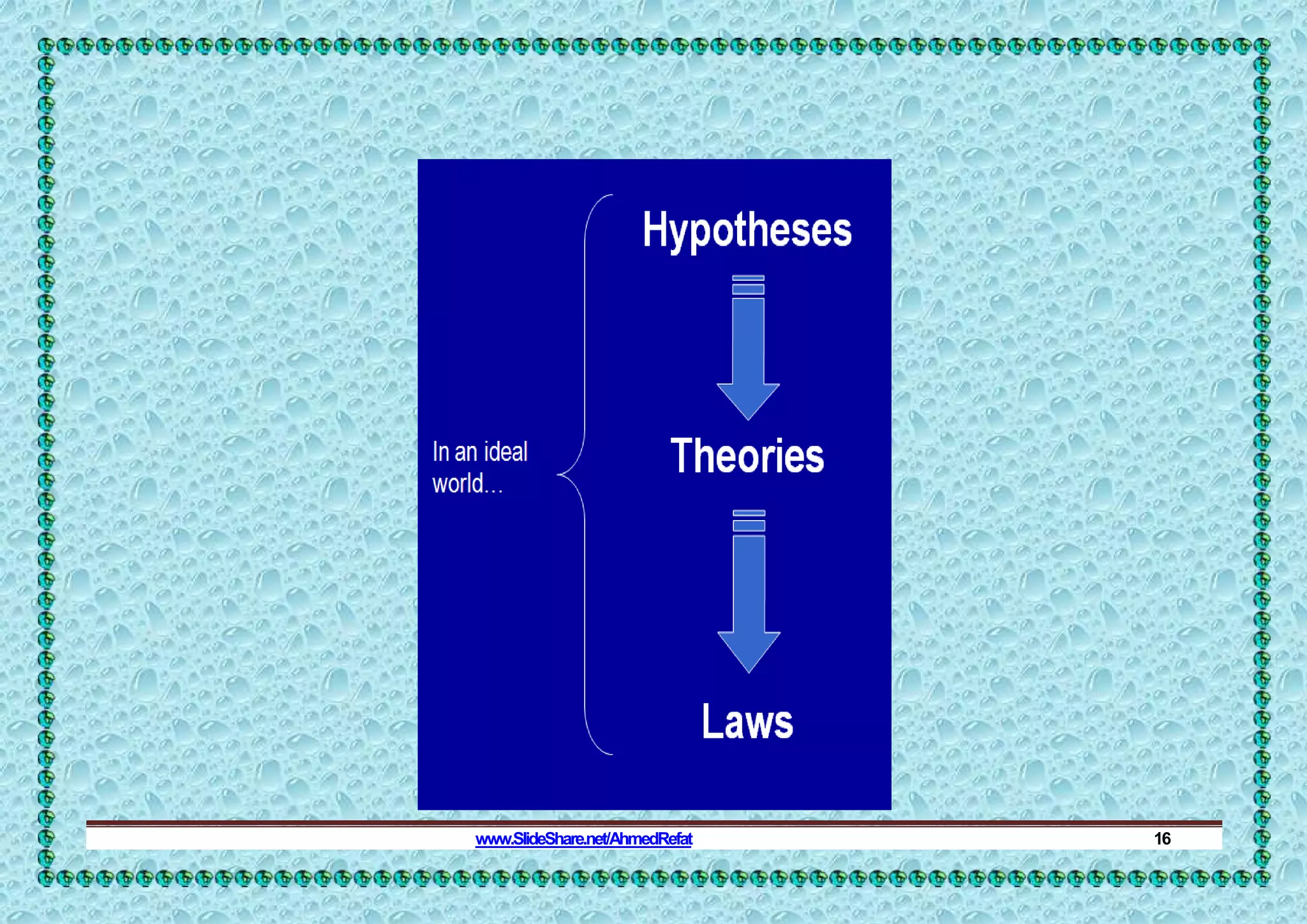
Theoryvs.Hypothesis
Hypothesis
–A belief or prediction of the final outcome of the
research
–A concrete, specific statement about the
relationships betweenphenomena
–Based on deductivereasoning
Theory
–A belief or assumption about how things relate to
each other
–A theory establishes a cause-and-effect
relationship between variables with a purpose
of explaining and predicting phenomena
–Based on inductivereasoning
www.SlideShare.net/AhmedRefat 15
www.SlideShare.net/AhmedRefat 16
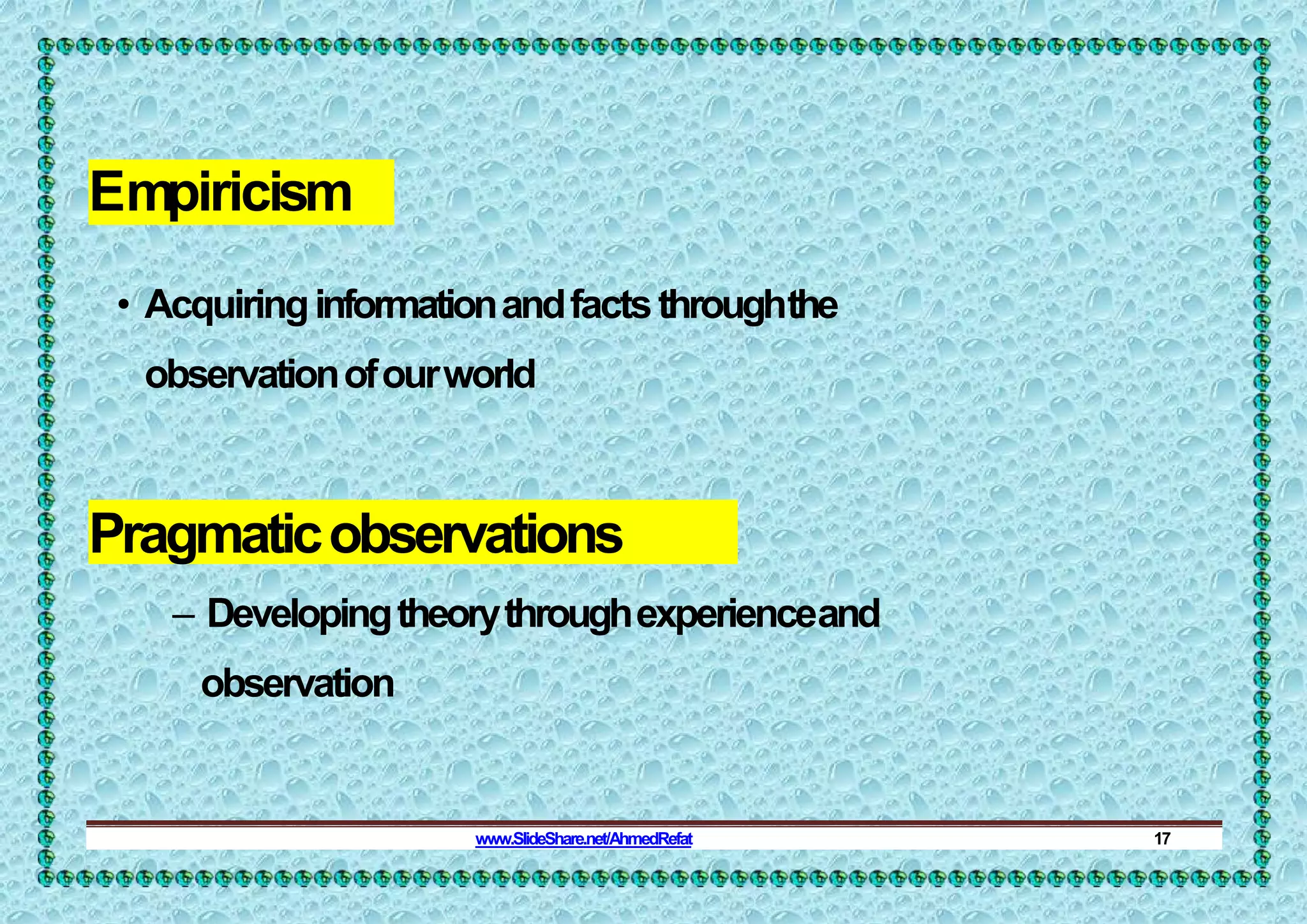
Empiricism
• Acquiringinformationandfactsthroughthe
observationofourworld
Pragmaticobservations
– Developingtheorythroughexperienceand
observation
www.SlideShare.net/AhmedRefat 17
TYPESOF
RESEARCH
www.SlideShare.net/AhmedRefat 18
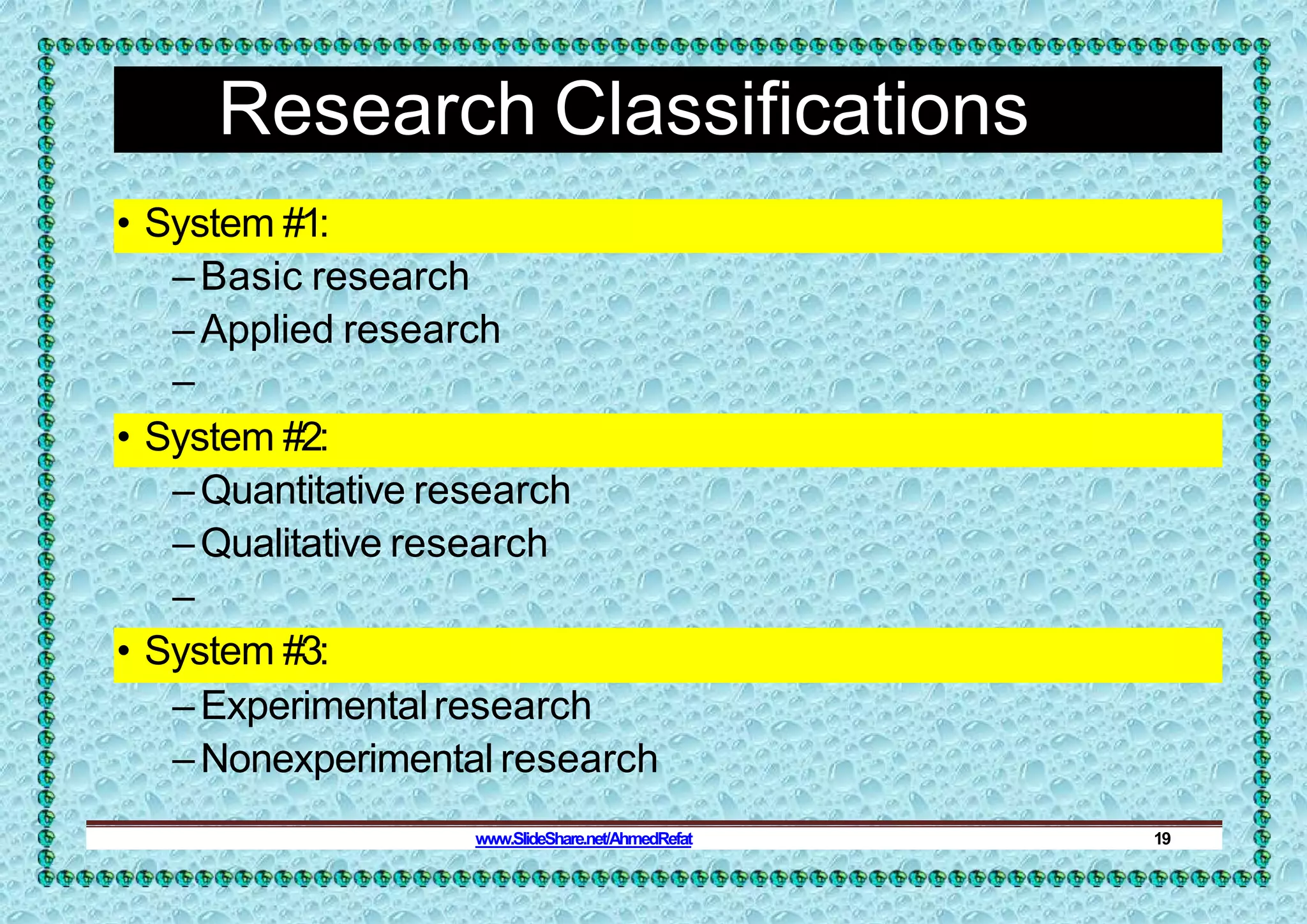
Research Classifications
• System #1:
–Basic research
–Applied research
–
• System #2:
–Quantitative research
–Qualitative research
–
• System #3:
–Experimentalresearch
–Nonexperimental research
www.SlideShare.net/AhmedRefat 19
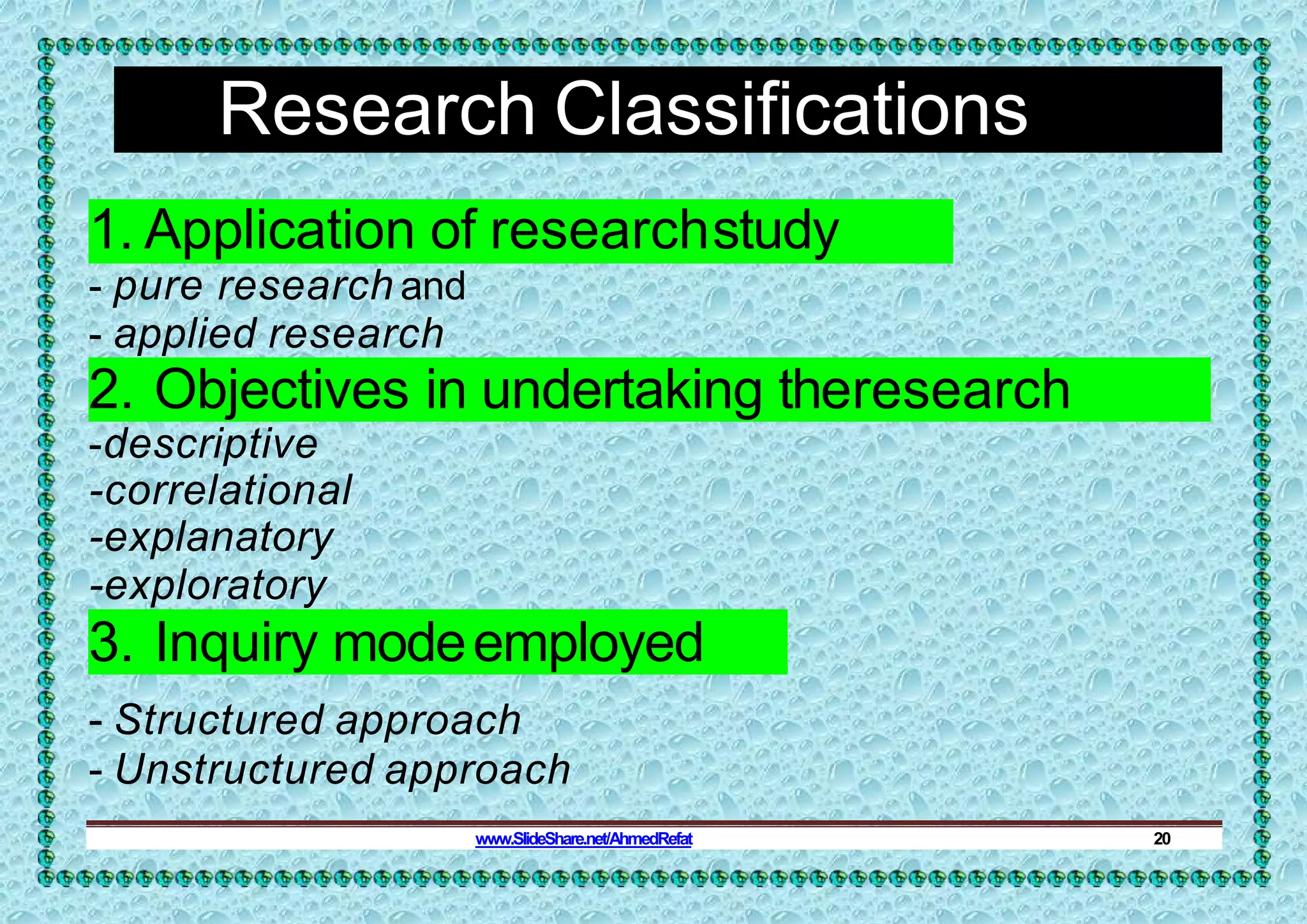
Research Classifications
1. Application of researchstudy
- pure research and
- applied research
2. Objectives in undertaking theresearch
-descriptive
-correlational
-explanatory
-exploratory
3. Inquiry modeemployed
- Structured approach
- Unstructured approach
www.SlideShare.net/AhmedRefat 20
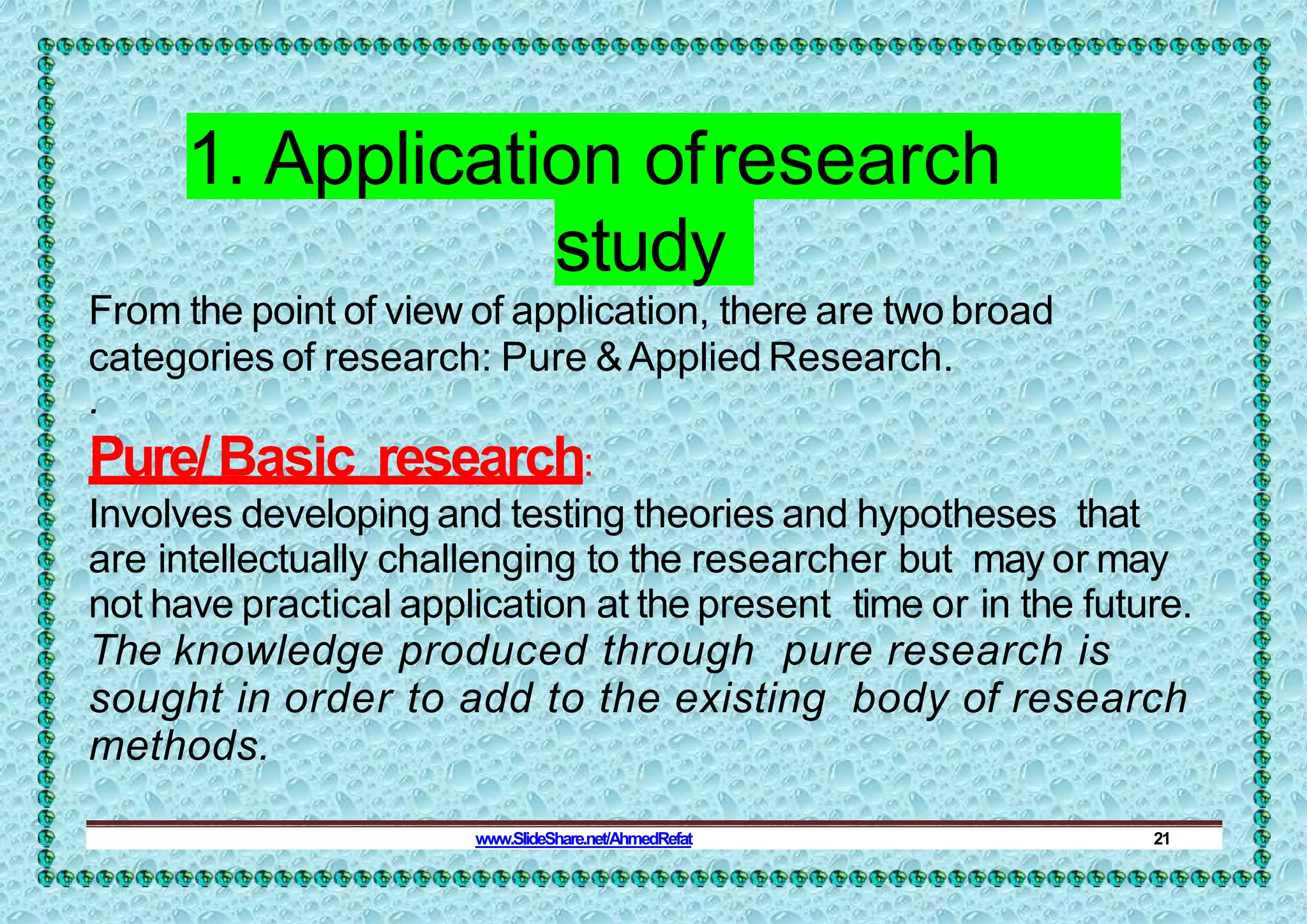
1. Application ofresearch
study
From the point of view of application, there are two broad
categories of research: Pure &Applied Research.
.
Pure/Basic research:
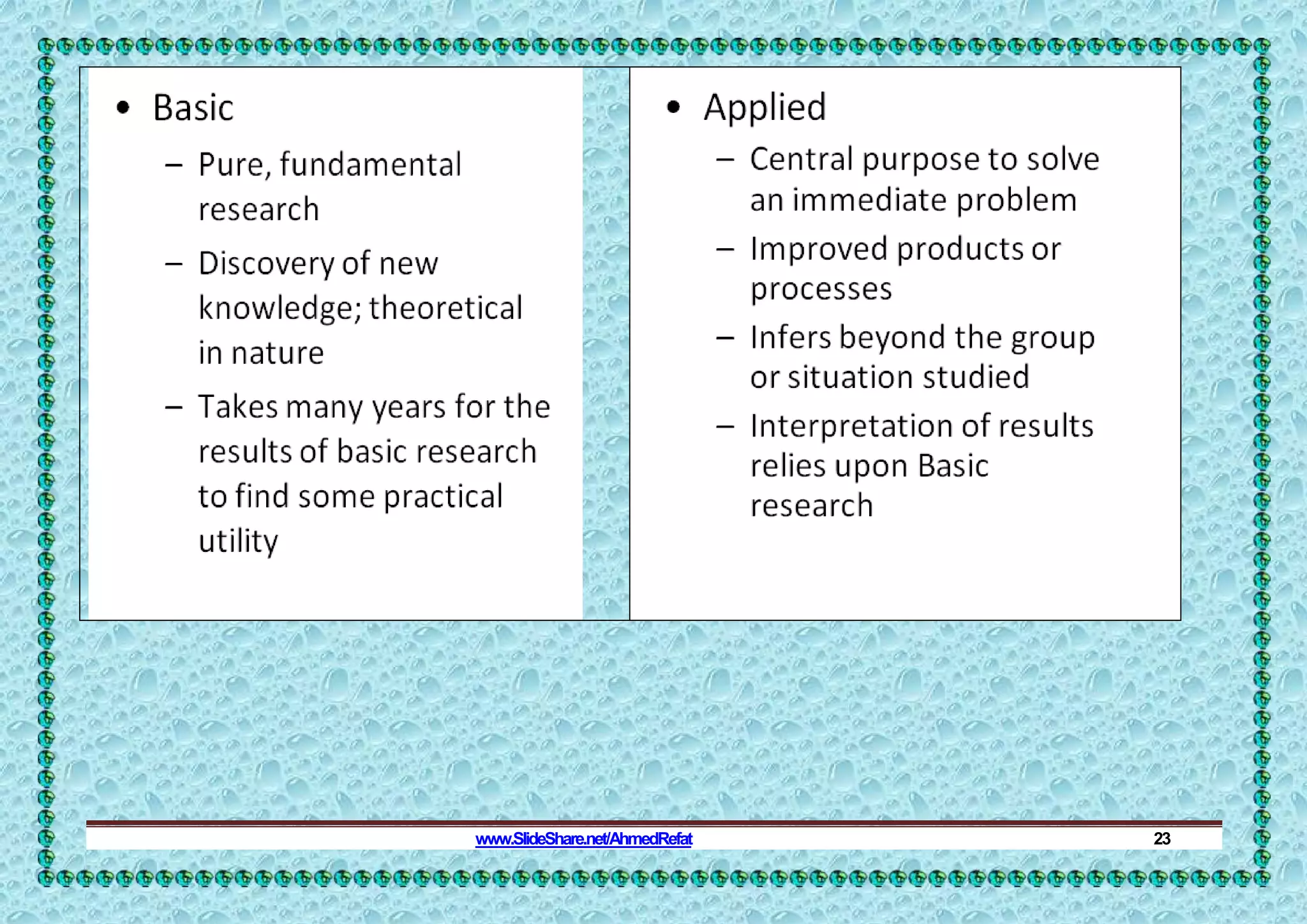
Involves developing and testing theories and hypotheses that
are intellectually challenging to the researcher but may or may
not have practical application at the present time or in the future.
The knowledge produced through pure research is
sought in order to add to the existing body of research
methods.
www.SlideShare.net/AhmedRefat 21
Appliedresearch
Applied Research is done to solve specific, practical questions;
for policy formulation, administration and understanding of a
phenomenon. It can be exploratory, but is usually
descriptive. It is almost always done on the basis of basic
research
www.SlideShare.net/AhmedRefat 22
www.SlideShare.net/AhmedRefat 23
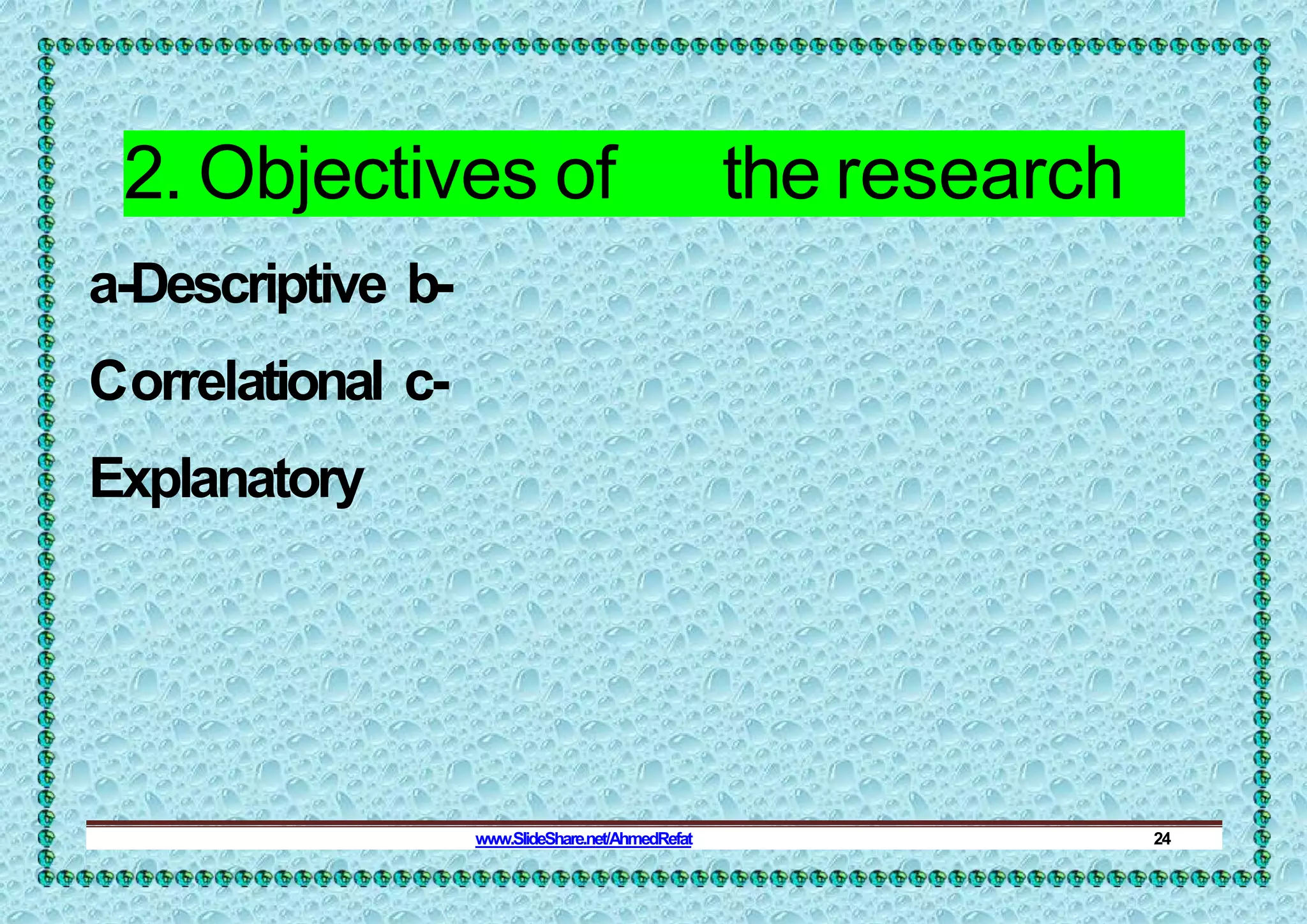
2. Objectives of the research
a-Descriptive b-
Correlational c-
Explanatory
www.SlideShare.net/AhmedRefat 24
a-Descriptive
Descriptive research attempts to describe systematically a
situation, problem, phenomenon, service or programme, or
provides information about , say, living condition of a community,
or describes attitudes towards an issue.
Descriptiveresearchrefers to research that provides an
accurate portrayal of characteristics of a particular individual,
situation, orgroup.
Descriptive research, also known as statisticalresearch.
www.SlideShare.net/AhmedRefat 25
Descriptivestudiesareameansof
discovering newmeaning,
describing whatexists,
determining the frequency with which something
occurs, and categorizinginformation.
Descriptiveresearchdealswitheverythingthatcan be countedand
studied,whichhasanimpactofthelivesof
thepeopleitdealswith.
For example, finding the most frequent disease that affects the
children of a town. The reader of the research will know what to
do to prevent that disease thus, more people will live a healthy
life.
www.SlideShare.net/AhmedRefat 26
Advantages:
• The people individual studied are unaware so they act
naturally or as they usually do in everyday situation;
• It is less expensive and time consuming than
quantitative experiments;
• Collects a large amount of notes for detailed studying;
• As it is used to describe and not make any conclusions it is to
start the research with it;
Disadvantages
• Descriptive research requires moreskills.
• Does not identify cause behind a phenomenon
• Response rate is low in this research.
• Results of this research can change over the period of time.
www.SlideShare.net/AhmedRefat 27
b-Correlationalresearch
Correlationalresearchreferstothesystematic investigationor
statisticalstudyofrelationshipsamong twoormorevariables,
withoutnecessarilydetermining cause andeffect.
Forexample,totestthehypothesis“Listeningtomusic lowers
bloodpressurelevels”thereare2waysof conductingresearch
• Experimental– groupsamplesandmakeonegroup listento
musicandthencomparetheBplevels
• Survey– askpeoplehowtheyfeel? Howoftenthey
listen?Andthencompare
www.SlideShare.net/AhmedRefat 28
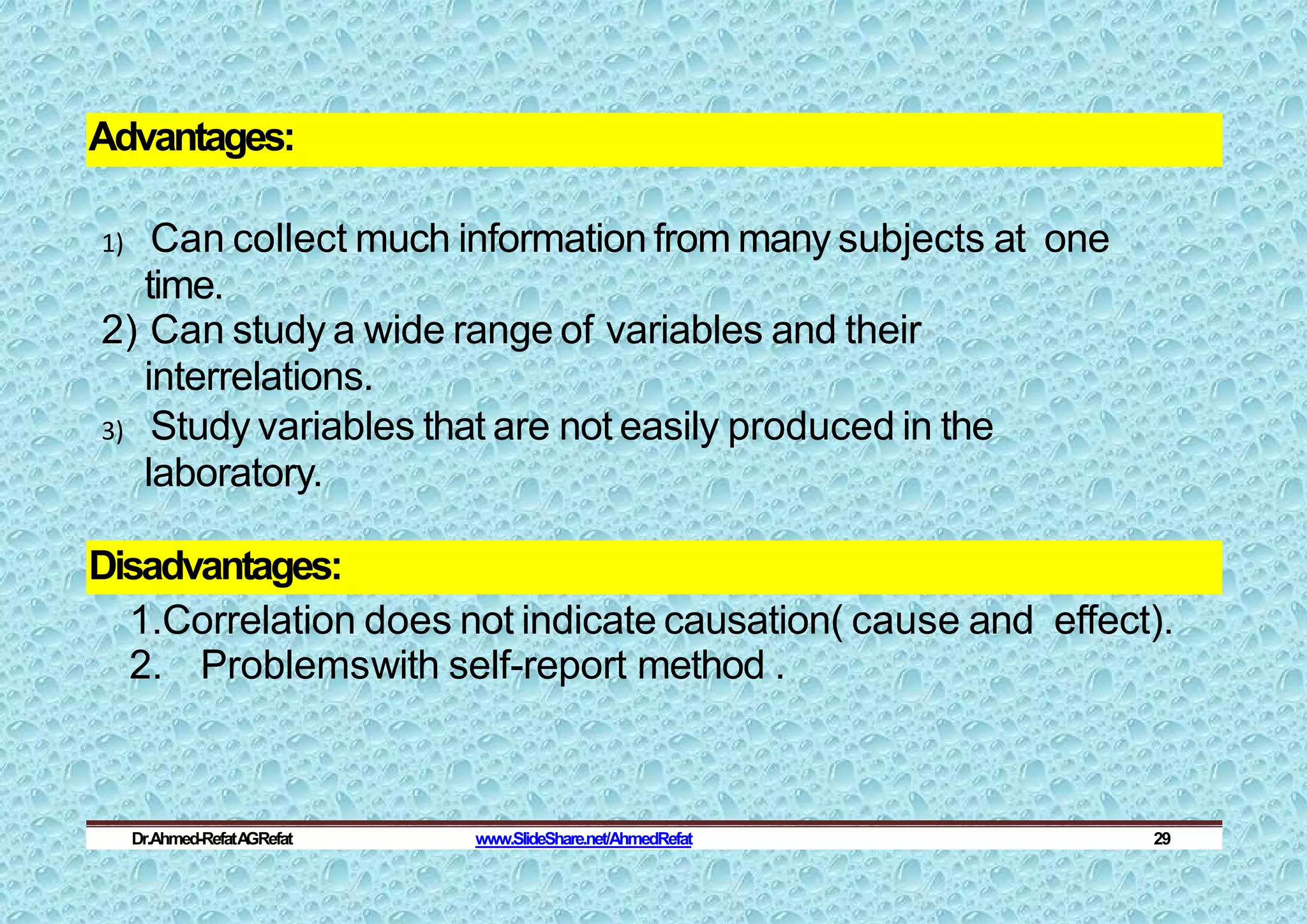
Advantages:
1) Can collect much information from many subjects at one
time.
2) Can study a wide range of variables and their
interrelations.
3) Study variables that are not easily produced in the
laboratory.
Disadvantages:
1.Correlation does not indicate causation( cause and effect).
2. Problemswith self-report method .
Dr.Ahmed-RefatA
GRefat www.SlideShare.net/AhmedRefat 29
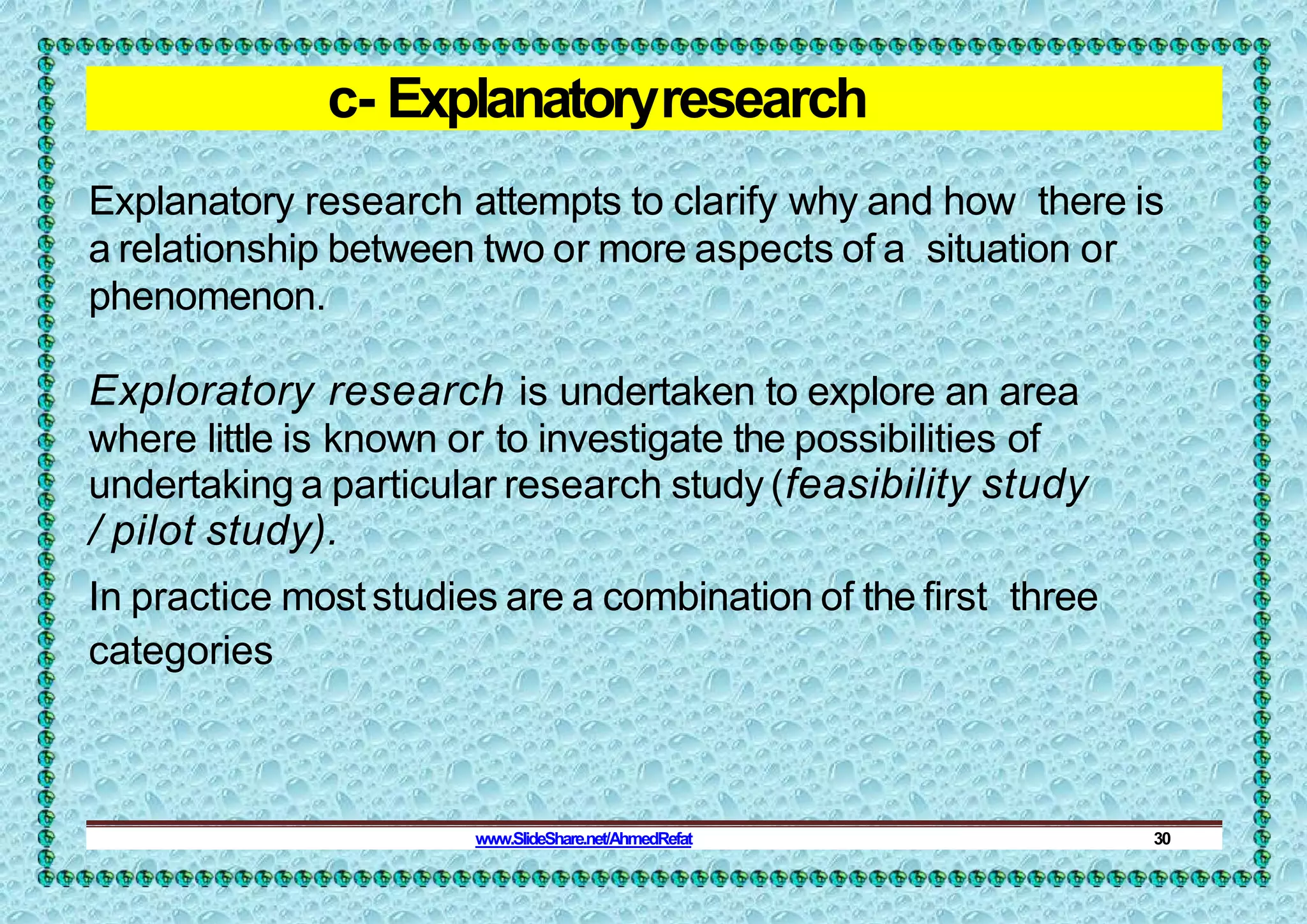
c- Explanatoryresearch
Explanatory research attempts to clarify why and how there is
a relationship between two or more aspects of a situation or
phenomenon.
Exploratory research is undertaken to explore an area
where little is known or to investigate the possibilities of
undertaking a particular research study (feasibility study
/ pilot study).
In practice moststudies are a combination of the first three
categories
www.SlideShare.net/AhmedRefat 30
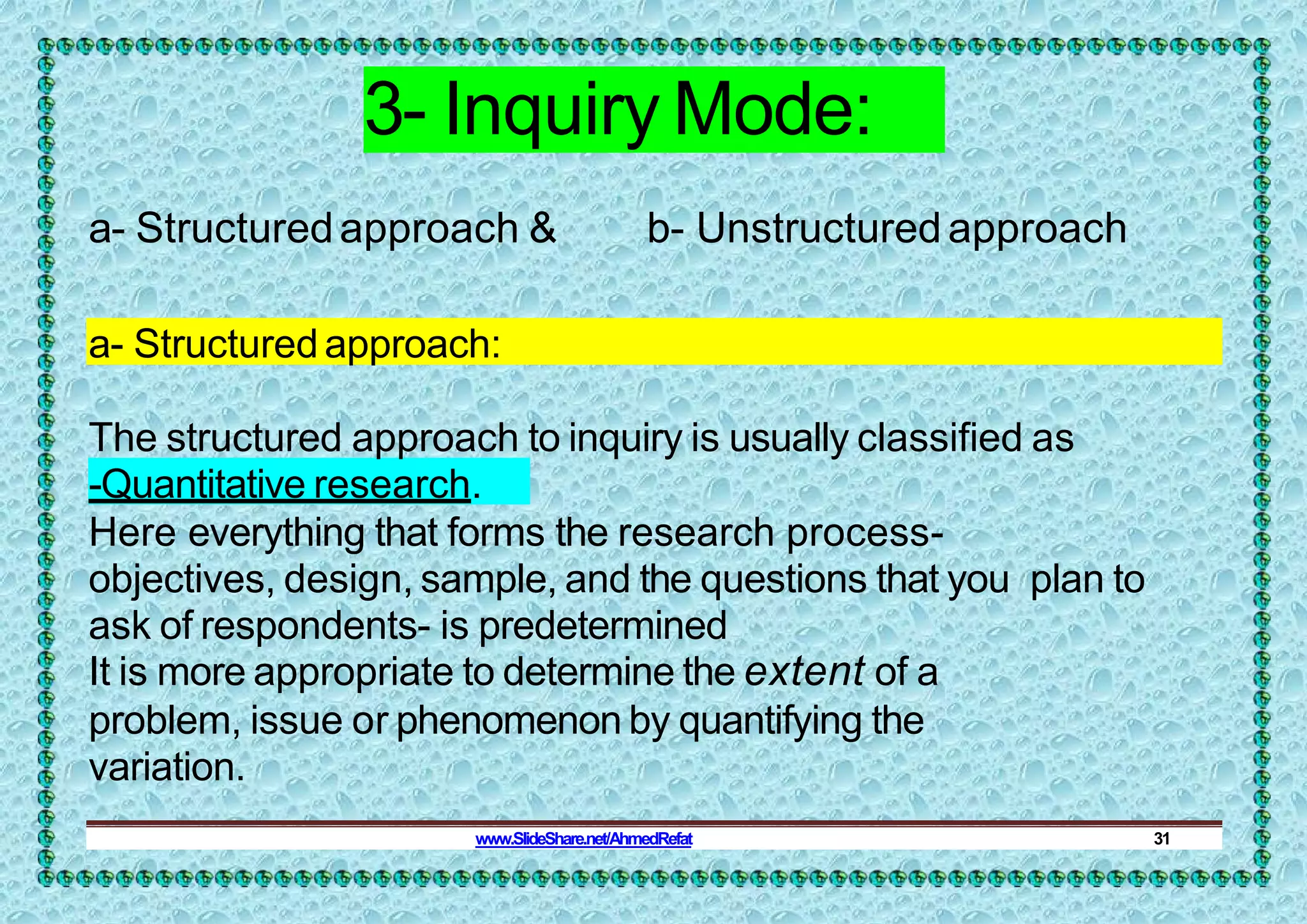
3- Inquiry Mode:
a- Structuredapproach & b- Unstructuredapproach
a- Structuredapproach:
The structured approach to inquiry is usually classified as
-Quantitative research.
Here everything that forms the research process-
objectives, design, sample, and the questions that you plan to
ask of respondents- is predetermined
It is more appropriate to determine the extent of a
problem, issue or phenomenon by quantifying the
variation.
www.SlideShare.net/AhmedRefat 31
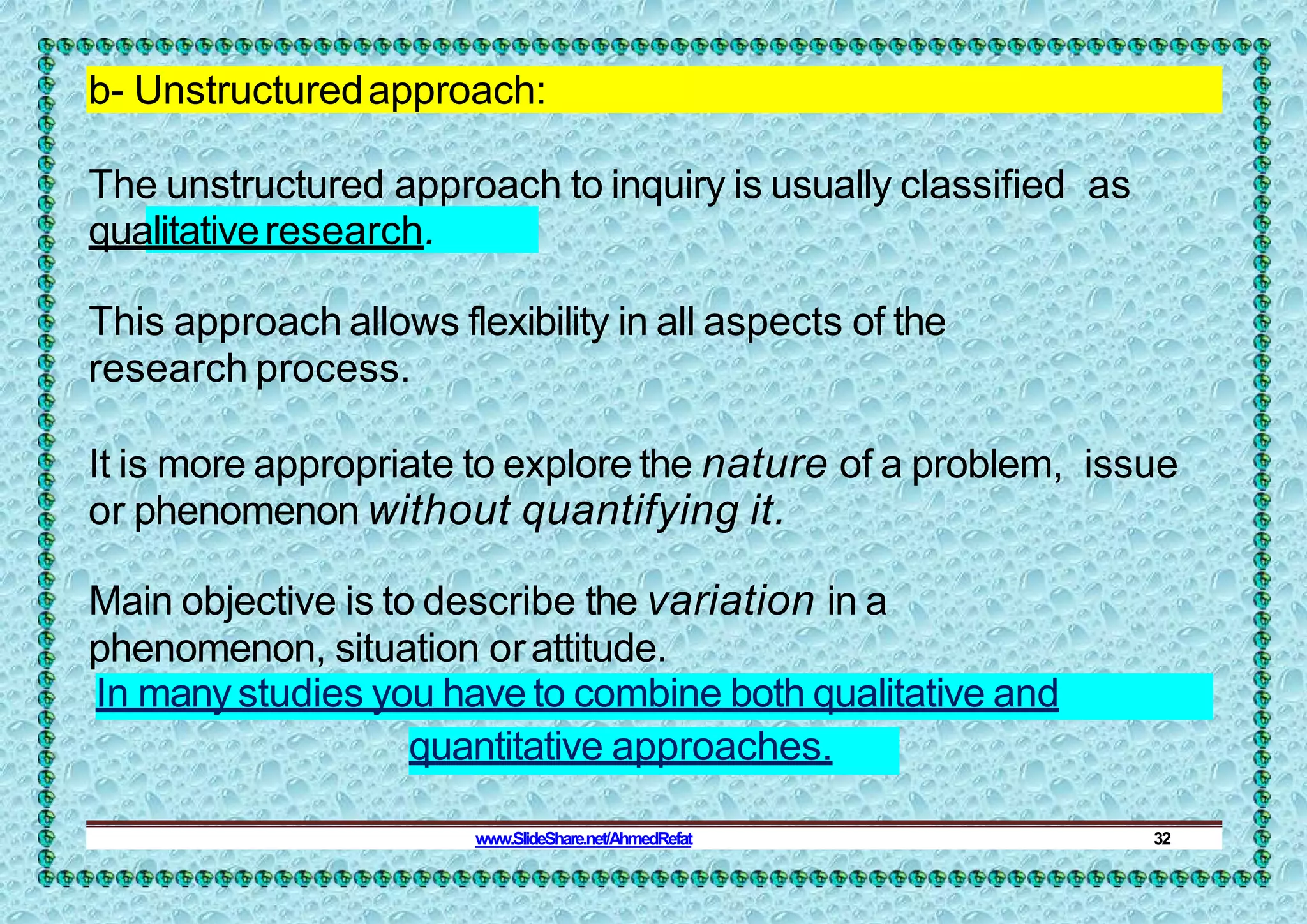
b- Unstructuredapproach:
The unstructured approach to inquiry is usually classified as
qualitativeresearch.
This approach allows flexibility in all aspects of the
research process.
It is more appropriate to explore the nature of a problem, issue
or phenomenon without quantifying it.
Main objective is to describe the variation in a
phenomenon, situation orattitude.
In manystudies you have to combine both qualitative and
quantitative approaches.
www.SlideShare.net/AhmedRefat 32
www.SlideShare.net/AhmedRefat 33
Common approaches
in qualitativeresearch
www.SlideShare.net/AhmedRefat 34
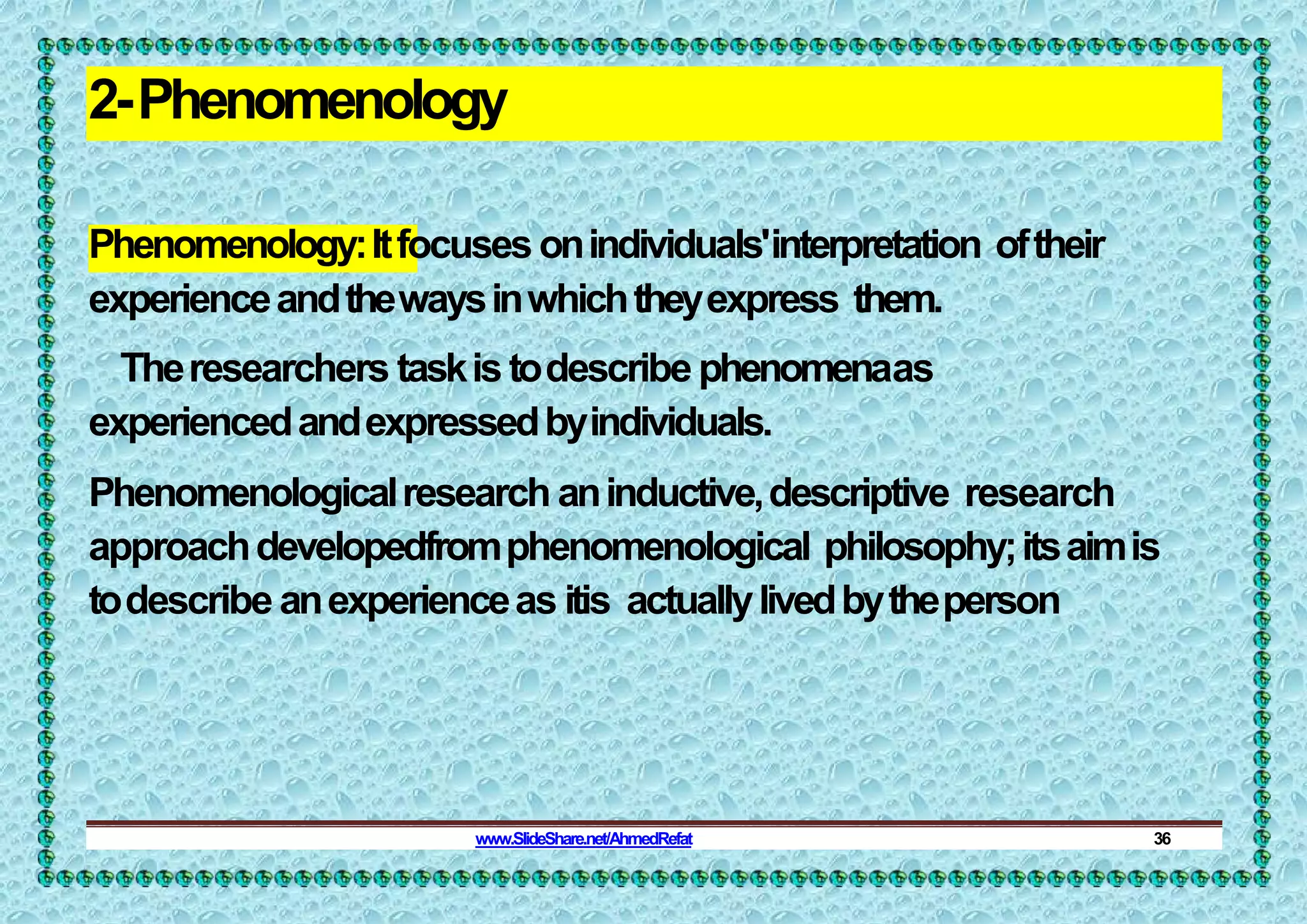
1-Ethnography
Ethnography:isanapproachrelyingonthecollection ofdatain
thenaturalenvironment.
Ethnographersareinterestedinhowthebehavioro
findividuals
isinfluencedormediatedbyculturein whichtheylive.
So,humanbehaviorcan onlybeunderstoodifstudied inthe
settinginwhichitoccurs.Aspeoplecan influenceandbe
influencedbythegroupstheylivein.
• Thepurposeofethnographicresearch istoattemptto understand
whatishappeningnaturallyinthesetting andtointerpretthedata
gatheredtoseewhat implicationscouldbeformedfromthedata.
www.SlideShare.net/AhmedRefat 35
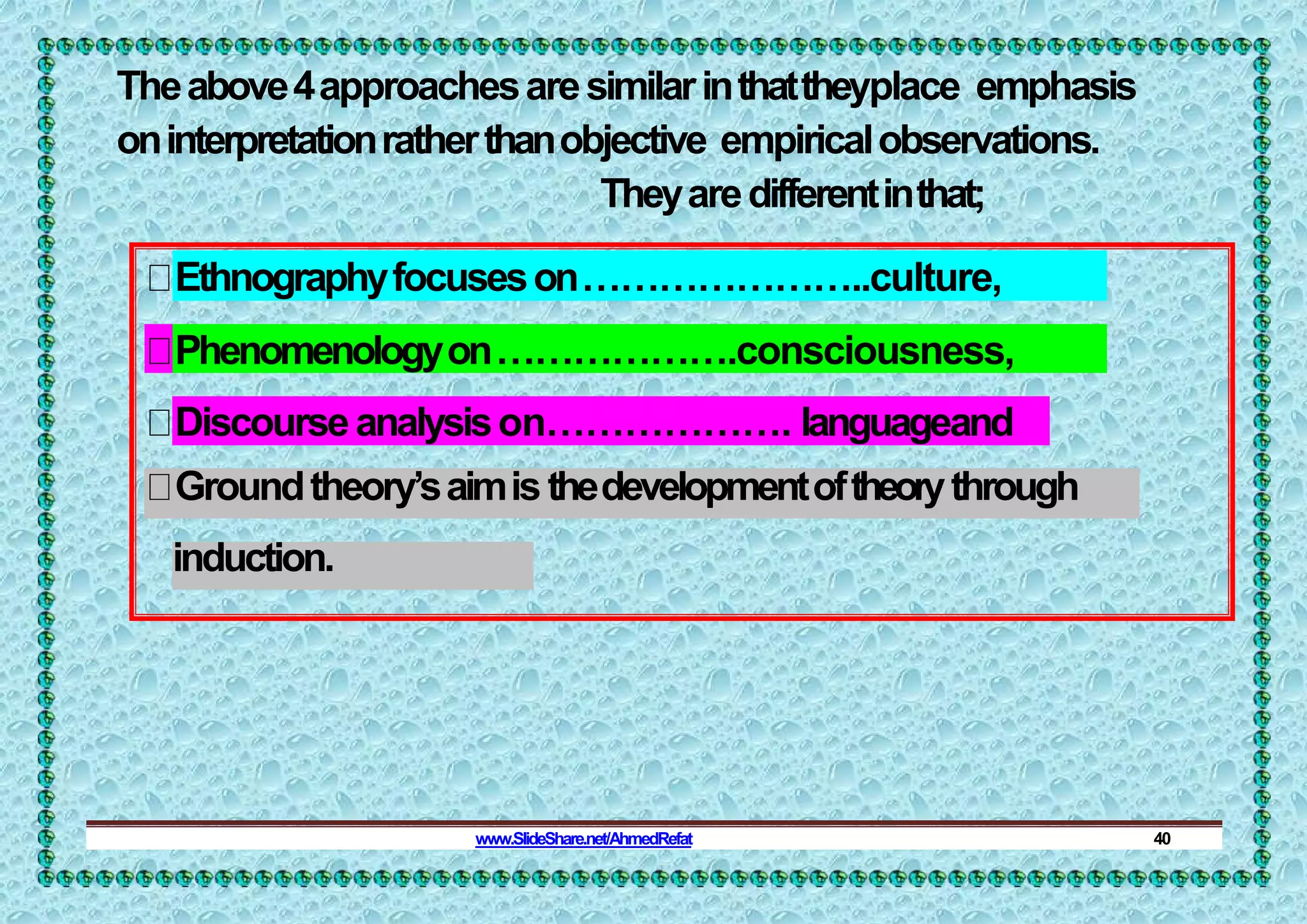
2-Phenomenology
Phenomenology:Itfocusesonindividuals'interpretation oftheir
experienceandthewaysinwhichtheyexpress them.
Theresearchers taskistodescribephenomenaas
experiencedandexpressedbyindividuals.
Phenomenologicalresearch aninductive,descriptive research
approachdevelopedfromphenomenological philosophy;itsaimis
todescribe anexperienceas itis actuallylivedbytheperson
www.SlideShare.net/AhmedRefat 36
3-Discourseanalysis
Discourse is a term used to describe the systems we use in
communication with others. These include verbal, non- verbal and
writtenmaterial.
Whatwesay,howwesayit,ourchoice ofwords,tone, timingare
fullofvalues,meaningsandintentions.
So,analysisofdiscourseincreasesourunderstanding ofhuman
behaviorthroughlanguageandinteraction.
www.SlideShare.net/AhmedRefat 37
4-Groundedtheory:
"Theoryarisesfromthedata"
GT isaninductiveapproachtoresearch whereby hypothesesand
theoriesemergeoutoraregroundedin data.
GT researchisaresearchapproachdesignedtodiscover what
problemsexistinagivensocial environmentand howthepersons
involvedhandlethem;itinvolves formulation,testing,andreformulation
ofpropositions untilatheoryisdeveloped.
www.SlideShare.net/AhmedRefat 38
GT isaresearchmethodthatoperatesalmostina
reversefashionfromtraditionalresearch andatfirstmay appeartobe
incontradictiontothescientificmethod.
Fourstages:
1. Codes-Identifyinganchorsthatallowthekeypoints
ofthedatatobegathered
2. Concepts-Collectionsofcodesofsimilarcontent
thatallowsthedatatobegrouped
3. Categories-Broadgroupsofsimilarconceptsthat
areusedtogenerateatheory
4. Theory-Acollectionofexplanationsthatexplainthe
subjectoftheresearch(hypotheses)
www.SlideShare.net/AhmedRefat 39
Theabove4approachesaresimilarinthattheyplace emphasis
oninterpretationratherthanobjective empiricalobservations.
Theyaredifferentinthat;
Ethnographyfocuseson…………………..culture,
Phenomenologyon……………….consciousness,
Discourseanalysison………………. languageand
Groundtheory’saimisthedevelopmentoftheorythrough
induction.
www.SlideShare.net/AhmedRefat 40
TheCritiqueofQualitative
Research
1. Qualitativeresearchistoosubjective
2. Difficulttoreplicate
3. Problemsofgeneralization
4. Lack oftransparency
www.SlideShare.net/AhmedRefat 41
Actionresearch
Actionresearchisastyleofresearch,ratherthana specific
methodology.Inactionresearch, the researchers workwiththe
peopleandforthepeople, ratherthanundertakeresearch onthem.
Thefocusof actionresearch isongeneratingsolutionsto
problems
identifiedbythepeoplewhoaregoingtousetheresults ofresearch.
Actionresearchisnotsynonymouswith qualitativeresearch. Butit
typicallydrawsonqualitative methodssuchas interviewsand
observations.
www.SlideShare.net/AhmedRefat 42
Experimental
vs.
Nonexperimental
www.SlideShare.net/AhmedRefat 43
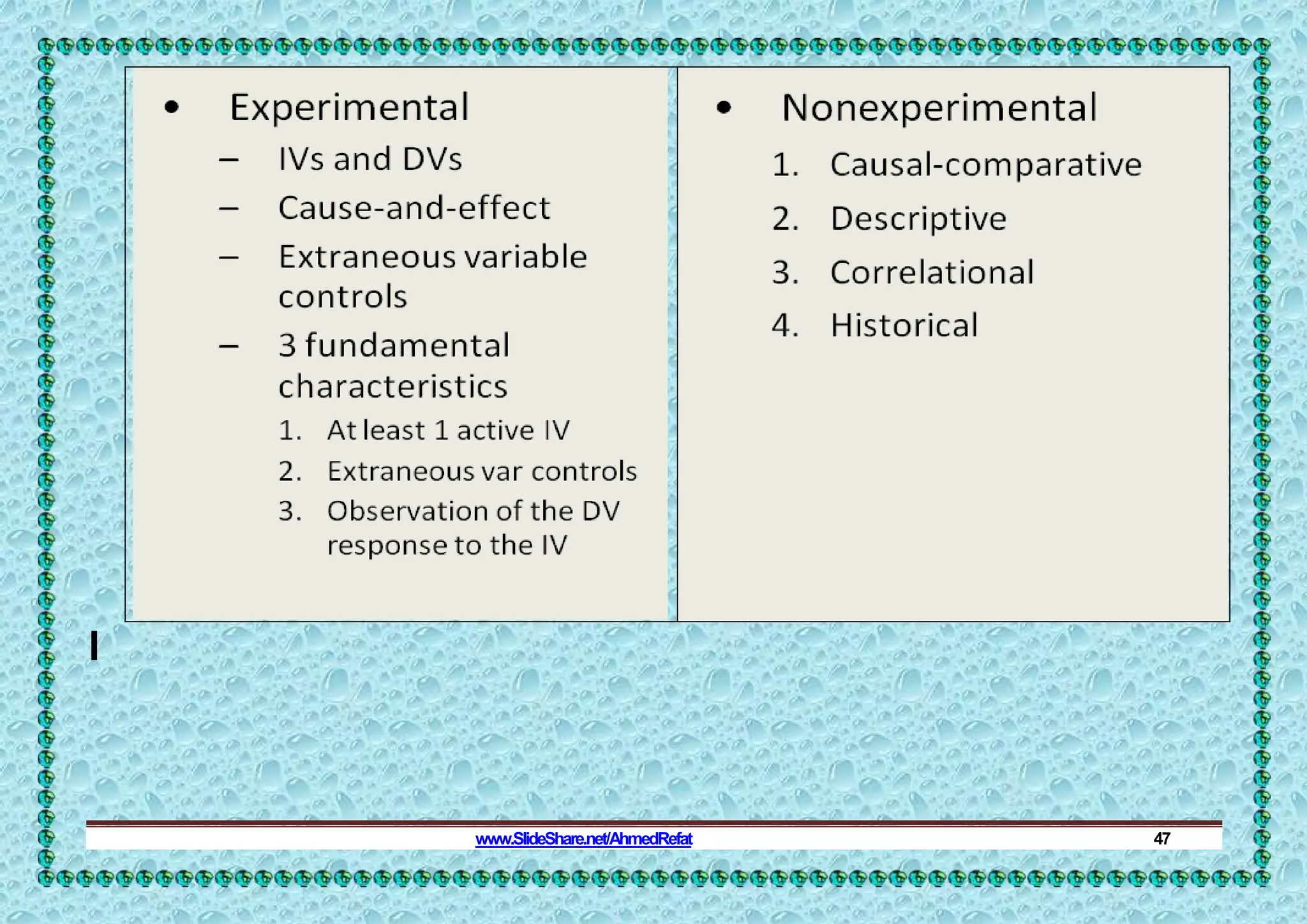
Experimentalresearch is anobjective,systematic, controlled
investigationforthepurposeofpredictingand controllingphenomena
andexaminingprobabilityand causalityamongselectedvariables
Advantages
• Bestestablishescause-and-effectrelationships
Disadvantages
• Feasibility
• Ethical Issues
www.SlideShare.net/AhmedRefat 44
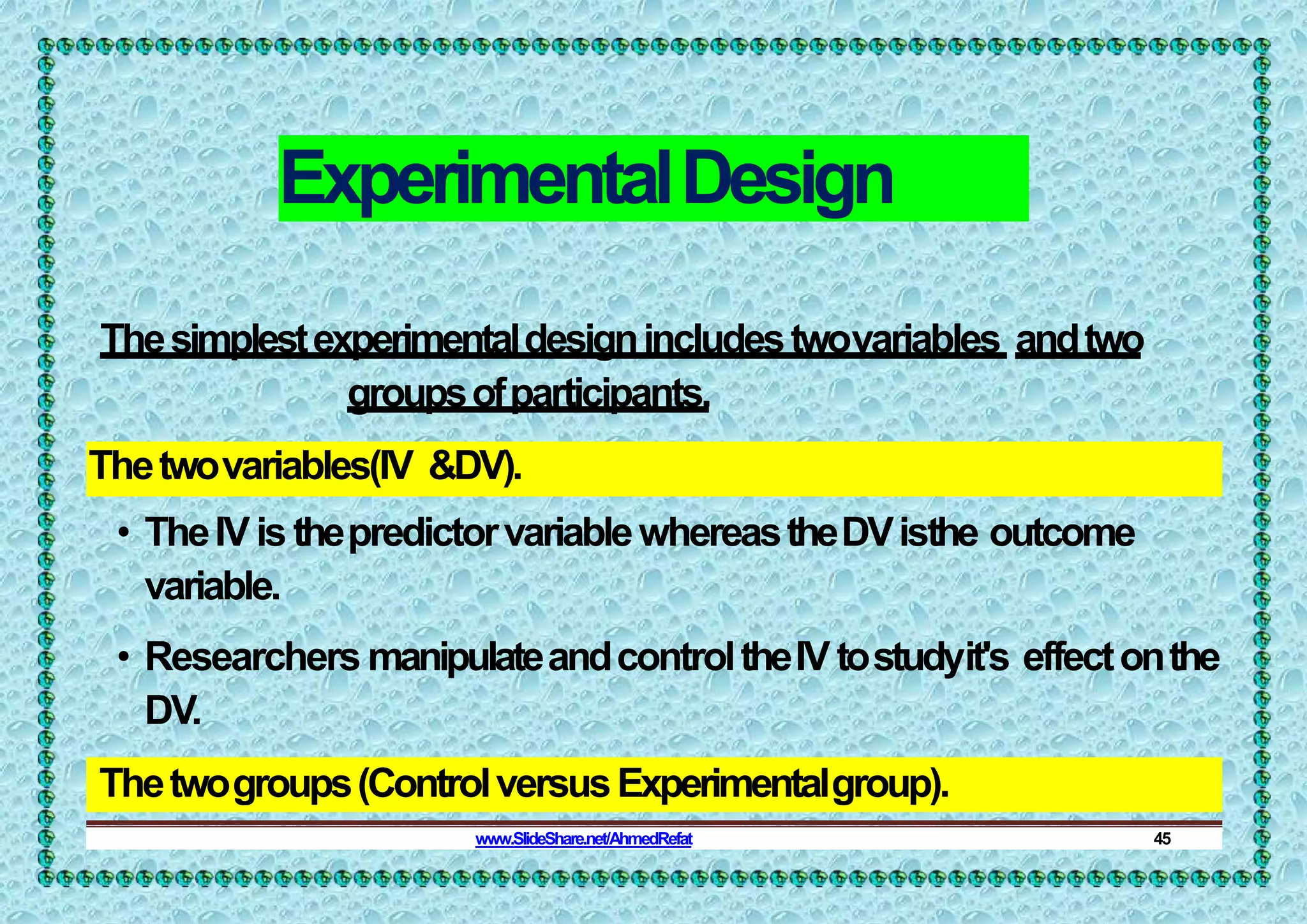
ExperimentalDesign
Thesimplestexperimentaldesignincludestwovariables andtwo
groupsofparticipants.
Thetwovariables(IV &DV).
• TheIVis thepredictorvariablewhereastheDVisthe outcome
variable.
• Researchers manipulateandcontroltheIV tostudyit's effectonthe
DV.
Thetwogroups(ControlversusExperimentalgroup).
www.SlideShare.net/AhmedRefat 45
• Beforebeginningtheexperiment,theresearcher (randomly)
assignshis/hersampletotwodifferent groups:thecontrol
groupandtheexperimental (treatmentgrouporclinical
group).
• Thecontrolgroupreceives nomanipulationoftheIV (no
treatment),whereastheexperimentalgroup receives the
manipulationoftheIV
www.SlideShare.net/AhmedRefat 46
l
www.SlideShare.net/AhmedRefat 47
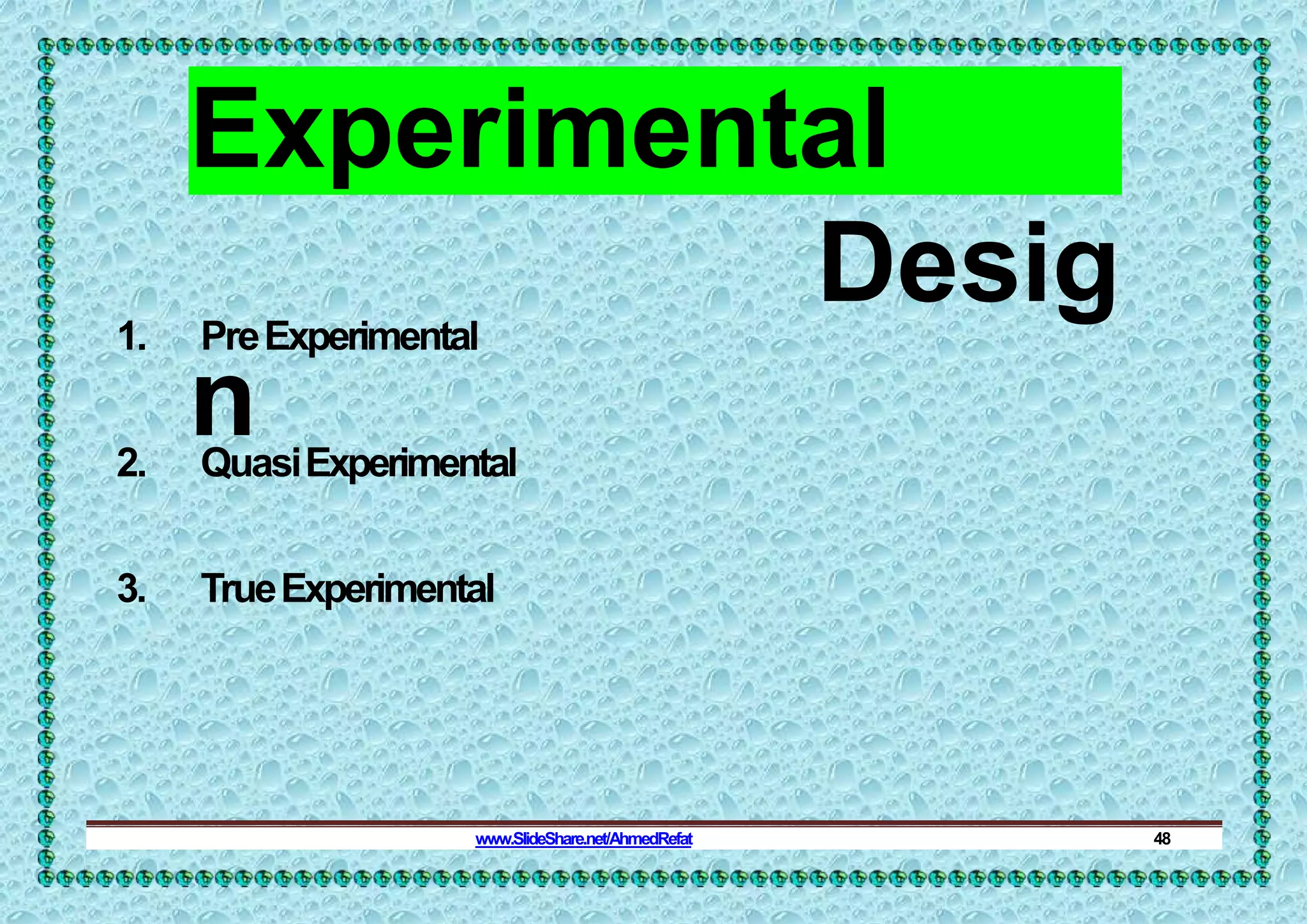
Experimental
Desig
n
1. PreExperimental
2. QuasiExperimental
3. TrueExperimental
www.SlideShare.net/AhmedRefat 48
A- Pre-experimentaldesigns
Pre-experimentaldesigns are so named because they follow
basic experimental steps but fail to include a control group.
In other words, a single group is often
studied but no comparison between an equivalent non-
treatment group ismade.
Examples include thefollowing:
A.1-OneGroupPretestPosttestStudy A.2-The
One-ShotCaseStudy
www.SlideShare.net/AhmedRefat 49
A.1-TheOne-ShotCaseStudy.
In this arrangement, subjects are presented with some type of
treatment, such as a semester of college work experience, and
then the outcome measure is applied, such ascollege grades.
Like all experimental designs, the goal is to
determine if the treatmenthad any effect on the outcome.
Without a comparison group, it is impossible to
determine if the outcome scores are any higher than they would
have been without the treatment. And, without any pre-test
scores, it is impossible to determine if any change within the
group itself has taken place.
www.SlideShare.net/AhmedRefat 50
A.2-OneGroupPretestPosttestStudy.
A benefit of this design over the previously discussed design is
the inclusion of a pretest to determine baseline scores. To
use this design in our study of college performance, we could
compare college grades prior to gaining the work experience to
the grades after completing a semester ofwork experience. We
can now at least state whether a change in the outcome or
dependent variable hastaken place. What we cannotsay
is if this change would have occurred even without the
application of the treatment orindependent variable. It is
possible that mere maturation caused the change in grades and
not the work experience itself.
www.SlideShare.net/AhmedRefat 51
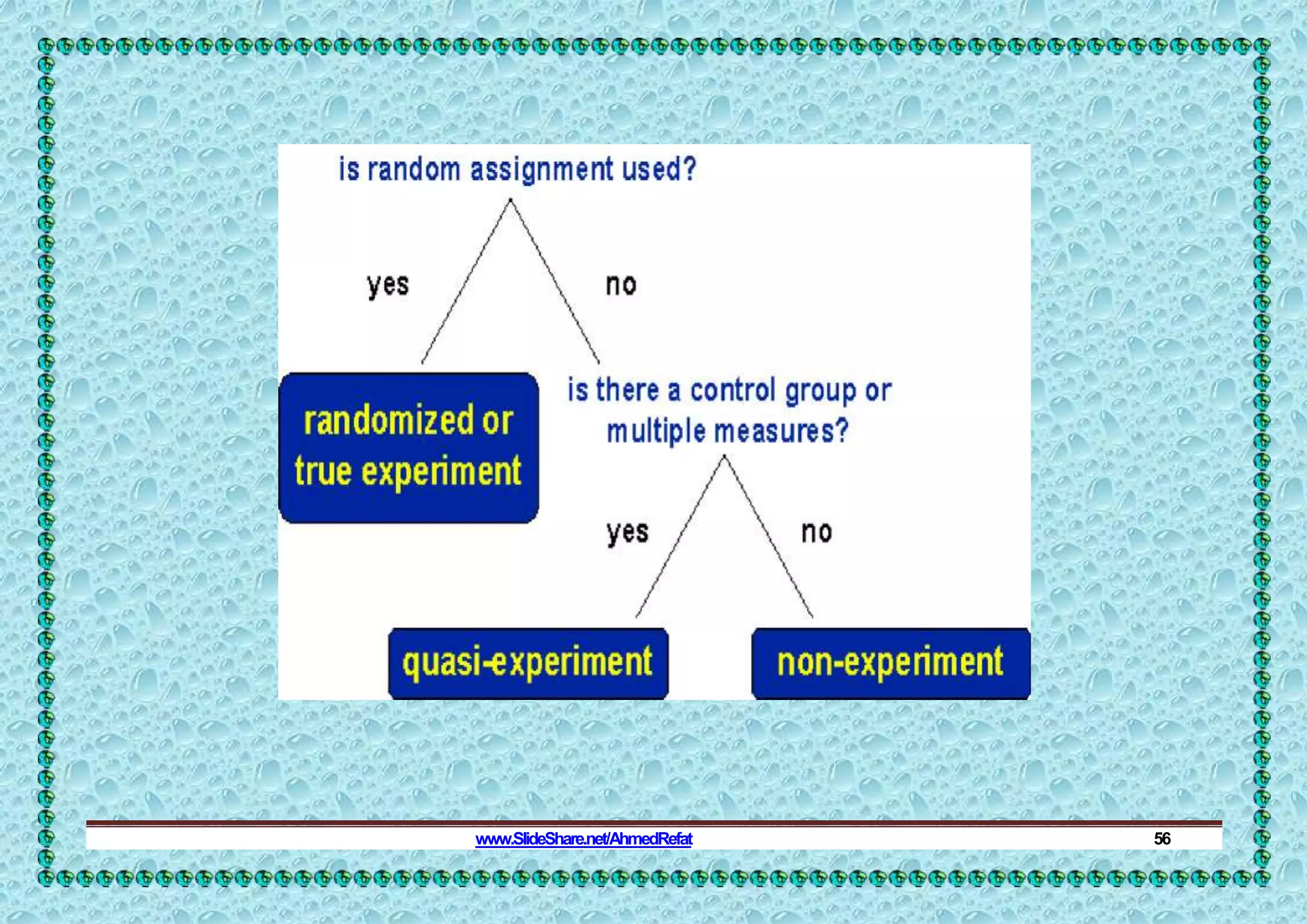
B-Quasi-ExperimentalDesign
Quasi designs fair better than pre-experimental studies in that
they employ a means to compare groups. They fall
short, however on one very important aspect of the experiment:
randomization.
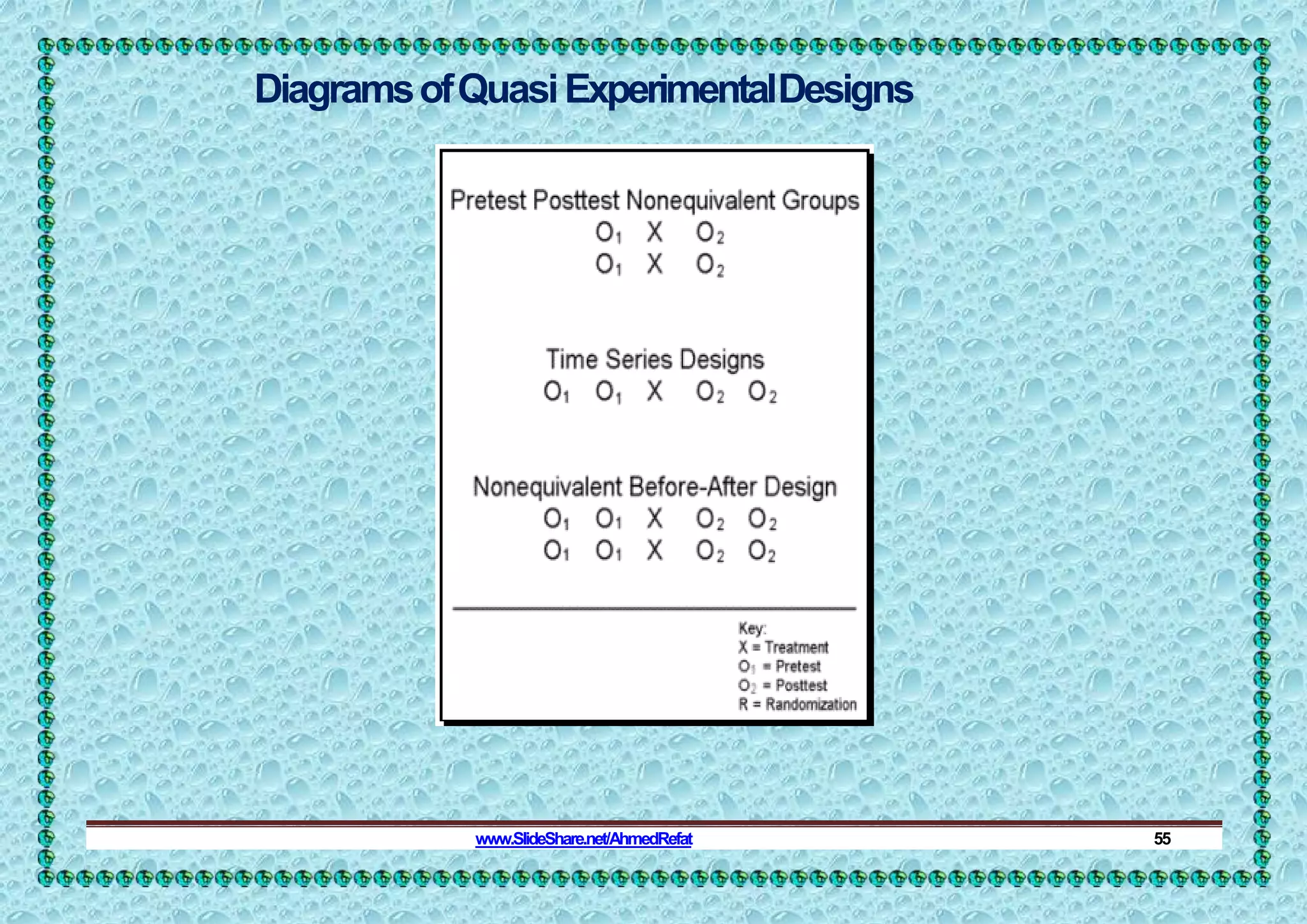
B.1-PretestPosttestNonequivalentGroup. With this design, both
a control group and an experimental group is compared,
however, the groups are chosen and assigned out of
convenience rather than through
randomization. This mightbe themethod ofchoice for our study on work experience as itwould be difficult to
choose students in a college settingat random andplace them inspecific groups andclasses. We mightask studentsto participate ina
www.SlideShare.net/AhmedRefat 52
one-semester work experience program. Wewould then measure all of the students’ grades prior to the start of the program and then again after the
program. Those students who participated would be our treatmentgroup; thosewho did not would be our control group.
B.2-TimeSeriesDesigns. Tim series designs refer to the
pretesting and posttesting of one group of subjects at different
intervals. The purpose might be to determine long
term effect of treatment and therefore the number of pre- and
posttests can vary from one each to many.
Sometimes there is an interruption between tests in order to
assess the strength of treatment overan extended time period.
When such a design is employed, the posttest is
referred to asfollow-up.
B.3-NonequivalentBefore-AfterDesign. This design is
used when we want to compare two groups that are likely
www.SlideShare.net/AhmedRefat 53
to be different even beforethe study begins. In other
words, if we want to see how a new treatment affects people
with different psychological disorders, the disorders
themselves would create two or more nonequivalent groups.
Once again, the number of pretests
and posttests can vary from one each to many.
Whenever subjects are chosen for groups based on
convenience rather than randomization, the reason for
inclusion in the study itself confounds our results.
www.SlideShare.net/AhmedRefat 54
DiagramsofQuasiExperimentalDesigns
www.SlideShare.net/AhmedRefat 55
www.SlideShare.net/AhmedRefat 56
C- TrueExperimentalDesign
The true experiment is often thought of as the only research
method that can adequately measure the cause and effect
relationship.
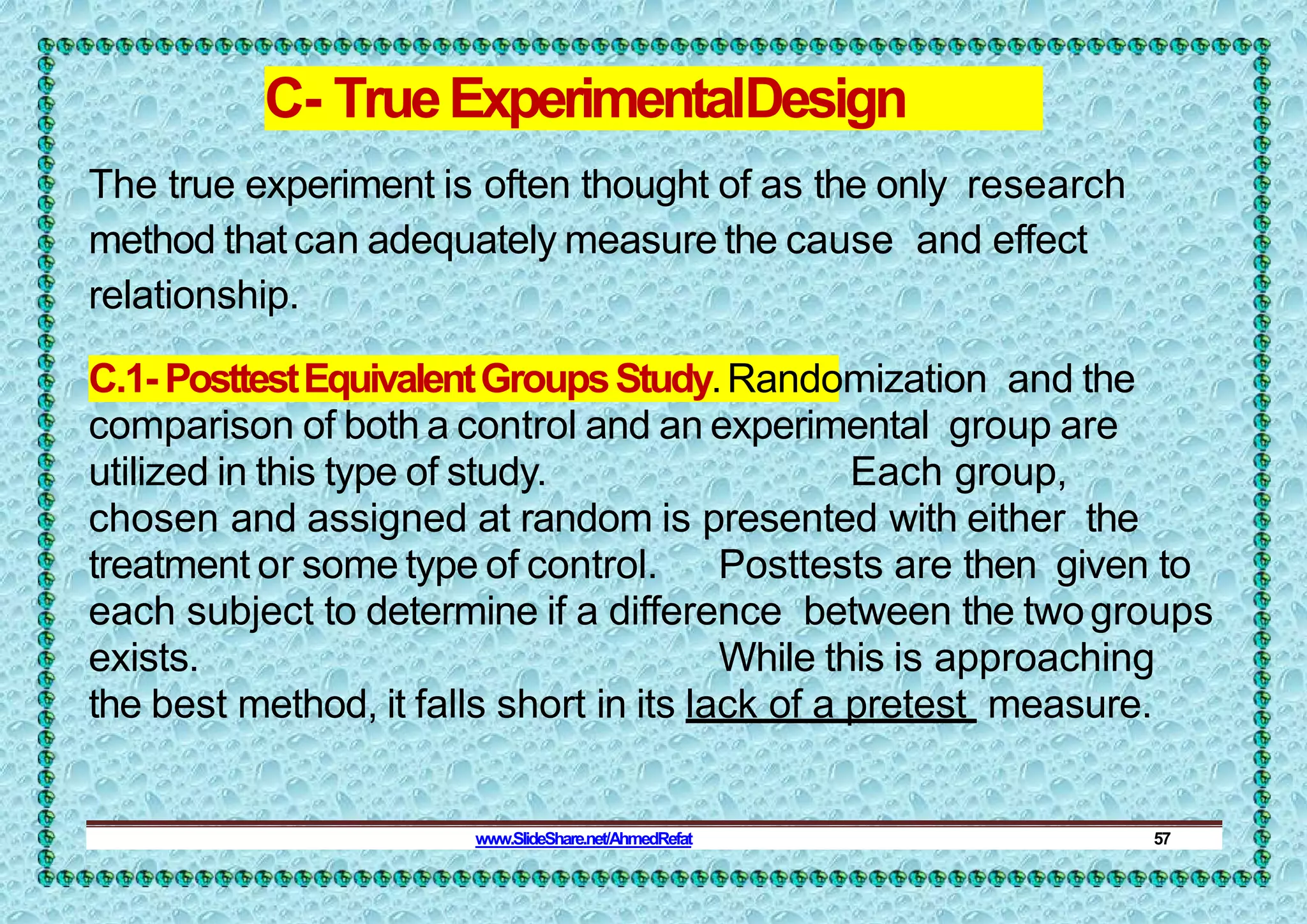
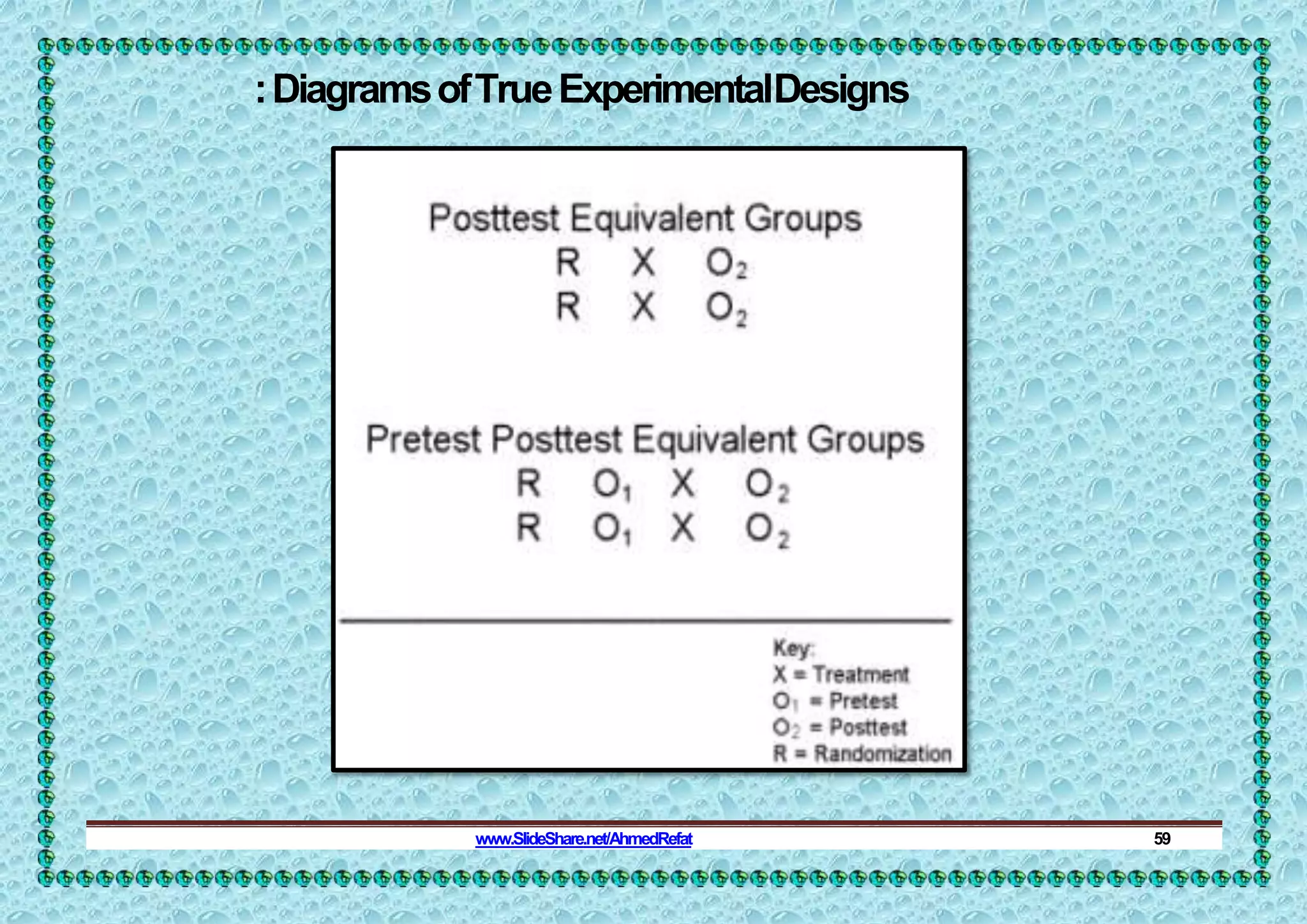
C.1- PosttestEquivalentGroupsStudy.Randomization and the
comparison of both a control and an experimental group are
utilized in this type of study. Each group,
chosen and assigned at random is presented with either the
treatment or some type of control. Posttests are then given to
each subject to determine if a difference between the twogroups
exists. While this is approaching
the best method, it falls short in its lack of a pretest measure.
www.SlideShare.net/AhmedRefat 57
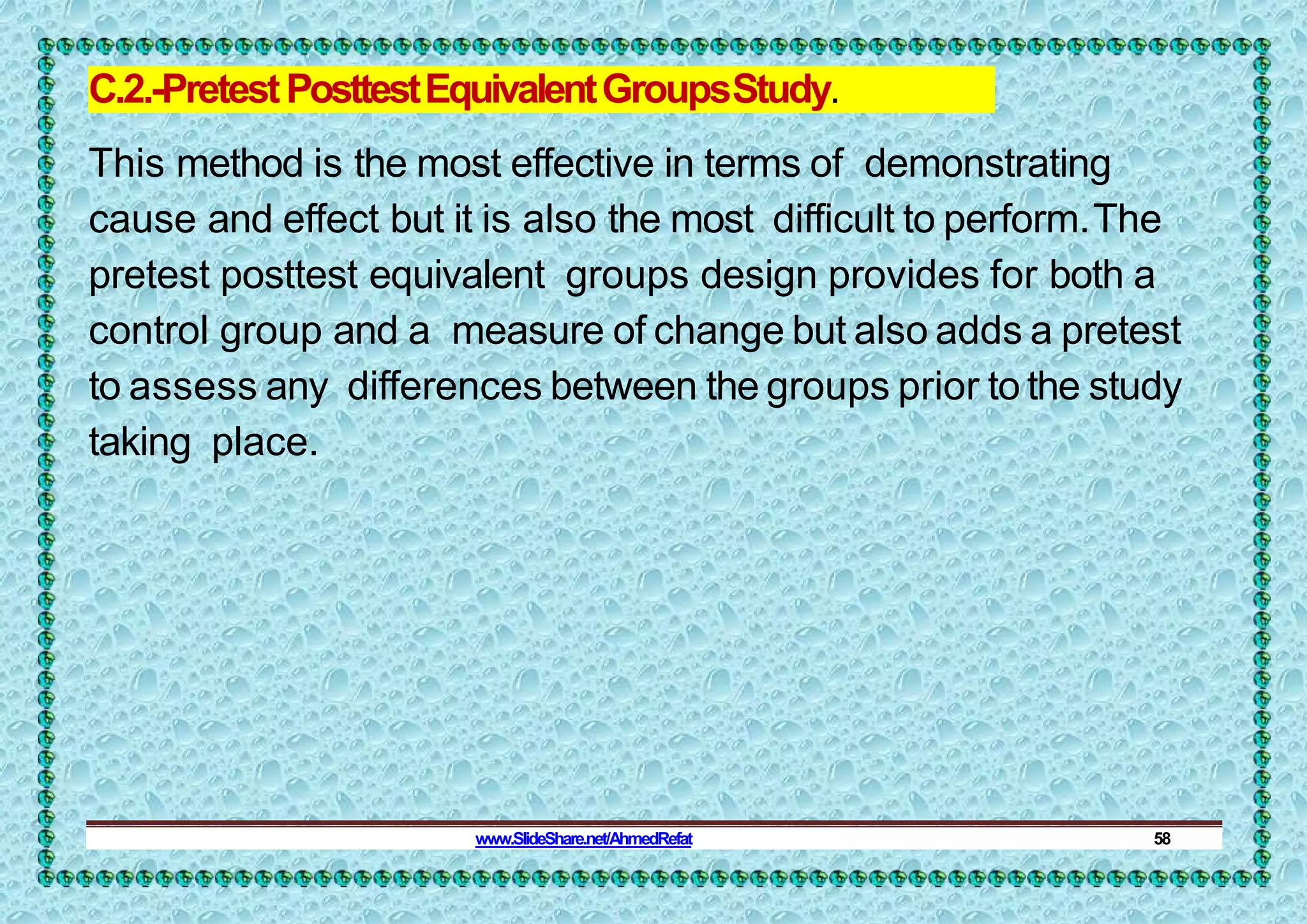
C.2.-PretestPosttestEquivalentGroupsStudy.
This method is the most effective in terms of demonstrating
cause and effect but it is also the most difficult to perform.The
pretest posttest equivalent groups design provides for both a
control group and a measure of change but also adds a pretest
to assess any differences between the groups prior to the study
taking place.
www.SlideShare.net/AhmedRefat 58
:DiagramsofTrueExperimentalDesigns
www.SlideShare.net/AhmedRefat 59
Final Word
Research Methodology:
1. Quantitative methods
2. Qualitative methods
3. Mixed methods
•
The methodological history can be summarized as
three waves
The dominance of quantitative methods as wave ..1
The emergence of qualitative methods as wave….2
The growth of mixed methods aswave ……………..3
www.SlideShare.net/AhmedRefat 60
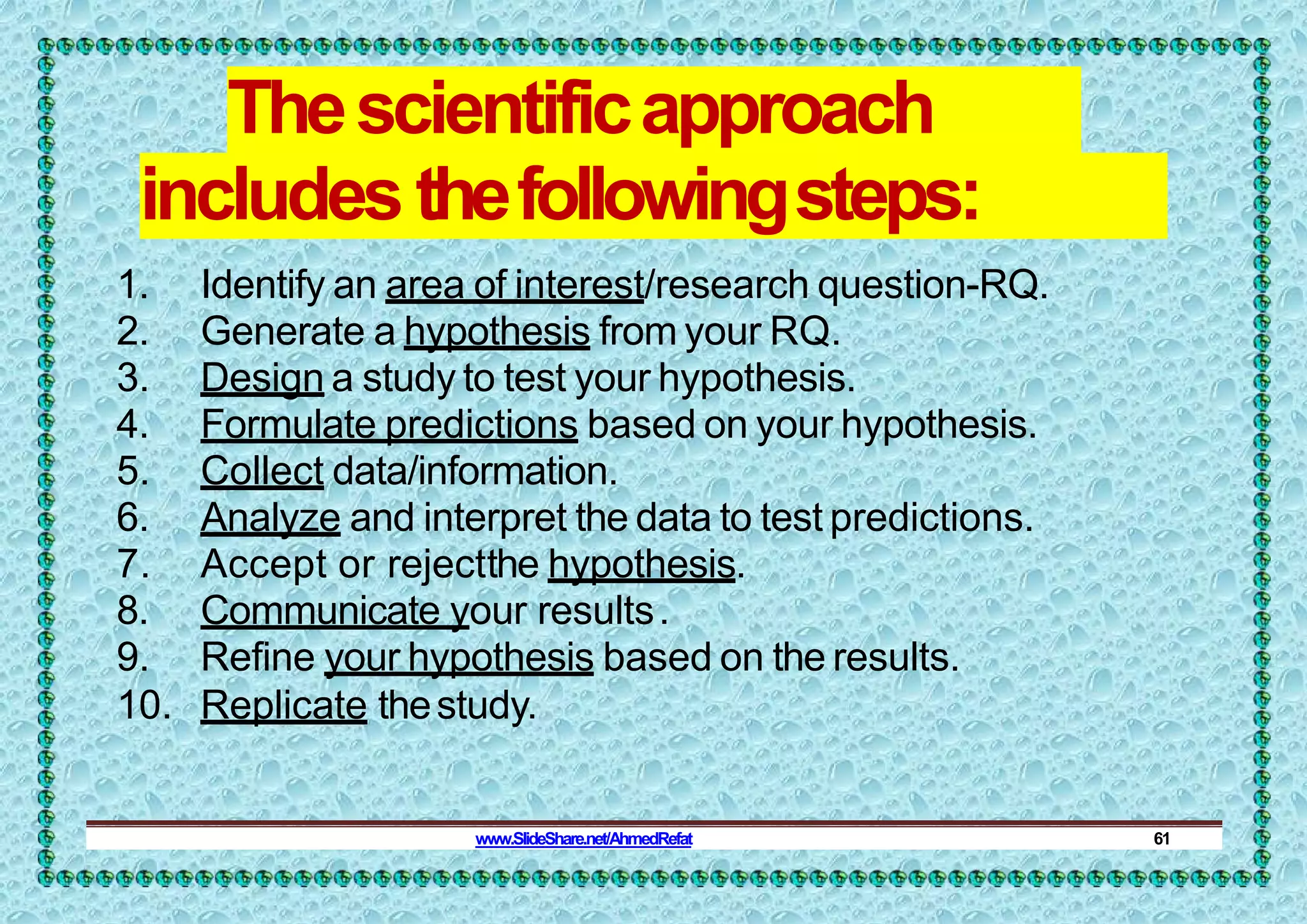
Thescientificapproach
includesthefollowingsteps:
1. Identify an area of interest/research question-RQ.
2. Generate a hypothesis from your RQ.
3. Design a study to test your hypothesis.
4. Formulate predictions based on your hypothesis.
5. Collect data/information.
6. Analyze and interpret the data to test predictions.
7. Accept or rejectthe hypothesis.
8. Communicate your results.
9. Refine your hypothesis based on the results.
10. Replicate thestudy.
www.SlideShare.net/AhmedRefat 61
www.SlideShare.net/AhmedRefat 62
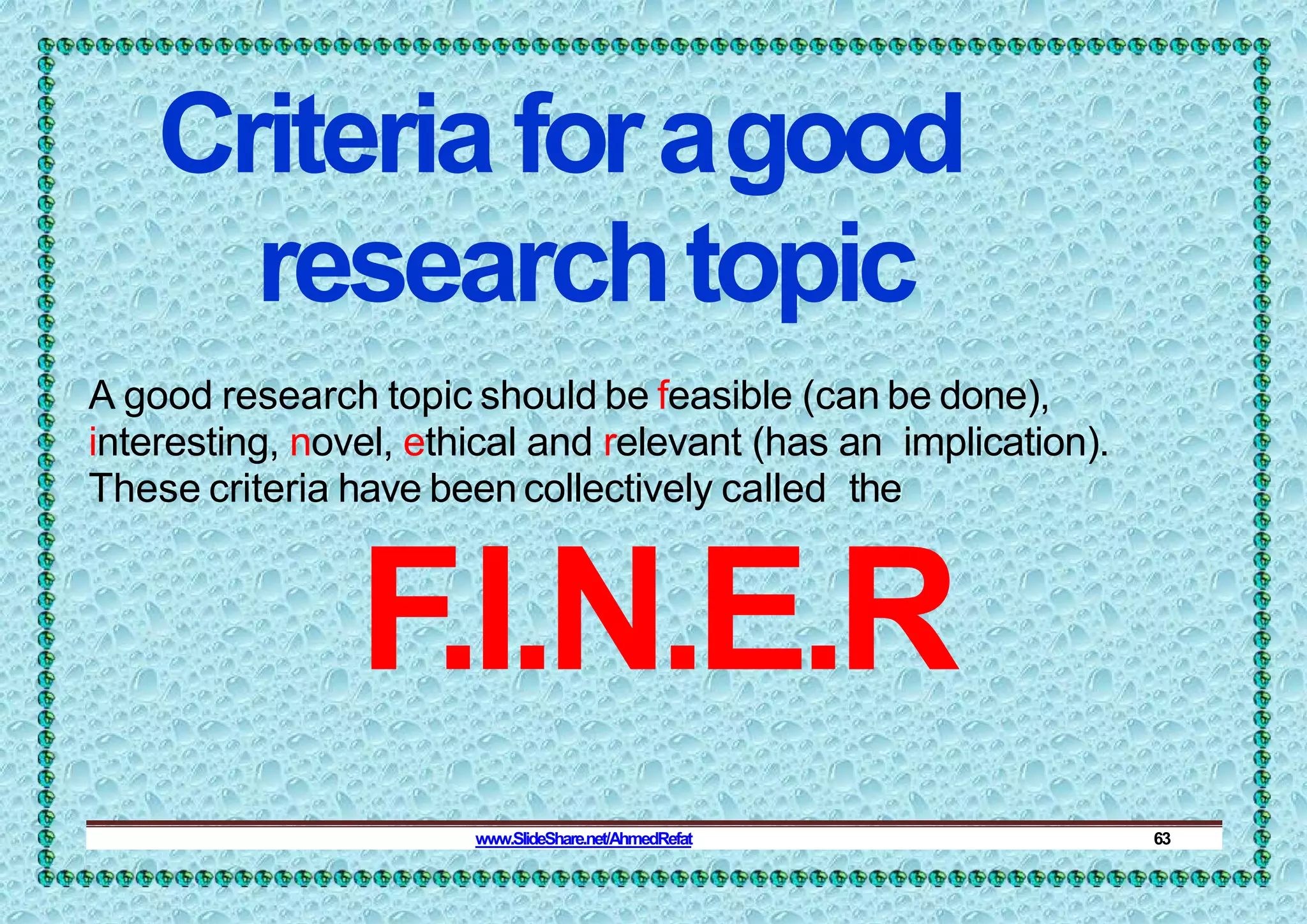
Criteriaforagood
researchtopic
A good research topic should be feasible (can be done),
interesting, novel, ethical and relevant (has an implication).
These criteria have been collectively called the
F.I.N.E.R
www.SlideShare.net/AhmedRefat 63
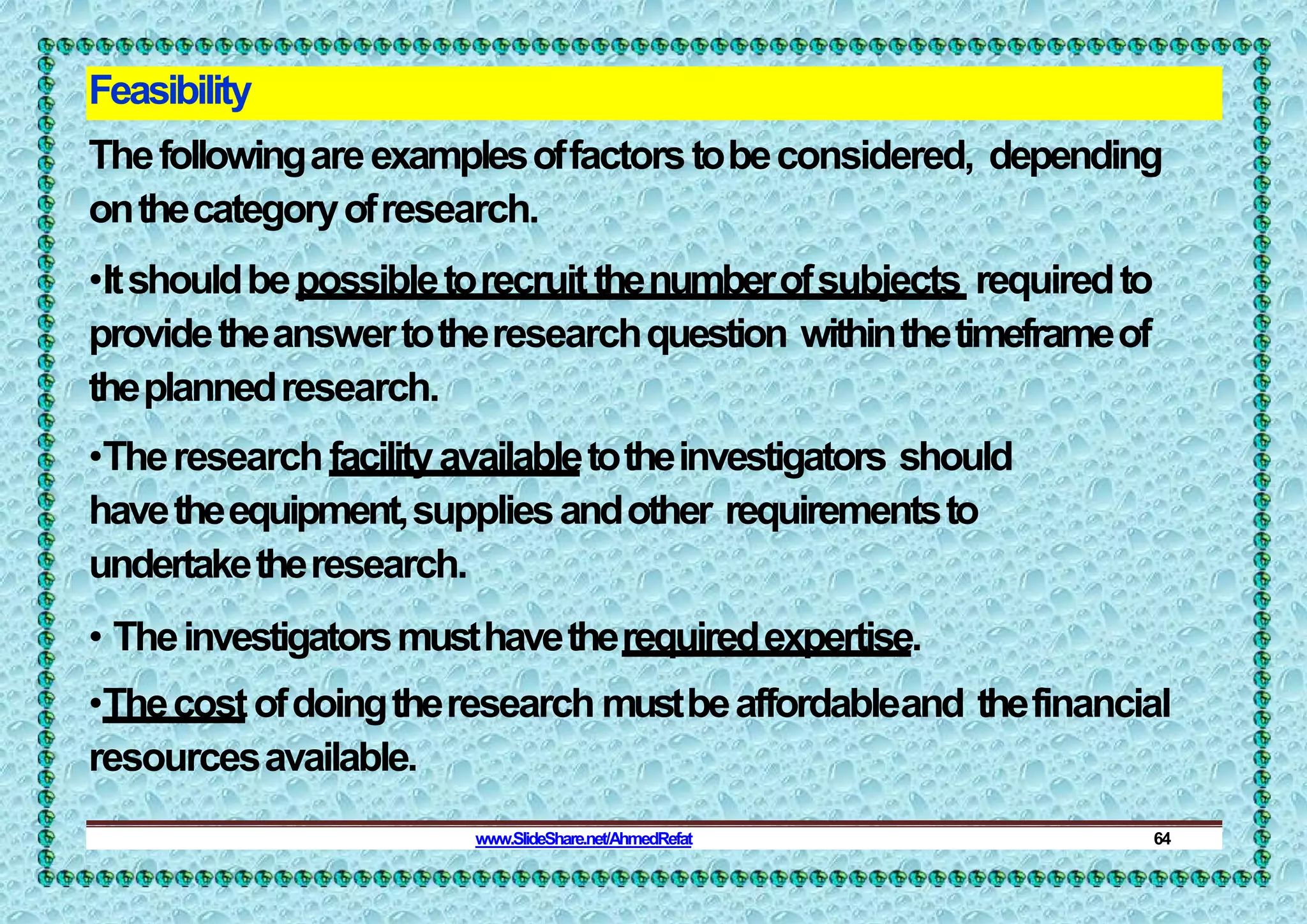
Feasibility
Thefollowingareexamplesoffactorstobeconsidered, depending
onthecategoryofresearch.
•Itshouldbepossibletorecruitthenumberofsubjects requiredto
providetheanswertotheresearchquestion withinthetimeframeof
theplannedresearch.
•Theresearchfacilityavailabletotheinvestigators should
havetheequipment,suppliesandother requirementsto
undertaketheresearch.
• Theinvestigatorsmusthavetherequiredexpertise.
•Thecostofdoingtheresearch mustbeaffordableand thefinancial
resourcesavailable.
www.SlideShare.net/AhmedRefat 64
Interest
Theresearchtopic mustbeofinteresttothe investigators
andtothescientificcommunity.Iftheinvestigatorsare notexcited
aboutthetopic,orcannotgetcolleagues
interestedinit,theprojectisprobablynotworthdoing. Novelty
Itisessentialthattheinvestigatorisfamiliarwiththeup- to-date
literatureontheplannedtopicfortheresearch.
Theresearchmustbeexpectedtocontributenew
information.
www.SlideShare.net/AhmedRefat 65
Noveldoesnotnecessarilymeanthattheresearch has notbeen
donebefore.Theprefix“re”intheword research impliessearching
again.
Mostgoodstudiesareneitheroriginalnorsimple
duplicationofotherstudies.
Theprogressofscience isincremental,withknowledge gradually
buildingupfromdifferentstudies.Thequestion
shouldnotbeaboutwhetherthestudyhasbeendone before,but
whetheritwilladdtotheexistingbodyof knowledge.
www.SlideShare.net/AhmedRefat 66
Ethics
Ethicalissuesmustbeaddressedattheearlystageof selecting
theresearchtopic.
Otherethicalissueswillneedtobeaddressedinplanning the
research.Someethicalproblemsmayindicatethat theresearch
shouldnotbeconsideredfromthe beginning.
Iftheresearch topicinvolvesexperimentationonhuman subjects,
thefollowingissues shouldbeconsidered.
•Ifthetopicis abouttestinganewtherapyorprocedure, evidence
shouldalreadybeavailabletosuggestthatit can besuperiorto
currentlyavailablealternatives.
www.SlideShare.net/AhmedRefat 67
•Adequatedatamustbeavailablefromanimalstudies andfrom
studiesonasmallnumberofhumansubjectsto confirmsafetyandto
suggesteffectiveness,before
subjectingpatientstoanewdrugorprocedure
Itisunjustifiabletodoclinical trialsontherapiesthatare unlikelyto
becomeavailabletopeopleinthecountryor community.
•Theresearchshouldnotconflictwiththesociety’s cultural,
moral,religiousandlegalvalues.
www.SlideShare.net/AhmedRefat 68
Relevance
Thiscriterioncan becalled:the“so-what?”test.Forthe researchto
beconsideredrelevant,itmusthavethe potentialtoadvance
scientificknowledge,influence clinical management,influence
healthpolicy,orguide furtherresearch
www.SlideShare.net/AhmedRefat 69
FurtherReading&CitedSources 1-
Research MethodsandWritingResearch Proposals
( Pdffile135pages,well organizedtextbook)- By:Prof.Dr.SamyTayie
http://www.pathways.cu.edu.eg/subpages/training_courses/Research%20Methods%208/C3-
1%20Research%20Methods%20and%20Writing%20Research%20Proposals.pdf
2 APracticalGuideforHealth Researchers
( Pdffile235page, Comprehensivetext,fromWHO)- MahmoudF.Fathalla .
http://applications.emro.who.int/dsaf/dsa237.pdf
3 RESEARCH METHODOLOGY
http://www.ihmctan.edu/PDF/notes/Research_Methodology.pdf
4 Research MethodsKnowledge Base:
TheResearchMethodsKnowledgeBaseisacomprehensiveweb-based textbookthat addressesall of
thetopicsinatypical introductoryundergraduateor graduatecoursein socialresearchmethods.It
coverstheentireresearchprocess http://www.socialresearchmethods.net/kb/contents.php
5 OrganizingYour SocialSciencesResearch Paper( WebsitefromUniversityofSouthernCalifornia
USA)Thepurposeof thisguideis toprovideadviceon how todevelopandorganizearesearchpaperin the social
sciences
http://libguides.usc.edu/content.php?pid=83009&sid=818072
6. SlidePresentation
Dr.Ahme-RefatAGRefat2013
www.SlideShare.net/AhmedRefat 70
THANK YOU!

Research_Basic-Concepts-and-Methods (1).pptx