Methods of Job Evalutaion
Content
• Introduction
• Job evaluation method
– NonAnalytical
• Ranking method
• Job grading method
– Analytical
• Point method
• Factor comparison
Introduction
• Job evaluation is a systematic way of determining the
value or worth of a job in relation to other jobs in an
organization
• Basis of job evaluation is job analysis
• It tries to make a systematic comparison between jobs
for the purpose of establishing a rational pay structure
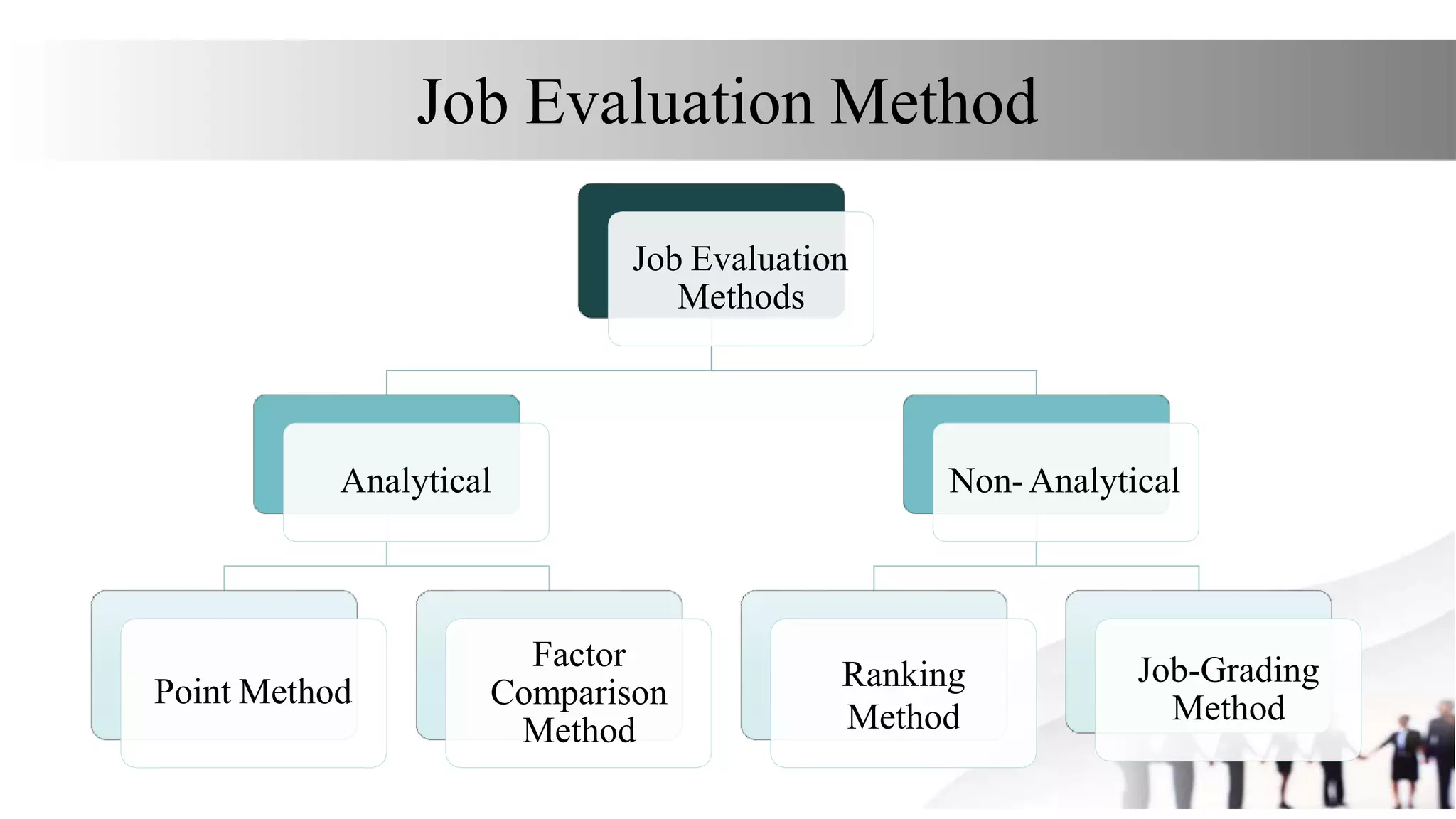
Job Evaluation Method
Job Evaluation
Methods
Analytical
Point Method
Factor
Comparison
Method
Non-Analytical
Ranking
Method
Job-Grading
Method
Ranking Method
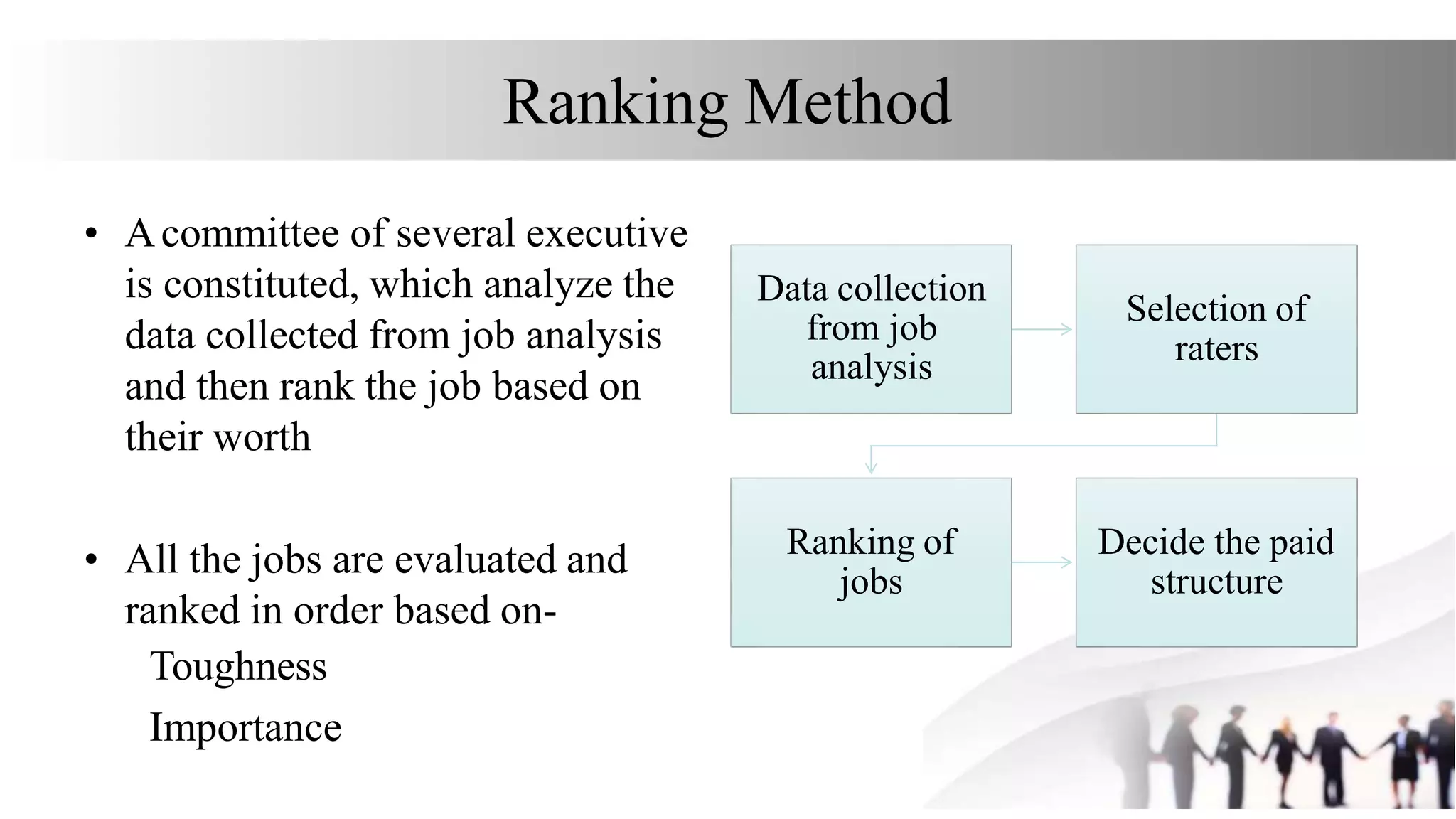
• Acommittee of several executive
is constituted, which analyze the
data collected from job analysis
and then rank the job based on
their worth
• All the jobs are evaluated and
ranked in order based on-
Toughness
Importance
Data collection
from job
analysis
Selection of
raters
Ranking of
jobs
Decide the paid
structure
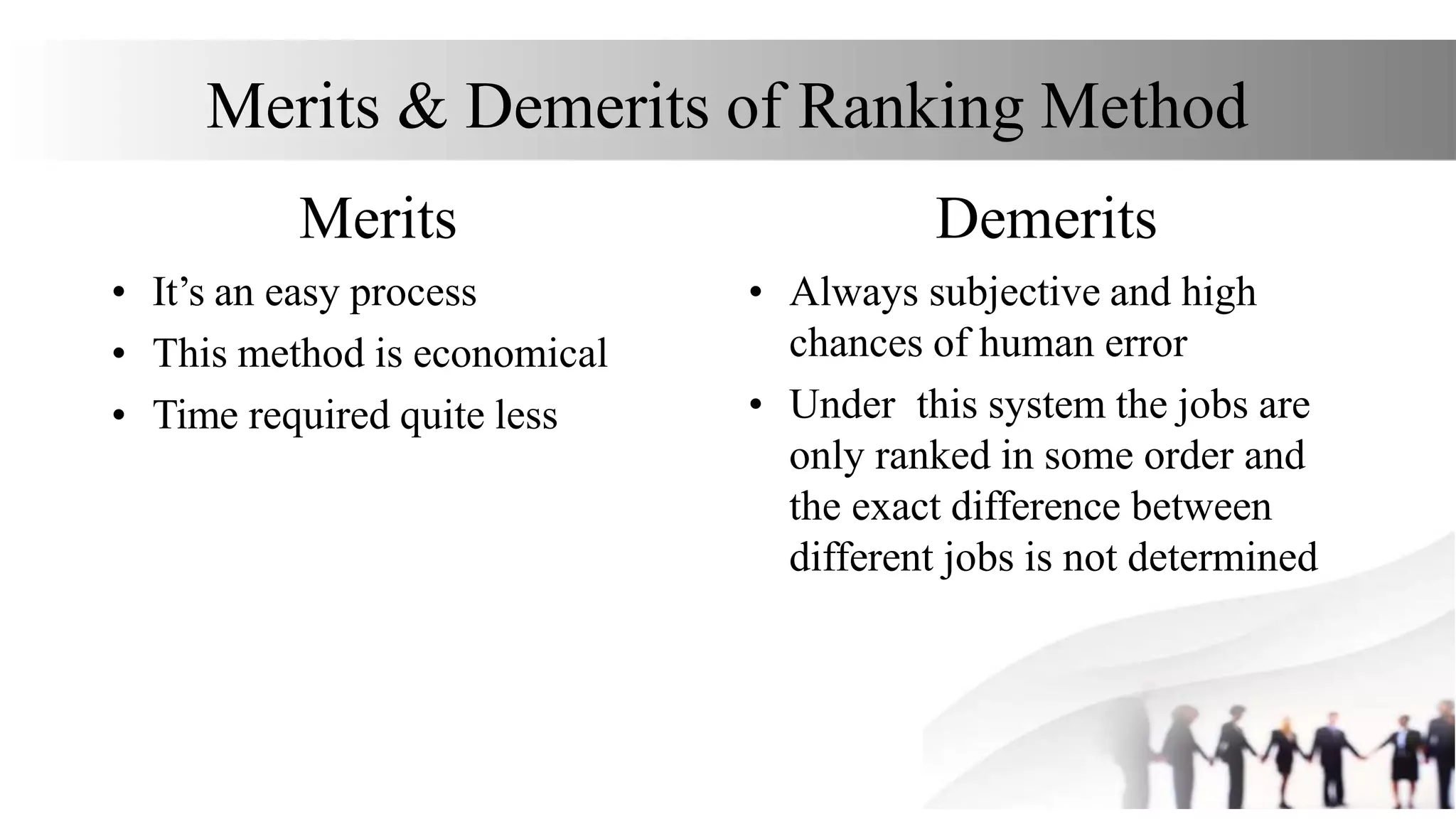
Merits & Demerits of Ranking Method
Merits
• It’s an easy process
• This method is economical
• Time required quite less
Demerits
• Always subjective and high
chances of human error
• Under this system the jobs are
only ranked in some order and
the exact difference between
different jobs is not determined
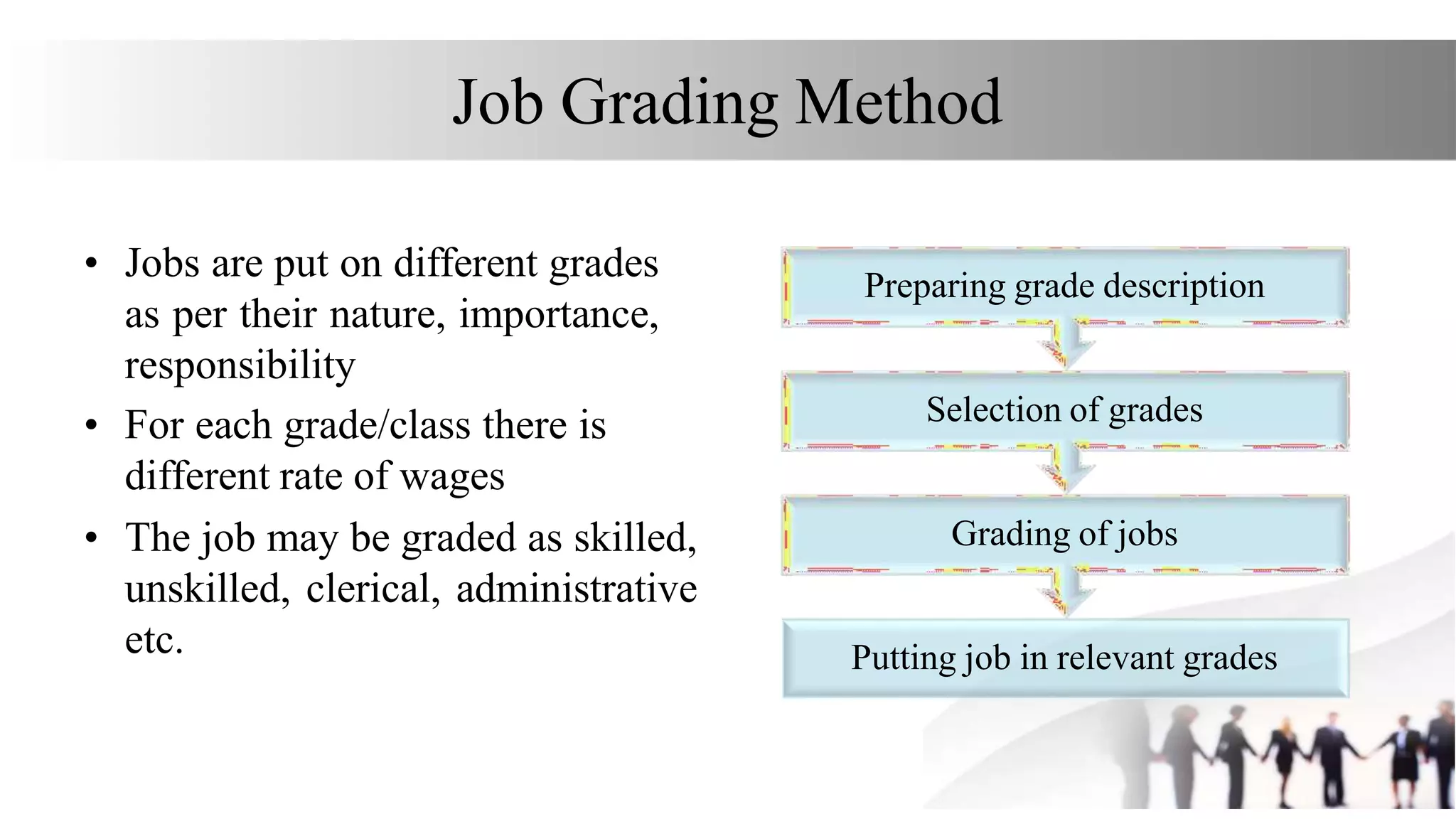
Job Grading Method
• Jobs are put on different grades
as per their nature, importance,
responsibility
• For each grade/class there is
different rate of wages
• The job may be graded as skilled,
unskilled, clerical, administrative
etc. Putting job in relevant grades
Grading of jobs
Selection of grades
Preparing grade description
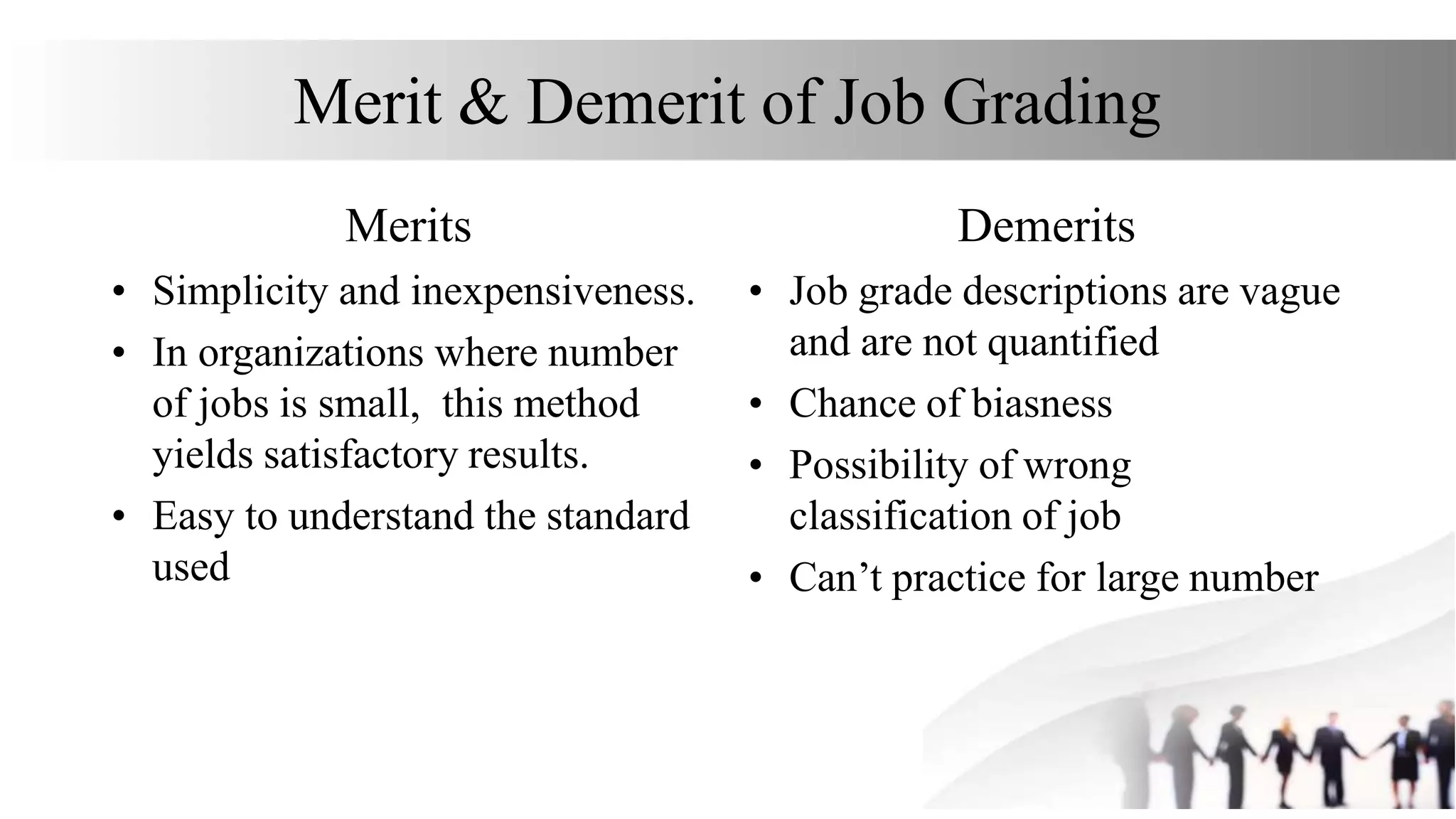
Merit & Demerit of Job Grading
Merits
• Simplicity and inexpensiveness.
• In organizations where number
of jobs is small, this method
yields satisfactory results.
• Easy to understand the standard
used
Demerits
• Job grade descriptions are vague
and are not quantified
• Chance of biasness
• Possibility of wrong
classification of job
• Can’t practice for large number
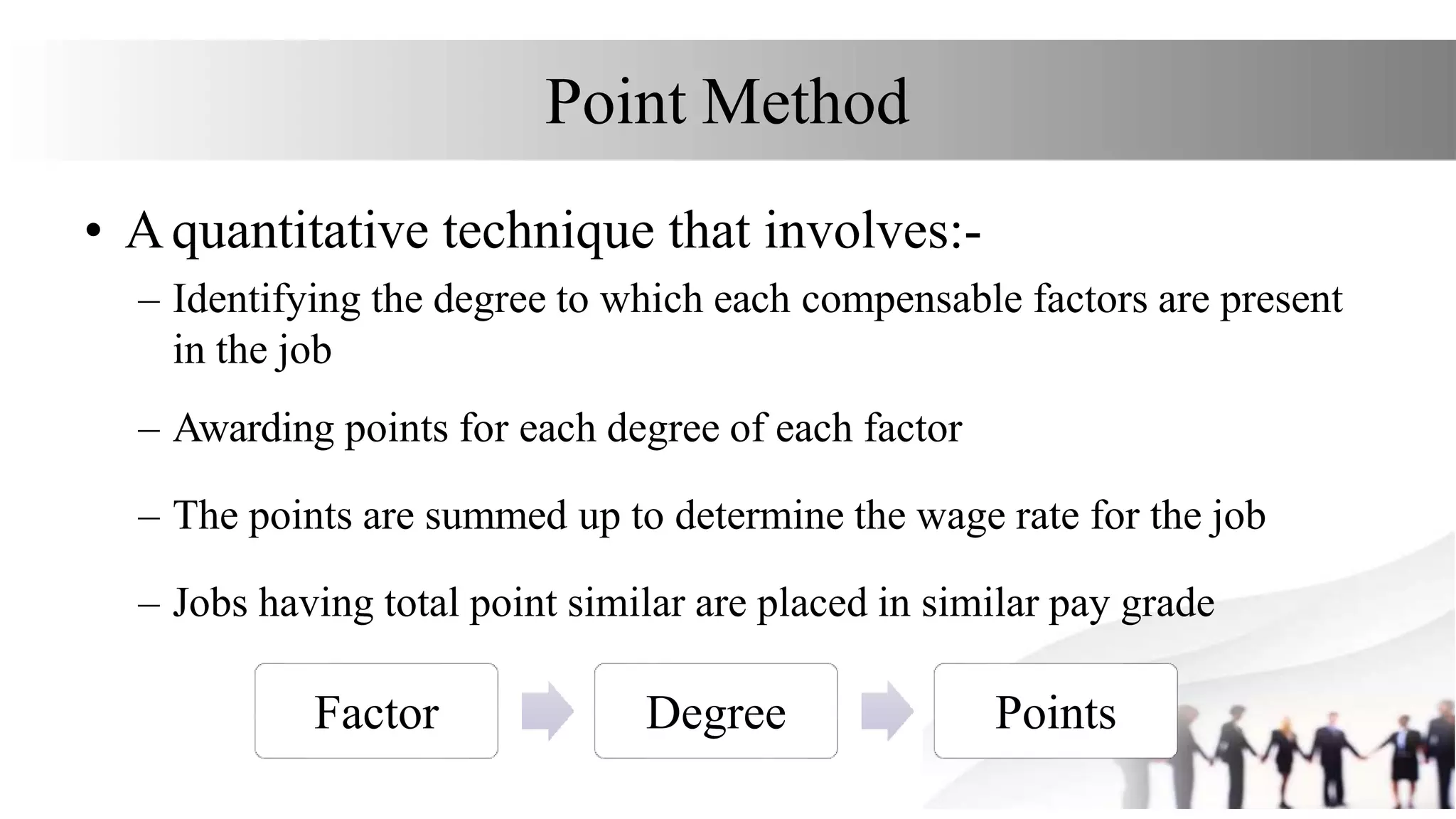
Point Method
• Aquantitative technique that involves:-
– Identifying the degree to which each compensable factors are present
in the job
– Awarding points for each degree of each factor
– The points are summed up to determine the wage rate for the job
– Jobs having total point similar are placed in similar pay grade
Factor Degree Points
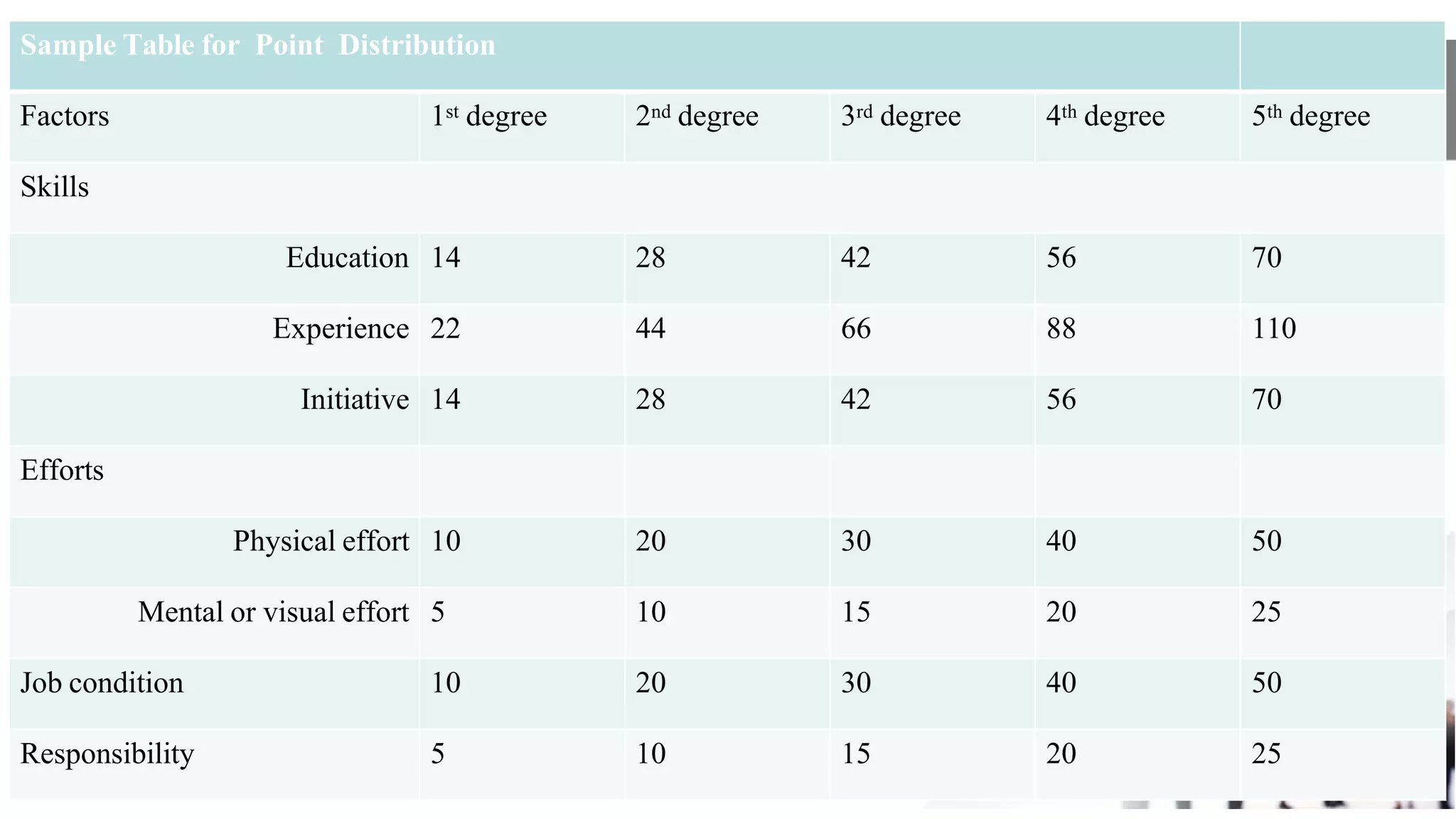
Sample Table for Point Distribution
Factors 1st degree 2nd degree 3rd degree 4th degree 5th degree
Skills
Education 14 28 42 56 70
Experience 22 44 66 88 110
Initiative 14 28 42 56 70
Efforts
Physical effort 10 20 30 40 50
Mental or visual effort 5 10 15 20 25
Job condition 10 20 30 40 50
Responsibility 5 10 15 20 25
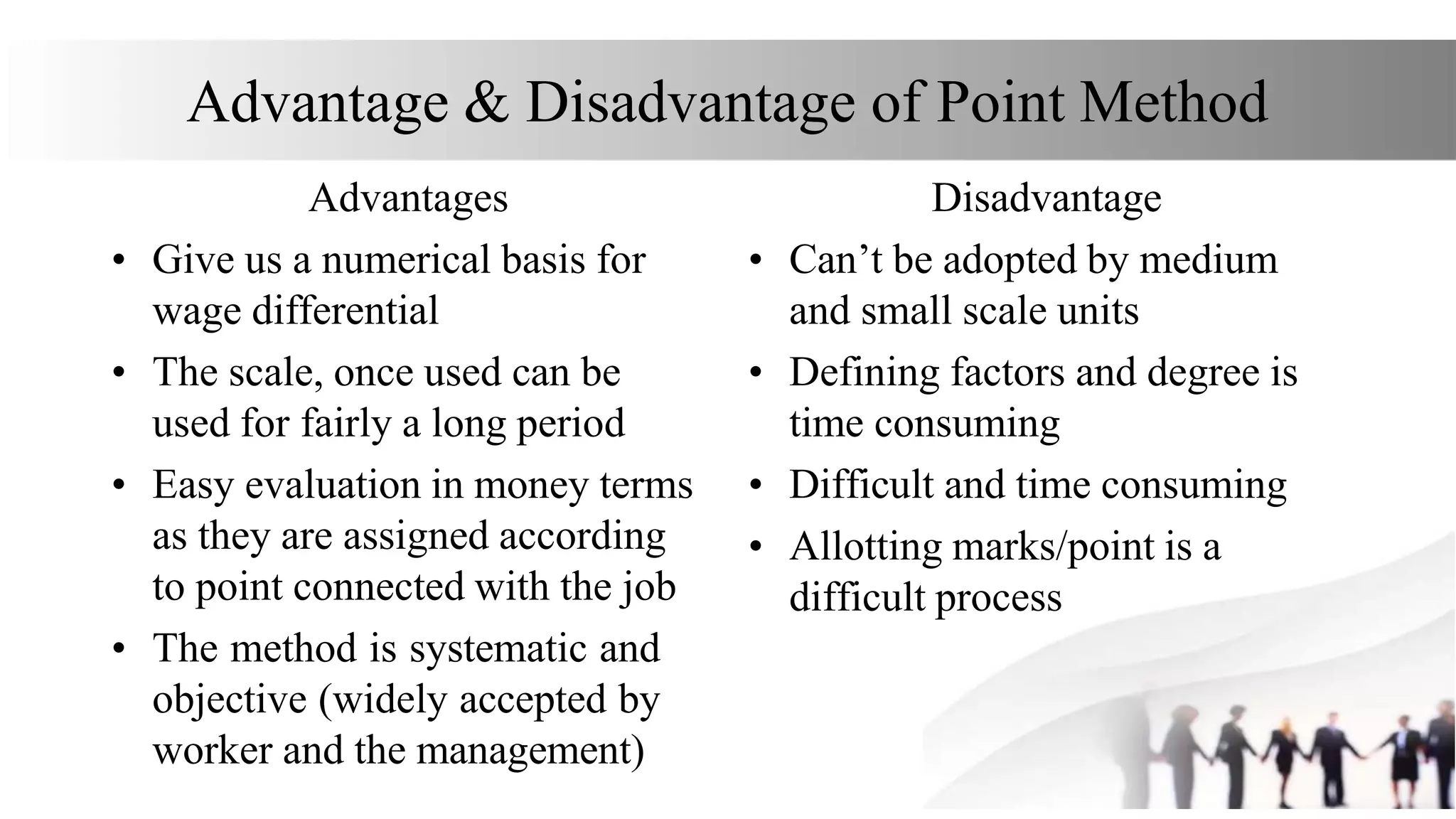
Advantage & Disadvantage of Point Method
Advantages
• Give us a numerical basis for
wage differential
• The scale, once used can be
used for fairly a long period
• Easy evaluation in money terms
as they are assigned according
to point connected with the job
• The method is systematic and
objective (widely accepted by
worker and the management)
Disadvantage
• Can’t be adopted by medium
and small scale units
• Defining factors and degree is
time consuming
• Difficult and time consuming
• Allotting marks/point is a
difficult process
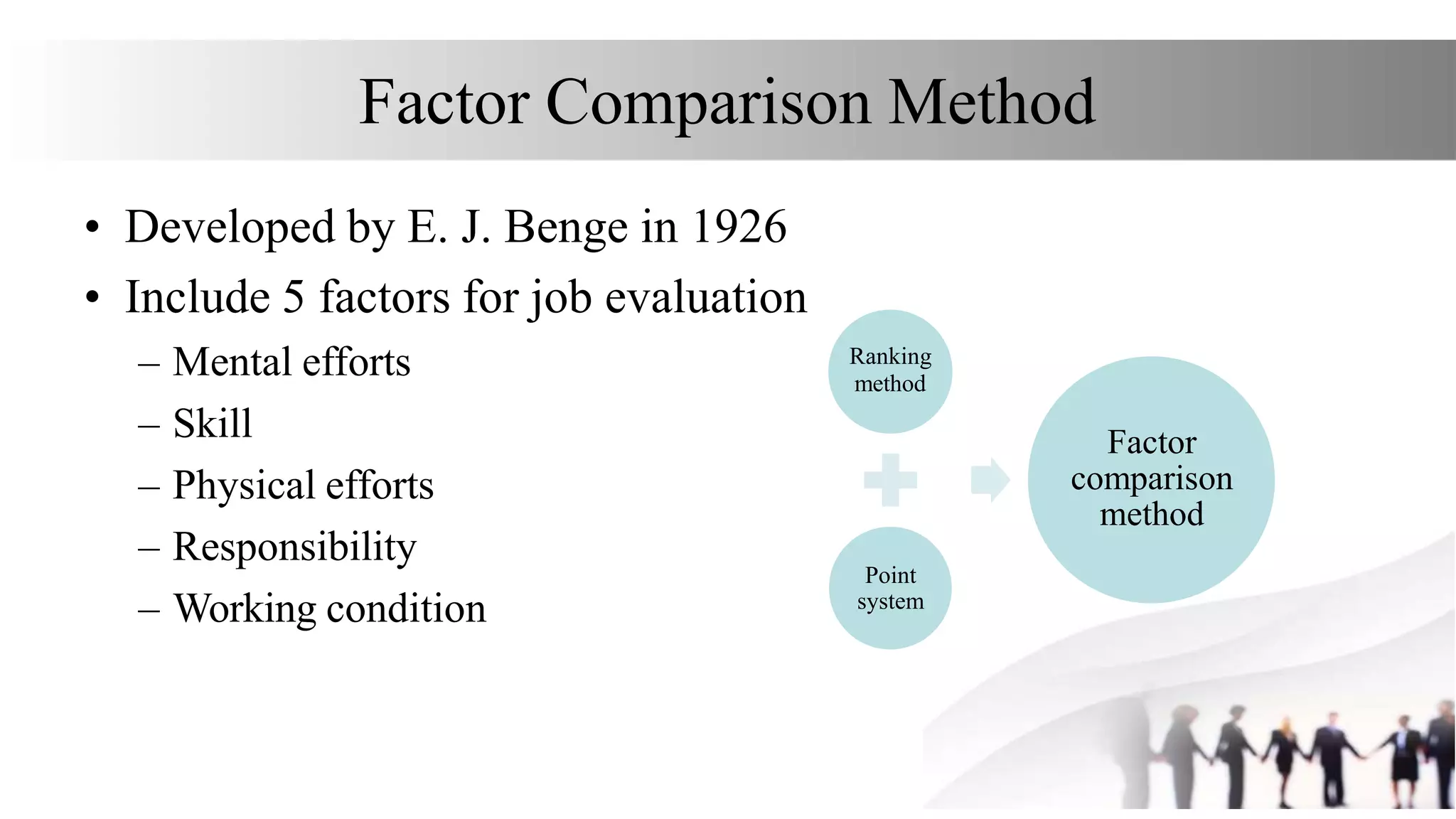
Factor Comparison Method
• Developed by E. J. Benge in 1926
• Include 5 factors for job evaluation
– Mental efforts
– Skill
– Physical efforts
– Responsibility
– Working condition
Ranking
method
Point
system
Factor
comparison
method
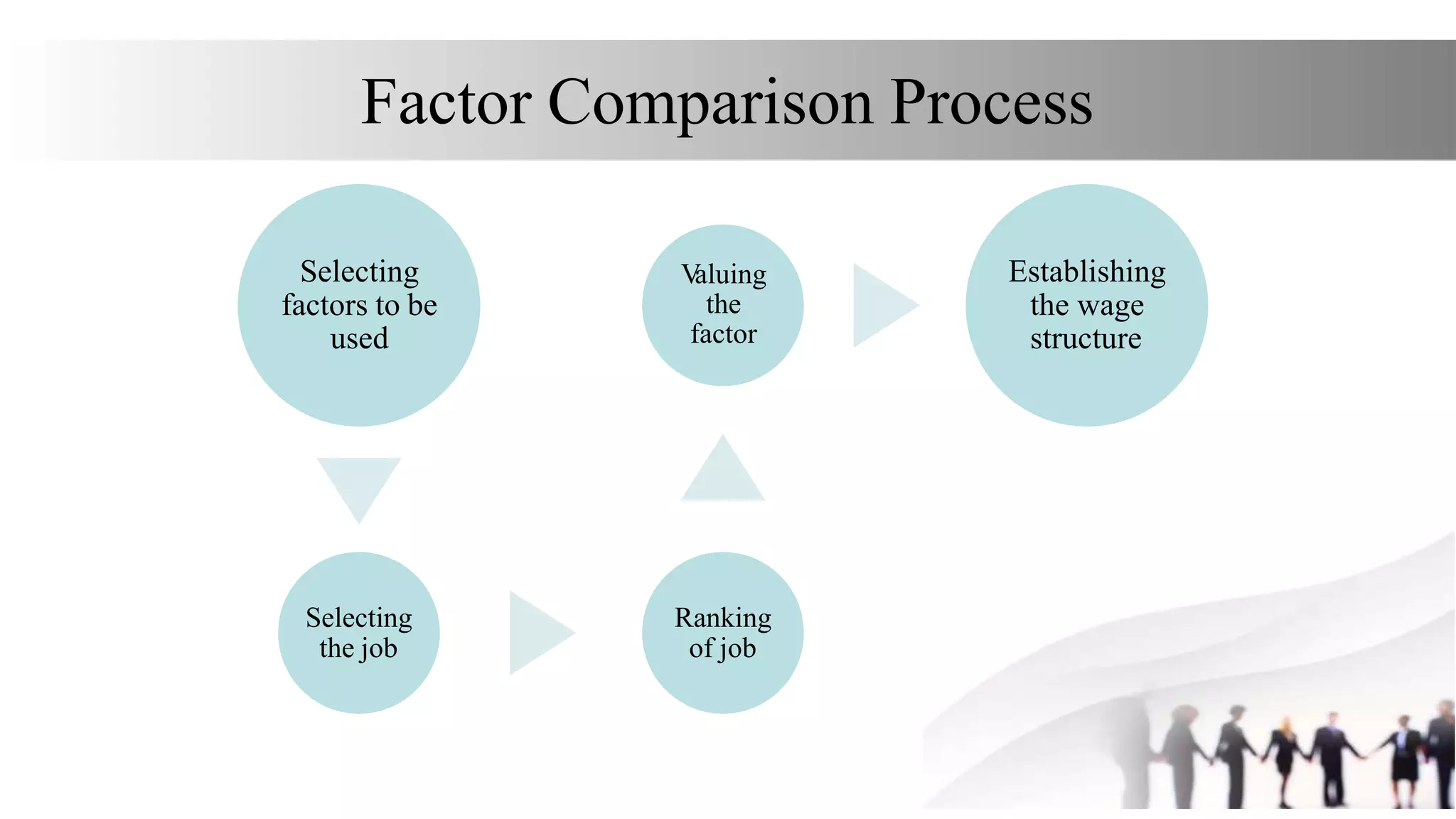
Selecting
factors to be
used
Selecting
the job
Ranking
of job
V
aluing
the
factor
Establishing
the wage
structure
Factor Comparison Process
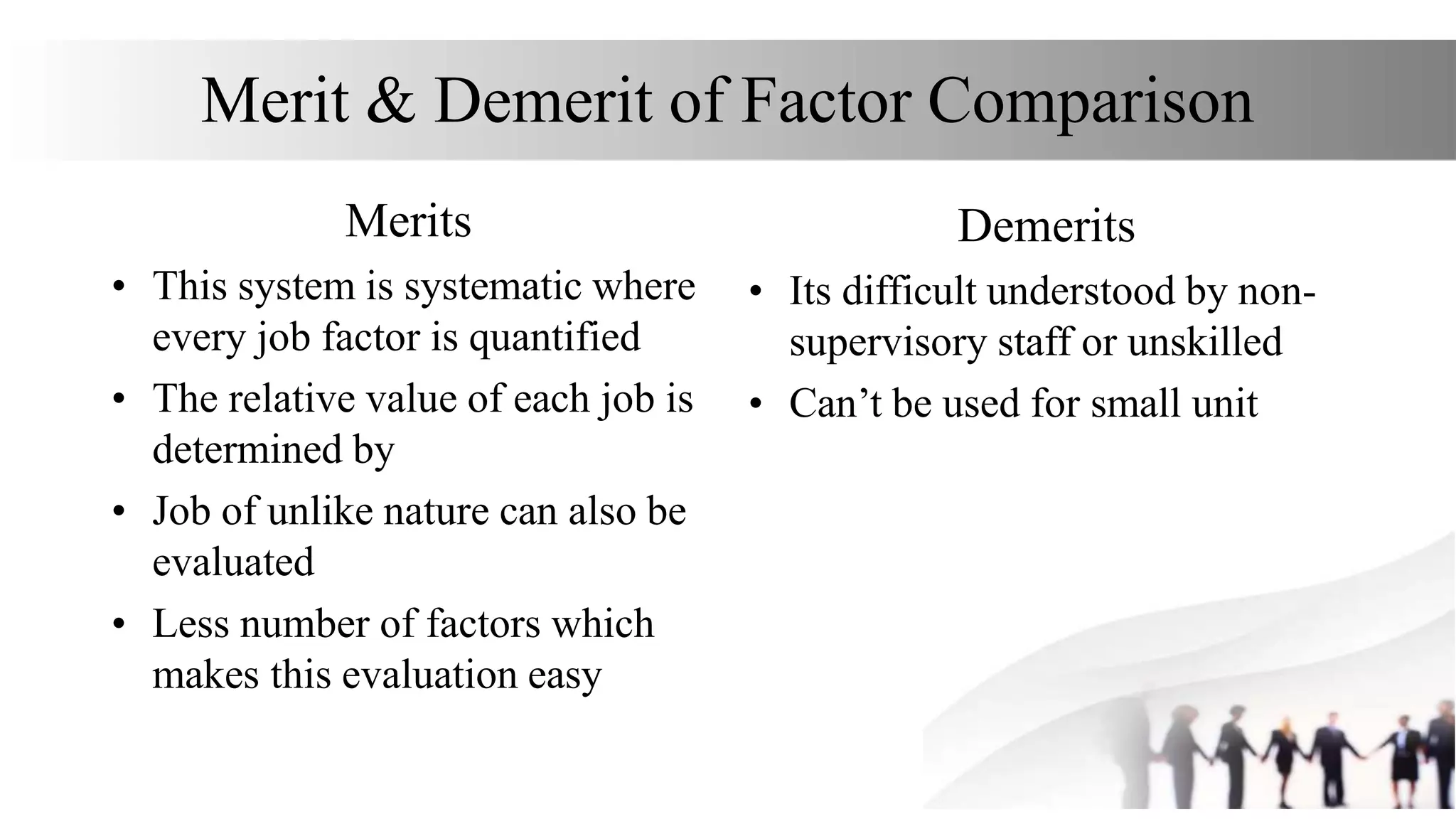
Merit & Demerit of Factor Comparison
Merits
• This system is systematic where
every job factor is quantified
• The relative value of each job is
determined by
• Job of unlike nature can also be
evaluated
• Less number of factors which
makes this evaluation easy
Demerits
• Its difficult understood by non-
supervisory staff or unskilled
• Can’t be used for small unit
Methods of Job Evaluation.pptx

Methods of Job Evaluation.pptx

  • 1.
    Methods of JobEvalutaion
  • 2.
    Content • Introduction • Jobevaluation method – NonAnalytical • Ranking method • Job grading method – Analytical • Point method • Factor comparison
  • 3.
    Introduction • Job evaluationis a systematic way of determining the value or worth of a job in relation to other jobs in an organization • Basis of job evaluation is job analysis • It tries to make a systematic comparison between jobs for the purpose of establishing a rational pay structure
  • 4.
    Job Evaluation Method JobEvaluation Methods Analytical Point Method Factor Comparison Method Non-Analytical Ranking Method Job-Grading Method
  • 5.
    Ranking Method • Acommitteeof several executive is constituted, which analyze the data collected from job analysis and then rank the job based on their worth • All the jobs are evaluated and ranked in order based on- Toughness Importance Data collection from job analysis Selection of raters Ranking of jobs Decide the paid structure
  • 6.
    Merits & Demeritsof Ranking Method Merits • It’s an easy process • This method is economical • Time required quite less Demerits • Always subjective and high chances of human error • Under this system the jobs are only ranked in some order and the exact difference between different jobs is not determined
  • 7.
    Job Grading Method •Jobs are put on different grades as per their nature, importance, responsibility • For each grade/class there is different rate of wages • The job may be graded as skilled, unskilled, clerical, administrative etc. Putting job in relevant grades Grading of jobs Selection of grades Preparing grade description
  • 8.
    Merit & Demeritof Job Grading Merits • Simplicity and inexpensiveness. • In organizations where number of jobs is small, this method yields satisfactory results. • Easy to understand the standard used Demerits • Job grade descriptions are vague and are not quantified • Chance of biasness • Possibility of wrong classification of job • Can’t practice for large number
  • 9.
    Point Method • Aquantitativetechnique that involves:- – Identifying the degree to which each compensable factors are present in the job – Awarding points for each degree of each factor – The points are summed up to determine the wage rate for the job – Jobs having total point similar are placed in similar pay grade Factor Degree Points
  • 10.
    Sample Table forPoint Distribution Factors 1st degree 2nd degree 3rd degree 4th degree 5th degree Skills Education 14 28 42 56 70 Experience 22 44 66 88 110 Initiative 14 28 42 56 70 Efforts Physical effort 10 20 30 40 50 Mental or visual effort 5 10 15 20 25 Job condition 10 20 30 40 50 Responsibility 5 10 15 20 25
  • 11.
    Advantage & Disadvantageof Point Method Advantages • Give us a numerical basis for wage differential • The scale, once used can be used for fairly a long period • Easy evaluation in money terms as they are assigned according to point connected with the job • The method is systematic and objective (widely accepted by worker and the management) Disadvantage • Can’t be adopted by medium and small scale units • Defining factors and degree is time consuming • Difficult and time consuming • Allotting marks/point is a difficult process
  • 12.
    Factor Comparison Method •Developed by E. J. Benge in 1926 • Include 5 factors for job evaluation – Mental efforts – Skill – Physical efforts – Responsibility – Working condition Ranking method Point system Factor comparison method
  • 13.
    Selecting factors to be used Selecting thejob Ranking of job V aluing the factor Establishing the wage structure Factor Comparison Process
  • 14.
    Merit & Demeritof Factor Comparison Merits • This system is systematic where every job factor is quantified • The relative value of each job is determined by • Job of unlike nature can also be evaluated • Less number of factors which makes this evaluation easy Demerits • Its difficult understood by non- supervisory staff or unskilled • Can’t be used for small unit