A grasp of ISO 9001: 2015
Requirements to Process Owners
OBJECTIVES OF THE TRAINING:
• Define and Understand Quality Management System.
• Grasp what is expected of ISO 9001:2015 Requirements.
• Understand the roles in the implementation of ISO
9001:2015.
• Determine the correct amount of documentation needed for
the effectiveness of its QMS
ISO (International Organization for Standardization) is an independent, non-governmental
membership organization and the world's largest developer of voluntary International
Standards.
Worldwide federation of National Standard Bodies, with
representatives from each of approximately 168 Countries.
They began their official functions on February 23, 1947
As of April 2022, the ISO has developed
over 24,261 standards, covering
everything from manufactured products
and technology to food safety,
agriculture and healthcare.
Because 'International Organization for
Standardization' would have different
acronyms in different languages (IOS in
English, OIN in French for Organisation
internationale de normalisation), ISO is
derived from the Greek isos, meaning
equal. ISO has 804 technical commitees
and subcommittees concerned
with standards development.
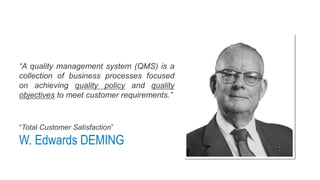
“A quality management system (QMS) is a
collection of business processes focused
on achieving quality policy and quality
objectives to meet customer requirements.”
“Total Customer Satisfaction”
W. Edwards DEMING
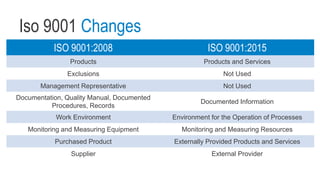
Iso 9001 Changes
ISO 9001:2008 ISO 9001:2015
Products Products and Services
Exclusions Not Used
Management Representative Not Used
Documentation, Quality Manual, Documented
Procedures, Records
Documented Information
Work Environment Environment for the Operation of Processes
Monitoring and Measuring Equipment Monitoring and Measuring Resources
Purchased Product Externally Provided Products and Services
Supplier External Provider
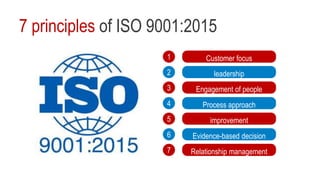
7 principles of ISO 9001:2015
Customer focus
1
leadership
2
Engagement of people
3
Process approach
4
improvement
5
Evidence-based decision
making
6
Relationship management
7
Why do we need it and how will it help us?
Reasons why companies get into iso
• For Compliance
• Prestige of Getting the Certification
• Solution to Problem Areas
• Quality Process Improvement
Why do we need it and how will it help us?
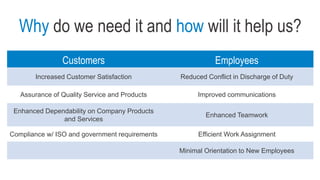
Customers Employees
Increased Customer Satisfaction Reduced Conflict in Discharge of Duty
Assurance of Quality Service and Products Improved communications
Enhanced Dependability on Company Products
and Services
Enhanced Teamwork
Compliance w/ ISO and government requirements Efficient Work Assignment
Minimal Orientation to New Employees
ISO 9001:2015 Requirements
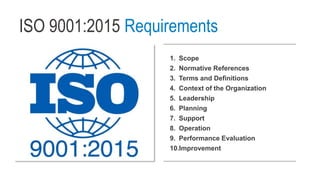
1. Scope
2. Normative References
3. Terms and Definitions
4. Context of the Organization
5. Leadership
6. Planning
7. Support
8. Operation
9. Performance Evaluation
10.Improvement
Iso 9001:2015 PDCA Cycle
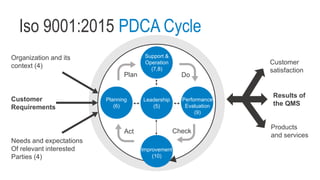
Organization and its
context (4)
Customer
Requirements
Needs and expectations
Of relevant interested
Parties (4)
Support &
Operation
(7,8)
Performance
Evaluation
(9)
Improvement
(10)
Planning
(6)
Customer
satisfaction
Products
and services
Results of
the QMS
Leadership
(5)
Plan Do
Check
Act
Clause 4.0 Context of the Organization
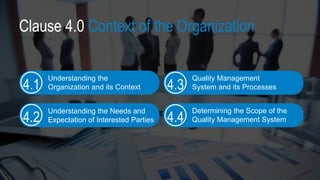
Understanding the
Organization and its Context
4.1
Understanding the Needs and
Expectation of Interested Parties
4.2
Determining the Scope of the
Quality Management System
4.4
Quality Management
System and its Processes
4.3
Clause 4.0 Context of the Organization
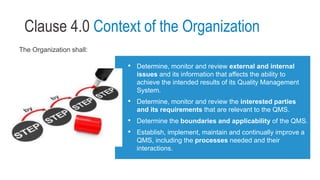
The Organization shall:
• Determine, monitor and review external and internal
issues and its information that affects the ability to
achieve the intended results of its Quality Management
System.
• Determine, monitor and review the interested parties
and its requirements that are relevant to the QMS.
• Determine the boundaries and applicability of the QMS.
• Establish, implement, maintain and continually improve a
QMS, including the processes needed and their
interactions.
Clause 4.0 Context of the Organization
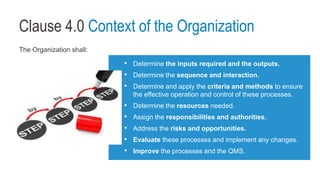
The Organization shall:
• Determine the inputs required and the outputs.
• Determine the sequence and interaction.
• Determine and apply the criteria and methods to ensure
the effective operation and control of these processes.
• Determine the resources needed.
• Assign the responsibilities and authorities.
• Address the risks and opportunities.
• Evaluate these processes and implement any changes.
• Improve the processes and the QMS.
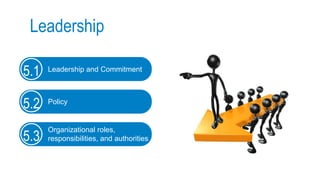
CLeadership
Leadership and Commitment
5.1
Policy
5.2
Organizational roles,
responsibilities, and authorities
5.3
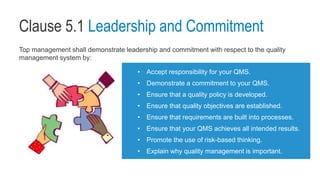
Clause 5.1 Leadership and Commitment
Top management shall demonstrate leadership and commitment with respect to the quality
management system by:
• Accept responsibility for your QMS.
• Demonstrate a commitment to your QMS.
• Ensure that a quality policy is developed.
• Ensure that quality objectives are established.
• Ensure that requirements are built into processes.
• Ensure that your QMS achieves all intended results.
• Promote the use of risk-based thinking.
• Explain why quality management is important.
Clause 5.1.2 Customer Focus
Top management shall demonstrate leadership and commitment with respect to customer
focus by:
• Customer and applicable statutory and regulatory
requirements are determined, understood and
consistently met
• The risk and opportunities that can affect conformity
of products and services and the ability to enhance
customer satisfaction are determined and addressed
• The focus on enhancing customer satisfaction is
maintained
Clause 5.2 Policy
The Management shall ensure that the quality policy:
• Is appropriate to the purpose of the organization and Context of the organization
• Provides a framework for establishing and
reviewing quality objectives;
• Includes a commitment to satisfy applicable requirements and to continual improvement
of the QMS
• Be available and be maintained as documented information
• Be communicated and understood within the organization
• Be available to relevant interested parties, as appropriate
Clause 5.3 Organizational Roles, Responsibilities, and
Authorities
Responsibilities and authorities shall be communicated and understood within the
organization:
Quality Management Representative
 Ensuring QMS conforms to the requirements of the
international standard.
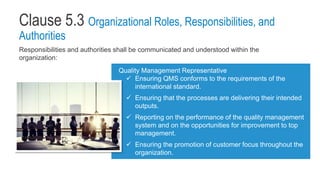
 Ensuring that the processes are delivering their intended
outputs.
 Reporting on the performance of the quality management
system and on the opportunities for improvement to top
management.
 Ensuring the promotion of customer focus throughout the
organization.
WORKSHOP
1. Form a group consisting of 3 - 5 members.
2. Choose any activity/ process. Create a PROCESS FLOW describing
your daily work routine.
3. Identify the Key Result Areas (KRAs) of the respective processes.
4. Identify the indicators of effective implementation. (Key Performance
Indicators)
5. What could be the possible factors that can affect the productivity?
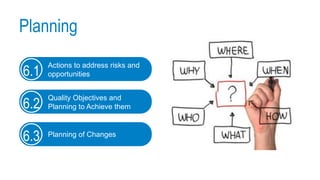
Planning
Actions to address risks and
opportunities
6.1
Quality Objectives and
Planning to Achieve them
6.2
Planning of Changes
6.3
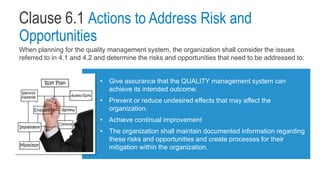
Clause 6.1 Actions to Address Risk and
Opportunities
When planning for the quality management system, the organization shall consider the issues
referred to in 4.1 and 4.2 and determine the risks and opportunities that need to be addressed to:
• Give assurance that the QUALITY management system can
achieve its intended outcome.
• Prevent or reduce undesired effects that may affect the
organization.
• Achieve continual improvement
• The organization shall maintain documented information regarding
these risks and opportunities and create processes for their
mitigation within the organization.
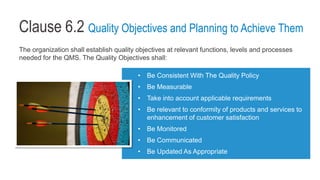
Clause 6.2 Quality Objectives and Planning to Achieve Them
The organization shall establish quality objectives at relevant functions, levels and processes
needed for the QMS. The Quality Objectives shall:
• Be Consistent With The Quality Policy
• Be Measurable
• Take into account applicable requirements
• Be relevant to conformity of products and services to
enhancement of customer satisfaction
• Be Monitored
• Be Communicated
• Be Updated As Appropriate
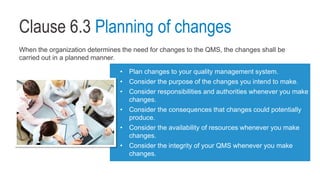
Clause 6.3 Planning of changes
When the organization determines the need for changes to the QMS, the changes shall be
carried out in a planned manner.
• Plan changes to your quality management system.
• Consider the purpose of the changes you intend to make.
• Consider responsibilities and authorities whenever you make
changes.
• Consider the consequences that changes could potentially
produce.
• Consider the availability of resources whenever you make
changes.
• Consider the integrity of your QMS whenever you make
changes.
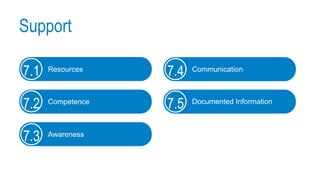
Support
Resources
7.1
Competence
7.2
Awareness
7.3
Communication
7.4
Documented Information
7.5
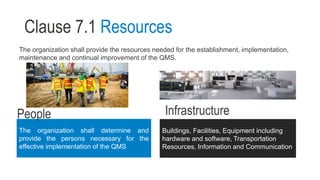
Clause 7.1 Resources
The organization shall provide the resources needed for the establishment, implementation,
maintenance and continual improvement of the QMS.
The organization shall determine and
provide the persons necessary for the
effective implementation of the QMS
People
Buildings, Facilities, Equipment including
hardware and software, Transportation
Resources, Information and Communication
Infrastructure
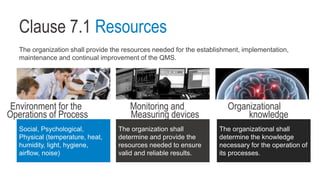
Clause 7.1 Resources
The organization shall provide the resources needed for the establishment, implementation,
maintenance and continual improvement of the QMS.
Social, Psychological,
Physical (temperature, heat,
humidity, light, hygiene,
airflow, noise)
Environment for the
Operations of Process
The organization shall
determine and provide the
resources needed to ensure
valid and reliable results.
Monitoring and
Measuring devices
The organizational shall
determine the knowledge
necessary for the operation of
its processes.
Organizational
knowledge
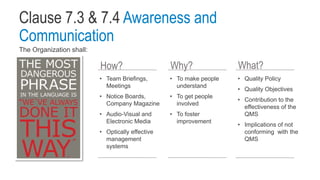
Clause 7.3 & 7.4 Awareness and
Communication
The Organization shall:
• Team Briefings,
Meetings
• Notice Boards,
Company Magazine
• Audio-Visual and
Electronic Media
• Optically effective
management
systems
• To make people
understand
• To get people
involved
• To foster
improvement
• Quality Policy
• Quality Objectives
• Contribution to the
effectiveness of the
QMS
• Implications of not
conforming with the
QMS
How? Why? What?
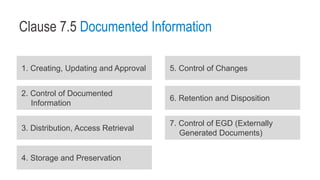
Clause 7.5 Documented Information
1. Creating, Updating and Approval
2. Control of Documented
Information
3. Distribution, Access Retrieval
4. Storage and Preservation
5. Control of Changes
6. Retention and Disposition
7. Control of EGD (Externally
Generated Documents)
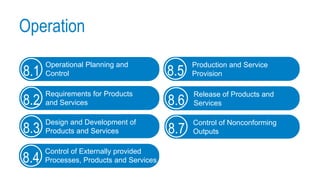
Operation
Operational Planning and
Control
8.1
Requirements for Products
and Services
8.2
Design and Development of
Products and Services
8.3
Control of Externally provided
Processes, Products and Services
8.4
Control of Nonconforming
Outputs
8.7
Release of Products and
Services
8.6
Production and Service
Provision
8.5
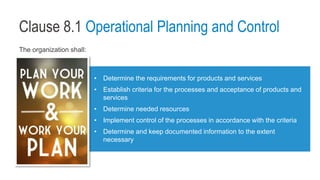
Clause 8.1 Operational Planning and Control
The organization shall:
• Determine the requirements for products and services
• Establish criteria for the processes and acceptance of products and
services
• Determine needed resources
• Implement control of the processes in accordance with the criteria
• Determine and keep documented information to the extent
necessary
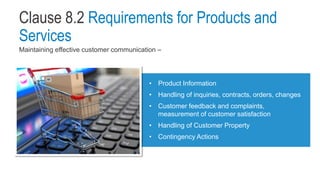
Clause 8.2 Requirements for Products and
Services
Maintaining effective customer communication –
• Product Information
• Handling of inquiries, contracts, orders, changes
• Customer feedback and complaints,
measurement of customer satisfaction
• Handling of Customer Property
• Contingency Actions
Clause
8.3
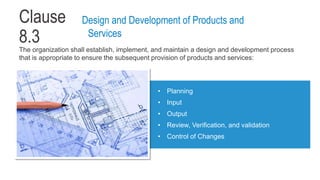
The organization shall establish, implement, and maintain a design and development process
that is appropriate to ensure the subsequent provision of products and services:
• Planning
• Input
• Output
• Review, Verification, and validation
• Control of Changes
Design and Development of Products and
Services
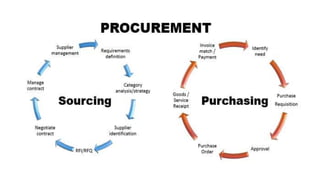
Clause 8.4
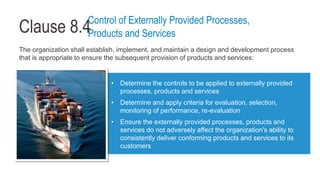
The organization shall establish, implement, and maintain a design and development process
that is appropriate to ensure the subsequent provision of products and services:
• Determine the controls to be applied to externally provided
processes, products and services
• Determine and apply criteria for evaluation, selection,
monitoring of performance, re-evaluation
• Ensure the externally provided processes, products and
services do not adversely affect the organization's ability to
consistently deliver conforming products and services to its
customers
Control of Externally Provided Processes,
Products and Services
Clause 8.5 Production and Service Provision
The organization shall implement production and service provision under controlled conditions.
• Availability of Documented Information that specifies the product or service.
• Implementation of monitoring and measurement activities.
• Use of suitable infrastructure and environment.
• Appointment of competent persons.
• The validation, and periodic revalidation of the ability to achieve planned results of the
processes.
• The implementation of actions to prevent human error.
• Methods for release, delivery and applicable post-delivery activities.
Clause 8.5 Production and Service Provision
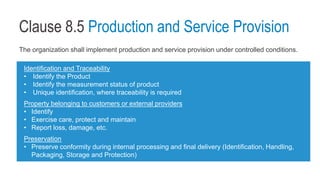
The organization shall implement production and service provision under controlled conditions.
Identification and Traceability
• Identify the Product
• Identify the measurement status of product
• Unique identification, where traceability is required
Property belonging to customers or external providers
• Identify
• Exercise care, protect and maintain
• Report loss, damage, etc.
Preservation
• Preserve conformity during internal processing and final delivery (Identification, Handling,
Packaging, Storage and Protection)
WAREHOUSING
ACCOUNTING
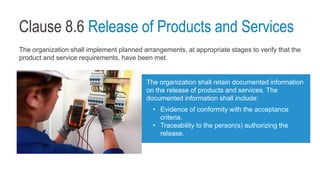
Clause 8.6 Release of Products and Services
The organization shall implement planned arrangements, at appropriate stages to verify that the
product and service requirements, have been met.
The organization shall retain documented information
on the release of products and services. The
documented information shall include:
• Evidence of conformity with the acceptance
criteria.
• Traceability to the person(s) authorizing the
release.
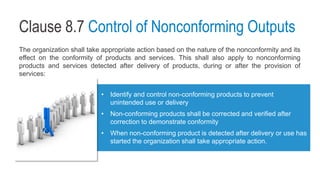
Clause 8.7 Control of Nonconforming Outputs
The organization shall take appropriate action based on the nature of the nonconformity and its
effect on the conformity of products and services. This shall also apply to nonconforming
products and services detected after delivery of products, during or after the provision of
services:
• Identify and control non-conforming products to prevent
unintended use or delivery
• Non-conforming products shall be corrected and verified after
correction to demonstrate conformity
• When non-conforming product is detected after delivery or use has
started the organization shall take appropriate action.
Repair & Preventive Maintenance Activities
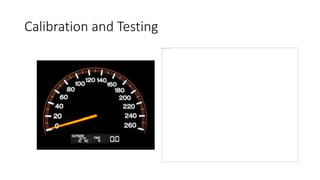
Calibration and Testing
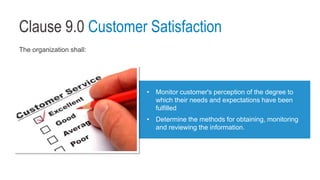
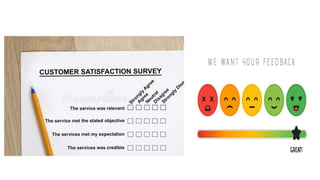
Clause 9.0 Customer Satisfaction
The organization shall:
• Monitor customer's perception of the degree to
which their needs and expectations have been
fulfilled
• Determine the methods for obtaining, monitoring
and reviewing the information.
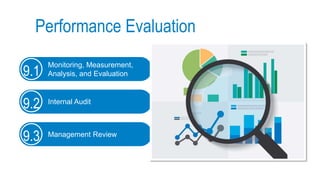
CPerformance Evaluation
Monitoring, Measurement,
Analysis, and Evaluation
9.1
Internal Audit
9.2
Management Review
9.3
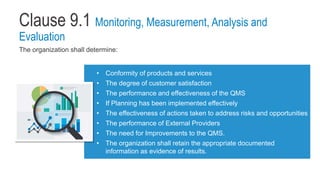
Clause 9.1 Monitoring, Measurement, Analysis and
Evaluation
The organization shall determine:
• Conformity of products and services
• The degree of customer satisfaction
• The performance and effectiveness of the QMS
• If Planning has been implemented effectively
• The effectiveness of actions taken to address risks and opportunities
• The performance of External Providers
• The need for Improvements to the QMS.
• The organization shall retain the appropriate documented
information as evidence of results.
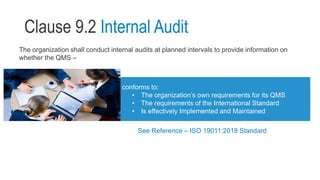
Clause 9.2 Internal Audit
The organization shall conduct internal audits at planned intervals to provide information on
whether the QMS –
conforms to:
• The organization’s own requirements for its QMS
• The requirements of the International Standard
• Is effectively Implemented and Maintained
See Reference – ISO 19011:2018 Standard
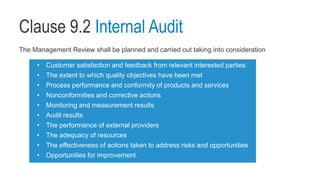
Clause 9.2 Internal Audit
The Management Review shall be planned and carried out taking into consideration
• Customer satisfaction and feedback from relevant interested parties
• The extent to which quality objectives have been met
• Process performance and conformity of products and services
• Nonconformities and corrective actions
• Monitoring and measurement results
• Audit results
• The performance of external providers
• The adequacy of resources
• The effectiveness of actions taken to address risks and opportunities
• Opportunities for improvement.
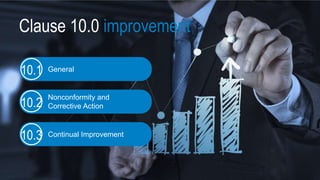
Clause 10.0 improvement
General
10.1
Nonconformity and
Corrective Action
10.2
Continual Improvement
10.3
Clause 10.0 Improvement
The Organization shall determine and select opportunities for improvement and implement
any necessary actions to meet customer requirements and enhance customer satisfaction:
• Improve the products and services to meet the
requirements.
• Correct, prevent or reduce undesired effects
• Improve the performance and effectiveness of
the QMS.
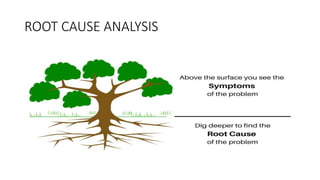
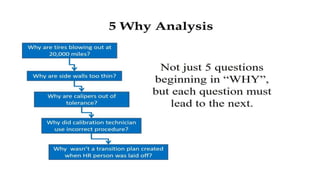
ROOT CAUSE ANALYSIS
Clause 10.2 & 10.3 Nonconformity and Corrective
Actions & Improvement
1. React to Nonconformity
2. Evaluate the need for action
3. Implement any action needed
4. Update Risks and Opportunities
5. Review the effectiveness of any
corrective action
6. Make changes to the QMS as
necessary
Meetings, coaching and mentoring sessions
ISO 9001:2015 Requirements.pptx

ISO 9001:2015 Requirements.pptx

  • 1.
    A grasp ofISO 9001: 2015 Requirements to Process Owners
  • 2.
    OBJECTIVES OF THETRAINING: • Define and Understand Quality Management System. • Grasp what is expected of ISO 9001:2015 Requirements. • Understand the roles in the implementation of ISO 9001:2015. • Determine the correct amount of documentation needed for the effectiveness of its QMS
  • 6.
    ISO (International Organizationfor Standardization) is an independent, non-governmental membership organization and the world's largest developer of voluntary International Standards. Worldwide federation of National Standard Bodies, with representatives from each of approximately 168 Countries. They began their official functions on February 23, 1947
  • 7.
    As of April2022, the ISO has developed over 24,261 standards, covering everything from manufactured products and technology to food safety, agriculture and healthcare. Because 'International Organization for Standardization' would have different acronyms in different languages (IOS in English, OIN in French for Organisation internationale de normalisation), ISO is derived from the Greek isos, meaning equal. ISO has 804 technical commitees and subcommittees concerned with standards development.
  • 9.
    “A quality managementsystem (QMS) is a collection of business processes focused on achieving quality policy and quality objectives to meet customer requirements.” “Total Customer Satisfaction” W. Edwards DEMING
  • 10.
    Iso 9001 Changes ISO9001:2008 ISO 9001:2015 Products Products and Services Exclusions Not Used Management Representative Not Used Documentation, Quality Manual, Documented Procedures, Records Documented Information Work Environment Environment for the Operation of Processes Monitoring and Measuring Equipment Monitoring and Measuring Resources Purchased Product Externally Provided Products and Services Supplier External Provider
  • 11.
    7 principles ofISO 9001:2015 Customer focus 1 leadership 2 Engagement of people 3 Process approach 4 improvement 5 Evidence-based decision making 6 Relationship management 7
  • 12.
    Why do weneed it and how will it help us? Reasons why companies get into iso • For Compliance • Prestige of Getting the Certification • Solution to Problem Areas • Quality Process Improvement
  • 13.
    Why do weneed it and how will it help us? Customers Employees Increased Customer Satisfaction Reduced Conflict in Discharge of Duty Assurance of Quality Service and Products Improved communications Enhanced Dependability on Company Products and Services Enhanced Teamwork Compliance w/ ISO and government requirements Efficient Work Assignment Minimal Orientation to New Employees
  • 14.
    ISO 9001:2015 Requirements 1.Scope 2. Normative References 3. Terms and Definitions 4. Context of the Organization 5. Leadership 6. Planning 7. Support 8. Operation 9. Performance Evaluation 10.Improvement
  • 15.
    Iso 9001:2015 PDCACycle Organization and its context (4) Customer Requirements Needs and expectations Of relevant interested Parties (4) Support & Operation (7,8) Performance Evaluation (9) Improvement (10) Planning (6) Customer satisfaction Products and services Results of the QMS Leadership (5) Plan Do Check Act
  • 16.
    Clause 4.0 Contextof the Organization Understanding the Organization and its Context 4.1 Understanding the Needs and Expectation of Interested Parties 4.2 Determining the Scope of the Quality Management System 4.4 Quality Management System and its Processes 4.3
  • 17.
    Clause 4.0 Contextof the Organization The Organization shall: • Determine, monitor and review external and internal issues and its information that affects the ability to achieve the intended results of its Quality Management System. • Determine, monitor and review the interested parties and its requirements that are relevant to the QMS. • Determine the boundaries and applicability of the QMS. • Establish, implement, maintain and continually improve a QMS, including the processes needed and their interactions.
  • 18.
    Clause 4.0 Contextof the Organization The Organization shall: • Determine the inputs required and the outputs. • Determine the sequence and interaction. • Determine and apply the criteria and methods to ensure the effective operation and control of these processes. • Determine the resources needed. • Assign the responsibilities and authorities. • Address the risks and opportunities. • Evaluate these processes and implement any changes. • Improve the processes and the QMS.
  • 25.
    CLeadership Leadership and Commitment 5.1 Policy 5.2 Organizationalroles, responsibilities, and authorities 5.3
  • 27.
    Clause 5.1 Leadershipand Commitment Top management shall demonstrate leadership and commitment with respect to the quality management system by: • Accept responsibility for your QMS. • Demonstrate a commitment to your QMS. • Ensure that a quality policy is developed. • Ensure that quality objectives are established. • Ensure that requirements are built into processes. • Ensure that your QMS achieves all intended results. • Promote the use of risk-based thinking. • Explain why quality management is important.
  • 28.
    Clause 5.1.2 CustomerFocus Top management shall demonstrate leadership and commitment with respect to customer focus by: • Customer and applicable statutory and regulatory requirements are determined, understood and consistently met • The risk and opportunities that can affect conformity of products and services and the ability to enhance customer satisfaction are determined and addressed • The focus on enhancing customer satisfaction is maintained
  • 29.
    Clause 5.2 Policy TheManagement shall ensure that the quality policy: • Is appropriate to the purpose of the organization and Context of the organization • Provides a framework for establishing and reviewing quality objectives; • Includes a commitment to satisfy applicable requirements and to continual improvement of the QMS • Be available and be maintained as documented information • Be communicated and understood within the organization • Be available to relevant interested parties, as appropriate
  • 30.
    Clause 5.3 OrganizationalRoles, Responsibilities, and Authorities Responsibilities and authorities shall be communicated and understood within the organization: Quality Management Representative  Ensuring QMS conforms to the requirements of the international standard.  Ensuring that the processes are delivering their intended outputs.  Reporting on the performance of the quality management system and on the opportunities for improvement to top management.  Ensuring the promotion of customer focus throughout the organization.

  • 31.
    WORKSHOP 1. Form agroup consisting of 3 - 5 members. 2. Choose any activity/ process. Create a PROCESS FLOW describing your daily work routine. 3. Identify the Key Result Areas (KRAs) of the respective processes. 4. Identify the indicators of effective implementation. (Key Performance Indicators) 5. What could be the possible factors that can affect the productivity?
  • 32.
    Planning Actions to addressrisks and opportunities 6.1 Quality Objectives and Planning to Achieve them 6.2 Planning of Changes 6.3
  • 36.
    Clause 6.1 Actionsto Address Risk and Opportunities When planning for the quality management system, the organization shall consider the issues referred to in 4.1 and 4.2 and determine the risks and opportunities that need to be addressed to: • Give assurance that the QUALITY management system can achieve its intended outcome. • Prevent or reduce undesired effects that may affect the organization. • Achieve continual improvement • The organization shall maintain documented information regarding these risks and opportunities and create processes for their mitigation within the organization.
  • 37.
    Clause 6.2 QualityObjectives and Planning to Achieve Them The organization shall establish quality objectives at relevant functions, levels and processes needed for the QMS. The Quality Objectives shall: • Be Consistent With The Quality Policy • Be Measurable • Take into account applicable requirements • Be relevant to conformity of products and services to enhancement of customer satisfaction • Be Monitored • Be Communicated • Be Updated As Appropriate
  • 38.
    Clause 6.3 Planningof changes When the organization determines the need for changes to the QMS, the changes shall be carried out in a planned manner. • Plan changes to your quality management system. • Consider the purpose of the changes you intend to make. • Consider responsibilities and authorities whenever you make changes. • Consider the consequences that changes could potentially produce. • Consider the availability of resources whenever you make changes. • Consider the integrity of your QMS whenever you make changes.
  • 40.
  • 42.
    Clause 7.1 Resources Theorganization shall provide the resources needed for the establishment, implementation, maintenance and continual improvement of the QMS. The organization shall determine and provide the persons necessary for the effective implementation of the QMS People Buildings, Facilities, Equipment including hardware and software, Transportation Resources, Information and Communication Infrastructure
  • 43.
    Clause 7.1 Resources Theorganization shall provide the resources needed for the establishment, implementation, maintenance and continual improvement of the QMS. Social, Psychological, Physical (temperature, heat, humidity, light, hygiene, airflow, noise) Environment for the Operations of Process The organization shall determine and provide the resources needed to ensure valid and reliable results. Monitoring and Measuring devices The organizational shall determine the knowledge necessary for the operation of its processes. Organizational knowledge
  • 51.
    Clause 7.3 &7.4 Awareness and Communication The Organization shall: • Team Briefings, Meetings • Notice Boards, Company Magazine • Audio-Visual and Electronic Media • Optically effective management systems • To make people understand • To get people involved • To foster improvement • Quality Policy • Quality Objectives • Contribution to the effectiveness of the QMS • Implications of not conforming with the QMS How? Why? What?
  • 52.
    Clause 7.5 DocumentedInformation 1. Creating, Updating and Approval 2. Control of Documented Information 3. Distribution, Access Retrieval 4. Storage and Preservation 5. Control of Changes 6. Retention and Disposition 7. Control of EGD (Externally Generated Documents)
  • 56.
    Operation Operational Planning and Control 8.1 Requirementsfor Products and Services 8.2 Design and Development of Products and Services 8.3 Control of Externally provided Processes, Products and Services 8.4 Control of Nonconforming Outputs 8.7 Release of Products and Services 8.6 Production and Service Provision 8.5
  • 58.
    Clause 8.1 OperationalPlanning and Control The organization shall: • Determine the requirements for products and services • Establish criteria for the processes and acceptance of products and services • Determine needed resources • Implement control of the processes in accordance with the criteria • Determine and keep documented information to the extent necessary
  • 60.
    Clause 8.2 Requirementsfor Products and Services Maintaining effective customer communication – • Product Information • Handling of inquiries, contracts, orders, changes • Customer feedback and complaints, measurement of customer satisfaction • Handling of Customer Property • Contingency Actions
  • 61.
    Clause 8.3 The organization shallestablish, implement, and maintain a design and development process that is appropriate to ensure the subsequent provision of products and services: • Planning • Input • Output • Review, Verification, and validation • Control of Changes Design and Development of Products and Services
  • 62.
    Clause 8.4 The organizationshall establish, implement, and maintain a design and development process that is appropriate to ensure the subsequent provision of products and services: • Determine the controls to be applied to externally provided processes, products and services • Determine and apply criteria for evaluation, selection, monitoring of performance, re-evaluation • Ensure the externally provided processes, products and services do not adversely affect the organization's ability to consistently deliver conforming products and services to its customers Control of Externally Provided Processes, Products and Services
  • 64.
    Clause 8.5 Productionand Service Provision The organization shall implement production and service provision under controlled conditions. • Availability of Documented Information that specifies the product or service. • Implementation of monitoring and measurement activities. • Use of suitable infrastructure and environment. • Appointment of competent persons. • The validation, and periodic revalidation of the ability to achieve planned results of the processes. • The implementation of actions to prevent human error. • Methods for release, delivery and applicable post-delivery activities.
  • 65.
    Clause 8.5 Productionand Service Provision The organization shall implement production and service provision under controlled conditions. Identification and Traceability • Identify the Product • Identify the measurement status of product • Unique identification, where traceability is required Property belonging to customers or external providers • Identify • Exercise care, protect and maintain • Report loss, damage, etc. Preservation • Preserve conformity during internal processing and final delivery (Identification, Handling, Packaging, Storage and Protection)
  • 66.
  • 67.
    Clause 8.6 Releaseof Products and Services The organization shall implement planned arrangements, at appropriate stages to verify that the product and service requirements, have been met. The organization shall retain documented information on the release of products and services. The documented information shall include: • Evidence of conformity with the acceptance criteria. • Traceability to the person(s) authorizing the release.
  • 70.
    Clause 8.7 Controlof Nonconforming Outputs The organization shall take appropriate action based on the nature of the nonconformity and its effect on the conformity of products and services. This shall also apply to nonconforming products and services detected after delivery of products, during or after the provision of services: • Identify and control non-conforming products to prevent unintended use or delivery • Non-conforming products shall be corrected and verified after correction to demonstrate conformity • When non-conforming product is detected after delivery or use has started the organization shall take appropriate action.
  • 72.
    Repair & PreventiveMaintenance Activities
  • 73.
  • 74.
    Clause 9.0 CustomerSatisfaction The organization shall: • Monitor customer's perception of the degree to which their needs and expectations have been fulfilled • Determine the methods for obtaining, monitoring and reviewing the information.
  • 76.
    CPerformance Evaluation Monitoring, Measurement, Analysis,and Evaluation 9.1 Internal Audit 9.2 Management Review 9.3
  • 78.
    Clause 9.1 Monitoring,Measurement, Analysis and Evaluation The organization shall determine: • Conformity of products and services • The degree of customer satisfaction • The performance and effectiveness of the QMS • If Planning has been implemented effectively • The effectiveness of actions taken to address risks and opportunities • The performance of External Providers • The need for Improvements to the QMS. • The organization shall retain the appropriate documented information as evidence of results.
  • 79.
    Clause 9.2 InternalAudit The organization shall conduct internal audits at planned intervals to provide information on whether the QMS – conforms to: • The organization’s own requirements for its QMS • The requirements of the International Standard • Is effectively Implemented and Maintained See Reference – ISO 19011:2018 Standard
  • 80.
    Clause 9.2 InternalAudit The Management Review shall be planned and carried out taking into consideration • Customer satisfaction and feedback from relevant interested parties • The extent to which quality objectives have been met • Process performance and conformity of products and services • Nonconformities and corrective actions • Monitoring and measurement results • Audit results • The performance of external providers • The adequacy of resources • The effectiveness of actions taken to address risks and opportunities • Opportunities for improvement.
  • 83.
    Clause 10.0 improvement General 10.1 Nonconformityand Corrective Action 10.2 Continual Improvement 10.3
  • 84.
    Clause 10.0 Improvement TheOrganization shall determine and select opportunities for improvement and implement any necessary actions to meet customer requirements and enhance customer satisfaction: • Improve the products and services to meet the requirements. • Correct, prevent or reduce undesired effects • Improve the performance and effectiveness of the QMS.
  • 85.
  • 87.
    Clause 10.2 &10.3 Nonconformity and Corrective Actions & Improvement 1. React to Nonconformity 2. Evaluate the need for action 3. Implement any action needed 4. Update Risks and Opportunities 5. Review the effectiveness of any corrective action 6. Make changes to the QMS as necessary
  • 89.
    Meetings, coaching andmentoring sessions