Week 2 Lecture Notes
COM350
Practicing rhetorical criticism using specific methods
Chapter 2: Doing Rhetorical Criticism
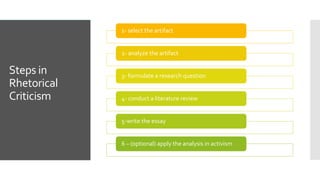
Steps in
Rhetorical
Criticism
1- select the artifact
2- analyze the artifact
3- formulate a research question
4- conduct a literature review
5-write the essay
6 – (optional) apply the analysis in activism
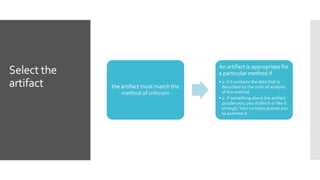
Select the
artifact the artifact must match the
method of criticism
An artifact is appropriate for
a particular method if
• 1- if it contains the data that is
described by the units of analysis
of the method
• 2- if something about the artifact
puzzles you, you dislike it or like it
strongly.Your curiosity pushes you
to examine it
Analyze the
artifact
Examine the artifact using units of
analysis
Units of analysis are things like
strategies, types of evidence, values,
fantasy themes, and metaphors
Code or analyze the artifact using the
procedure described by the method
chose.
Each critique method has a specific
process for analyzing an artifact.
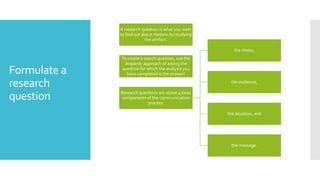
Formulate a
research
question
A research question is what you want
to find out about rhetoric by studying
the artifact.
To create a search question, use the
Jeopardy approach of asking the
question for which the analysis you
have completed is the answer!
Research questions are about 4 basic
components of the communication
process:
the rhetor,
the audience,
the situation, and
the message.
Avoid 3
mistakes
 Avoid 3 mistakes beginning critics make when writing a
research question:
 Making the question too broad and generic
 Wording of the questions does not allow for the
exploration and explanation of anything interesting or
significant
 including the specific artifact in the research question
(do not do this!).The question should be larger than the
artifact.
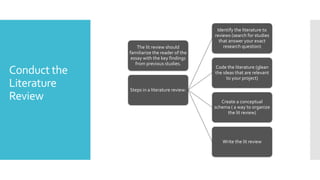
Conduct the
Literature
Review
The lit review should
familiarize the reader of the
essay with the key findings
from previous studies.
Steps in a literature review:
Identify the literature to
reviews (search for studies
that answer your exact
research question)
Code the literature (glean
the ideas that are relevant
to your project)
Create a conceptual
schema ( a way to organize
the lit review)
Write the lit review
Write the
essay
The essay has the following
parts:
The introduction: Orients
the reader to the topic and
tells the purpose of the
essay. Identify the research
question that the analysis
answers.
The literature review:Tell
about other studies that
have been conducted on this
artifact
Describe (justify) the
artifact.Tell why this artifact
is appropriate for this
research question.
Describe the method used
Report the findings of the
analysis
Tell the contribution to
rhetorical theory (the
contribution is your answer
to your research question)
Apply the analysis in
activism (optional). Use the
criticism to transform society
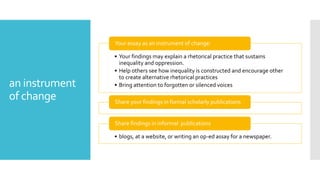
an instrument
of change
• Your findings may explain a rhetorical practice that sustains
inequality and oppression.
• Help others see how inequality is constructed and encourage other
to create alternative rhetorical practices
• Bring attention to forgotten or silenced voices
Your essay as an instrument of change:
Share your findings in formal scholarly publications
• blogs, at a website, or writing an op-ed assay for a newspaper.
Share findings in informal publications
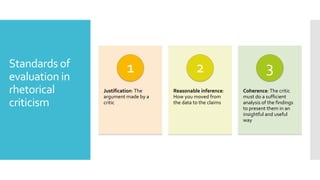
Standards of
evaluation in
rhetorical
criticism
Justification:The
argument made by a
critic
1
Reasonable inference:
How you moved from
the data to the claims
2
Coherence:The critic
must do a sufficient
analysis of the findings
to present them in an
insightful and useful
way
3
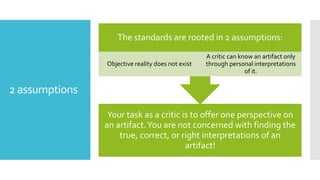
2 assumptions
Your task as a critic is to offer one perspective on
an artifact.You are not concerned with finding the
true, correct, or right interpretations of an
artifact!
The standards are rooted in 2 assumptions:
Objective reality does not exist
A critic can know an artifact only
through personal interpretations
of it.
References
 Foss, S. (2018). Rhetorical criticism, chapter 2. Long Grove: IL;
Waveland Press.

Week 2 lecturenotes com350

  • 1.
    Week 2 LectureNotes COM350 Practicing rhetorical criticism using specific methods Chapter 2: Doing Rhetorical Criticism
  • 2.
    Steps in Rhetorical Criticism 1- selectthe artifact 2- analyze the artifact 3- formulate a research question 4- conduct a literature review 5-write the essay 6 – (optional) apply the analysis in activism
  • 3.
    Select the artifact theartifact must match the method of criticism An artifact is appropriate for a particular method if • 1- if it contains the data that is described by the units of analysis of the method • 2- if something about the artifact puzzles you, you dislike it or like it strongly.Your curiosity pushes you to examine it
  • 4.
    Analyze the artifact Examine theartifact using units of analysis Units of analysis are things like strategies, types of evidence, values, fantasy themes, and metaphors Code or analyze the artifact using the procedure described by the method chose. Each critique method has a specific process for analyzing an artifact.
  • 5.
    Formulate a research question A researchquestion is what you want to find out about rhetoric by studying the artifact. To create a search question, use the Jeopardy approach of asking the question for which the analysis you have completed is the answer! Research questions are about 4 basic components of the communication process: the rhetor, the audience, the situation, and the message.
  • 6.
    Avoid 3 mistakes  Avoid3 mistakes beginning critics make when writing a research question:  Making the question too broad and generic  Wording of the questions does not allow for the exploration and explanation of anything interesting or significant  including the specific artifact in the research question (do not do this!).The question should be larger than the artifact.
  • 7.
    Conduct the Literature Review The litreview should familiarize the reader of the essay with the key findings from previous studies. Steps in a literature review: Identify the literature to reviews (search for studies that answer your exact research question) Code the literature (glean the ideas that are relevant to your project) Create a conceptual schema ( a way to organize the lit review) Write the lit review
  • 8.
    Write the essay The essayhas the following parts: The introduction: Orients the reader to the topic and tells the purpose of the essay. Identify the research question that the analysis answers. The literature review:Tell about other studies that have been conducted on this artifact Describe (justify) the artifact.Tell why this artifact is appropriate for this research question. Describe the method used Report the findings of the analysis Tell the contribution to rhetorical theory (the contribution is your answer to your research question) Apply the analysis in activism (optional). Use the criticism to transform society
  • 9.
    an instrument of change •Your findings may explain a rhetorical practice that sustains inequality and oppression. • Help others see how inequality is constructed and encourage other to create alternative rhetorical practices • Bring attention to forgotten or silenced voices Your essay as an instrument of change: Share your findings in formal scholarly publications • blogs, at a website, or writing an op-ed assay for a newspaper. Share findings in informal publications
  • 10.
    Standards of evaluation in rhetorical criticism Justification:The argumentmade by a critic 1 Reasonable inference: How you moved from the data to the claims 2 Coherence:The critic must do a sufficient analysis of the findings to present them in an insightful and useful way 3
  • 11.
    2 assumptions Your taskas a critic is to offer one perspective on an artifact.You are not concerned with finding the true, correct, or right interpretations of an artifact! The standards are rooted in 2 assumptions: Objective reality does not exist A critic can know an artifact only through personal interpretations of it.
  • 12.
    References  Foss, S.(2018). Rhetorical criticism, chapter 2. Long Grove: IL; Waveland Press.