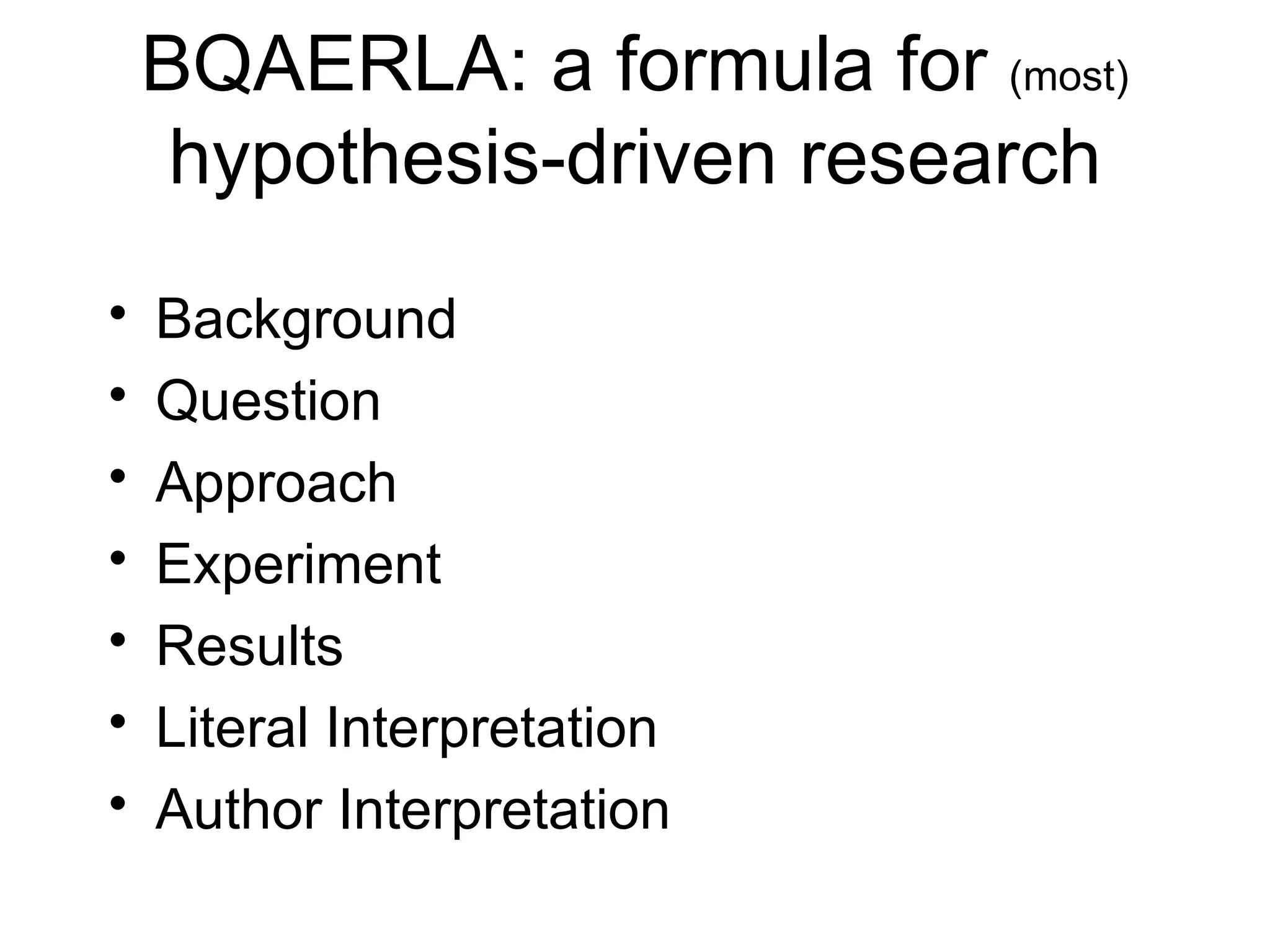
BQAERLA: a formula for  (most)  hypothesis-driven research Background Question Approach Experiment Results Literal Interpretation Author Interpretation
Background Summary of what is currently known about the subject/topic/protein/gene/process/etc. Sets up the Big Question and the smaller questions that are current in the field and specific for the study
Question(s) subdivided into  The Big Question  and smaller subquestions The Big Question is one that drives research in the field as a whole subquestions  drive individual studies (papers) and individual experiments
Approach The Approach lays out  in a general sense  how the question will be addressed It  does not  encompass experimental details
Experiment and Results The  Experiment  includes the relevant  detail  needed to understand scope Results  are usually figures/pictures/graphs/tables/etc. Results do not encompass  any  interpretation (comparative or judgemental, etc.)
What’s the difference between Literal and Author Interpretations? Literal interpretations  are simple, logical extensions of the Results (they are also known as  Conclusions ) Author interpretations  put the Literal interpretations into the context of the Big Question and often include some speculation and/or more questions
Biol-311L Cell Biology Techniques Oral Presentation Instructions Prepare a 10-12 minute presentation using  PowerPoint .  You will present your PowerPoint to a group of colleagues at one of the presentation sessions (date and time TBA, see BlackBoard).  This presentation is physically due by email or on some sort of disk (floppy, CD or ZIP) three hours before the start of the session.  The order of presentations will be determined at the beginning of the session, so be prepared to go first.  If you made the presentation on a home/personal computer, then you should try it on a college computer prior to submitting it. Consider the following: What  Background  information needs to be understood? What cellular processes and what are the Big Questions about the cellular process? What gene/protein are you talking about? What is known about this protein? Does it have any interesting domains? What are their molecular/biochemical functions? Does it have relatives (paralogues or orthologues) and what do they do? How are the biochemical functions and cellular role required by the tissue and whole organism? What is not known? Questions ? The focus of the presentation is one to three figures worth of  primary data .  The data that you present may be your own RNAi experiment  or  published data about your  C. elegans  gene  or  a homologue.  Data that provides insight into some significant aspect of the biology of the gene/protein is required .  What are the  Approaches  being employed to answer the  Questions ? Is there an hypothesis (what is the proposed answer to the questions)? What is the  Experiment  being presented?  How did you (or someone else) generate the  Result ? What is the  Result (s)? What is the  Literal  interpretation of the  Result ? What can be concluded? What is/are the  Author's   or your  interpretations of the  Result ? What might be done next?
 
Approach Question Experiment Result Literal Interp. Author Interp. 2004 Cohort
Approach Question Experiment Result Literal Interp. Author Interp. 2005 Cohort
Approach Question Experiment Result Literal Interp. Author Interp. Peer Evaluation  (2004 cohort)
The “Formula” Background Question Approach Experiment Results Literal Interpretation Author Interpretation
The “Formula” Background Question Approach Experiment Results Literal Interpretation Author Interpretation Sections of a research paper Abstract Introduction Materials and  Methods Results Discussion
The “Formula” Background Question Approach Experiment Justification Sections of a research proposal Background Specific Aims The reasons a proposed experiment is important, necessary, logical, interesting, etc.

Biowriting

  • 1.
    BQAERLA: a formulafor (most) hypothesis-driven research Background Question Approach Experiment Results Literal Interpretation Author Interpretation
  • 2.
    Background Summary ofwhat is currently known about the subject/topic/protein/gene/process/etc. Sets up the Big Question and the smaller questions that are current in the field and specific for the study
  • 3.
    Question(s) subdivided into The Big Question and smaller subquestions The Big Question is one that drives research in the field as a whole subquestions drive individual studies (papers) and individual experiments
  • 4.
    Approach The Approachlays out in a general sense how the question will be addressed It does not encompass experimental details
  • 5.
    Experiment and ResultsThe Experiment includes the relevant detail needed to understand scope Results are usually figures/pictures/graphs/tables/etc. Results do not encompass any interpretation (comparative or judgemental, etc.)
  • 6.
    What’s the differencebetween Literal and Author Interpretations? Literal interpretations are simple, logical extensions of the Results (they are also known as Conclusions ) Author interpretations put the Literal interpretations into the context of the Big Question and often include some speculation and/or more questions
  • 7.
    Biol-311L Cell BiologyTechniques Oral Presentation Instructions Prepare a 10-12 minute presentation using PowerPoint . You will present your PowerPoint to a group of colleagues at one of the presentation sessions (date and time TBA, see BlackBoard). This presentation is physically due by email or on some sort of disk (floppy, CD or ZIP) three hours before the start of the session. The order of presentations will be determined at the beginning of the session, so be prepared to go first. If you made the presentation on a home/personal computer, then you should try it on a college computer prior to submitting it. Consider the following: What Background information needs to be understood? What cellular processes and what are the Big Questions about the cellular process? What gene/protein are you talking about? What is known about this protein? Does it have any interesting domains? What are their molecular/biochemical functions? Does it have relatives (paralogues or orthologues) and what do they do? How are the biochemical functions and cellular role required by the tissue and whole organism? What is not known? Questions ? The focus of the presentation is one to three figures worth of primary data . The data that you present may be your own RNAi experiment or published data about your C. elegans gene or a homologue. Data that provides insight into some significant aspect of the biology of the gene/protein is required . What are the Approaches being employed to answer the Questions ? Is there an hypothesis (what is the proposed answer to the questions)? What is the Experiment being presented? How did you (or someone else) generate the Result ? What is the Result (s)? What is the Literal interpretation of the Result ? What can be concluded? What is/are the Author's or your interpretations of the Result ? What might be done next?
  • 8.
  • 9.
    Approach Question ExperimentResult Literal Interp. Author Interp. 2004 Cohort
  • 10.
    Approach Question ExperimentResult Literal Interp. Author Interp. 2005 Cohort
  • 11.
    Approach Question ExperimentResult Literal Interp. Author Interp. Peer Evaluation (2004 cohort)
  • 12.
    The “Formula” BackgroundQuestion Approach Experiment Results Literal Interpretation Author Interpretation
  • 13.
    The “Formula” BackgroundQuestion Approach Experiment Results Literal Interpretation Author Interpretation Sections of a research paper Abstract Introduction Materials and Methods Results Discussion
  • 14.
    The “Formula” BackgroundQuestion Approach Experiment Results Literal Interpretation Author Interpretation Sections of a research paper Abstract Introduction Materials and Methods Results Discussion
  • 15.
    The “Formula” BackgroundQuestion Approach Experiment Justification Sections of a research proposal Background Specific Aims The reasons a proposed experiment is important, necessary, logical, interesting, etc.
  • 16.
    The “Formula” BackgroundQuestion Approach Experiment Justification Sections of a research proposal Background Specific Aims The reasons a proposed experiment is important, necessary, logical, interesting, etc.