©2011, Brooks/Cole Publishing, A
Division of Cengage Learning, Inc.
Chapter 20
Qualitative Data Analysis
PowerPoint presentation developed by:
Jennifer Manuel & Sarah E. Bledsoe
©2011, Brooks/Cole Publishing, A
Division of Cengage Learning, Inc.
Overview
Introduction
Linking Theory and Analysis
Qualitative Data Processing
Computer Programs for Qualitative Data
©2011, Brooks/Cole Publishing, A
Division of Cengage Learning, Inc.
Introduction
Qualitative analysis is the nonnumerical
examination and interpretation of
observations
– Purpose is to discover underlying meanings
and patterns, such as changes over time or
possible causal links between variables
– Involves a continuing interplay between data
collection and theory
©2011, Brooks/Cole Publishing, A
Division of Cengage Learning, Inc.
Linking Theory and Analysis
Theories represent our understanding of how
life operates
The more our research confirms a set of
relationships among a set of concepts, the
more confident we become that our
understanding coincides with reality
©2011, Brooks/Cole Publishing, A
Division of Cengage Learning, Inc.
Linking Theory and Analysis
In examining your data, you will look for patterns
– Variable-oriented analysis attempts to gain a partial,
overall explanation by focusing on the interrelations
among a small number of variables (e.g., voting intentions
based on two or three key variables)
– Case-oriented analysis attempts to understand a
particular case fully (e.g., voting intentions based on as
many factors as possible in one case)
– Cross-case analysis involves the researcher paying close
attention to the variables important in the first case while
also understanding other cases in full detail and to explore
why cases reflect similar or different patterns
©2011, Brooks/Cole Publishing, A
Division of Cengage Learning, Inc.
Formal Qualitative Analysis Methods
Grounded Theory Method
– Fundamental, inductive tenet of building theory
from data
– Employs constant comparative method, which
involves 4 stages:
• Comparing evidence of concepts across cases
• Combining concepts and their phenomena
• Restricting concepts
• Reporting theory
©2011, Brooks/Cole Publishing, A
Division of Cengage Learning, Inc.
Formal Qualitative Analysis Methods
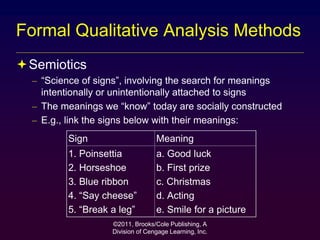
Semiotics
– “Science of signs”, involving the search for meanings
intentionally or unintentionally attached to signs
– The meanings we “know” today are socially constructed
– E.g., link the signs below with their meanings:
Sign Meaning
1. Poinsettia
2. Horseshoe
3. Blue ribbon
4. “Say cheese”
5. “Break a leg”
a. Good luck
b. First prize
c. Christmas
d. Acting
e. Smile for a picture
©2011, Brooks/Cole Publishing, A
Division of Cengage Learning, Inc.
Formal Qualitative Analysis Methods
Conversation Analysis
– Seeks to uncover the implicit assumptions and
structures in social life through a close scrutiny of
the way we converse with each other
– 3 fundamental assumptions:
• Conversation is a socially structured activity
• Conversations must be understood in context
• Conversation analysis attempts to understand the
structure and meaning of conversations through exact
transcripts of conversations (i.e., exact words, uhs, ers,
pauses and bad grammar are all noted)
©2011, Brooks/Cole Publishing, A
Division of Cengage Learning, Inc.
Qualitative Data Processing
The processing of qualitative data is as much
art as science
Three key tools for preparing data for analysis
are
– Coding
– Memoing
– Concept mapping
©2011, Brooks/Cole Publishing, A
Division of Cengage Learning, Inc.
Qualitative Data Processing: Coding
Coding involves classifying or categorizing
individual pieces of data coupled with some
kind of retrieval system
The concept is the organizing principle for
qualitative coding
Hypothesis-driven coding versus open coding
– Hypothesis-driven coding involves generating
codes based on theory a priori
– Open coding pertains to categorizing information
through close examination and questioning of the
data
©2011, Brooks/Cole Publishing, A
Division of Cengage Learning, Inc.
Qualitative Data Processing: Memoing
Memoing involves writing memos or notes to
yourself or others involved in the project
during analysis
Captures code meanings, theoretical ideas,
preliminary conclusions, and other thoughts
that will be useful during analysis, as well as in
writing up the results
3 types of memos: code notes, theoretical
notes, and operational notes
©2011, Brooks/Cole Publishing, A
Division of Cengage Learning, Inc.
Qualitative Data Processing: Concept
Mapping
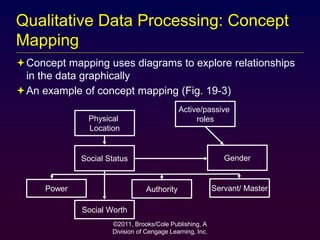
Concept mapping uses diagrams to explore relationships
in the data graphically
An example of concept mapping (Fig. 19-3)
Active/passive
rolesPhysical
Location
Social Status Gender
Power Authority Servant/ Master
Social Worth
©2011, Brooks/Cole Publishing, A
Division of Cengage Learning, Inc.
Computer Programs for Qualitative
Data
Researchers can take advantage of the
capabilities of common software tools such as
word processors, database programs, and
spreadsheets
Several computer programs, such as NUD*IST,
are specifically designed to assist researchers in
the analysis of qualitative data
Sociologists at the University of Surrey, England
have prepared a list of programs:
www.soc.surrey.ac.uk/sru/SRU1.html

Chapter 20 Presentation

  • 1.
    ©2011, Brooks/Cole Publishing,A Division of Cengage Learning, Inc. Chapter 20 Qualitative Data Analysis PowerPoint presentation developed by: Jennifer Manuel & Sarah E. Bledsoe
  • 2.
    ©2011, Brooks/Cole Publishing,A Division of Cengage Learning, Inc. Overview Introduction Linking Theory and Analysis Qualitative Data Processing Computer Programs for Qualitative Data
  • 3.
    ©2011, Brooks/Cole Publishing,A Division of Cengage Learning, Inc. Introduction Qualitative analysis is the nonnumerical examination and interpretation of observations – Purpose is to discover underlying meanings and patterns, such as changes over time or possible causal links between variables – Involves a continuing interplay between data collection and theory
  • 4.
    ©2011, Brooks/Cole Publishing,A Division of Cengage Learning, Inc. Linking Theory and Analysis Theories represent our understanding of how life operates The more our research confirms a set of relationships among a set of concepts, the more confident we become that our understanding coincides with reality
  • 5.
    ©2011, Brooks/Cole Publishing,A Division of Cengage Learning, Inc. Linking Theory and Analysis In examining your data, you will look for patterns – Variable-oriented analysis attempts to gain a partial, overall explanation by focusing on the interrelations among a small number of variables (e.g., voting intentions based on two or three key variables) – Case-oriented analysis attempts to understand a particular case fully (e.g., voting intentions based on as many factors as possible in one case) – Cross-case analysis involves the researcher paying close attention to the variables important in the first case while also understanding other cases in full detail and to explore why cases reflect similar or different patterns
  • 6.
    ©2011, Brooks/Cole Publishing,A Division of Cengage Learning, Inc. Formal Qualitative Analysis Methods Grounded Theory Method – Fundamental, inductive tenet of building theory from data – Employs constant comparative method, which involves 4 stages: • Comparing evidence of concepts across cases • Combining concepts and their phenomena • Restricting concepts • Reporting theory
  • 7.
    ©2011, Brooks/Cole Publishing,A Division of Cengage Learning, Inc. Formal Qualitative Analysis Methods Semiotics – “Science of signs”, involving the search for meanings intentionally or unintentionally attached to signs – The meanings we “know” today are socially constructed – E.g., link the signs below with their meanings: Sign Meaning 1. Poinsettia 2. Horseshoe 3. Blue ribbon 4. “Say cheese” 5. “Break a leg” a. Good luck b. First prize c. Christmas d. Acting e. Smile for a picture
  • 8.
    ©2011, Brooks/Cole Publishing,A Division of Cengage Learning, Inc. Formal Qualitative Analysis Methods Conversation Analysis – Seeks to uncover the implicit assumptions and structures in social life through a close scrutiny of the way we converse with each other – 3 fundamental assumptions: • Conversation is a socially structured activity • Conversations must be understood in context • Conversation analysis attempts to understand the structure and meaning of conversations through exact transcripts of conversations (i.e., exact words, uhs, ers, pauses and bad grammar are all noted)
  • 9.
    ©2011, Brooks/Cole Publishing,A Division of Cengage Learning, Inc. Qualitative Data Processing The processing of qualitative data is as much art as science Three key tools for preparing data for analysis are – Coding – Memoing – Concept mapping
  • 10.
    ©2011, Brooks/Cole Publishing,A Division of Cengage Learning, Inc. Qualitative Data Processing: Coding Coding involves classifying or categorizing individual pieces of data coupled with some kind of retrieval system The concept is the organizing principle for qualitative coding Hypothesis-driven coding versus open coding – Hypothesis-driven coding involves generating codes based on theory a priori – Open coding pertains to categorizing information through close examination and questioning of the data
  • 11.
    ©2011, Brooks/Cole Publishing,A Division of Cengage Learning, Inc. Qualitative Data Processing: Memoing Memoing involves writing memos or notes to yourself or others involved in the project during analysis Captures code meanings, theoretical ideas, preliminary conclusions, and other thoughts that will be useful during analysis, as well as in writing up the results 3 types of memos: code notes, theoretical notes, and operational notes
  • 12.
    ©2011, Brooks/Cole Publishing,A Division of Cengage Learning, Inc. Qualitative Data Processing: Concept Mapping Concept mapping uses diagrams to explore relationships in the data graphically An example of concept mapping (Fig. 19-3) Active/passive rolesPhysical Location Social Status Gender Power Authority Servant/ Master Social Worth
  • 13.
    ©2011, Brooks/Cole Publishing,A Division of Cengage Learning, Inc. Computer Programs for Qualitative Data Researchers can take advantage of the capabilities of common software tools such as word processors, database programs, and spreadsheets Several computer programs, such as NUD*IST, are specifically designed to assist researchers in the analysis of qualitative data Sociologists at the University of Surrey, England have prepared a list of programs: www.soc.surrey.ac.uk/sru/SRU1.html