Submitted By:
Osama Alam
Department of Bio-Technology
University of Science & Technology,
Bannu
September 2022
CONTENT
oDefinition
oImportance of Research Report
oCharacteristics of good Research
report
oTypes of Research Report
oSteps of Research Report
oLayout of Research Report
RESEARCH REPORT
• A well-written document describing your
research study in enough detail of what you did,
how you did, what you found, and how your
study is related to the body of knowledge in your
area.
IMPORTANCE OF RESEARCH REPORT
• Knowledge Transfer: A research report
serves as a means to effectively communicate the
findings of a systematic investigation to all and
sundry.
• Identification of Knowledge Gaps: With a
research report, you’d be able to identify
knowledge gaps for further inquiry. A research
report shows what has been done while hinting
at other areas needing systematic investigation.
Characteristics of good research report
 Attractive
 Clear topic
 Balanced language
 No repetition of facts
 Statement of scientific facts
 Practicability
 Description of the difficulties and the
shortcomings
TYPES OF RESEARCH REPORT
• Thesis / Dissertation: It is a document submitted in
support of candidature for an academic degree or
professional qualification presenting the author’s
research and findings.
• Journal Article: Journal articles that are written by
experts or authorities in a professional field to
report their research or scholarly opinion of a topic.
• Conference paper: Conference paper are article that
are submitted to a conference to get an opportunity
to present your results.
STEPS OF RESEARCH REPORT
Step 1: Analyze the task
1. What is the purpose of the report?
2. Who is the audience for the report?
3. What is the word limit?
4. What is the topic of the report?
5. What is the expect format of the report?
Step 2: Preparation of the final outline
• Outlines are the framework upon which long
written works are constructed.
• They are an aid to the logical organization of the
material and a reminder of the points to be
stressed in the report.
Step 3: Preparation of the rough draft
Develop the section headings
Write a thesis statement
Jot down anything you know already about the
topic and what you have done in the context of
your research study.
Steps 4: Rewriting and polishing of the
rough draft
• The careful revision makes the difference between a
mediocre and a good piece of writing.
Are the subject and purpose clearly stated?
Are all required parts of the report included?
Is each illustration clear and properly labeled?
Is each sentences written effectively?
Are the conclusion valid?
Is sufficient information given to support the
conclusion?
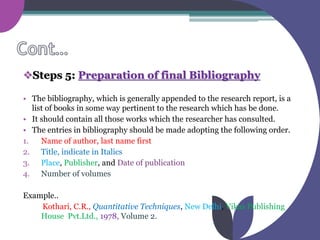
Steps 5: Preparation of final Bibliography
• The bibliography, which is generally appended to the research report, is a
list of books in some way pertinent to the research which has be done.
• It should contain all those works which the researcher has consulted.
• The entries in bibliography should be made adopting the following order.
1. Name of author, last name first
2. Title, indicate in Italics
3. Place, Publisher, and Date of publication
4. Number of volumes
Example..
Kothari, C.R., Quantitative Techniques, New Delhi, Vikas Publishing
House Pvt.Ltd., 1978, Volume 2.
Steps 6: Writing the final draft
• The final draft should be written in a concise and
objectives styles and in simple language.
• Avoiding vague expression such as a “it seems”,
“there may be”, and “the like once”.
• It should be remembered that every report should
be an attempt to solve intellectual problem and must
contribute to the solution of a problem and must
add to the knowledge of both the researcher and the
reader.
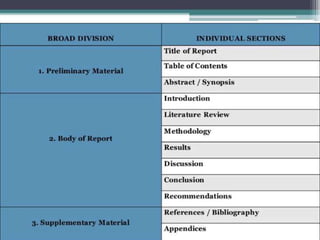
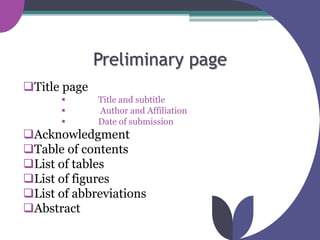
Preliminary page
Title page
 Title and subtitle
 Author and Affiliation
 Date of submission
Acknowledgment
Table of contents
List of tables
List of figures
List of abbreviations
Abstract
Abstract
• A summary of the research report
• Should be organized like the report
• Descriptive or structured abstract
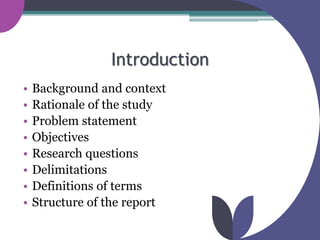
Introduction
• Background and context
• Rationale of the study
• Problem statement
• Objectives
• Research questions
• Delimitations
• Definitions of terms
• Structure of the report
Literature Review
• Summary of relevant studies with logical
connections.
• Identification of a research gap
• Hypothesis / Thesis
Methodology
• This section outlines; how you gathered
information, where from and how much.
What apparatus was used?
How did you conduct the experiment?
How many times did you repeat the procedure?
What precautions did you take to increase
accuracy?
RESULT
• This sections has only job which is to present the
finding of your research as simply and clearly as
possible.
• Use tables, graphs and diagram of your results.
Discussion
• Interpretation of results with respect to
hypothesis.
• Similarities and differences of your findings with
that of previous studies.
• Implications of findings for knowledge, policy
and practice.
• Strengths and limitations of the study.
Conclusion
• It summarize major findings of the study.
• It indicates whether hypothesis were accepted or
rejected.
Recommendation
• These can take two forms: recommendation for
further study, or recommendation for change, or
both. Each recommendation should trace directly to
a conclusion.
References
• Whenever you cite information from another
source, you must credit the source in your
reference. Always check with your instructor to
determine which reference style to use.
Appendices
• Material that is related but supplementary to the
main argument.
• http://www.slideshare.net/zulfazoufishan/resea
rch-report-45426923-m-app=android
• http://www.slideshare.net/ShrutiMishra19/ppt-
on-report-writing?from-m-app=andriod
• http://www.slideshare.net/kp-
abhinav/contents-of-research-report?from-m-
app=andriod
RESEARCH REPORT WRITING.pptx

RESEARCH REPORT WRITING.pptx

  • 1.
    Submitted By: Osama Alam Departmentof Bio-Technology University of Science & Technology, Bannu September 2022
  • 2.
    CONTENT oDefinition oImportance of ResearchReport oCharacteristics of good Research report oTypes of Research Report oSteps of Research Report oLayout of Research Report
  • 3.
    RESEARCH REPORT • Awell-written document describing your research study in enough detail of what you did, how you did, what you found, and how your study is related to the body of knowledge in your area.
  • 4.
    IMPORTANCE OF RESEARCHREPORT • Knowledge Transfer: A research report serves as a means to effectively communicate the findings of a systematic investigation to all and sundry. • Identification of Knowledge Gaps: With a research report, you’d be able to identify knowledge gaps for further inquiry. A research report shows what has been done while hinting at other areas needing systematic investigation.
  • 5.
    Characteristics of goodresearch report  Attractive  Clear topic  Balanced language  No repetition of facts  Statement of scientific facts  Practicability  Description of the difficulties and the shortcomings
  • 6.
    TYPES OF RESEARCHREPORT • Thesis / Dissertation: It is a document submitted in support of candidature for an academic degree or professional qualification presenting the author’s research and findings. • Journal Article: Journal articles that are written by experts or authorities in a professional field to report their research or scholarly opinion of a topic. • Conference paper: Conference paper are article that are submitted to a conference to get an opportunity to present your results.
  • 7.
    STEPS OF RESEARCHREPORT Step 1: Analyze the task 1. What is the purpose of the report? 2. Who is the audience for the report? 3. What is the word limit? 4. What is the topic of the report? 5. What is the expect format of the report?
  • 8.
    Step 2: Preparationof the final outline • Outlines are the framework upon which long written works are constructed. • They are an aid to the logical organization of the material and a reminder of the points to be stressed in the report.
  • 9.
    Step 3: Preparationof the rough draft Develop the section headings Write a thesis statement Jot down anything you know already about the topic and what you have done in the context of your research study.
  • 10.
    Steps 4: Rewritingand polishing of the rough draft • The careful revision makes the difference between a mediocre and a good piece of writing. Are the subject and purpose clearly stated? Are all required parts of the report included? Is each illustration clear and properly labeled? Is each sentences written effectively? Are the conclusion valid? Is sufficient information given to support the conclusion?
  • 11.
    Steps 5: Preparationof final Bibliography • The bibliography, which is generally appended to the research report, is a list of books in some way pertinent to the research which has be done. • It should contain all those works which the researcher has consulted. • The entries in bibliography should be made adopting the following order. 1. Name of author, last name first 2. Title, indicate in Italics 3. Place, Publisher, and Date of publication 4. Number of volumes Example.. Kothari, C.R., Quantitative Techniques, New Delhi, Vikas Publishing House Pvt.Ltd., 1978, Volume 2.
  • 12.
    Steps 6: Writingthe final draft • The final draft should be written in a concise and objectives styles and in simple language. • Avoiding vague expression such as a “it seems”, “there may be”, and “the like once”. • It should be remembered that every report should be an attempt to solve intellectual problem and must contribute to the solution of a problem and must add to the knowledge of both the researcher and the reader.
  • 14.
    Preliminary page Title page Title and subtitle  Author and Affiliation  Date of submission Acknowledgment Table of contents List of tables List of figures List of abbreviations Abstract
  • 15.
    Abstract • A summaryof the research report • Should be organized like the report • Descriptive or structured abstract
  • 16.
    Introduction • Background andcontext • Rationale of the study • Problem statement • Objectives • Research questions • Delimitations • Definitions of terms • Structure of the report
  • 17.
    Literature Review • Summaryof relevant studies with logical connections. • Identification of a research gap • Hypothesis / Thesis
  • 18.
    Methodology • This sectionoutlines; how you gathered information, where from and how much. What apparatus was used? How did you conduct the experiment? How many times did you repeat the procedure? What precautions did you take to increase accuracy?
  • 19.
    RESULT • This sectionshas only job which is to present the finding of your research as simply and clearly as possible. • Use tables, graphs and diagram of your results.
  • 20.
    Discussion • Interpretation ofresults with respect to hypothesis. • Similarities and differences of your findings with that of previous studies. • Implications of findings for knowledge, policy and practice. • Strengths and limitations of the study.
  • 21.
    Conclusion • It summarizemajor findings of the study. • It indicates whether hypothesis were accepted or rejected. Recommendation • These can take two forms: recommendation for further study, or recommendation for change, or both. Each recommendation should trace directly to a conclusion.
  • 22.
    References • Whenever youcite information from another source, you must credit the source in your reference. Always check with your instructor to determine which reference style to use. Appendices • Material that is related but supplementary to the main argument.
  • 23.