Report Writing
&
Presentation of Data
• A research report is: a written document or oral
presentation based on a written document that
communicates the purpose, scope, objective(s),
hypotheses, methodology, findings, limitations
& finally, recommendations of a research
project to others.
• The researcher has to convince the client [&
others who may read the report] that the
research findings can be acted on for their own
benefit.
Any research report contains,
1. descriptions on methodology,
2. results obtained,
3. and recommendations made.
• The basic orientation of a research report
depends on its audience.
• Before writing the report the researcher must
know his or her audience; he/she may have to
make assumptions about the composition,
background & interests of the target readers.
Types of Research Report:
• Two types of reports:-
– Technical Report: suitable for a target audience of
• researchers, research managers or other people familiar
with and interested in the technicalities such as research
design, sampling methods, statistical details etc.,
– Popular Report: suitable for:
• a more general audience, interested mainly in the research
findings as it is non-technical in nature.
• The writing style is designed to facilitate easy &
rapid reading and understanding of the research
findings and recommendations.
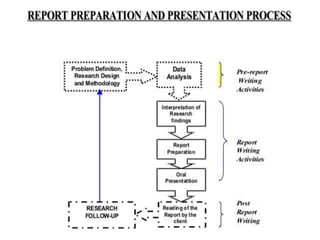
The first step in the process involves
• The interpretation of the results of data
analysis in light of:
– the marketing research problem investigated,
– and the research design & methodology
followed.
• The research report is a means of
communication that can be understood,
believed, trusted by everyone who are
likely to be affected by the research, &
acted upon by the decision maker.
Before writing the report:
• The researcher should discuss: the major
findings, conclusions, & recommendations with
the key decision makers.
– necessary to ensure that the report meets the
client's needs & is ultimately accepted.
• The entire research project:
– should be summarized in a single written report or
in several reports addressed to different readers.
– should present the findings in such a way that they
can be used directly as input into decision making.
Report Writing Format
• No universally accepted standard format
or style for research writing.
• Different researchers may prepare their
reports differently.
–The personality, background, expertise, &
responsibility of the researcher & those of
the decision maker for whom the report is
written interact to give each report a unique
character.
• Report formats are likely to vary with the
nature of the project itself.
• However, the research report closely
resembles the steps of the research
process.
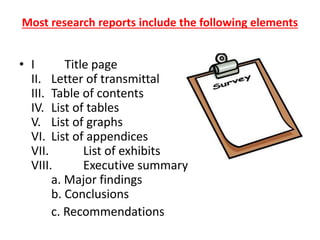
Most research reports include the following elements
• I Title page
II. Letter of transmittal
III. Table of contents
IV. List of tables
V. List of graphs
VI. List of appendices
VII. List of exhibits
VIII. Executive summary
a. Major findings
b. Conclusions
c. Recommendations
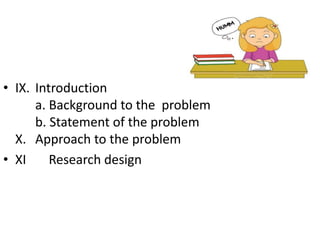
• IX. Introduction
a. Background to the problem
b. Statement of the problem
X. Approach to the problem
• XI Research design
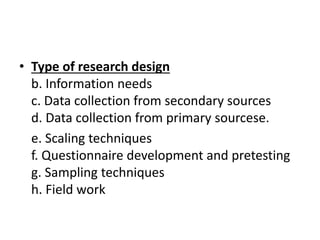
• Type of research design
b. Information needs
c. Data collection from secondary sources
d. Data collection from primary sourcese.
e. Scaling techniques
f. Questionnaire development and pretesting
g. Sampling techniques
h. Field work
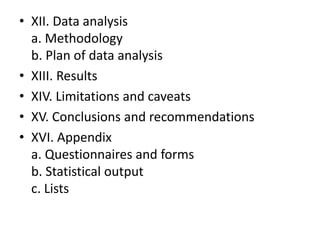
• XII. Data analysis
a. Methodology
b. Plan of data analysis
• XIII. Results
• XIV. Limitations and caveats
• XV. Conclusions and recommendations
• XVI. Appendix
a. Questionnaires and forms
b. Statistical output
c. Lists
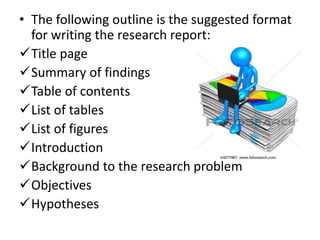
• The following outline is the suggested format
for writing the research report:
✓Title page
✓Summary of findings
✓Table of contents
✓List of tables
✓List of figures
✓Introduction
✓Background to the research problem
✓Objectives
✓Hypotheses
Methodology-Data collection
✓Sample and sampling method
✓ Statistical or qualitative methods used for
data analysis
✓ Sample description
Findings
✓ Results, interpretation and conclusions.
• The summary of findings is perhaps the most
important component of the written report,
since many of the management team who are
to receive a copy of the report will only read
this section.
• The summary of findings is usually put right
after the title page, or is bound separately &
presented together with the report.
Report Writing:
• Effective report writing is an art.
• Some basic points to note in writing a
report.
–Readers: The report should take into
account the level of readers' technical
sophistication, their interest in the project,
ability to understand as well as the
circumstances under which they will read
the report and how they will use it..
–Adherence to study objectives: A research
report must show that the research
objectives have been accomplished.
–Easy to follow: The most basic characteristic
of a good report is that it is easy to follow.
–It should be well organized, logically
structured, and clearly and lucidly written.
– Headings and sub-headings should be used
for different topics and subtopics
respectively
• Selectivity: A researcher must use his or her
discretion in deciding what should be included
in the report.
• Concise: A report should be concise. Yet
brevity should not be achieved at the expense
of completeness.
• Presentation: The report should be
professionally done with quality paper, good
typing, and attractive binding.
• Visual aids: Key information presented in the
text of a research report should be reinforced
with tables, graphs, pictures, maps, and other
visual devices.
• Guidelines for Tables: Statistical tables are a
vital part of the report and deserve special
attention.
• Every table should have a number and brief
but clear title.
• Basis or unit of measurement should be
clearly stated to facilitate understanding.
• The arrangement of the data item should
emphasize the most important aspect of the
data being presented.
• If necessary, explanations, comments etc.
should be provided as footnotes.
• If the table presents secondary data, the
source(s) must be cited clearly.
Oral Presentation
• Should be carefully prepared keeping the
audience in mind.
• A good presentation does not mean a lengthy
presentation.
• Carefully selected visual aids such as graphs,
tables, charts, maps etc. help presentation.
• During oral presentation, people may seek
clarification.
• The speaker must be patient and should not
show signs of anger or frustration. He or she
should be natural, establish eye contact with
the audience, and interact with them.
• Body language and descriptive gestures are
also quite useful.
Thank
You

Report Writing and Presentation of Data.pdf

  • 1.
  • 2.
    • A researchreport is: a written document or oral presentation based on a written document that communicates the purpose, scope, objective(s), hypotheses, methodology, findings, limitations & finally, recommendations of a research project to others. • The researcher has to convince the client [& others who may read the report] that the research findings can be acted on for their own benefit.
  • 3.
    Any research reportcontains, 1. descriptions on methodology, 2. results obtained, 3. and recommendations made. • The basic orientation of a research report depends on its audience. • Before writing the report the researcher must know his or her audience; he/she may have to make assumptions about the composition, background & interests of the target readers.
  • 4.
    Types of ResearchReport: • Two types of reports:- – Technical Report: suitable for a target audience of • researchers, research managers or other people familiar with and interested in the technicalities such as research design, sampling methods, statistical details etc., – Popular Report: suitable for: • a more general audience, interested mainly in the research findings as it is non-technical in nature. • The writing style is designed to facilitate easy & rapid reading and understanding of the research findings and recommendations.
  • 6.
    The first stepin the process involves • The interpretation of the results of data analysis in light of: – the marketing research problem investigated, – and the research design & methodology followed. • The research report is a means of communication that can be understood, believed, trusted by everyone who are likely to be affected by the research, & acted upon by the decision maker.
  • 7.
    Before writing thereport: • The researcher should discuss: the major findings, conclusions, & recommendations with the key decision makers. – necessary to ensure that the report meets the client's needs & is ultimately accepted. • The entire research project: – should be summarized in a single written report or in several reports addressed to different readers. – should present the findings in such a way that they can be used directly as input into decision making.
  • 8.
    Report Writing Format •No universally accepted standard format or style for research writing. • Different researchers may prepare their reports differently. –The personality, background, expertise, & responsibility of the researcher & those of the decision maker for whom the report is written interact to give each report a unique character.
  • 9.
    • Report formatsare likely to vary with the nature of the project itself. • However, the research report closely resembles the steps of the research process.
  • 10.
    Most research reportsinclude the following elements • I Title page II. Letter of transmittal III. Table of contents IV. List of tables V. List of graphs VI. List of appendices VII. List of exhibits VIII. Executive summary a. Major findings b. Conclusions c. Recommendations
  • 11.
    • IX. Introduction a.Background to the problem b. Statement of the problem X. Approach to the problem • XI Research design
  • 12.
    • Type ofresearch design b. Information needs c. Data collection from secondary sources d. Data collection from primary sourcese. e. Scaling techniques f. Questionnaire development and pretesting g. Sampling techniques h. Field work
  • 13.
    • XII. Dataanalysis a. Methodology b. Plan of data analysis • XIII. Results • XIV. Limitations and caveats • XV. Conclusions and recommendations • XVI. Appendix a. Questionnaires and forms b. Statistical output c. Lists
  • 15.
    • The followingoutline is the suggested format for writing the research report: ✓Title page ✓Summary of findings ✓Table of contents ✓List of tables ✓List of figures ✓Introduction ✓Background to the research problem ✓Objectives ✓Hypotheses
  • 16.
    Methodology-Data collection ✓Sample andsampling method ✓ Statistical or qualitative methods used for data analysis ✓ Sample description Findings ✓ Results, interpretation and conclusions.
  • 17.
    • The summaryof findings is perhaps the most important component of the written report, since many of the management team who are to receive a copy of the report will only read this section. • The summary of findings is usually put right after the title page, or is bound separately & presented together with the report.
  • 18.
    Report Writing: • Effectivereport writing is an art. • Some basic points to note in writing a report. –Readers: The report should take into account the level of readers' technical sophistication, their interest in the project, ability to understand as well as the circumstances under which they will read the report and how they will use it..
  • 19.
    –Adherence to studyobjectives: A research report must show that the research objectives have been accomplished. –Easy to follow: The most basic characteristic of a good report is that it is easy to follow. –It should be well organized, logically structured, and clearly and lucidly written. – Headings and sub-headings should be used for different topics and subtopics respectively
  • 20.
    • Selectivity: Aresearcher must use his or her discretion in deciding what should be included in the report. • Concise: A report should be concise. Yet brevity should not be achieved at the expense of completeness. • Presentation: The report should be professionally done with quality paper, good typing, and attractive binding.
  • 21.
    • Visual aids:Key information presented in the text of a research report should be reinforced with tables, graphs, pictures, maps, and other visual devices. • Guidelines for Tables: Statistical tables are a vital part of the report and deserve special attention. • Every table should have a number and brief but clear title.
  • 22.
    • Basis orunit of measurement should be clearly stated to facilitate understanding. • The arrangement of the data item should emphasize the most important aspect of the data being presented. • If necessary, explanations, comments etc. should be provided as footnotes. • If the table presents secondary data, the source(s) must be cited clearly.
  • 23.
    Oral Presentation • Shouldbe carefully prepared keeping the audience in mind. • A good presentation does not mean a lengthy presentation. • Carefully selected visual aids such as graphs, tables, charts, maps etc. help presentation.
  • 24.
    • During oralpresentation, people may seek clarification. • The speaker must be patient and should not show signs of anger or frustration. He or she should be natural, establish eye contact with the audience, and interact with them. • Body language and descriptive gestures are also quite useful.
  • 25.