Report writing and
Presentation of data
Mrs . Sapana Patil
•Definition: Report writing is a oral (or)
written presentation of evidence and the
findings in such detailed form, so as to be
readily understood and assessed by the
reader.
SIGNIFICANCE OF REPORT WRITING:
• Research report is considered a major component of the research study for
the research task remains incomplete till the report has been presented
and/or written.
• As a matter of fact even the most brilliant hypothesis, highly well-designed
and conducted research study, and the most striking generalizations and
findings are of little value unless they are effectively communicated to
others.
• The purpose of research is not well served unless the findings are made
known to others.
• Research results must invariably enter the general store of knowledge.
• There are people who do not consider writing a report as an integral part of
the research process.
• But the general opinion is in favor of treating the presentation of
research results or the writing of report as part and parcel of
the research project.
• Writing of report is the last step in a research study and requires
a set of skills somewhat different from those called for in respect
of the earlier stages of research.
• This task should be accomplished by the researcher with utmost
care; he may seek the assistance and guidance of experts for
the purpose.
STEPS IN REPORT WRITING:
(a) Logical analysis of the subject
matter.
b) Preparation of the final outline.
(c) Preparation of the rough draft.
(d) Rewriting and polishing.
(e) Preparation of the final
bibliography
(f) Writing the final draft.
A) LOGICAL ANALYSIS OF THE SUBJECT MATTER:
• It is the first step which is primarily concerned with the development
of a subject.
• There are two ways in which to develop a subject
• (a) Logically.
• (b) Chronologically.
• Logical development is made based on mental connections and
associations between the one thing and another by means of
analysis.
• Logical treatment often consists in developing the material from
the simple possible to the most complex structures.
• Chronological development is based on a connection or sequence in
time or occurrence.
B) PREPARATION OF THE FINAL OUTLINE:
• It is the next step in writing the research report "Outlines are the
framework upon which long written works are constructed.
• They are an aid to the logical organization of the material and a
reminder of the points to be stressed in the report."
C) PREPARATION OF THE ROUGH DRAFT:
• This follows the logical analysis of the subject and the
preparation of the final outline.
• Such a step is of utmost importance for the researcher now
sits to write down what he has done in the context of his
research study.
• He will write down the procedure adopted by him in
collecting the material for his study along with various
limitations faced by him, the technique of analysis
adopted by him, the broad findings and generalizations
and the various suggestions he wants to offer regarding
the problem concerned.
D) REWRITING AND POLISHING OF THE ROUGH DRAFT:
• This step happens to be most difficult part of all formal writing.
• Usually, this step requires more time than the writing of the rough
draft.
• The careful revision makes the difference between a mediocre and
a good piece of writing.
• While rewriting and polishing, one should also, all the aspects of
report and correct it if written wrong , should check whether
meaning of sentence is the same as we want to convey .
• " In addition the researcher should give due attention to the fact
that in his rough draft he has been consistent or not.
• He should check the mechanics of writing grammar, spelling
and usage
E) PREPARATION OF THE FINAL BIBLIOGRAPHY:
• Next in order comes the task of the preparation of the final
bibliography.
• The bibliography, which is generally appended to the research
report, is a list of books in some way pertinent to the research
that has been done.
• It should contain all those works which the researcher has
consulted.
• The bibliography should be arranged alphabetically and may be
divided into two parts.
• 1. The first part may contain the names of books and pamphlets.
• 2. The second part may contain the names of magazine and
newspaper articles.
• Generally, this pattern of bibliography is considered convenient
and satisfactory from the point of view of reader, though it is not
the only way of presenting bibliography.
• The entries in bibliography should be made
adopting the following order:
FOR BOOKS AND PAMPHLETS THE ORDER MAY BE
AS UNDER
1. Name of author, last name first.
2. Title, underlined to indicate italics
3. Place, publisher, and date of publication.
4. Number of volumes
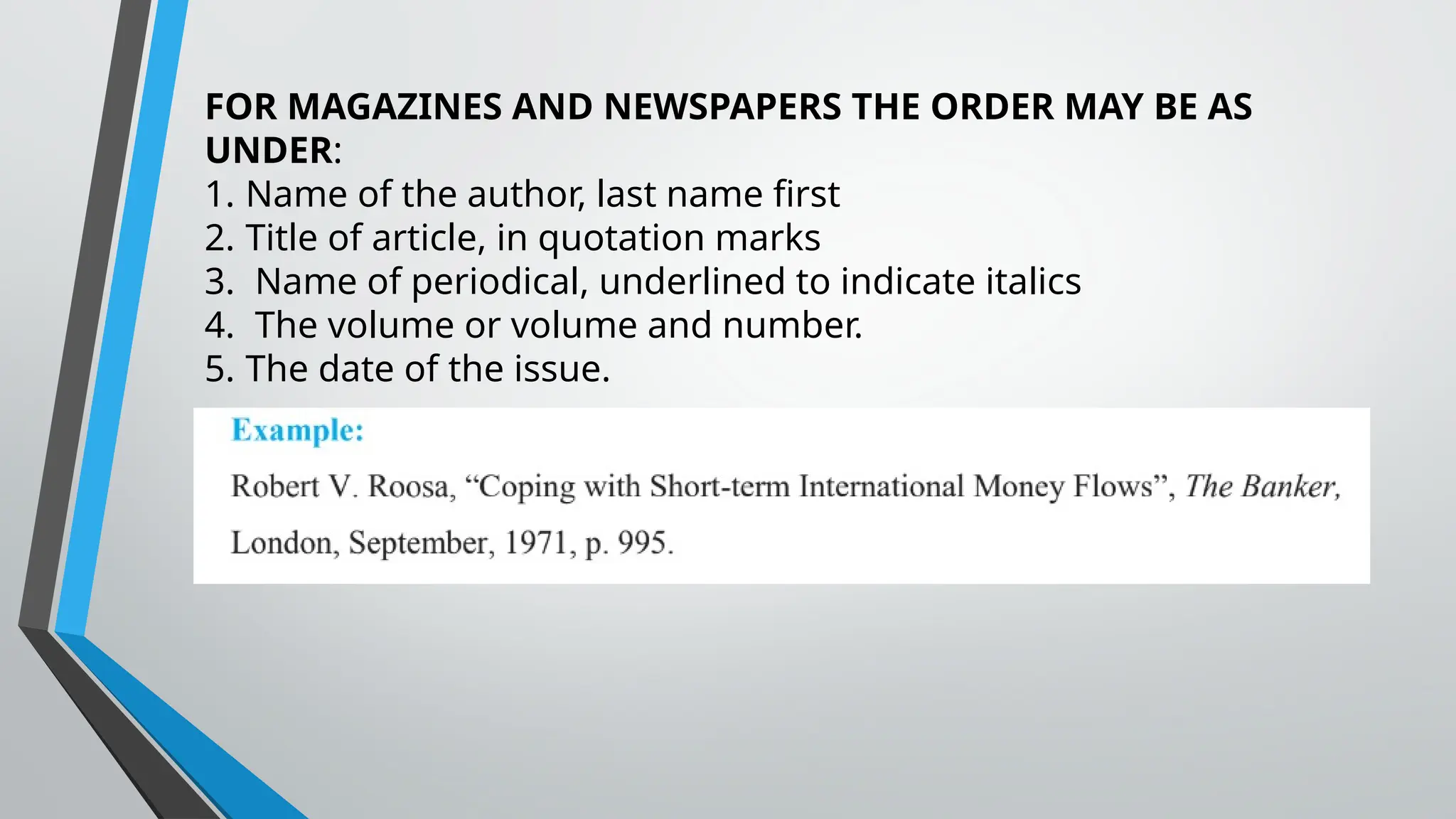
FOR MAGAZINES AND NEWSPAPERS THE ORDER MAY BE AS
UNDER:
1. Name of the author, last name first
2. Title of article, in quotation marks
3. Name of periodical, underlined to indicate italics
4. The volume or volume and number.
5. The date of the issue.
D) WRITING THE FINAL DRAFT:
• This constitutes the last step.
• The final draft should be written in a concise and objective
style and in simple language, avoiding vague expressions
such as "it seems", "there may be", and the like ones.
• While writing the final draft, the researcher must avoid
abstract terminology and technical jargon.( abbreviations,
Terms that are not familiar to most people. )
• A research report should not be dull, but must enthuse people
and maintain interest and must show originality.
• It must be remembered that every report should be an attempt
to solve some intellectual problem and must contribute to
the solution of a problem and must add to the knowledge of
both the researcher and the reader.
LAYOUT OF REPORT
• The layout of the report should be as follows:
(i) The preliminary pages;
(ii) The main text, and
(iii) The end matter.
(i) In its preliminary pages the report should carry title and date
followed by acknowledgments and a foreword. ( intro of article
and author )
• Then there should be a table of contents followed by a list of
tables and list of graphs and charts, if any, given in the report.
(ii) The main text of the report should have the following parts:
(a)Introduction:
• It should contain a clear statement of the objective of the
research and an explanation of the methodology adopted in
accomplishing the research.
• The scope of the study along with various limitations should as
well be stated in this part
(b) Summary of findings:
• After introduction there would appear a statement of findings and
recommendations in non-technical language.
• If the findings are extensive, they should be summarised.
(c) Main report: The main body of the report should be presented in
logical sequence and broken-down into readily identifiable
sections.
d) Conclusion:
• Towards the end of the main text, researcher should again put
iii. At the end of the report, appendices should be enlisted in
respect of all technical data.
Bibliography, i.e., a list of books, journals, reports, etc.,
consulted, should also be given in the end.
• Index should also be given specially in a published research
report.
Title, Acknowledgements, Abstract, Table of Contents, Introduction,
Literature Review, Conceptual Framework, Methods and Procedures,
Results, Summary and Conclusions.
A. Title: Authors, affiliations, keyword and similar information are
mentioned often on title page.
B. Acknowledgements: Recognize the assistance and support of
individuals and organizations, especially funding.
C. Abstract: A compact summary of the research report, sometimes
called "executive summary".
It is the only thing most people will read (in deciding to read your
paper).
Components of a Research Report:
D. Table of Contents: A listing or outline of the organization of
the report. It shows headings, subheadings, and other divisions.
Sometimes includes lists of Tables and Figures (esp. in thesis or
dissertation).
E. Introductions: Styles for introductions vary, from long and
detailed to short or even absent.
F. Review of Literature: It serves the same purpose as in the
research proposal.
G. Methods and Procedures: This section explains how the
analysis portion of the research was conducted.
It includes data collection and manipulation, data sources,
analytical procedures, models developed and used, empirical
procedures and techniques, and analyses conducted.
Also includes problems encountered and how they were
addressed.
H. Results (Findings): It presents and explains the results of the
analysis. This is the end product of all the analyses from which
objectives were either achieved or not.
Hypotheses have been tested and the results are reported here.
I. Summary and Conclusions: This provided the reader with a
general understanding of the research project. It most often
includes an overview of the entire study, emphasizing problems,
objectives, methods, procedures and results.
Conclusions represent the researcher's interpretations of the
results.
J. List of References: A listing of all references used in every part
of the report. Often very similar to the research proposal.
K. Appendices: They can be used to present material that might
disrupt the flow of thoughts in the report (eg. too much detail) or
include information of interest to only some readers eg.
Report writing and presentation of data.pptx

Report writing and presentation of data.pptx

  • 1.
    Report writing and Presentationof data Mrs . Sapana Patil
  • 2.
    •Definition: Report writingis a oral (or) written presentation of evidence and the findings in such detailed form, so as to be readily understood and assessed by the reader.
  • 3.
    SIGNIFICANCE OF REPORTWRITING: • Research report is considered a major component of the research study for the research task remains incomplete till the report has been presented and/or written. • As a matter of fact even the most brilliant hypothesis, highly well-designed and conducted research study, and the most striking generalizations and findings are of little value unless they are effectively communicated to others. • The purpose of research is not well served unless the findings are made known to others. • Research results must invariably enter the general store of knowledge. • There are people who do not consider writing a report as an integral part of the research process.
  • 4.
    • But thegeneral opinion is in favor of treating the presentation of research results or the writing of report as part and parcel of the research project. • Writing of report is the last step in a research study and requires a set of skills somewhat different from those called for in respect of the earlier stages of research. • This task should be accomplished by the researcher with utmost care; he may seek the assistance and guidance of experts for the purpose.
  • 5.
    STEPS IN REPORTWRITING: (a) Logical analysis of the subject matter. b) Preparation of the final outline. (c) Preparation of the rough draft. (d) Rewriting and polishing. (e) Preparation of the final bibliography (f) Writing the final draft.
  • 6.
    A) LOGICAL ANALYSISOF THE SUBJECT MATTER: • It is the first step which is primarily concerned with the development of a subject. • There are two ways in which to develop a subject • (a) Logically. • (b) Chronologically. • Logical development is made based on mental connections and associations between the one thing and another by means of analysis. • Logical treatment often consists in developing the material from the simple possible to the most complex structures. • Chronological development is based on a connection or sequence in time or occurrence.
  • 7.
    B) PREPARATION OFTHE FINAL OUTLINE: • It is the next step in writing the research report "Outlines are the framework upon which long written works are constructed. • They are an aid to the logical organization of the material and a reminder of the points to be stressed in the report."
  • 8.
    C) PREPARATION OFTHE ROUGH DRAFT: • This follows the logical analysis of the subject and the preparation of the final outline. • Such a step is of utmost importance for the researcher now sits to write down what he has done in the context of his research study. • He will write down the procedure adopted by him in collecting the material for his study along with various limitations faced by him, the technique of analysis adopted by him, the broad findings and generalizations and the various suggestions he wants to offer regarding the problem concerned.
  • 9.
    D) REWRITING ANDPOLISHING OF THE ROUGH DRAFT: • This step happens to be most difficult part of all formal writing. • Usually, this step requires more time than the writing of the rough draft. • The careful revision makes the difference between a mediocre and a good piece of writing. • While rewriting and polishing, one should also, all the aspects of report and correct it if written wrong , should check whether meaning of sentence is the same as we want to convey . • " In addition the researcher should give due attention to the fact that in his rough draft he has been consistent or not. • He should check the mechanics of writing grammar, spelling and usage
  • 10.
    E) PREPARATION OFTHE FINAL BIBLIOGRAPHY: • Next in order comes the task of the preparation of the final bibliography. • The bibliography, which is generally appended to the research report, is a list of books in some way pertinent to the research that has been done. • It should contain all those works which the researcher has consulted. • The bibliography should be arranged alphabetically and may be divided into two parts. • 1. The first part may contain the names of books and pamphlets. • 2. The second part may contain the names of magazine and newspaper articles. • Generally, this pattern of bibliography is considered convenient and satisfactory from the point of view of reader, though it is not the only way of presenting bibliography.
  • 11.
    • The entriesin bibliography should be made adopting the following order: FOR BOOKS AND PAMPHLETS THE ORDER MAY BE AS UNDER 1. Name of author, last name first. 2. Title, underlined to indicate italics 3. Place, publisher, and date of publication. 4. Number of volumes
  • 12.
    FOR MAGAZINES ANDNEWSPAPERS THE ORDER MAY BE AS UNDER: 1. Name of the author, last name first 2. Title of article, in quotation marks 3. Name of periodical, underlined to indicate italics 4. The volume or volume and number. 5. The date of the issue.
  • 13.
    D) WRITING THEFINAL DRAFT: • This constitutes the last step. • The final draft should be written in a concise and objective style and in simple language, avoiding vague expressions such as "it seems", "there may be", and the like ones. • While writing the final draft, the researcher must avoid abstract terminology and technical jargon.( abbreviations, Terms that are not familiar to most people. ) • A research report should not be dull, but must enthuse people and maintain interest and must show originality. • It must be remembered that every report should be an attempt to solve some intellectual problem and must contribute to the solution of a problem and must add to the knowledge of both the researcher and the reader.
  • 14.
    LAYOUT OF REPORT •The layout of the report should be as follows: (i) The preliminary pages; (ii) The main text, and (iii) The end matter. (i) In its preliminary pages the report should carry title and date followed by acknowledgments and a foreword. ( intro of article and author ) • Then there should be a table of contents followed by a list of tables and list of graphs and charts, if any, given in the report. (ii) The main text of the report should have the following parts:
  • 15.
    (a)Introduction: • It shouldcontain a clear statement of the objective of the research and an explanation of the methodology adopted in accomplishing the research. • The scope of the study along with various limitations should as well be stated in this part (b) Summary of findings: • After introduction there would appear a statement of findings and recommendations in non-technical language. • If the findings are extensive, they should be summarised. (c) Main report: The main body of the report should be presented in logical sequence and broken-down into readily identifiable sections. d) Conclusion: • Towards the end of the main text, researcher should again put
  • 16.
    iii. At theend of the report, appendices should be enlisted in respect of all technical data. Bibliography, i.e., a list of books, journals, reports, etc., consulted, should also be given in the end. • Index should also be given specially in a published research report.
  • 17.
    Title, Acknowledgements, Abstract,Table of Contents, Introduction, Literature Review, Conceptual Framework, Methods and Procedures, Results, Summary and Conclusions. A. Title: Authors, affiliations, keyword and similar information are mentioned often on title page. B. Acknowledgements: Recognize the assistance and support of individuals and organizations, especially funding. C. Abstract: A compact summary of the research report, sometimes called "executive summary". It is the only thing most people will read (in deciding to read your paper). Components of a Research Report:
  • 18.
    D. Table ofContents: A listing or outline of the organization of the report. It shows headings, subheadings, and other divisions. Sometimes includes lists of Tables and Figures (esp. in thesis or dissertation). E. Introductions: Styles for introductions vary, from long and detailed to short or even absent. F. Review of Literature: It serves the same purpose as in the research proposal. G. Methods and Procedures: This section explains how the analysis portion of the research was conducted. It includes data collection and manipulation, data sources, analytical procedures, models developed and used, empirical procedures and techniques, and analyses conducted. Also includes problems encountered and how they were addressed.
  • 19.
    H. Results (Findings):It presents and explains the results of the analysis. This is the end product of all the analyses from which objectives were either achieved or not. Hypotheses have been tested and the results are reported here. I. Summary and Conclusions: This provided the reader with a general understanding of the research project. It most often includes an overview of the entire study, emphasizing problems, objectives, methods, procedures and results. Conclusions represent the researcher's interpretations of the results. J. List of References: A listing of all references used in every part of the report. Often very similar to the research proposal. K. Appendices: They can be used to present material that might disrupt the flow of thoughts in the report (eg. too much detail) or include information of interest to only some readers eg.