Research Poster
Presented by:
Munib Qureshi
Presented to:
Dr Sehroon Duranni
What is a Research Poster?
• Posters are widely used in the academic community,
and most conferences include poster presentations in
their program.
• Research posters summarize information or research
concisely and attractively to help publicize it and
generate discussion.
• The poster is usually a mixture of a brief text mixed
with tables, graphs, pictures, and other presentation
formats.
• At a conference, the researcher stands by the poster
display while other participants can come and view the
presentation and interact with the author.
What makes a good poster?
• Important information should be readable from about
10 feet away
• Title is short and draws interest
• Word count of about 300 to 800 words
• Text is clear and to the point
• Use of bullets, numbering, and headlines make it easy
to read
• Effective use of graphics, color and fonts
• Consistent and clean layout
• Includes acknowledgments, your name and institutional
affiliation
Where do I begin?
• Answer these three questions:
• 1. What is the most
important/interesting/astounding finding from
my research project?
• 2. How can I visually share my research with
conference attendees? Should I use charts,
graphs, photos, images?
• 3. What kind of information can I convey during
my talk that will complement my poster?
What software can I use to make a
poster?
• PowerPoint:
A popular, easy-to-use option. It is part of Microsoft Office package
and is available on the library computers in rooms LC337 and LC336.
(Advice for creating a poster with PowerPoint).
Adobe Illustrator, Photoshop and InDesign:
Feature-rich professional software that is good for posters including
lots of high-resolution images, but they are more complex and
expensive.
Open Source Alternatives:
Open Office in the free alternative to MS Office (Impress is its
PowerPoint alternative). Inkscape and Gimp are alternatives to
Adobe products. For charts and diagrams try Gliffy or Lovely Charts.
A complete list of free graphics software
Biodegradation of Butyl Rubber by Aspergillus niger
• It has been reported that butyl rubber
weighing more 12 billion tons is
produced annually.
• The problem is with their fate in
environment after use.
• Most of the rubber products are used
onetime only and are disposed to the
environment in unsafe manner.
• The swelling phenomena of butyl
rubber increases risk of polluting
environment
• Aspergillus niger a key role in
degradation of butyl rubber .Therefore
it will be more suitable for
biodegradation.
Introduction
Existing methods of plastic waste
treatment is:
• Landfilling
• Pylorises
• Recycling
• Microbial Biodegradation
 it is the most preferred way for
degradation of rubber.
 Most of the waste materials in
demineralized by fungi, collectively
called decomposers.
 Present studies focusses on
biodegradation of butyl rubber waste
by microbes and GE microbes.
Feasibility Analysis
 How to develop green
technology/environment friendly
protocol to utilize waste butyl
rubber.
 Can A. niger could be an efficient
species for biodegradation of butyl
rubber.
 Is A. niger could be found at the
dumping site?
Research question
Our experiment provides that the
involvement of such microorganisms
as Aspergillus Niger in the
biodegradation of Butyl rubber
derivatives (tire tubes, ball bladders)
is decreased in weight and size by
desulfurization and oxidation. it is
expected that the generated results
will contribute to the solution of
certain problems associated with the
disposal and management will be
solved soon.
Conclusion
The present feasibility analysis
prioritizes the “Biodegradation
using microbes and GE microbes is
a better choice to address the plastic
waste as a global need ”.
Recommendation
1.Kroschwitz,ConciseEncyclopedi
a of Polymer Science Engineering.
Wiley- lntcrscience. New York.
2002.
2. Singh, B., Sharma, N., 2008.
Mechanistic implications of plastic
degradation. Polym. Degrad.
3. Bonhomme, S., Cuer, A., Delort,
A.M., Lemaire, J., Sancelme, M.,
Scott, G., 2003. Environmental
biodegradation of polyethylene.
Polymer Degrad.
4.Sivan, A., 2011. New perspective
in plastic biodegradation. Curr.
Opin. Biotechnol.
References
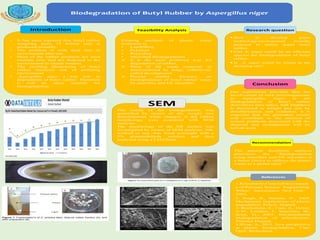
The extent of the biodegradation was
quantified by means of dry weight loss
determination while changes in the rubber
morphology were examined with SEM
analyses.
The morphology of the NR surface was
investigated by means of SEM analyses. NR,
washed or not, was fixed overnight with a
5% glutaraldehyde solution and then
analyzed using a LEO/Zeiss .
SEM
Refrences
• http://guides.nyu.edu/posters
• https://nau.edu/undergraduate-
research/poster-presentation-tips/
(Research Poster).pptx

(Research Poster).pptx

  • 1.
    Research Poster Presented by: MunibQureshi Presented to: Dr Sehroon Duranni
  • 2.
    What is aResearch Poster? • Posters are widely used in the academic community, and most conferences include poster presentations in their program. • Research posters summarize information or research concisely and attractively to help publicize it and generate discussion. • The poster is usually a mixture of a brief text mixed with tables, graphs, pictures, and other presentation formats. • At a conference, the researcher stands by the poster display while other participants can come and view the presentation and interact with the author.
  • 3.
    What makes agood poster? • Important information should be readable from about 10 feet away • Title is short and draws interest • Word count of about 300 to 800 words • Text is clear and to the point • Use of bullets, numbering, and headlines make it easy to read • Effective use of graphics, color and fonts • Consistent and clean layout • Includes acknowledgments, your name and institutional affiliation
  • 4.
    Where do Ibegin? • Answer these three questions: • 1. What is the most important/interesting/astounding finding from my research project? • 2. How can I visually share my research with conference attendees? Should I use charts, graphs, photos, images? • 3. What kind of information can I convey during my talk that will complement my poster?
  • 5.
    What software canI use to make a poster? • PowerPoint: A popular, easy-to-use option. It is part of Microsoft Office package and is available on the library computers in rooms LC337 and LC336. (Advice for creating a poster with PowerPoint). Adobe Illustrator, Photoshop and InDesign: Feature-rich professional software that is good for posters including lots of high-resolution images, but they are more complex and expensive. Open Source Alternatives: Open Office in the free alternative to MS Office (Impress is its PowerPoint alternative). Inkscape and Gimp are alternatives to Adobe products. For charts and diagrams try Gliffy or Lovely Charts. A complete list of free graphics software
  • 6.
    Biodegradation of ButylRubber by Aspergillus niger • It has been reported that butyl rubber weighing more 12 billion tons is produced annually. • The problem is with their fate in environment after use. • Most of the rubber products are used onetime only and are disposed to the environment in unsafe manner. • The swelling phenomena of butyl rubber increases risk of polluting environment • Aspergillus niger a key role in degradation of butyl rubber .Therefore it will be more suitable for biodegradation. Introduction Existing methods of plastic waste treatment is: • Landfilling • Pylorises • Recycling • Microbial Biodegradation  it is the most preferred way for degradation of rubber.  Most of the waste materials in demineralized by fungi, collectively called decomposers.  Present studies focusses on biodegradation of butyl rubber waste by microbes and GE microbes. Feasibility Analysis  How to develop green technology/environment friendly protocol to utilize waste butyl rubber.  Can A. niger could be an efficient species for biodegradation of butyl rubber.  Is A. niger could be found at the dumping site? Research question Our experiment provides that the involvement of such microorganisms as Aspergillus Niger in the biodegradation of Butyl rubber derivatives (tire tubes, ball bladders) is decreased in weight and size by desulfurization and oxidation. it is expected that the generated results will contribute to the solution of certain problems associated with the disposal and management will be solved soon. Conclusion The present feasibility analysis prioritizes the “Biodegradation using microbes and GE microbes is a better choice to address the plastic waste as a global need ”. Recommendation 1.Kroschwitz,ConciseEncyclopedi a of Polymer Science Engineering. Wiley- lntcrscience. New York. 2002. 2. Singh, B., Sharma, N., 2008. Mechanistic implications of plastic degradation. Polym. Degrad. 3. Bonhomme, S., Cuer, A., Delort, A.M., Lemaire, J., Sancelme, M., Scott, G., 2003. Environmental biodegradation of polyethylene. Polymer Degrad. 4.Sivan, A., 2011. New perspective in plastic biodegradation. Curr. Opin. Biotechnol. References The extent of the biodegradation was quantified by means of dry weight loss determination while changes in the rubber morphology were examined with SEM analyses. The morphology of the NR surface was investigated by means of SEM analyses. NR, washed or not, was fixed overnight with a 5% glutaraldehyde solution and then analyzed using a LEO/Zeiss . SEM
  • 7.