FINANCIAL
MANAGEMENT
Dr.S.BELLARMIN DIANA
ASSISTANT PROFESSOR
PG & RESEARCH DEPARTMENT OF MANAGEMENT STUDIES
BON SECOURS COLLEGE FOR WOMEN, THANJAVUR.
INTRODUCTION
Finance is defined as the provision of
money at the time it is wanted. It is the art
and science of managing money.
Finance is one of the basic foundation of all
kinds of economic activities.
It is the master key which provides access
to all the sources for being employed in
manufacturing and merchandising
activities.
Business Finance
Business finance is the activity which
is concerned with the acquisition and
conservation of capital funds in
meeting financial needs and overall
objectives of a business enterprises.
In other words it is the activity
concerned with planning, raising,
controlling and administering of the
funds used in the business
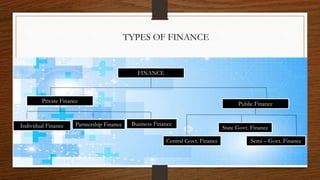
TYPES OF FINANCE
FINANCE
Private Finance Public Finance
Individual Finance Partnership Finance Business Finance
Central Govt. Finance
State Govt. Finance
Semi – Govt. Finance
Financial Management
Financial Management is concerned
with the efficient use of an important
economic resource, namely capital
funds.
It is an application of general
managerial principles to the area of
financial decision making.
It is the operational activity of a
business that is responsible for
obtaining and effectively utilizing the
funds necessary for efficient operations
IMPORTANCE
Financial management helps to determine the financial requirement of
the business concern and leads to take financial planning of the
concern.
It helps to acquire the needed funds from the best possible source at
minimum cost.
It enable the finance manager to use the funds properly and thereby
helps to reduce the cost of capital and increase in the value of the firm
OBJECTIVES
OBJECTIVES OTHER
OBJECTIVES
PROFIT
MAXIMIZATION
WEALTH
MAXIMIZATION
LIQUIDITY
MANAGEMENT
PROFIT MAXIMIZATION
• Profit maximization is the traditional and narrow
approach, which aims at, maximizes the profit of the
concern.
• Profit maximization is also called as cashing per
share maximization. It leads to maximize the
business operation for profit maximization.
• Ultimate aim of the business concern is earning
profit, hence, it considers all the possible ways to
increase the profitability of the concern
FAVORABLE ARGUMENTS FOR PROFIT
MAXIMIZATION
• Main aim is earning profit.
• Profit is the parameter of the business operation.
• Profit reduces risk of the business concern.
• Profit is the main source of finance.
• Profitability meets the social needs also.
CRITICISM OF PROFIT MAXIMIZATION
• Profit maximization leads to exploiting workers and
consumers.
• Profit maximization creates immoral practices such as
corrupt practice, unfair trade practice, etc.
• Profit maximization objectives leads to inequalities
among the stake holders such as customers, suppliers,
public shareholders, etc.
• .
CRITICISM OF PROFIT MAXIMIZATION
• It creates some unnecessary opinion regarding earning
habits of the business concern.
• It ignores the time value of money
• Profit maximization does not consider risk of the
business concern
WEALTH MAXIMIZATION
• Wealth maximization is one of the modern
approaches
• The term wealth means shareholder wealth
or the wealth of the persons those who are
involved in the business concern
• Wealth maximization is also known as value
maximization or net present worth
maximization.
FAVORABLE ARGUMENTS FOR WEALTH
MAXIMIZATION
• Wealth maximization is superior to the profit maximization
because the main aim of the business concern under this
concept is to improve the value or wealth of the
shareholders.
• It considers the comparison of the value to cost associated
with the business concern. Total value detected from the
total cost incurred for the business operation. It provides
extract value of the business concern.
FAVORABLE ARGUMENTS FOR WEALTH
MAXIMIZATION
• It considers both time and risk of the business concern.
• It provides efficient allocation of resources.
• It ensures the economic interest of the society.
CRITICISM OF WEALTH MAXIMIZATION
• Wealth maximization leads to prescriptive idea of the
business concern but it may not be suitable to present
day business activities.
• Wealth maximization is nothing, it is also profit
maximization, it is the indirect name of the profit
maximization.
• Wealth maximization creates ownership-management
controversy.
CRITICISM OF WEALTH MAXIMIZATION
• Management alone enjoy certain benefits.
• The ultimate aim of the wealth maximization
objectives is to maximize the profit.
• Wealth maximization can be activated only
with the help of the profitable position of the
business concern
LIQUIDITY MANAGEMENT
Liquidity means that the firm has:
• Adequate cash to pay bills as and when they fall due, and
• Sufficient cash reserves to meet emergencies and unforeseen demands,
at all time.
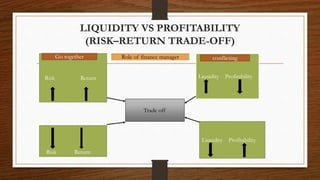
• Liquidity and profitability are conflicting decisions. When one
increases, the other decreases.
• More liquidity results in less profitability and vice versa. This conflict
finance manager has to face as all the financial decisions involve both
liquidity and profitability.
OTHER OBJECTIVES
• Ensuring a fair return to shareholders.
• Ensuring maximum operational efficiency by efficient and
effective utilization of finances.
• Building up reserves for expansion and growth, and
• Ensuring financial discipline in the organization.
LIQUIDITY VS PROFITABILITY
(RISK–RETURN TRADE-OFF)
Risk Return Liquidity Profitability
Trade off
Risk Return
Liquidity Profitability
Role of finance managerGo together conflicting
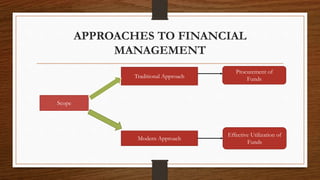
APPROACHES TO FINANCIAL
MANAGEMENT
Scope
Traditional Approach
Procurement of
Funds
Modern Approach
Effective Utilization of
Funds
TRADITIONAL APPROACH
As per this approach, the following aspects only were included in the
scope of financial management:
• Estimation of requirements of finance,
• Arrangement of funds from financial institutions,
• Arrangement of funds through financial instruments such as
shares, debentures, bonds and loans, and
• Looking after the accounting and legal work connected with the
raising of funds.
MODERN APPROACH
• The modern approach is analytical way of looking into the financial problems
of the firm.
• The emphasis of Financial Management has been shifted from raising of funds
to the effective and judicious utilization of funds.
• The central issue of financial policy is the use of funds. It is helpful in achieving
the broad financial goals which an enterprise sets for itself
FINANCE FUNCTION
• Investment Decision or Long-term Asset mix decision
• Finance Decision or Capital mix decision
• Liquidity Decision or Short-term asset mix decision
• Dividend Decision or Profit allocation decision
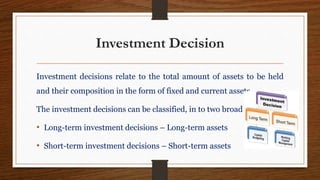
Investment Decision
Investment decisions relate to the total amount of assets to be held
and their composition in the form of fixed and current assets.
The investment decisions can be classified, in to two broad categories:
• Long-term investment decisions – Long-term assets
• Short-term investment decisions – Short-term assets
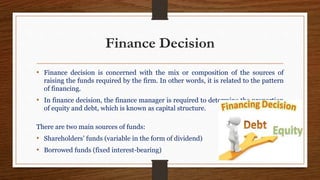
Finance Decision
• Finance decision is concerned with the mix or composition of the sources of
raising the funds required by the firm. In other words, it is related to the pattern
of financing.
• In finance decision, the finance manager is required to determine the proportion
of equity and debt, which is known as capital structure.
There are two main sources of funds:
• Shareholders’ funds (variable in the form of dividend)
• Borrowed funds (fixed interest-bearing)
Liquidity Decision
• Liquidity decision is concerned with the management of current
assets. Basically, this is Working Capital Management.
• It is concerned with short-term survival. Short term-survival is a
prerequisite for long-term survival.
• A proper balance must be maintained between liquidity and
profitability of the firm. This is the key area where finance manager
has to play significant role.
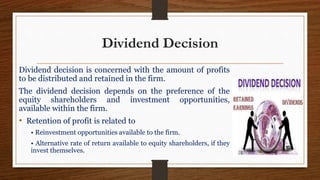
Dividend Decision
Dividend decision is concerned with the amount of profits
to be distributed and retained in the firm.
The dividend decision depends on the preference of the
equity shareholders and investment opportunities,
available within the firm.
• Retention of profit is related to
• Reinvestment opportunities available to the firm.
• Alternative rate of return available to equity shareholders, if they
invest themselves.
THANK YOU

Financial management

  • 1.
    FINANCIAL MANAGEMENT Dr.S.BELLARMIN DIANA ASSISTANT PROFESSOR PG& RESEARCH DEPARTMENT OF MANAGEMENT STUDIES BON SECOURS COLLEGE FOR WOMEN, THANJAVUR.
  • 2.
    INTRODUCTION Finance is definedas the provision of money at the time it is wanted. It is the art and science of managing money. Finance is one of the basic foundation of all kinds of economic activities. It is the master key which provides access to all the sources for being employed in manufacturing and merchandising activities.
  • 3.
    Business Finance Business financeis the activity which is concerned with the acquisition and conservation of capital funds in meeting financial needs and overall objectives of a business enterprises. In other words it is the activity concerned with planning, raising, controlling and administering of the funds used in the business
  • 4.
    TYPES OF FINANCE FINANCE PrivateFinance Public Finance Individual Finance Partnership Finance Business Finance Central Govt. Finance State Govt. Finance Semi – Govt. Finance
  • 5.
    Financial Management Financial Managementis concerned with the efficient use of an important economic resource, namely capital funds. It is an application of general managerial principles to the area of financial decision making. It is the operational activity of a business that is responsible for obtaining and effectively utilizing the funds necessary for efficient operations
  • 6.
    IMPORTANCE Financial management helpsto determine the financial requirement of the business concern and leads to take financial planning of the concern. It helps to acquire the needed funds from the best possible source at minimum cost. It enable the finance manager to use the funds properly and thereby helps to reduce the cost of capital and increase in the value of the firm
  • 7.
  • 8.
    PROFIT MAXIMIZATION • Profitmaximization is the traditional and narrow approach, which aims at, maximizes the profit of the concern. • Profit maximization is also called as cashing per share maximization. It leads to maximize the business operation for profit maximization. • Ultimate aim of the business concern is earning profit, hence, it considers all the possible ways to increase the profitability of the concern
  • 9.
    FAVORABLE ARGUMENTS FORPROFIT MAXIMIZATION • Main aim is earning profit. • Profit is the parameter of the business operation. • Profit reduces risk of the business concern. • Profit is the main source of finance. • Profitability meets the social needs also.
  • 10.
    CRITICISM OF PROFITMAXIMIZATION • Profit maximization leads to exploiting workers and consumers. • Profit maximization creates immoral practices such as corrupt practice, unfair trade practice, etc. • Profit maximization objectives leads to inequalities among the stake holders such as customers, suppliers, public shareholders, etc. • .
  • 11.
    CRITICISM OF PROFITMAXIMIZATION • It creates some unnecessary opinion regarding earning habits of the business concern. • It ignores the time value of money • Profit maximization does not consider risk of the business concern
  • 12.
    WEALTH MAXIMIZATION • Wealthmaximization is one of the modern approaches • The term wealth means shareholder wealth or the wealth of the persons those who are involved in the business concern • Wealth maximization is also known as value maximization or net present worth maximization.
  • 13.
    FAVORABLE ARGUMENTS FORWEALTH MAXIMIZATION • Wealth maximization is superior to the profit maximization because the main aim of the business concern under this concept is to improve the value or wealth of the shareholders. • It considers the comparison of the value to cost associated with the business concern. Total value detected from the total cost incurred for the business operation. It provides extract value of the business concern.
  • 14.
    FAVORABLE ARGUMENTS FORWEALTH MAXIMIZATION • It considers both time and risk of the business concern. • It provides efficient allocation of resources. • It ensures the economic interest of the society.
  • 15.
    CRITICISM OF WEALTHMAXIMIZATION • Wealth maximization leads to prescriptive idea of the business concern but it may not be suitable to present day business activities. • Wealth maximization is nothing, it is also profit maximization, it is the indirect name of the profit maximization. • Wealth maximization creates ownership-management controversy.
  • 16.
    CRITICISM OF WEALTHMAXIMIZATION • Management alone enjoy certain benefits. • The ultimate aim of the wealth maximization objectives is to maximize the profit. • Wealth maximization can be activated only with the help of the profitable position of the business concern
  • 17.
    LIQUIDITY MANAGEMENT Liquidity meansthat the firm has: • Adequate cash to pay bills as and when they fall due, and • Sufficient cash reserves to meet emergencies and unforeseen demands, at all time. • Liquidity and profitability are conflicting decisions. When one increases, the other decreases. • More liquidity results in less profitability and vice versa. This conflict finance manager has to face as all the financial decisions involve both liquidity and profitability.
  • 18.
    OTHER OBJECTIVES • Ensuringa fair return to shareholders. • Ensuring maximum operational efficiency by efficient and effective utilization of finances. • Building up reserves for expansion and growth, and • Ensuring financial discipline in the organization.
  • 19.
    LIQUIDITY VS PROFITABILITY (RISK–RETURNTRADE-OFF) Risk Return Liquidity Profitability Trade off Risk Return Liquidity Profitability Role of finance managerGo together conflicting
  • 20.
    APPROACHES TO FINANCIAL MANAGEMENT Scope TraditionalApproach Procurement of Funds Modern Approach Effective Utilization of Funds
  • 21.
    TRADITIONAL APPROACH As perthis approach, the following aspects only were included in the scope of financial management: • Estimation of requirements of finance, • Arrangement of funds from financial institutions, • Arrangement of funds through financial instruments such as shares, debentures, bonds and loans, and • Looking after the accounting and legal work connected with the raising of funds.
  • 22.
    MODERN APPROACH • Themodern approach is analytical way of looking into the financial problems of the firm. • The emphasis of Financial Management has been shifted from raising of funds to the effective and judicious utilization of funds. • The central issue of financial policy is the use of funds. It is helpful in achieving the broad financial goals which an enterprise sets for itself
  • 23.
    FINANCE FUNCTION • InvestmentDecision or Long-term Asset mix decision • Finance Decision or Capital mix decision • Liquidity Decision or Short-term asset mix decision • Dividend Decision or Profit allocation decision
  • 24.
    Investment Decision Investment decisionsrelate to the total amount of assets to be held and their composition in the form of fixed and current assets. The investment decisions can be classified, in to two broad categories: • Long-term investment decisions – Long-term assets • Short-term investment decisions – Short-term assets
  • 25.
    Finance Decision • Financedecision is concerned with the mix or composition of the sources of raising the funds required by the firm. In other words, it is related to the pattern of financing. • In finance decision, the finance manager is required to determine the proportion of equity and debt, which is known as capital structure. There are two main sources of funds: • Shareholders’ funds (variable in the form of dividend) • Borrowed funds (fixed interest-bearing)
  • 26.
    Liquidity Decision • Liquiditydecision is concerned with the management of current assets. Basically, this is Working Capital Management. • It is concerned with short-term survival. Short term-survival is a prerequisite for long-term survival. • A proper balance must be maintained between liquidity and profitability of the firm. This is the key area where finance manager has to play significant role.
  • 27.
    Dividend Decision Dividend decisionis concerned with the amount of profits to be distributed and retained in the firm. The dividend decision depends on the preference of the equity shareholders and investment opportunities, available within the firm. • Retention of profit is related to • Reinvestment opportunities available to the firm. • Alternative rate of return available to equity shareholders, if they invest themselves.
  • 28.