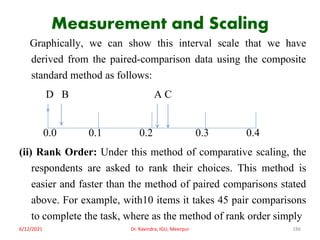
Business Research Methods
Unit-II
Dr. Ravindra
Associate Professor
Department of Commerce
Indira Gandhi University,
Meerpur, Rewari
1
Dr. Ravindra, IGU, Meerpur
6/12/2021
Research Design
Meaning
The formidable problem that follow the task of defining
the research problem is the preparation of a design of the
research project, popularly known as ‘research design’. A
research design is the arrangement of conditions for
collection and analysis of data in a manner that aims to
combine relevance to the research purpose with economy
in procedure. In, fact the research design is the conceptual
structure within which research is conducted; it constitute
the blueprint for the collection, measurement and analysis
of data. As such the design includes an outline of what the
6/12/2021 Dr. Ravindra, IGU, Meerpur 2
Research Design
researcher will do from writing the hypothesis and its
operational implications to the final analysis of data. More
explicitly the design happen to be in respect of;
(i) What is the study about?
(ii) What is the study being made?
(iii) Where will the study be carried out?
(iv) What type of data is required?
(v) Where can the required data be found?
(vi) What periods of time will the study include?
(vii)What will be the sample design?
6/12/2021 Dr. Ravindra, IGU, Meerpur 3
Research Design
(viii) What techniques of data collection will be used?
(ix) How will the data be analyzed?
(x) In what style will the report be prepared?
Keeping in view the above stated design decisions, one may
split the overall research design into the following part;
(i) The sampling design which deals with the method of
selecting items to be observed for given study.
(ii) The observational design which relates to the conditions
under which the observations are to be made.
(iii) The statistical design which concerns the question of how
many items are to be observed and how the information and
data gathered is to be analyzed.
6/12/2021 Dr. Ravindra, IGU, Meerpur 4
Research Design
(iv) The operational design which deals with the techniques
by which the procedures specified in the sampling,
statistical and observational design can be carried out.
Features of Research Design
(i) It is a plan that specifies the sources and types of
information relevant to the research problem.
(ii) It is a strategy specifying which approach will be used
for gathering and analyzing the data.
(iii) It also includes the time and cost budgets since most
studies are done under these two constraints.
6/12/2021 Dr. Ravindra, IGU, Meerpur 5
Research Design
In brief, research design must, at least, contain;
(a) A clear statement of the problem.
(b) Procedure and techniques to be used for gathering
information.
(c) The population to be studied.
(d) Methods to be used in processing and analyzing data.
Need for Research Design
Research design is needed because it facilitates the smooth
sailing of the various research operations, thereby making
6/12/2021 Dr. Ravindra, IGU, Meerpur 6
Need for Research Design
research as efficient as possible yielding maximal
information with minimal expenditure of effort, time and
money. Just as for better, economical and attractive
construction of a house, we need a blueprint well thought
out and prepared by an expert architect, similarly, we need
a research design or a plan in advance of data collection
and analysis for our research project. Research design
stands for advance planning of the methods to be adopted
for collecting the relevant data and the technique to be
used in their analysis, keeping in view the objective of the
6/12/2021 Dr. Ravindra, IGU, Meerpur 7
Need for Research Design
research and availability of staff, time and money. Preparation
of the research design should be done with great care as any
error in it may upset the entire project. Research design in
fact, has a great bearing on the reliability of the results arrived
at and as such constitute the firm foundation of the entire
edifice of the research work.
Thoughtlessness in designing the research project may result
in rendering the research exercise futile. It is, therefore,
imperative that an efficient and appropriate design must be
prepared before starting research operations.
6/12/2021 Dr. Ravindra, IGU, Meerpur 8
Features of a Good Design
A good design is often characterized by adjectives like;
Flexible, Appropriate , Efficient, Economical and so on.
Generally, the design which minimizes bias and maximizes
the reliability of the data collected and analyzed is considered
a good design. The design which gives the smallest
experimental error is supposed to be the best design in many
investigations. Similarly, a design which yields maximal
information and provides an opportunity for considering many
different aspects of a problem is considered most appropriate
and efficient design in respect of many research problems.
Thus, the question of good research design is related to the
6/12/2021 Dr. Ravindra, IGU, Meerpur 9
Features of a Good Design
purpose and objectives of the research problem and also with
the nature of the problem to be studied. A design may be quite
suitable in one case, but may be found wanting in one respect
or the other in the context of some other research problem.
One single design cannot serve the purpose of all type of
research problems.
A research design appropriate for a particular research
problem, usually involves the consideration of the following
factors;
(i) The means of obtaining information
(ii) The availability and skills of the researcher and his staff.
6/12/2021 Dr. Ravindra, IGU, Meerpur 10
Features of a Good Design
(iii) The objective of the problem to be studied.
(iv) The nature of the problem to be studied.
(v) The availability of time and money for the research work.
Important Concepts Related to the Research Design
Before describing the different research designs, it will be
appropriate to explain the various concepts relating to
designs so that these may be better and easily understood.
1. Dependent and Independent Variables: A concept
which can take on different quantitative value is called a
variable. As such the concept like weight, height, income
6/12/2021 Dr. Ravindra, IGU, Meerpur 11
Concepts Related to Research Design
are all examples of variables. Qualitative phenomena or
the attributes are also quantified on the basis of the
presence or absence of the concerning attribute (s).
Phenomena which can take on quantitatively different
values even in decimal points are called ‘continuous
variables’. But all variables are not continuous. If they can
only be expressed in integral values, they are non-
continuous variables or in statistical language ‘discrete
variables’. Age is an example of continuous variable, but
the number of children is an example of discrete variable.
6/12/2021 Dr. Ravindra, IGU, Meerpur 12
Concepts Related to Research Design
If one variable depends upon or is a consequence of the other
variable, it is termed as a dependent variable and the variable
that is antecedent to the dependent variable it is termed as an
independent variable.
2. Extraneous Variable: Independent variables that are not
related to the purpose of the study, but may affect the
dependent variable are termed as extraneous variables.
Whatever effect is noticed on dependent variable as a result of
extraneous variable (s) is technically described as an
‘experimental error’. A study must always be so designed that
the effect upon the dependent variable is attributed entirely to
the independent variable (s), and not to some extraneous
variable or variables.
6/12/2021 Dr. Ravindra, IGU, Meerpur 13
Concepts Related to Research Design
3. Control: One important characteristics of a good research
design is to minimize the influence or effect of extraneous
variables. The technical term ‘control’ is used when we
design the study minimizing the effects of extraneous
independent variables. In experimental researches, the
term ‘control’ is used to refer to restrain experimental
conditions.
4. Confounded Relationship: When the dependent variable
is not free from the influence of extraneous variable (s),
the relationship between the dependent and independent
variables is said to be confounded by an extraneous
variable (s).
6/12/2021 Dr. Ravindra, IGU, Meerpur 14
Concepts Related to Research Design
5. Research Hypothesis: When a prediction or a
hypothesized relationship is to be tested by scientific
methods, it is termed as research hypothesis. The research
hypothesis is a predictive statement that relates an
independent variable to a dependent variable. Usually, a
research hypothesis must contain, at least, one
independent and one dependent variable. Predictive
statements which are not to be objectively verified or the
relationship that are assumed but not to be tested, are not
termed research hypothesis.
6/12/2021 Dr. Ravindra, IGU, Meerpur 15
Concepts Related to Research Design
6. Experimental and Non-Experimental Hypothesis-Testing
Research: When the purpose of research is to test a research
hypothesis, it is termed as hypothesis-testing research. It can
be experimental design or of the non-experimental design.
Research in which the independent variable is manipulated is
termed as ‘experimental hypothesis-testing research’ and a
research in which an independent variable is not manipulated
is called ‘non-experimental hypothesis-testing research’.
7. Experiment and Control Groups: In an experimental
hypothesis-testing research when a group is exposed to usual
conditions, it is termed as ‘control group’, but when the group
is exposed to some novel or special condition, it is termed as
6/12/2021 Dr. Ravindra, IGU, Meerpur 16
Concepts Related to Research Design
‘experimental group’.
8. Treatments: The different conditions under which
experimental and control groups are put are usually referred to
as ‘treatments’. For example, if we want to determine through
an experiment the comparative impact of three varieties of
fertilizers on the yield of wheat, in that case the three varieties
of fertilizers will be treated as three treatments.
9. Experiment: The process of examining the truth of a
statistical hypothesis, relating to some research problem, is
known as an experiment. Experiment can be of two types viz.,
6/12/2021 Dr. Ravindra, IGU, Meerpur 17
Concepts Related to Research Design
absolute experiment and comparative experiment. If we want
to determine the impact of a fertilizer on the yield of a crop, it
is a case of absolute experiment; but if we want to determine
the impact of one fertilizer as compared to the impact of some
other fertilizer, our experiment then will be termed as a
comparative experiment. Often, we undertake comparative
experiments when we talk about designs of experiments.
10. Experimental Unit (s): The predetermined plots or the
blocks, where different treatments are used, are known as
experiment units. Such experiment units must be selected very
carefully.
6/12/2021 Dr. Ravindra, IGU, Meerpur 18
Types of Research Design
Different research design can be categorized as;
1. Exploratory
2. Descriptive/Diagnostic
3. Experimental/Casual/Hypothesis -Testing
1. Exploratory Research Design: Exploratory research studies
are also termed as formulative research studies. The main
purpose of such studies is that of formulating a problem for
more precise investigation or of developing the working
hypothesis from an operational point of view. The major
emphasis in such studies is on the discovery of ideas and
insights. As such the research design appropriate for such
6/12/2021 Dr. Ravindra, IGU, Meerpur 19
Types of Research Design
for such studies must be flexible enough to provide
opportunity for considering different aspects of a problem
under study. Inbuilt flexibility in research design is needed
because the research problem, broadly defined initially, is
transformed into one with more precise meaning in
exploratory studies, which infact may necessitate changes in
the research procedure for gathering relevant data. Generally
the following three methods in the context of research design
for such studies are talked about;
(i) The survey of concerning literature.
(ii) The experience survey.
(iii) The analysis of ‘insight stimulating examples’.
6/12/2021 Dr. Ravindra, IGU, Meerpur 20
Types of Research Design
2. Descriptive and Diagnostic Research Design: Descriptive
research studies are those studies which are concerned with
describing the characteristics of a particular individual, or of a
group, whereas diagnostic research studies determine the
frequency with which something occurs or its association with
something else. The studies concerning whether certain
variables are associated are examples of diagnostic research
studies. As against this, studies concerned with specific
predictions, with narration of facts and characteristics
concerning individual, group or situation are all examples of
descriptive research studies. Most of the social research comes
6/12/2021 Dr. Ravindra, IGU, Meerpur 21
Types of Research Design
under this category. From the point of view of the research
design, the descriptive as well as diagnostic studies share
common requirements and as such we may group together
these two types of research studies. In descriptive as well as
diagnostic studies, the researcher must be able to define
clearly, what he want to measure and must find adequate
methods for measuring it along with a clear cut definition of
‘population’ he want to study. Since the aim is to obtain
complete and accurate information in the said studies, the
procedure to be used must be carefully planed. The research
design must make enough provision for protection against
bias and must maximize reliability, with due concern for the
6/12/2021 Dr. Ravindra, IGU, Meerpur 22
Types of Research Design
economical completion of the research study. The design
in such studies must be rigid and not flexible and must
focus attention on the following;
(i) Formulating the objective of the study.
(ii) Designing the methods of data collection.
(iii) Selecting the sample.
(iv) Collecting the data.
(v) Processing and analyzing the data.
(vi) Reporting the findings.
6/12/2021 Dr. Ravindra, IGU, Meerpur 23
Types of Research Design
3. Experimental/Casual/Hypothesis-Testing Research
Design: Hypothesis-testing research studies or
experimental design are those where the researcher tests
the hypothesis or casual relationship between variables.
Such studies require procedure that will not only reduce
bias and increase reliability, but will permit drawing
inferences about causality. Usually experiments meet this
requirement. Hence, when we talk of research design
such studies, we often mean the design of experiments.
Professor R.A. Fisher’s name is associated with
experimental designs. Beginning of such design was made
6/12/2021 Dr. Ravindra, IGU, Meerpur 24
Types of Research Design
by him when he was working at Rothamsted Experimental
Station (Centre for agriculture research in England). As
such the study of experimental designs has its origin in
agricultural research. Professor Fisher found that by
dividing agricultural fields or plots into different blocks
and then by conducting experiments in each of these
blocks, whatever information is collected and inferences
drawn from them, happens to be more reliable. This fact
inspired him to develop certain experimental design for
testing hypothesis concerning scientific investigations.
Today, the experimental designs are being used in
researches relating to phenomena of several disciplines.
6/12/2021 Dr. Ravindra, IGU, Meerpur 25
Types of Research Design
Since experimental designs originated in the context of
agricultural operations, we still use, through in a technical
sense, several terms of agriculture such as treatment, yield,
plot, block etc. in experimental design.
Basic Principles of Experimental Design
Professor Fisher has enumerated three principles of
experimental designs; The Principle of Replication, The
Principle of Randomization, and The Principle of Local
Control. Let see these principle in detail.
1. Principle of Replication: The experiment should be repeated
6/12/2021 Dr. Ravindra, IGU, Meerpur 26
Types of Research Design
more than once. Thus, each treatment is applied in many
experimental units instead of one. By doing so the
statistical accuracy of the experiments is increased.
Suppose we are examine the effect of two varieties of rice.
For this purpose we may divide the field into two parts
and grow one variety in one part and the other variety in
the in the other part. We can then compare the yield of the
two parts and draw conclusion on that basis. But if we are
to apply the principle of replication to this experiment,
then we first divide the field into several parts, grow one
6/12/2021 Dr. Ravindra, IGU, Meerpur 27
Types of Research Design
variety in half of these parts and the other variety in the
remaining parts. We can then collect the data of yield of the
two varieties and draw conclusion by comparing the same.
The result so obtained will be more reliable in comparison to
the conclusion we draw without applying the principle of
replication. Conceptually replication does not present any
difficulty, but computationally it does.
2. The Principle of Randomization: This principle provides
protection when we conduct an experiment against the effect
of extraneous factors by randomization. In other words, this
principle indicates that we should design or plan the
experiment in such a way that the variations caused by
extraneous factors can all be combined under the general
6/12/2021 Dr. Ravindra, IGU, Meerpur 28
Types of Research Design
heading of ‘chance’. For instance, if we grow one variety
of rice, say, in the first half of the parts of a field and the
other variety is grown in the other half, then it is just
possible that the soil fertility may be different in the first
half in comparison to the other half. If this is so, our
results would be realistic. In such a situation, we may
assign the variety of rice to be grown in different parts of
the field on the basis of some random sampling technique
i.e., we may apply randomization principle and protect
ourselves against the effects of the extraneous factors.
6/12/2021 Dr. Ravindra, IGU, Meerpur 29
Types of Research Design
As such, through the application of the principle of
randomization, we can have a better estimate of the
experimental error.
3. The Principle of Local Control: This is another important
principle of experimental designs. Under it the extraneous
factor, the known source of variability, is made to vary
deliberately over as wide range as necessary and this needs to
be done in such a way that the variability it causes can be
measured and hence eliminated from the experimental error.
This means that we should plan the experiment in a manner
that we can perform a two-way analysis of variance, in which
the total variability of the data is divided into three component
6/12/2021 Dr. Ravindra, IGU, Meerpur 30
Types of Research Design
attributed to treatments (variety of rice in this case), the
extraneous factor (soil fertility in this case) and experimental
error. In other words, according to the principle of local
control, we first divide the field into several homogeneous
parts, known as blocks, and then each such block is divided
into parts equal to the number of treatments. Then the
treatments are randomly assigned to these parts of a block.
Dividing the field into several homogeneous parts is known as
‘blocking’. In general, blocks are the levels at which we hold
an extraneous factor fixed, so that we can measure its
contribution to the total variability of the data by means of a
6/12/2021 Dr. Ravindra, IGU, Meerpur 31
Types of Research Design
two-way analysis of variance. In brief, through the principle
of local control we can eliminate the variability due to
extraneous factor (s) from the experimental error.
Important experimental Designs
Experimental design refers to the framework or structure of
an experiment and as such there are several experimental
designs. We can classify experimental designs into two broad
categories, viz., informal experimental designs and formal
experimental designs. Informal experimental designs are those
designs that normally use a less sophisticated form of analysis
based on differences in magnitudes, whereas formal
experimental design offer relatively more control and use
6/12/2021 Dr. Ravindra, IGU, Meerpur 32
Types of Research Design
precise statistical procedures for analysis. Important
experimental designs are as follows;
(a) Informal experimental designs:
(i) Before-and-after without control design.
(ii) After-only with control design.
(iii) Before-and-after with control design.
(b) Formal experimental designs:
(i) Completely randomized design (C.R. Design)
(ii) Randomized block design (R.B. Design)
(iii) Latin square design (L.S. Design)
(iv) Factorial designs.
6/12/2021 Dr. Ravindra, IGU, Meerpur 33
Informal Experimental Research Design
We may briefly deal with each of the above stated
informal as well as formal experimental designs.
(i) Before-and-after without control design: in such a
design a single test group or area is selected and the
dependent variable is measured before the introduction of
the treatment. The treatment is then introduced and the
dependent variable is measured again after the treatment
has been introduced. The effect of the treatment would be
equal to the level of the phenomenon after the treatment
minus the level of the phenomenon before the treatment.
The design can be represented as;
6/12/2021 Dr. Ravindra, IGU, Meerpur 34
Informal Experimental Research Design
level of phenomena Treatment Level of phenomenon
Test Area: before treatment (X) introduced after treatment (Y)
Treatment Effect = (Y) – (X)
The main difficulty of such a design is that with the passage
of time considerable extraneous variables may be there in
its treatment effect.
(ii) After-only with control design: In this design two groups
or areas (test area and control area) are selected and the
treatment is introduced into the test area only. The
dependent variable is then measured in both the areas at the
6/12/2021 Dr. Ravindra, IGU, Meerpur 35
Informal Experimental Research Design
same time. Treatment impact is assessed by subtracting the
value of the dependent variable in the control area from its
value in the test area. This can be exhibited in the following
form;
Level of phenomenon
Test Area : Treatment introduced after treatment (Y)
Control Area : level of phenomenon
without treatment (Z)
Treatment Effect = (Y) – (Z)
6/12/2021 Dr. Ravindra, IGU, Meerpur 36
Informal Experimental Research Design
The basic assumption in such a design is that the two areas
are identical with respect to their behaviour towards the
phenomenon considered. If this assumptions is not true,
there is the possibility of extraneous variation entering
into the treatment effect. However, data can be collected
in such a design without the introduction of problems with
the passage of time. In this respect the design is superior
to before-and-after without control design.
(iii) Before-and-after with control design: In this design
two areas are selected and the dependent variable is
measured in both the areas for an identical time-period
6/12/2021 Dr. Ravindra, IGU, Meerpur 37
Informal Experimental Research Design
before the treatment. The treatment is then introduced into
the test area only, and the dependent variable is measured
in both for an identical time-period after the introduction
of the treatment. The treatment effect is determined by
subtracting the change in the dependent variable in the
control area from the changes in the dependent variable in
the test area. This design shown in this way; figure in the
next slide.
This design is superior to the above two designs for the
simple reason that it avoids extraneous variation resulting
both from the passage of time and from non-comparability
6/12/2021 Dr. Ravindra, IGU, Meerpur 38
Informal Experimental Research Design
of the test and control areas. But at times, due to lack of historical
data, time or a comparable control area, we should prefer to select
one of the first two informal designs stated below.
Time Period I Time Period II
Test area : Level of phenomenon Treatment Level of phenomenon
before treatment (X) introduction after treatment (Y)
Control area: Level of phenomenon Level of phenomenon
without treatment without treatment
(A) (Z)
Treatment Effect = (Y – X) - (Z – A)
6/12/2021 Dr. Ravindra, IGU, Meerpur 39
Formal Experimental Research Design
(i) Completely Randomized Design (C.R. Design): The
design involve only two principles viz., the principle of
replication and the principle of randomization of
experimental designs. It is the simplest possible design
and its procedure of analysis is also easier. The essential
characteristics of the design is that subjects are randomly
assigned to experimental treatments or vice-versa. For
instance, if we have 10 subjects and if we wish to test 5
under treatment A and 5 under treatment B, the
randomization process gives every possible group of 5
subjects selected from a set of 10 an equal opportunity of
6/12/2021 Dr. Ravindra, IGU, Meerpur 40
Formal Experimental Research Design
being assigned to treatment A and treatment B. One-way
analysis of variance (one way ANOVA) is used to
analyzed such a design. Even uneven replications can also
work in this design. It provides maximum number of
degrees of freedom to the error. Such a design is generally
used when experimental areas happen to be homogenous.
Technically, when all the variation due to uncontrolled
extraneous factors are included under the heading of
chance variation, we refer to the design of experiment as
C. R. Design. We can classify this design into two
categories;
6/12/2021 Dr. Ravindra, IGU, Meerpur 41
Formal Experimental Research Design
(a) Two-group simple randomized experimental design:
In a two-group simple randomized design, first of all the
population is defined and then from the population a
sample is selected randomly. Further, requirement of this
design is that items, after being selected randomly from
the population, be randomly assigned to the experimental
and control groups (such random assignment of the items
to two groups is technically described as principle of
randomization). Thus, this design yields two groups as
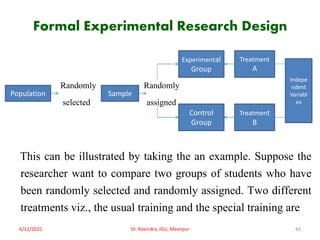
representatives of the population. The design is shown as;
6/12/2021 Dr. Ravindra, IGU, Meerpur 42
Formal Experimental Research Design
Randomly Randomly
selected assigned
This can be illustrated by taking the an example. Suppose the
researcher want to compare two groups of students who have
been randomly selected and randomly assigned. Two different
treatments viz., the usual training and the special training are
6/12/2021 Dr. Ravindra, IGU, Meerpur 43
Population Sample
Experimental
Group
Control
Group
Treatment
A
Treatment
B
Indepe
ndent
Variabl
es
Formal Experimental Research Design
being given to the two groups. The researcher hypothesis
is that the greater gain by the groups getting special
training. To determine this, he test each group before and
after the training, and then compare the amount of gain for
two groups to accept and reject the hypothesis. In this
example of randomize design, individual differences
among the student analyzed, but extraneous factor effect
(teachers effect) ignored.
(b) Random replication design: The limitation of two-
group randomization design is usually eliminated within
the random replication design. In the illustration just cited
6/12/2021 Dr. Ravindra, IGU, Meerpur 44
Formal Experimental Research Design
above, the teachers differences on the dependent variable were
ignored, i.e. the extraneous variable was not controlled. But in
a random replications design, the effect of such differences
are minimized by providing a number of repetitions for each
treatment. Each repetition is technically called a ‘replication’.
Randomize replication design serve two purposes viz., its
provides controls for the differential effects of the extraneous
independent variables and secondly, it randomizes any
individual differences among those conducting the treatments.
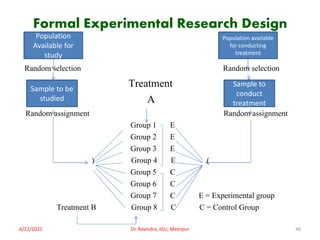
Diagrammatically we can illustrate the random replication
design as;
6/12/2021 Dr. Ravindra, IGU, Meerpur 45
Formal Experimental Research Design
Random selection Random selection
Treatment
A
Random assignment Random assignment
Group 1 E
Group 2 E
Group 3 E
) Group 4 E (
Group 5 C
Group 6 C
Group 7 C E = Experimental group
Treatment B Group 8 C C = Control Group
6/12/2021 Dr. Ravindra, IGU, Meerpur 46
Population
Available for
study
Population available
for conducting
treatment
Sample to be
studied
Sample to
conduct
treatment
Formal Experimental Research Design
From the diagram it is clear that there are two population in
the replication design. The sample is taken randomly from the
population available for study and is randomly assigned to,
say, four experimental and four control groups. Similarly,
sample is taken randomly from the population available to
control experiments (because eight groups, eight such
individuals be selected) and the eight individuals so selected
be randomly assigned to the eight groups. Generally, equal
number of items are put in each groups so that the size of the
group is not likely to affect the result of the study. Variables
relating to both population characteristics are assumed to be
6/12/2021 Dr. Ravindra, IGU, Meerpur 47
Formal Experimental Research Design
randomly distributed among the two groups. Thus, this
random replication design is, in fact, an extension of the
two-group simple randomized design.
(ii) Randomized Block Design (R.B. Design): Randomized
Block Design is an improvement over C.R. design. In the
R.B. design the principle of local control can be applied
along with the other two principles of experimental
design. In the R.B. design, subject are first divided into
groups, known as blocks, such that within each group the
subjects are relatively homogeneous in respect to some
selected variable. The variable selected for grouping the
6/12/2021 Dr. Ravindra, IGU, Meerpur 48
Formal Experimental Research Design
subjects is one that is believed to be related to the
measures to be obtained in respect of the dependent
variable. The number of subjects in a given block would
be equal to the number of the dependent variable. The
number of subjects in a given block would be equal to the
number of treatments and one subject in each block would
be randomly assigned to each treatment. In general, blocks
are the level at which we would the extraneous factor
fixed, so that its contribution to the total variability of data
can be measured. The main feature of the R.B. design is
that in this treatment appears the same number of times in
6/12/2021 Dr. Ravindra, IGU, Meerpur 49
Formal Experimental Research Design
each block. The R.B. design is analyzed by the two-way
analysis of variance technique.
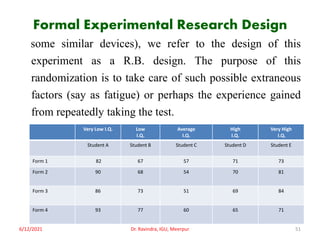
Let us illustrate the R.B. design with the help of an
example. Suppose four different forms of a standardized
test in statistics were given to each of five students
(elected one from each of the five I.Q. blocks) and
following are the sources which they obtained. The table
show the results in the next slide.
If each student separately randomized the order in which
he or she took the four test (by using random numbers or
6/12/2021 Dr. Ravindra, IGU, Meerpur 50
Formal Experimental Research Design
some similar devices), we refer to the design of this
experiment as a R.B. design. The purpose of this
randomization is to take care of such possible extraneous
factors (say as fatigue) or perhaps the experience gained
from repeatedly taking the test.
6/12/2021 Dr. Ravindra, IGU, Meerpur 51
Very Low I.Q. Low
I.Q.
Average
I.Q.
High
I.Q.
Very High
I.Q.
Student A Student B Student C Student D Student E
Form 1 82 67 57 71 73
Form 2 90 68 54 70 81
Form 3 86 73 51 69 84
Form 4 93 77 60 65 71
Formal Experimental Research Design
(iii) Latin Square Design (L.S. Design): This is an
experimental design very frequently used in agricultural
research. The conditions under which agricultural
investigations are carried out are different from those in
other studies for nature plays an important role in
agriculture. For instance, an experiment has to be made
through which the effects of five different varieties of
fertilizers on the yield of a certain crop, say wheat, is to be
judged. In such a case the varying fertility of the soil in
different blocks in which the experimental has to be
performed must be taken into consideration; otherwise the
6/12/2021 Dr. Ravindra, IGU, Meerpur 52
Formal Experimental Research Design
results obtained may not be very dependable because the
output happens to be the effect of not only fertilizers, but
it may also be the effect of fertility of soil. Similarly, there
may be impact of varying seeds on the yield. To overcome
such difficulties, the L.S. design is used when there are
two major extraneous factors such as the varying soil
fertility and varying seeds.
The Latin square design is one wherein each fertilizer, in
our example, appears five times but is used only once in
each row and each column of the design. In other words,
the treatments in a L.S. design are so allocated among the
6/12/2021 Dr. Ravindra, IGU, Meerpur 53
Formal Experimental Research Design
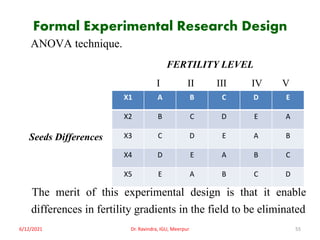
plots that no treatment occurs more than once in any one row
or any one column. The two blocking factors may be
represented through rows and column. The following is a
diagrammatic form of such a design in respect of, say, five
types of fertilizers, viz., A, B, C, D and E, and the two
blocking factors viz., the varying soil fertility and the varying
seeds. The diagram is represented in the next slid.
The diagram clearly shows that in a L.S. design the field is
divided into as many blocks as there are varieties of fertilizers
in such a way that each of the fertilizer variety is used in each
of the block (whether column-wise or row-wise) only once.
The analysis of the L.S. design is very similar to the two-way
6/12/2021 Dr. Ravindra, IGU, Meerpur 54
Formal Experimental Research Design
ANOVA technique.
FERTILITY LEVEL
I II III IV V
Seeds Differences
The merit of this experimental design is that it enable
differences in fertility gradients in the field to be eliminated
6/12/2021 Dr. Ravindra, IGU, Meerpur 55
X1 A B C D E
X2 B C D E A
X3 C D E A B
X4 D E A B C
X5 E A B C D
Formal Experimental Research Design
in comparison to the effects of different varieties of
fertilizers on the yield of the crop. But this design suffers
from one limitation, and it is that although each row and
each column means both up and across the field. In other
words that there is no interaction between treatments and
blocking factors. This defect can, however, be removed by
taking the means of row and column equal to the field
mean by adjusting the results. Another limitation of this
design is that it requires number of row, columns and
treatments to be equal. This reduces the utility of this
design.
6/12/2021 Dr. Ravindra, IGU, Meerpur 56
Formal Experimental Research Design
(iv) Factorial Design: Factorial designs are used in
experiments where the effects of varying more than one
factors are to be determined. They are specially important
in several economic and social phenomena where usually
a large number of factors affect a particular problem.
Factorial designs can be of two types; (a) simple factorial
designs and (b) complex factorial designs.
(a) Simple factorial designs: In case of simple factorial
designs, we consider the effects of varying two factors on
the dependent variable, but when an experiment is done
with more than two factors, we use complex factorial
designs. Simple factorial design is also termed as a ‘two-
6/12/2021 Dr. Ravindra, IGU, Meerpur 57
Formal Experimental Research Design
factor-factorial design’, whereas complex factorial design
is known as ‘multi-factor-factorial design.’ Simple
factorial design may either be a 2 × 2 simple factorial
design, or it may be, say, 3 × 4 or 5 × 3 or the like type of
simple factorial design. Some simple factorial designs as
under:
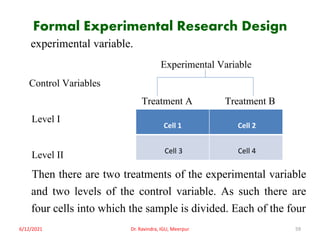
Example: A 2 × 2 simple factorial design can graphically
be depicted as in the figure at next slide.
In this design the extraneous variable to be controlled by
homogeneity is called the control variable and the
independent variable, which is manipulated, is called the
6/12/2021 Dr. Ravindra, IGU, Meerpur 58
Formal Experimental Research Design
experimental variable.
Experimental Variable
Control Variables
Treatment A Treatment B
Level I
Level II
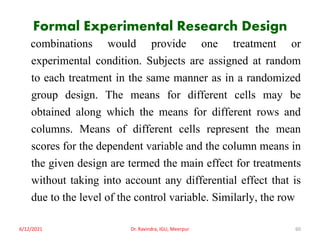
Then there are two treatments of the experimental variable
and two levels of the control variable. As such there are
four cells into which the sample is divided. Each of the four
6/12/2021 Dr. Ravindra, IGU, Meerpur 59
Cell 1 Cell 2
Cell 3 Cell 4
Formal Experimental Research Design
combinations would provide one treatment or
experimental condition. Subjects are assigned at random
to each treatment in the same manner as in a randomized
group design. The means for different cells may be
obtained along which the means for different rows and
columns. Means of different cells represent the mean
scores for the dependent variable and the column means in
the given design are termed the main effect for treatments
without taking into account any differential effect that is
due to the level of the control variable. Similarly, the row
6/12/2021 Dr. Ravindra, IGU, Meerpur 60
Formal Experimental Research Design
means in the said design are termed the main effects for
levels without regard to treatment. Thus, through this
design we can study the main effects of treatments as well
as the main effects of levels. An additional merit of this
design is that one can examine the interaction between
treatments and levels, through which one may say whether
the treatment and levels are independent of each other or
they are not so. The following examples make clear the
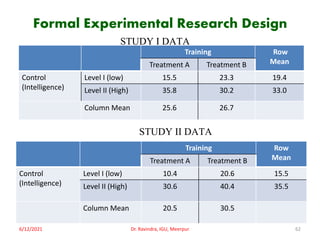
interaction effect between treatments and level. The data
obtained in case of two (2 × 2) simple factorial studies
given in the next slide;
6/12/2021 Dr. Ravindra, IGU, Meerpur 61
Formal Experimental Research Design
STUDY I DATA
STUDY II DATA
6/12/2021 Dr. Ravindra, IGU, Meerpur 62
Training Row
Mean
Treatment A Treatment B
Control
(Intelligence)
Level I (low) 15.5 23.3 19.4
Level II (High) 35.8 30.2 33.0
Column Mean 25.6 26.7
Training Row
Mean
Treatment A Treatment B
Control
(Intelligence)
Level I (low) 10.4 20.6 15.5
Level II (High) 30.6 40.4 35.5
Column Mean 20.5 30.5
Formal Experimental Research Design
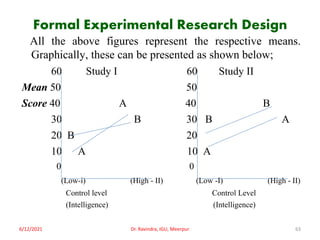
All the above figures represent the respective means.
Graphically, these can be presented as shown below;
60 Study I 60 Study II
Mean 50 50
Score 40 A 40 B
30 B 30 B A
20 B 20
10 A 10 A
0 0
(Low-i) (High - II) (Low -I) (High - II)
Control level Control Level
(Intelligence) (Intelligence)
6/12/2021 Dr. Ravindra, IGU, Meerpur 63
Formal Experimental Research Design
The graph relating to Study I indicates that there is an
interaction between the treatment and the level which , in
other words, means that the treatment and the level are not
independent of each other. The graph relating to Study II
shows that there is no interaction effect which means that
treatment and level in this study are relatively independent
of each other.
(b) Complex factorial design: Experiments with more than
two factors at a time involve the use of complex factorial
designs. A design which considers three or more
independent variables simultaneously is called a complex
6/12/2021 Dr. Ravindra, IGU, Meerpur 64
Formal Experimental Research Design
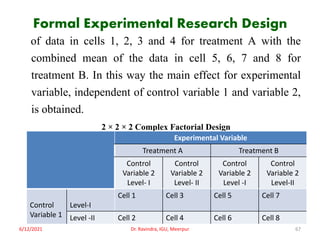
factorial design. In case of three factors with one experimental
variable having two treatments and two control variables,
each one of which having two levels, the design used will be
termed 2 × 2 × 2 complex factorial design which will contain
a total of eight cell as shown in the next slide;
From this design it is possible to determine the main effects
of three variables i.e., one experimental and two control
variables. The researcher can also determine the interactions
between each possible pair of variables (such interactions are
called ‘First order interactions’) and interaction between
variable taken in triplets (such interaction are called Second
6/12/2021 Dr. Ravindra, IGU, Meerpur 65
Formal Experimental Research Design
order interactions) . In case of a 2 × 2 × 2 design, the further
given first order interactions are possible:
• Experiment variable with control variable 1 (or EV×CV 1)
• Experiment variable with control variable 2 (or EV×CV 2)
• Control variable 1 with control variable 2 (or CV × CV 2)
There will be one second order interaction as well in the given
design (it is between all the three variables i.e., EV × CV1 ×
CV2).
To determine the main effects for the experimental variable,
the researcher must necessarily compare the combined mean
6/12/2021 Dr. Ravindra, IGU, Meerpur 66
Formal Experimental Research Design
of data in cells 1, 2, 3 and 4 for treatment A with the
combined mean of the data in cell 5, 6, 7 and 8 for
treatment B. In this way the main effect for experimental
variable, independent of control variable 1 and variable 2,
is obtained.
2 × 2 × 2 Complex Factorial Design
6/12/2021 Dr. Ravindra, IGU, Meerpur 67
Experimental Variable
Treatment A Treatment B
Control
Variable 2
Level- I
Control
Variable 2
Level- II
Control
Variable 2
Level -I
Control
Variable 2
Level-II
Control
Variable 1
Level-I
Cell 1 Cell 3 Cell 5 Cell 7
Level -II Cell 2 Cell 4 Cell 6 Cell 8
Formal Experimental Research Design
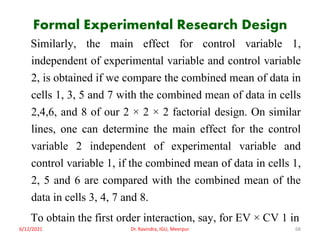
Similarly, the main effect for control variable 1,
independent of experimental variable and control variable
2, is obtained if we compare the combined mean of data in
cells 1, 3, 5 and 7 with the combined mean of data in cells
2,4,6, and 8 of our 2 × 2 × 2 factorial design. On similar
lines, one can determine the main effect for the control
variable 2 independent of experimental variable and
control variable 1, if the combined mean of data in cells 1,
2, 5 and 6 are compared with the combined mean of the
data in cells 3, 4, 7 and 8.
To obtain the first order interaction, say, for EV × CV 1 in
6/12/2021 Dr. Ravindra, IGU, Meerpur 68
Formal Experimental Research Design
the above stated design, the researcher must necessarily
ignore control variable 2 for which purpose he may
develop 2 × 2 design from the 2 × 2 × 2 design by
combining the data of the relevant cells of the latter
design.
Similarly, the researcher can determine other order
interactions. The analysis of the first order interaction, in
the manner described above, is essentially a simple
factorial analysis as only two variables are considered at a
time and the remaining one is ignored. But the analysis of
6/12/2021 Dr. Ravindra, IGU, Meerpur 69
Formal Experimental Research Design
the second order interaction would not ignore one of the
three independent variables in case of a 2 × 2 × 2 design.
The analysis would be termed as a complex factorial
analysis.
It may, however, be remembered that the complex
factorial design need not necessarily be of 2 × 2 × 2 type
design, but can be generalized to any number and
combination of experimental and control independent
variables. Of course, the greater number of independent
variables included in a complex factorial design, the
higher the order of the interaction analysis possible. But
6/12/2021 Dr. Ravindra, IGU, Meerpur 70
Formal Experimental Research Design
the overall task goes on becoming more and more
complicated with the inclusion of more and more
independent variables in our design.
Factorial designs are used mainly because of the two
advantages. (i) They provide equivalent accuracy with less
labour and as such are a source of economy. Using
factorial designs, we can determine the main effects of
two (in simple factorial design) or more (in case of
complex factorial design) factors or variables in one single
experiment. (ii) They permit various other comparisons of
6/12/2021 Dr. Ravindra, IGU, Meerpur 71
Formal Experimental Research Design
interest. For example, they give information about such
effects which cannot be obtained by treating one single
factor at a time. The determination of interaction effects is
possible in case of factorial designs.
end of the topic
------------------- ◌ -------------- ◌ ---------------------
6/12/2021 Dr. Ravindra, IGU, Meerpur 72
Design of Sampling Survey
Introduction
All items in any field of enquiry constitute a “Universe’ or
‘Population’. A complete enumeration of all items in the
‘Population’ is known as census inquiry or census survey. It is
obvious that for any study or investigation census survey is
rather infeasible. For example, to have an idea of average per
capita monthly income of the people in India, we will have to
enumerate all the earning individuals in the country, which is
a very difficult task.
Census survey is impossible in the situations when population
is infinite. In some cases when population is finite but the
units are destroyed while inspected, census survey is not at all
6/12/2021 Dr. Ravindra, IGU, Meerpur 73
Design of Sampling Survey
desirable, e.g., inspection of crackers. Further, many a
time it is not possible to examine every item in the
population, and sometimes it is possible to obtain
sufficiently accurate results by studying only a part of
total population. In such cases there is no utility of census
survey.
When field studies are undertaken in practical life,
considerations of time and cost almost invariably leads to
a selection of respondents i.e., selection of only a few
items. The respondents selected should be as
representative of the total population as possible in order
6/12/2021 Dr. Ravindra, IGU, Meerpur 74
Design of Sampling Survey
produce a miniature cross-section. The selected respondents
constitute what is technically called a ‘sample’ and the
selection process is called ‘sampling technique’. The survey
so conducted is known as ‘sample survey’.
Sample Design
A sample design is definite plan for obtaining a sample from a
given population. It refers to the technique or the procedure
the researcher would adopt in selecting items for the sample.
Sample design may as well lay down the number of items to
be included in the sample i.e., the size of the sample. Sample
design is determined before data are collected. There are
many sample designs from which a researcher can choose.
6/12/2021 Dr. Ravindra, IGU, Meerpur 75
Design of Sampling Survey
Some design are relatively more precise and easier to apply
than others. Researcher must select a sample design which
should be reliable and appropriate for his research study. The
main steps of sampling design are as follow;
(i) Objective: The first step of sampling design is to define the
objectives of survey in clear and concrete terms. The
researcher of the survey should confirm that the objectives
are commensurate with the money, manpower and time
limit available for the survey.
(ii) Population: In order to meet the objective of the survey,
what should be the population? This question should be
answered in the second step. The population should be
clearly defined.
6/12/2021 Dr. Ravindra, IGU, Meerpur 76
Design of Sampling Survey
3. Sampling Units and Frame: A decision has to be taken
concerning a sampling unit before selecting sample.
Sampling unit may be geographical one such as state,
district, village etc., or a construction unit as house, flat,
etc., or it may be a social unit such as family, club, school,
etc., or an individual. The list of sampling units is called
as ‘frame’ or ‘sampling frame’. Sampling frame contain
the names of all items of a universe.
4. Size of Sample: This refers to the number of items to be
selected from the universe to constitute a sample. The
size of the sample should neither be excessively large,
nor too small. It should be optimum. An optimum sample
6/12/2021 Dr. Ravindra, IGU, Meerpur 77
Design of Sampling Survey
is one which fulfils the requirements of efficiency,
representativeness, reliability and flexibility. While
deciding the size of sample, researcher must determine the
desired precision as also an acceptable confidence level
for the estimate. The size of population variance needs to
be considered as in case of large variance usually a bigger
sample is needed. The parameters of interest in a research
study must be kept in view, while deciding the size of
sample. Cost too dictate the size of the sample that we can
draw. As such, budgetary constraint must invariably be
taken into consideration when we decide the sample size.
6/12/2021 Dr. Ravindra, IGU, Meerpur 78
Design of Sampling Survey
5. Parameters of Interest: Statistical constant of the population
are called as parameters, e.g., population mean, population
proportion etc. When we do census survey we get the actual
value of the parameters. On the other hand, when we do
sample survey we get the estimates of unknown population
parameters in place of their actual values. In determining the
sample design, one must consider the question of the specific
population parameter which are of interest.
6. Data Collection: No irrelevant information should be
collected and no essential information should be discarded.
The objective of the survey should be very much clear in the
mind of the surveyor.
6/12/2021 Dr. Ravindra, IGU, Meerpur 79
Design of Sampling Survey
7. Non Respondents: Because of the practical difficulties, data
may not be collected for all the sampled units. This non-
response tends to change the results. The reasons for non-
response should be recorded by the investigators. Such cases
should be handled with caution.
8. Selection of Proper Sampling Design: The researcher must
decided the type of sample he will use i.e., he must decide
about the technique to be used in selecting the items for the
sample. In fact, this technique or procedure stands for the
sample design itself. There are several sample designs out of
which the researcher must choose one for his study.
6/12/2021 Dr. Ravindra, IGU, Meerpur 80
Design of Sampling Survey
9. Organizing Field Work: The success of a survey depends on
the reliable field work. There should be efficient supervisory
staff and trained personnel's for the field work.
10. Pilot Survey: It is always helpful to try out the research
design on a small scale before going to the field. This is called
as ‘pilot survey’ or ‘pretest’. It might give the better idea of
practical problems and troubles.
11. Budgetary Constraint: Cost consideration, from practical
point of view, have a major impact upon decisions relating to
not only the size of the sample but also to the type of sample.
This fact can even lead to the use of non-probability sample.
6/12/2021 Dr. Ravindra, IGU, Meerpur 81
Sampling and Non-sampling Errors
The error involves in the collection of data are classified into
sampling and non-sampling errors.
Sampling Errors
Sampling errors arise due to the fact that only a part of the
population has been used to estimate population parameters
and to draw inferences about the population. Sampling errors
are absent in a census survey. Sampling error can be measured
for a given sample design and size. The measurement of
sampling errors is usually called the ‘precision of the
sampling plan’. If we increase the sample size the precision
6/12/2021 Dr. Ravindra, IGU, Meerpur 82
Sampling and Non-sampling Errors
improved. But increasing the size of the sample has its
own limitations viz., a large size sample increases the cost
of collecting data and also enhances the systematic bias.
Thus the effective way to increase precision is usually to
select a better sampling design which has a smaller
sampling error for a given sample size at a given cost.
In brief, while selecting a sampling procedure, researcher
must ensure that the procedure causes a relatively small
sampling error and helps to control the systematic bias in
a better way.
6/12/2021 Dr. Ravindra, IGU, Meerpur 83
Sampling and Non-sampling Errors
Non-sampling Errors
Non-sampling errors as the name implies, are all those errors
which occur in different stages of research except in the
selection of sampling. Obviously, these errors are many and
varied. A non-sampling error can arise right at the beginning
when the problem is defined wrongly. It can also occur in any
of the subsequent stages such as in designing a questionnaire,
non-response of the questionnaire, in the analysis and
interpretation of data, etc.
An important point to note is that sampling error is measurable
6/12/2021 Dr. Ravindra, IGU, Meerpur 84
Sampling and Non-sampling Errors
while it is not easy to measure a non-sampling error.
Another point to note is that sampling error decreases as
the sample size increases. This is not necessarily so in the
case of non-sampling error. As the chance of non-
sampling errors are several during the course of study, the
marketing researcher has to be very particular to ensure an
effective control over them. Different types of non-
sampling errors are briefly explained below.
Types of Non-sampling Errors
The following are the non-sampling errors occurred
during conducting the research.
6/12/2021 Dr. Ravindra, IGU, Meerpur 85
Sampling and Non-sampling Errors
(i) Defective Problem Definition: Problem on which
research is to be undertaken should be precisely defined.
For example, a study on unemployment must be clear as
to the concept of unemployment, the reference period, the
geographic area to be covered, and so on. If any of these
basic concepts has wrong connotation, the results of the
study would turn out to be wrong.
(ii) Defective Population Definition: If the population is
not well-defined and does not fit to the objects of research
study then an error occurs.
(iii) Frame Error: The sampling frame is the list of all units
6/12/2021 Dr. Ravindra, IGU, Meerpur 86
Sampling and Non-sampling Errors
comprising the population from which a sample is to be
drawn. If the sampling frame is incomplete or inaccurate,
its use will give rise to this type of error.
(iv) Surrogate Information Error: This type of error
occurs when the information sought by the researcher is
different from the information needed to solve the
problem. A simple example of this error is when price of
brand is taken to represent its quality. In such a case, it is
presumed that higher the price of the brand, the better is
its quality. This may or may not be true.
6/12/2021 Dr. Ravindra, IGU, Meerpur 87
Sampling and Non-sampling Errors
(v) Non-response Error: It is almost impossible to obtain data
from each and every respondent covered in the sample. There
are always some respondents who refuse to give any
information. Thus, non-response error occurs when
respondents refuse to cooperate with the interviewer by not
answering his/her questions.
(vi) Measurement Error: This is caused when the information
gathered is different from the information sought. For
example, respondents are asked to indicate whether they own
a colour television set. Some of them may respond in the
affirmative just to boost their image before an interviewer,
even though they may not be owning a colour television set.
6/12/2021 Dr. Ravindra, IGU, Meerpur 88
Sampling and Non-sampling Errors
Such response will result in measurement error. This type
of error occurs frequently in research studies.
(vii) Experimental Error: An experiment aims at
measuring the impact of one or more independent
variables on a dependent variable. Take the case of the
impact of training on the performance of salesmen.
During the period when the training is given, there may be
a decline in competition and as a result sales performance
may improve. The results of such an experimental study
will be misleading.
(viii) Poor Questionnaire Design: A questionnaire is an
6/12/2021 Dr. Ravindra, IGU, Meerpur 89
Sampling and Non-sampling Errors
instrument to collect the data from respondents in a survey. If
the questionnaire is defective, the data collected on that basis
will be misleading.
(ix) Interviewer Bias: This error occurs on account of
interviewer’s influence in conducting an interview or wrong
recording by him. By putting emphasis on a certain word or
phrase in a questionnaire, interviewers can influence
respondents to answer in particular way.
(x) Data Processing Error: After the data have been collected,
they are to be processed. This involve coding the responses,
recording the codes, etc., so that data collection can be
transformed into suitable tables. Mistake can occur during the
processing stage of data.
6/12/2021 Dr. Ravindra, IGU, Meerpur 90
Sampling and Non-sampling Errors
(xi) Data Analysis Error: As in the case of data processing,
error can occur on account of wrong analysis of data. Apart
from simple mistakes in summation, division, etc., more
complex errors can occur.
(xii) Interpretation Error: Sometime wrong interpretation of
data can cause this type of error. In order to support a
particular line of action, the researcher may deliberately
misinterpret data. Wrong interpretation of data may occur at
time without one being aware of it.
Types of Sampling Designs
The method of selecting a sample is of fundamental
importance and depends upon the nature of data and
investigation. The techniques of selecting a sample are
6/12/2021 Dr. Ravindra, IGU, Meerpur 91
Types of Sampling Design
classified as – ‘probability sampling’ and ‘non-probability
sampling’ . We take up these two designs separately.
Probability Sampling
probability sampling is also known as ‘random sampling’ or
‘chance sampling’. Under this sampling design, every item of
the universe has an equal chance of inclusion in the sample. It
is, so to say, a lottery method in which individual units are
picked up from the whole group not deliberately but by some
mechanical process. Here it is blind chance alone that
determine whether one item or the other is selected. The
results obtained from probability
6/12/2021 Dr. Ravindra, IGU, Meerpur 92
Types of Sampling Design
or random sampling can be assured in terms of probability
i.e., we can measure the errors of estimation or the
significance of results obtained from a random sample,
and this fact bring out the superiority of random sampling
design over the deliberate sampling design. Random
sampling ensures the law of Statistical Regularity which
states that if on an average the sample chosen is a random
one, the sample will have the same composition and
characteristics as the universe. This is the reason why
random sampling is considered as the best technique of
selecting a representative sample.
6/12/2021 Dr. Ravindra, IGU, Meerpur 93
Types of Sampling Design
1. Simple Random Sampling: Simple random sampling
from a finite population refers to that method of sample
selection which gives each possible sample combination
an equal probability of being picked up and each item in
the entire population to have an equal chance of being
included in the sample. This applies to sampling without
replacement i.e., once an item is selected for the sample,
it cannot appear in the sample again, sampling with
replacement is used frequently less in which procedure,
the element selected for the sample is returned to the
population before the next element is selected. In such a
6/12/2021 Dr. Ravindra, IGU, Meerpur 94
Types of Sampling Design
situation the same element could appear twice in the
sample before the second element is chosen. In brief, the
implications of random sampling are;
(a) It gives each element in the population an equal
probability of getting into the sample, and all choices are
independent of one another.
(b) It gives each possible sample combination an equal
probability of being chosen.
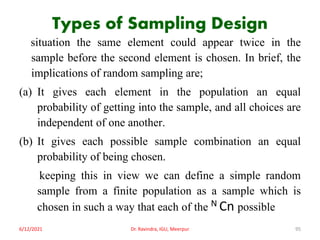
keeping this in view we can define a simple random
sample from a finite population as a sample which is
chosen in such a way that each of the N Cn possible
6/12/2021 Dr. Ravindra, IGU, Meerpur 95
Types of Sampling Design
samples has the same probability, 1/ N Cn of being selected.
There are number of way through which the unit can be
selected like; lottery method, random number table developed
by various statistician i.e. Tippett, Yates, Fisher etc.
Simple random sample, we have discussed above is ‘simple
random sample without replacement ‘, here, a unit which is
selected once is not replaced back to the population, i.e., one
sampling unit can be selected only once. Other alternative to
this design is ‘simple random sample with replacement’.
Because of the probability of over-representation of some
sampling units, this design is not of much practical usage.
6/12/2021 Dr. Ravindra, IGU, Meerpur 96
Types of Sampling Design
So far we have talked about random sampling, keeping in
view only the finite populations. But what about random
sampling in context of infinite population? It is relatively
difficult to explain the concept of random sampling from an
infinite population. However, a few examples will show the
basic characteristics of such a sample. Suppose we consider
the 20 throws of a fair dice as a sample from the
hypothetically infinite population which consists of the results
of all possible throws of the dice. If the probability of getting
a particular number, say 1, is the same for each throw and the
20 throws are all independent, then we say that the sample is
random. Similarly, it would be said to be sampling from an
6/12/2021 Dr. Ravindra, IGU, Meerpur 97
Types of Sampling Design
infinite population if we sample with replacement from a finite
population and our sample would be considered as a random
sample if in each draw all elements of the population have the
same probability of being selected and successive draws
happen to be independent. In brief, one can say that the
selection of each item in a random sample from an infinite
population is controlled by the same probabilities and that
successive selections are independent of one another.
2. Systematic Sampling: In some instances, the most practical
way of sampling is to select every ith item on a list. Sampling
of this type is known as systematic sampling. An element of
6/12/2021 Dr. Ravindra, IGU, Meerpur 98
Types of Sampling Design
randomness is introduced into this kind of sampling by
using random numbers to pick up the unit with which to
start. For instance, if a 4 percent sample is desired, the
first item would be selected randomly from the first
twenty-five and thereafter every 25th item would
automatically be included in the sample. Thus, in
systematic sampling only the first unit is selected
randomly and the remaining units of the sample are
selected at fixed intervals. Although a systematic sample
is not a random sample in the strict sense of the term, but
it is often considered reasonable to treat systematic sample
6/12/2021 Dr. Ravindra, IGU, Meerpur 99
Types of Sampling Design
as if it were a random sample. Systematic sampling has certain
plus points. It can be taken as an improvement over a simple
random sample in as much as the systematic sample is spread
more evenly over the entire population. It is an easier and less
costlier method of sampling and can be conveniently used
even in case of large populations. But there are certain
dangers too in using this type of sampling. If there is a hidden
periodicity in the population, systematic sampling will prove
to be an inefficient method of sampling. For instance, every
25th item produced by a certain production process is
defective. If we are to select a 4% sample of the items in this
6/12/2021 Dr. Ravindra, IGU, Meerpur 100
Types of Sampling Design
process in a systematic manner, we would either get all
defective items or all good items in our sample depending
upon the random starting position. If all elements of the
universe are observed in a manner representative of the
total population, i.e. the population list is in random order,
systematic sampling is considered equivalent to random
sampling. But if this is not so, then the results of such
sampling may, at times, not be very reliable. In practice,
systematic sampling is used when lists of population are
available and they are of considerable length.
6/12/2021 Dr. Ravindra, IGU, Meerpur 101
Types of Sampling Design
3. Stratified Sampling: If a population from which a sample
is to be drawn does not constitute a homogeneous group,
stratified sampling technique is generally applied in order
to obtain a representative sample. Under stratified
sampling the population is divided into several sub-
populations that are individually more homogeneous than
the total population (the different sub-populations are
called ‘strata’) and then we select items from each stratum
to constitute a sample. Since each stratum is more
homogeneous than the total population, we are able to get
more precise estimates for each stratum and by estimating
6/12/2021 Dr. Ravindra, IGU, Meerpur 102
Types of Sampling Design
more accurately each of the component parts, we get a better
estimate of the whole. In brief, stratified sampling results is
more reliable and detailed information can be obtained from
this sampling method.
The following three questions are highly relevant in the
context of stratified sampling:
(a) How to form strata?
(b) How should items be selected from each stratum?
(c) How many items be selected from each stratum or how to
allocate the sample size of each stratum?
Regarding the first question, we can say that the strata be
formed on the basis of common characteristics of the items
6/12/2021 Dr. Ravindra, IGU, Meerpur 103
Types of Sampling Design
to be put in each stratum. This means that various strata be
formed in such a way as to ensure elements being most
homogeneous within each stratum and most
heterogeneous between the different strata. Thus, strata
are purposively formed and are usually based on past
experience and personal judgment of the researcher.
In respect of the second question, we can say that the
usual method, for selection of items for the sample from
each stratum, resorted to is that of simple random
sampling. Systematic sampling can be used if it is
considered more appropriate in certain situations.
6/12/2021 Dr. Ravindra, IGU, Meerpur 104
Types of Sampling Design
regarding the third question, we usually follow the method of
proportional allocation under which the size of the samples
from the different strata are kept proportional to the sizes of
the strata. It is not necessary that stratification be done
keeping in view a single characteristics. Population are often
stratified according to several characteristics. Stratification of
this type is know as cross-stratification, and up to a point such
stratification increases the reliability of estimates and is much
used in opinion survey.
From what has been stated above in respect of stratified
sampling, we can say that the sample so constituted is the
result of successive application of purposive and random
6/12/2021 Dr. Ravindra, IGU, Meerpur 105
Types of Sampling Design
sampling methods. As such it is an example of mixed
sampling. The procedure wherein we first have stratification
and then simple random sampling is known as stratified
random sampling.
4. Cluster Sampling: If the total area of interest happens to be a
big one, a convenient way in which a sample can be taken is
to divide the area into a number of smaller non-overlapping
areas and then to randomly select a number of these smaller
areas (usually called clusters), with the ultimate sample
consisting of all unit in these small areas or clusters.
Thus, in cluster sampling the total population is divided into a
6/12/2021 Dr. Ravindra, IGU, Meerpur 106
Types of Sampling Design
number of relatively small sub-divisions which are
themselves clusters of still smaller units and then some of
these clusters are randomly selected for inclusion in the
overall sample.
Cluster sampling, no doubt, reduces cost by concentrating
surveys in selected clusters. But certainly it is less precise
than random sampling. There is also not as much
information in ‘n’ observations within a cluster as there
happens to be in ‘n’ randomly drawn observations. Cluster
sampling is used only because of the economic advantage
it possesses; estimates based on cluster samples are
usually more reliable per unit cost.
6/12/2021 Dr. Ravindra, IGU, Meerpur 107
Types of Sampling Design
If cluster happen to be some geographic sub-divisions, in
that case cluster sampling is better known as area
sampling. In other words, cluster designs, where the
primary sampling unit represents a cluster of units based
on geographic area, are distinguished as area sampling.
The plus and minus points of cluster sampling are also
applicable to area sampling.
5. Multi-stage Sampling: Multi-stage sampling is a further
development of the principle of cluster sampling.
Suppose, we want to investigate the working efficiency of
6/12/2021 Dr. Ravindra, IGU, Meerpur 108
Types of Sampling Design
nationalized banks in India and we want to take a sample
of few banks for this purpose. The first stage is to select
large primary sampling unit such as states in a country.
Then we may select certain districts and interview all
banks in the chosen districts. This would represent a two-
stage sampling design with the ultimate sampling units
being clusters of districts.
If instead of taking a census of all banks within the
selected districts, we select certain towns and interview all
banks in the chosen towns. This would represent a three-
stage sampling design. If instead of taking a census of all
6/12/2021 Dr. Ravindra, IGU, Meerpur 109
Types of Sampling Design
banks within the selected towns, we randomly sample
banks from each selected town, then it is case of using a
four-stage sampling plan. If we select randomly at all
stages, we will have what is known as ‘multi-stage
random sampling design’.
Ordinarily multi-stage sampling is applied in big inquires
extending to a considerable large geographical area, say,
the entire country. There are two advantages of this
sampling design viz., (a) it is easier to administer than
most single stage designs mainly because of the fact that
sampling frame under multi-stage sampling is developed
in partial units. (b) a large number of units can be sampled
6/12/2021 Dr. Ravindra, IGU, Meerpur 110
Types of Sampling Design
for a given cost under multi-stage sampling because of
sequential clustering, whereas this is not possible in most of
the simple designs.
6. Sampling with Probability Proportional to Size: In case the
cluster sampling units do not have the same number or
approximately the same number of elements, it is considered
appropriate to use a random selection process where the
probability of each cluster being included in the sample is
proportional to the size of the cluster. For this purpose, we
have to list the number of elements in each cluster irrespective
of the method of ordering the cluster. Then we must sample
6/12/2021 Dr. Ravindra, IGU, Meerpur 111
Types of Sampling Design
systematically the appropriate number of elements from the
cumulative total. The actual number selected in this way do
not refer to individual elements, but indicate which clusters
and how many from the cluster are to be selected by simple
random sampling or by systematic sampling. The results of
this type of sampling are equivalent to those of a simple
random sample and the method is less cumbersome and is also
relatively less expensive.
7. Sequential Sampling: This sampling design is some what
complex sample design. The ultimate size of the sample under
this technique is not fixed in advance, but is determined
6/12/2021 Dr. Ravindra, IGU, Meerpur 112
Types of Sampling Design
according to mathematical decision rules on the basis of
information yielded as survey progresses. This is usually
adopted in case of acceptance sampling plan in context of
statistical quality control. When a particular lot is to be
accepted or rejected on the basis of two samples, it is known
as double sampling and in case the decision rests on the basis
of more than two samples but the number of samples is more
than two but it is neither certain nor decided in advance, this
type of system is often referred to as sequential sampling.
Thus, in brief, we can say that in sequential sampling, one can
go on taking samples one after another as long as one desires
to do so.
6/12/2021 Dr. Ravindra, IGU, Meerpur 113
Types of Sampling Design
Non Probability Sampling
Non-probability sampling methods includes; Judgment
sampling /Purposive sampling, Convenience sampling, Quota
sampling and Snowball sampling. Let see all these sampling
methods in detail.
1. Judgment/Purposive Sampling: The main characteristic of
judgment sampling is that units or elements in the population
are purposively selected. It is because of this that judgment
samples are also called purposive samples. Since the process
of selection is not based on the random method, a judgment
sample is considered to be non-probability sampling.
6/12/2021 Dr. Ravindra, IGU, Meerpur 114
Types of Sampling Design
Occasionally it may be desirable to use judgment
sampling. Thus, an expert may be asked to select a
sample of ‘representative’ business firms. The reliability
of such a sample would depend upon the judgment of the
expert. The quota sample, is in a way a judgment sample
where the actual selection of units within the earlier fixed
quota depends on the interviewer.
It may be noted that when a small sample of a few units is
to be selected, a judgment sample may be more suitable as
the errors of judgment are likely to be less than the
random errors of a probability sample. However, when a
6/12/2021 Dr. Ravindra, IGU, Meerpur 115
Types of Sampling Design
large sample is to be selected, the element of bias in the
selection could be quite large in the case of a judgment
sample. Further, it may be costlier than the random
sampling.
2. Convenience Sampling: Convenience sampling, as the
name implies, is based on the convenience of the
researcher who is to select a sample. This type of
sampling is also called accidental sampling as the
respondents in the sample are included in it merely on
account of their being available on the spot where the
survey is in progress. Thus, a researcher may stand at a
6/12/2021 Dr. Ravindra, IGU, Meerpur 116
Types of Sampling Design
certain prominent point and interview all those or selected
people who pass through that place. A survey based on
such a sample or respondents may not be useful if the
respondents are not representative of the population. It is
not possible in convenience sampling to know
‘representativeness’ of the selected sample. As such, it
introduces an unknown degree of bias in the estimate. In
view of this major limitation, convenience sampling
should be avoided as far as possible. It may however be
more suitable in exploratory research, where the focus is
on getting new ideas and insights into a given problem.
6/12/2021 Dr. Ravindra, IGU, Meerpur 117
Types of Sampling Design
3. Quota Sampling: Quota sampling is quite frequently used in
marketing research. It involves the fixation of certain quota,
which are to be fulfilled by the interviewers. In this sampling
design we my fix certain controls which can be either
independent or inter-related. A survey of 2000 households
has been chosen, subject to the condition that 1200 of these
should be from rural areas and 800 from the urban areas of the
territory. Likewise, of the 2000 households, the rich
households should number 150, the middle class ones 650 and
the remaining 1200 should be from the poor class. In first case
there are independent quota control, where as, in second case
it is inter-related
6/12/2021 Dr. Ravindra, IGU, Meerpur 118
Types of Sampling Design
quota controls. Inter-related quota controls allow less
freedom of selection of the units than that available in the
case of independent controls.
There are certain advantages in both the schemes.
Independent controls are much simpler, especially from
the viewpoint of interviewers. They are also likely to be
cheaper as interviewers may cover their quotas within a
small geographical area. In view of this, independent
controls may affect the representativeness of the quota
sampling. Inter-related quota controls are more
representative through such controls may involve more
time and effort on the part of interviewers. Also, they may
6/12/2021 Dr. Ravindra, IGU, Meerpur 119
Types of Sampling Design
be costlier than independent quota controls.
In view of the non-random element of quota sampling, it has
been severely criticized especially by statisticians, who
consider it theoretically weak and unsound. There are points
both in favor of and against quota sampling.
Advantages
• It is economical, as travelling costs can be reduced.
• It is administratively convenient.
• When the field work is to be done quickly, perhaps quota
sampling is most appropriate and feasible.
• It is independent of the existence of sampling frames.
6/12/2021 Dr. Ravindra, IGU, Meerpur 120
Types of Sampling Design
Limitations
• Since quota sampling is not based on random selection, it
is not possible to calculate estimates of standard errors for
the sample results.
• It may not be possible to get a ‘representative’ sample
within the quota as the selection depends entirely on the
mood and convenience of the interviewers.
• Since too much latitude is given to the interviewers, the
quality of work suffers if they are not competent.
• It may be extremely difficult to supervise the control and
field investigation under quota sampling.
6/12/2021 Dr. Ravindra, IGU, Meerpur 121
Types of Sampling Design
4. Snowball Sampling: In the initial stage of snowball
sampling, sample units may or may not be selected by
using probability methods. Subsequently, additional units
are obtained on the basis of information given by initial
sample units. Against, these units may provide other
names to the researcher. In this way, the sample build up
as more and more names are covered by it. The need for
snowball sampling arises because of the difficulty in
identifying the respondents right in the beginning of the
proposed research study.
6/12/2021 Dr. Ravindra, IGU, Meerpur 122
Characteristics of Good Sample Design
A good sample design requires the judicious balancing of four
broad criteria – goal orientation, measurability, practicality
and economy.
1. Goal Oriented: This suggest that a sample design should be
oriented to the research objectives, tailored to the survey
design, and fitted to the survey conditions. If this done, it
should influence the choice of the population, the
measurement as also the procedure of choosing a sample.
2. Measurability: A sample design should enable the
computation of valid estimates of its sampling variability.
6/12/2021 Dr. Ravindra, IGU, Meerpur 123
Characteristics of Good Sample Design
Normally, this variability is expressed in the form of standard
errors in surveys. However, this is possible only in the case of
probability sampling. In non-probability samples, such as a
quota sample, it is not possible to know the degree of
precision of the survey results.
3. Practicality: This implies that the sample design can be
followed properly in the survey, as envisaged earlier. It is
necessary that complete, correct, practical and clear
instructions should be given to the interviewer so that no
mistakes are made in the selection of sampling units and the
final selection in the field is not different from the original
6/12/2021 Dr. Ravindra, IGU, Meerpur 124
Characteristics of Good Sample Design
sample design. Practicality also refers to simplicity of the
design, i.e. it should be capable of being understood and
followed in actual operation of the field work.
4. Economy: Finally, economy implies that the objectives of
the survey should be achieved with minimum cost and
effort. Survey objectives are generally spelt out in terms
of precision, i.e. the inverse of the variance of survey
estimates. For a given degree of precision, the sample
design should give the minimum cost. Alternatively, for a
given per unit cost, the sample design should achieve
maximum precision.
6/12/2021 Dr. Ravindra, IGU, Meerpur 125
Measurement and Scaling
Introduction
In our daily life as we are said to measure when we use
some yardstick to determine weight, height or some other
features of a physical object. We also measure when we
judge how well we like a song, a painting or the
personalities of our friends. We, thus, measure physical
objects as well as abstract concepts. Measurement is a
relatively complex and demanding task, specially so when
it concerns qualitative or abstract phenomena. Other
examples of qualitative characteristics are taste, honesty,
intelligence, customer’s perception and brand loyalty etc.
6/12/2021 Dr. Ravindra, IGU, Meerpur 126
Measurement and Scaling
These characteristics are also called as constructs. The
feelings and perceptions of customers and employees are
very important for a company.
It is easy to assign numbers in respect of properties of
some objects, but it is relatively difficult in respect of
others. For instance, measuring such things as social
conformity, intelligence, or marital adjustment is much
less obvious and requires much closer attention than
measuring physical weight, biological age or a person’s
financial assets. In other words, properties like weight,
height, etc., can be measured directly with some standard
6/12/2021 Dr. Ravindra, IGU, Meerpur 127
Measurement and Scaling
unit of measurement, but it is not that easy to measure
properties like motivation to success, ability to stand stress
and the like. For the meaningful assessment of the
qualitative characteristics it is essential that they are also
measured.
Quantitative and Qualitative Data
Measurement is defined as a process of associating
numbers or symbols to observations obtained in a research
study. These observation could be qualitative or
quantitative.
Most of the analysis can be conducted using quantitative
6/12/2021 Dr. Ravindra, IGU, Meerpur 128
Measurement and Scaling
data. For example, mean, standard deviation, etc. can be
computed for quantitative characteristics. Qualitative
characteristics can be counted and cannot be computed.
Therefore, the researcher must have a clear understanding
of the type of characteristics or variable before collecting
the data. The observations on qualitative variables may
also be assigned numbers. For example, we can record a
person’s marital status as 1, 2, 3, or 4 depending on
whether the person is single, married, widowed or
divorced. We can as well record ‘Yes’ or ‘No’ answer to
question as ‘0’ and ‘1’. In this artificial or normal way,
6/12/2021 Dr. Ravindra, IGU, Meerpur 129
Measurement and Scaling
categorical data (qualitative or descriptive) can be made
into numerical data and if we thus code the various
categories, we refer to the numbers we record as nominal
data.
Nominal data is numerical in name only, because they do
not share any of the properties of the numbers we deal in
ordinary arithmetic.
In those situations when we cannot do anything except set
up inequalities, we refer to the data as ordinal data. For
instance, if one material can scratch another, it receives a
higher hardness number and on Mohs’ scale the numbers
6/12/2021 Dr. Ravindra, IGU, Meerpur 130
Measurement and Scaling
from 1 to 10 are assigned respectively to talc, gypsum,
calcite, fluorite, apatite, quartz, topaz, sapphire and
diamond. With these numbers we can write 5 > 2 or 6 < 9
as apatite is harder than gypsum and feldspar is softer than
sapphire, but we cannot write for example 10 – 9 = 5 – 4,
because the difference in hardness between diamond and
sapphire is actually much greater than that between apatite
and fluorite. It would also be meaningless to say that
topaz is twice as hard as fluorite simply because their
respective hardness numbers on Mohs’ scale are 8 and 4.
6/12/2021 Dr. Ravindra, IGU, Meerpur 131
Measurement and Scaling
The grater than symbol (i.e. >) in connection with ordinal
data may be used to designate ‘higher than’ preferred to’
and so on.
When in addition to setting up inequalities we can also
differences, we refer to the data as interval data. Suppose
we are given the following temperature readings (in
degrees Fahrenheit); 58o, 63o, 70o, 95o, 110o, 126o and
135o . In this case, we can write 100o > 70o or 95o < 135o
which simply means that 110o is warmer than 70o and
that 95o or from 110o to 135o . On the other hand, it would
6/12/2021 Dr. Ravindra, IGU, Meerpur 132
Measurement and Scaling
not be mean much if we said that 126o is twice as hot as
63o even though 126o ÷ 63o = 2. To show the reason, we
have only to change to the centigrade scale, where the first
temperature becomes 5/9 (126 – 32) = 52o, the second
temperature become 5/9 (63 – 32) = 17o and the first
figure is now more than three times the second. This
difficulty arises from the fact that Fahrenheit and
Centigrade scales both have artificial origins (zeros) i.e.,
the number 0 of neither scale is indicative of the absence
of whatever quality we are trying to measure.
When in addition to setting up inequalities and forming
6/12/2021 Dr. Ravindra, IGU, Meerpur 133
Measurement and Scaling
differences we can also form quotients , we refer to such
data as ratio data. In this sense, ratio data includes all the
usual measurement of length, height, money amounts,
weight, volume, area, pressures etc.
The above stated discussion between nominal, ordinal,
interval and ration data is important for the nature of a set
of data may suggest the use of particular statistical
techniques. A researcher has to be quite alert about this
aspect while measuring properties of objects or of abstract
concepts.
6/12/2021 Dr. Ravindra, IGU, Meerpur 134
Measurement and Scaling
Classifications of Measurement Scales
From what has been stated in previous slides, we can write
that scales of measurement can be considered in terms of their
mathematical properties. The most widely classification of
measurement scales are; (1) Nominal Scale (2) Ordinal Scale
(3) Interval Scale and (4) Ratio Scale.
1. Nominal Scale: Nominal scale is simply a system of assigning
number, symbols to events in order to label them. The usual
example of this is the assignment of numbers of basketball
players in order of identify them. Such numbers cannot be
considered to be associated with an order scale for their order
6/12/2021 Dr. Ravindra, IGU, Meerpur 135
Measurement and Scaling
is of no consequence; the number are just convenient
labels for the particular class of events and as such have
no quantitative value. Nominal scales provide convenient
ways of keeping track of people, objects and events. One
cannot do much with the numbers involved. For example,
one cannot usefully average the numbers on the back of a
group of football players and come up with a meaningful
value. Neither can one usefully compare the numbers
assigned to one group with the numbers assigned to
another. The counting of members in each group is the
only possible arithmetic operation when a nominal scale is
6/12/2021 Dr. Ravindra, IGU, Meerpur 136
Measurement and Scaling
employed. Accordingly, we are restricted to use mode as
the measure of central tendency. There is no generally
used measure of dispersion for nominal scales. Chi-square
test is the most common test of statistical significance that
can be utilized, and for the measures of correlation, the
contingency coefficient can be worked out.
Nominal scale is the least powerful level of measurement.
It indicates no order or distance relationship and has no
arithmetic origin. A nominal scale simply describes
differences between things by assigning them to
categories. Nominal data is, thus counted data. The scale
6/12/2021 Dr. Ravindra, IGU, Meerpur 137
Measurement and Scaling
wastes any information that we may have about varying
degrees of attitude, skills, understandings, etc. in spite of
all this, nominal scales are still very useful and are widely
used in surveys and other ex-post-facto research when
data is being classified by major sub-groups of the
population.
2. Ordinal scale: Ordinal scales, as name implies, are
ranking scales. The ordinal scale places the events in
order, but there is non attempt to make the intervals of the
scale equal in terms of some rules. Rank order present
ordinal scales and are frequently used in research relating
6/12/2021 Dr. Ravindra, IGU, Meerpur 138
Measurement and Scaling
relating to qualitative phenomena. A student’s rank in his
graduation class involves the use of an ordinal scale. One
has to be very careful in making statement about scores
based on ordinal scales. For instance, Ram’s position in
his class is 10th and Mohan’s position is 40, it cannot be
said that Ram’s position is four times as good as that of
Mohan. The statement would make no sense at all.
Ordinal scales only permit the ranking of items from
highest to lowest. Ordinal measures have no absolute
values, and the real differences between adjacent ranks
may not be equal. All that can be said is that one person is
6/12/2021 Dr. Ravindra, IGU, Meerpur 139
Measurement and Scaling
higher or lower on the scale than another, but more precise
comparisons cannot be made.
Thus, the use of an ordinal scale implies a statement of
‘greater than’ or ‘less than’ (an equality statement is also
acceptable) without our being able to state how much
greater or less. The real difference between ranks 1 and 2
may be more or less than the difference between ranks 5
and 6. Since the numbers of this scale have only a rank
meaning, the appropriate measure of central tendency is
the median. A percentile or quartile measures is used for
measuring dispersion. Correlations are restricted to
various rank order methods. Measures of statistical
6/12/2021 Dr. Ravindra, IGU, Meerpur 140
Measurement and Scaling
significance are restricted to the non-parametric methods.
3. Interval Scale: In the case of interval scale, the intervals are
adjusted in terms of some rule that have been established as
basis for making the units equal. The units are equal only in
so far as one accepts the assumptions on which the rule is
based. Interval scales can have an arbitrary zero, but it is not
possible to determine for them what may be called an absolute
zero or the unique origin. The primary limitation of the
interval scale is the lack of a true zero, it does not have the
capacity to measure the complete absence of a trait or
characteristics. The Fahrenheit scale is an example of an
6/12/2021 Dr. Ravindra, IGU, Meerpur 141
Measurement and Scaling
interval scale and shows similarities in what one can and
cannot do with it. One can say that an increase in
temperature from 30o to 40o involves the same increase in
temperature as an increase from 60o to 70o , but one can
not say that the temperature of 60o is twice as warm as the
temperature of 30o because both numbers are dependent
on the fact that the zero on the scale is set arbitrarily at the
temperature of the freezing point of water. The ratio of the
two temperatures, 30o and 60o , means noting because
zero is an arbitrary point.
6/12/2021 Dr. Ravindra, IGU, Meerpur 142
Measurement and Scaling
Interval scale provide more powerful measurement than
ordinal scales for interval scale also incorporates the
concepts of equality of interval. As such more powerful
statistical measures can be used with interval scales. Mean
is the appropriate measure of central tendency, while
standard deviation is the most widely used measure of
dispersion. Product moment correlation techniques are
appropriate and the generally used tests for statistical
significance are the ‘t’ test and ‘F’ test.
4. Ratio Scale: Ratio scale have an absolute or true zero of
measurement. The term ‘absolute zero’ is not as precise as
6/12/2021 Dr. Ravindra, IGU, Meerpur 143
Measurement and Scaling
it was once believed to be. We can conceive of an
absolute zero of length and similarly we can conceive of
an absolute zero of time. For example, the zero point on a
centimeter scale indicates the complete absence of length
or height. But an absolute zero of temperature is
theoretically unobtainable and it remains a concept
existing only in the scientist’s mind. The number of miner
traffic rule violations and the number of incorrect letters
in a page of type script represent scores on ratio scales.
Both these scales have absolute zeros and as such all
minor traffic violations and all typing errors can be
assumed to be equal in significance. With ration scales
6/12/2021 Dr. Ravindra, IGU, Meerpur 144
Measurement and Scaling
involved one can make statements like “Jyoti’s” typing
performance was twice as good as that of “Renu” . The ration
involved does have significance and facilitates a kind of
comparison which is not possible in case of an interval scale.
Ration scale represents the actual amount of variables.
Measures of physical dimensions such as weight, height,
distance, etc. are examples. Generally, all statistical techniques
are usable with ratio scales and all manipulations that one can
carry out with real numbers can also be carried out with ratio
scale values. Multiplication and division can be used with this
scale but not with other scales mentioned above. Geometric
6/12/2021 Dr. Ravindra, IGU, Meerpur 145
Measurement and Scaling
and harmonic means can be used as measures of central
tendency and coefficients of variation may also be
calculated. Thus, proceeding from the nominal scale (the
least precise type of scale) to ratio scale (the most
precise), relevant information is obtained increasingly. If
the nature of the variables permits, the researcher should
used the scale that provides the most precise description.
Researcher in physical sciences have the advantage to
describe variables in interval scale form, a less precise
type of measurement.
6/12/2021 Dr. Ravindra, IGU, Meerpur 146
Measurement and Scaling
Goodness of Measurement Scales
A measurement scale has to have certain desirable
qualities to judge their goodness in measuring the
characteristics under study. These qualities are described
here;
1. Validity: Validity is the most critical criterion and
indicates the degree to which an instrument measures
what it is supposed to measure. Validity can also be
thought of as utility. In other words, validity is the extent
to which differences found with a measuring instrument
reflect true differences among those being tested. But the
question arises; how can one determine validity without
6/12/2021 Dr. Ravindra, IGU, Meerpur 147
Measurement and Scaling
direct confirming knowledge? The answer may be that we
seek other relevant evidence that confirms the answers we
have found with out measuring tool. What is relevant,
evidence often depends upon the nature of the research
problem and the judgment of the researcher. But one can
certainly consider three types of validity in this connection: (i)
Content validity, (ii) Criterion validity, and (iii) Construct
validity.
(i) Content validity is the extent to which a measuring instrument
provides adequate coverage of the topic under study. If the
instrument contains a representative sample of the universe,
the content validity is good. Its determination is primarily
6/12/2021 Dr. Ravindra, IGU, Meerpur 148
Measurement and Scaling
judgmental and intuitive. It can also be determined by using a
panel of persons who shall judge how well the measuring
instrument meets the standards, but there is no numerical way
to express it.
(ii) Criterion-related validity relates to our ability to predict
some outcome or estimate the existence of some current
condition. This form of validity reflects the success of
measures used for some empirical estimating purpose. The
concerned criterion must possess the following qualities;
• Relevance: A criterion is relevant if it is defined in terms we
judge to be the proper measure.
• Freedom from bias: Freedom from bias is attained when the
6/12/2021 Dr. Ravindra, IGU, Meerpur 149
Measurement and Scaling
criterion gives each subject an equal opportunity to score well.
• Reliability: A reliable criterion is stable or producible.
• Availability: The information specified by the criterion must
be available.
In fact, a Criterion-related validity is a broad term that actually
refers to (i)Predictive validity and (ii) Concurrent validity.
The former refers to the usefulness of a test in predicting some
future performance whereas the latter refers to the usefulness
of a test is closely relating to other measures of known
validity. Criterion-related validity is expressed as the
coefficient of correlation between test scores and some
measure of future performance or between test scores and
6/12/2021 Dr. Ravindra, IGU, Meerpur 150
Measurement and Scaling
scores on another measure of known validity.
(iii) Construct validity is the most complex and abstract. A
measure is said to possess construct validity to the degree
that it conforms to predicted correlations with other
theoretical propositions. Construct validity is the degree to
which scores on a test can be accounted for by the
explanatory constructs of a sound theory. For determining
construct validity, we associate a set of other propositions
with the results received from suing our measurement
instrument. If measurements, we can conclude that there is
6/12/2021 Dr. Ravindra, IGU, Meerpur 151
Measurement and Scaling
some construct validity.
If the above stated criteria and tests are met with, we may
state that our measuring instrument is valid and will result
in correct measurement; otherwise we shall have to look
for more information and/or resort to exercise of
judgment.
2. Reliability: The test of reliability is another important test
of sound measurement. A measuring instrument is reliable
if it provides consistent results. Reliable measuring
instrument does contribute to validity, but a reliable
instrument need not be a valid instrument. For instance, a
scale that consistently overweighs objects by five kg., is a
6/12/2021 Dr. Ravindra, IGU, Meerpur 152
Measurement and Scaling
reliable scale, but it does not give a valid measure of
weight. But the other way is not true i.e., a valid
instrument is always reliable. Accordingly, reliability is
not as valuable as validity, but it is easier to assess
reliability in comparison to validity. If the quality of
reliability is satisfied by an instrument, then while using it
we can be confident that the transient and situational
factors are not interfering.
Two aspects of reliability viz., stability and equivalence
deserve special mention. The stability aspect is concerned
6/12/2021 Dr. Ravindra, IGU, Meerpur 153
Measurement and Scaling
with securing consistent results with repeated
measurements of the same person and with the same
instrument. We usually determine the degree of stability
by comparing the results of repeated measurements. The
equivalence aspect considers how much error may get
introduced by different investigators or different samples
of the items being studied. A good way to test for the
equivalence of measurements by investigators is to
compare their observations of the same events. Reliability
can be improved in the following two ways:
6/12/2021 Dr. Ravindra, IGU, Meerpur 154
Measurement and Scaling
(i) By standardizing the conditions under which the measurement
takes place.
(ii) By carefully designed directions for measurement with no
variation from group to group by using trained and motivated
personal to conduct the research and also by broadening the
sample of items used.
3. Practicality: The practicality characteristic of a measuring
instrument can be judged in terms of economy, convenience
and interpretability. From the operational point of view, the
measuring instrument ought to be practical i.e., it should be
economical, convenient and interpretable.
Economy consideration suggest that some trade-off is needed
6/12/2021 Dr. Ravindra, IGU, Meerpur 155
Measurement and Scaling
between the ideal research project and that which the
budget can afford. The length of measuring instrument is
an important area where economy pressures are quickly
felt. Although more items give greater reliability as stated
earlier, but in the interest of limiting the interview or
observation time, we have to take only few items for our
study purpose. Similarly, data-collection methods to be
used are also dependent at times upon economic factors.
Convenience test suggests that the measuring instrument
should be easy to administer. For this purpose one should
given due attention to the proper layout of the measuring
6/12/2021 Dr. Ravindra, IGU, Meerpur 156
Measurement and Scaling
instrument. For instance, a questionnaire, with clear
instructions is certainly more effective and easier to
complete than one which lacks these features.
Interpretability consideration is specially important when
person other than the designers of the test are to interpret
the results. The measuring instrument, in order to be
interpretable, must be supplemented by (a) detailed
instructions for administering the test; (b) scoring keys;
(c) evidence about the reliability and (d) guide for using
the test and for interpreting results.
6/12/2021 Dr. Ravindra, IGU, Meerpur 157
Measurement and Scaling
4. Accuracy: The characteristics of accuracy of a
measurement scale means it should be a true
representative of the observation of underplaying
characteristics. For example, measuring with an ‘inch’
scale will provide accurate value only up to one-eighth of
an inch, while measuring with ‘cm’ scale will provide
more accurate value.
Sources of Error in Measurement
Measurement should be precise and unambiguous in an
ideal research study. This objectives, however, is often not
met with in entirely. As such the researcher must be aware
about the sources of error in measurement. The following
6/12/2021 Dr. Ravindra, IGU, Meerpur 158
Measurement and Scaling
are the possible sources of error in measurement.
1. Respondent: At times the respondent may be reluctant
to express strong negative feelings or it is just possible
that he may have very little knowledge but may not
admit his ignorance. All this reluctance is likely to result
in an interview of ‘guesses’. Transient factors like
fatigue, boredom, anxiety, etc. may limit the ability of
the respondent to respond accurately and fully.
2. Situation: Situational factors may also come in the way
of correct measurement. Any condition which places a
strain on interview can have serious effects on the
6/12/2021 Dr. Ravindra, IGU, Meerpur 159
Measurement and Scaling
interviewer respondent rapport. For instance, if someone
else is present, he can distort responses by joining in or
merely by being present. If the respondents feels that
anonymity is not assured, he may reluctant to express
certain feelings.
3. Measurer: The interviewer can distort responses by
rewording or reordering questions. His behaviour, style
and looks may encourage or discourage certain replies
from respondents. Careless mechanical processing may
distort the findings. Errors may also creep in because of
incorrect coding, faulty tabulation and/or statistical
calculations, particularly in the data analysis stage.
6/12/2021 Dr. Ravindra, IGU, Meerpur 160
Measurement and Scaling
4. Instrument: Error may arise because of the defective
measuring instrument. The use of complex words, beyond
the comprehension of the respondent, ambiguous
meanings, poor printing, inadequate space for replies,
response choice omissions, etc. are a few things that make
the measuring instrument defective and may result in
measurement errors. Another type of instrument
deficiency is the poor sampling of the universe of items of
concern.
Researcher must know that correct measurement depends
on successfully meeting all of the problem listed above.
6/12/2021 . Ravindra, IGU, MeerpuDrr 161
Measurement and Scaling
Techniques of Developing Measurement Tools
The technique of developing measurement tools involves a
four stage process, consisting of the following;
a. Concept development.
b. Specification of concept dimensions.
c. Selection of indicators; and
d. Formation of index.
The first and foremost step is that of concept development
which means that the researcher should arrive at an
understanding of the major concepts pertaining to his study.
6/12/2021 Dr. Ravindra, IGU, Meerpur 162
Measurement and Scaling
The second step requires the researcher to specify the
dimensions of the concepts that he developed in the first
stage. This task may either be accomplished by deduction
i.e., by adopting a more or less intuitive approach or by
empirical correlation of the individual dimensions with the
total concept and/or the other concepts.
Once the dimensions of a concept have been specified, the
researcher must develop indicators for measuring each
concept element. Indicators are specific questions, scales,
or other devices by which respondent’s knowledge,
opinion, expectation, etc., are measured. As there is
seldom a prefect measure of a concept, the researcher
6/12/2021 Dr. Ravindra, IGU, Meerpur 163
Measurement and Scaling
should consider several alternatives for the purpose. The use
of more than one indicator gives stability to the scores and it
also improves their validity.
The last step is that of combining the various indicators into
an index, i.e., formation of an index. When we have several
dimensions of a concept or different measurements of a
dimension, we may need to combine them into a single index.
One simple way for getting an overall index is to provide
scale values to the responses and then sum up the
corresponding scores. Such an overall index would provide a
better measurement tool than a single indicator because of the
6/12/2021 Dr. Ravindra, IGU, Meerpur 164
Measurement and Scaling
fact that an ‘individual indicator has only a probability
relation to what we really want to know.’ This way we
must obtain an overall index for the various concepts
concerning the research study.
Scaling
In research we quite often face measurement problem,
specially when the concepts to be measured are complex
and abstract like attitude, opinion, perception, etc., and we
do not possess the standardized measurement tools.
Scaling describes the procedures of assigning numbers to
various degrees of opinion, attitude and other concepts.
6/12/2021 Dr. Ravindra, IGU, Meerpur 165
Measurement and Scaling
This can be done in two ways viz. (i) making a judgment
about some characteristics of an individual and then
placing him directly on a scale that has been defined in
terms of that characteristics and (ii) constructing
questionnaires in such a way that the score of individual’s
responses assigns him a place on a scale. It may be stated
here that a scale is a continuum, consisting of the highest
point and the lowest point along with several intermediate
point between these two extreme points. These scale-point
position are so related to each other that when the first
point happens to be the highest point, the second point
6/12/2021 Dr. Ravindra, IGU, Meerpur 166
Measurement and Scaling
indicates a higher degree in terms of a given
characteristics as compared to the third point and the third
point indicates a higher degree as compared to the fourth
and so on. Numbers for measuring the distinctions of
degree in the attitude/opinions are, thus, assigned to
individuals corresponding to their scale positions. All this
is better understood when we talk about scaling
technique(s). Hence, the term ‘scaling’ is applied to the
procedures for attempting to determine quantitative
measures of subjective abstract concepts. Scaling has been
defined as a ‘procedure for the assignment of numbers to a
6/12/2021 Dr. Ravindra, IGU, Meerpur 167
Measurement and Scaling
property of objects in order to impart some of the
characteristics of numbers to the properties in question.
Scale Classification Bases
The number assigning procedures or the scaling procedures
may be broadly classified on one or more of the following
bases: (a) subject orientation; (b) response form; (c) degree of
subjectivity; (d) scale properties; (e) number of dimensions
and (f) scale construction techniques. Lets explain these one
by one;
(a) Subject Orientation: Under it a scale may be designed to
measure characteristics of the respondent who complete it or
to judge the stimulus object which is presented to the
respondent. In respect of the former, we presume that the
6/12/2021 Dr. Ravindra, IGU, Meerpur 168
Measurement and Scaling
stimuli presented are sufficiently homogeneous so that the
between stimuli variation is small as compared to the
variation among respondents. In the latter approach, we ask
the respondents to judge some specific object in terms of one
or more dimensions and we presume that the between-
respondent variation will be small as compared to the
variation among the different stimuli presented to respondents
for judging.
(b) Response Form: Under this we may classify the scales as
categorical and comparative. Categorical scales are also
known as rating scales. These scales are used when a
respondent score some object without direct reference to other
6/12/2021 Dr. Ravindra, IGU, Meerpur 169
Measurement and Scaling
objects. Under comparative scales, which are also known
as ranking scales, the respondents is asked to compare two
or more objects. In this sense the respondents may state
that one object is superior to the other or that three models
of pen rank in order 1, 2 and 3. The essence of ranking is,
in fact, a relative comparison of a certain property of two
or more objects.
(c) Degree of Subjectivity: With this basis the scale data
may be based on whether we measure subjective personal
preferences or simply make non-preference judgments. In
6/12/2021 Dr. Ravindra, IGU, Meerpur 170
Measurement and Scaling
the former case, the respondents is asked to choose which
person he favours or which solution he would like to see
employed, whereas in the latter case he is simply asked to
judge which person is more effective in some aspect or
which solution will take fewer resources without
reflecting any personal preference.
(d) Scale Properties: Considering scale properties, one may
classify the scales as nominal, ordinal, interval and ratio
scales. Nominal scales merely classify without indicating
order, distance or unique origin. Ordinal scales indicate
magnitude relationships of ‘more than’ or ‘less than’, but
6/12/2021 Dr. Ravindra, IGU, Meerpur 171
Measurement and Scaling
indicate no distance or unique origin. Interval scales have
both order and distance values, but no unique origin.
Ratio scales possess all these features.
(e) Number of Dimensions: In respect of this basis, scales
can be classified as ‘unidimensional’ and
‘multidimensional’ scales. Under the former we measure
only one attribute of the respondent or object, whereas
multidimensional scaling recognizes that an object might
be described better by using the concept of an attribute
space of ‘n’ dimensions, rather than a single-dimension
continuum.
6/12/2021 Dr. Ravindra, IGU, Meerpur 172
Measurement and Scaling
(f) Scale Construction Techniques: Following are the five
main techniques by which scales can be developed.
(i) Arbitrary Approach: It is an approach where scale is
developed on adhoc basis. This is the most widely used
approach. It is presumed that such scale measure the
concepts for which they have been designed, although
there is little evidence to support such an assumption.
(ii) Consensus Approach: Here a panel of judges evaluate
the items chosen for inclusion in the instrument in terms
of whether they are relevant to the topic area and
unambiguous in implication.
6/12/2021 Dr. Ravindra, IGU, Meerpur 173
Measurement and Scaling
(iii) Item Analysis Approach: Under it a number individual
items are developed into a test which is given to a group
of respondents. After administering the test, the total score
are calculated for every one. Individual items are then
analyzed to determine which items discriminate between
persons or objects with high total score and those with low
scores.
(iv) Cumulative Scale: The scale is chosen on the basis of
their conforming to some ranking of items with ascending
and descending discriminating power . For instance, in
such a scale the endorsement of all items indicating a less
extreme position.
6/12/2021 Dr. Ravindra, IGU, Meerpur 174
Measurement and Scaling
(v) Factor Scales: The scale may be constructed on the basis
of inter-correlations of items which indicate that a
common factor accounts for the relationship between
items. This relationship is typically measured through
factor analysis method.
Scaling Techniques
Scaling techniques are broadly classified into
‘comparative scaling techniques’ and ‘non-comparative
scaling techniques’. Comparative scale involve direct
comparison of stimulus objects. Comparative scale data
are interpreted in relative terms and are measured on
ordinal scale. This technique is a non-numerical scaling
6/12/2021 Dr. Ravindra, IGU, Meerpur 175
Measurement and Scaling
technique as ordinal data cannot be used for numerical
operations. These techniques are easy to understand and
apply. The main disadvantage of comparative scale is the
inability to generalize beyond the stimulus objects.
In non-comparative scale, each object is scaled
independently of the others. For example, the respondents
are asked to give preference score on a 1 to 6 scale to
brand ‘A’ of the toothpaste. Here 1= no preferred at all
and 6 = highly preferred. Similarly score can be obtained
for brand ‘B’ and ‘C’. Because of these numeric data and
wide applications, non-comparative scale are widely used
6/12/2021 Dr. Ravindra, IGU, Meerpur 176
Measurement and Scaling
in research. Now we present comparative and non-
comparative scale which are commonly used.
A. Comparative Scaling Techniques
(i) Paired comparison.
(ii) Rank order
(iii) Constant sum.
(i) Paired comparison: In this method the respondent can
express his attitude by making a choice between two
objects, say between a new flavor of soft drink and an
established brand of drink. But when there are more than
6/12/2021 Dr. Ravindra, IGU, Meerpur 177
Measurement and Scaling
two stimuli to judge, the number of judgments required in
a paired comparison is given by the formula;
n(n – 1)
N =
2
Where N = Number of judgment.
n = number of stimuli or objects to be judged.
For instance, if there are 10 suggestions for bargaining
proposals available to a worker’s union, there are 45
paired comparison that can be made with them. When N
6/12/2021 Dr. Ravindra, IGU, Meerpur 178
Measurement and Scaling
happens to be a big figure, there is the risk of respondents
giving ill considered answers or they may even refuse to
answer. We can reduce the number of comparisons per
respondent either by presenting to each one of them only a
sample of stimuli or by choosing few objects which cover
the range of attractiveness at about equal intervals and
then comparing all other stimuli to these few standard
objects. Thus, paired comparison data may be treated in
several ways. If there is substantial consistency, we will
find that if X is preferred to Y, and Y to Z, then X will
consistently be preferred to Z. if this is true, we may take
the total number of preferences among the comparisons as
6/12/2021 Dr. Ravindra, IGU, Meerpur 179
Measurement and Scaling
the score for that stimulus.
It should be remembered that paired comparison provides
ordinal data, but the same may be converted into an
interval scale by the method of the Law of Comparative
Judgment developed by L.L. Thurstone. This technique
involves the conversion of frequencies of preferences into
a table of proportions which are then transformed into Z
matrix by referring to the table of area under the normal
curve. J.P. Guildford in his book “Psychometric Methods”
has given a procedure which is relatively easier:
6/12/2021 Dr. Ravindra, IGU, Meerpur 180
Measurement and Scaling
Suppose there are four proposals which some union
bargaining committee is considering. The committee
wants to know how the union membership ranks these
proposals. For this purpose a sample of 100 members
might express the views as shown in the following table;
6/12/2021 Dr. Ravindra, IGU, Meerpur 181
Measurement and Scaling
Response Patterns of 100 Members’ Paired Comparisons
of Suggestions for Union Bargaining Proposal Priorities
6/12/2021 Dr. Ravindra, IGU, Meerpur 182
Suggestions
A B C D
A -- 65 32 20
B 40 -- 38 42
C 45 50 -- 70
D 80 20 98 --
TOTAL 165 135 168 132
Mp 0.5375 0.4625 0.5450 0.4550
Zi 0.09 (-) 0.09 0.11 (-) 0.11
Ri 0.20 0.02 0.22 0.00
Measurement and Scaling
Comparing the total number of preferences for each of the
four proposals, we find that C is the most popular,
followed by A, B, and C respectively in popularity. The
rank order shown in the above table explains all this.
By following the composite standard method, we can
develop an interval scale from the paired comparison
ordinal data given in the above table for which purpose we
have to adopt the following steps in order:
(i) Using the data in the above table, we work out the column
mean with the help of the formula given in the next slide.
6/12/2021 Dr. Ravindra, IGU, Meerpur 183
Measurement and Scaling
C + .5(N) 165 + .5(100)
Mp = = = .5375
nN 4(100)
Where; Mp = The mean proportion of the column.
C = The total number of choices for a given suggestion.
n = Number of stimuli (proposal in the given problem).
N = Number of items in the sample.
The column means have been shown in the Mp row in the
above table.
(ii) The Z values for the Mp are secured from the table giving
6/12/2021 Dr. Ravindra, IGU, Meerpur 184
Measurement and Scaling
the area under the normal curve. When the Mp value is
less than .5, the Z value is negative and for all Mp values
higher than .5, the Z values are positive. These Z values
are shown in Zi row in the above table.
(iii) As the Zi values represent an interval scale, zero is an
arbitrary value. Hence, we can eliminate negative scale
values by giving the value of zero to the lowest scale
value (this being (-) .11 in our example which we shall
take equal to zero) and then adding the absolute value of
this lowest scale value to all other scale items. This scale
has been shown in Ri row in the above table.
6/12/2021 Dr. Ravindra, IGU, Meerpur 185
Measurement and Scaling
Graphically, we can show this interval scale that we have
derived from the paired-comparison data using the composite
standard method as follows:
D B A C
0.0 0.1 0.2 0.3 0.4
(ii) Rank Order: Under this method of comparative scaling, the
respondents are asked to rank their choices. This method is
easier and faster than the method of paired comparisons stated
above. For example, with10 items it takes 45 pair comparisons
to complete the task, where as the method of rank order simply
6/12/2021 Dr. Ravindra, IGU, Meerpur 186
Measurement and Scaling
required ranking of 10 items only. The problem of
transitivity (such as A prefers to B, B to C, but C prefers
to A) is also not there in case we adopt method of rank
order. Moreover, a complete ranking at times is not
needed in which case the respondents may be asked to
rank only their first, say, four choices while the number of
overall items involved may be more than four, say, it may
be 15 or 20 or more. To secure a simple ranking of all
items involved we simply total rank values received by
each item. There are methods through which we can as
well develop an interval scale of these data. But then there
6/12/2021 Dr. Ravindra, IGU, Meerpur 187
Measurement and Scaling
are limitations of this method. The first one is that data
obtained through this method is ordinal data and hence
rank ordering is an ordinal scale with all its limitations.
Then there may be the problem of respondents becoming
careless in assigning ranks particularly when there are
many items.
(iii) Constant Sum: Constant sum scaling technique is used
to assess the relative importance attached by a respondent
to the stimulus objects. The respondent gives certain
points to each stimulus object out of a fixed sum of point.
6/12/2021 Dr. Ravindra, IGU, Meerpur 188
Measurement and Scaling
This fixed sum is usually taken as 100, but it could be some
other value also. For example, a family planning a holiday,
fixes the budget of Rs. 50,000. They wish to plan the
expenditures on transportation, accommodation, food, drinks,
and others. The constant sum is 50,000 in this example which
could be divided as;
Transportation 10,000
Accommodation 20,000
Food 12,000
Drink 0
Others 8,000
6/12/2021 Dr. Ravindra, IGU, Meerpur 189
Measurement and Scaling
The data obtained here is numeric but cannot be
generalized beyond the list of stimulus objects. So, this
data is considered as ordinal data. This technique
distinguishes the objects in less time. However, it is not
useful with uneducated people or with large number of
objects.
B. Non-comparative Scaling Techniques
Most common non-comparative scaling techniques are:
(i) Continuous rating or graphic rating.
(ii) Itemized rating.
6/12/2021 Dr. Ravindra, IGU, Meerpur 190
Measurement and Scaling
(iii) Simple/multiple category scale.
(iv) Verbal frequency scale.
These technique discussed briefly as follows;
(i) Continuous Rating or Graphical Rating: The graphical
rating scale is quite simple and is commonly used in practice.
Under it the various points are usually put along the line to
form a continuum and the rater indicates his rating by simply
making a mark at the appropriate point on a line that runs
from one extreme to the other. Scale points with brief
descriptions may be indicated along the line, their function
being to assist the rater in performing his job. The following is
an example of five-point graphical rating scale when we wish
6/12/2021 Dr. Ravindra, IGU, Meerpur 191
Measurement and Scaling
to ascertain people’s liking or disliking any product.
How do you like the product? (please tick)
Likely very Like some Neutral Dislike some Dislike
much what what very much
This type of scale has several limitations. The respondents
may check at almost any position along the line which is in
fact may increase the difficulty of analysis. The meaning of
the terms like ‘very much’ and ‘some what’ may depend
6/12/2021 Dr. Ravindra, IGU, Meerpur 192
Measurement and Scaling
upon respondent’s frame of reference so much so that the
statement might be challenged in terms of its equivalency.
Several other rating scale variants (boxes replacing line may
also be used.
(ii) Itemized Rating: A scale having numbers or brief
descriptions of each category is provided. Categories are
ordered in terms of scale positions. The respondents select one
of the categories that best describes the stimulus object.
Commonly used itemized rating scales are;
(A) Likert Scales: Likert scale or summated scales are
developed by utilizing the item analysis approach wherein a
particular item is evaluated on the basis of how well it
discriminates between those persons whose total score is high
6/12/2021 Dr. Ravindra, IGU, Meerpur 193
Measurement and Scaling
and those whose score is low. Those items or statements
that best meet this sort of discrimination test are included
in the final instrument.
Thus, summated scales consist of a number of statements
which express either a favorable or unfavorable attitude
towards the given object to which the respondent is asked
to react. The respondent indicate his agreement or
disagreement with each statement in the instrument. Each
response is given a numerical score, indicating its
favorableness or unfavourableness, and the score are
totaled to measure the respondent’s attitude. In other
6/12/2021 Dr. Ravindra, IGU, Meerpur 194
Measurement and Scaling
words, the overall score represents the respondent’s
position on the continuum of favourable-unfavourableness
towards an issue.
Most frequently used summated scales in the study of
social attitudes follows the pattern devised by Likert. For
this reason they are often referred to as Likert-type scales.
In a Likert scale, the respondents is asked to respond to
each of the statements in terms of several degrees, usually
five degree. For example, when asked to express opinion
whether one considers his job quite pleasant, the
respondent may respond in any one of the following ways:
6/12/2021 Dr. Ravindra, IGU, Meerpur 195
Measurement and Scaling
(i) strongly agree, (ii) agree, (iii) undecided, (iv) disagree,
(v) strongly disagree.
We find that these five points constitute the scale. At one
extreme of the scale there is strong agreement with the
given statement and at the other, strong disagreement, and
between them lie intermediate points. We may illustrate
this as under:
Strongly Agree Undecided Disagree Strongly
Agree (1) (2) (3) (4) disagree (5)
6/12/2021 Dr. Ravindra, IGU, Meerpur 196
Measurement and Scaling
Each point on the scale carries a score. Response
indicating the least favourable degree of job satisfaction is
given the least score (say 1) and the most favourable is
given the highest score (say 5). These score – values are
normally not printed on the instrument but are shown here
just to indicate the scoring pattern. The Likert scaling
technique, thus assigns a scale value to each of the five
way the instrument yields a total score for each
respondent, which would then measure the respondent’s
favourableness toward the given point of view. If the
instrument consists of, say 30 statements, the following
6/12/2021 Dr. Ravindra, IGU, Meerpur 197
Measurement and Scaling
score value would be revealing.
30 × 5 = 150 Most favourable response possible.
30 × 3 = 90 A neutral attitude.
30 × 1 = 30 Most unfavourable attitude.
The score for any individual would fall between 30 and
150. if the score happens to be above 90, it shows
favourable opinion to the given point of view, a score of
below 90 would mean unfavourable opinion and a score
of exactly 90 would be suggestive of a neutral attitude.
6/12/2021 Dr. Ravindra, IGU, Meerpur 198
Measurement and Scaling
Procedure: The procedure for developing a Likert-type scale
is as follows:
(i) As a first step the researcher collect a large number of
statement which are relevant to the attitude being studied
and each statement expresses definite favorableness and
unfavourableness, and the statement of each type is
approximately equal.
(ii) After the statement have been gathered, a trial test should be
administered to a number of subjects.
(iii) The response to various statements are scored in such a way
that a response indicative of the most favorable attitude is
6/12/2021 Dr. Ravindra, IGU, Meerpur 199
Measurement and Scaling
given the highest score of 5 and that with the most
unfavourable attitude is given the lowest score, say, of 1.
(iv) Then the total score of each respondent is obtained by
adding his scores that he received for separate statement.
(v) The next step is to array total score and find out those
statement which have a high discriminatory power. The
researcher then select those statement which are having the
discriminatory power say, upper 25 percent and lowest 25
percent.
(vi) Only those statements that correlate with the total test should
be retained in the final instrument and all others must be
discarded form it.
6/12/2021 Dr. Ravindra, IGU, Meerpur 200
Measurement and Scaling
B. Semantic Differential Scale: Semantic differential scale
or the S.D. scale developed by Charles E. Osgood, G.J.
Suci and P.H. Tannenbaum (1957), is an attempt to
measure the psychological meaning of an object to an
individual. This scale is based on the presumption that an
object can have different dimensions of connotative
meaning which can be located in multidimensional
property space, or what can be called the semantic space
in the context of S.D. scale. This scaling consists of a set
of bipolar rating scales, usually of 7 points, by which one
or more respondents rate one or more concepts on each
6/12/2021 Dr. Ravindra, IGU, Meerpur 201
Measurement and Scaling
scale item. For instance, the S.D. scale items for analyzing
candidates for leadership position may be shown as under;
(E) Successful Unsuccessful
(P) Severe Lenient
(P) Heavy Light
(A) Hot Cold
(E) Progressive Regressive
(P) Strong Weak
(A) Active Passive
(A) Fast Slow
3 2 1 0 -1 -2 -3
6/12/2021 Dr. Ravindra, IGU, Meerpur 202
Measurement and Scaling
Candidates for leadership position may be compared and we
may score them from +3 to -3 on the basis of the above stated
scales. (The letter E, P, A showing the relevant facors viz.
evaluation, potency and activity respectively, written along
the left side are not written in actual scale.)
Osgood and others did produce a list of some adjectives pairs
for attitude research purposes and concluded that semantic
space is multidimensional rather than unidimensional . They
mad sincere effort and ultimately found that three factors, viz.,
evaluation, potency and activity, contributed most to
meaningful judgments by respondents. The evaluation
dimension generally accounts for ½ and ¾ of the extractable
6/12/2021 Dr. Ravindra, IGU, Meerpur 203
Measurement and Scaling
variance and the other two factors account for the balance.
Procedure: Various steps involved in developing S.D.
scale are as follows:
(i) First of all the concepts to be studied are selected. The
concepts are usually chosen by personal judgment ,
keeping in view the nature of the problem.
(ii) The next step is to select the scales bearing in mind the
criterion of factor composition and the criterion of scale’s
relevance to the concepts being judged. One more
criterion to be kept in view is that scales should be stable
across subjects and concepts.
6/12/2021 Dr. Ravindra, IGU, Meerpur 204
Measurement and Scaling
(iii) Then a panel of judges are used to rate the various
stimuli or objects on the various selected scales and the
responses of all judges would then be combined to
determine the composite scaling.
To conclude, the S.D. scale has a number of specific
advantages. It is an efficient and easy way to secure
attitudes from a large sample. These attitudes may be
measured in both direction and intensity. The total set of
responses provides a comprehensive picture of the
meaning of an object, as well as a measure of the subject
6/12/2021 Dr. Ravindra, IGU, Meerpur 205
Measurement and Scaling
doing the rating. It is a standardized technique that is easily
repeated, but escape many of the problems of response
distortion found with more direct methods.
(iii) Staple Scale: This scale was developed by John Staple. This
is the uni-polar rating scale with usually 10 categories
numbered from -5 to +5. this scale does not have zero or
neutral point. Respondents rate how each term describes the
object by selecting the appropriate number. Positive number
means the term describes the object accurately, while negative
number implies that the term describes the object inaccurately.
+5 means the highest degree of accuracy while -.5 means the
highest degree of inaccuracy.
6/12/2021 Dr. Ravindra, IGU, Meerpur 206
Measurement and Scaling
For example, consider the phrases (i) Tasty food, (ii) Fast
Services, and (iii) Good Ambience for a restaurant. A
respondent is asked to rate how accurately these terms or
phrases describe a specified restaurant. (See in the next
slid).
The respondent selects +1 for ‘tasty food’, -2 for ‘fast
service’ and +3 for ‘good ambience’. This means the
respondent thinks that the phrase ‘tasty food’ is accurate
with a minimum degree of accuracy. So according to the
respondent the ambience of the restaurant is good, food
test is okay but service is slow.
6/12/2021 Dr. Ravindra, IGU, Meerpur 207
Measurement and Scaling
+5 +5 +5
+4 +4 +4
+3 +3 [+3]
+2 +2 +2
[ +1] +1 +1
Tasty Food Fast Service Good Ambience
-1 -1 -1
-2 [-2] -2
-3 -3 -3
-4 -4 -4
-5 -5 -5
6/12/2021 Dr. Ravindra, IGU, Meerpur 208
Measurement and Scaling
This method is applicable when the responses are rated on
a single dimension. The method is very economic and data
can be collected over telephonic interview also. Some
researcher think that the method is confusing and of not
much use.
(iii) Single/Multiple Category Scales: These scales are also
known as dichotomous scales. Here we have two or more
mutually exclusive responses. For example, ‘Yes’ and
‘No’, ‘True’ and ‘False’. The respondent has to choose
only one out of the categories. It would be clear from the
6/12/2021 Dr. Ravindra, IGU, Meerpur 209
Measurement and Scaling
following example questions of a questionnaire:
1. Do you play cricket?
Yes ( ) No ( )
2. What is your marital status?
Married ( ) Unmarried ( ) Divorce ( ) Widower ( )
3. What is your employment type?
Salaried ( ) Self employed business ( ) Student ( )
Self employed professional ( ) Retired ( ) Home maker ( )
6/12/2021 Dr. Ravindra, IGU, Meerpur 210
Measurement and Scaling
These scales can also be generalized to have more than one
responses. For example,
1. What do you know?
Car ( ) House ( ) Computer ( ) Home theatre ( )
2. What are you interested in?
Music ( ) Films ( ) Sports ( ) Reading ( )
Travelling ( )
3. What do you like to do on internet?
Social networking ( ) E-mail ( ) New reading ( )
Knowledge gaining ( ) Gaming ( )
6/12/2021 Dr. Ravindra, IGU, Meerpur 211
Measurement and Scaling
It should be insured that the provided choice exhaust
almost all possible answers of the asked question. The
choice ‘others’ may be given along with other choices.
The collected data is on nominal scale. The method is
easy and very popular on internet surveys.
(iv) Verbal frequency Scale: This scale is used when the
respondent is unable or unwilling to give the exact
numbers in the answer. For example;
1. How often do you eat out?
(i) Frequently ( ) Sometime ( ) Rarely ( ) Never ( )
6/12/2021 Dr. Ravindra, IGU, Meerpur 212
Measurement and Scaling
This scale provides only an approximation of frequency
and so the data is on ordinal scale.
Dimensions: In uni-dimensional scale, only one attribute
of the object is measured. While, a multi-dimensional
scale considers that an object is described with several
dimensions. For example, the popularity of a restaurant
can be measured by a single measure food taste. It can be
defined on multiple dimensions like food taste, service,
cleanliness, ambience, etc.
Number of Scale Categories: Larger number of scale
categories will provide better precision in the collected
data. However, it would become inconvenient for the
6/12/2021 Dr. Ravindra, IGU, Meerpur 213
Measurement and Scaling
respondent. So, the number of scale categories is a trade-
off between precision and convenience. It should be
chosen with care.
Balanced and Unbalanced Scale: In balanced scale,
number of favorable and unfavorable categories are equal,
while they are unequal in an unbalanced scale. The scale
should be balanced in general to collect an unbiased
opinion. However, if the distribution of responses is likely
to be skewed on one direction, an unbalanced scale having
more categories on the opposite direction is used.
6/12/2021 Dr. Ravindra, IGU, Meerpur 214
Measurement and Scaling
The End!
6/12/2021 Dr. Ravindra, IGU, Meerpur 215

Business research methods pp ts 11

  • 1.
    Business Research Methods Unit-II Dr.Ravindra Associate Professor Department of Commerce Indira Gandhi University, Meerpur, Rewari 1 Dr. Ravindra, IGU, Meerpur 6/12/2021
  • 2.
    Research Design Meaning The formidableproblem that follow the task of defining the research problem is the preparation of a design of the research project, popularly known as ‘research design’. A research design is the arrangement of conditions for collection and analysis of data in a manner that aims to combine relevance to the research purpose with economy in procedure. In, fact the research design is the conceptual structure within which research is conducted; it constitute the blueprint for the collection, measurement and analysis of data. As such the design includes an outline of what the 6/12/2021 Dr. Ravindra, IGU, Meerpur 2
  • 3.
    Research Design researcher willdo from writing the hypothesis and its operational implications to the final analysis of data. More explicitly the design happen to be in respect of; (i) What is the study about? (ii) What is the study being made? (iii) Where will the study be carried out? (iv) What type of data is required? (v) Where can the required data be found? (vi) What periods of time will the study include? (vii)What will be the sample design? 6/12/2021 Dr. Ravindra, IGU, Meerpur 3
  • 4.
    Research Design (viii) Whattechniques of data collection will be used? (ix) How will the data be analyzed? (x) In what style will the report be prepared? Keeping in view the above stated design decisions, one may split the overall research design into the following part; (i) The sampling design which deals with the method of selecting items to be observed for given study. (ii) The observational design which relates to the conditions under which the observations are to be made. (iii) The statistical design which concerns the question of how many items are to be observed and how the information and data gathered is to be analyzed. 6/12/2021 Dr. Ravindra, IGU, Meerpur 4
  • 5.
    Research Design (iv) Theoperational design which deals with the techniques by which the procedures specified in the sampling, statistical and observational design can be carried out. Features of Research Design (i) It is a plan that specifies the sources and types of information relevant to the research problem. (ii) It is a strategy specifying which approach will be used for gathering and analyzing the data. (iii) It also includes the time and cost budgets since most studies are done under these two constraints. 6/12/2021 Dr. Ravindra, IGU, Meerpur 5
  • 6.
    Research Design In brief,research design must, at least, contain; (a) A clear statement of the problem. (b) Procedure and techniques to be used for gathering information. (c) The population to be studied. (d) Methods to be used in processing and analyzing data. Need for Research Design Research design is needed because it facilitates the smooth sailing of the various research operations, thereby making 6/12/2021 Dr. Ravindra, IGU, Meerpur 6
  • 7.
    Need for ResearchDesign research as efficient as possible yielding maximal information with minimal expenditure of effort, time and money. Just as for better, economical and attractive construction of a house, we need a blueprint well thought out and prepared by an expert architect, similarly, we need a research design or a plan in advance of data collection and analysis for our research project. Research design stands for advance planning of the methods to be adopted for collecting the relevant data and the technique to be used in their analysis, keeping in view the objective of the 6/12/2021 Dr. Ravindra, IGU, Meerpur 7
  • 8.
    Need for ResearchDesign research and availability of staff, time and money. Preparation of the research design should be done with great care as any error in it may upset the entire project. Research design in fact, has a great bearing on the reliability of the results arrived at and as such constitute the firm foundation of the entire edifice of the research work. Thoughtlessness in designing the research project may result in rendering the research exercise futile. It is, therefore, imperative that an efficient and appropriate design must be prepared before starting research operations. 6/12/2021 Dr. Ravindra, IGU, Meerpur 8
  • 9.
    Features of aGood Design A good design is often characterized by adjectives like; Flexible, Appropriate , Efficient, Economical and so on. Generally, the design which minimizes bias and maximizes the reliability of the data collected and analyzed is considered a good design. The design which gives the smallest experimental error is supposed to be the best design in many investigations. Similarly, a design which yields maximal information and provides an opportunity for considering many different aspects of a problem is considered most appropriate and efficient design in respect of many research problems. Thus, the question of good research design is related to the 6/12/2021 Dr. Ravindra, IGU, Meerpur 9
  • 10.
    Features of aGood Design purpose and objectives of the research problem and also with the nature of the problem to be studied. A design may be quite suitable in one case, but may be found wanting in one respect or the other in the context of some other research problem. One single design cannot serve the purpose of all type of research problems. A research design appropriate for a particular research problem, usually involves the consideration of the following factors; (i) The means of obtaining information (ii) The availability and skills of the researcher and his staff. 6/12/2021 Dr. Ravindra, IGU, Meerpur 10
  • 11.
    Features of aGood Design (iii) The objective of the problem to be studied. (iv) The nature of the problem to be studied. (v) The availability of time and money for the research work. Important Concepts Related to the Research Design Before describing the different research designs, it will be appropriate to explain the various concepts relating to designs so that these may be better and easily understood. 1. Dependent and Independent Variables: A concept which can take on different quantitative value is called a variable. As such the concept like weight, height, income 6/12/2021 Dr. Ravindra, IGU, Meerpur 11
  • 12.
    Concepts Related toResearch Design are all examples of variables. Qualitative phenomena or the attributes are also quantified on the basis of the presence or absence of the concerning attribute (s). Phenomena which can take on quantitatively different values even in decimal points are called ‘continuous variables’. But all variables are not continuous. If they can only be expressed in integral values, they are non- continuous variables or in statistical language ‘discrete variables’. Age is an example of continuous variable, but the number of children is an example of discrete variable. 6/12/2021 Dr. Ravindra, IGU, Meerpur 12
  • 13.
    Concepts Related toResearch Design If one variable depends upon or is a consequence of the other variable, it is termed as a dependent variable and the variable that is antecedent to the dependent variable it is termed as an independent variable. 2. Extraneous Variable: Independent variables that are not related to the purpose of the study, but may affect the dependent variable are termed as extraneous variables. Whatever effect is noticed on dependent variable as a result of extraneous variable (s) is technically described as an ‘experimental error’. A study must always be so designed that the effect upon the dependent variable is attributed entirely to the independent variable (s), and not to some extraneous variable or variables. 6/12/2021 Dr. Ravindra, IGU, Meerpur 13
  • 14.
    Concepts Related toResearch Design 3. Control: One important characteristics of a good research design is to minimize the influence or effect of extraneous variables. The technical term ‘control’ is used when we design the study minimizing the effects of extraneous independent variables. In experimental researches, the term ‘control’ is used to refer to restrain experimental conditions. 4. Confounded Relationship: When the dependent variable is not free from the influence of extraneous variable (s), the relationship between the dependent and independent variables is said to be confounded by an extraneous variable (s). 6/12/2021 Dr. Ravindra, IGU, Meerpur 14
  • 15.
    Concepts Related toResearch Design 5. Research Hypothesis: When a prediction or a hypothesized relationship is to be tested by scientific methods, it is termed as research hypothesis. The research hypothesis is a predictive statement that relates an independent variable to a dependent variable. Usually, a research hypothesis must contain, at least, one independent and one dependent variable. Predictive statements which are not to be objectively verified or the relationship that are assumed but not to be tested, are not termed research hypothesis. 6/12/2021 Dr. Ravindra, IGU, Meerpur 15
  • 16.
    Concepts Related toResearch Design 6. Experimental and Non-Experimental Hypothesis-Testing Research: When the purpose of research is to test a research hypothesis, it is termed as hypothesis-testing research. It can be experimental design or of the non-experimental design. Research in which the independent variable is manipulated is termed as ‘experimental hypothesis-testing research’ and a research in which an independent variable is not manipulated is called ‘non-experimental hypothesis-testing research’. 7. Experiment and Control Groups: In an experimental hypothesis-testing research when a group is exposed to usual conditions, it is termed as ‘control group’, but when the group is exposed to some novel or special condition, it is termed as 6/12/2021 Dr. Ravindra, IGU, Meerpur 16
  • 17.
    Concepts Related toResearch Design ‘experimental group’. 8. Treatments: The different conditions under which experimental and control groups are put are usually referred to as ‘treatments’. For example, if we want to determine through an experiment the comparative impact of three varieties of fertilizers on the yield of wheat, in that case the three varieties of fertilizers will be treated as three treatments. 9. Experiment: The process of examining the truth of a statistical hypothesis, relating to some research problem, is known as an experiment. Experiment can be of two types viz., 6/12/2021 Dr. Ravindra, IGU, Meerpur 17
  • 18.
    Concepts Related toResearch Design absolute experiment and comparative experiment. If we want to determine the impact of a fertilizer on the yield of a crop, it is a case of absolute experiment; but if we want to determine the impact of one fertilizer as compared to the impact of some other fertilizer, our experiment then will be termed as a comparative experiment. Often, we undertake comparative experiments when we talk about designs of experiments. 10. Experimental Unit (s): The predetermined plots or the blocks, where different treatments are used, are known as experiment units. Such experiment units must be selected very carefully. 6/12/2021 Dr. Ravindra, IGU, Meerpur 18
  • 19.
    Types of ResearchDesign Different research design can be categorized as; 1. Exploratory 2. Descriptive/Diagnostic 3. Experimental/Casual/Hypothesis -Testing 1. Exploratory Research Design: Exploratory research studies are also termed as formulative research studies. The main purpose of such studies is that of formulating a problem for more precise investigation or of developing the working hypothesis from an operational point of view. The major emphasis in such studies is on the discovery of ideas and insights. As such the research design appropriate for such 6/12/2021 Dr. Ravindra, IGU, Meerpur 19
  • 20.
    Types of ResearchDesign for such studies must be flexible enough to provide opportunity for considering different aspects of a problem under study. Inbuilt flexibility in research design is needed because the research problem, broadly defined initially, is transformed into one with more precise meaning in exploratory studies, which infact may necessitate changes in the research procedure for gathering relevant data. Generally the following three methods in the context of research design for such studies are talked about; (i) The survey of concerning literature. (ii) The experience survey. (iii) The analysis of ‘insight stimulating examples’. 6/12/2021 Dr. Ravindra, IGU, Meerpur 20
  • 21.
    Types of ResearchDesign 2. Descriptive and Diagnostic Research Design: Descriptive research studies are those studies which are concerned with describing the characteristics of a particular individual, or of a group, whereas diagnostic research studies determine the frequency with which something occurs or its association with something else. The studies concerning whether certain variables are associated are examples of diagnostic research studies. As against this, studies concerned with specific predictions, with narration of facts and characteristics concerning individual, group or situation are all examples of descriptive research studies. Most of the social research comes 6/12/2021 Dr. Ravindra, IGU, Meerpur 21
  • 22.
    Types of ResearchDesign under this category. From the point of view of the research design, the descriptive as well as diagnostic studies share common requirements and as such we may group together these two types of research studies. In descriptive as well as diagnostic studies, the researcher must be able to define clearly, what he want to measure and must find adequate methods for measuring it along with a clear cut definition of ‘population’ he want to study. Since the aim is to obtain complete and accurate information in the said studies, the procedure to be used must be carefully planed. The research design must make enough provision for protection against bias and must maximize reliability, with due concern for the 6/12/2021 Dr. Ravindra, IGU, Meerpur 22
  • 23.
    Types of ResearchDesign economical completion of the research study. The design in such studies must be rigid and not flexible and must focus attention on the following; (i) Formulating the objective of the study. (ii) Designing the methods of data collection. (iii) Selecting the sample. (iv) Collecting the data. (v) Processing and analyzing the data. (vi) Reporting the findings. 6/12/2021 Dr. Ravindra, IGU, Meerpur 23
  • 24.
    Types of ResearchDesign 3. Experimental/Casual/Hypothesis-Testing Research Design: Hypothesis-testing research studies or experimental design are those where the researcher tests the hypothesis or casual relationship between variables. Such studies require procedure that will not only reduce bias and increase reliability, but will permit drawing inferences about causality. Usually experiments meet this requirement. Hence, when we talk of research design such studies, we often mean the design of experiments. Professor R.A. Fisher’s name is associated with experimental designs. Beginning of such design was made 6/12/2021 Dr. Ravindra, IGU, Meerpur 24
  • 25.
    Types of ResearchDesign by him when he was working at Rothamsted Experimental Station (Centre for agriculture research in England). As such the study of experimental designs has its origin in agricultural research. Professor Fisher found that by dividing agricultural fields or plots into different blocks and then by conducting experiments in each of these blocks, whatever information is collected and inferences drawn from them, happens to be more reliable. This fact inspired him to develop certain experimental design for testing hypothesis concerning scientific investigations. Today, the experimental designs are being used in researches relating to phenomena of several disciplines. 6/12/2021 Dr. Ravindra, IGU, Meerpur 25
  • 26.
    Types of ResearchDesign Since experimental designs originated in the context of agricultural operations, we still use, through in a technical sense, several terms of agriculture such as treatment, yield, plot, block etc. in experimental design. Basic Principles of Experimental Design Professor Fisher has enumerated three principles of experimental designs; The Principle of Replication, The Principle of Randomization, and The Principle of Local Control. Let see these principle in detail. 1. Principle of Replication: The experiment should be repeated 6/12/2021 Dr. Ravindra, IGU, Meerpur 26
  • 27.
    Types of ResearchDesign more than once. Thus, each treatment is applied in many experimental units instead of one. By doing so the statistical accuracy of the experiments is increased. Suppose we are examine the effect of two varieties of rice. For this purpose we may divide the field into two parts and grow one variety in one part and the other variety in the in the other part. We can then compare the yield of the two parts and draw conclusion on that basis. But if we are to apply the principle of replication to this experiment, then we first divide the field into several parts, grow one 6/12/2021 Dr. Ravindra, IGU, Meerpur 27
  • 28.
    Types of ResearchDesign variety in half of these parts and the other variety in the remaining parts. We can then collect the data of yield of the two varieties and draw conclusion by comparing the same. The result so obtained will be more reliable in comparison to the conclusion we draw without applying the principle of replication. Conceptually replication does not present any difficulty, but computationally it does. 2. The Principle of Randomization: This principle provides protection when we conduct an experiment against the effect of extraneous factors by randomization. In other words, this principle indicates that we should design or plan the experiment in such a way that the variations caused by extraneous factors can all be combined under the general 6/12/2021 Dr. Ravindra, IGU, Meerpur 28
  • 29.
    Types of ResearchDesign heading of ‘chance’. For instance, if we grow one variety of rice, say, in the first half of the parts of a field and the other variety is grown in the other half, then it is just possible that the soil fertility may be different in the first half in comparison to the other half. If this is so, our results would be realistic. In such a situation, we may assign the variety of rice to be grown in different parts of the field on the basis of some random sampling technique i.e., we may apply randomization principle and protect ourselves against the effects of the extraneous factors. 6/12/2021 Dr. Ravindra, IGU, Meerpur 29
  • 30.
    Types of ResearchDesign As such, through the application of the principle of randomization, we can have a better estimate of the experimental error. 3. The Principle of Local Control: This is another important principle of experimental designs. Under it the extraneous factor, the known source of variability, is made to vary deliberately over as wide range as necessary and this needs to be done in such a way that the variability it causes can be measured and hence eliminated from the experimental error. This means that we should plan the experiment in a manner that we can perform a two-way analysis of variance, in which the total variability of the data is divided into three component 6/12/2021 Dr. Ravindra, IGU, Meerpur 30
  • 31.
    Types of ResearchDesign attributed to treatments (variety of rice in this case), the extraneous factor (soil fertility in this case) and experimental error. In other words, according to the principle of local control, we first divide the field into several homogeneous parts, known as blocks, and then each such block is divided into parts equal to the number of treatments. Then the treatments are randomly assigned to these parts of a block. Dividing the field into several homogeneous parts is known as ‘blocking’. In general, blocks are the levels at which we hold an extraneous factor fixed, so that we can measure its contribution to the total variability of the data by means of a 6/12/2021 Dr. Ravindra, IGU, Meerpur 31
  • 32.
    Types of ResearchDesign two-way analysis of variance. In brief, through the principle of local control we can eliminate the variability due to extraneous factor (s) from the experimental error. Important experimental Designs Experimental design refers to the framework or structure of an experiment and as such there are several experimental designs. We can classify experimental designs into two broad categories, viz., informal experimental designs and formal experimental designs. Informal experimental designs are those designs that normally use a less sophisticated form of analysis based on differences in magnitudes, whereas formal experimental design offer relatively more control and use 6/12/2021 Dr. Ravindra, IGU, Meerpur 32
  • 33.
    Types of ResearchDesign precise statistical procedures for analysis. Important experimental designs are as follows; (a) Informal experimental designs: (i) Before-and-after without control design. (ii) After-only with control design. (iii) Before-and-after with control design. (b) Formal experimental designs: (i) Completely randomized design (C.R. Design) (ii) Randomized block design (R.B. Design) (iii) Latin square design (L.S. Design) (iv) Factorial designs. 6/12/2021 Dr. Ravindra, IGU, Meerpur 33
  • 34.
    Informal Experimental ResearchDesign We may briefly deal with each of the above stated informal as well as formal experimental designs. (i) Before-and-after without control design: in such a design a single test group or area is selected and the dependent variable is measured before the introduction of the treatment. The treatment is then introduced and the dependent variable is measured again after the treatment has been introduced. The effect of the treatment would be equal to the level of the phenomenon after the treatment minus the level of the phenomenon before the treatment. The design can be represented as; 6/12/2021 Dr. Ravindra, IGU, Meerpur 34
  • 35.
    Informal Experimental ResearchDesign level of phenomena Treatment Level of phenomenon Test Area: before treatment (X) introduced after treatment (Y) Treatment Effect = (Y) – (X) The main difficulty of such a design is that with the passage of time considerable extraneous variables may be there in its treatment effect. (ii) After-only with control design: In this design two groups or areas (test area and control area) are selected and the treatment is introduced into the test area only. The dependent variable is then measured in both the areas at the 6/12/2021 Dr. Ravindra, IGU, Meerpur 35
  • 36.
    Informal Experimental ResearchDesign same time. Treatment impact is assessed by subtracting the value of the dependent variable in the control area from its value in the test area. This can be exhibited in the following form; Level of phenomenon Test Area : Treatment introduced after treatment (Y) Control Area : level of phenomenon without treatment (Z) Treatment Effect = (Y) – (Z) 6/12/2021 Dr. Ravindra, IGU, Meerpur 36
  • 37.
    Informal Experimental ResearchDesign The basic assumption in such a design is that the two areas are identical with respect to their behaviour towards the phenomenon considered. If this assumptions is not true, there is the possibility of extraneous variation entering into the treatment effect. However, data can be collected in such a design without the introduction of problems with the passage of time. In this respect the design is superior to before-and-after without control design. (iii) Before-and-after with control design: In this design two areas are selected and the dependent variable is measured in both the areas for an identical time-period 6/12/2021 Dr. Ravindra, IGU, Meerpur 37
  • 38.
    Informal Experimental ResearchDesign before the treatment. The treatment is then introduced into the test area only, and the dependent variable is measured in both for an identical time-period after the introduction of the treatment. The treatment effect is determined by subtracting the change in the dependent variable in the control area from the changes in the dependent variable in the test area. This design shown in this way; figure in the next slide. This design is superior to the above two designs for the simple reason that it avoids extraneous variation resulting both from the passage of time and from non-comparability 6/12/2021 Dr. Ravindra, IGU, Meerpur 38
  • 39.
    Informal Experimental ResearchDesign of the test and control areas. But at times, due to lack of historical data, time or a comparable control area, we should prefer to select one of the first two informal designs stated below. Time Period I Time Period II Test area : Level of phenomenon Treatment Level of phenomenon before treatment (X) introduction after treatment (Y) Control area: Level of phenomenon Level of phenomenon without treatment without treatment (A) (Z) Treatment Effect = (Y – X) - (Z – A) 6/12/2021 Dr. Ravindra, IGU, Meerpur 39
  • 40.
    Formal Experimental ResearchDesign (i) Completely Randomized Design (C.R. Design): The design involve only two principles viz., the principle of replication and the principle of randomization of experimental designs. It is the simplest possible design and its procedure of analysis is also easier. The essential characteristics of the design is that subjects are randomly assigned to experimental treatments or vice-versa. For instance, if we have 10 subjects and if we wish to test 5 under treatment A and 5 under treatment B, the randomization process gives every possible group of 5 subjects selected from a set of 10 an equal opportunity of 6/12/2021 Dr. Ravindra, IGU, Meerpur 40
  • 41.
    Formal Experimental ResearchDesign being assigned to treatment A and treatment B. One-way analysis of variance (one way ANOVA) is used to analyzed such a design. Even uneven replications can also work in this design. It provides maximum number of degrees of freedom to the error. Such a design is generally used when experimental areas happen to be homogenous. Technically, when all the variation due to uncontrolled extraneous factors are included under the heading of chance variation, we refer to the design of experiment as C. R. Design. We can classify this design into two categories; 6/12/2021 Dr. Ravindra, IGU, Meerpur 41
  • 42.
    Formal Experimental ResearchDesign (a) Two-group simple randomized experimental design: In a two-group simple randomized design, first of all the population is defined and then from the population a sample is selected randomly. Further, requirement of this design is that items, after being selected randomly from the population, be randomly assigned to the experimental and control groups (such random assignment of the items to two groups is technically described as principle of randomization). Thus, this design yields two groups as representatives of the population. The design is shown as; 6/12/2021 Dr. Ravindra, IGU, Meerpur 42
  • 43.
    Formal Experimental ResearchDesign Randomly Randomly selected assigned This can be illustrated by taking the an example. Suppose the researcher want to compare two groups of students who have been randomly selected and randomly assigned. Two different treatments viz., the usual training and the special training are 6/12/2021 Dr. Ravindra, IGU, Meerpur 43 Population Sample Experimental Group Control Group Treatment A Treatment B Indepe ndent Variabl es
  • 44.
    Formal Experimental ResearchDesign being given to the two groups. The researcher hypothesis is that the greater gain by the groups getting special training. To determine this, he test each group before and after the training, and then compare the amount of gain for two groups to accept and reject the hypothesis. In this example of randomize design, individual differences among the student analyzed, but extraneous factor effect (teachers effect) ignored. (b) Random replication design: The limitation of two- group randomization design is usually eliminated within the random replication design. In the illustration just cited 6/12/2021 Dr. Ravindra, IGU, Meerpur 44
  • 45.
    Formal Experimental ResearchDesign above, the teachers differences on the dependent variable were ignored, i.e. the extraneous variable was not controlled. But in a random replications design, the effect of such differences are minimized by providing a number of repetitions for each treatment. Each repetition is technically called a ‘replication’. Randomize replication design serve two purposes viz., its provides controls for the differential effects of the extraneous independent variables and secondly, it randomizes any individual differences among those conducting the treatments. Diagrammatically we can illustrate the random replication design as; 6/12/2021 Dr. Ravindra, IGU, Meerpur 45
  • 46.
    Formal Experimental ResearchDesign Random selection Random selection Treatment A Random assignment Random assignment Group 1 E Group 2 E Group 3 E ) Group 4 E ( Group 5 C Group 6 C Group 7 C E = Experimental group Treatment B Group 8 C C = Control Group 6/12/2021 Dr. Ravindra, IGU, Meerpur 46 Population Available for study Population available for conducting treatment Sample to be studied Sample to conduct treatment
  • 47.
    Formal Experimental ResearchDesign From the diagram it is clear that there are two population in the replication design. The sample is taken randomly from the population available for study and is randomly assigned to, say, four experimental and four control groups. Similarly, sample is taken randomly from the population available to control experiments (because eight groups, eight such individuals be selected) and the eight individuals so selected be randomly assigned to the eight groups. Generally, equal number of items are put in each groups so that the size of the group is not likely to affect the result of the study. Variables relating to both population characteristics are assumed to be 6/12/2021 Dr. Ravindra, IGU, Meerpur 47
  • 48.
    Formal Experimental ResearchDesign randomly distributed among the two groups. Thus, this random replication design is, in fact, an extension of the two-group simple randomized design. (ii) Randomized Block Design (R.B. Design): Randomized Block Design is an improvement over C.R. design. In the R.B. design the principle of local control can be applied along with the other two principles of experimental design. In the R.B. design, subject are first divided into groups, known as blocks, such that within each group the subjects are relatively homogeneous in respect to some selected variable. The variable selected for grouping the 6/12/2021 Dr. Ravindra, IGU, Meerpur 48
  • 49.
    Formal Experimental ResearchDesign subjects is one that is believed to be related to the measures to be obtained in respect of the dependent variable. The number of subjects in a given block would be equal to the number of the dependent variable. The number of subjects in a given block would be equal to the number of treatments and one subject in each block would be randomly assigned to each treatment. In general, blocks are the level at which we would the extraneous factor fixed, so that its contribution to the total variability of data can be measured. The main feature of the R.B. design is that in this treatment appears the same number of times in 6/12/2021 Dr. Ravindra, IGU, Meerpur 49
  • 50.
    Formal Experimental ResearchDesign each block. The R.B. design is analyzed by the two-way analysis of variance technique. Let us illustrate the R.B. design with the help of an example. Suppose four different forms of a standardized test in statistics were given to each of five students (elected one from each of the five I.Q. blocks) and following are the sources which they obtained. The table show the results in the next slide. If each student separately randomized the order in which he or she took the four test (by using random numbers or 6/12/2021 Dr. Ravindra, IGU, Meerpur 50
  • 51.
    Formal Experimental ResearchDesign some similar devices), we refer to the design of this experiment as a R.B. design. The purpose of this randomization is to take care of such possible extraneous factors (say as fatigue) or perhaps the experience gained from repeatedly taking the test. 6/12/2021 Dr. Ravindra, IGU, Meerpur 51 Very Low I.Q. Low I.Q. Average I.Q. High I.Q. Very High I.Q. Student A Student B Student C Student D Student E Form 1 82 67 57 71 73 Form 2 90 68 54 70 81 Form 3 86 73 51 69 84 Form 4 93 77 60 65 71
  • 52.
    Formal Experimental ResearchDesign (iii) Latin Square Design (L.S. Design): This is an experimental design very frequently used in agricultural research. The conditions under which agricultural investigations are carried out are different from those in other studies for nature plays an important role in agriculture. For instance, an experiment has to be made through which the effects of five different varieties of fertilizers on the yield of a certain crop, say wheat, is to be judged. In such a case the varying fertility of the soil in different blocks in which the experimental has to be performed must be taken into consideration; otherwise the 6/12/2021 Dr. Ravindra, IGU, Meerpur 52
  • 53.
    Formal Experimental ResearchDesign results obtained may not be very dependable because the output happens to be the effect of not only fertilizers, but it may also be the effect of fertility of soil. Similarly, there may be impact of varying seeds on the yield. To overcome such difficulties, the L.S. design is used when there are two major extraneous factors such as the varying soil fertility and varying seeds. The Latin square design is one wherein each fertilizer, in our example, appears five times but is used only once in each row and each column of the design. In other words, the treatments in a L.S. design are so allocated among the 6/12/2021 Dr. Ravindra, IGU, Meerpur 53
  • 54.
    Formal Experimental ResearchDesign plots that no treatment occurs more than once in any one row or any one column. The two blocking factors may be represented through rows and column. The following is a diagrammatic form of such a design in respect of, say, five types of fertilizers, viz., A, B, C, D and E, and the two blocking factors viz., the varying soil fertility and the varying seeds. The diagram is represented in the next slid. The diagram clearly shows that in a L.S. design the field is divided into as many blocks as there are varieties of fertilizers in such a way that each of the fertilizer variety is used in each of the block (whether column-wise or row-wise) only once. The analysis of the L.S. design is very similar to the two-way 6/12/2021 Dr. Ravindra, IGU, Meerpur 54
  • 55.
    Formal Experimental ResearchDesign ANOVA technique. FERTILITY LEVEL I II III IV V Seeds Differences The merit of this experimental design is that it enable differences in fertility gradients in the field to be eliminated 6/12/2021 Dr. Ravindra, IGU, Meerpur 55 X1 A B C D E X2 B C D E A X3 C D E A B X4 D E A B C X5 E A B C D
  • 56.
    Formal Experimental ResearchDesign in comparison to the effects of different varieties of fertilizers on the yield of the crop. But this design suffers from one limitation, and it is that although each row and each column means both up and across the field. In other words that there is no interaction between treatments and blocking factors. This defect can, however, be removed by taking the means of row and column equal to the field mean by adjusting the results. Another limitation of this design is that it requires number of row, columns and treatments to be equal. This reduces the utility of this design. 6/12/2021 Dr. Ravindra, IGU, Meerpur 56
  • 57.
    Formal Experimental ResearchDesign (iv) Factorial Design: Factorial designs are used in experiments where the effects of varying more than one factors are to be determined. They are specially important in several economic and social phenomena where usually a large number of factors affect a particular problem. Factorial designs can be of two types; (a) simple factorial designs and (b) complex factorial designs. (a) Simple factorial designs: In case of simple factorial designs, we consider the effects of varying two factors on the dependent variable, but when an experiment is done with more than two factors, we use complex factorial designs. Simple factorial design is also termed as a ‘two- 6/12/2021 Dr. Ravindra, IGU, Meerpur 57
  • 58.
    Formal Experimental ResearchDesign factor-factorial design’, whereas complex factorial design is known as ‘multi-factor-factorial design.’ Simple factorial design may either be a 2 × 2 simple factorial design, or it may be, say, 3 × 4 or 5 × 3 or the like type of simple factorial design. Some simple factorial designs as under: Example: A 2 × 2 simple factorial design can graphically be depicted as in the figure at next slide. In this design the extraneous variable to be controlled by homogeneity is called the control variable and the independent variable, which is manipulated, is called the 6/12/2021 Dr. Ravindra, IGU, Meerpur 58
  • 59.
    Formal Experimental ResearchDesign experimental variable. Experimental Variable Control Variables Treatment A Treatment B Level I Level II Then there are two treatments of the experimental variable and two levels of the control variable. As such there are four cells into which the sample is divided. Each of the four 6/12/2021 Dr. Ravindra, IGU, Meerpur 59 Cell 1 Cell 2 Cell 3 Cell 4
  • 60.
    Formal Experimental ResearchDesign combinations would provide one treatment or experimental condition. Subjects are assigned at random to each treatment in the same manner as in a randomized group design. The means for different cells may be obtained along which the means for different rows and columns. Means of different cells represent the mean scores for the dependent variable and the column means in the given design are termed the main effect for treatments without taking into account any differential effect that is due to the level of the control variable. Similarly, the row 6/12/2021 Dr. Ravindra, IGU, Meerpur 60
  • 61.
    Formal Experimental ResearchDesign means in the said design are termed the main effects for levels without regard to treatment. Thus, through this design we can study the main effects of treatments as well as the main effects of levels. An additional merit of this design is that one can examine the interaction between treatments and levels, through which one may say whether the treatment and levels are independent of each other or they are not so. The following examples make clear the interaction effect between treatments and level. The data obtained in case of two (2 × 2) simple factorial studies given in the next slide; 6/12/2021 Dr. Ravindra, IGU, Meerpur 61
  • 62.
    Formal Experimental ResearchDesign STUDY I DATA STUDY II DATA 6/12/2021 Dr. Ravindra, IGU, Meerpur 62 Training Row Mean Treatment A Treatment B Control (Intelligence) Level I (low) 15.5 23.3 19.4 Level II (High) 35.8 30.2 33.0 Column Mean 25.6 26.7 Training Row Mean Treatment A Treatment B Control (Intelligence) Level I (low) 10.4 20.6 15.5 Level II (High) 30.6 40.4 35.5 Column Mean 20.5 30.5
  • 63.
    Formal Experimental ResearchDesign All the above figures represent the respective means. Graphically, these can be presented as shown below; 60 Study I 60 Study II Mean 50 50 Score 40 A 40 B 30 B 30 B A 20 B 20 10 A 10 A 0 0 (Low-i) (High - II) (Low -I) (High - II) Control level Control Level (Intelligence) (Intelligence) 6/12/2021 Dr. Ravindra, IGU, Meerpur 63
  • 64.
    Formal Experimental ResearchDesign The graph relating to Study I indicates that there is an interaction between the treatment and the level which , in other words, means that the treatment and the level are not independent of each other. The graph relating to Study II shows that there is no interaction effect which means that treatment and level in this study are relatively independent of each other. (b) Complex factorial design: Experiments with more than two factors at a time involve the use of complex factorial designs. A design which considers three or more independent variables simultaneously is called a complex 6/12/2021 Dr. Ravindra, IGU, Meerpur 64
  • 65.
    Formal Experimental ResearchDesign factorial design. In case of three factors with one experimental variable having two treatments and two control variables, each one of which having two levels, the design used will be termed 2 × 2 × 2 complex factorial design which will contain a total of eight cell as shown in the next slide; From this design it is possible to determine the main effects of three variables i.e., one experimental and two control variables. The researcher can also determine the interactions between each possible pair of variables (such interactions are called ‘First order interactions’) and interaction between variable taken in triplets (such interaction are called Second 6/12/2021 Dr. Ravindra, IGU, Meerpur 65
  • 66.
    Formal Experimental ResearchDesign order interactions) . In case of a 2 × 2 × 2 design, the further given first order interactions are possible: • Experiment variable with control variable 1 (or EV×CV 1) • Experiment variable with control variable 2 (or EV×CV 2) • Control variable 1 with control variable 2 (or CV × CV 2) There will be one second order interaction as well in the given design (it is between all the three variables i.e., EV × CV1 × CV2). To determine the main effects for the experimental variable, the researcher must necessarily compare the combined mean 6/12/2021 Dr. Ravindra, IGU, Meerpur 66
  • 67.
    Formal Experimental ResearchDesign of data in cells 1, 2, 3 and 4 for treatment A with the combined mean of the data in cell 5, 6, 7 and 8 for treatment B. In this way the main effect for experimental variable, independent of control variable 1 and variable 2, is obtained. 2 × 2 × 2 Complex Factorial Design 6/12/2021 Dr. Ravindra, IGU, Meerpur 67 Experimental Variable Treatment A Treatment B Control Variable 2 Level- I Control Variable 2 Level- II Control Variable 2 Level -I Control Variable 2 Level-II Control Variable 1 Level-I Cell 1 Cell 3 Cell 5 Cell 7 Level -II Cell 2 Cell 4 Cell 6 Cell 8
  • 68.
    Formal Experimental ResearchDesign Similarly, the main effect for control variable 1, independent of experimental variable and control variable 2, is obtained if we compare the combined mean of data in cells 1, 3, 5 and 7 with the combined mean of data in cells 2,4,6, and 8 of our 2 × 2 × 2 factorial design. On similar lines, one can determine the main effect for the control variable 2 independent of experimental variable and control variable 1, if the combined mean of data in cells 1, 2, 5 and 6 are compared with the combined mean of the data in cells 3, 4, 7 and 8. To obtain the first order interaction, say, for EV × CV 1 in 6/12/2021 Dr. Ravindra, IGU, Meerpur 68
  • 69.
    Formal Experimental ResearchDesign the above stated design, the researcher must necessarily ignore control variable 2 for which purpose he may develop 2 × 2 design from the 2 × 2 × 2 design by combining the data of the relevant cells of the latter design. Similarly, the researcher can determine other order interactions. The analysis of the first order interaction, in the manner described above, is essentially a simple factorial analysis as only two variables are considered at a time and the remaining one is ignored. But the analysis of 6/12/2021 Dr. Ravindra, IGU, Meerpur 69
  • 70.
    Formal Experimental ResearchDesign the second order interaction would not ignore one of the three independent variables in case of a 2 × 2 × 2 design. The analysis would be termed as a complex factorial analysis. It may, however, be remembered that the complex factorial design need not necessarily be of 2 × 2 × 2 type design, but can be generalized to any number and combination of experimental and control independent variables. Of course, the greater number of independent variables included in a complex factorial design, the higher the order of the interaction analysis possible. But 6/12/2021 Dr. Ravindra, IGU, Meerpur 70
  • 71.
    Formal Experimental ResearchDesign the overall task goes on becoming more and more complicated with the inclusion of more and more independent variables in our design. Factorial designs are used mainly because of the two advantages. (i) They provide equivalent accuracy with less labour and as such are a source of economy. Using factorial designs, we can determine the main effects of two (in simple factorial design) or more (in case of complex factorial design) factors or variables in one single experiment. (ii) They permit various other comparisons of 6/12/2021 Dr. Ravindra, IGU, Meerpur 71
  • 72.
    Formal Experimental ResearchDesign interest. For example, they give information about such effects which cannot be obtained by treating one single factor at a time. The determination of interaction effects is possible in case of factorial designs. end of the topic ------------------- ◌ -------------- ◌ --------------------- 6/12/2021 Dr. Ravindra, IGU, Meerpur 72
  • 73.
    Design of SamplingSurvey Introduction All items in any field of enquiry constitute a “Universe’ or ‘Population’. A complete enumeration of all items in the ‘Population’ is known as census inquiry or census survey. It is obvious that for any study or investigation census survey is rather infeasible. For example, to have an idea of average per capita monthly income of the people in India, we will have to enumerate all the earning individuals in the country, which is a very difficult task. Census survey is impossible in the situations when population is infinite. In some cases when population is finite but the units are destroyed while inspected, census survey is not at all 6/12/2021 Dr. Ravindra, IGU, Meerpur 73
  • 74.
    Design of SamplingSurvey desirable, e.g., inspection of crackers. Further, many a time it is not possible to examine every item in the population, and sometimes it is possible to obtain sufficiently accurate results by studying only a part of total population. In such cases there is no utility of census survey. When field studies are undertaken in practical life, considerations of time and cost almost invariably leads to a selection of respondents i.e., selection of only a few items. The respondents selected should be as representative of the total population as possible in order 6/12/2021 Dr. Ravindra, IGU, Meerpur 74
  • 75.
    Design of SamplingSurvey produce a miniature cross-section. The selected respondents constitute what is technically called a ‘sample’ and the selection process is called ‘sampling technique’. The survey so conducted is known as ‘sample survey’. Sample Design A sample design is definite plan for obtaining a sample from a given population. It refers to the technique or the procedure the researcher would adopt in selecting items for the sample. Sample design may as well lay down the number of items to be included in the sample i.e., the size of the sample. Sample design is determined before data are collected. There are many sample designs from which a researcher can choose. 6/12/2021 Dr. Ravindra, IGU, Meerpur 75
  • 76.
    Design of SamplingSurvey Some design are relatively more precise and easier to apply than others. Researcher must select a sample design which should be reliable and appropriate for his research study. The main steps of sampling design are as follow; (i) Objective: The first step of sampling design is to define the objectives of survey in clear and concrete terms. The researcher of the survey should confirm that the objectives are commensurate with the money, manpower and time limit available for the survey. (ii) Population: In order to meet the objective of the survey, what should be the population? This question should be answered in the second step. The population should be clearly defined. 6/12/2021 Dr. Ravindra, IGU, Meerpur 76
  • 77.
    Design of SamplingSurvey 3. Sampling Units and Frame: A decision has to be taken concerning a sampling unit before selecting sample. Sampling unit may be geographical one such as state, district, village etc., or a construction unit as house, flat, etc., or it may be a social unit such as family, club, school, etc., or an individual. The list of sampling units is called as ‘frame’ or ‘sampling frame’. Sampling frame contain the names of all items of a universe. 4. Size of Sample: This refers to the number of items to be selected from the universe to constitute a sample. The size of the sample should neither be excessively large, nor too small. It should be optimum. An optimum sample 6/12/2021 Dr. Ravindra, IGU, Meerpur 77
  • 78.
    Design of SamplingSurvey is one which fulfils the requirements of efficiency, representativeness, reliability and flexibility. While deciding the size of sample, researcher must determine the desired precision as also an acceptable confidence level for the estimate. The size of population variance needs to be considered as in case of large variance usually a bigger sample is needed. The parameters of interest in a research study must be kept in view, while deciding the size of sample. Cost too dictate the size of the sample that we can draw. As such, budgetary constraint must invariably be taken into consideration when we decide the sample size. 6/12/2021 Dr. Ravindra, IGU, Meerpur 78
  • 79.
    Design of SamplingSurvey 5. Parameters of Interest: Statistical constant of the population are called as parameters, e.g., population mean, population proportion etc. When we do census survey we get the actual value of the parameters. On the other hand, when we do sample survey we get the estimates of unknown population parameters in place of their actual values. In determining the sample design, one must consider the question of the specific population parameter which are of interest. 6. Data Collection: No irrelevant information should be collected and no essential information should be discarded. The objective of the survey should be very much clear in the mind of the surveyor. 6/12/2021 Dr. Ravindra, IGU, Meerpur 79
  • 80.
    Design of SamplingSurvey 7. Non Respondents: Because of the practical difficulties, data may not be collected for all the sampled units. This non- response tends to change the results. The reasons for non- response should be recorded by the investigators. Such cases should be handled with caution. 8. Selection of Proper Sampling Design: The researcher must decided the type of sample he will use i.e., he must decide about the technique to be used in selecting the items for the sample. In fact, this technique or procedure stands for the sample design itself. There are several sample designs out of which the researcher must choose one for his study. 6/12/2021 Dr. Ravindra, IGU, Meerpur 80
  • 81.
    Design of SamplingSurvey 9. Organizing Field Work: The success of a survey depends on the reliable field work. There should be efficient supervisory staff and trained personnel's for the field work. 10. Pilot Survey: It is always helpful to try out the research design on a small scale before going to the field. This is called as ‘pilot survey’ or ‘pretest’. It might give the better idea of practical problems and troubles. 11. Budgetary Constraint: Cost consideration, from practical point of view, have a major impact upon decisions relating to not only the size of the sample but also to the type of sample. This fact can even lead to the use of non-probability sample. 6/12/2021 Dr. Ravindra, IGU, Meerpur 81
  • 82.
    Sampling and Non-samplingErrors Sampling and Non-sampling Errors The error involves in the collection of data are classified into sampling and non-sampling errors. Sampling Errors Sampling errors arise due to the fact that only a part of the population has been used to estimate population parameters and to draw inferences about the population. Sampling errors are absent in a census survey. Sampling error can be measured for a given sample design and size. The measurement of sampling errors is usually called the ‘precision of the sampling plan’. If we increase the sample size the precision 6/12/2021 Dr. Ravindra, IGU, Meerpur 82
  • 83.
    Sampling and Non-samplingErrors improved. But increasing the size of the sample has its own limitations viz., a large size sample increases the cost of collecting data and also enhances the systematic bias. Thus the effective way to increase precision is usually to select a better sampling design which has a smaller sampling error for a given sample size at a given cost. In brief, while selecting a sampling procedure, researcher must ensure that the procedure causes a relatively small sampling error and helps to control the systematic bias in a better way. 6/12/2021 Dr. Ravindra, IGU, Meerpur 83
  • 84.
    Sampling and Non-samplingErrors Non-sampling Errors Non-sampling errors as the name implies, are all those errors which occur in different stages of research except in the selection of sampling. Obviously, these errors are many and varied. A non-sampling error can arise right at the beginning when the problem is defined wrongly. It can also occur in any of the subsequent stages such as in designing a questionnaire, non-response of the questionnaire, in the analysis and interpretation of data, etc. An important point to note is that sampling error is measurable 6/12/2021 Dr. Ravindra, IGU, Meerpur 84
  • 85.
    Sampling and Non-samplingErrors while it is not easy to measure a non-sampling error. Another point to note is that sampling error decreases as the sample size increases. This is not necessarily so in the case of non-sampling error. As the chance of non- sampling errors are several during the course of study, the marketing researcher has to be very particular to ensure an effective control over them. Different types of non- sampling errors are briefly explained below. Types of Non-sampling Errors The following are the non-sampling errors occurred during conducting the research. 6/12/2021 Dr. Ravindra, IGU, Meerpur 85
  • 86.
    Sampling and Non-samplingErrors (i) Defective Problem Definition: Problem on which research is to be undertaken should be precisely defined. For example, a study on unemployment must be clear as to the concept of unemployment, the reference period, the geographic area to be covered, and so on. If any of these basic concepts has wrong connotation, the results of the study would turn out to be wrong. (ii) Defective Population Definition: If the population is not well-defined and does not fit to the objects of research study then an error occurs. (iii) Frame Error: The sampling frame is the list of all units 6/12/2021 Dr. Ravindra, IGU, Meerpur 86
  • 87.
    Sampling and Non-samplingErrors comprising the population from which a sample is to be drawn. If the sampling frame is incomplete or inaccurate, its use will give rise to this type of error. (iv) Surrogate Information Error: This type of error occurs when the information sought by the researcher is different from the information needed to solve the problem. A simple example of this error is when price of brand is taken to represent its quality. In such a case, it is presumed that higher the price of the brand, the better is its quality. This may or may not be true. 6/12/2021 Dr. Ravindra, IGU, Meerpur 87
  • 88.
    Sampling and Non-samplingErrors (v) Non-response Error: It is almost impossible to obtain data from each and every respondent covered in the sample. There are always some respondents who refuse to give any information. Thus, non-response error occurs when respondents refuse to cooperate with the interviewer by not answering his/her questions. (vi) Measurement Error: This is caused when the information gathered is different from the information sought. For example, respondents are asked to indicate whether they own a colour television set. Some of them may respond in the affirmative just to boost their image before an interviewer, even though they may not be owning a colour television set. 6/12/2021 Dr. Ravindra, IGU, Meerpur 88
  • 89.
    Sampling and Non-samplingErrors Such response will result in measurement error. This type of error occurs frequently in research studies. (vii) Experimental Error: An experiment aims at measuring the impact of one or more independent variables on a dependent variable. Take the case of the impact of training on the performance of salesmen. During the period when the training is given, there may be a decline in competition and as a result sales performance may improve. The results of such an experimental study will be misleading. (viii) Poor Questionnaire Design: A questionnaire is an 6/12/2021 Dr. Ravindra, IGU, Meerpur 89
  • 90.
    Sampling and Non-samplingErrors instrument to collect the data from respondents in a survey. If the questionnaire is defective, the data collected on that basis will be misleading. (ix) Interviewer Bias: This error occurs on account of interviewer’s influence in conducting an interview or wrong recording by him. By putting emphasis on a certain word or phrase in a questionnaire, interviewers can influence respondents to answer in particular way. (x) Data Processing Error: After the data have been collected, they are to be processed. This involve coding the responses, recording the codes, etc., so that data collection can be transformed into suitable tables. Mistake can occur during the processing stage of data. 6/12/2021 Dr. Ravindra, IGU, Meerpur 90
  • 91.
    Sampling and Non-samplingErrors (xi) Data Analysis Error: As in the case of data processing, error can occur on account of wrong analysis of data. Apart from simple mistakes in summation, division, etc., more complex errors can occur. (xii) Interpretation Error: Sometime wrong interpretation of data can cause this type of error. In order to support a particular line of action, the researcher may deliberately misinterpret data. Wrong interpretation of data may occur at time without one being aware of it. Types of Sampling Designs The method of selecting a sample is of fundamental importance and depends upon the nature of data and investigation. The techniques of selecting a sample are 6/12/2021 Dr. Ravindra, IGU, Meerpur 91
  • 92.
    Types of SamplingDesign classified as – ‘probability sampling’ and ‘non-probability sampling’ . We take up these two designs separately. Probability Sampling probability sampling is also known as ‘random sampling’ or ‘chance sampling’. Under this sampling design, every item of the universe has an equal chance of inclusion in the sample. It is, so to say, a lottery method in which individual units are picked up from the whole group not deliberately but by some mechanical process. Here it is blind chance alone that determine whether one item or the other is selected. The results obtained from probability 6/12/2021 Dr. Ravindra, IGU, Meerpur 92
  • 93.
    Types of SamplingDesign or random sampling can be assured in terms of probability i.e., we can measure the errors of estimation or the significance of results obtained from a random sample, and this fact bring out the superiority of random sampling design over the deliberate sampling design. Random sampling ensures the law of Statistical Regularity which states that if on an average the sample chosen is a random one, the sample will have the same composition and characteristics as the universe. This is the reason why random sampling is considered as the best technique of selecting a representative sample. 6/12/2021 Dr. Ravindra, IGU, Meerpur 93
  • 94.
    Types of SamplingDesign 1. Simple Random Sampling: Simple random sampling from a finite population refers to that method of sample selection which gives each possible sample combination an equal probability of being picked up and each item in the entire population to have an equal chance of being included in the sample. This applies to sampling without replacement i.e., once an item is selected for the sample, it cannot appear in the sample again, sampling with replacement is used frequently less in which procedure, the element selected for the sample is returned to the population before the next element is selected. In such a 6/12/2021 Dr. Ravindra, IGU, Meerpur 94
  • 95.
    Types of SamplingDesign situation the same element could appear twice in the sample before the second element is chosen. In brief, the implications of random sampling are; (a) It gives each element in the population an equal probability of getting into the sample, and all choices are independent of one another. (b) It gives each possible sample combination an equal probability of being chosen. keeping this in view we can define a simple random sample from a finite population as a sample which is chosen in such a way that each of the N Cn possible 6/12/2021 Dr. Ravindra, IGU, Meerpur 95
  • 96.
    Types of SamplingDesign samples has the same probability, 1/ N Cn of being selected. There are number of way through which the unit can be selected like; lottery method, random number table developed by various statistician i.e. Tippett, Yates, Fisher etc. Simple random sample, we have discussed above is ‘simple random sample without replacement ‘, here, a unit which is selected once is not replaced back to the population, i.e., one sampling unit can be selected only once. Other alternative to this design is ‘simple random sample with replacement’. Because of the probability of over-representation of some sampling units, this design is not of much practical usage. 6/12/2021 Dr. Ravindra, IGU, Meerpur 96
  • 97.
    Types of SamplingDesign So far we have talked about random sampling, keeping in view only the finite populations. But what about random sampling in context of infinite population? It is relatively difficult to explain the concept of random sampling from an infinite population. However, a few examples will show the basic characteristics of such a sample. Suppose we consider the 20 throws of a fair dice as a sample from the hypothetically infinite population which consists of the results of all possible throws of the dice. If the probability of getting a particular number, say 1, is the same for each throw and the 20 throws are all independent, then we say that the sample is random. Similarly, it would be said to be sampling from an 6/12/2021 Dr. Ravindra, IGU, Meerpur 97
  • 98.
    Types of SamplingDesign infinite population if we sample with replacement from a finite population and our sample would be considered as a random sample if in each draw all elements of the population have the same probability of being selected and successive draws happen to be independent. In brief, one can say that the selection of each item in a random sample from an infinite population is controlled by the same probabilities and that successive selections are independent of one another. 2. Systematic Sampling: In some instances, the most practical way of sampling is to select every ith item on a list. Sampling of this type is known as systematic sampling. An element of 6/12/2021 Dr. Ravindra, IGU, Meerpur 98
  • 99.
    Types of SamplingDesign randomness is introduced into this kind of sampling by using random numbers to pick up the unit with which to start. For instance, if a 4 percent sample is desired, the first item would be selected randomly from the first twenty-five and thereafter every 25th item would automatically be included in the sample. Thus, in systematic sampling only the first unit is selected randomly and the remaining units of the sample are selected at fixed intervals. Although a systematic sample is not a random sample in the strict sense of the term, but it is often considered reasonable to treat systematic sample 6/12/2021 Dr. Ravindra, IGU, Meerpur 99
  • 100.
    Types of SamplingDesign as if it were a random sample. Systematic sampling has certain plus points. It can be taken as an improvement over a simple random sample in as much as the systematic sample is spread more evenly over the entire population. It is an easier and less costlier method of sampling and can be conveniently used even in case of large populations. But there are certain dangers too in using this type of sampling. If there is a hidden periodicity in the population, systematic sampling will prove to be an inefficient method of sampling. For instance, every 25th item produced by a certain production process is defective. If we are to select a 4% sample of the items in this 6/12/2021 Dr. Ravindra, IGU, Meerpur 100
  • 101.
    Types of SamplingDesign process in a systematic manner, we would either get all defective items or all good items in our sample depending upon the random starting position. If all elements of the universe are observed in a manner representative of the total population, i.e. the population list is in random order, systematic sampling is considered equivalent to random sampling. But if this is not so, then the results of such sampling may, at times, not be very reliable. In practice, systematic sampling is used when lists of population are available and they are of considerable length. 6/12/2021 Dr. Ravindra, IGU, Meerpur 101
  • 102.
    Types of SamplingDesign 3. Stratified Sampling: If a population from which a sample is to be drawn does not constitute a homogeneous group, stratified sampling technique is generally applied in order to obtain a representative sample. Under stratified sampling the population is divided into several sub- populations that are individually more homogeneous than the total population (the different sub-populations are called ‘strata’) and then we select items from each stratum to constitute a sample. Since each stratum is more homogeneous than the total population, we are able to get more precise estimates for each stratum and by estimating 6/12/2021 Dr. Ravindra, IGU, Meerpur 102
  • 103.
    Types of SamplingDesign more accurately each of the component parts, we get a better estimate of the whole. In brief, stratified sampling results is more reliable and detailed information can be obtained from this sampling method. The following three questions are highly relevant in the context of stratified sampling: (a) How to form strata? (b) How should items be selected from each stratum? (c) How many items be selected from each stratum or how to allocate the sample size of each stratum? Regarding the first question, we can say that the strata be formed on the basis of common characteristics of the items 6/12/2021 Dr. Ravindra, IGU, Meerpur 103
  • 104.
    Types of SamplingDesign to be put in each stratum. This means that various strata be formed in such a way as to ensure elements being most homogeneous within each stratum and most heterogeneous between the different strata. Thus, strata are purposively formed and are usually based on past experience and personal judgment of the researcher. In respect of the second question, we can say that the usual method, for selection of items for the sample from each stratum, resorted to is that of simple random sampling. Systematic sampling can be used if it is considered more appropriate in certain situations. 6/12/2021 Dr. Ravindra, IGU, Meerpur 104
  • 105.
    Types of SamplingDesign regarding the third question, we usually follow the method of proportional allocation under which the size of the samples from the different strata are kept proportional to the sizes of the strata. It is not necessary that stratification be done keeping in view a single characteristics. Population are often stratified according to several characteristics. Stratification of this type is know as cross-stratification, and up to a point such stratification increases the reliability of estimates and is much used in opinion survey. From what has been stated above in respect of stratified sampling, we can say that the sample so constituted is the result of successive application of purposive and random 6/12/2021 Dr. Ravindra, IGU, Meerpur 105
  • 106.
    Types of SamplingDesign sampling methods. As such it is an example of mixed sampling. The procedure wherein we first have stratification and then simple random sampling is known as stratified random sampling. 4. Cluster Sampling: If the total area of interest happens to be a big one, a convenient way in which a sample can be taken is to divide the area into a number of smaller non-overlapping areas and then to randomly select a number of these smaller areas (usually called clusters), with the ultimate sample consisting of all unit in these small areas or clusters. Thus, in cluster sampling the total population is divided into a 6/12/2021 Dr. Ravindra, IGU, Meerpur 106
  • 107.
    Types of SamplingDesign number of relatively small sub-divisions which are themselves clusters of still smaller units and then some of these clusters are randomly selected for inclusion in the overall sample. Cluster sampling, no doubt, reduces cost by concentrating surveys in selected clusters. But certainly it is less precise than random sampling. There is also not as much information in ‘n’ observations within a cluster as there happens to be in ‘n’ randomly drawn observations. Cluster sampling is used only because of the economic advantage it possesses; estimates based on cluster samples are usually more reliable per unit cost. 6/12/2021 Dr. Ravindra, IGU, Meerpur 107
  • 108.
    Types of SamplingDesign If cluster happen to be some geographic sub-divisions, in that case cluster sampling is better known as area sampling. In other words, cluster designs, where the primary sampling unit represents a cluster of units based on geographic area, are distinguished as area sampling. The plus and minus points of cluster sampling are also applicable to area sampling. 5. Multi-stage Sampling: Multi-stage sampling is a further development of the principle of cluster sampling. Suppose, we want to investigate the working efficiency of 6/12/2021 Dr. Ravindra, IGU, Meerpur 108
  • 109.
    Types of SamplingDesign nationalized banks in India and we want to take a sample of few banks for this purpose. The first stage is to select large primary sampling unit such as states in a country. Then we may select certain districts and interview all banks in the chosen districts. This would represent a two- stage sampling design with the ultimate sampling units being clusters of districts. If instead of taking a census of all banks within the selected districts, we select certain towns and interview all banks in the chosen towns. This would represent a three- stage sampling design. If instead of taking a census of all 6/12/2021 Dr. Ravindra, IGU, Meerpur 109
  • 110.
    Types of SamplingDesign banks within the selected towns, we randomly sample banks from each selected town, then it is case of using a four-stage sampling plan. If we select randomly at all stages, we will have what is known as ‘multi-stage random sampling design’. Ordinarily multi-stage sampling is applied in big inquires extending to a considerable large geographical area, say, the entire country. There are two advantages of this sampling design viz., (a) it is easier to administer than most single stage designs mainly because of the fact that sampling frame under multi-stage sampling is developed in partial units. (b) a large number of units can be sampled 6/12/2021 Dr. Ravindra, IGU, Meerpur 110
  • 111.
    Types of SamplingDesign for a given cost under multi-stage sampling because of sequential clustering, whereas this is not possible in most of the simple designs. 6. Sampling with Probability Proportional to Size: In case the cluster sampling units do not have the same number or approximately the same number of elements, it is considered appropriate to use a random selection process where the probability of each cluster being included in the sample is proportional to the size of the cluster. For this purpose, we have to list the number of elements in each cluster irrespective of the method of ordering the cluster. Then we must sample 6/12/2021 Dr. Ravindra, IGU, Meerpur 111
  • 112.
    Types of SamplingDesign systematically the appropriate number of elements from the cumulative total. The actual number selected in this way do not refer to individual elements, but indicate which clusters and how many from the cluster are to be selected by simple random sampling or by systematic sampling. The results of this type of sampling are equivalent to those of a simple random sample and the method is less cumbersome and is also relatively less expensive. 7. Sequential Sampling: This sampling design is some what complex sample design. The ultimate size of the sample under this technique is not fixed in advance, but is determined 6/12/2021 Dr. Ravindra, IGU, Meerpur 112
  • 113.
    Types of SamplingDesign according to mathematical decision rules on the basis of information yielded as survey progresses. This is usually adopted in case of acceptance sampling plan in context of statistical quality control. When a particular lot is to be accepted or rejected on the basis of two samples, it is known as double sampling and in case the decision rests on the basis of more than two samples but the number of samples is more than two but it is neither certain nor decided in advance, this type of system is often referred to as sequential sampling. Thus, in brief, we can say that in sequential sampling, one can go on taking samples one after another as long as one desires to do so. 6/12/2021 Dr. Ravindra, IGU, Meerpur 113
  • 114.
    Types of SamplingDesign Non Probability Sampling Non-probability sampling methods includes; Judgment sampling /Purposive sampling, Convenience sampling, Quota sampling and Snowball sampling. Let see all these sampling methods in detail. 1. Judgment/Purposive Sampling: The main characteristic of judgment sampling is that units or elements in the population are purposively selected. It is because of this that judgment samples are also called purposive samples. Since the process of selection is not based on the random method, a judgment sample is considered to be non-probability sampling. 6/12/2021 Dr. Ravindra, IGU, Meerpur 114
  • 115.
    Types of SamplingDesign Occasionally it may be desirable to use judgment sampling. Thus, an expert may be asked to select a sample of ‘representative’ business firms. The reliability of such a sample would depend upon the judgment of the expert. The quota sample, is in a way a judgment sample where the actual selection of units within the earlier fixed quota depends on the interviewer. It may be noted that when a small sample of a few units is to be selected, a judgment sample may be more suitable as the errors of judgment are likely to be less than the random errors of a probability sample. However, when a 6/12/2021 Dr. Ravindra, IGU, Meerpur 115
  • 116.
    Types of SamplingDesign large sample is to be selected, the element of bias in the selection could be quite large in the case of a judgment sample. Further, it may be costlier than the random sampling. 2. Convenience Sampling: Convenience sampling, as the name implies, is based on the convenience of the researcher who is to select a sample. This type of sampling is also called accidental sampling as the respondents in the sample are included in it merely on account of their being available on the spot where the survey is in progress. Thus, a researcher may stand at a 6/12/2021 Dr. Ravindra, IGU, Meerpur 116
  • 117.
    Types of SamplingDesign certain prominent point and interview all those or selected people who pass through that place. A survey based on such a sample or respondents may not be useful if the respondents are not representative of the population. It is not possible in convenience sampling to know ‘representativeness’ of the selected sample. As such, it introduces an unknown degree of bias in the estimate. In view of this major limitation, convenience sampling should be avoided as far as possible. It may however be more suitable in exploratory research, where the focus is on getting new ideas and insights into a given problem. 6/12/2021 Dr. Ravindra, IGU, Meerpur 117
  • 118.
    Types of SamplingDesign 3. Quota Sampling: Quota sampling is quite frequently used in marketing research. It involves the fixation of certain quota, which are to be fulfilled by the interviewers. In this sampling design we my fix certain controls which can be either independent or inter-related. A survey of 2000 households has been chosen, subject to the condition that 1200 of these should be from rural areas and 800 from the urban areas of the territory. Likewise, of the 2000 households, the rich households should number 150, the middle class ones 650 and the remaining 1200 should be from the poor class. In first case there are independent quota control, where as, in second case it is inter-related 6/12/2021 Dr. Ravindra, IGU, Meerpur 118
  • 119.
    Types of SamplingDesign quota controls. Inter-related quota controls allow less freedom of selection of the units than that available in the case of independent controls. There are certain advantages in both the schemes. Independent controls are much simpler, especially from the viewpoint of interviewers. They are also likely to be cheaper as interviewers may cover their quotas within a small geographical area. In view of this, independent controls may affect the representativeness of the quota sampling. Inter-related quota controls are more representative through such controls may involve more time and effort on the part of interviewers. Also, they may 6/12/2021 Dr. Ravindra, IGU, Meerpur 119
  • 120.
    Types of SamplingDesign be costlier than independent quota controls. In view of the non-random element of quota sampling, it has been severely criticized especially by statisticians, who consider it theoretically weak and unsound. There are points both in favor of and against quota sampling. Advantages • It is economical, as travelling costs can be reduced. • It is administratively convenient. • When the field work is to be done quickly, perhaps quota sampling is most appropriate and feasible. • It is independent of the existence of sampling frames. 6/12/2021 Dr. Ravindra, IGU, Meerpur 120
  • 121.
    Types of SamplingDesign Limitations • Since quota sampling is not based on random selection, it is not possible to calculate estimates of standard errors for the sample results. • It may not be possible to get a ‘representative’ sample within the quota as the selection depends entirely on the mood and convenience of the interviewers. • Since too much latitude is given to the interviewers, the quality of work suffers if they are not competent. • It may be extremely difficult to supervise the control and field investigation under quota sampling. 6/12/2021 Dr. Ravindra, IGU, Meerpur 121
  • 122.
    Types of SamplingDesign 4. Snowball Sampling: In the initial stage of snowball sampling, sample units may or may not be selected by using probability methods. Subsequently, additional units are obtained on the basis of information given by initial sample units. Against, these units may provide other names to the researcher. In this way, the sample build up as more and more names are covered by it. The need for snowball sampling arises because of the difficulty in identifying the respondents right in the beginning of the proposed research study. 6/12/2021 Dr. Ravindra, IGU, Meerpur 122
  • 123.
    Characteristics of GoodSample Design Characteristics of Good Sample Design A good sample design requires the judicious balancing of four broad criteria – goal orientation, measurability, practicality and economy. 1. Goal Oriented: This suggest that a sample design should be oriented to the research objectives, tailored to the survey design, and fitted to the survey conditions. If this done, it should influence the choice of the population, the measurement as also the procedure of choosing a sample. 2. Measurability: A sample design should enable the computation of valid estimates of its sampling variability. 6/12/2021 Dr. Ravindra, IGU, Meerpur 123
  • 124.
    Characteristics of GoodSample Design Normally, this variability is expressed in the form of standard errors in surveys. However, this is possible only in the case of probability sampling. In non-probability samples, such as a quota sample, it is not possible to know the degree of precision of the survey results. 3. Practicality: This implies that the sample design can be followed properly in the survey, as envisaged earlier. It is necessary that complete, correct, practical and clear instructions should be given to the interviewer so that no mistakes are made in the selection of sampling units and the final selection in the field is not different from the original 6/12/2021 Dr. Ravindra, IGU, Meerpur 124
  • 125.
    Characteristics of GoodSample Design sample design. Practicality also refers to simplicity of the design, i.e. it should be capable of being understood and followed in actual operation of the field work. 4. Economy: Finally, economy implies that the objectives of the survey should be achieved with minimum cost and effort. Survey objectives are generally spelt out in terms of precision, i.e. the inverse of the variance of survey estimates. For a given degree of precision, the sample design should give the minimum cost. Alternatively, for a given per unit cost, the sample design should achieve maximum precision. 6/12/2021 Dr. Ravindra, IGU, Meerpur 125
  • 126.
    Measurement and Scaling Introduction Inour daily life as we are said to measure when we use some yardstick to determine weight, height or some other features of a physical object. We also measure when we judge how well we like a song, a painting or the personalities of our friends. We, thus, measure physical objects as well as abstract concepts. Measurement is a relatively complex and demanding task, specially so when it concerns qualitative or abstract phenomena. Other examples of qualitative characteristics are taste, honesty, intelligence, customer’s perception and brand loyalty etc. 6/12/2021 Dr. Ravindra, IGU, Meerpur 126
  • 127.
    Measurement and Scaling Thesecharacteristics are also called as constructs. The feelings and perceptions of customers and employees are very important for a company. It is easy to assign numbers in respect of properties of some objects, but it is relatively difficult in respect of others. For instance, measuring such things as social conformity, intelligence, or marital adjustment is much less obvious and requires much closer attention than measuring physical weight, biological age or a person’s financial assets. In other words, properties like weight, height, etc., can be measured directly with some standard 6/12/2021 Dr. Ravindra, IGU, Meerpur 127
  • 128.
    Measurement and Scaling unitof measurement, but it is not that easy to measure properties like motivation to success, ability to stand stress and the like. For the meaningful assessment of the qualitative characteristics it is essential that they are also measured. Quantitative and Qualitative Data Measurement is defined as a process of associating numbers or symbols to observations obtained in a research study. These observation could be qualitative or quantitative. Most of the analysis can be conducted using quantitative 6/12/2021 Dr. Ravindra, IGU, Meerpur 128
  • 129.
    Measurement and Scaling data.For example, mean, standard deviation, etc. can be computed for quantitative characteristics. Qualitative characteristics can be counted and cannot be computed. Therefore, the researcher must have a clear understanding of the type of characteristics or variable before collecting the data. The observations on qualitative variables may also be assigned numbers. For example, we can record a person’s marital status as 1, 2, 3, or 4 depending on whether the person is single, married, widowed or divorced. We can as well record ‘Yes’ or ‘No’ answer to question as ‘0’ and ‘1’. In this artificial or normal way, 6/12/2021 Dr. Ravindra, IGU, Meerpur 129
  • 130.
    Measurement and Scaling categoricaldata (qualitative or descriptive) can be made into numerical data and if we thus code the various categories, we refer to the numbers we record as nominal data. Nominal data is numerical in name only, because they do not share any of the properties of the numbers we deal in ordinary arithmetic. In those situations when we cannot do anything except set up inequalities, we refer to the data as ordinal data. For instance, if one material can scratch another, it receives a higher hardness number and on Mohs’ scale the numbers 6/12/2021 Dr. Ravindra, IGU, Meerpur 130
  • 131.
    Measurement and Scaling from1 to 10 are assigned respectively to talc, gypsum, calcite, fluorite, apatite, quartz, topaz, sapphire and diamond. With these numbers we can write 5 > 2 or 6 < 9 as apatite is harder than gypsum and feldspar is softer than sapphire, but we cannot write for example 10 – 9 = 5 – 4, because the difference in hardness between diamond and sapphire is actually much greater than that between apatite and fluorite. It would also be meaningless to say that topaz is twice as hard as fluorite simply because their respective hardness numbers on Mohs’ scale are 8 and 4. 6/12/2021 Dr. Ravindra, IGU, Meerpur 131
  • 132.
    Measurement and Scaling Thegrater than symbol (i.e. >) in connection with ordinal data may be used to designate ‘higher than’ preferred to’ and so on. When in addition to setting up inequalities we can also differences, we refer to the data as interval data. Suppose we are given the following temperature readings (in degrees Fahrenheit); 58o, 63o, 70o, 95o, 110o, 126o and 135o . In this case, we can write 100o > 70o or 95o < 135o which simply means that 110o is warmer than 70o and that 95o or from 110o to 135o . On the other hand, it would 6/12/2021 Dr. Ravindra, IGU, Meerpur 132
  • 133.
    Measurement and Scaling notbe mean much if we said that 126o is twice as hot as 63o even though 126o ÷ 63o = 2. To show the reason, we have only to change to the centigrade scale, where the first temperature becomes 5/9 (126 – 32) = 52o, the second temperature become 5/9 (63 – 32) = 17o and the first figure is now more than three times the second. This difficulty arises from the fact that Fahrenheit and Centigrade scales both have artificial origins (zeros) i.e., the number 0 of neither scale is indicative of the absence of whatever quality we are trying to measure. When in addition to setting up inequalities and forming 6/12/2021 Dr. Ravindra, IGU, Meerpur 133
  • 134.
    Measurement and Scaling differenceswe can also form quotients , we refer to such data as ratio data. In this sense, ratio data includes all the usual measurement of length, height, money amounts, weight, volume, area, pressures etc. The above stated discussion between nominal, ordinal, interval and ration data is important for the nature of a set of data may suggest the use of particular statistical techniques. A researcher has to be quite alert about this aspect while measuring properties of objects or of abstract concepts. 6/12/2021 Dr. Ravindra, IGU, Meerpur 134
  • 135.
    Measurement and Scaling Classificationsof Measurement Scales From what has been stated in previous slides, we can write that scales of measurement can be considered in terms of their mathematical properties. The most widely classification of measurement scales are; (1) Nominal Scale (2) Ordinal Scale (3) Interval Scale and (4) Ratio Scale. 1. Nominal Scale: Nominal scale is simply a system of assigning number, symbols to events in order to label them. The usual example of this is the assignment of numbers of basketball players in order of identify them. Such numbers cannot be considered to be associated with an order scale for their order 6/12/2021 Dr. Ravindra, IGU, Meerpur 135
  • 136.
    Measurement and Scaling isof no consequence; the number are just convenient labels for the particular class of events and as such have no quantitative value. Nominal scales provide convenient ways of keeping track of people, objects and events. One cannot do much with the numbers involved. For example, one cannot usefully average the numbers on the back of a group of football players and come up with a meaningful value. Neither can one usefully compare the numbers assigned to one group with the numbers assigned to another. The counting of members in each group is the only possible arithmetic operation when a nominal scale is 6/12/2021 Dr. Ravindra, IGU, Meerpur 136
  • 137.
    Measurement and Scaling employed.Accordingly, we are restricted to use mode as the measure of central tendency. There is no generally used measure of dispersion for nominal scales. Chi-square test is the most common test of statistical significance that can be utilized, and for the measures of correlation, the contingency coefficient can be worked out. Nominal scale is the least powerful level of measurement. It indicates no order or distance relationship and has no arithmetic origin. A nominal scale simply describes differences between things by assigning them to categories. Nominal data is, thus counted data. The scale 6/12/2021 Dr. Ravindra, IGU, Meerpur 137
  • 138.
    Measurement and Scaling wastesany information that we may have about varying degrees of attitude, skills, understandings, etc. in spite of all this, nominal scales are still very useful and are widely used in surveys and other ex-post-facto research when data is being classified by major sub-groups of the population. 2. Ordinal scale: Ordinal scales, as name implies, are ranking scales. The ordinal scale places the events in order, but there is non attempt to make the intervals of the scale equal in terms of some rules. Rank order present ordinal scales and are frequently used in research relating 6/12/2021 Dr. Ravindra, IGU, Meerpur 138
  • 139.
    Measurement and Scaling relatingto qualitative phenomena. A student’s rank in his graduation class involves the use of an ordinal scale. One has to be very careful in making statement about scores based on ordinal scales. For instance, Ram’s position in his class is 10th and Mohan’s position is 40, it cannot be said that Ram’s position is four times as good as that of Mohan. The statement would make no sense at all. Ordinal scales only permit the ranking of items from highest to lowest. Ordinal measures have no absolute values, and the real differences between adjacent ranks may not be equal. All that can be said is that one person is 6/12/2021 Dr. Ravindra, IGU, Meerpur 139
  • 140.
    Measurement and Scaling higheror lower on the scale than another, but more precise comparisons cannot be made. Thus, the use of an ordinal scale implies a statement of ‘greater than’ or ‘less than’ (an equality statement is also acceptable) without our being able to state how much greater or less. The real difference between ranks 1 and 2 may be more or less than the difference between ranks 5 and 6. Since the numbers of this scale have only a rank meaning, the appropriate measure of central tendency is the median. A percentile or quartile measures is used for measuring dispersion. Correlations are restricted to various rank order methods. Measures of statistical 6/12/2021 Dr. Ravindra, IGU, Meerpur 140
  • 141.
    Measurement and Scaling significanceare restricted to the non-parametric methods. 3. Interval Scale: In the case of interval scale, the intervals are adjusted in terms of some rule that have been established as basis for making the units equal. The units are equal only in so far as one accepts the assumptions on which the rule is based. Interval scales can have an arbitrary zero, but it is not possible to determine for them what may be called an absolute zero or the unique origin. The primary limitation of the interval scale is the lack of a true zero, it does not have the capacity to measure the complete absence of a trait or characteristics. The Fahrenheit scale is an example of an 6/12/2021 Dr. Ravindra, IGU, Meerpur 141
  • 142.
    Measurement and Scaling intervalscale and shows similarities in what one can and cannot do with it. One can say that an increase in temperature from 30o to 40o involves the same increase in temperature as an increase from 60o to 70o , but one can not say that the temperature of 60o is twice as warm as the temperature of 30o because both numbers are dependent on the fact that the zero on the scale is set arbitrarily at the temperature of the freezing point of water. The ratio of the two temperatures, 30o and 60o , means noting because zero is an arbitrary point. 6/12/2021 Dr. Ravindra, IGU, Meerpur 142
  • 143.
    Measurement and Scaling Intervalscale provide more powerful measurement than ordinal scales for interval scale also incorporates the concepts of equality of interval. As such more powerful statistical measures can be used with interval scales. Mean is the appropriate measure of central tendency, while standard deviation is the most widely used measure of dispersion. Product moment correlation techniques are appropriate and the generally used tests for statistical significance are the ‘t’ test and ‘F’ test. 4. Ratio Scale: Ratio scale have an absolute or true zero of measurement. The term ‘absolute zero’ is not as precise as 6/12/2021 Dr. Ravindra, IGU, Meerpur 143
  • 144.
    Measurement and Scaling itwas once believed to be. We can conceive of an absolute zero of length and similarly we can conceive of an absolute zero of time. For example, the zero point on a centimeter scale indicates the complete absence of length or height. But an absolute zero of temperature is theoretically unobtainable and it remains a concept existing only in the scientist’s mind. The number of miner traffic rule violations and the number of incorrect letters in a page of type script represent scores on ratio scales. Both these scales have absolute zeros and as such all minor traffic violations and all typing errors can be assumed to be equal in significance. With ration scales 6/12/2021 Dr. Ravindra, IGU, Meerpur 144
  • 145.
    Measurement and Scaling involvedone can make statements like “Jyoti’s” typing performance was twice as good as that of “Renu” . The ration involved does have significance and facilitates a kind of comparison which is not possible in case of an interval scale. Ration scale represents the actual amount of variables. Measures of physical dimensions such as weight, height, distance, etc. are examples. Generally, all statistical techniques are usable with ratio scales and all manipulations that one can carry out with real numbers can also be carried out with ratio scale values. Multiplication and division can be used with this scale but not with other scales mentioned above. Geometric 6/12/2021 Dr. Ravindra, IGU, Meerpur 145
  • 146.
    Measurement and Scaling andharmonic means can be used as measures of central tendency and coefficients of variation may also be calculated. Thus, proceeding from the nominal scale (the least precise type of scale) to ratio scale (the most precise), relevant information is obtained increasingly. If the nature of the variables permits, the researcher should used the scale that provides the most precise description. Researcher in physical sciences have the advantage to describe variables in interval scale form, a less precise type of measurement. 6/12/2021 Dr. Ravindra, IGU, Meerpur 146
  • 147.
    Measurement and Scaling Goodnessof Measurement Scales A measurement scale has to have certain desirable qualities to judge their goodness in measuring the characteristics under study. These qualities are described here; 1. Validity: Validity is the most critical criterion and indicates the degree to which an instrument measures what it is supposed to measure. Validity can also be thought of as utility. In other words, validity is the extent to which differences found with a measuring instrument reflect true differences among those being tested. But the question arises; how can one determine validity without 6/12/2021 Dr. Ravindra, IGU, Meerpur 147
  • 148.
    Measurement and Scaling directconfirming knowledge? The answer may be that we seek other relevant evidence that confirms the answers we have found with out measuring tool. What is relevant, evidence often depends upon the nature of the research problem and the judgment of the researcher. But one can certainly consider three types of validity in this connection: (i) Content validity, (ii) Criterion validity, and (iii) Construct validity. (i) Content validity is the extent to which a measuring instrument provides adequate coverage of the topic under study. If the instrument contains a representative sample of the universe, the content validity is good. Its determination is primarily 6/12/2021 Dr. Ravindra, IGU, Meerpur 148
  • 149.
    Measurement and Scaling judgmentaland intuitive. It can also be determined by using a panel of persons who shall judge how well the measuring instrument meets the standards, but there is no numerical way to express it. (ii) Criterion-related validity relates to our ability to predict some outcome or estimate the existence of some current condition. This form of validity reflects the success of measures used for some empirical estimating purpose. The concerned criterion must possess the following qualities; • Relevance: A criterion is relevant if it is defined in terms we judge to be the proper measure. • Freedom from bias: Freedom from bias is attained when the 6/12/2021 Dr. Ravindra, IGU, Meerpur 149
  • 150.
    Measurement and Scaling criteriongives each subject an equal opportunity to score well. • Reliability: A reliable criterion is stable or producible. • Availability: The information specified by the criterion must be available. In fact, a Criterion-related validity is a broad term that actually refers to (i)Predictive validity and (ii) Concurrent validity. The former refers to the usefulness of a test in predicting some future performance whereas the latter refers to the usefulness of a test is closely relating to other measures of known validity. Criterion-related validity is expressed as the coefficient of correlation between test scores and some measure of future performance or between test scores and 6/12/2021 Dr. Ravindra, IGU, Meerpur 150
  • 151.
    Measurement and Scaling scoreson another measure of known validity. (iii) Construct validity is the most complex and abstract. A measure is said to possess construct validity to the degree that it conforms to predicted correlations with other theoretical propositions. Construct validity is the degree to which scores on a test can be accounted for by the explanatory constructs of a sound theory. For determining construct validity, we associate a set of other propositions with the results received from suing our measurement instrument. If measurements, we can conclude that there is 6/12/2021 Dr. Ravindra, IGU, Meerpur 151
  • 152.
    Measurement and Scaling someconstruct validity. If the above stated criteria and tests are met with, we may state that our measuring instrument is valid and will result in correct measurement; otherwise we shall have to look for more information and/or resort to exercise of judgment. 2. Reliability: The test of reliability is another important test of sound measurement. A measuring instrument is reliable if it provides consistent results. Reliable measuring instrument does contribute to validity, but a reliable instrument need not be a valid instrument. For instance, a scale that consistently overweighs objects by five kg., is a 6/12/2021 Dr. Ravindra, IGU, Meerpur 152
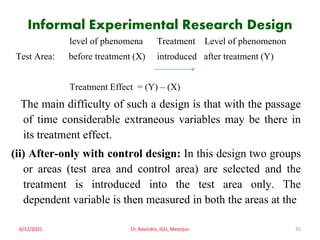
  • 153.
    Measurement and Scaling reliablescale, but it does not give a valid measure of weight. But the other way is not true i.e., a valid instrument is always reliable. Accordingly, reliability is not as valuable as validity, but it is easier to assess reliability in comparison to validity. If the quality of reliability is satisfied by an instrument, then while using it we can be confident that the transient and situational factors are not interfering. Two aspects of reliability viz., stability and equivalence deserve special mention. The stability aspect is concerned 6/12/2021 Dr. Ravindra, IGU, Meerpur 153
  • 154.
    Measurement and Scaling withsecuring consistent results with repeated measurements of the same person and with the same instrument. We usually determine the degree of stability by comparing the results of repeated measurements. The equivalence aspect considers how much error may get introduced by different investigators or different samples of the items being studied. A good way to test for the equivalence of measurements by investigators is to compare their observations of the same events. Reliability can be improved in the following two ways: 6/12/2021 Dr. Ravindra, IGU, Meerpur 154
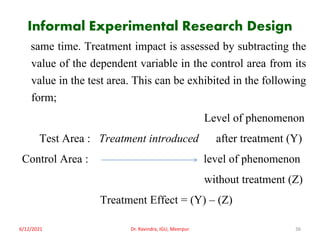
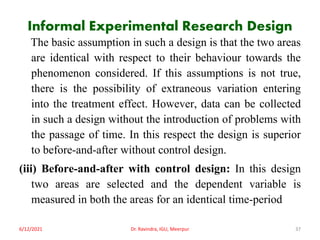
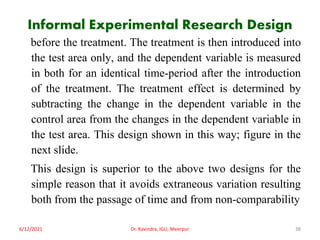
  • 155.
    Measurement and Scaling (i)By standardizing the conditions under which the measurement takes place. (ii) By carefully designed directions for measurement with no variation from group to group by using trained and motivated personal to conduct the research and also by broadening the sample of items used. 3. Practicality: The practicality characteristic of a measuring instrument can be judged in terms of economy, convenience and interpretability. From the operational point of view, the measuring instrument ought to be practical i.e., it should be economical, convenient and interpretable. Economy consideration suggest that some trade-off is needed 6/12/2021 Dr. Ravindra, IGU, Meerpur 155
  • 156.
    Measurement and Scaling betweenthe ideal research project and that which the budget can afford. The length of measuring instrument is an important area where economy pressures are quickly felt. Although more items give greater reliability as stated earlier, but in the interest of limiting the interview or observation time, we have to take only few items for our study purpose. Similarly, data-collection methods to be used are also dependent at times upon economic factors. Convenience test suggests that the measuring instrument should be easy to administer. For this purpose one should given due attention to the proper layout of the measuring 6/12/2021 Dr. Ravindra, IGU, Meerpur 156
  • 157.
    Measurement and Scaling instrument.For instance, a questionnaire, with clear instructions is certainly more effective and easier to complete than one which lacks these features. Interpretability consideration is specially important when person other than the designers of the test are to interpret the results. The measuring instrument, in order to be interpretable, must be supplemented by (a) detailed instructions for administering the test; (b) scoring keys; (c) evidence about the reliability and (d) guide for using the test and for interpreting results. 6/12/2021 Dr. Ravindra, IGU, Meerpur 157
  • 158.
    Measurement and Scaling 4.Accuracy: The characteristics of accuracy of a measurement scale means it should be a true representative of the observation of underplaying characteristics. For example, measuring with an ‘inch’ scale will provide accurate value only up to one-eighth of an inch, while measuring with ‘cm’ scale will provide more accurate value. Sources of Error in Measurement Measurement should be precise and unambiguous in an ideal research study. This objectives, however, is often not met with in entirely. As such the researcher must be aware about the sources of error in measurement. The following 6/12/2021 Dr. Ravindra, IGU, Meerpur 158
  • 159.
    Measurement and Scaling arethe possible sources of error in measurement. 1. Respondent: At times the respondent may be reluctant to express strong negative feelings or it is just possible that he may have very little knowledge but may not admit his ignorance. All this reluctance is likely to result in an interview of ‘guesses’. Transient factors like fatigue, boredom, anxiety, etc. may limit the ability of the respondent to respond accurately and fully. 2. Situation: Situational factors may also come in the way of correct measurement. Any condition which places a strain on interview can have serious effects on the 6/12/2021 Dr. Ravindra, IGU, Meerpur 159
  • 160.
    Measurement and Scaling interviewerrespondent rapport. For instance, if someone else is present, he can distort responses by joining in or merely by being present. If the respondents feels that anonymity is not assured, he may reluctant to express certain feelings. 3. Measurer: The interviewer can distort responses by rewording or reordering questions. His behaviour, style and looks may encourage or discourage certain replies from respondents. Careless mechanical processing may distort the findings. Errors may also creep in because of incorrect coding, faulty tabulation and/or statistical calculations, particularly in the data analysis stage. 6/12/2021 Dr. Ravindra, IGU, Meerpur 160
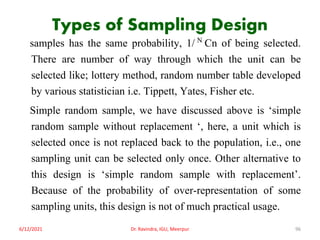
  • 161.
    Measurement and Scaling 4.Instrument: Error may arise because of the defective measuring instrument. The use of complex words, beyond the comprehension of the respondent, ambiguous meanings, poor printing, inadequate space for replies, response choice omissions, etc. are a few things that make the measuring instrument defective and may result in measurement errors. Another type of instrument deficiency is the poor sampling of the universe of items of concern. Researcher must know that correct measurement depends on successfully meeting all of the problem listed above. 6/12/2021 . Ravindra, IGU, MeerpuDrr 161
  • 162.
    Measurement and Scaling Techniquesof Developing Measurement Tools The technique of developing measurement tools involves a four stage process, consisting of the following; a. Concept development. b. Specification of concept dimensions. c. Selection of indicators; and d. Formation of index. The first and foremost step is that of concept development which means that the researcher should arrive at an understanding of the major concepts pertaining to his study. 6/12/2021 Dr. Ravindra, IGU, Meerpur 162
  • 163.
    Measurement and Scaling Thesecond step requires the researcher to specify the dimensions of the concepts that he developed in the first stage. This task may either be accomplished by deduction i.e., by adopting a more or less intuitive approach or by empirical correlation of the individual dimensions with the total concept and/or the other concepts. Once the dimensions of a concept have been specified, the researcher must develop indicators for measuring each concept element. Indicators are specific questions, scales, or other devices by which respondent’s knowledge, opinion, expectation, etc., are measured. As there is seldom a prefect measure of a concept, the researcher 6/12/2021 Dr. Ravindra, IGU, Meerpur 163
  • 164.
    Measurement and Scaling shouldconsider several alternatives for the purpose. The use of more than one indicator gives stability to the scores and it also improves their validity. The last step is that of combining the various indicators into an index, i.e., formation of an index. When we have several dimensions of a concept or different measurements of a dimension, we may need to combine them into a single index. One simple way for getting an overall index is to provide scale values to the responses and then sum up the corresponding scores. Such an overall index would provide a better measurement tool than a single indicator because of the 6/12/2021 Dr. Ravindra, IGU, Meerpur 164
  • 165.
    Measurement and Scaling factthat an ‘individual indicator has only a probability relation to what we really want to know.’ This way we must obtain an overall index for the various concepts concerning the research study. Scaling In research we quite often face measurement problem, specially when the concepts to be measured are complex and abstract like attitude, opinion, perception, etc., and we do not possess the standardized measurement tools. Scaling describes the procedures of assigning numbers to various degrees of opinion, attitude and other concepts. 6/12/2021 Dr. Ravindra, IGU, Meerpur 165
  • 166.
    Measurement and Scaling Thiscan be done in two ways viz. (i) making a judgment about some characteristics of an individual and then placing him directly on a scale that has been defined in terms of that characteristics and (ii) constructing questionnaires in such a way that the score of individual’s responses assigns him a place on a scale. It may be stated here that a scale is a continuum, consisting of the highest point and the lowest point along with several intermediate point between these two extreme points. These scale-point position are so related to each other that when the first point happens to be the highest point, the second point 6/12/2021 Dr. Ravindra, IGU, Meerpur 166
  • 167.
    Measurement and Scaling indicatesa higher degree in terms of a given characteristics as compared to the third point and the third point indicates a higher degree as compared to the fourth and so on. Numbers for measuring the distinctions of degree in the attitude/opinions are, thus, assigned to individuals corresponding to their scale positions. All this is better understood when we talk about scaling technique(s). Hence, the term ‘scaling’ is applied to the procedures for attempting to determine quantitative measures of subjective abstract concepts. Scaling has been defined as a ‘procedure for the assignment of numbers to a 6/12/2021 Dr. Ravindra, IGU, Meerpur 167
  • 168.
    Measurement and Scaling propertyof objects in order to impart some of the characteristics of numbers to the properties in question. Scale Classification Bases The number assigning procedures or the scaling procedures may be broadly classified on one or more of the following bases: (a) subject orientation; (b) response form; (c) degree of subjectivity; (d) scale properties; (e) number of dimensions and (f) scale construction techniques. Lets explain these one by one; (a) Subject Orientation: Under it a scale may be designed to measure characteristics of the respondent who complete it or to judge the stimulus object which is presented to the respondent. In respect of the former, we presume that the 6/12/2021 Dr. Ravindra, IGU, Meerpur 168
  • 169.
    Measurement and Scaling stimulipresented are sufficiently homogeneous so that the between stimuli variation is small as compared to the variation among respondents. In the latter approach, we ask the respondents to judge some specific object in terms of one or more dimensions and we presume that the between- respondent variation will be small as compared to the variation among the different stimuli presented to respondents for judging. (b) Response Form: Under this we may classify the scales as categorical and comparative. Categorical scales are also known as rating scales. These scales are used when a respondent score some object without direct reference to other 6/12/2021 Dr. Ravindra, IGU, Meerpur 169
  • 170.
    Measurement and Scaling objects.Under comparative scales, which are also known as ranking scales, the respondents is asked to compare two or more objects. In this sense the respondents may state that one object is superior to the other or that three models of pen rank in order 1, 2 and 3. The essence of ranking is, in fact, a relative comparison of a certain property of two or more objects. (c) Degree of Subjectivity: With this basis the scale data may be based on whether we measure subjective personal preferences or simply make non-preference judgments. In 6/12/2021 Dr. Ravindra, IGU, Meerpur 170
  • 171.
    Measurement and Scaling theformer case, the respondents is asked to choose which person he favours or which solution he would like to see employed, whereas in the latter case he is simply asked to judge which person is more effective in some aspect or which solution will take fewer resources without reflecting any personal preference. (d) Scale Properties: Considering scale properties, one may classify the scales as nominal, ordinal, interval and ratio scales. Nominal scales merely classify without indicating order, distance or unique origin. Ordinal scales indicate magnitude relationships of ‘more than’ or ‘less than’, but 6/12/2021 Dr. Ravindra, IGU, Meerpur 171
  • 172.
    Measurement and Scaling indicateno distance or unique origin. Interval scales have both order and distance values, but no unique origin. Ratio scales possess all these features. (e) Number of Dimensions: In respect of this basis, scales can be classified as ‘unidimensional’ and ‘multidimensional’ scales. Under the former we measure only one attribute of the respondent or object, whereas multidimensional scaling recognizes that an object might be described better by using the concept of an attribute space of ‘n’ dimensions, rather than a single-dimension continuum. 6/12/2021 Dr. Ravindra, IGU, Meerpur 172
  • 173.
    Measurement and Scaling (f)Scale Construction Techniques: Following are the five main techniques by which scales can be developed. (i) Arbitrary Approach: It is an approach where scale is developed on adhoc basis. This is the most widely used approach. It is presumed that such scale measure the concepts for which they have been designed, although there is little evidence to support such an assumption. (ii) Consensus Approach: Here a panel of judges evaluate the items chosen for inclusion in the instrument in terms of whether they are relevant to the topic area and unambiguous in implication. 6/12/2021 Dr. Ravindra, IGU, Meerpur 173
  • 174.
    Measurement and Scaling (iii)Item Analysis Approach: Under it a number individual items are developed into a test which is given to a group of respondents. After administering the test, the total score are calculated for every one. Individual items are then analyzed to determine which items discriminate between persons or objects with high total score and those with low scores. (iv) Cumulative Scale: The scale is chosen on the basis of their conforming to some ranking of items with ascending and descending discriminating power . For instance, in such a scale the endorsement of all items indicating a less extreme position. 6/12/2021 Dr. Ravindra, IGU, Meerpur 174
  • 175.
    Measurement and Scaling (v)Factor Scales: The scale may be constructed on the basis of inter-correlations of items which indicate that a common factor accounts for the relationship between items. This relationship is typically measured through factor analysis method. Scaling Techniques Scaling techniques are broadly classified into ‘comparative scaling techniques’ and ‘non-comparative scaling techniques’. Comparative scale involve direct comparison of stimulus objects. Comparative scale data are interpreted in relative terms and are measured on ordinal scale. This technique is a non-numerical scaling 6/12/2021 Dr. Ravindra, IGU, Meerpur 175
  • 176.
    Measurement and Scaling techniqueas ordinal data cannot be used for numerical operations. These techniques are easy to understand and apply. The main disadvantage of comparative scale is the inability to generalize beyond the stimulus objects. In non-comparative scale, each object is scaled independently of the others. For example, the respondents are asked to give preference score on a 1 to 6 scale to brand ‘A’ of the toothpaste. Here 1= no preferred at all and 6 = highly preferred. Similarly score can be obtained for brand ‘B’ and ‘C’. Because of these numeric data and wide applications, non-comparative scale are widely used 6/12/2021 Dr. Ravindra, IGU, Meerpur 176
  • 177.
    Measurement and Scaling inresearch. Now we present comparative and non- comparative scale which are commonly used. A. Comparative Scaling Techniques (i) Paired comparison. (ii) Rank order (iii) Constant sum. (i) Paired comparison: In this method the respondent can express his attitude by making a choice between two objects, say between a new flavor of soft drink and an established brand of drink. But when there are more than 6/12/2021 Dr. Ravindra, IGU, Meerpur 177
  • 178.
    Measurement and Scaling twostimuli to judge, the number of judgments required in a paired comparison is given by the formula; n(n – 1) N = 2 Where N = Number of judgment. n = number of stimuli or objects to be judged. For instance, if there are 10 suggestions for bargaining proposals available to a worker’s union, there are 45 paired comparison that can be made with them. When N 6/12/2021 Dr. Ravindra, IGU, Meerpur 178
  • 179.
    Measurement and Scaling happensto be a big figure, there is the risk of respondents giving ill considered answers or they may even refuse to answer. We can reduce the number of comparisons per respondent either by presenting to each one of them only a sample of stimuli or by choosing few objects which cover the range of attractiveness at about equal intervals and then comparing all other stimuli to these few standard objects. Thus, paired comparison data may be treated in several ways. If there is substantial consistency, we will find that if X is preferred to Y, and Y to Z, then X will consistently be preferred to Z. if this is true, we may take the total number of preferences among the comparisons as 6/12/2021 Dr. Ravindra, IGU, Meerpur 179
  • 180.
    Measurement and Scaling thescore for that stimulus. It should be remembered that paired comparison provides ordinal data, but the same may be converted into an interval scale by the method of the Law of Comparative Judgment developed by L.L. Thurstone. This technique involves the conversion of frequencies of preferences into a table of proportions which are then transformed into Z matrix by referring to the table of area under the normal curve. J.P. Guildford in his book “Psychometric Methods” has given a procedure which is relatively easier: 6/12/2021 Dr. Ravindra, IGU, Meerpur 180
  • 181.
    Measurement and Scaling Supposethere are four proposals which some union bargaining committee is considering. The committee wants to know how the union membership ranks these proposals. For this purpose a sample of 100 members might express the views as shown in the following table; 6/12/2021 Dr. Ravindra, IGU, Meerpur 181
  • 182.
    Measurement and Scaling ResponsePatterns of 100 Members’ Paired Comparisons of Suggestions for Union Bargaining Proposal Priorities 6/12/2021 Dr. Ravindra, IGU, Meerpur 182 Suggestions A B C D A -- 65 32 20 B 40 -- 38 42 C 45 50 -- 70 D 80 20 98 -- TOTAL 165 135 168 132 Mp 0.5375 0.4625 0.5450 0.4550 Zi 0.09 (-) 0.09 0.11 (-) 0.11 Ri 0.20 0.02 0.22 0.00
  • 183.
    Measurement and Scaling Comparingthe total number of preferences for each of the four proposals, we find that C is the most popular, followed by A, B, and C respectively in popularity. The rank order shown in the above table explains all this. By following the composite standard method, we can develop an interval scale from the paired comparison ordinal data given in the above table for which purpose we have to adopt the following steps in order: (i) Using the data in the above table, we work out the column mean with the help of the formula given in the next slide. 6/12/2021 Dr. Ravindra, IGU, Meerpur 183
  • 184.
    Measurement and Scaling C+ .5(N) 165 + .5(100) Mp = = = .5375 nN 4(100) Where; Mp = The mean proportion of the column. C = The total number of choices for a given suggestion. n = Number of stimuli (proposal in the given problem). N = Number of items in the sample. The column means have been shown in the Mp row in the above table. (ii) The Z values for the Mp are secured from the table giving 6/12/2021 Dr. Ravindra, IGU, Meerpur 184
  • 185.
    Measurement and Scaling thearea under the normal curve. When the Mp value is less than .5, the Z value is negative and for all Mp values higher than .5, the Z values are positive. These Z values are shown in Zi row in the above table. (iii) As the Zi values represent an interval scale, zero is an arbitrary value. Hence, we can eliminate negative scale values by giving the value of zero to the lowest scale value (this being (-) .11 in our example which we shall take equal to zero) and then adding the absolute value of this lowest scale value to all other scale items. This scale has been shown in Ri row in the above table. 6/12/2021 Dr. Ravindra, IGU, Meerpur 185
  • 186.
    Measurement and Scaling Graphically,we can show this interval scale that we have derived from the paired-comparison data using the composite standard method as follows: D B A C 0.0 0.1 0.2 0.3 0.4 (ii) Rank Order: Under this method of comparative scaling, the respondents are asked to rank their choices. This method is easier and faster than the method of paired comparisons stated above. For example, with10 items it takes 45 pair comparisons to complete the task, where as the method of rank order simply 6/12/2021 Dr. Ravindra, IGU, Meerpur 186
  • 187.
    Measurement and Scaling requiredranking of 10 items only. The problem of transitivity (such as A prefers to B, B to C, but C prefers to A) is also not there in case we adopt method of rank order. Moreover, a complete ranking at times is not needed in which case the respondents may be asked to rank only their first, say, four choices while the number of overall items involved may be more than four, say, it may be 15 or 20 or more. To secure a simple ranking of all items involved we simply total rank values received by each item. There are methods through which we can as well develop an interval scale of these data. But then there 6/12/2021 Dr. Ravindra, IGU, Meerpur 187
  • 188.
    Measurement and Scaling arelimitations of this method. The first one is that data obtained through this method is ordinal data and hence rank ordering is an ordinal scale with all its limitations. Then there may be the problem of respondents becoming careless in assigning ranks particularly when there are many items. (iii) Constant Sum: Constant sum scaling technique is used to assess the relative importance attached by a respondent to the stimulus objects. The respondent gives certain points to each stimulus object out of a fixed sum of point. 6/12/2021 Dr. Ravindra, IGU, Meerpur 188
  • 189.
    Measurement and Scaling Thisfixed sum is usually taken as 100, but it could be some other value also. For example, a family planning a holiday, fixes the budget of Rs. 50,000. They wish to plan the expenditures on transportation, accommodation, food, drinks, and others. The constant sum is 50,000 in this example which could be divided as; Transportation 10,000 Accommodation 20,000 Food 12,000 Drink 0 Others 8,000 6/12/2021 Dr. Ravindra, IGU, Meerpur 189
  • 190.
    Measurement and Scaling Thedata obtained here is numeric but cannot be generalized beyond the list of stimulus objects. So, this data is considered as ordinal data. This technique distinguishes the objects in less time. However, it is not useful with uneducated people or with large number of objects. B. Non-comparative Scaling Techniques Most common non-comparative scaling techniques are: (i) Continuous rating or graphic rating. (ii) Itemized rating. 6/12/2021 Dr. Ravindra, IGU, Meerpur 190
  • 191.
    Measurement and Scaling (iii)Simple/multiple category scale. (iv) Verbal frequency scale. These technique discussed briefly as follows; (i) Continuous Rating or Graphical Rating: The graphical rating scale is quite simple and is commonly used in practice. Under it the various points are usually put along the line to form a continuum and the rater indicates his rating by simply making a mark at the appropriate point on a line that runs from one extreme to the other. Scale points with brief descriptions may be indicated along the line, their function being to assist the rater in performing his job. The following is an example of five-point graphical rating scale when we wish 6/12/2021 Dr. Ravindra, IGU, Meerpur 191
  • 192.
    Measurement and Scaling toascertain people’s liking or disliking any product. How do you like the product? (please tick) Likely very Like some Neutral Dislike some Dislike much what what very much This type of scale has several limitations. The respondents may check at almost any position along the line which is in fact may increase the difficulty of analysis. The meaning of the terms like ‘very much’ and ‘some what’ may depend 6/12/2021 Dr. Ravindra, IGU, Meerpur 192
  • 193.
    Measurement and Scaling uponrespondent’s frame of reference so much so that the statement might be challenged in terms of its equivalency. Several other rating scale variants (boxes replacing line may also be used. (ii) Itemized Rating: A scale having numbers or brief descriptions of each category is provided. Categories are ordered in terms of scale positions. The respondents select one of the categories that best describes the stimulus object. Commonly used itemized rating scales are; (A) Likert Scales: Likert scale or summated scales are developed by utilizing the item analysis approach wherein a particular item is evaluated on the basis of how well it discriminates between those persons whose total score is high 6/12/2021 Dr. Ravindra, IGU, Meerpur 193
  • 194.
    Measurement and Scaling andthose whose score is low. Those items or statements that best meet this sort of discrimination test are included in the final instrument. Thus, summated scales consist of a number of statements which express either a favorable or unfavorable attitude towards the given object to which the respondent is asked to react. The respondent indicate his agreement or disagreement with each statement in the instrument. Each response is given a numerical score, indicating its favorableness or unfavourableness, and the score are totaled to measure the respondent’s attitude. In other 6/12/2021 Dr. Ravindra, IGU, Meerpur 194
  • 195.
    Measurement and Scaling words,the overall score represents the respondent’s position on the continuum of favourable-unfavourableness towards an issue. Most frequently used summated scales in the study of social attitudes follows the pattern devised by Likert. For this reason they are often referred to as Likert-type scales. In a Likert scale, the respondents is asked to respond to each of the statements in terms of several degrees, usually five degree. For example, when asked to express opinion whether one considers his job quite pleasant, the respondent may respond in any one of the following ways: 6/12/2021 Dr. Ravindra, IGU, Meerpur 195
  • 196.
    Measurement and Scaling (i)strongly agree, (ii) agree, (iii) undecided, (iv) disagree, (v) strongly disagree. We find that these five points constitute the scale. At one extreme of the scale there is strong agreement with the given statement and at the other, strong disagreement, and between them lie intermediate points. We may illustrate this as under: Strongly Agree Undecided Disagree Strongly Agree (1) (2) (3) (4) disagree (5) 6/12/2021 Dr. Ravindra, IGU, Meerpur 196
  • 197.
    Measurement and Scaling Eachpoint on the scale carries a score. Response indicating the least favourable degree of job satisfaction is given the least score (say 1) and the most favourable is given the highest score (say 5). These score – values are normally not printed on the instrument but are shown here just to indicate the scoring pattern. The Likert scaling technique, thus assigns a scale value to each of the five way the instrument yields a total score for each respondent, which would then measure the respondent’s favourableness toward the given point of view. If the instrument consists of, say 30 statements, the following 6/12/2021 Dr. Ravindra, IGU, Meerpur 197
  • 198.
    Measurement and Scaling scorevalue would be revealing. 30 × 5 = 150 Most favourable response possible. 30 × 3 = 90 A neutral attitude. 30 × 1 = 30 Most unfavourable attitude. The score for any individual would fall between 30 and 150. if the score happens to be above 90, it shows favourable opinion to the given point of view, a score of below 90 would mean unfavourable opinion and a score of exactly 90 would be suggestive of a neutral attitude. 6/12/2021 Dr. Ravindra, IGU, Meerpur 198
  • 199.
    Measurement and Scaling Procedure:The procedure for developing a Likert-type scale is as follows: (i) As a first step the researcher collect a large number of statement which are relevant to the attitude being studied and each statement expresses definite favorableness and unfavourableness, and the statement of each type is approximately equal. (ii) After the statement have been gathered, a trial test should be administered to a number of subjects. (iii) The response to various statements are scored in such a way that a response indicative of the most favorable attitude is 6/12/2021 Dr. Ravindra, IGU, Meerpur 199
  • 200.
    Measurement and Scaling giventhe highest score of 5 and that with the most unfavourable attitude is given the lowest score, say, of 1. (iv) Then the total score of each respondent is obtained by adding his scores that he received for separate statement. (v) The next step is to array total score and find out those statement which have a high discriminatory power. The researcher then select those statement which are having the discriminatory power say, upper 25 percent and lowest 25 percent. (vi) Only those statements that correlate with the total test should be retained in the final instrument and all others must be discarded form it. 6/12/2021 Dr. Ravindra, IGU, Meerpur 200
  • 201.
    Measurement and Scaling B.Semantic Differential Scale: Semantic differential scale or the S.D. scale developed by Charles E. Osgood, G.J. Suci and P.H. Tannenbaum (1957), is an attempt to measure the psychological meaning of an object to an individual. This scale is based on the presumption that an object can have different dimensions of connotative meaning which can be located in multidimensional property space, or what can be called the semantic space in the context of S.D. scale. This scaling consists of a set of bipolar rating scales, usually of 7 points, by which one or more respondents rate one or more concepts on each 6/12/2021 Dr. Ravindra, IGU, Meerpur 201
  • 202.
    Measurement and Scaling scaleitem. For instance, the S.D. scale items for analyzing candidates for leadership position may be shown as under; (E) Successful Unsuccessful (P) Severe Lenient (P) Heavy Light (A) Hot Cold (E) Progressive Regressive (P) Strong Weak (A) Active Passive (A) Fast Slow 3 2 1 0 -1 -2 -3 6/12/2021 Dr. Ravindra, IGU, Meerpur 202
  • 203.
    Measurement and Scaling Candidatesfor leadership position may be compared and we may score them from +3 to -3 on the basis of the above stated scales. (The letter E, P, A showing the relevant facors viz. evaluation, potency and activity respectively, written along the left side are not written in actual scale.) Osgood and others did produce a list of some adjectives pairs for attitude research purposes and concluded that semantic space is multidimensional rather than unidimensional . They mad sincere effort and ultimately found that three factors, viz., evaluation, potency and activity, contributed most to meaningful judgments by respondents. The evaluation dimension generally accounts for ½ and ¾ of the extractable 6/12/2021 Dr. Ravindra, IGU, Meerpur 203
  • 204.
    Measurement and Scaling varianceand the other two factors account for the balance. Procedure: Various steps involved in developing S.D. scale are as follows: (i) First of all the concepts to be studied are selected. The concepts are usually chosen by personal judgment , keeping in view the nature of the problem. (ii) The next step is to select the scales bearing in mind the criterion of factor composition and the criterion of scale’s relevance to the concepts being judged. One more criterion to be kept in view is that scales should be stable across subjects and concepts. 6/12/2021 Dr. Ravindra, IGU, Meerpur 204
  • 205.
    Measurement and Scaling (iii)Then a panel of judges are used to rate the various stimuli or objects on the various selected scales and the responses of all judges would then be combined to determine the composite scaling. To conclude, the S.D. scale has a number of specific advantages. It is an efficient and easy way to secure attitudes from a large sample. These attitudes may be measured in both direction and intensity. The total set of responses provides a comprehensive picture of the meaning of an object, as well as a measure of the subject 6/12/2021 Dr. Ravindra, IGU, Meerpur 205
  • 206.
    Measurement and Scaling doingthe rating. It is a standardized technique that is easily repeated, but escape many of the problems of response distortion found with more direct methods. (iii) Staple Scale: This scale was developed by John Staple. This is the uni-polar rating scale with usually 10 categories numbered from -5 to +5. this scale does not have zero or neutral point. Respondents rate how each term describes the object by selecting the appropriate number. Positive number means the term describes the object accurately, while negative number implies that the term describes the object inaccurately. +5 means the highest degree of accuracy while -.5 means the highest degree of inaccuracy. 6/12/2021 Dr. Ravindra, IGU, Meerpur 206
  • 207.
    Measurement and Scaling Forexample, consider the phrases (i) Tasty food, (ii) Fast Services, and (iii) Good Ambience for a restaurant. A respondent is asked to rate how accurately these terms or phrases describe a specified restaurant. (See in the next slid). The respondent selects +1 for ‘tasty food’, -2 for ‘fast service’ and +3 for ‘good ambience’. This means the respondent thinks that the phrase ‘tasty food’ is accurate with a minimum degree of accuracy. So according to the respondent the ambience of the restaurant is good, food test is okay but service is slow. 6/12/2021 Dr. Ravindra, IGU, Meerpur 207
  • 208.
    Measurement and Scaling +5+5 +5 +4 +4 +4 +3 +3 [+3] +2 +2 +2 [ +1] +1 +1 Tasty Food Fast Service Good Ambience -1 -1 -1 -2 [-2] -2 -3 -3 -3 -4 -4 -4 -5 -5 -5 6/12/2021 Dr. Ravindra, IGU, Meerpur 208
  • 209.
    Measurement and Scaling Thismethod is applicable when the responses are rated on a single dimension. The method is very economic and data can be collected over telephonic interview also. Some researcher think that the method is confusing and of not much use. (iii) Single/Multiple Category Scales: These scales are also known as dichotomous scales. Here we have two or more mutually exclusive responses. For example, ‘Yes’ and ‘No’, ‘True’ and ‘False’. The respondent has to choose only one out of the categories. It would be clear from the 6/12/2021 Dr. Ravindra, IGU, Meerpur 209
  • 210.
    Measurement and Scaling followingexample questions of a questionnaire: 1. Do you play cricket? Yes ( ) No ( ) 2. What is your marital status? Married ( ) Unmarried ( ) Divorce ( ) Widower ( ) 3. What is your employment type? Salaried ( ) Self employed business ( ) Student ( ) Self employed professional ( ) Retired ( ) Home maker ( ) 6/12/2021 Dr. Ravindra, IGU, Meerpur 210
  • 211.
    Measurement and Scaling Thesescales can also be generalized to have more than one responses. For example, 1. What do you know? Car ( ) House ( ) Computer ( ) Home theatre ( ) 2. What are you interested in? Music ( ) Films ( ) Sports ( ) Reading ( ) Travelling ( ) 3. What do you like to do on internet? Social networking ( ) E-mail ( ) New reading ( ) Knowledge gaining ( ) Gaming ( ) 6/12/2021 Dr. Ravindra, IGU, Meerpur 211
  • 212.
    Measurement and Scaling Itshould be insured that the provided choice exhaust almost all possible answers of the asked question. The choice ‘others’ may be given along with other choices. The collected data is on nominal scale. The method is easy and very popular on internet surveys. (iv) Verbal frequency Scale: This scale is used when the respondent is unable or unwilling to give the exact numbers in the answer. For example; 1. How often do you eat out? (i) Frequently ( ) Sometime ( ) Rarely ( ) Never ( ) 6/12/2021 Dr. Ravindra, IGU, Meerpur 212
  • 213.
    Measurement and Scaling Thisscale provides only an approximation of frequency and so the data is on ordinal scale. Dimensions: In uni-dimensional scale, only one attribute of the object is measured. While, a multi-dimensional scale considers that an object is described with several dimensions. For example, the popularity of a restaurant can be measured by a single measure food taste. It can be defined on multiple dimensions like food taste, service, cleanliness, ambience, etc. Number of Scale Categories: Larger number of scale categories will provide better precision in the collected data. However, it would become inconvenient for the 6/12/2021 Dr. Ravindra, IGU, Meerpur 213
  • 214.
    Measurement and Scaling respondent.So, the number of scale categories is a trade- off between precision and convenience. It should be chosen with care. Balanced and Unbalanced Scale: In balanced scale, number of favorable and unfavorable categories are equal, while they are unequal in an unbalanced scale. The scale should be balanced in general to collect an unbiased opinion. However, if the distribution of responses is likely to be skewed on one direction, an unbalanced scale having more categories on the opposite direction is used. 6/12/2021 Dr. Ravindra, IGU, Meerpur 214
  • 215.
    Measurement and Scaling TheEnd! 6/12/2021 Dr. Ravindra, IGU, Meerpur 215