Financial
Accounting
Dr.BELLARMIN DIANA
Assistant Professor
Department of Management Studies
Bon Secours College for Women, Thanjavur
INTRODUCTION
Accounting has rightly been termed as the language of the business. The basic
function of a language is to serve as a means of communication. Accounting also
serves this function. It communicates the result of business operations to various
parties who have some stake in the business, viz., the proprietor, creditors,
investors, Government and other agencies.
ACCOUNTING
Meaning
– Accounting is primarily concerned with designing the systems for recording,
classifying and summarizing the recorded data and interpreting them for
internal and external end users.
Definition
– The American Institute of Certified Public Accountants also defines accounting
as “the art of recording, classifying and summarizing the financial transactions”.
Accounting helps in achieving our desired objective of maintaining proper
accounts, i.e., to know the profitability and the financial position of the business,
by maintaining proper accounts.
BOOK KEEPING
– Book-keeping is mainly concerned with recording of financial data relating to
the business operations in a significant and orderly manner. A book-keeper may
be responsible for keeping all the records of a business A substantial portion of
the book-keeper’s work is of a clerical nature and is increasingly being
accomplished through the use of mechanical and electronical devices.
Accounting and Accountancy
– Accounting is traditionally one of the three principles of accountancy (the others
were bookkeeping and auditing). Traditionally, accountancy is the parent term
for the entire field and accounting was a specific duty of an accountant.
– Accountancy is referred to as the actual process of communicating information
about the financial state of a company to its shareholders, usually in the form of
financial statements, which show the assets and resources under the company’s
control in monetary terms.
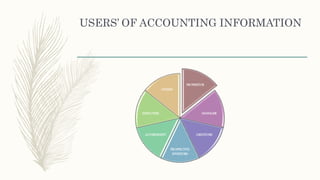
USERS’ OF ACCOUNTING INFORMATION
PROPRIETOR
MANAGER
CREDITORS
PROSPECTIVE
INVESTORS
GOVERNMENT
EMPLOYEES
CITIZEN
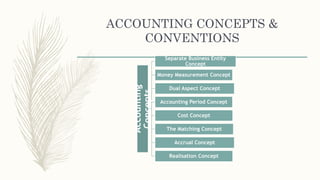
ACCOUNTING CONCEPTS &
CONVENTIONS
Accounting
Concepts
Separate Business Entity
Concept
Money Measurement Concept
Dual Aspect Concept
Accounting Period Concept
Cost Concept
The Matching Concept
Accrual Concept
Realisation Concept
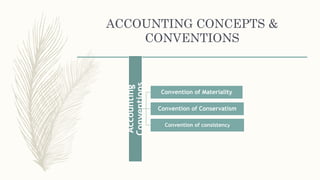
ACCOUNTING CONCEPTS &
CONVENTIONS
Accounting
Conventions
Convention of Materiality
Convention of Conservatism
Convention of consistency
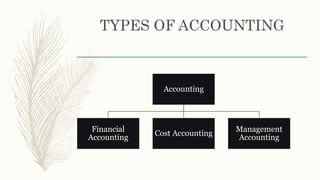
TYPES OF ACCOUNTING
Accounting
Financial
Accounting
Cost Accounting
Management
Accounting
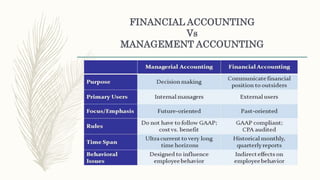
FINANCIAL ACCOUNTING
Vs
MANAGEMENT ACCOUNTING
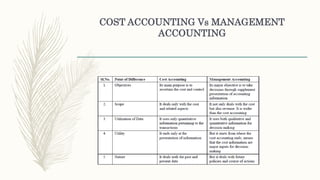
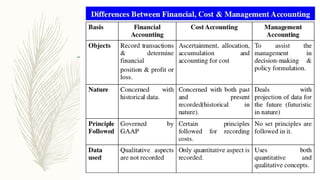
COST ACCOUNTING Vs MANAGEMENT
ACCOUNTING
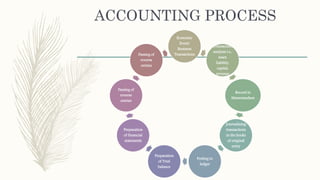
ACCOUNTING PROCESS
Economic
Event/
Business
Transactions
Transaction
analysis i.e.,
Asset,
liability,
capital,
revenue
Record in
Memorandum
Journalizing
transactions
in the books
of original
entry
Posting to
ledger
Preparation
of Trial
balance
Preparation
of financial
statements
Passing of
reverse
entries
Passing of
reverse
entries
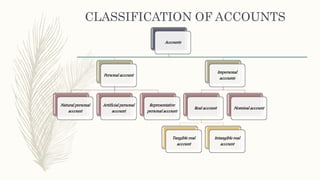
CLASSIFICATION OF ACCOUNTS
Accounts
Personal account
Natural personal
account
Artificial personal
account
Representative
personal account
Impersonal
accounts
Real account
Tangible real
account
Intangible real
account
Nominal account
JOURNAL & JOURNALZING
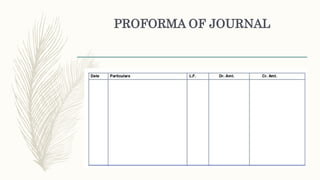
 Journal is a primary book for recording the day to day transactions in a
chronological order i.e. the order in which they occur. The journal is a form of
diary for business transactions. This is called the book of first entry since every
transaction is recorded firstly in the journal.
 Journalism is the process of recording journal entries in the Journal. It is a
systematic act of entering the transaction in a day book in order of their
occurrence i.e., date-wise or event-wise.
PROFORMA OF JOURNAL
LEDGER
– Ledger is a book which contains various accounts. In simple words,
ledger is a set of accounts. It includes all accounts of the business
enterprise whether Real, Nominal or Personal. Ledger may be kept
in any of the following two forms:
Bound Ledger; and
Loose Leaf Ledger
POSTING
 The term ‘Posting’ means transferring the debit and credit items from the Journal
to their respective accounts in the ledger. It is important to note that the exact
names of accounts used in the Journal should be carried to the ledger.
SUBSIDIARY BOOKS
 Subsidiary Books are also known as special journals or “Day Books”. Special
journals refer to the journals meant for recording specific business transactions
of similar nature.
 To overcome the shortcomings of the use of the journal as the only book of
original entry, the journal is subdivided into special journals. It is divided in such
a way that a separate book is used for each category of business transactions
which are repetitive in nature, similar and are sufficiently large in number.
TYPES OF SUBSIDIARY BOOKS
Cash Book: It records all those transactions which are in cash or by
cheques.
Purchases Book: It records all transactions relating to goods purchased
on credit.
Sales Book: It records all transactions relating to goods sold on credit.
Purchases Return Book: It records return of goods to suppliers.
Sales Return Book: It records return of goods by the customers.
TYPES OF SUBSIDIARY BOOKS
Bills Receivable Book: It records entries regarding bills receivables. The details of
bills are given in this book.
Bills Payable Book: All bills which are accepted and payable by a business house are
recorded in this book.
Journal Proper: Those transactions which are not recorded in any of the above
mentioned books are recorded in the Journal Proper.
THANK YOU

Financial accounting

  • 1.
    Financial Accounting Dr.BELLARMIN DIANA Assistant Professor Departmentof Management Studies Bon Secours College for Women, Thanjavur
  • 2.
    INTRODUCTION Accounting has rightlybeen termed as the language of the business. The basic function of a language is to serve as a means of communication. Accounting also serves this function. It communicates the result of business operations to various parties who have some stake in the business, viz., the proprietor, creditors, investors, Government and other agencies.
  • 3.
    ACCOUNTING Meaning – Accounting isprimarily concerned with designing the systems for recording, classifying and summarizing the recorded data and interpreting them for internal and external end users. Definition – The American Institute of Certified Public Accountants also defines accounting as “the art of recording, classifying and summarizing the financial transactions”. Accounting helps in achieving our desired objective of maintaining proper accounts, i.e., to know the profitability and the financial position of the business, by maintaining proper accounts.
  • 4.
    BOOK KEEPING – Book-keepingis mainly concerned with recording of financial data relating to the business operations in a significant and orderly manner. A book-keeper may be responsible for keeping all the records of a business A substantial portion of the book-keeper’s work is of a clerical nature and is increasingly being accomplished through the use of mechanical and electronical devices.
  • 5.
    Accounting and Accountancy –Accounting is traditionally one of the three principles of accountancy (the others were bookkeeping and auditing). Traditionally, accountancy is the parent term for the entire field and accounting was a specific duty of an accountant. – Accountancy is referred to as the actual process of communicating information about the financial state of a company to its shareholders, usually in the form of financial statements, which show the assets and resources under the company’s control in monetary terms.
  • 6.
    USERS’ OF ACCOUNTINGINFORMATION PROPRIETOR MANAGER CREDITORS PROSPECTIVE INVESTORS GOVERNMENT EMPLOYEES CITIZEN
  • 7.
    ACCOUNTING CONCEPTS & CONVENTIONS Accounting Concepts SeparateBusiness Entity Concept Money Measurement Concept Dual Aspect Concept Accounting Period Concept Cost Concept The Matching Concept Accrual Concept Realisation Concept
  • 8.
    ACCOUNTING CONCEPTS & CONVENTIONS Accounting Conventions Conventionof Materiality Convention of Conservatism Convention of consistency
  • 9.
  • 10.
  • 11.
    COST ACCOUNTING VsMANAGEMENT ACCOUNTING
  • 13.
    ACCOUNTING PROCESS Economic Event/ Business Transactions Transaction analysis i.e., Asset, liability, capital, revenue Recordin Memorandum Journalizing transactions in the books of original entry Posting to ledger Preparation of Trial balance Preparation of financial statements Passing of reverse entries Passing of reverse entries
  • 14.
    CLASSIFICATION OF ACCOUNTS Accounts Personalaccount Natural personal account Artificial personal account Representative personal account Impersonal accounts Real account Tangible real account Intangible real account Nominal account
  • 16.
    JOURNAL & JOURNALZING Journal is a primary book for recording the day to day transactions in a chronological order i.e. the order in which they occur. The journal is a form of diary for business transactions. This is called the book of first entry since every transaction is recorded firstly in the journal.  Journalism is the process of recording journal entries in the Journal. It is a systematic act of entering the transaction in a day book in order of their occurrence i.e., date-wise or event-wise.
  • 17.
  • 18.
    LEDGER – Ledger isa book which contains various accounts. In simple words, ledger is a set of accounts. It includes all accounts of the business enterprise whether Real, Nominal or Personal. Ledger may be kept in any of the following two forms: Bound Ledger; and Loose Leaf Ledger
  • 19.
    POSTING  The term‘Posting’ means transferring the debit and credit items from the Journal to their respective accounts in the ledger. It is important to note that the exact names of accounts used in the Journal should be carried to the ledger.
  • 20.
    SUBSIDIARY BOOKS  SubsidiaryBooks are also known as special journals or “Day Books”. Special journals refer to the journals meant for recording specific business transactions of similar nature.  To overcome the shortcomings of the use of the journal as the only book of original entry, the journal is subdivided into special journals. It is divided in such a way that a separate book is used for each category of business transactions which are repetitive in nature, similar and are sufficiently large in number.
  • 21.
    TYPES OF SUBSIDIARYBOOKS Cash Book: It records all those transactions which are in cash or by cheques. Purchases Book: It records all transactions relating to goods purchased on credit. Sales Book: It records all transactions relating to goods sold on credit. Purchases Return Book: It records return of goods to suppliers. Sales Return Book: It records return of goods by the customers.
  • 22.
    TYPES OF SUBSIDIARYBOOKS Bills Receivable Book: It records entries regarding bills receivables. The details of bills are given in this book. Bills Payable Book: All bills which are accepted and payable by a business house are recorded in this book. Journal Proper: Those transactions which are not recorded in any of the above mentioned books are recorded in the Journal Proper.
  • 23.