CAPITAL STRUCTURE
Dr. S. BELLARMIN DIANA
ASSISTANT PROFESSOR
DEPARTMENT OF MANAGEMENT STUDIES
BON SECOURS COLLEGE FOR WOMEN, THANJAVUR
CAPITAL STRUCTURE
Meaning of Capital Structure
Capital structure refers to the kinds of securities and the proportionate amounts that
make up capitalization. It is the mix of different sources of long-term sources such as equity
shares, preference shares, debentures, long-term loans and retained earnings.
The term capital structure refers to the relationship between the various long-term
source financing such as equity capital, preference share capital and debt capital. Deciding
the suitable capital structure is the important decision of the financial management because
it is closely related to the value of the firm. Capital structure is the permanent financing of
the company represented primarily by long-term debt and equity.
Definition of Capital Structure
The following definitions clearly initiate, the meaning and objective of the capital
structures.
✓ According to the definition of Gerestenbeg, “Capital Structure of a company refers
to the composition or make up of its capitalization and it includes all long-term
capital resources”.
✓ According to the definition of James C. Van Horne, “The mix of a firm’s
permanent long-term financing represented by debt, preferred stock, and common
stock equity”.
✓ According to the definition of Presana Chandra, “The composition of a firm’s
financing consists of equity, preference, and debt”.
✓ According to the definition of R.H. Wessel, “The long term sources of fund
employed in a business enterprise”.
FINANCIAL STRUCTURE
The term financial structure is different from the capital structure. Financial structure
shows the pattern total financing. It measures the extent to which total funds are available
to finance the total assets of the business.
Financial Structure = Total liabilities
Or
Financial Structure = Capital Structure + Current liabilities.
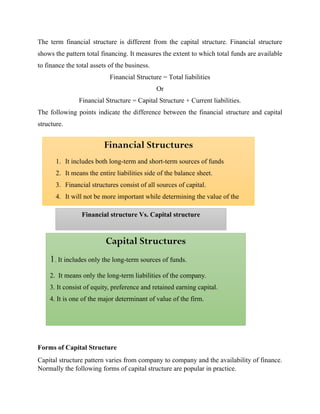
The following points indicate the difference between the financial structure and capital
structure.
Forms of Capital Structure
Capital structure pattern varies from company to company and the availability of finance.
Normally the following forms of capital structure are popular in practice.
Financial Structures
1. It includes both long-term and short-term sources of funds
2. It means the entire liabilities side of the balance sheet.
3. Financial structures consist of all sources of capital.
4. It will not be more important while determining the value of the
firm.
Capital Structures
1. It includes only the long-term sources of funds.
2. It means only the long-term liabilities of the company.
3. It consist of equity, preference and retained earning capital.
4. It is one of the major determinant of value of the firm.
Financial structure Vs. Capital structure
• Equity shares only.
• Equity and preference shares only.
• Equity and Debentures only.
• Equity shares, preference shares and debentures.
CONCEPT AND SIGNIFICANCE OF OPTIMUM CAPITAL STRUCTURE
The optimum capital structure is obtained when the market value per share is
maximum while the average cost of capital is minimum.
The optimum capital structure may be defined as “that capital structure or
combination of debt and equity that leads to the maximum value of firm”.
So, the optimum capital structure is that relationship of debt and equity, which
maximizes the value of the company’s equity share in the stock exchange. Normally,
every firm uses debt and equity in financing its assets. In case, company’s borrowing
helps the company in increasing its market value of share in the stock exchange, it can
be said that the company is moving towards its optimum capital structure. However, if
the use of borrowing results in the fall of market value of share in the stock exchange,
it can be said that the company is moving away from its optimum capital structure.
So, the objective of the firm is to select that type of financing or debt-equity mix,
which leads to maximize the value of equity share in the stock exchange.
CONSIDERATIONS
The following considerations should be kept in mind while achieving the goal of
achieving optimum capital structure.
(A) Borrow when cheap: Company should borrow as long as its cost of debt is lower
than the return on investment. If the interest paid on debentures/long term loans or
dividend payable on preference share capital is lower than the return on investment, it
is preferable to borrow. It will increase the market value of the share. So, every effort
has to be made to take possible advantage of leverage.
(B) Tax Advantage of Corporate Taxes: Interest paid on borrowing is eligible for tax
benefit. So, effective cost of debt goes down in comparison to other forms of financing.
So, tax advantage comes with borrowing.
(C) Avoid Perceived High Risk: Beyond a point, increased debt financing is attached
with undue risk. If the shareholders perceive excessive amount of debt in the capital
structure, the price of the equity share may drop. The finance manager should not,
therefore, borrow whether risky or not if the investors perceive borrowing as an
excessive risky proposition. Investor’s perception is likely to depress the market price
of equity share of that company. So, firm should avoid undue financial risk, attached
with borrowing.
(D) Flexible structure: The flexibility of capital structure refers to the ability of the
firm to raise additional capital funds, whenever needed to finance viable and profitable
investment opportunities. The capital structure should enable the firm to take advantage
of the opportunities that may come up due to changing conditions. Precisely, it means
firm should have always untapped borrowing power. It facilitates to take advantage of
the favorable government policies or capital market. If the capital market is conducive,
the firm should raise additional funds through equity market rather than the issue of
debt.
(E)Continuous Process: Achieving balanced or optimum capital structure, practically,
is a difficult task. The Board of Directors or chief operating officer develops the capital
structure, which is most advantageous to the company. As many factors affect the
determination of the capital structure, the judgment of the person who is making the
capital structure decision plays an important role. Two similar companies may have
different capital structure, if the decision-makers differ in their judgment. The capital
structure decision is a continuous process and has to be taken, whenever firm needs
additional finances.
OPTIMAL CAPITAL STRUCTURE –DIFFICULT TASK
There are two extremes in financing, one is 0% debt financing and the other is
99.99% debt financing, because 100% debt financing is not possible. Between these
two extremes, particular debt-mix finance is to be decided. As already stated, there is
no mathematical formula or method to determine the optimal capital mix. This is a
formidable task. This is not possible to achieve overnight.
At optimum capital structure, the value of equity share is at its maximum and
average cost of capital is at its minimum. As long as the return on investment is more
than the cost of debt, every rupee of borrowing brings in more profits. Then, why firms
do not have more debt content in their capital structure? The simple reason is debt
brings risk. Once investors perceive the risk, they may retreat from the share market
and in consequence, the share price may fall. However, if they consider the risk is
reasonable and would bring in more profits, instead of share price declining, it may as
well increase on account of investors’ speculation. Share market is highly complex,
does not work on theories and capital markets are never perfect.
The exact optimal capital structure may be impossible and, therefore, every effort is
to be made to achieve the best approximation to the optimum capital structure. The
capital structure so arrived may not be optimum but appropriate in those circumstances.
Optimum capital structure is a hypothetical concept. So, some people prefer to use the
term ‘sound or appropriate capital structure’ in place of optimum capital structure as
the former appears to be more realistic. Let us see what optimal capital structure
requires.
ESSENTIAL FEATURES OF AN APPROPRIATE CAPITAL STRUCTURE
A capital structure will be considered to be appropriate, if it possesses the following
features:
(A) Profitability: The capital structure of a company should be the most profitable. The
most profitable capital structure is one, when the cost of financing is at its minimum and
earning per share is at peak.
(B) Risk: The use of excessive debt threatens the solvency of the firm. To the point debt
does not add significant risk, the debt should be used. Beyond that level, debt should be
avoided. So, the content of the debt should not, therefore, increase the financial and
business risk, beyond the manageable limits. While designing the capital structure, the
finance manager has to design the capital structure in such a manner that the cost and risk
are minimum.
(C)Flexibility: The capital structure should be flexible. Flexibility means the capital
structure should always have an untapped borrowing power, which can be used in
conditions, which may arise due to favorable capital market, government policies etc. The
structure should be such that it can be maneuvered to meet the changing requirements and
conditions. The company should not borrow to its maximum extent. Whenever, the firm
finds profitable opportunities, it should be in a position to take advantage. Borrowing scope
should be left to avail profitable opportunities.
(D) Capacity: The capital structure should be within the debt capacity of the company.
The debt capacity depends on its ability to generate future cash flows. In other words, the
borrowing should be commensurate with the company’s ability to generate future cash
flows. The firm should be in a position to meet its obligations in paying the loan and interest
charges as and when they fall due.
(E) Control: The firm should so devise its capital structure that it involves minimum risk
of loss of control. When additional funds are raised, the controlling interest of the existing
owners gets diluted, automatically, unless they invest additional funds, suitably. Even the
preference shareholders would get the voting right if the dividend is not paid for two
consecutive years. In such an event, the composition of the board of directors may change
that may result in reduced level of control. More so, the owners of closely held companies
are, particularly, always concerned with the dilution of control.
Conflicting Approach: The above mentioned are the general principles of an appropriate
capital structure. Some of the features are conflicting with each other. For example, rising
funds through debt is cheap and so complies with the principle of profitability. However,
debt is risky and so goes against the principles of conservatism and solvency.
Degree of Emphasis: Companies give different degrees of emphasis to these features. For
example, a company may give more importance to control while another company is
concerned with solvency. Further, relative importance of these requirements may change
with shifting conditions.
Conflicting interests: The finance manager is responsible to design the appropriate capital
structure, which is most advantageous to the interests of different groups that may be
conflicting. Equity shareholders are the owners of the company. Therefore, their interest is
primary and due consideration has to be given to them. However, there are other interested
groups such as customers, employees, society and the government. So, due consideration
is also required to be given to them.
Final Compromise: The prudent finance manager should try to have the best out of the
circumstances within which the company is operating. The fact remains that the finance
manager has to make a satisfactory compromise to suit the management’s desires and
prevailing trends in the capital market when market is tapped for raising funds.
FACTORS DETERMINING CAPITAL STRUCTURE
The factors that determine the capital structure are of different importance and not possible
to rank. The influence of the individual factors depends on the preferences of the
management and also change over a period of time. For example, a closely held company
may give more importance to the question of control. As and when funds are needed, the
finance manager has to study the pros and cons of the various sources of finance so as to
select the right combination for raising funds.
The ‘Essential features’ detailed above also determine the structure. Following are the
additional factors:
1. Financial Leverage or Trading on Equity: The use of long-term fixed interest bearing
debt and preference share capital along with equity share capital is called financial
leverage. Financial Leverage is the most important factor that determines capital structure.
Financial leverage is used as long as the cost of debt is lower than the return on investment.
The use of debt increases the return on equity and magnifies the earnings per share.
However, leverage can operate adversely if the expected rate of earnings of the firm falls
below the cost of debt. Interest on long-term debt is fixed with a commitment over a long
period. In the light of inherent greater risk with financial leverage, caution is required in
planning the capital structure.
2. Stability of Sales and Growth: If the sales of a firm were fairly stable, the earnings of
the firm would reasonably be constant. If there is no great risk for decline in earnings, firm
can utilize the financial leverage to its optimum advantage. When there is assured growth,
firm can plan to utilize the borrowing for expansion, without much risk. In case of those
firms, firm can plan to use more debt in its capital structure for increased earnings.
3. Cost of Capital: Every rupee invested in business has a cost. Cost of capital is the
minimum return expected by its suppliers. There are different sources of finance. Amongst
the different sources, long-term debt is the cheapest. The reasons for its cheapness are
(A) Fixed interest rate,
(B) Long-term debt is, normally, secured by those assets for which finance is sanctioned.
Suppliers get priority for repayment of principal and interest on debt compared to
Preference share capital and Equity Share Capital, so they would be willing to invest at a
lower cost.
(C) Admissibility of interest as an expense under income tax so it’s effective cost becomes
the lowest. Preference share capital has a legal obligation for a fixed rate of dividend. The
dividend paid to preference shareholders is not an admissible expense under the tax. So,
cost of preference share capital is higher than the cost of debt. Equity share capital is
costlier compared to preference share capital. The reason is equity share capital does not
have any fixed obligation for payment of dividend. So, comparatively, equity share capital
is dearer to preference share capital. Preference share capital is cheaper to Equity share
capital while long-term debt is still cheaper in terms of cost implication. While formulating
capital structure, every effort has to be made to keep the over-all cost of capital lowest to
boost up the earning per equity share.
4. Cash Flow Ability to Service Debt: This ability is measured through fixed charges
coverage ratio. This is calculated by Comparison of the existing coverage ratio with the
future ratio, after the anticipated borrowings, gives idea about the risk the firm would be
exposed to. If the future cash flows grow in line with the increased amount of borrowing,
the firm would able to service the debt, without difficulty. In case, the interest coverage
ratio falls, after borrowing, this would be an indicator that the changed capital structure
would create problems to that firm. Cash flows are more important than absolute amount
of profit. Firms with stable and growing cash flows can employ more debt in comparison
to those firms with unstable and lesser ability firms.
5. Nature and Size of Business: Nature and size of business also influence the capital
structure. A public utility concern, for example, electricity-generating unit requires more
funds on account of heavy investment in fixed assets. These types of concerns enjoy regular
and assured cash flows so they can afford more debt. Similarly, big firms can raise funds
through debt as investors consider them less risky. Small firms, not well known in the
market, experiences more difficulty to raise funds through debt and so have to rely
considerably upon the owners’ funds for financing.
6. Legal Requirements: The promoters of the company have to comply with legal
requirements while deciding about the capital structure of the company. For example,
banking companies are not allowed to issue any other type of securities other than equity
share capital for raising funds. SEBI governs regulatory framework. Approval of SEBI is
needed for capital issue, which is accorded only after the stipulated guidelines are complied
with. Such approval is not necessary while raising a long-term loan from financial
institution. So, the finance manager has to take into account the legal and regulatory
framework while designing the capital structure.
7. Capital Market Conditions and Market Sentiment: Capital market conditions play
an important role for raising funds in the market. Capital market conditions always do not
remain the same. There are boom and depression periods. The choice of the securities is
influenced by market conditions. During the period of depression, investors are cautious
and do not intend to take risk. So, they prefer investment in debentures as they consider
them less risky. In times of boom, market sentiment is always high and so preference is
towards investment in equity shares as the market considers investment in shares would be
more profitable with anticipated appreciation in market value, at a faster pace. So,
depending upon the capital market conditions and sentiment, companies have to plan their
capital structure for raising funds.
8. Corporate Tax Rate: High corporate tax rate compels the companies to raise funds
through debt as interest on debt is an admissible expenditure so taxable profits would be
low. In consequence, tax liability would be low. On the other hand, dividend on shares is
not an admissible expenditure so companies give lower preference for raising funds
through equity for tax planning.
CAPITAL STRUCTURE THEORIES
Capital structure is the major part of the firm’s financial decision which affects the value
of the firm and it leads to change EBIT and market value of the shares. There is a
relationship among the capital structure, cost of capital and value of the firm. The aim of
effective capital structure is to maximize the value of the firm and to reduce the cost of
capital.
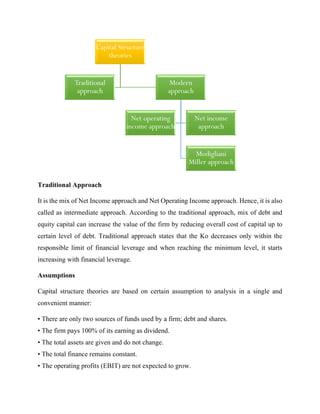
There are two major theories explaining the relationship between capital structure, cost of
capital and value of the firm.
Traditional Approach
It is the mix of Net Income approach and Net Operating Income approach. Hence, it is also
called as intermediate approach. According to the traditional approach, mix of debt and
equity capital can increase the value of the firm by reducing overall cost of capital up to
certain level of debt. Traditional approach states that the Ko decreases only within the
responsible limit of financial leverage and when reaching the minimum level, it starts
increasing with financial leverage.
Assumptions
Capital structure theories are based on certain assumption to analysis in a single and
convenient manner:
• There are only two sources of funds used by a firm; debt and shares.
• The firm pays 100% of its earning as dividend.
• The total assets are given and do not change.
• The total finance remains constant.
• The operating profits (EBIT) are not expected to grow.
Capital Structure
theories
Modern
approach
Net income
approach
Net operating
income approach
Modigliani
Miller approach
Traditional
approach
• The business risk remains constant.
• The firm has a perpetual life.
• The investors behave rationally.
Net Income (NI) Approach
Net income approach suggested by the Durand. According to this approach, the capital
structure decision is relevant to the valuation of the firm. In other words, a change in the
capital structure leads to a corresponding change in the overall cost of capital as well as the
total value of the firm. According to this approach, use more debt finance to reduce the
overall cost of capital and increase the value of firm.
Net income approach is based on the following three important assumptions:
1. There are no corporate taxes.
2. The cost debt is less than the cost of equity.
3. The use of debt does not change the risk perception of the investor.
Where
V = S+B
V = Value of firm
S = Market value of equity
B = Market value of debt
Market value of the equity can be ascertained by the following formula:
NI
S= _____
Ke
where
NI = Earnings available to equity shareholder
Ke = Cost of equity/equity capitalization rate
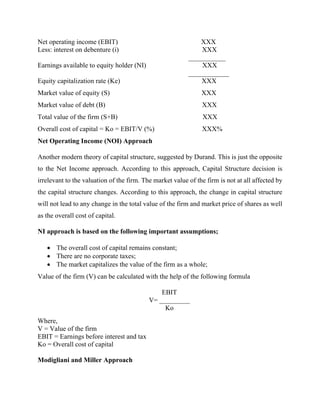
Format for calculating value of the firm on the basis of NI approach.
Particulars Amount
Net operating income (EBIT) XXX
Less: interest on debenture (i) XXX
___________
Earnings available to equity holder (NI) XXX
____________
Equity capitalization rate (Ke) XXX
Market value of equity (S) XXX
Market value of debt (B) XXX
Total value of the firm (S+B) XXX
Overall cost of capital = Ko = EBIT/V (%) XXX%
Net Operating Income (NOI) Approach
Another modern theory of capital structure, suggested by Durand. This is just the opposite
to the Net Income approach. According to this approach, Capital Structure decision is
irrelevant to the valuation of the firm. The market value of the firm is not at all affected by
the capital structure changes. According to this approach, the change in capital structure
will not lead to any change in the total value of the firm and market price of shares as well
as the overall cost of capital.
NI approach is based on the following important assumptions;
• The overall cost of capital remains constant;
• There are no corporate taxes;
• The market capitalizes the value of the firm as a whole;
Value of the firm (V) can be calculated with the help of the following formula
EBIT
V= _________
Ko
Where,
V = Value of the firm
EBIT = Earnings before interest and tax
Ko = Overall cost of capital
Modigliani and Miller Approach
Modigliani and Miller approach states that the financing decision of a firm does not affect
the market value of a firm in a perfect capital market. In other words MM approach
maintains that the average cost of capital does not change with change in the debt weighted
equity mix or capital structures of the firm.
Modigliani and Miller approach is based on the following important assumptions:
• There is a perfect capital market.
• There are no retained earnings.
• There are no corporate taxes.
• The investors act rationally.
• The dividend payout ratio is 100%.
• The business consists of the same level of business risk.
Value of the firm can be calculated with the help of the following formula:
EBIT
_________ (1-t)
Ko
Where
EBIT = Earnings before interest and tax
Ko = Overall cost of capital
t = Tax rate

Capital structure

  • 1.
    CAPITAL STRUCTURE Dr. S.BELLARMIN DIANA ASSISTANT PROFESSOR DEPARTMENT OF MANAGEMENT STUDIES BON SECOURS COLLEGE FOR WOMEN, THANJAVUR
  • 2.
    CAPITAL STRUCTURE Meaning ofCapital Structure Capital structure refers to the kinds of securities and the proportionate amounts that make up capitalization. It is the mix of different sources of long-term sources such as equity shares, preference shares, debentures, long-term loans and retained earnings. The term capital structure refers to the relationship between the various long-term source financing such as equity capital, preference share capital and debt capital. Deciding the suitable capital structure is the important decision of the financial management because it is closely related to the value of the firm. Capital structure is the permanent financing of the company represented primarily by long-term debt and equity. Definition of Capital Structure The following definitions clearly initiate, the meaning and objective of the capital structures. ✓ According to the definition of Gerestenbeg, “Capital Structure of a company refers to the composition or make up of its capitalization and it includes all long-term capital resources”. ✓ According to the definition of James C. Van Horne, “The mix of a firm’s permanent long-term financing represented by debt, preferred stock, and common stock equity”. ✓ According to the definition of Presana Chandra, “The composition of a firm’s financing consists of equity, preference, and debt”. ✓ According to the definition of R.H. Wessel, “The long term sources of fund employed in a business enterprise”. FINANCIAL STRUCTURE
  • 3.
    The term financialstructure is different from the capital structure. Financial structure shows the pattern total financing. It measures the extent to which total funds are available to finance the total assets of the business. Financial Structure = Total liabilities Or Financial Structure = Capital Structure + Current liabilities. The following points indicate the difference between the financial structure and capital structure. Forms of Capital Structure Capital structure pattern varies from company to company and the availability of finance. Normally the following forms of capital structure are popular in practice. Financial Structures 1. It includes both long-term and short-term sources of funds 2. It means the entire liabilities side of the balance sheet. 3. Financial structures consist of all sources of capital. 4. It will not be more important while determining the value of the firm. Capital Structures 1. It includes only the long-term sources of funds. 2. It means only the long-term liabilities of the company. 3. It consist of equity, preference and retained earning capital. 4. It is one of the major determinant of value of the firm. Financial structure Vs. Capital structure
  • 4.
    • Equity sharesonly. • Equity and preference shares only. • Equity and Debentures only. • Equity shares, preference shares and debentures. CONCEPT AND SIGNIFICANCE OF OPTIMUM CAPITAL STRUCTURE The optimum capital structure is obtained when the market value per share is maximum while the average cost of capital is minimum. The optimum capital structure may be defined as “that capital structure or combination of debt and equity that leads to the maximum value of firm”. So, the optimum capital structure is that relationship of debt and equity, which maximizes the value of the company’s equity share in the stock exchange. Normally, every firm uses debt and equity in financing its assets. In case, company’s borrowing helps the company in increasing its market value of share in the stock exchange, it can be said that the company is moving towards its optimum capital structure. However, if the use of borrowing results in the fall of market value of share in the stock exchange, it can be said that the company is moving away from its optimum capital structure. So, the objective of the firm is to select that type of financing or debt-equity mix, which leads to maximize the value of equity share in the stock exchange. CONSIDERATIONS The following considerations should be kept in mind while achieving the goal of achieving optimum capital structure. (A) Borrow when cheap: Company should borrow as long as its cost of debt is lower than the return on investment. If the interest paid on debentures/long term loans or dividend payable on preference share capital is lower than the return on investment, it is preferable to borrow. It will increase the market value of the share. So, every effort has to be made to take possible advantage of leverage.
  • 5.
    (B) Tax Advantageof Corporate Taxes: Interest paid on borrowing is eligible for tax benefit. So, effective cost of debt goes down in comparison to other forms of financing. So, tax advantage comes with borrowing. (C) Avoid Perceived High Risk: Beyond a point, increased debt financing is attached with undue risk. If the shareholders perceive excessive amount of debt in the capital structure, the price of the equity share may drop. The finance manager should not, therefore, borrow whether risky or not if the investors perceive borrowing as an excessive risky proposition. Investor’s perception is likely to depress the market price of equity share of that company. So, firm should avoid undue financial risk, attached with borrowing. (D) Flexible structure: The flexibility of capital structure refers to the ability of the firm to raise additional capital funds, whenever needed to finance viable and profitable investment opportunities. The capital structure should enable the firm to take advantage of the opportunities that may come up due to changing conditions. Precisely, it means firm should have always untapped borrowing power. It facilitates to take advantage of the favorable government policies or capital market. If the capital market is conducive, the firm should raise additional funds through equity market rather than the issue of debt. (E)Continuous Process: Achieving balanced or optimum capital structure, practically, is a difficult task. The Board of Directors or chief operating officer develops the capital structure, which is most advantageous to the company. As many factors affect the determination of the capital structure, the judgment of the person who is making the capital structure decision plays an important role. Two similar companies may have different capital structure, if the decision-makers differ in their judgment. The capital structure decision is a continuous process and has to be taken, whenever firm needs additional finances. OPTIMAL CAPITAL STRUCTURE –DIFFICULT TASK
  • 6.
    There are twoextremes in financing, one is 0% debt financing and the other is 99.99% debt financing, because 100% debt financing is not possible. Between these two extremes, particular debt-mix finance is to be decided. As already stated, there is no mathematical formula or method to determine the optimal capital mix. This is a formidable task. This is not possible to achieve overnight. At optimum capital structure, the value of equity share is at its maximum and average cost of capital is at its minimum. As long as the return on investment is more than the cost of debt, every rupee of borrowing brings in more profits. Then, why firms do not have more debt content in their capital structure? The simple reason is debt brings risk. Once investors perceive the risk, they may retreat from the share market and in consequence, the share price may fall. However, if they consider the risk is reasonable and would bring in more profits, instead of share price declining, it may as well increase on account of investors’ speculation. Share market is highly complex, does not work on theories and capital markets are never perfect. The exact optimal capital structure may be impossible and, therefore, every effort is to be made to achieve the best approximation to the optimum capital structure. The capital structure so arrived may not be optimum but appropriate in those circumstances. Optimum capital structure is a hypothetical concept. So, some people prefer to use the term ‘sound or appropriate capital structure’ in place of optimum capital structure as the former appears to be more realistic. Let us see what optimal capital structure requires. ESSENTIAL FEATURES OF AN APPROPRIATE CAPITAL STRUCTURE A capital structure will be considered to be appropriate, if it possesses the following features: (A) Profitability: The capital structure of a company should be the most profitable. The most profitable capital structure is one, when the cost of financing is at its minimum and earning per share is at peak.
  • 7.
    (B) Risk: Theuse of excessive debt threatens the solvency of the firm. To the point debt does not add significant risk, the debt should be used. Beyond that level, debt should be avoided. So, the content of the debt should not, therefore, increase the financial and business risk, beyond the manageable limits. While designing the capital structure, the finance manager has to design the capital structure in such a manner that the cost and risk are minimum. (C)Flexibility: The capital structure should be flexible. Flexibility means the capital structure should always have an untapped borrowing power, which can be used in conditions, which may arise due to favorable capital market, government policies etc. The structure should be such that it can be maneuvered to meet the changing requirements and conditions. The company should not borrow to its maximum extent. Whenever, the firm finds profitable opportunities, it should be in a position to take advantage. Borrowing scope should be left to avail profitable opportunities. (D) Capacity: The capital structure should be within the debt capacity of the company. The debt capacity depends on its ability to generate future cash flows. In other words, the borrowing should be commensurate with the company’s ability to generate future cash flows. The firm should be in a position to meet its obligations in paying the loan and interest charges as and when they fall due. (E) Control: The firm should so devise its capital structure that it involves minimum risk of loss of control. When additional funds are raised, the controlling interest of the existing owners gets diluted, automatically, unless they invest additional funds, suitably. Even the preference shareholders would get the voting right if the dividend is not paid for two consecutive years. In such an event, the composition of the board of directors may change that may result in reduced level of control. More so, the owners of closely held companies are, particularly, always concerned with the dilution of control. Conflicting Approach: The above mentioned are the general principles of an appropriate capital structure. Some of the features are conflicting with each other. For example, rising
  • 8.
    funds through debtis cheap and so complies with the principle of profitability. However, debt is risky and so goes against the principles of conservatism and solvency. Degree of Emphasis: Companies give different degrees of emphasis to these features. For example, a company may give more importance to control while another company is concerned with solvency. Further, relative importance of these requirements may change with shifting conditions. Conflicting interests: The finance manager is responsible to design the appropriate capital structure, which is most advantageous to the interests of different groups that may be conflicting. Equity shareholders are the owners of the company. Therefore, their interest is primary and due consideration has to be given to them. However, there are other interested groups such as customers, employees, society and the government. So, due consideration is also required to be given to them. Final Compromise: The prudent finance manager should try to have the best out of the circumstances within which the company is operating. The fact remains that the finance manager has to make a satisfactory compromise to suit the management’s desires and prevailing trends in the capital market when market is tapped for raising funds. FACTORS DETERMINING CAPITAL STRUCTURE The factors that determine the capital structure are of different importance and not possible to rank. The influence of the individual factors depends on the preferences of the management and also change over a period of time. For example, a closely held company may give more importance to the question of control. As and when funds are needed, the finance manager has to study the pros and cons of the various sources of finance so as to select the right combination for raising funds. The ‘Essential features’ detailed above also determine the structure. Following are the additional factors:
  • 9.
    1. Financial Leverageor Trading on Equity: The use of long-term fixed interest bearing debt and preference share capital along with equity share capital is called financial leverage. Financial Leverage is the most important factor that determines capital structure. Financial leverage is used as long as the cost of debt is lower than the return on investment. The use of debt increases the return on equity and magnifies the earnings per share. However, leverage can operate adversely if the expected rate of earnings of the firm falls below the cost of debt. Interest on long-term debt is fixed with a commitment over a long period. In the light of inherent greater risk with financial leverage, caution is required in planning the capital structure. 2. Stability of Sales and Growth: If the sales of a firm were fairly stable, the earnings of the firm would reasonably be constant. If there is no great risk for decline in earnings, firm can utilize the financial leverage to its optimum advantage. When there is assured growth, firm can plan to utilize the borrowing for expansion, without much risk. In case of those firms, firm can plan to use more debt in its capital structure for increased earnings. 3. Cost of Capital: Every rupee invested in business has a cost. Cost of capital is the minimum return expected by its suppliers. There are different sources of finance. Amongst the different sources, long-term debt is the cheapest. The reasons for its cheapness are (A) Fixed interest rate, (B) Long-term debt is, normally, secured by those assets for which finance is sanctioned. Suppliers get priority for repayment of principal and interest on debt compared to Preference share capital and Equity Share Capital, so they would be willing to invest at a lower cost. (C) Admissibility of interest as an expense under income tax so it’s effective cost becomes the lowest. Preference share capital has a legal obligation for a fixed rate of dividend. The dividend paid to preference shareholders is not an admissible expense under the tax. So, cost of preference share capital is higher than the cost of debt. Equity share capital is costlier compared to preference share capital. The reason is equity share capital does not
  • 10.
    have any fixedobligation for payment of dividend. So, comparatively, equity share capital is dearer to preference share capital. Preference share capital is cheaper to Equity share capital while long-term debt is still cheaper in terms of cost implication. While formulating capital structure, every effort has to be made to keep the over-all cost of capital lowest to boost up the earning per equity share. 4. Cash Flow Ability to Service Debt: This ability is measured through fixed charges coverage ratio. This is calculated by Comparison of the existing coverage ratio with the future ratio, after the anticipated borrowings, gives idea about the risk the firm would be exposed to. If the future cash flows grow in line with the increased amount of borrowing, the firm would able to service the debt, without difficulty. In case, the interest coverage ratio falls, after borrowing, this would be an indicator that the changed capital structure would create problems to that firm. Cash flows are more important than absolute amount of profit. Firms with stable and growing cash flows can employ more debt in comparison to those firms with unstable and lesser ability firms. 5. Nature and Size of Business: Nature and size of business also influence the capital structure. A public utility concern, for example, electricity-generating unit requires more funds on account of heavy investment in fixed assets. These types of concerns enjoy regular and assured cash flows so they can afford more debt. Similarly, big firms can raise funds through debt as investors consider them less risky. Small firms, not well known in the market, experiences more difficulty to raise funds through debt and so have to rely considerably upon the owners’ funds for financing. 6. Legal Requirements: The promoters of the company have to comply with legal requirements while deciding about the capital structure of the company. For example, banking companies are not allowed to issue any other type of securities other than equity share capital for raising funds. SEBI governs regulatory framework. Approval of SEBI is needed for capital issue, which is accorded only after the stipulated guidelines are complied with. Such approval is not necessary while raising a long-term loan from financial
  • 11.
    institution. So, thefinance manager has to take into account the legal and regulatory framework while designing the capital structure. 7. Capital Market Conditions and Market Sentiment: Capital market conditions play an important role for raising funds in the market. Capital market conditions always do not remain the same. There are boom and depression periods. The choice of the securities is influenced by market conditions. During the period of depression, investors are cautious and do not intend to take risk. So, they prefer investment in debentures as they consider them less risky. In times of boom, market sentiment is always high and so preference is towards investment in equity shares as the market considers investment in shares would be more profitable with anticipated appreciation in market value, at a faster pace. So, depending upon the capital market conditions and sentiment, companies have to plan their capital structure for raising funds. 8. Corporate Tax Rate: High corporate tax rate compels the companies to raise funds through debt as interest on debt is an admissible expenditure so taxable profits would be low. In consequence, tax liability would be low. On the other hand, dividend on shares is not an admissible expenditure so companies give lower preference for raising funds through equity for tax planning. CAPITAL STRUCTURE THEORIES Capital structure is the major part of the firm’s financial decision which affects the value of the firm and it leads to change EBIT and market value of the shares. There is a relationship among the capital structure, cost of capital and value of the firm. The aim of effective capital structure is to maximize the value of the firm and to reduce the cost of capital. There are two major theories explaining the relationship between capital structure, cost of capital and value of the firm.
  • 12.
    Traditional Approach It isthe mix of Net Income approach and Net Operating Income approach. Hence, it is also called as intermediate approach. According to the traditional approach, mix of debt and equity capital can increase the value of the firm by reducing overall cost of capital up to certain level of debt. Traditional approach states that the Ko decreases only within the responsible limit of financial leverage and when reaching the minimum level, it starts increasing with financial leverage. Assumptions Capital structure theories are based on certain assumption to analysis in a single and convenient manner: • There are only two sources of funds used by a firm; debt and shares. • The firm pays 100% of its earning as dividend. • The total assets are given and do not change. • The total finance remains constant. • The operating profits (EBIT) are not expected to grow. Capital Structure theories Modern approach Net income approach Net operating income approach Modigliani Miller approach Traditional approach
  • 13.
    • The businessrisk remains constant. • The firm has a perpetual life. • The investors behave rationally. Net Income (NI) Approach Net income approach suggested by the Durand. According to this approach, the capital structure decision is relevant to the valuation of the firm. In other words, a change in the capital structure leads to a corresponding change in the overall cost of capital as well as the total value of the firm. According to this approach, use more debt finance to reduce the overall cost of capital and increase the value of firm. Net income approach is based on the following three important assumptions: 1. There are no corporate taxes. 2. The cost debt is less than the cost of equity. 3. The use of debt does not change the risk perception of the investor. Where V = S+B V = Value of firm S = Market value of equity B = Market value of debt Market value of the equity can be ascertained by the following formula: NI S= _____ Ke where NI = Earnings available to equity shareholder Ke = Cost of equity/equity capitalization rate Format for calculating value of the firm on the basis of NI approach. Particulars Amount
  • 14.
    Net operating income(EBIT) XXX Less: interest on debenture (i) XXX ___________ Earnings available to equity holder (NI) XXX ____________ Equity capitalization rate (Ke) XXX Market value of equity (S) XXX Market value of debt (B) XXX Total value of the firm (S+B) XXX Overall cost of capital = Ko = EBIT/V (%) XXX% Net Operating Income (NOI) Approach Another modern theory of capital structure, suggested by Durand. This is just the opposite to the Net Income approach. According to this approach, Capital Structure decision is irrelevant to the valuation of the firm. The market value of the firm is not at all affected by the capital structure changes. According to this approach, the change in capital structure will not lead to any change in the total value of the firm and market price of shares as well as the overall cost of capital. NI approach is based on the following important assumptions; • The overall cost of capital remains constant; • There are no corporate taxes; • The market capitalizes the value of the firm as a whole; Value of the firm (V) can be calculated with the help of the following formula EBIT V= _________ Ko Where, V = Value of the firm EBIT = Earnings before interest and tax Ko = Overall cost of capital Modigliani and Miller Approach
  • 15.
    Modigliani and Millerapproach states that the financing decision of a firm does not affect the market value of a firm in a perfect capital market. In other words MM approach maintains that the average cost of capital does not change with change in the debt weighted equity mix or capital structures of the firm. Modigliani and Miller approach is based on the following important assumptions: • There is a perfect capital market. • There are no retained earnings. • There are no corporate taxes. • The investors act rationally. • The dividend payout ratio is 100%. • The business consists of the same level of business risk. Value of the firm can be calculated with the help of the following formula: EBIT _________ (1-t) Ko Where EBIT = Earnings before interest and tax Ko = Overall cost of capital t = Tax rate