Research methods
& techniques
An introduction to
• Primary
• Secondary
• Quantitative
• Qualitative
Last week
What did we learn about in planning &
research?
Today
You will be recapping research methods and
techniques, before continuing with your
planning & research theory report.
By the end of today, you
• MUST understand the difference between
primary and secondary research
• SHOULD be able to explain the difference
between quantitative & qualitative
research
• COULD analyse different research
methods strengths and weaknesses.
Screen Writing
Why do we research?
To gather information that
• influences our creative ideas
• Identifies our audience
• Affects our planning
• Affects our production
In screen writing
A good script is built on great research
Like every other part of film & TV
screen writing involves research.
Lots & lots of research….
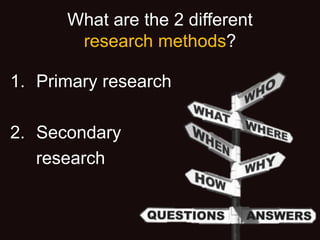
What are the 2 different
research methods?
1. Primary research
2. Secondary
research
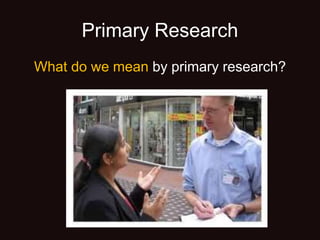
Primary Research
What do we mean by primary research?
Primary Research
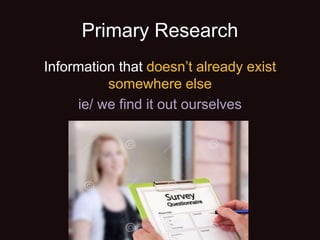
Information that doesn’t already exist
somewhere else
ie/ we find it out ourselves
Primary Research
What different techniques can we use when
conducting primary research?
Primary Research
What different techniques can we use when
conducting primary research?
• Surveys
• Questionnaires
• 1 on 1 interviews
• Focus groups
Primary Research
What are the strengths of primary research?
Primary Research
What are the strengths of primary research?
• Tailor the questions to find out the answers
you need
• Get in depth answers
• Original information so arguably more
reliable
Primary Research
What are the weaknesses of primary
research?
Primary Research
What are the weaknesses of primary
research?
• Time consuming (more stages to process)
• Expensive (staff costs)
Secondary Research
What do we mean by secondary research?
Secondary Research
Existing information which has been created
by someone else.
Secondary Research
What are the strengths of secondary
research?
Secondary Research
What are the strengths of secondary
research?
• Cheap (less staff, easier process to
manage, less travelling)
• Abundance of data available on the
internet
Secondary Research
What are the weaknesses of secondary
research?
Secondary Research
What are the weaknesses of secondary
research?
• May not answer your specific questions
• Can be time consuming finding information
• Verifying someone elses research is
difficult (less reliable)
Secondary Research
What different techniques can we use when
conducting secondary research?
Secondary Research
What different techniques can we use when
conducting secondary research?
• Internet search
• Newspaper / existing journalism
• Archive footage
• Reference books
Quantitative versus Qualitative questioning
There are 2 types of ‘data’ (ie. Information)
we can get back from our research:
• Quantitative
• Qualitative
Qualitative data
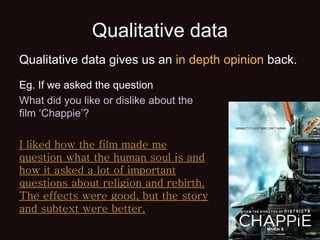
Eg. If we asked the question
What did you like or dislike about the
film ‘Chappie’?
I liked how the film made me
question what the human soul is and
how it asked a lot of important
questions about religion and rebirth.
The effects were good, but the story
and subtext were better.
Qualitative data gives us an in depth opinion back.
Quantitative data
Quantitative data gives us a measure of what
people think, in a statistical or numerical way.
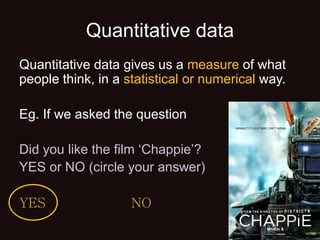
Eg. If we asked the question
Did you like the film ‘Chappie’?
YES or NO (circle your answer)
YES NO
Quantitative versus Qualitative questioning
Which gives us a more useful answer for
deep analysis of peoples reactions to our
subject?
Quantitative versus Qualitative questioning
Which is easier to present in a graphical,
simple way?
Quantitative data
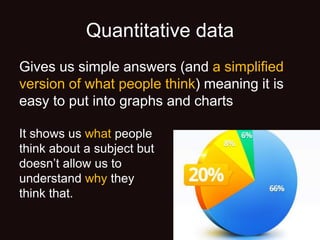
Gives us simple answers (and a simplified
version of what people think) meaning it is
easy to put into graphs and charts
It shows us what people
think about a subject but
doesn’t allow us to
understand why they
think that.
Quantitative data
Gives us in depth answers which allow us to
understand our audiences reactions, but it is
hard to put these complex results into
graphs and charts
It shows us what people
think about a subject but
doesn’t allow us to
understand why they
think that.
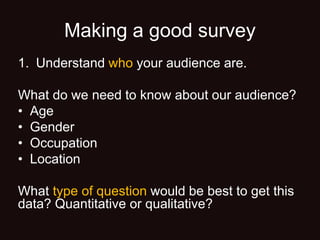
Making a good survey
1. Understand who your audience are.
What do we need to know about our audience?
• Age
• Gender
• Occupation
• Location
What type of question would be best to get this
data? Quantitative or qualitative?
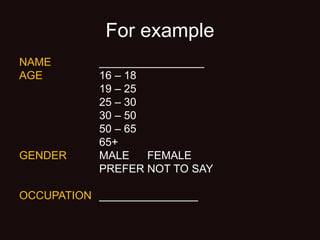
For example
NAME _________________
AGE 16 – 18
19 – 25
25 – 30
30 – 50
50 – 65
65+
GENDER MALE FEMALE
PREFER NOT TO SAY
OCCUPATION ________________
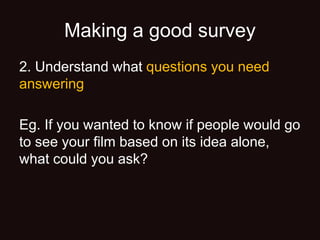
Making a good survey
2. Understand what questions you need
answering
Eg. If you wanted to know if people would go
to see your film based on its idea alone,
what could you ask?
Making a good survey
3. Get a large enough sample of participants to
make it useful.
If you ask 20 people, and 19 of them are
teenagers your data will obviously state that
teenagers are your main market, when in fact
this is probably not true.
Ask a range of different people, of different
ages, genders and occupations to get a varied,
reliable sample.
Task 1
Working alone, log onto moodle and go to
the planning & research section.
Read the brief for Planning & Research
theory, and then continue to write out your
essay, using examples of your own
production work to prove all of the points
you are making.

Research: primary, secondary, quant, qual

  • 1.
    Research methods & techniques Anintroduction to • Primary • Secondary • Quantitative • Qualitative
  • 2.
    Last week What didwe learn about in planning & research?
  • 3.
    Today You will berecapping research methods and techniques, before continuing with your planning & research theory report.
  • 4.
    By the endof today, you • MUST understand the difference between primary and secondary research • SHOULD be able to explain the difference between quantitative & qualitative research • COULD analyse different research methods strengths and weaknesses.
  • 5.
    Screen Writing Why dowe research? To gather information that • influences our creative ideas • Identifies our audience • Affects our planning • Affects our production
  • 6.
    In screen writing Agood script is built on great research Like every other part of film & TV screen writing involves research. Lots & lots of research….
  • 7.
    What are the2 different research methods? 1. Primary research 2. Secondary research
  • 8.
    Primary Research What dowe mean by primary research?
  • 9.
    Primary Research Information thatdoesn’t already exist somewhere else ie/ we find it out ourselves
  • 10.
    Primary Research What differenttechniques can we use when conducting primary research?
  • 11.
    Primary Research What differenttechniques can we use when conducting primary research? • Surveys • Questionnaires • 1 on 1 interviews • Focus groups
  • 12.
    Primary Research What arethe strengths of primary research?
  • 13.
    Primary Research What arethe strengths of primary research? • Tailor the questions to find out the answers you need • Get in depth answers • Original information so arguably more reliable
  • 14.
    Primary Research What arethe weaknesses of primary research?
  • 15.
    Primary Research What arethe weaknesses of primary research? • Time consuming (more stages to process) • Expensive (staff costs)
  • 16.
    Secondary Research What dowe mean by secondary research?
  • 17.
    Secondary Research Existing informationwhich has been created by someone else.
  • 18.
    Secondary Research What arethe strengths of secondary research?
  • 19.
    Secondary Research What arethe strengths of secondary research? • Cheap (less staff, easier process to manage, less travelling) • Abundance of data available on the internet
  • 20.
    Secondary Research What arethe weaknesses of secondary research?
  • 21.
    Secondary Research What arethe weaknesses of secondary research? • May not answer your specific questions • Can be time consuming finding information • Verifying someone elses research is difficult (less reliable)
  • 22.
    Secondary Research What differenttechniques can we use when conducting secondary research?
  • 23.
    Secondary Research What differenttechniques can we use when conducting secondary research? • Internet search • Newspaper / existing journalism • Archive footage • Reference books
  • 24.
    Quantitative versus Qualitativequestioning There are 2 types of ‘data’ (ie. Information) we can get back from our research: • Quantitative • Qualitative
  • 25.
    Qualitative data Eg. Ifwe asked the question What did you like or dislike about the film ‘Chappie’? I liked how the film made me question what the human soul is and how it asked a lot of important questions about religion and rebirth. The effects were good, but the story and subtext were better. Qualitative data gives us an in depth opinion back.
  • 26.
    Quantitative data Quantitative datagives us a measure of what people think, in a statistical or numerical way. Eg. If we asked the question Did you like the film ‘Chappie’? YES or NO (circle your answer) YES NO
  • 27.
    Quantitative versus Qualitativequestioning Which gives us a more useful answer for deep analysis of peoples reactions to our subject?
  • 28.
    Quantitative versus Qualitativequestioning Which is easier to present in a graphical, simple way?
  • 29.
    Quantitative data Gives ussimple answers (and a simplified version of what people think) meaning it is easy to put into graphs and charts It shows us what people think about a subject but doesn’t allow us to understand why they think that.
  • 30.
    Quantitative data Gives usin depth answers which allow us to understand our audiences reactions, but it is hard to put these complex results into graphs and charts It shows us what people think about a subject but doesn’t allow us to understand why they think that.
  • 31.
    Making a goodsurvey 1. Understand who your audience are. What do we need to know about our audience? • Age • Gender • Occupation • Location What type of question would be best to get this data? Quantitative or qualitative?
  • 32.
    For example NAME _________________ AGE16 – 18 19 – 25 25 – 30 30 – 50 50 – 65 65+ GENDER MALE FEMALE PREFER NOT TO SAY OCCUPATION ________________
  • 33.
    Making a goodsurvey 2. Understand what questions you need answering Eg. If you wanted to know if people would go to see your film based on its idea alone, what could you ask?
  • 34.
    Making a goodsurvey 3. Get a large enough sample of participants to make it useful. If you ask 20 people, and 19 of them are teenagers your data will obviously state that teenagers are your main market, when in fact this is probably not true. Ask a range of different people, of different ages, genders and occupations to get a varied, reliable sample.
  • 35.
    Task 1 Working alone,log onto moodle and go to the planning & research section. Read the brief for Planning & Research theory, and then continue to write out your essay, using examples of your own production work to prove all of the points you are making.