Unit 1: P1, M1, D1
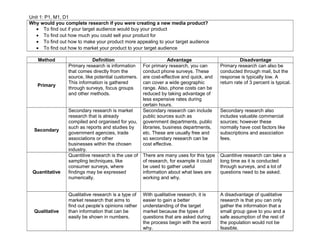
Why would you complete research if you were creating a new media product?
• To find out if your target audience would buy your product
• To find out how much you could sell your product for
• To find out how to make your product more appealing to your target audience
• To find out how to market your product to your target audience
Method Definition Advantage Disadvantage
Primary
Primary research is information
that comes directly from the
source, like potential customers.
This information is gathered
through surveys, focus groups
and other methods.
For primary research, you can
conduct phone surveys. These
are cost-effective and quick, and
can cover a wide geographic
range. Also, phone costs can be
reduced by taking advantage of
less expensive rates during
certain hours.
Primary research can also be
conducted through mail, but the
response is typically low. A
return rate of 3 percent is typical.
Secondary
Secondary research is market
research that is already
compiled and organised for you,
such as reports and studies by
government agencies, trade
associations or other
businesses within the chosen
industry.
Secondary research can include
public sources such as
government departments, public
libraries, business departments,
etc. These are usually free and
so secondary research can be
cost effective.
Secondary research also
includes valuable commercial
sources; however these
normally have cost factors like
subscriptions and association
fees.
Quantitative
Quantitive research is the use of
sampling techniques, like
consumer surveys, where
findings may be expressed
numerically.
There are many uses for this type
of research, for example it could
be used to gather useful
information about what laws are
working and why.
Quantitive research can take a
long time as it is conducted
through surveys, and a lot of
questions need to be asked.
Qualitative
Qualitative research is a type of
market research that aims to
find out people’s opinions rather
than information that can be
easily be shown in numbers.
With qualitative research, it is
easier to gain a better
understanding of the target
market because the types of
questions that are asked during
the process begin with the word
why.
A disadvantage of qualitative
research is that you can only
gather the information that a
small group gave to you and a
safe assumption of the rest of
the population would not be
feasible.
Unit 1: P1, M1, D1
What research methods did you use when completing the assignments in year 11 (Unit 18 Advertising and Unit
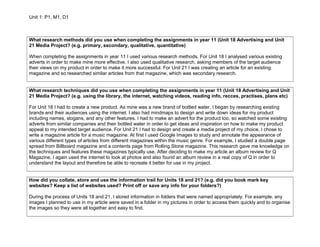
21 Media Project? (e.g. primary, secondary, qualitative, quantitative)
When completing the assignments in year 11 I used various research methods. For Unit 18 I analysed various existing
adverts in order to make mine more effective. I also used qualitative research, asking members of the target audience
their views on my product in order to make it more successful. For Unit 21 I was creating an article for an existing
magazine and so researched similar articles from that magazine, which was secondary research.
What research techniques did you use when completing the assignments in year 11 (Unit 18 Advertising and Unit
21 Media Project? (e.g. using the library, the internet, watching videos, reading info, recces, practises, plans etc)
For Unit 18 I had to create a new product. As mine was a new brand of bottled water, I began by researching existing
brands and their audiences using the internet. I also had mindmaps to design and write down ideas for my product
including names, slogans, and any other features. I had to make an advert for the product too, so watched some existing
adverts from similar companies and their bottled water in order to get ideas and inspiration on how to make my product
appeal to my intended target audience. For Unit 21 I had to design and create a media project of my choice. I chose to
write a magazine article for a music magazine. At first I used Google Images to study and annotate the appearance of
various different types of articles from different magazines within the music genre. For example, I studied a double page
spread from Billboard magazine and a contents page from Rolling Stone magazine. This research gave me knowledge on
the techniques and features these magazines typically use. After deciding to make my article an album review for Q
Magazine, I again used the internet to look at photos and also found an album review in a real copy of Q in order to
understand the layout and therefore be able to recreate it better for use in my project.
How did you collate, store and use the information trail for Units 18 and 21? (e.g. did you book mark key
websites? Keep a list of websites used? Print off or save any info for your folders?)
During the process of Units 18 and 21, I stored information in folders that were named appropriately. For example, any
images I planned to use in my article were saved in a folder in my pictures in order to access them quickly and to organise
the images so they were all together and easy to find.
Unit 1: P1, M1, D1
How and why might you use the four research methods in a real life situation? For example if you worked for the
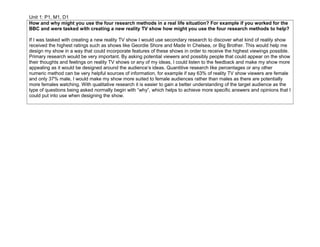
BBC and were tasked with creating a new reality TV show how might you use the four research methods to help?
If I was tasked with creating a new reality TV show I would use secondary research to discover what kind of reality show
received the highest ratings such as shows like Geordie Shore and Made In Chelsea, or Big Brother. This would help me
design my show in a way that could incorporate features of these shows in order to receive the highest viewings possible.
Primary research would be very important. By asking potential viewers and possibly people that could appear on the show
their thoughts and feelings on reality TV shows or any of my ideas, I could listen to the feedback and make my show more
appealing as it would be designed around the audience’s ideas. Quantitive research like percentages or any other
numeric method can be very helpful sources of information, for example if say 63% of reality TV show viewers are female
and only 37% male, I would make my show more suited to female audiences rather than males as there are potentially
more females watching. With qualitative research it is easier to gain a better understanding of the target audience as the
type of questions being asked normally begin with “why”, which helps to achieve more specific answers and opinions that I
could put into use when designing the show.

Unit 1 research methods worksheet

  • 1.
    Unit 1: P1,M1, D1 Why would you complete research if you were creating a new media product? • To find out if your target audience would buy your product • To find out how much you could sell your product for • To find out how to make your product more appealing to your target audience • To find out how to market your product to your target audience Method Definition Advantage Disadvantage Primary Primary research is information that comes directly from the source, like potential customers. This information is gathered through surveys, focus groups and other methods. For primary research, you can conduct phone surveys. These are cost-effective and quick, and can cover a wide geographic range. Also, phone costs can be reduced by taking advantage of less expensive rates during certain hours. Primary research can also be conducted through mail, but the response is typically low. A return rate of 3 percent is typical. Secondary Secondary research is market research that is already compiled and organised for you, such as reports and studies by government agencies, trade associations or other businesses within the chosen industry. Secondary research can include public sources such as government departments, public libraries, business departments, etc. These are usually free and so secondary research can be cost effective. Secondary research also includes valuable commercial sources; however these normally have cost factors like subscriptions and association fees. Quantitative Quantitive research is the use of sampling techniques, like consumer surveys, where findings may be expressed numerically. There are many uses for this type of research, for example it could be used to gather useful information about what laws are working and why. Quantitive research can take a long time as it is conducted through surveys, and a lot of questions need to be asked. Qualitative Qualitative research is a type of market research that aims to find out people’s opinions rather than information that can be easily be shown in numbers. With qualitative research, it is easier to gain a better understanding of the target market because the types of questions that are asked during the process begin with the word why. A disadvantage of qualitative research is that you can only gather the information that a small group gave to you and a safe assumption of the rest of the population would not be feasible.
  • 2.
    Unit 1: P1,M1, D1 What research methods did you use when completing the assignments in year 11 (Unit 18 Advertising and Unit 21 Media Project? (e.g. primary, secondary, qualitative, quantitative) When completing the assignments in year 11 I used various research methods. For Unit 18 I analysed various existing adverts in order to make mine more effective. I also used qualitative research, asking members of the target audience their views on my product in order to make it more successful. For Unit 21 I was creating an article for an existing magazine and so researched similar articles from that magazine, which was secondary research. What research techniques did you use when completing the assignments in year 11 (Unit 18 Advertising and Unit 21 Media Project? (e.g. using the library, the internet, watching videos, reading info, recces, practises, plans etc) For Unit 18 I had to create a new product. As mine was a new brand of bottled water, I began by researching existing brands and their audiences using the internet. I also had mindmaps to design and write down ideas for my product including names, slogans, and any other features. I had to make an advert for the product too, so watched some existing adverts from similar companies and their bottled water in order to get ideas and inspiration on how to make my product appeal to my intended target audience. For Unit 21 I had to design and create a media project of my choice. I chose to write a magazine article for a music magazine. At first I used Google Images to study and annotate the appearance of various different types of articles from different magazines within the music genre. For example, I studied a double page spread from Billboard magazine and a contents page from Rolling Stone magazine. This research gave me knowledge on the techniques and features these magazines typically use. After deciding to make my article an album review for Q Magazine, I again used the internet to look at photos and also found an album review in a real copy of Q in order to understand the layout and therefore be able to recreate it better for use in my project. How did you collate, store and use the information trail for Units 18 and 21? (e.g. did you book mark key websites? Keep a list of websites used? Print off or save any info for your folders?) During the process of Units 18 and 21, I stored information in folders that were named appropriately. For example, any images I planned to use in my article were saved in a folder in my pictures in order to access them quickly and to organise the images so they were all together and easy to find.
  • 3.
    Unit 1: P1,M1, D1 How and why might you use the four research methods in a real life situation? For example if you worked for the BBC and were tasked with creating a new reality TV show how might you use the four research methods to help? If I was tasked with creating a new reality TV show I would use secondary research to discover what kind of reality show received the highest ratings such as shows like Geordie Shore and Made In Chelsea, or Big Brother. This would help me design my show in a way that could incorporate features of these shows in order to receive the highest viewings possible. Primary research would be very important. By asking potential viewers and possibly people that could appear on the show their thoughts and feelings on reality TV shows or any of my ideas, I could listen to the feedback and make my show more appealing as it would be designed around the audience’s ideas. Quantitive research like percentages or any other numeric method can be very helpful sources of information, for example if say 63% of reality TV show viewers are female and only 37% male, I would make my show more suited to female audiences rather than males as there are potentially more females watching. With qualitative research it is easier to gain a better understanding of the target audience as the type of questions being asked normally begin with “why”, which helps to achieve more specific answers and opinions that I could put into use when designing the show.