CHARACTERISTICS, PURPOSE
AND TYPES OF RESEARCH
ALAN S. ABERILLA
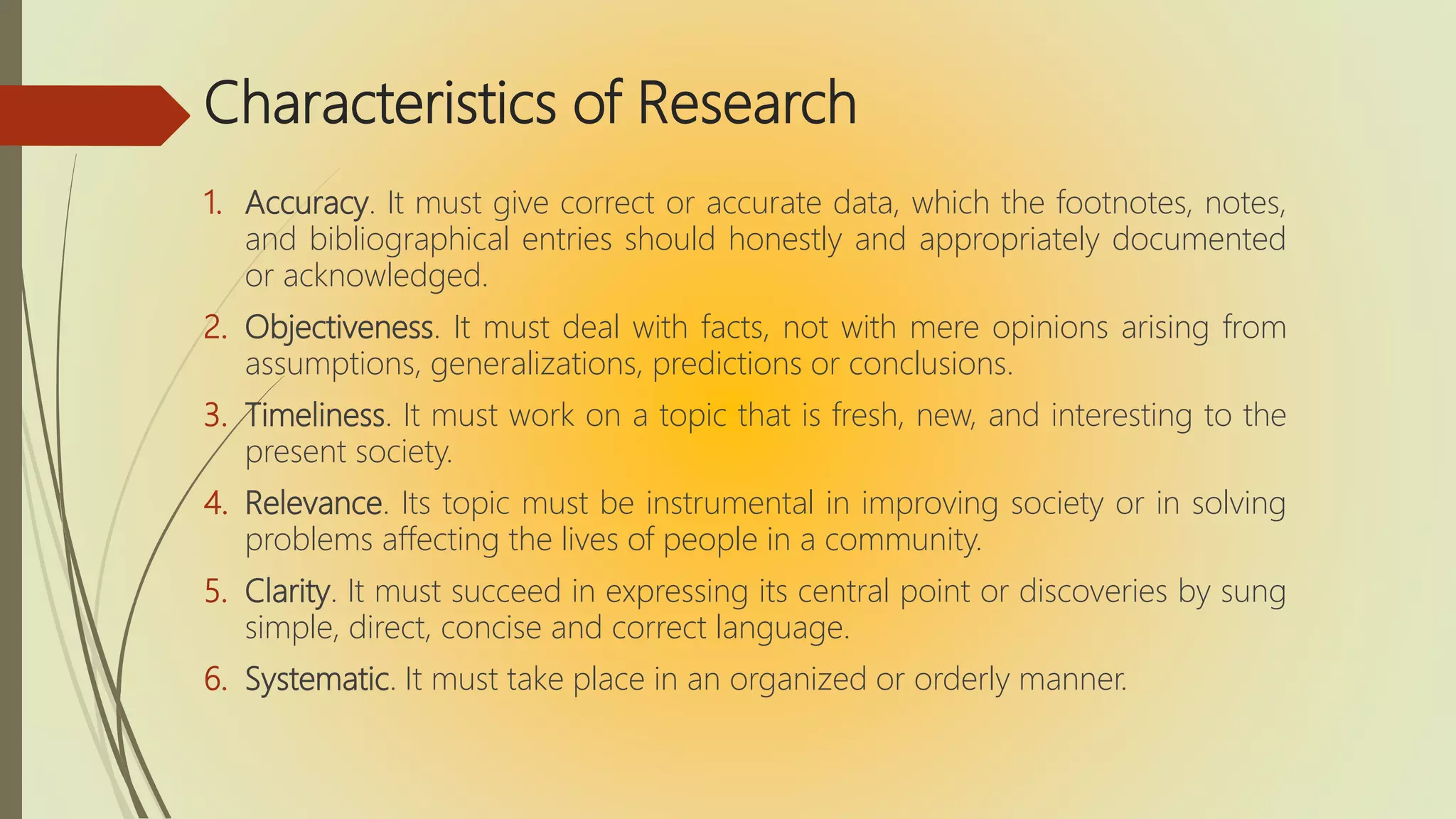
Characteristics of Research
1. Accuracy. It must give correct or accurate data, which the footnotes, notes,
and bibliographical entries should honestly and appropriately documented
or acknowledged.
2. Objectiveness. It must deal with facts, not with mere opinions arising from
assumptions, generalizations, predictions or conclusions.
3. Timeliness. It must work on a topic that is fresh, new, and interesting to the
present society.
4. Relevance. Its topic must be instrumental in improving society or in solving
problems affecting the lives of people in a community.
5. Clarity. It must succeed in expressing its central point or discoveries by sung
simple, direct, concise and correct language.
6. Systematic. It must take place in an organized or orderly manner.
Purpose of Research
1. To learn how to work independently
2. To learn how to work scientifically or systematically
3. To have an in-depth knowledge of something
4. To elevate your mental abilities by letting you think in higher-order thinking
skills (HOTS) or inferring, evaluating, synthesizing, appreciating, applying
and creating
5. To improve your reading and writing skills
6. To be familiar with the basic tools of research and the various techniques of
gathering data of presenting research findings
7. To free yourself, to a certain extent, from the domination or strong influence
of a single textbook or of the professor’s lone viewpoint or spoon feeding
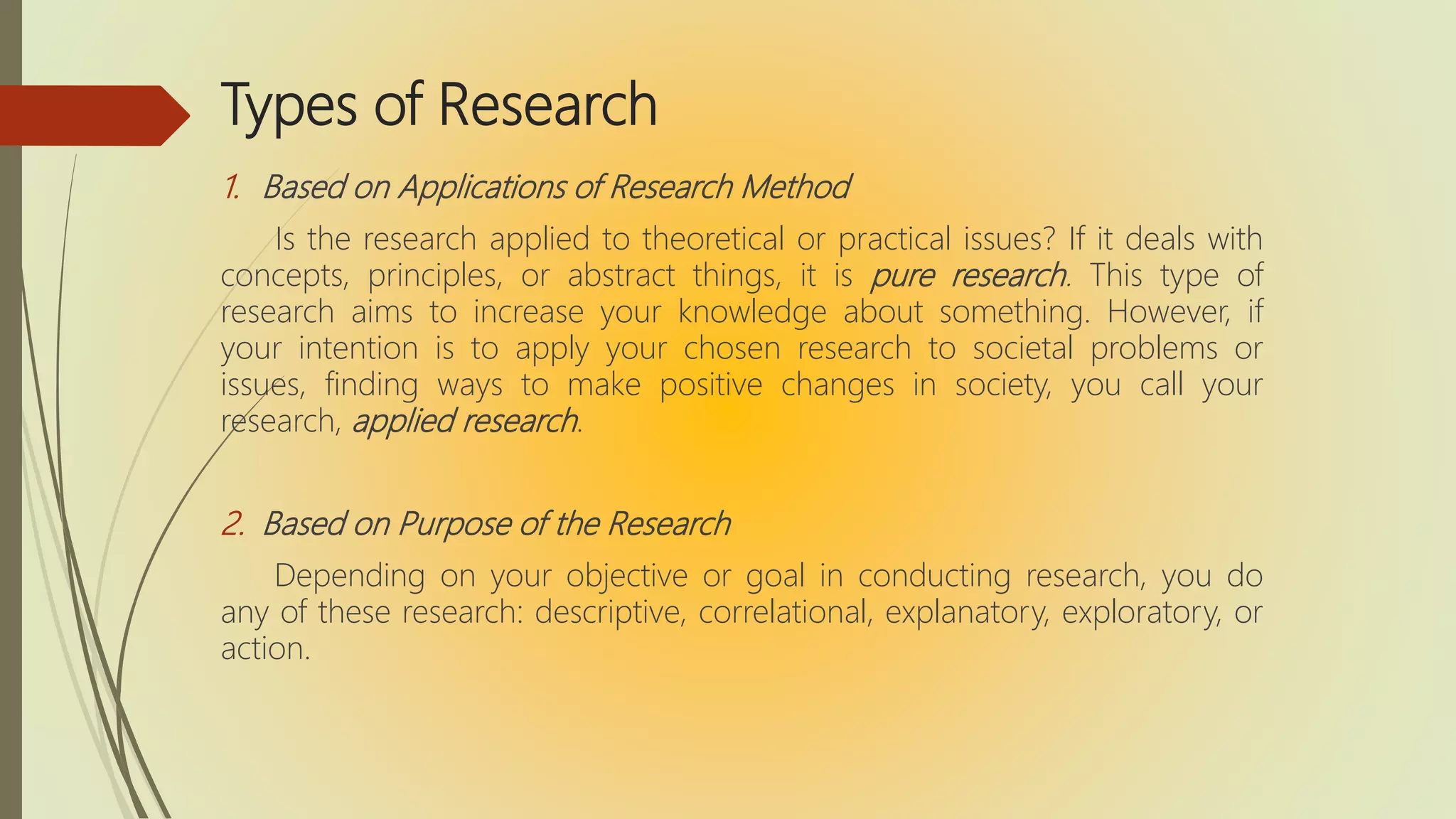
Types of Research
1. Based on Applications of Research Method
Is the research applied to theoretical or practical issues? If it deals with
concepts, principles, or abstract things, it is pure research. This type of
research aims to increase your knowledge about something. However, if
your intention is to apply your chosen research to societal problems or
issues, finding ways to make positive changes in society, you call your
research, applied research.
2. Based on Purpose of the Research
Depending on your objective or goal in conducting research, you do
any of these research: descriptive, correlational, explanatory, exploratory, or
action.
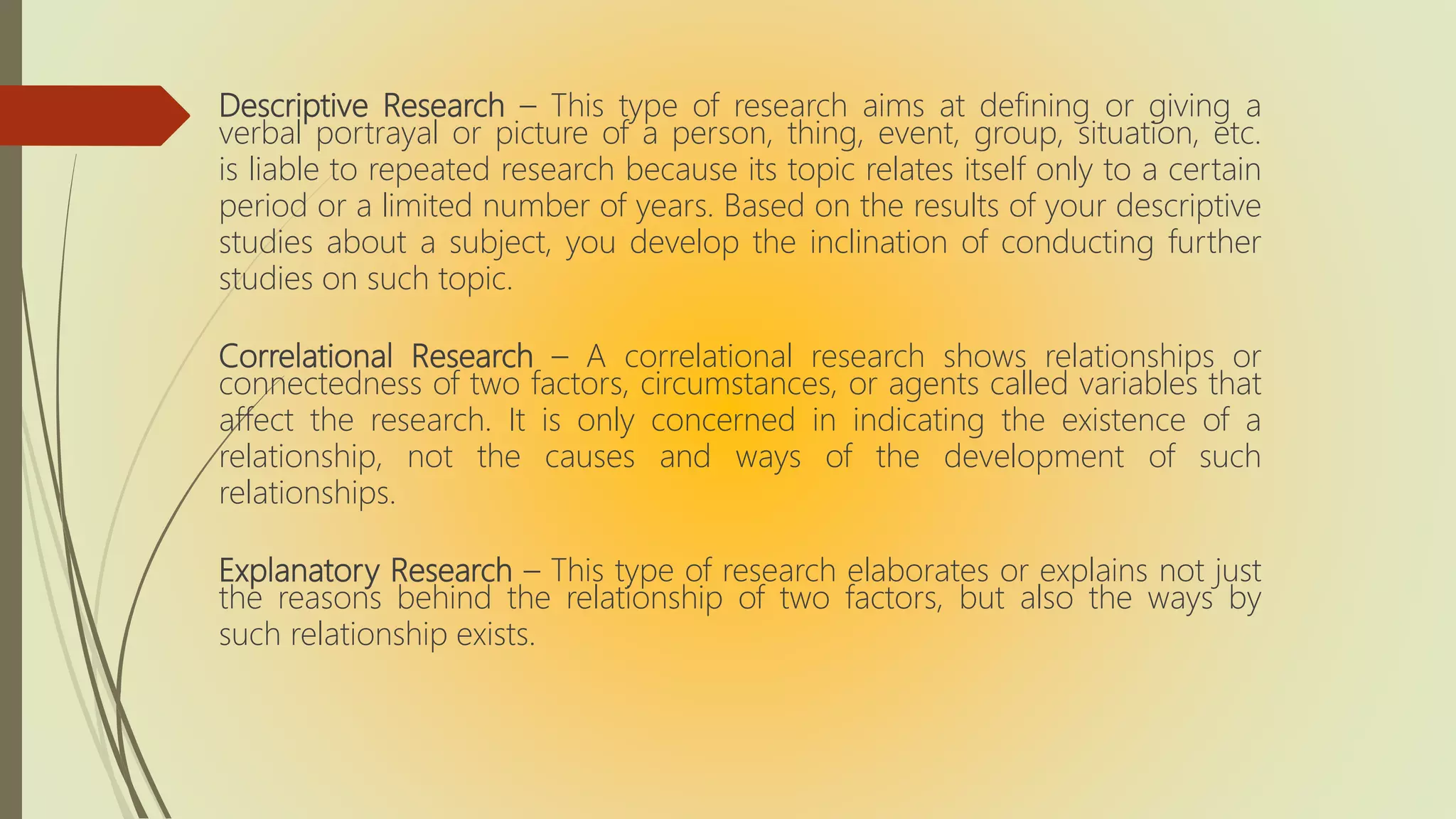
Descriptive Research – This type of research aims at defining or giving a
verbal portrayal or picture of a person, thing, event, group, situation, etc.
is liable to repeated research because its topic relates itself only to a certain
period or a limited number of years. Based on the results of your descriptive
studies about a subject, you develop the inclination of conducting further
studies on such topic.
Correlational Research – A correlational research shows relationships or
connectedness of two factors, circumstances, or agents called variables that
affect the research. It is only concerned in indicating the existence of a
relationship, not the causes and ways of the development of such
relationships.
Explanatory Research – This type of research elaborates or explains not just
the reasons behind the relationship of two factors, but also the ways by
such relationship exists.
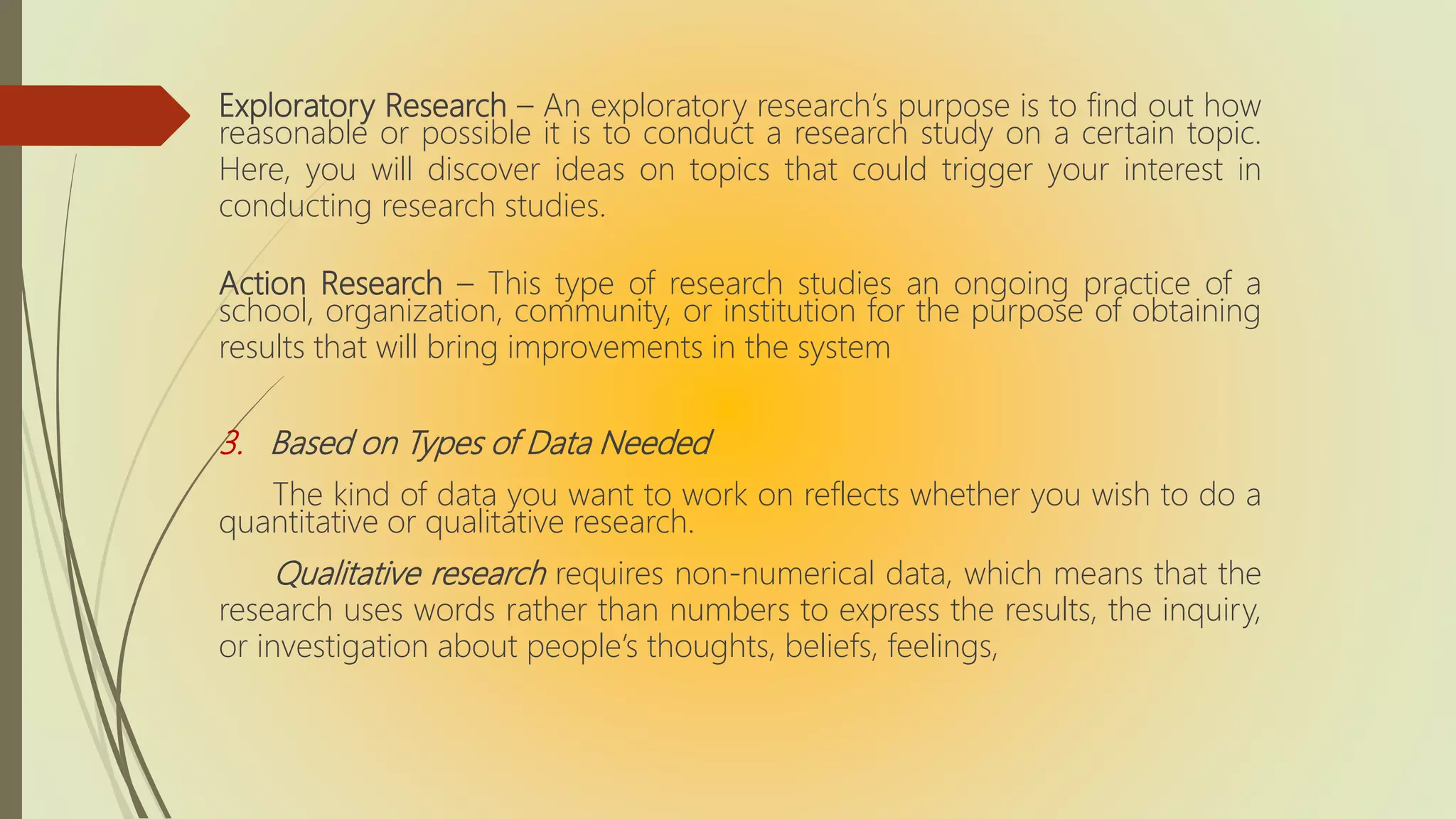
Exploratory Research – An exploratory research’s purpose is to find out how
reasonable or possible it is to conduct a research study on a certain topic.
Here, you will discover ideas on topics that could trigger your interest in
conducting research studies.
Action Research – This type of research studies an ongoing practice of a
school, organization, community, or institution for the purpose of obtaining
results that will bring improvements in the system
3. Based on Types of Data Needed
The kind of data you want to work on reflects whether you wish to do a
quantitative or qualitative research.
Qualitative research requires non-numerical data, which means that the
research uses words rather than numbers to express the results, the inquiry,
or investigation about people’s thoughts, beliefs, feelings,
views, and lifestyles regarding the object of the study. These opinionated
answers from people are not measurable; so, verbal language is the right way
to express your findings in a qualitative research.
Qualitative research involves measurement of data. Thus, it presents
research findings referring to the number or frequency of something in
numerical forms (i.e., using percentages, fractions, numbers).
The data you deal with in research are either primary or secondary data.
Primary data are obtained through direct observation or contact with
people, objects, artifacts, paintings, etc. Primary data are new and original
information resulting from your sensory experience. However, if such data
have already been written about or reported on and are available for reading
purposes, the exist as secondary data.
Qualitative Research
 It is handled with qualitative phenomena that involves quality or kind.
 The research designed to find out how people feel or what people
often think are coming under this research (emotions, feelings, words).
 It is important in behavioral science.
 Its aim is to discover the underlying motives of human behavior
through detailed description.
 The data is in the form of words, pictures or objects and all.
Quantitative Research
 This research is based on the measurement of quantity
or amount (numbers and figures).
 It can only be expressed in terms of quantity.
 Researcher use tools such as questionnaire or
equipment to collect data and all aspects of the study
 are carefully designated before data is collected.
 Here data is in the form of numbers or statistics and this
data is more efficient and able to test.
Approaches to Research
After choosing your topic for research, what is your next move? In other
words, how are you going to approach or begin your research, deal with your
data, and establish a connection among all things or activities involved in your
research?
The first is the scientific or positive approach, in which you discover and
measure information as well as observe and control variables in an impersonal
manner. It allows control of variables. Therefore, the data gathering techniques
appropriate for this approach are structured interviews, questionnaires, and
observational checklists. Data given by these techniques are expressed through
numbers, which means that this method is suitable for quantitative research.
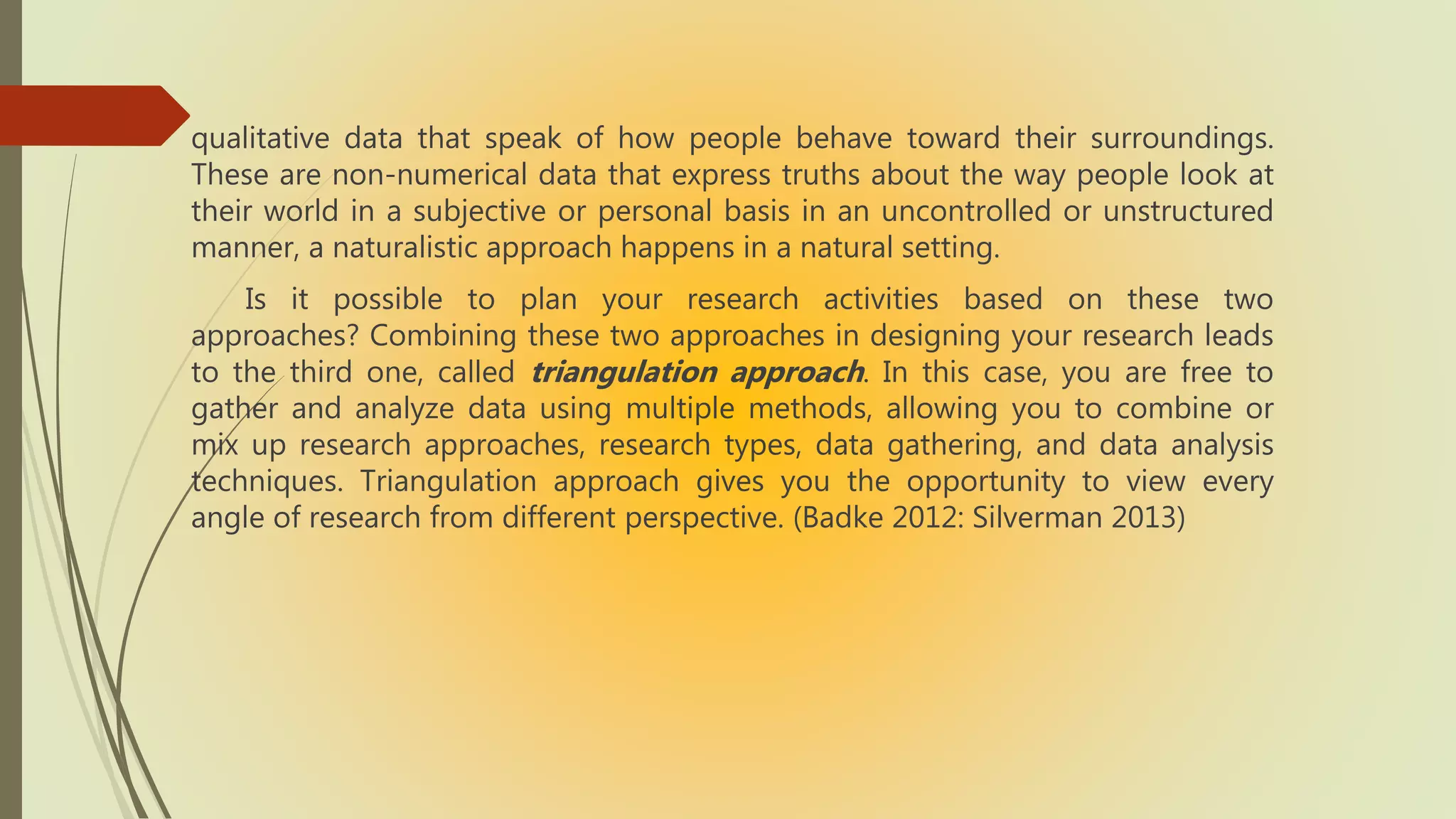
The second approach is the naturalistic approach. In contrast to the
scientific approach that uses numbers to express data, the naturalistic approach
uses words. This research approach directs you to deal with
qualitative data that speak of how people behave toward their surroundings.
These are non-numerical data that express truths about the way people look at
their world in a subjective or personal basis in an uncontrolled or unstructured
manner, a naturalistic approach happens in a natural setting.
Is it possible to plan your research activities based on these two
approaches? Combining these two approaches in designing your research leads
to the third one, called triangulation approach. In this case, you are free to
gather and analyze data using multiple methods, allowing you to combine or
mix up research approaches, research types, data gathering, and data analysis
techniques. Triangulation approach gives you the opportunity to view every
angle of research from different perspective. (Badke 2012: Silverman 2013)
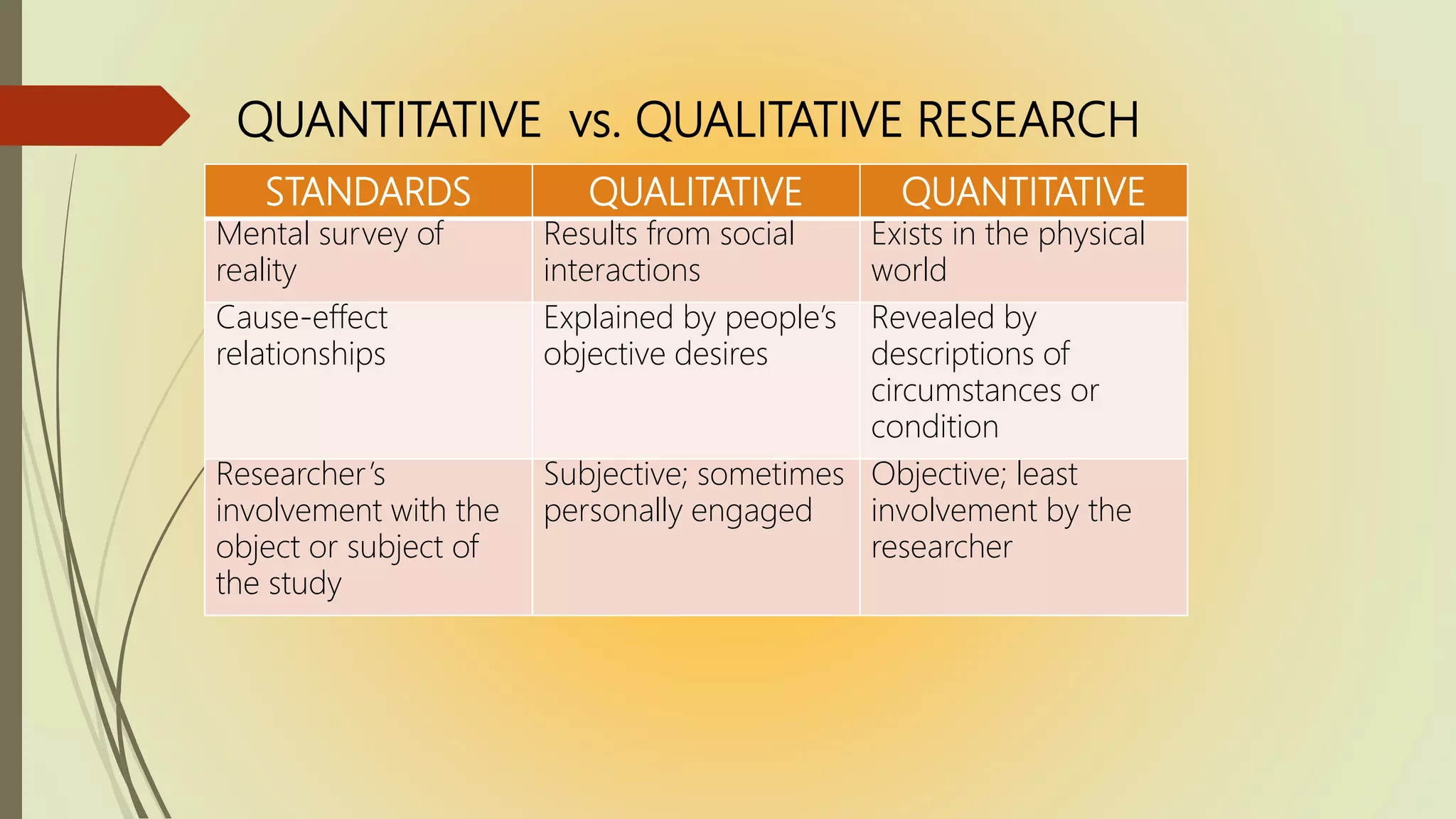
QUANTITATIVE vs. QUALITATIVE RESEARCH
STANDARDS QUALITATIVE QUANTITATIVE
Mental survey of
reality
Results from social
interactions
Exists in the physical
world
Cause-effect
relationships
Explained by people’s
objective desires
Revealed by
descriptions of
circumstances or
condition
Researcher’s
involvement with the
object or subject of
the study
Subjective; sometimes
personally engaged
Objective; least
involvement by the
researcher
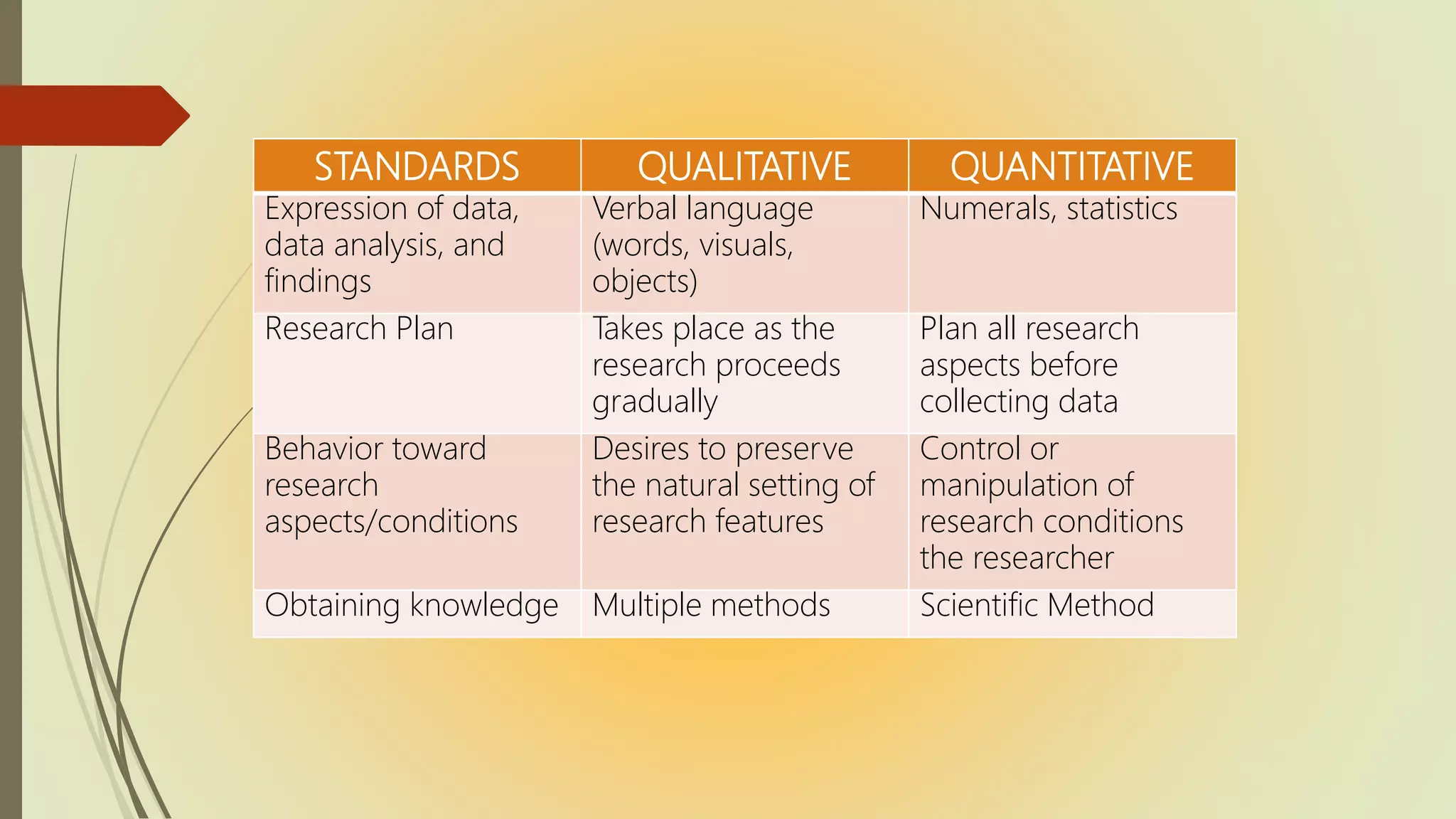
STANDARDS QUALITATIVE QUANTITATIVE
Expression of data,
data analysis, and
findings
Verbal language
(words, visuals,
objects)
Numerals, statistics
Research Plan Takes place as the
research proceeds
gradually
Plan all research
aspects before
collecting data
Behavior toward
research
aspects/conditions
Desires to preserve
the natural setting of
research features
Control or
manipulation of
research conditions
the researcher
Obtaining knowledge Multiple methods Scientific Method
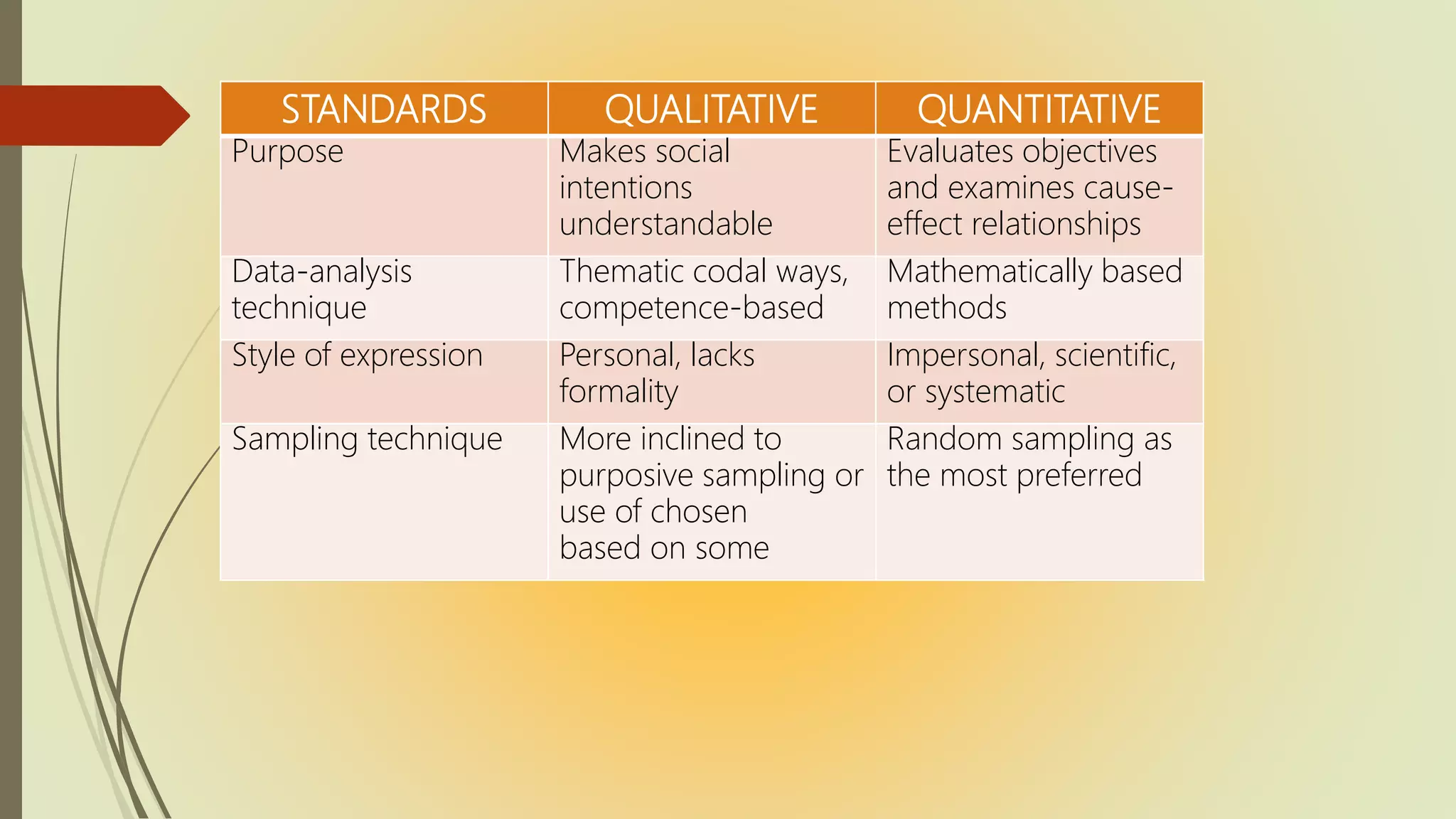
STANDARDS QUALITATIVE QUANTITATIVE
Purpose Makes social
intentions
understandable
Evaluates objectives
and examines cause-
effect relationships
Data-analysis
technique
Thematic codal ways,
competence-based
Mathematically based
methods
Style of expression Personal, lacks
formality
Impersonal, scientific,
or systematic
Sampling technique More inclined to
purposive sampling or
use of chosen
based on some
Random sampling as
the most preferred
ACTIVITY 1: (GIVE ME MORE)
Research:
10 additional types/kinds of research
Explain and describe each
Use short bond paper
Font style – Arial
Font size – 12
Encoded
GOOD LUCK
KEEP SAFE
GOD BLESS
Sir A
Baraceros, E., Practical Research 1. Rex Book Store

Lesson 2 characteristics, purpose and types of research

  • 1.
    CHARACTERISTICS, PURPOSE AND TYPESOF RESEARCH ALAN S. ABERILLA
  • 2.
    Characteristics of Research 1.Accuracy. It must give correct or accurate data, which the footnotes, notes, and bibliographical entries should honestly and appropriately documented or acknowledged. 2. Objectiveness. It must deal with facts, not with mere opinions arising from assumptions, generalizations, predictions or conclusions. 3. Timeliness. It must work on a topic that is fresh, new, and interesting to the present society. 4. Relevance. Its topic must be instrumental in improving society or in solving problems affecting the lives of people in a community. 5. Clarity. It must succeed in expressing its central point or discoveries by sung simple, direct, concise and correct language. 6. Systematic. It must take place in an organized or orderly manner.
  • 3.
    Purpose of Research 1.To learn how to work independently 2. To learn how to work scientifically or systematically 3. To have an in-depth knowledge of something 4. To elevate your mental abilities by letting you think in higher-order thinking skills (HOTS) or inferring, evaluating, synthesizing, appreciating, applying and creating 5. To improve your reading and writing skills 6. To be familiar with the basic tools of research and the various techniques of gathering data of presenting research findings 7. To free yourself, to a certain extent, from the domination or strong influence of a single textbook or of the professor’s lone viewpoint or spoon feeding
  • 4.
    Types of Research 1.Based on Applications of Research Method Is the research applied to theoretical or practical issues? If it deals with concepts, principles, or abstract things, it is pure research. This type of research aims to increase your knowledge about something. However, if your intention is to apply your chosen research to societal problems or issues, finding ways to make positive changes in society, you call your research, applied research. 2. Based on Purpose of the Research Depending on your objective or goal in conducting research, you do any of these research: descriptive, correlational, explanatory, exploratory, or action.
  • 5.
    Descriptive Research –This type of research aims at defining or giving a verbal portrayal or picture of a person, thing, event, group, situation, etc. is liable to repeated research because its topic relates itself only to a certain period or a limited number of years. Based on the results of your descriptive studies about a subject, you develop the inclination of conducting further studies on such topic. Correlational Research – A correlational research shows relationships or connectedness of two factors, circumstances, or agents called variables that affect the research. It is only concerned in indicating the existence of a relationship, not the causes and ways of the development of such relationships. Explanatory Research – This type of research elaborates or explains not just the reasons behind the relationship of two factors, but also the ways by such relationship exists.
  • 6.
    Exploratory Research –An exploratory research’s purpose is to find out how reasonable or possible it is to conduct a research study on a certain topic. Here, you will discover ideas on topics that could trigger your interest in conducting research studies. Action Research – This type of research studies an ongoing practice of a school, organization, community, or institution for the purpose of obtaining results that will bring improvements in the system 3. Based on Types of Data Needed The kind of data you want to work on reflects whether you wish to do a quantitative or qualitative research. Qualitative research requires non-numerical data, which means that the research uses words rather than numbers to express the results, the inquiry, or investigation about people’s thoughts, beliefs, feelings,
  • 7.
    views, and lifestylesregarding the object of the study. These opinionated answers from people are not measurable; so, verbal language is the right way to express your findings in a qualitative research. Qualitative research involves measurement of data. Thus, it presents research findings referring to the number or frequency of something in numerical forms (i.e., using percentages, fractions, numbers). The data you deal with in research are either primary or secondary data. Primary data are obtained through direct observation or contact with people, objects, artifacts, paintings, etc. Primary data are new and original information resulting from your sensory experience. However, if such data have already been written about or reported on and are available for reading purposes, the exist as secondary data.
  • 8.
    Qualitative Research  Itis handled with qualitative phenomena that involves quality or kind.  The research designed to find out how people feel or what people often think are coming under this research (emotions, feelings, words).  It is important in behavioral science.  Its aim is to discover the underlying motives of human behavior through detailed description.  The data is in the form of words, pictures or objects and all.
  • 9.
    Quantitative Research  Thisresearch is based on the measurement of quantity or amount (numbers and figures).  It can only be expressed in terms of quantity.  Researcher use tools such as questionnaire or equipment to collect data and all aspects of the study  are carefully designated before data is collected.  Here data is in the form of numbers or statistics and this data is more efficient and able to test.
  • 10.
    Approaches to Research Afterchoosing your topic for research, what is your next move? In other words, how are you going to approach or begin your research, deal with your data, and establish a connection among all things or activities involved in your research? The first is the scientific or positive approach, in which you discover and measure information as well as observe and control variables in an impersonal manner. It allows control of variables. Therefore, the data gathering techniques appropriate for this approach are structured interviews, questionnaires, and observational checklists. Data given by these techniques are expressed through numbers, which means that this method is suitable for quantitative research. The second approach is the naturalistic approach. In contrast to the scientific approach that uses numbers to express data, the naturalistic approach uses words. This research approach directs you to deal with
  • 11.
    qualitative data thatspeak of how people behave toward their surroundings. These are non-numerical data that express truths about the way people look at their world in a subjective or personal basis in an uncontrolled or unstructured manner, a naturalistic approach happens in a natural setting. Is it possible to plan your research activities based on these two approaches? Combining these two approaches in designing your research leads to the third one, called triangulation approach. In this case, you are free to gather and analyze data using multiple methods, allowing you to combine or mix up research approaches, research types, data gathering, and data analysis techniques. Triangulation approach gives you the opportunity to view every angle of research from different perspective. (Badke 2012: Silverman 2013)
  • 12.
    QUANTITATIVE vs. QUALITATIVERESEARCH STANDARDS QUALITATIVE QUANTITATIVE Mental survey of reality Results from social interactions Exists in the physical world Cause-effect relationships Explained by people’s objective desires Revealed by descriptions of circumstances or condition Researcher’s involvement with the object or subject of the study Subjective; sometimes personally engaged Objective; least involvement by the researcher
  • 13.
    STANDARDS QUALITATIVE QUANTITATIVE Expressionof data, data analysis, and findings Verbal language (words, visuals, objects) Numerals, statistics Research Plan Takes place as the research proceeds gradually Plan all research aspects before collecting data Behavior toward research aspects/conditions Desires to preserve the natural setting of research features Control or manipulation of research conditions the researcher Obtaining knowledge Multiple methods Scientific Method
  • 14.
    STANDARDS QUALITATIVE QUANTITATIVE PurposeMakes social intentions understandable Evaluates objectives and examines cause- effect relationships Data-analysis technique Thematic codal ways, competence-based Mathematically based methods Style of expression Personal, lacks formality Impersonal, scientific, or systematic Sampling technique More inclined to purposive sampling or use of chosen based on some Random sampling as the most preferred
  • 15.
    ACTIVITY 1: (GIVEME MORE) Research: 10 additional types/kinds of research Explain and describe each Use short bond paper Font style – Arial Font size – 12 Encoded
  • 16.
    GOOD LUCK KEEP SAFE GODBLESS Sir A Baraceros, E., Practical Research 1. Rex Book Store