7
6
5
4
3
RESEARCH
I
apo nR I aT
L
e o
D e F I n I T nI o
o F
v a R I a B
L
e S
After studying this chapter,
the learners should able to:
Define what a variable is and explain its
uses in research.
Describe and compare the different types of
variables and give examples of each, and
 Identify the variables on a given study
and determine the nature of relationship
between them.
A variable is a
concept that
stands for a variation
within a
class of objects or
persons (Fraenkel and
Wallen, 1996).
A variable is a
characteristics or
property that can
take different
values or
Variables
Variables are the
basic elements
which are measured
in a study.
They are observable
Variables
Research
I
Chapter
5
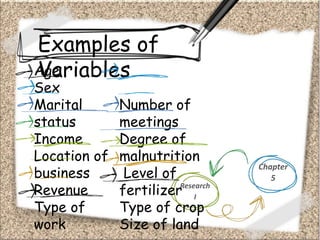
Examples of
VariablesAge
Sex
Marital
status
Income
Location of
business
Revenue
Type of
work
Number of
meetings
Degree of
malnutrition
Level of
fertilizer
Type of crop
Size of land
The dependent variable is
the “assumed effect” of
another variable. It is
change that occurs in the
study population when one
or more factors are
changed or when an
intervention is introduced.Usually
dependent
variable is the
Dependent
Variable
The independent variable is
the
“assumed cause” of a problem.
It is an assumed reason for
any “change” or variation in a
dependent variable. An
independent variable is
sometimes treated as
“antecedent” variable
(the variable before).
Independent
VariableLikewise, an
“antecedent”
variable may be
treated as an
“independent”
Examples No. 1
In the study on “ The Relationship
Between Exposure to Mass Media
and Smoking Habits among Young
Adults”, the dependent variable is
“smoking habits”, while the
independent variable is “ exposure
to mass media”. A person’s smoking
habit is assumed to change or vary
depending on his/her mere exposure
to print or broadcast media related
Examples No. 2
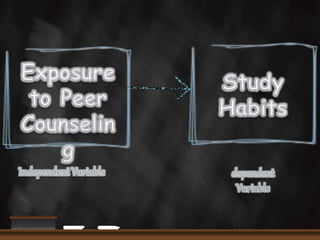
In the experimental study to test
the “ Effect of Peer Counseling on
the Students’ Study Habits”, the
independent variable is “ exposure
to peer counseling”. It is assumed
that students who have been
counseled by peers will have better
study habits that those who were
not counseled by peers or those
who have been exposed to
Examples No. 3
In the study entitled “Factors that
Influence of Extent of Participation
in Household Decision-making among
Married Professionals”, the
dependent variable is “the extent
of participation in household
decision” making while the
independent variable is “factors”,
which include the personal
characteristics of the respondents,
The intervening variable is a
factor that works “between”
the independent and
dependent variables. It can
weaken (decrease) or
strengthen (increase) the
effect of the independent on
the dependent.
Intervening
VariableIt is also called
a “facilitating
variable”,
“moderator” or
Examples No. 1
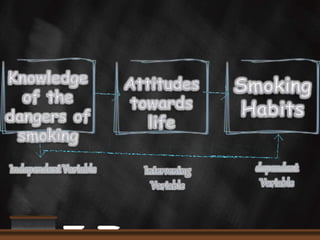
In the study on “ Knowledge of the
Dangers of Smoking, Attitudes
towards Life, and Smoking Habits
of Young Professionals”, the
intervening variable is the “attitude
towards life”. A person’d attitude
may increase or decrease the
influence of “knowledge on dangers
of smoking (independent variable)
on “smoking habits” (dependent
Cont’d…
One may argue, however, that
knowledge about the dangers of
smoking may not necessarily prevent
a person from smoking if he does not
mind dying early as long as he/she
enjoys life.
Examples No. 2
In the study on “Factors that
Influence Household Decision –
making Participation of Married
Professionals”, the intervening
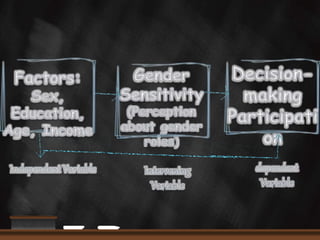
variable “gender sensitivity” may
affect the relationship between
“selected factors” (independent
variables) and “decision-making
participation” (dependent variable).
Men are generally expected to
Cont’d…
Older, better educated individuals
and those with big income are also
expected to participate more
actively in decision-making than
their younger less educated
counterparts. It may also be possible
that a woman with a gender sensitive
partner may also be actively involved
in decision-making, despite poor
education or low income.
Examples No. 3
In the study on “ The Effect of
Information Education Campaign
(IEC) on Land Reform on the
Farmer’s Attitude Towards land
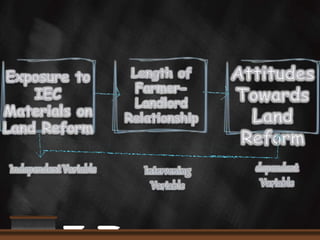
Reform”, the “length of a farmer-
landlord relationship” is the
intervening variable. It is assumed
that this variable can strengthen or
weaken the relationship between
“exposure to IEC materials”
Cont’d…
A farmer may have read or heard
about the benefits of land reform,
but still reject it (negative attitude)
because of a long and close
relationship with his landlord and his
family which he does not want to be
“cut off” by land.
The antecedent variable is a
factor or characteristics
which is found before (ante)
the independent variable. It is
expected to influence the
independent variable/s.
Antecedent
Variable
It is usually
irreversible.
Examples No. 1
In the study entitled “ Attitudes
Towards Land Reform and
Acceptance of the Program among
Lowland Farmers of Northern
Luzon”. The major concern of the
study is the influence of “attitude
towards land reform” (independent
variable) on the “farmer’s
acceptance of the program”
(dependent variable).
Cont’d…
The farmer’s attitude towards land
reform is expected to vary
according to their “education,
tenurial status and the size of the
land they own” (antecedent variable).
More educated farmers who own
their farm lots and are tilling more
than a hectare of land may be more
receptive of land reform than the
less educated farmers and those
Examples No. 2
In the study entitled “ Extent of
Exposure to Print Media and
Reading Ability of College
Freshmen”, the main concern is the
relationship between students’ “
extent of exposure to print media”
(independent variable) and their
“reading ability” (dependent
variable). The students’ exposure to
print media, however, may depend
Cont’d…
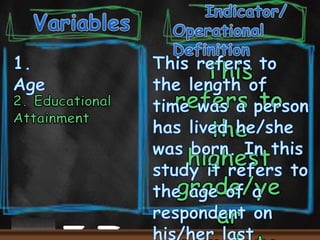
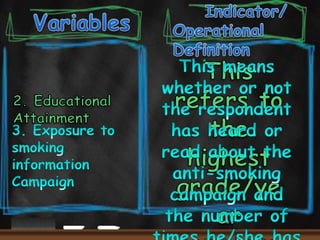
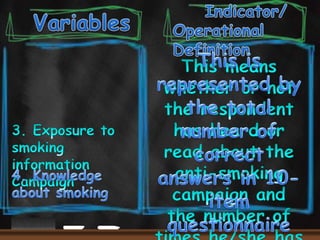
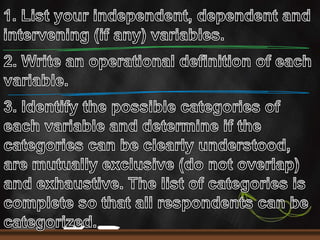
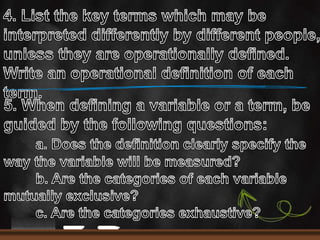
The operational definition gives a specific meaning
to the variable. The definition clarifies how a
variable or a term is used and measured in
Terms of events/units of measurement that are
observable by the senses (Fisher, et al., 1994).
These events/units of measurement serve as
indicators of the variable.
Cont’d…
The operational definition of a variable specifies
how a variable or a term is interpreted in the
study and also sets the procedure for measuring
Variable. An operational definition of a variable
used in one study may differ from that employed
in another study.
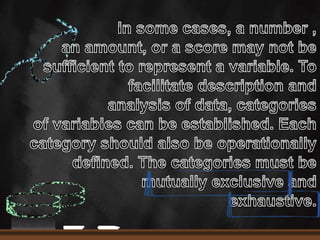
Mutually exclusive categories do
not overlap. Categories are
mutually exclusive when a
respondent cannot be assigned to
more than one category.
Mutually exclusive
Categories
Some variables, like
knowledge scores, can
be grouped and each group
assigned to a category such as
“high level knowledge”, “average
level of knowledge” and “low
level of knowledge”. Each of
Example No. 1
If for instance, the operational
definition of level of knowledge
about cancer is “ the number of
questions about cancer which a
respondent answered correctly”,
each level of knowledge may be
assigned a range of scores.
Assuming that the total possible
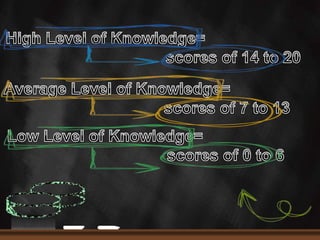
score is 20, the possible categories
could be:
Cont’d…
In the example above the categories
are mutually exclusive because a
respondent with a score of 15 can be
assigned only to “high level
knowledge”. However, if scores are
decimal numbers, the score limits of
each level should be specified, like,
“0 to 6.5”, 6.6 to 13.5” and “13.6 to
20”.
Example No. 2
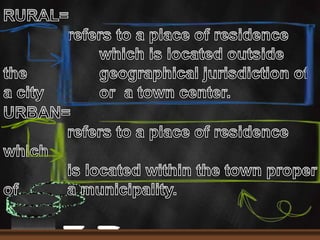
For a variable like “residence”, if its
operational definition is”
geographical characteristics of the
area where the respondents
permanently reside”, the possible
answers may be categorized as
“rural” and “urban”. The meaning of
“rural” and “urban” , however, may
be different in other studies. The
operational definition depends on
Categories are exhaustive if all the
possible response are included among
the options of responses. The answers
given by every respondent can be
assigned to a particular category. If a
researcher is not sure about the
exhaustiveness of the categories
identified, he/she should include
“Others”, the “catch all” category.
Exhaustive
Categories
Under this category,
responses which can not
assigned to any of the
Example
A list of categories like:
“Protestant, Catholic, Muslim and
Buddhist” for responses to a
question on religion is not
exhaustive because a Mormon
cannot be classified under any of
the categories in the list.
For instance, the variable "hobbies”
is operationally defined as “a type
of activity a person engages in
Cont’d…
The possible categories of this
variable may be: “singing”, “reading”,
“painting “writing poems”, “sewing”,
“Others, specify”. What may not be
classified under the five specific
categories can be classified under
“Others". However, if during data
analysis, the number of responses
falling under “others” exceed three,
the responses must be specified and
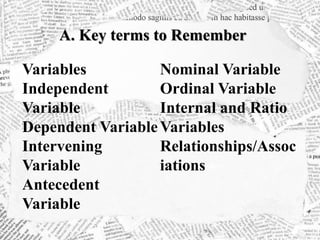
A. Key terms to Remember
Variables
Independent
Variable
Dependent Variable
Intervening
Variable
Antecedent
Variable
Nominal Variable
Ordinal Variable
Internal and Ratio
Variables
Relationships/Assoc
iations
B. Questions for Discussion
1. What are variables?
2. What are the different types of
variables and how do they differ from
each other? Give at least two examples
of each type.
3. How can you measure a variable?
Illustrate using the problem you have
selected to study.
C. Exercise
1. Select two relational studies in the
list below (next slide) and identify
the variables in each of the
following research problems.
2. Illustrate in a diagram the possible
connections between the variables
of each study. Indicate with an
arrow the direction of assumed
relationship between the variables.
Cont’d…
3. Write an operational definition for
each variables.
4. Indicate all the possible categories of
responses for each variable.
5. Select a variable among those you
have defined, the categories of which
still need operational definition. Then
define the categories.
Problems
“The Relationship Between Educational
Attainment and Fathers’ Involvement in
School Activities of their Children”
“The Experience with Sexual
Harassment of Rank and File
Employees In selected Government
Offices”
Cont’d…
“The Effect of Training in Total Quality
Management on the Management Skills
of Middle Level Managers of Medium-
Sized Establishment in region IV”
5
4
3
Research Variables (Chapter 5)

Research Variables (Chapter 5)

  • 1.
  • 2.
  • 3.
  • 4.
  • 5.
  • 8.
  • 10.
    apo nR IaT L e o D e F I n I T nI o o F v a R I a B L e S
  • 13.
    After studying thischapter, the learners should able to: Define what a variable is and explain its uses in research. Describe and compare the different types of variables and give examples of each, and  Identify the variables on a given study and determine the nature of relationship between them.
  • 15.
    A variable isa concept that stands for a variation within a class of objects or persons (Fraenkel and Wallen, 1996). A variable is a characteristics or property that can take different values or Variables
  • 16.
    Variables are the basicelements which are measured in a study. They are observable Variables
  • 17.
    Research I Chapter 5 Examples of VariablesAge Sex Marital status Income Location of business Revenue Typeof work Number of meetings Degree of malnutrition Level of fertilizer Type of crop Size of land
  • 20.
    The dependent variableis the “assumed effect” of another variable. It is change that occurs in the study population when one or more factors are changed or when an intervention is introduced.Usually dependent variable is the Dependent Variable
  • 21.
    The independent variableis the “assumed cause” of a problem. It is an assumed reason for any “change” or variation in a dependent variable. An independent variable is sometimes treated as “antecedent” variable (the variable before). Independent VariableLikewise, an “antecedent” variable may be treated as an “independent”

  • 22.
    Examples No. 1 Inthe study on “ The Relationship Between Exposure to Mass Media and Smoking Habits among Young Adults”, the dependent variable is “smoking habits”, while the independent variable is “ exposure to mass media”. A person’s smoking habit is assumed to change or vary depending on his/her mere exposure to print or broadcast media related
  • 24.
    Examples No. 2 Inthe experimental study to test the “ Effect of Peer Counseling on the Students’ Study Habits”, the independent variable is “ exposure to peer counseling”. It is assumed that students who have been counseled by peers will have better study habits that those who were not counseled by peers or those who have been exposed to
  • 26.
    Examples No. 3 Inthe study entitled “Factors that Influence of Extent of Participation in Household Decision-making among Married Professionals”, the dependent variable is “the extent of participation in household decision” making while the independent variable is “factors”, which include the personal characteristics of the respondents,
  • 28.
    The intervening variableis a factor that works “between” the independent and dependent variables. It can weaken (decrease) or strengthen (increase) the effect of the independent on the dependent. Intervening VariableIt is also called a “facilitating variable”, “moderator” or
  • 29.
    Examples No. 1 Inthe study on “ Knowledge of the Dangers of Smoking, Attitudes towards Life, and Smoking Habits of Young Professionals”, the intervening variable is the “attitude towards life”. A person’d attitude may increase or decrease the influence of “knowledge on dangers of smoking (independent variable) on “smoking habits” (dependent
  • 30.
    Cont’d… One may argue,however, that knowledge about the dangers of smoking may not necessarily prevent a person from smoking if he does not mind dying early as long as he/she enjoys life.
  • 32.
    Examples No. 2 Inthe study on “Factors that Influence Household Decision – making Participation of Married Professionals”, the intervening variable “gender sensitivity” may affect the relationship between “selected factors” (independent variables) and “decision-making participation” (dependent variable). Men are generally expected to
  • 33.
    Cont’d… Older, better educatedindividuals and those with big income are also expected to participate more actively in decision-making than their younger less educated counterparts. It may also be possible that a woman with a gender sensitive partner may also be actively involved in decision-making, despite poor education or low income.
  • 35.
    Examples No. 3 Inthe study on “ The Effect of Information Education Campaign (IEC) on Land Reform on the Farmer’s Attitude Towards land Reform”, the “length of a farmer- landlord relationship” is the intervening variable. It is assumed that this variable can strengthen or weaken the relationship between “exposure to IEC materials”
  • 36.
    Cont’d… A farmer mayhave read or heard about the benefits of land reform, but still reject it (negative attitude) because of a long and close relationship with his landlord and his family which he does not want to be “cut off” by land.
  • 38.
    The antecedent variableis a factor or characteristics which is found before (ante) the independent variable. It is expected to influence the independent variable/s. Antecedent Variable It is usually irreversible.
  • 39.
    Examples No. 1 Inthe study entitled “ Attitudes Towards Land Reform and Acceptance of the Program among Lowland Farmers of Northern Luzon”. The major concern of the study is the influence of “attitude towards land reform” (independent variable) on the “farmer’s acceptance of the program” (dependent variable).
  • 40.
    Cont’d… The farmer’s attitudetowards land reform is expected to vary according to their “education, tenurial status and the size of the land they own” (antecedent variable). More educated farmers who own their farm lots and are tilling more than a hectare of land may be more receptive of land reform than the less educated farmers and those
  • 42.
    Examples No. 2 Inthe study entitled “ Extent of Exposure to Print Media and Reading Ability of College Freshmen”, the main concern is the relationship between students’ “ extent of exposure to print media” (independent variable) and their “reading ability” (dependent variable). The students’ exposure to print media, however, may depend
  • 47.
    Cont’d… The operational definitiongives a specific meaning to the variable. The definition clarifies how a variable or a term is used and measured in Terms of events/units of measurement that are observable by the senses (Fisher, et al., 1994). These events/units of measurement serve as indicators of the variable.
  • 48.
    Cont’d… The operational definitionof a variable specifies how a variable or a term is interpreted in the study and also sets the procedure for measuring Variable. An operational definition of a variable used in one study may differ from that employed in another study.
  • 55.
    Mutually exclusive categoriesdo not overlap. Categories are mutually exclusive when a respondent cannot be assigned to more than one category. Mutually exclusive Categories Some variables, like knowledge scores, can be grouped and each group assigned to a category such as “high level knowledge”, “average level of knowledge” and “low level of knowledge”. Each of
  • 56.
    Example No. 1 Iffor instance, the operational definition of level of knowledge about cancer is “ the number of questions about cancer which a respondent answered correctly”, each level of knowledge may be assigned a range of scores. Assuming that the total possible score is 20, the possible categories could be:
  • 58.
    Cont’d… In the exampleabove the categories are mutually exclusive because a respondent with a score of 15 can be assigned only to “high level knowledge”. However, if scores are decimal numbers, the score limits of each level should be specified, like, “0 to 6.5”, 6.6 to 13.5” and “13.6 to 20”.
  • 59.
    Example No. 2 Fora variable like “residence”, if its operational definition is” geographical characteristics of the area where the respondents permanently reside”, the possible answers may be categorized as “rural” and “urban”. The meaning of “rural” and “urban” , however, may be different in other studies. The operational definition depends on
  • 61.
    Categories are exhaustiveif all the possible response are included among the options of responses. The answers given by every respondent can be assigned to a particular category. If a researcher is not sure about the exhaustiveness of the categories identified, he/she should include “Others”, the “catch all” category. Exhaustive Categories Under this category, responses which can not assigned to any of the
  • 62.
    Example A list ofcategories like: “Protestant, Catholic, Muslim and Buddhist” for responses to a question on religion is not exhaustive because a Mormon cannot be classified under any of the categories in the list. For instance, the variable "hobbies” is operationally defined as “a type of activity a person engages in
  • 63.
    Cont’d… The possible categoriesof this variable may be: “singing”, “reading”, “painting “writing poems”, “sewing”, “Others, specify”. What may not be classified under the five specific categories can be classified under “Others". However, if during data analysis, the number of responses falling under “others” exceed three, the responses must be specified and
  • 78.
    A. Key termsto Remember Variables Independent Variable Dependent Variable Intervening Variable Antecedent Variable Nominal Variable Ordinal Variable Internal and Ratio Variables Relationships/Assoc iations
  • 79.
    B. Questions forDiscussion 1. What are variables? 2. What are the different types of variables and how do they differ from each other? Give at least two examples of each type. 3. How can you measure a variable? Illustrate using the problem you have selected to study.
  • 80.
    C. Exercise 1. Selecttwo relational studies in the list below (next slide) and identify the variables in each of the following research problems. 2. Illustrate in a diagram the possible connections between the variables of each study. Indicate with an arrow the direction of assumed relationship between the variables.
  • 81.
    Cont’d… 3. Write anoperational definition for each variables. 4. Indicate all the possible categories of responses for each variable. 5. Select a variable among those you have defined, the categories of which still need operational definition. Then define the categories.
  • 82.
    Problems “The Relationship BetweenEducational Attainment and Fathers’ Involvement in School Activities of their Children” “The Experience with Sexual Harassment of Rank and File Employees In selected Government Offices”
  • 83.
    Cont’d… “The Effect ofTraining in Total Quality Management on the Management Skills of Middle Level Managers of Medium- Sized Establishment in region IV”
  • 84.
  • 85.
  • 86.