Submitted by:-
Er.Abhineet godayal (B.Sc.,B.Tech)
Research in Geotechnical
Engineering
INTRODUCTION :-
 Ground improvement is the most imaginative
field of the geotechnical engineering. It is the field
in which the engineer forces the ground to adopt
the project requirements by altering its natural
state , instead of alter in design.
 The result usually include saving in construction
cost and reduction of implementation time
NEED TO IMPROVE GROUND..
 To reduce settlement of structure
 Improve shear strength of soil and thus
increasing bearing capacity of soil
 Increase the factor of safety against possible
failure of embankment.
 Reduce the shrinkage and swelling of soils
 Increase the liquefaction resistance
SIMPLE METHOD TO DESCRIBE
GROUND IMPROVEMENT
 Drop a handful of sand from certain height. You
will get a heap of sand. Keep your foot over it,
sand will disperse in all directions. Measure this
dispersion as ‘x’
 Drop again handful of sand on the leap of sand .
Keep your handkerchief on the top and then keep
your foot . Dispersion of sand will again be there ,
but less than previous one.
 Reason :- Friction developed between
handkerchief and soil due to which adhesion took
place between cloth and soil particles, thus soil
did not flow away
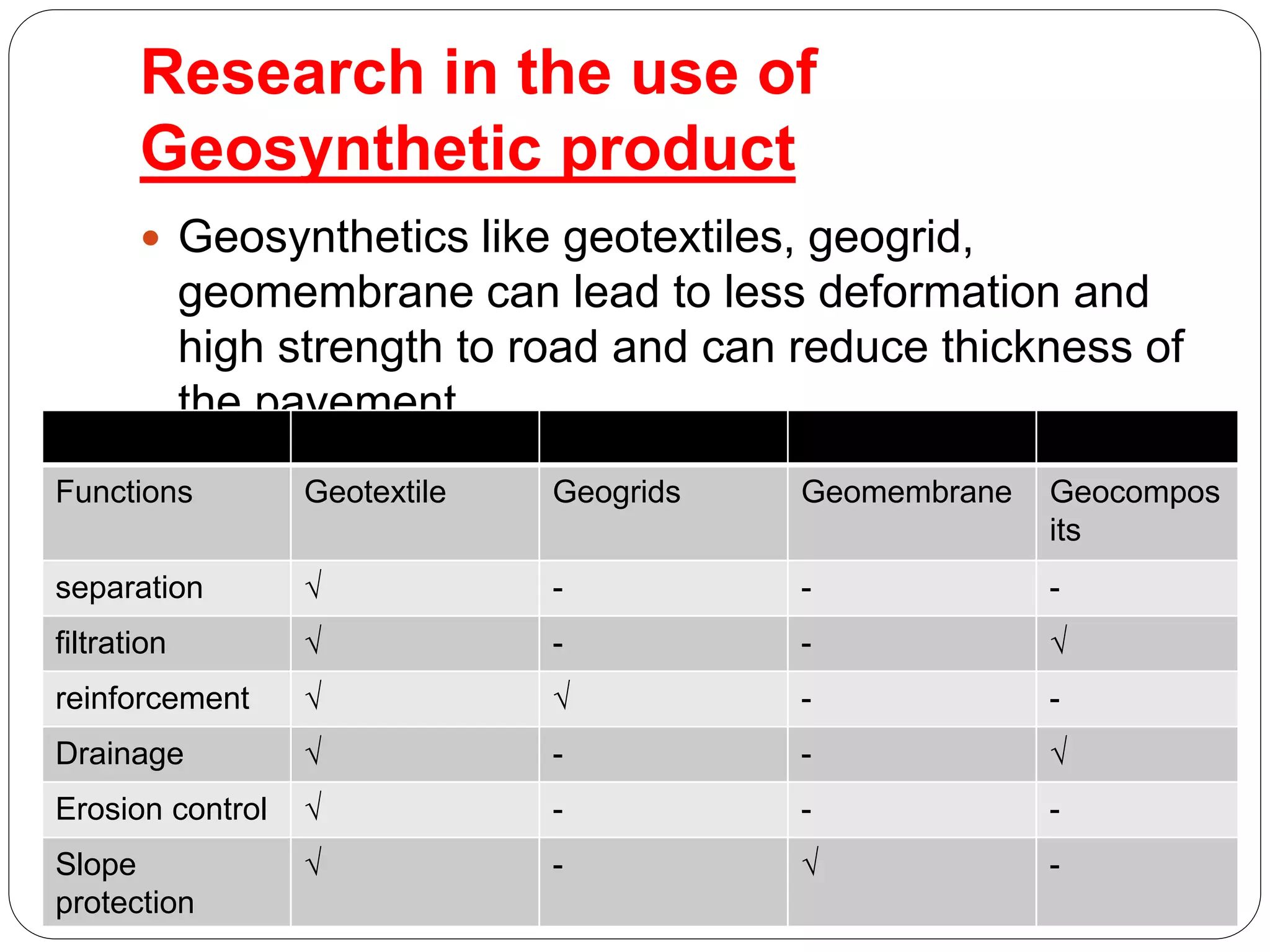
Research in the use of
Geosynthetic product
 Geosynthetics like geotextiles, geogrid,
geomembrane can lead to less deformation and
high strength to road and can reduce thickness of
the pavement
Functions Geotextile Geogrids Geomembrane Geocompos
its
separation √ - - -
filtration √ - - √
reinforcement √ √ - -
Drainage √ - - √
Erosion control √ - - -
Slope
protection
√ - √ -
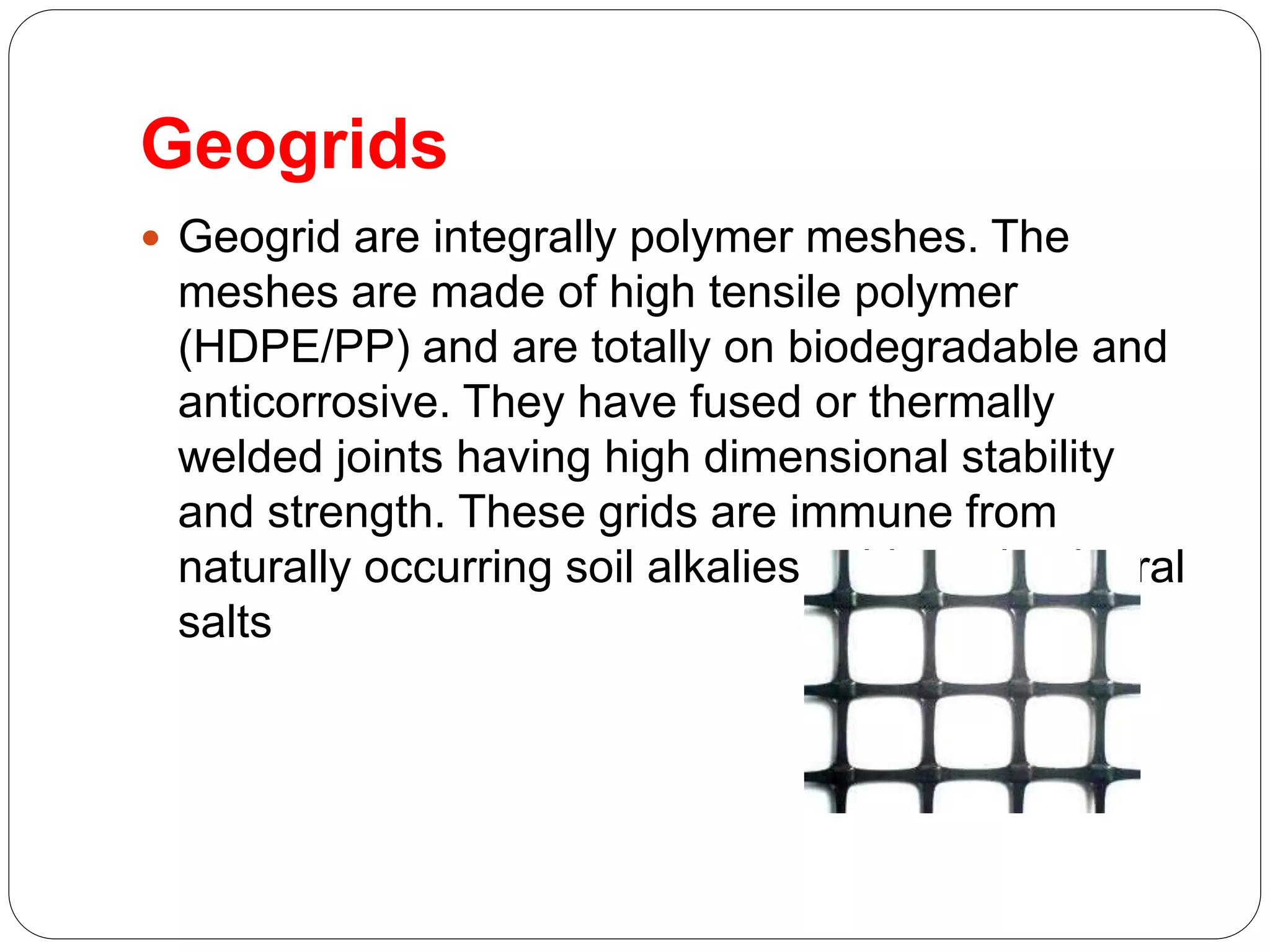
Geogrids
 Geogrid are integrally polymer meshes. The
meshes are made of high tensile polymer
(HDPE/PP) and are totally on biodegradable and
anticorrosive. They have fused or thermally
welded joints having high dimensional stability
and strength. These grids are immune from
naturally occurring soil alkalies,acids and mineral
salts
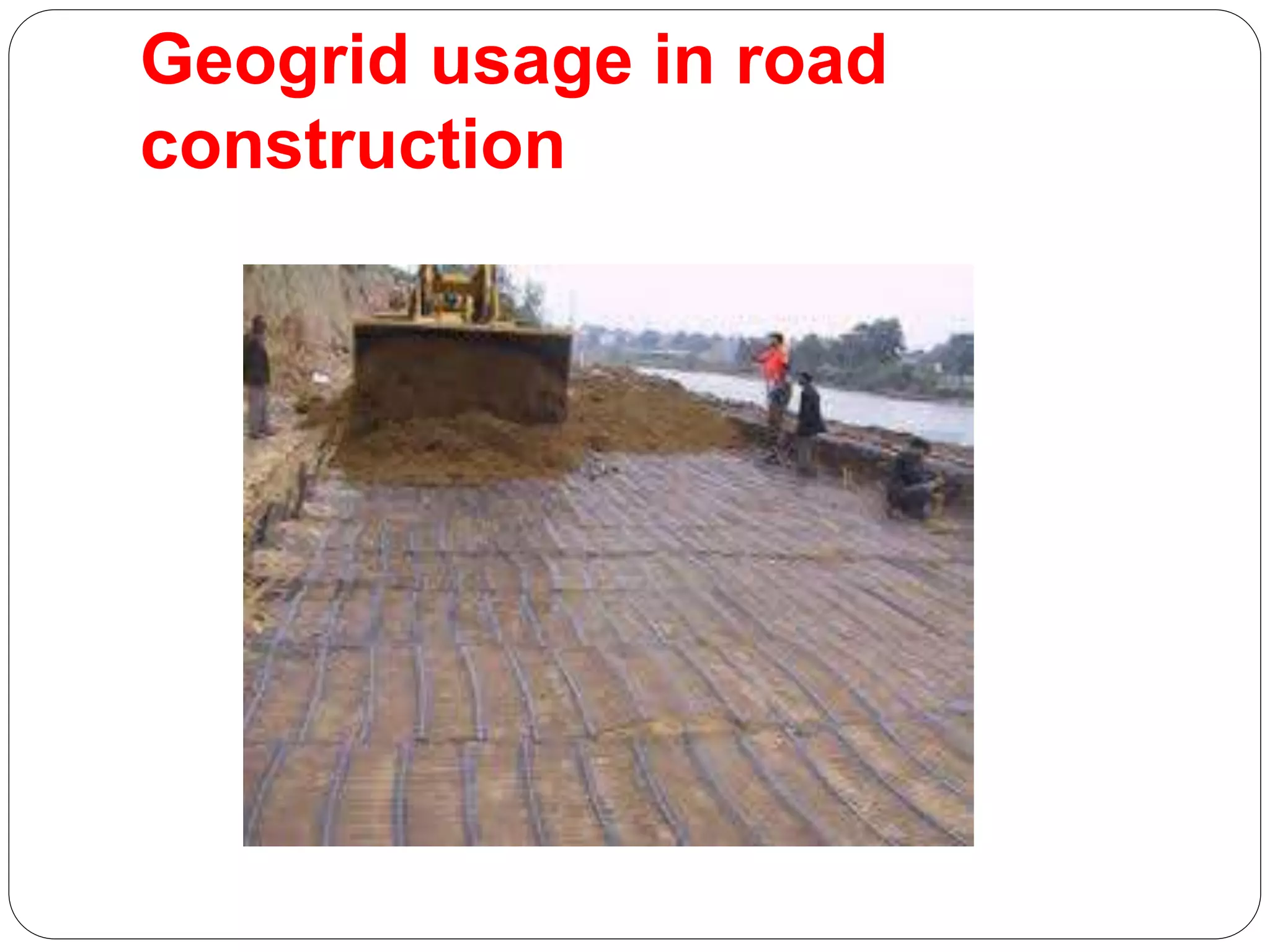
Geogrid usage in road
construction
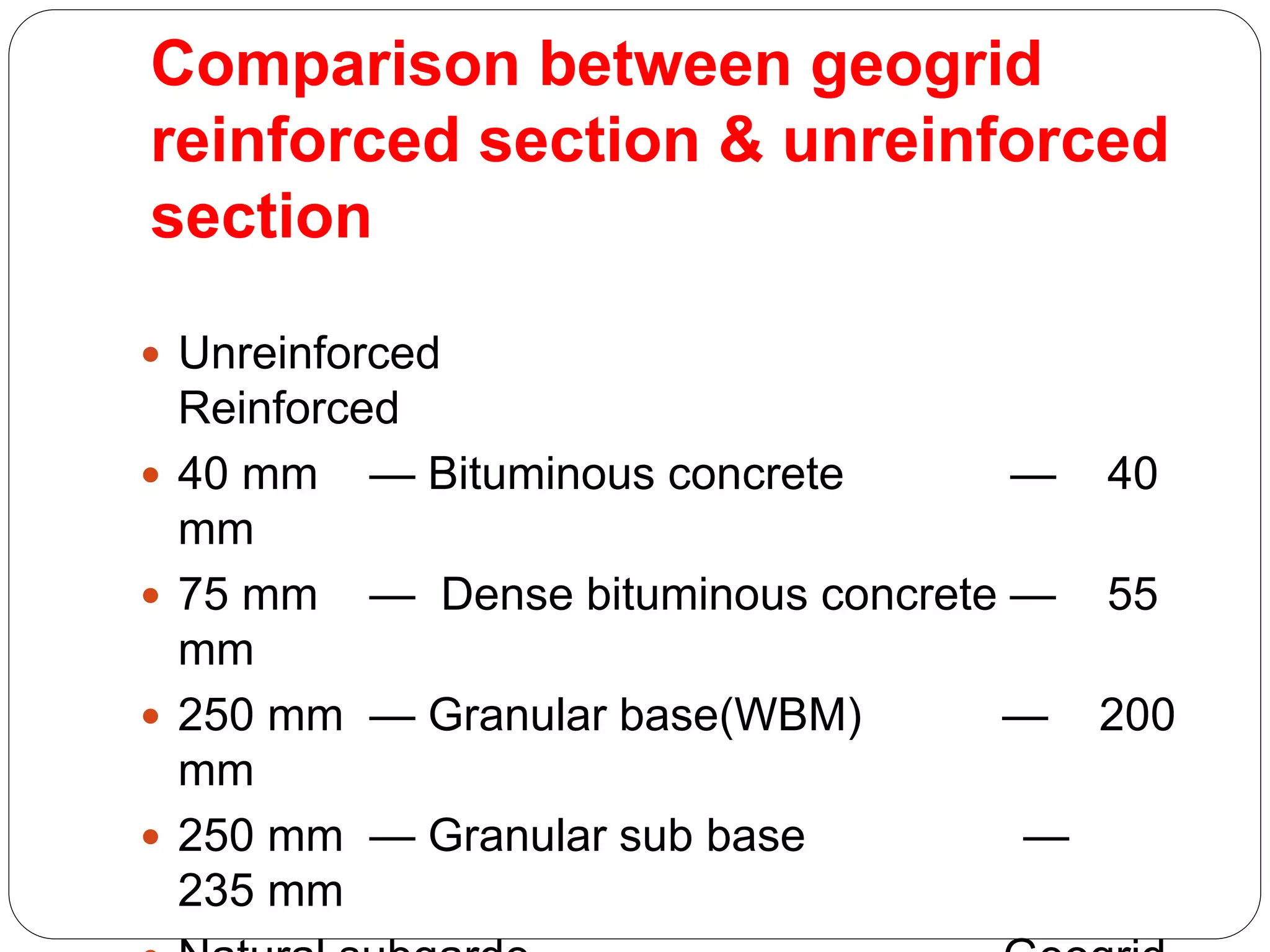
Comparison between geogrid
reinforced section & unreinforced
section
 Unreinforced
Reinforced
 40 mm — Bituminous concrete — 40
mm
 75 mm — Dense bituminous concrete — 55
mm
 250 mm — Granular base(WBM) — 200
mm
 250 mm — Granular sub base —
235 mm
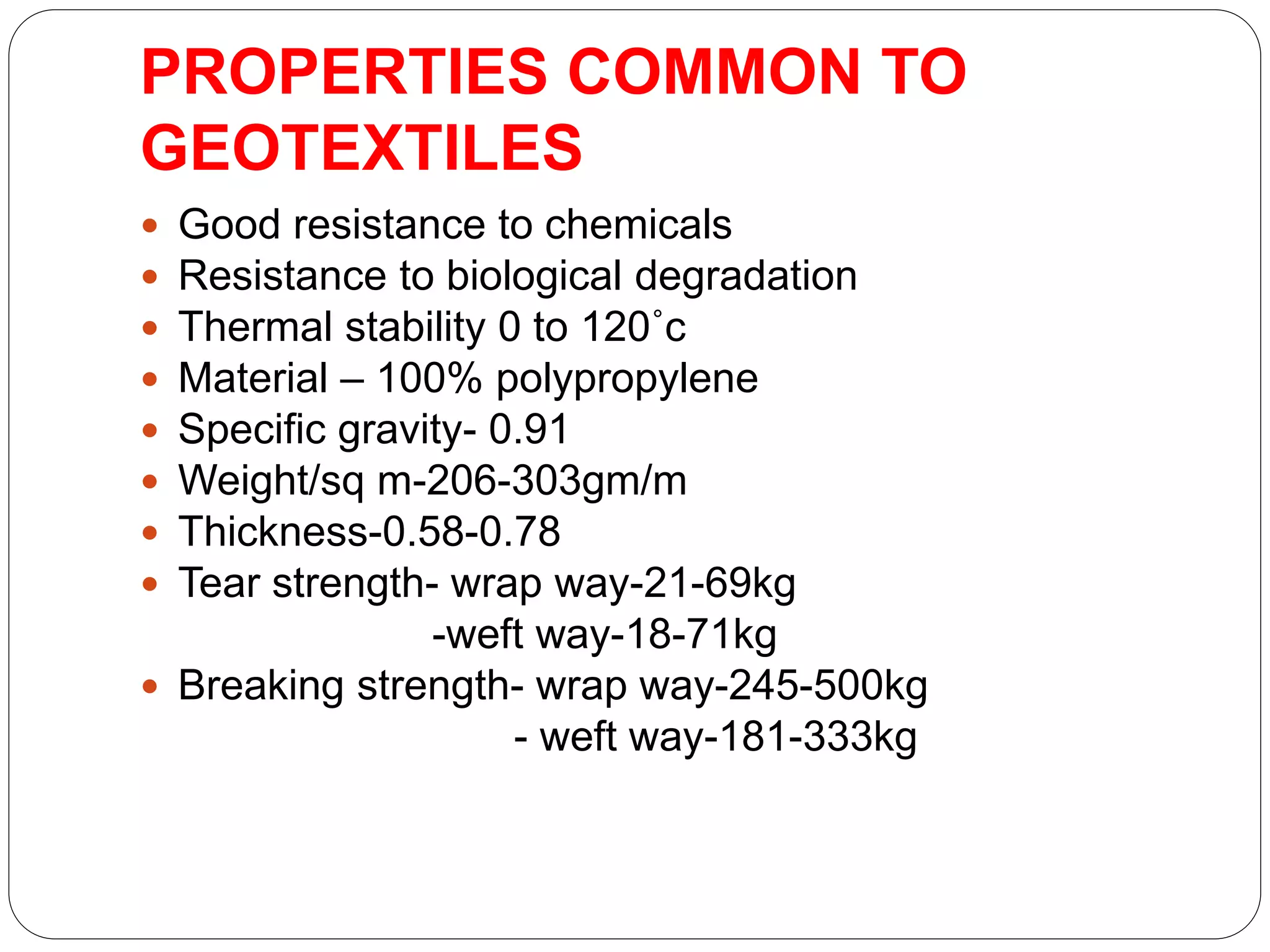
PROPERTIES COMMON TO
GEOTEXTILES
 Good resistance to chemicals
 Resistance to biological degradation
 Thermal stability 0 to 120˚c
 Material – 100% polypropylene
 Specific gravity- 0.91
 Weight/sq m-206-303gm/m
 Thickness-0.58-0.78
 Tear strength- wrap way-21-69kg
-weft way-18-71kg
 Breaking strength- wrap way-245-500kg
- weft way-181-333kg
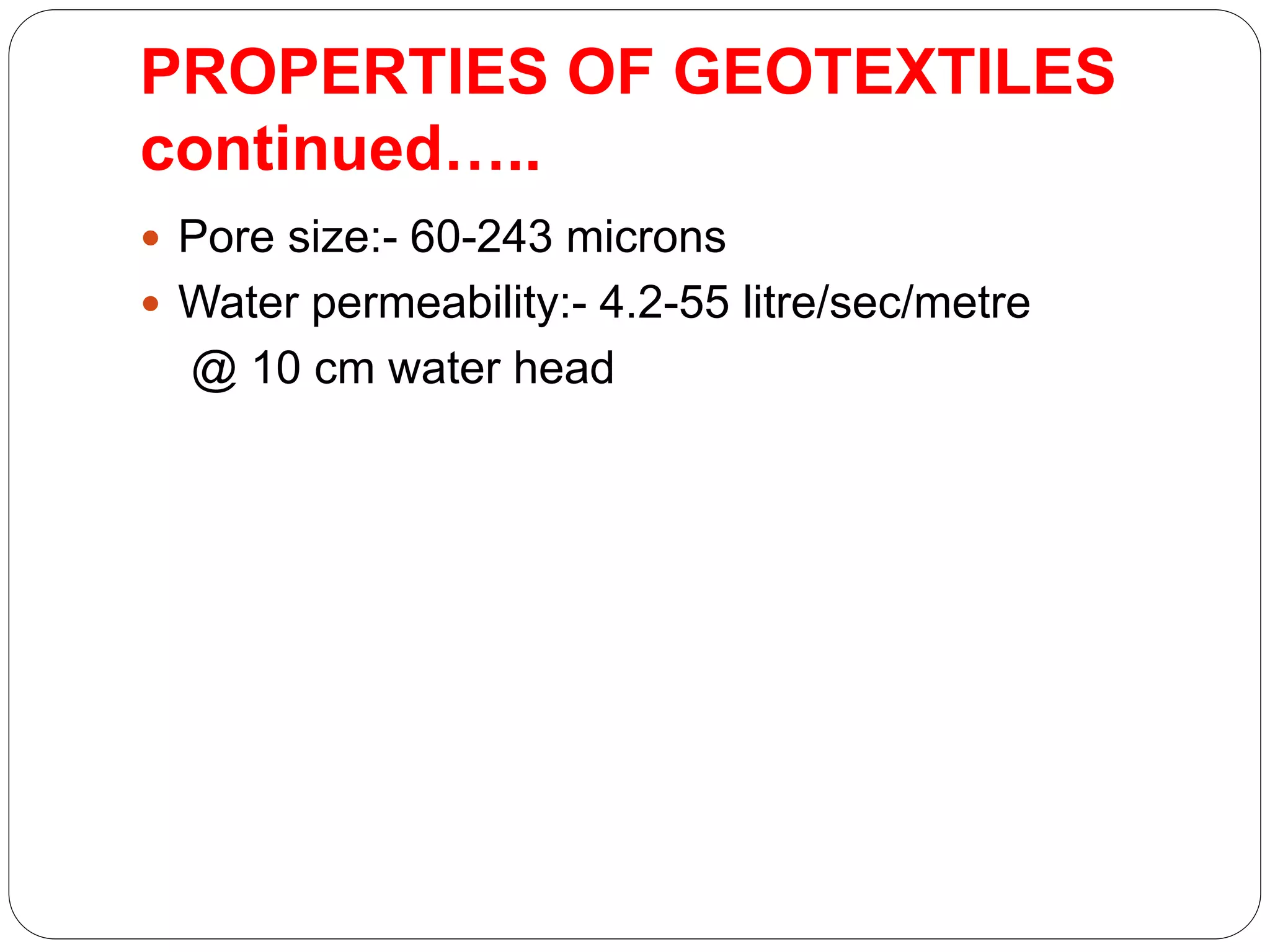
PROPERTIES OF GEOTEXTILES
continued…..
 Pore size:- 60-243 microns
 Water permeability:- 4.2-55 litre/sec/metre
@ 10 cm water head

Research in geotechnical engineering

  • 1.
    Submitted by:- Er.Abhineet godayal(B.Sc.,B.Tech) Research in Geotechnical Engineering
  • 2.
    INTRODUCTION :-  Groundimprovement is the most imaginative field of the geotechnical engineering. It is the field in which the engineer forces the ground to adopt the project requirements by altering its natural state , instead of alter in design.  The result usually include saving in construction cost and reduction of implementation time
  • 3.
    NEED TO IMPROVEGROUND..  To reduce settlement of structure  Improve shear strength of soil and thus increasing bearing capacity of soil  Increase the factor of safety against possible failure of embankment.  Reduce the shrinkage and swelling of soils  Increase the liquefaction resistance
  • 4.
    SIMPLE METHOD TODESCRIBE GROUND IMPROVEMENT  Drop a handful of sand from certain height. You will get a heap of sand. Keep your foot over it, sand will disperse in all directions. Measure this dispersion as ‘x’  Drop again handful of sand on the leap of sand . Keep your handkerchief on the top and then keep your foot . Dispersion of sand will again be there , but less than previous one.  Reason :- Friction developed between handkerchief and soil due to which adhesion took place between cloth and soil particles, thus soil did not flow away
  • 5.
    Research in theuse of Geosynthetic product  Geosynthetics like geotextiles, geogrid, geomembrane can lead to less deformation and high strength to road and can reduce thickness of the pavement Functions Geotextile Geogrids Geomembrane Geocompos its separation √ - - - filtration √ - - √ reinforcement √ √ - - Drainage √ - - √ Erosion control √ - - - Slope protection √ - √ -
  • 6.
    Geogrids  Geogrid areintegrally polymer meshes. The meshes are made of high tensile polymer (HDPE/PP) and are totally on biodegradable and anticorrosive. They have fused or thermally welded joints having high dimensional stability and strength. These grids are immune from naturally occurring soil alkalies,acids and mineral salts
  • 7.
    Geogrid usage inroad construction
  • 8.
    Comparison between geogrid reinforcedsection & unreinforced section  Unreinforced Reinforced  40 mm — Bituminous concrete — 40 mm  75 mm — Dense bituminous concrete — 55 mm  250 mm — Granular base(WBM) — 200 mm  250 mm — Granular sub base — 235 mm
  • 9.
    PROPERTIES COMMON TO GEOTEXTILES Good resistance to chemicals  Resistance to biological degradation  Thermal stability 0 to 120˚c  Material – 100% polypropylene  Specific gravity- 0.91  Weight/sq m-206-303gm/m  Thickness-0.58-0.78  Tear strength- wrap way-21-69kg -weft way-18-71kg  Breaking strength- wrap way-245-500kg - weft way-181-333kg
  • 10.
    PROPERTIES OF GEOTEXTILES continued….. Pore size:- 60-243 microns  Water permeability:- 4.2-55 litre/sec/metre @ 10 cm water head