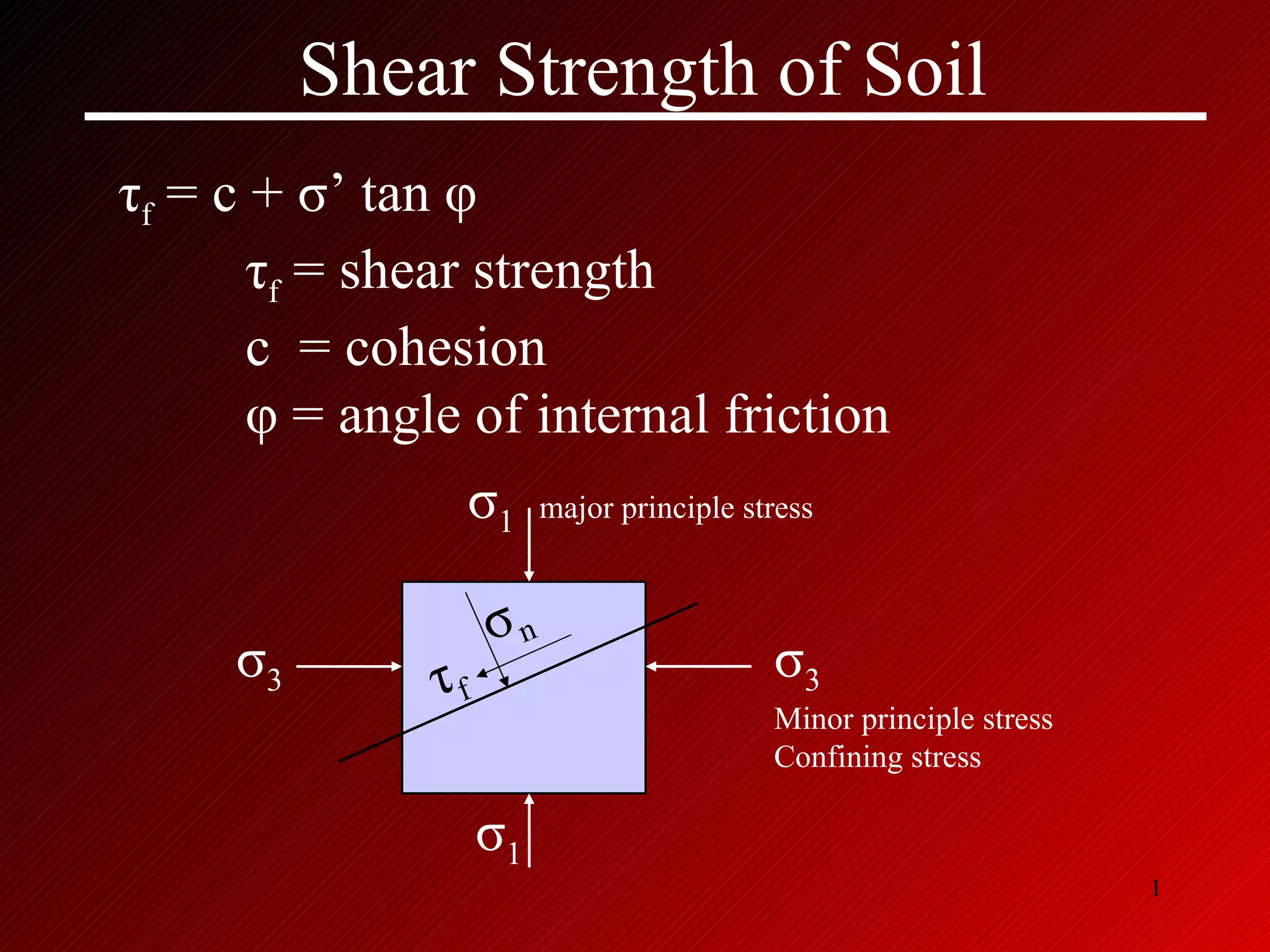
Shear Strength of Soil τ f  = c +  σ ’ tan  φ τ f  = shear strength c  = cohesion φ  = angle of internal friction σ 1   σ 1  major principle stress   σ 3 σ 3 Minor principle stress Confining stress σ n τ f
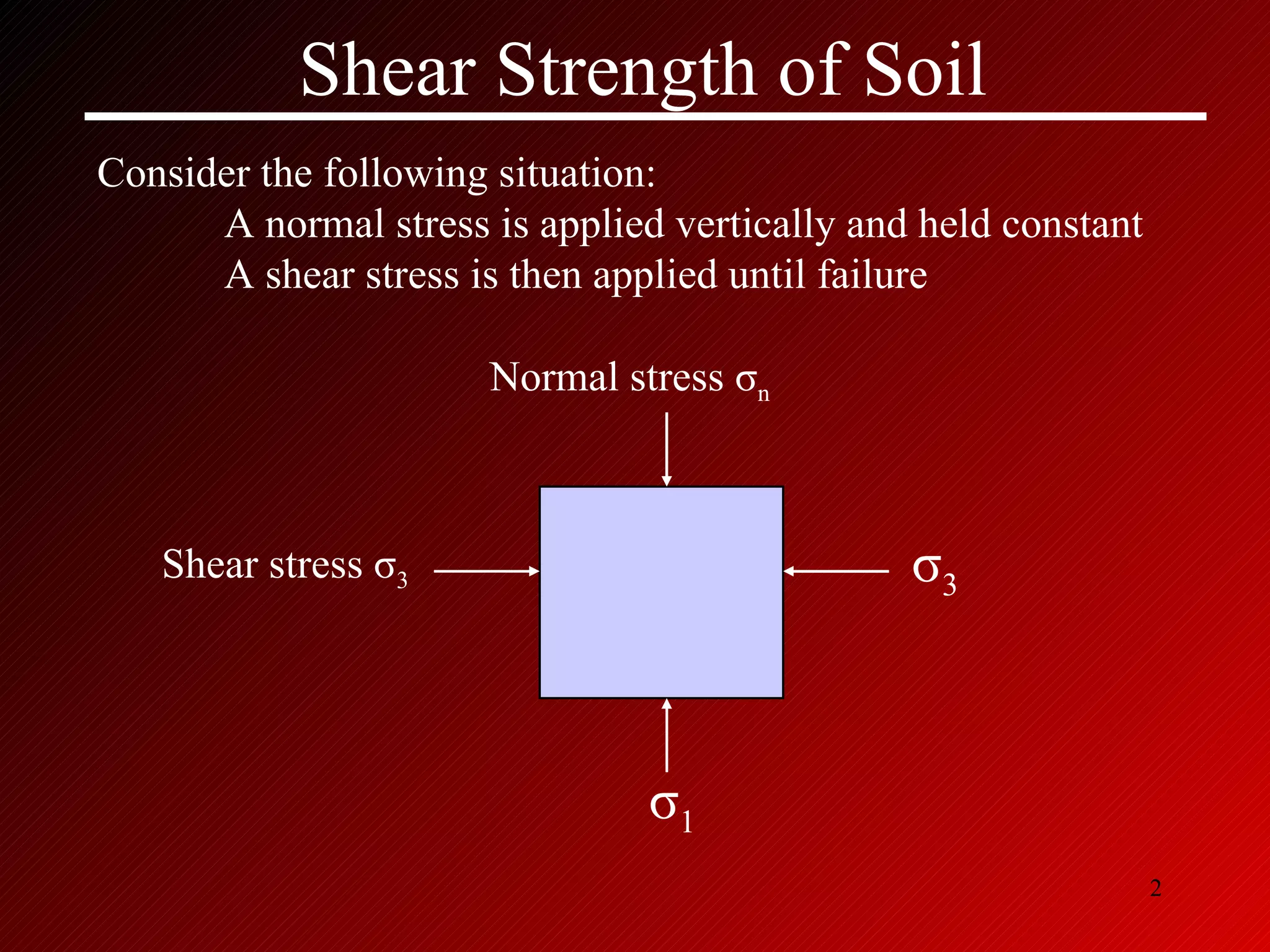
Shear Strength of Soil σ 1   Shear stress  σ 3 σ 3 Normal stress  σ n Consider the following situation: A normal stress is applied vertically and held constant A shear stress is then applied until failure
Shear Strength of Soil σ 1   Shear stress  σ 3 σ 3 Normal stress  σ n For any given normal stress, there will be one value of shear stress If the normal stress is increased, the shear stress will typically increase in sands and stay the same in clays
Direct Shear Test Soil Normal stress  σ n Shear stress  σ 3 Common lab test in practice Sample placed in the direct shear device The base is locked down Constant normal stress applied Shear stress increased until failure
c φ Shear stress normal stress Plotting 2 or more points provides the following Direct Shear Test
Direct Shear Test Direct shear test is Quick and Inexpensive Shortcoming is that it fails the soil on a designated plane which may not be the weakest one
c Shear stress normal stress In practice, may run several direct shear tests Place all the data on one plot What might you do then to determine c and  φ ? Direct Shear Test
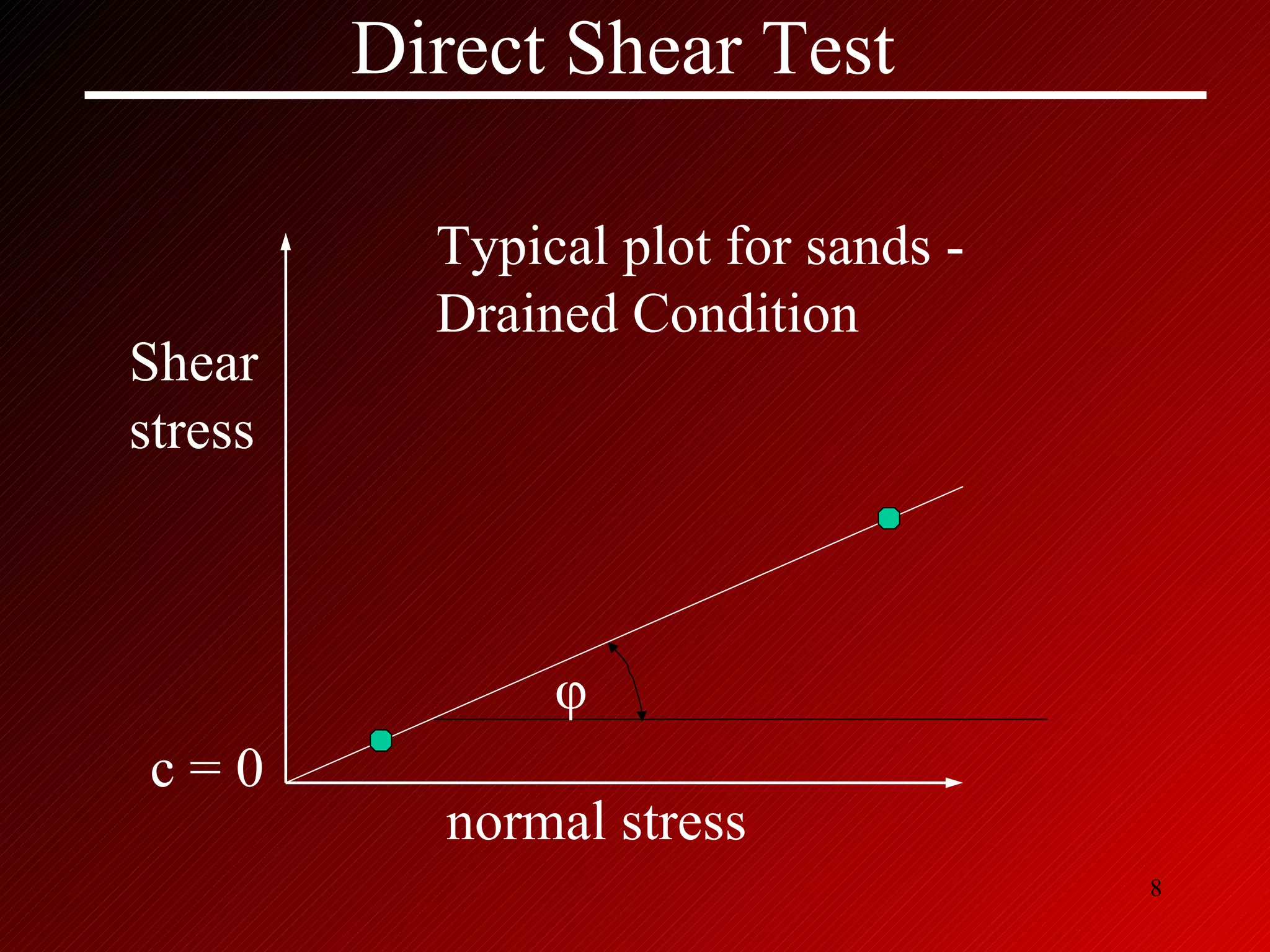
c = 0 φ Shear stress normal stress Typical plot for sands -  Drained Condition Direct Shear Test
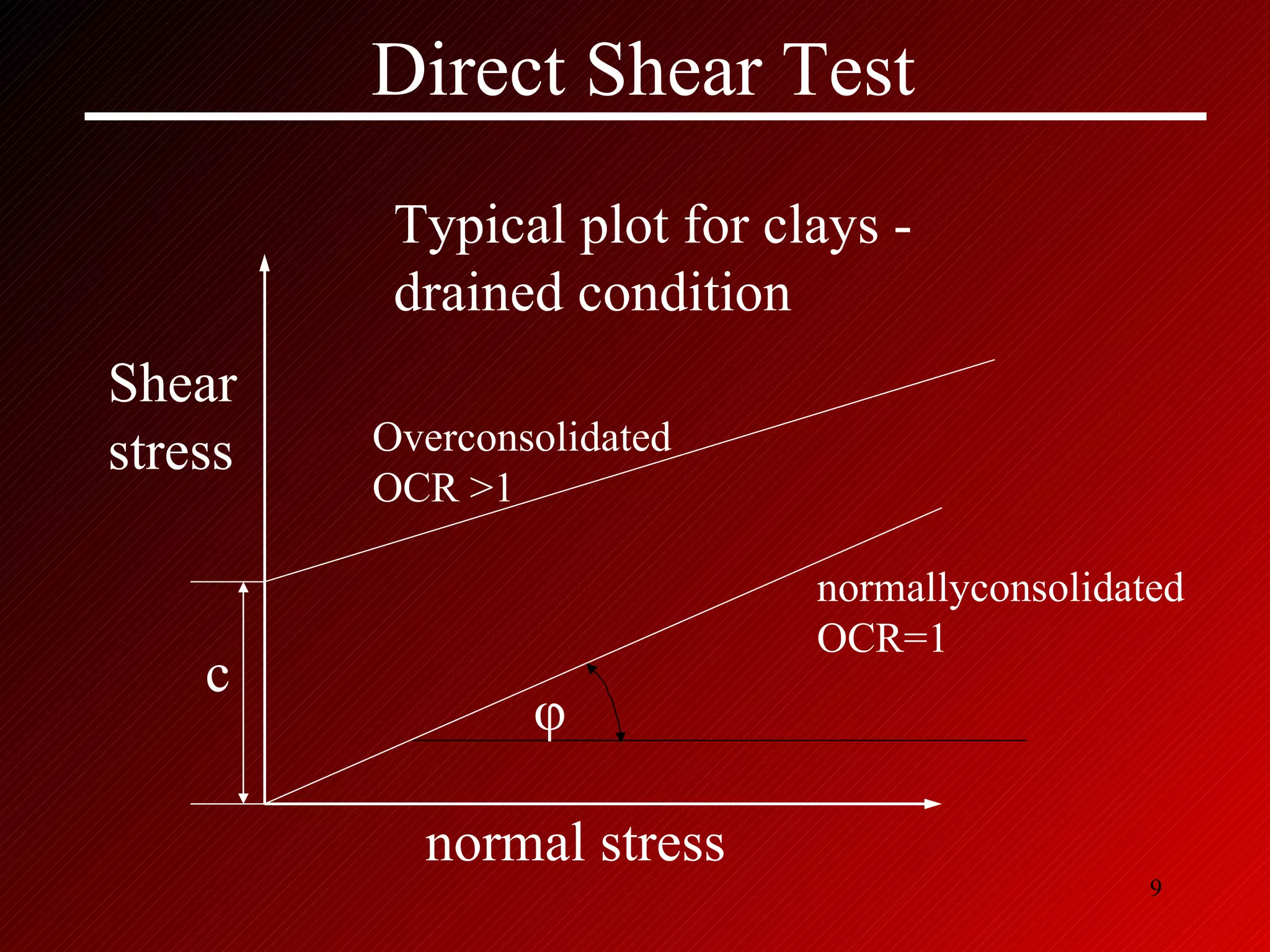
Direct Shear Test φ Shear stress normal stress Typical plot for clays -  drained condition Overconsolidated OCR >1 normallyconsolidated OCR=1 c
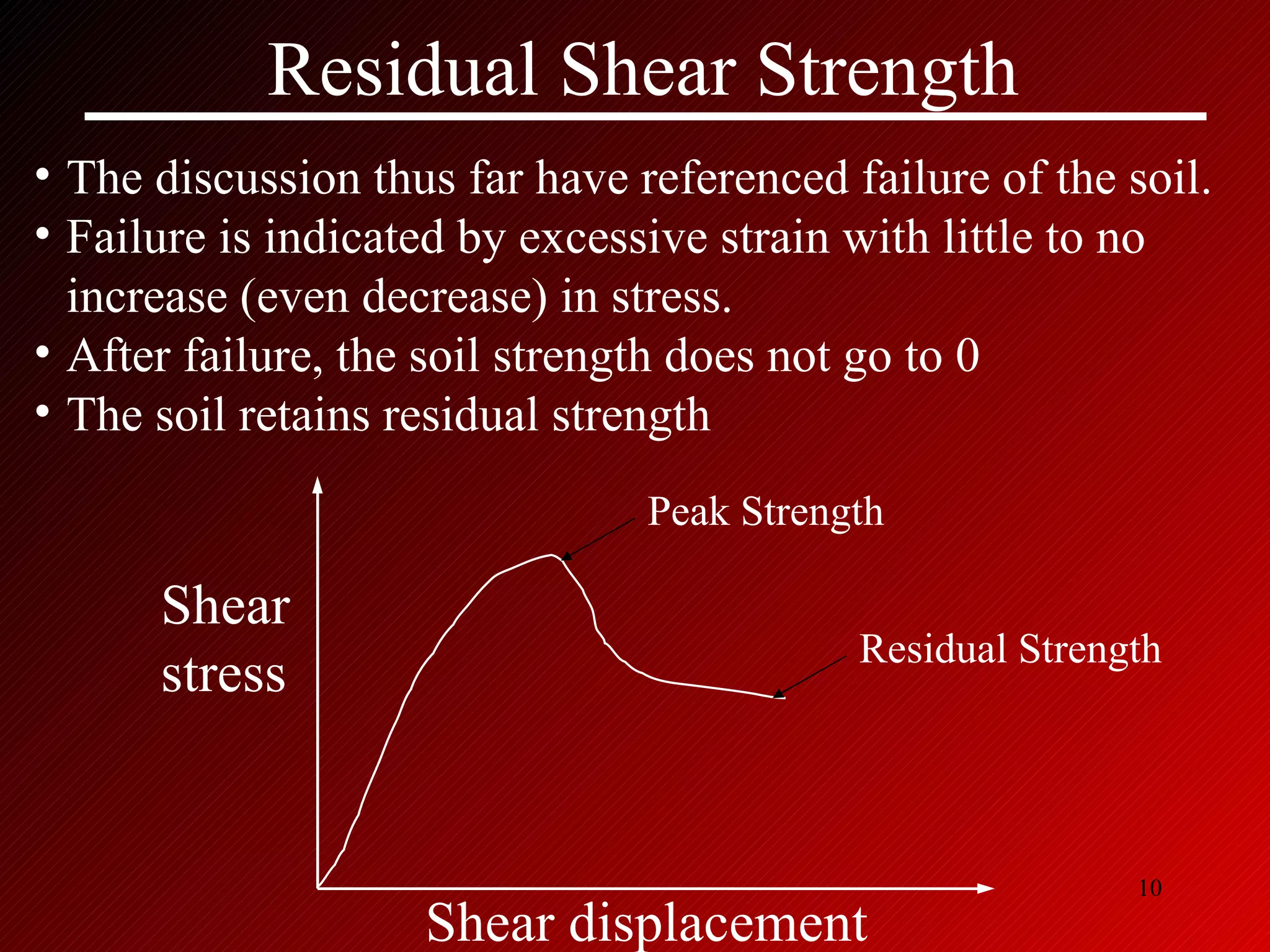
Residual Shear Strength The discussion thus far have referenced failure of the soil. Failure is indicated by excessive strain with little to no increase (even decrease) in stress. After failure, the soil strength does not go to 0 The soil retains residual strength Shear stress Shear displacement Peak Strength Residual Strength
Triaxial Shear Test
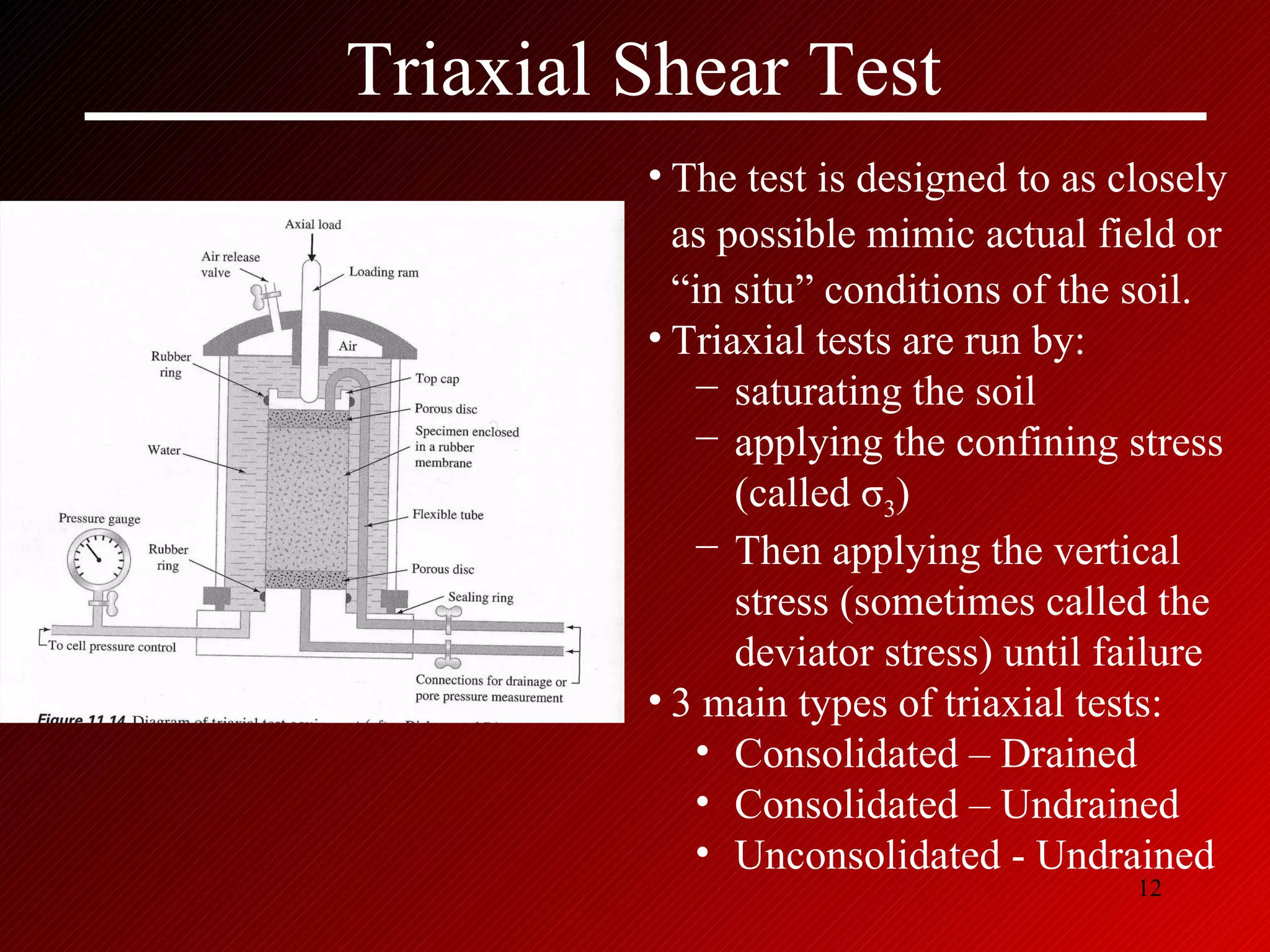
Triaxial Shear Test The test is designed to as closely as possible mimic actual field or “in situ” conditions of the soil. Triaxial tests are run by: saturating the soil applying the confining stress (called  σ 3 ) Then applying the vertical stress (sometimes called the deviator stress) until failure 3 main types of triaxial tests: Consolidated – Drained Consolidated – Undrained Unconsolidated - Undrained
Consolidated – Drained Triaxial Test The specimen is saturated Confining stress ( σ 3 )  is applied This squeezes the sample causing volume decrease Drain lines kept open and must wait for full consolidation (u = 0) to continue with test Once full consolidation is achieved, normal stress applied to failure with drain lines still open Normal stress applied very slowly allowing full drainage and full consolidation of sample during test (u =  0) Test can be run with varying values of  σ 3  to create a Mohrs circle and to obtain a plot showing c and  φ Test can also be run such  that  σ 3  is applied allowing full consolidation, then decreased (likely allowing some swelling) then the normal stress applied to failure simluating overconsolidated soil.
Consolidated – Drained Triaxial Test In the CD test, the total and effective stress is the same since u is maintained at 0 by allowing drainage This means you are testing the soil in effective stress conditions Applicable in conditions where the soil will fail under a long term constant load where the soil is allowed to drain (long term slope stability)
Consolidated – Undrained Triaxial Test The specimen is saturated Confining stress ( σ 3 )  is applied This squeezes the sample causing volume decrease Again, must wait for full consolidation (u = 0) Once full consolidation is achieved, drain lines are closed (no drainage for the rest of the test), and normal stress applied to failure Normal stress can be applied faster since no drainage is necessary  (u not equal to 0) Test can be run with varying values of  σ 3  to create a Mohrs circle and to obtain a plot showing c and  φ Applicable in  situations where failure may occur suddenly such as a rapid drawdown in a dam or levee
Unconsolidated – Undrained Test The specimen is saturated Confining stress ( σ 3 )  is applied without drainage or consolidation (drains closed the entire time) Normal stress then increased to failure without allowing drainage or consolidation This test can be run quicker than the other 2 tests since no consolidation or drainage is needed. Test can be run with varying values of  σ 3  to create a Mohrs circle and to obtain a plot showing c and  φ Applicable in most practical situations – foundations for example. This test commonly shows a  φ  = 0 condition
Shear Strength of Soil c Shear stress normal stress Typical UU plot for clays
Unconfined Compression Test The specimen is not placed in the cell Specimen is open to air with a  σ 3  of 0   Test is similar to concrete compression test, except with soil (cohesive – why?) Applicable in most practical situations – foundations for example. Drawing Mohrs circle with  σ 3  at 0 and the failure (normal) stress  σ 3  defining the 2 nd  point of the circle – often called q u  in this special case c becomes ½ of the failure stress
The Real World Triaxial tests rarely run The unconfined test is very common In most cases, clays considered  φ  = 0 and c is used as the strength Sands are considered c = 0 and  φ  is the strength parameter Direct shear test gives us good enough data for sand / clay mixes (soils with both c and  φ ) Tables showing N value vs strength very commonly used (page 567 for clays for example).
Suggested Problems 11.4 11.5 11.7 11.15

Shearstrength

  • 1.
    Shear Strength ofSoil τ f = c + σ ’ tan φ τ f = shear strength c = cohesion φ = angle of internal friction σ 1 σ 1 major principle stress σ 3 σ 3 Minor principle stress Confining stress σ n τ f
  • 2.
    Shear Strength ofSoil σ 1 Shear stress σ 3 σ 3 Normal stress σ n Consider the following situation: A normal stress is applied vertically and held constant A shear stress is then applied until failure
  • 3.
    Shear Strength ofSoil σ 1 Shear stress σ 3 σ 3 Normal stress σ n For any given normal stress, there will be one value of shear stress If the normal stress is increased, the shear stress will typically increase in sands and stay the same in clays
  • 4.
    Direct Shear TestSoil Normal stress σ n Shear stress σ 3 Common lab test in practice Sample placed in the direct shear device The base is locked down Constant normal stress applied Shear stress increased until failure
  • 5.
    c φ Shearstress normal stress Plotting 2 or more points provides the following Direct Shear Test
  • 6.
    Direct Shear TestDirect shear test is Quick and Inexpensive Shortcoming is that it fails the soil on a designated plane which may not be the weakest one
  • 7.
    c Shear stressnormal stress In practice, may run several direct shear tests Place all the data on one plot What might you do then to determine c and φ ? Direct Shear Test
  • 8.
    c = 0φ Shear stress normal stress Typical plot for sands - Drained Condition Direct Shear Test
  • 9.
    Direct Shear Testφ Shear stress normal stress Typical plot for clays - drained condition Overconsolidated OCR >1 normallyconsolidated OCR=1 c
  • 10.
    Residual Shear StrengthThe discussion thus far have referenced failure of the soil. Failure is indicated by excessive strain with little to no increase (even decrease) in stress. After failure, the soil strength does not go to 0 The soil retains residual strength Shear stress Shear displacement Peak Strength Residual Strength
  • 11.
  • 12.
    Triaxial Shear TestThe test is designed to as closely as possible mimic actual field or “in situ” conditions of the soil. Triaxial tests are run by: saturating the soil applying the confining stress (called σ 3 ) Then applying the vertical stress (sometimes called the deviator stress) until failure 3 main types of triaxial tests: Consolidated – Drained Consolidated – Undrained Unconsolidated - Undrained
  • 13.
    Consolidated – DrainedTriaxial Test The specimen is saturated Confining stress ( σ 3 ) is applied This squeezes the sample causing volume decrease Drain lines kept open and must wait for full consolidation (u = 0) to continue with test Once full consolidation is achieved, normal stress applied to failure with drain lines still open Normal stress applied very slowly allowing full drainage and full consolidation of sample during test (u = 0) Test can be run with varying values of σ 3 to create a Mohrs circle and to obtain a plot showing c and φ Test can also be run such that σ 3 is applied allowing full consolidation, then decreased (likely allowing some swelling) then the normal stress applied to failure simluating overconsolidated soil.
  • 14.
    Consolidated – DrainedTriaxial Test In the CD test, the total and effective stress is the same since u is maintained at 0 by allowing drainage This means you are testing the soil in effective stress conditions Applicable in conditions where the soil will fail under a long term constant load where the soil is allowed to drain (long term slope stability)
  • 15.
    Consolidated – UndrainedTriaxial Test The specimen is saturated Confining stress ( σ 3 ) is applied This squeezes the sample causing volume decrease Again, must wait for full consolidation (u = 0) Once full consolidation is achieved, drain lines are closed (no drainage for the rest of the test), and normal stress applied to failure Normal stress can be applied faster since no drainage is necessary (u not equal to 0) Test can be run with varying values of σ 3 to create a Mohrs circle and to obtain a plot showing c and φ Applicable in situations where failure may occur suddenly such as a rapid drawdown in a dam or levee
  • 16.
    Unconsolidated – UndrainedTest The specimen is saturated Confining stress ( σ 3 ) is applied without drainage or consolidation (drains closed the entire time) Normal stress then increased to failure without allowing drainage or consolidation This test can be run quicker than the other 2 tests since no consolidation or drainage is needed. Test can be run with varying values of σ 3 to create a Mohrs circle and to obtain a plot showing c and φ Applicable in most practical situations – foundations for example. This test commonly shows a φ = 0 condition
  • 17.
    Shear Strength ofSoil c Shear stress normal stress Typical UU plot for clays
  • 18.
    Unconfined Compression TestThe specimen is not placed in the cell Specimen is open to air with a σ 3 of 0 Test is similar to concrete compression test, except with soil (cohesive – why?) Applicable in most practical situations – foundations for example. Drawing Mohrs circle with σ 3 at 0 and the failure (normal) stress σ 3 defining the 2 nd point of the circle – often called q u in this special case c becomes ½ of the failure stress
  • 19.
    The Real WorldTriaxial tests rarely run The unconfined test is very common In most cases, clays considered φ = 0 and c is used as the strength Sands are considered c = 0 and φ is the strength parameter Direct shear test gives us good enough data for sand / clay mixes (soils with both c and φ ) Tables showing N value vs strength very commonly used (page 567 for clays for example).
  • 20.
    Suggested Problems 11.411.5 11.7 11.15