1
 Introduction
 Types of geotextiles
 Placing of geotextiles in pavement
 Functions and applications of geotextiles in
pavement
 References
2
 Geotextiles are polymer fabrics used in the
construction of roads, drains, harbour works,
breakwaters, and for land reclamation and many
other civil engineering purposes.
 Used with geotech. eng. related materials as an
integral part of human made structures.
3
 Geotextiles are usually made from polymers such as
polyester or polypropylene.
 Further prepared in 3 different categories-
1.Woven type
2.Non-woven type
3.Knitted type
4
 These were the first to be developed from the
synthetic fibers.
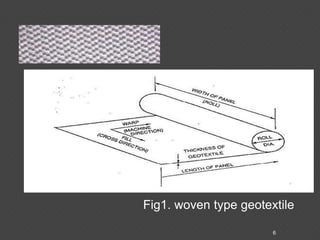
 Manufactured with a process of weaving narrow strip
of film together to form one large piece. Weaving is
done by interlocking perpendicular threads.
 Can be used in roadways as it has higher load
capacity.
 Does not have good drainage characteristics.
5
Fig1. woven type geotextile
6
 Can be made from either continuous filament
or staple fibres, these are continuously
extruded and spun, placed on a moving belt, to
form mat, which is then bonded by using any
of these processes-
1. needle-punching
2. heat bonding
3. resin bonding
7
4. combination bonding
 Thicker than woven type geotextiles.
 These are flat porous sheets.
Fig.-non-woven geotextile
8
 Manufacturing process adopted from clothing
textiles industry, and that process is called knitting.
 Interlocking a series of yarns together is made in this
process.
Fig.-knitted type geotextile
9
 Between aggregate layer and natural subgrade
layer.
 Mechanically or with hand.
 It will be rolled around a pipe, just unroll it.
10
Fig.3 placing of geotextile mechanically
11
Fig.-placed geotextile
12
 These are the main functions performed by
geotextile in pavement-
1. Separation
2. Filtration
3. Reinforcement
4. Drainage
5. Erosion control
13
 These are main layer in a section of pavement-
1.Subbase/Subgrade layer
2.Base/Aggregate layer
3.Surface layer
 Geotextile is placed between subgrade and base
layer-as a separater, so that they can perform
effectively.
14
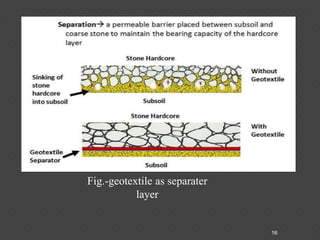
 Prevent the mixing of two dissimilar materials.
 Greater density of provided material can be
achieved.
 Releases pore water pressure, that results in
consolidation of subgrade.
 Life of pavement increases.
15
Fig.-geotextile as separater
layer
16
 Oldest and most widely known function.
 The geotextile is placed in contact with and
down gradient of soil to be drained.
 Allows water to pass and retains soil particals.
 Permeability and long time clogging are the
properties of geotextiles, which are considered
in this function.
17
Fig.-geotextile as filtration layer
18
 Geotextile as reinforcement means a
significance increase in pavement-strength.
 Mechanism-It is the lateral restrain through
friction between soil and geotextile.
 Geotextile resist the tensile force developed.
 Geo-grids are in common use in US instead of
Geotextiles.
19
 Requirement-
Geotextile should posses enough strength.
 Knitted type of geotextile is preferred.
Fig.-geotextile performing like reinforcement in pavement
20
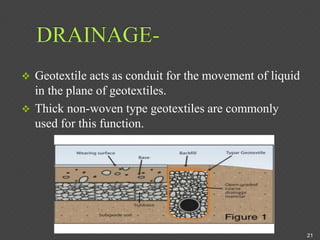
 Geotextile acts as conduit for the movement of liquid
in the plane of geotextiles.
 Thick non-woven type geotextiles are commonly
used for this function.
21
 The geotextile protects soil surfaces from the
tractive forces of moving water or wind and
rainfall erosion.
22
Fig.-geotextile controlling errosion
23
 Geotextiles are very important part of pavement
construction regarding its strength, durability, and
working performance.
 Very useful in case of silt and clay.
24
 1. Sharma, Kanaungo, Khatri.,2014, “Application of
Geotextiles in Pavement Drainage Systems,
International Journal of Civil Engineering
Research.volume” 5(4),385-390
 2. Chair, Flintsch, Trani., “Effectivness of using
geotextitles in flexible pavements: life-cycle cost
analysis” Feb 27, 2006.
 3. Guyer, Pe, Ra. 2009, “An introduction to
geotextile in pavement and drainage application”,
C02-019
25
ANY QUESTION?
PLEASE ASK…
26
THANK YOU
27

Geotextiles in pavement

  • 1.
  • 2.
     Introduction  Typesof geotextiles  Placing of geotextiles in pavement  Functions and applications of geotextiles in pavement  References 2
  • 3.
     Geotextiles arepolymer fabrics used in the construction of roads, drains, harbour works, breakwaters, and for land reclamation and many other civil engineering purposes.  Used with geotech. eng. related materials as an integral part of human made structures. 3
  • 4.
     Geotextiles areusually made from polymers such as polyester or polypropylene.  Further prepared in 3 different categories- 1.Woven type 2.Non-woven type 3.Knitted type 4
  • 5.
     These werethe first to be developed from the synthetic fibers.  Manufactured with a process of weaving narrow strip of film together to form one large piece. Weaving is done by interlocking perpendicular threads.  Can be used in roadways as it has higher load capacity.  Does not have good drainage characteristics. 5
  • 6.
    Fig1. woven typegeotextile 6
  • 7.
     Can bemade from either continuous filament or staple fibres, these are continuously extruded and spun, placed on a moving belt, to form mat, which is then bonded by using any of these processes- 1. needle-punching 2. heat bonding 3. resin bonding 7
  • 8.
    4. combination bonding Thicker than woven type geotextiles.  These are flat porous sheets. Fig.-non-woven geotextile 8
  • 9.
     Manufacturing processadopted from clothing textiles industry, and that process is called knitting.  Interlocking a series of yarns together is made in this process. Fig.-knitted type geotextile 9
  • 10.
     Between aggregatelayer and natural subgrade layer.  Mechanically or with hand.  It will be rolled around a pipe, just unroll it. 10
  • 11.
    Fig.3 placing ofgeotextile mechanically 11
  • 12.
  • 13.
     These arethe main functions performed by geotextile in pavement- 1. Separation 2. Filtration 3. Reinforcement 4. Drainage 5. Erosion control 13
  • 14.
     These aremain layer in a section of pavement- 1.Subbase/Subgrade layer 2.Base/Aggregate layer 3.Surface layer  Geotextile is placed between subgrade and base layer-as a separater, so that they can perform effectively. 14
  • 15.
     Prevent themixing of two dissimilar materials.  Greater density of provided material can be achieved.  Releases pore water pressure, that results in consolidation of subgrade.  Life of pavement increases. 15
  • 16.
  • 17.
     Oldest andmost widely known function.  The geotextile is placed in contact with and down gradient of soil to be drained.  Allows water to pass and retains soil particals.  Permeability and long time clogging are the properties of geotextiles, which are considered in this function. 17
  • 18.
  • 19.
     Geotextile asreinforcement means a significance increase in pavement-strength.  Mechanism-It is the lateral restrain through friction between soil and geotextile.  Geotextile resist the tensile force developed.  Geo-grids are in common use in US instead of Geotextiles. 19
  • 20.
     Requirement- Geotextile shouldposses enough strength.  Knitted type of geotextile is preferred. Fig.-geotextile performing like reinforcement in pavement 20
  • 21.
     Geotextile actsas conduit for the movement of liquid in the plane of geotextiles.  Thick non-woven type geotextiles are commonly used for this function. 21
  • 22.
     The geotextileprotects soil surfaces from the tractive forces of moving water or wind and rainfall erosion. 22
  • 23.
  • 24.
     Geotextiles arevery important part of pavement construction regarding its strength, durability, and working performance.  Very useful in case of silt and clay. 24
  • 25.
     1. Sharma,Kanaungo, Khatri.,2014, “Application of Geotextiles in Pavement Drainage Systems, International Journal of Civil Engineering Research.volume” 5(4),385-390  2. Chair, Flintsch, Trani., “Effectivness of using geotextitles in flexible pavements: life-cycle cost analysis” Feb 27, 2006.  3. Guyer, Pe, Ra. 2009, “An introduction to geotextile in pavement and drainage application”, C02-019 25
  • 26.
  • 27.