 Sampling
 Pilot Studies
 Case Studies
 Comparative Studies
 Content Analysis
 Triangulation
 Longitudinal Studies
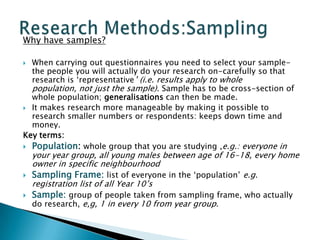
Why have samples?
 When carrying out questionnaires you need to select your sample-
the people you will actually do your research on-carefully so that
research is ‘representative’ (i.e. results apply to whole
population, not just the sample). Sample has to be cross-section of
whole population; generalisations can then be made.
 It makes research more manageable by making it possible to
research smaller numbers or respondents: keeps down time and
money.
Key terms:
 Population: whole group that you are studying ,e.g.: everyone in
your year group, all young males between age of 16-18, every home
owner in specific neighbourhood
 Sampling Frame: list of everyone in the ‘population’ e.g.
registration list of all Year 10’s
 Sample: group of people taken from sampling frame, who actually
do research, e,g, 1 in every 10 from year group.
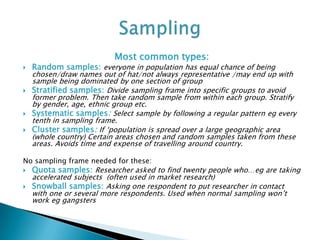
Most common types:
 Random samples: everyone in population has equal chance of being
chosen/draw names out of hat/not always representative /may end up with
sample being dominated by one section of group
 Stratified samples: Divide sampling frame into specific groups to avoid
former problem. Then take random sample from within each group. Stratify
by gender, age, ethnic group etc.
 Systematic samples: Select sample by following a regular pattern eg every
tenth in sampling frame.
 Cluster samples: If ‘population is spread over a large geographic area
(whole country) Certain areas chosen and random samples taken from these
areas. Avoids time and expense of travelling around country.
No sampling frame needed for these:
 Quota samples: Researcher asked to find twenty people who…eg are taking
accelerated subjects (often used in market research)
 Snowball samples: Asking one respondent to put researcher in contact
with one or several more respondents. Used when normal sampling won’t
work eg gangsters
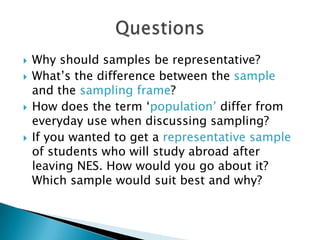
 Why should samples be representative?
 What’s the difference between the sample
and the sampling frame?
 How does the term ‘population’ differ from
everyday use when discussing sampling?
 If you wanted to get a representative sample
of students who will study abroad after
leaving NES. How would you go about it?
Which sample would suit best and why?
Pilot Studies
 An initial study carried out
in advance of main research
 Aim: to help researchers
identify problems with
research early and rectify
them
Case Studies
 In depth, detailed study of one
particular example of a type of
group, organisation or event.
 Eg: Researcher studies particular
behaviour of students in
(only)one school- ‘A Glasgow
Gang Observed’ was a case
study.
 Limitations: can’t generalise
from findings (unless earlier
research shows findings as
typical)
 Strengths: Valuable as may be
used to develop ideas for further
testing. Adequate for student
research
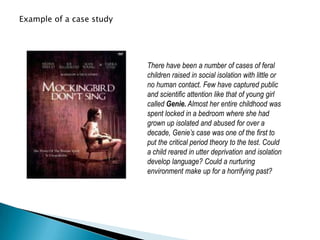
There have been a number of cases of feral
children raised in social isolation with little or
no human contact. Few have captured public
and scientific attention like that of young girl
called Genie. Almost her entire childhood was
spent locked in a bedroom where she had
grown up isolated and abused for over a
decade, Genie’s case was one of the first to
put the critical period theory to the test. Could
a child reared in utter deprivation and isolation
develop language? Could a nurturing
environment make up for a horrifying past?
Example of a case study
Content Analysis
Used to investigate the content of mass
media ( eg books, films, magazines
etc)
 The researcher might count the
number of times a certain behaviour
appears thus helping to build up a
picture of patterns of behaviour. (eg
how many minutes women and men
appear in a certain programme)
 It produces reliable quantitative data.
It is unobtrusive and objective.
 However it can be time-consuming
and while telling us the ‘quantity’ not
much said about quality of
relationship studied..
Comparative Studies
 Comparing two or more
similar
groups, institutions, eg
two schools
 Often used to compare
two different countries or
cultures
 Useful to avoid
ethnocentric attitudes
(assuming that our way is
always best!)
 This refers to carrying out
research using more than
one method or using more
than one researcher
 Aim: to check the validity of
findings
 The findings of a
questionnaire could be
checked against an in depth
interview with a sample of
respondents or by
participant observation
 Improves validity and
reliability
Example
 Eileen Barker’s study of the ‘Moonies’
(a religious sect) See P.45 text book
 Aim of research to find out to what
extent the members were
brainwashed into joining the sect.
 Carried out overt observation, living
in their communities.
 Also carried out interviews and sent
questionnaires to all Moonies in
Britain.
 Enabled her to check that findings
from one research were not
contradicted by those of another.
 Conclusion: members not
brainwashed; free to join and leave.
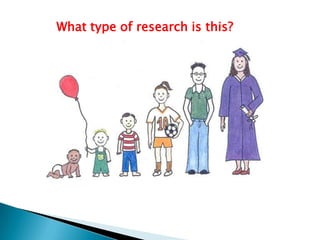
What type of research is this?
 Research which takes place at regular intervals over
a long period of time-Enables researcher to track
changes in lives of individuals
 Longitudinal studies show us that groups (eg lone
parents, poor) are not fixed and unchanging, they
move in and out of these groups over time
 Disadvantage: difficult to maintain initial numbers;
some participants move away, lose contact, wish to
no longer take part or die.
1. ‘7UP ‘ study carried out beginning 1964 examined lives of
7 year olds (panel study)from different social
classes, interviewed them intermittently over next 42 years
at 7 year intervals).Results fascinating in that it showed that
children from privileged backgrounds became privileged
adults while those from working class backgrounds moved
only marginally up the class system
2. British Household Panel Survey: 1991 ongoing, tracks 5000
households
3. The Millennium Cohort Study (MCS) follows the lives of
around 19,000 children born in the UK, starting 2000/1. It
has carried out 4 studies so far and next sweep of study is
due 2012.
LOOK UP ANY OF THESE STUDIES ON THE INTERNET!
1. What’s the main reason why researchers carry
out pilot studies?
2. Explain one benefit and one drawback of case
studies.
3. Which two research methods did Eileen Barker
use in her study of the Moonies? Why did she
feel the need to use two different methods?
4. What kind of comparative study may prove
useful for you as an amateur sociologist?
5. What can longitudinal studies offer the
researcher that shorter studies cannot?

Unit 1d other research CIE syllabus

  • 1.
     Sampling  PilotStudies  Case Studies  Comparative Studies  Content Analysis  Triangulation  Longitudinal Studies
  • 2.
    Why have samples? When carrying out questionnaires you need to select your sample- the people you will actually do your research on-carefully so that research is ‘representative’ (i.e. results apply to whole population, not just the sample). Sample has to be cross-section of whole population; generalisations can then be made.  It makes research more manageable by making it possible to research smaller numbers or respondents: keeps down time and money. Key terms:  Population: whole group that you are studying ,e.g.: everyone in your year group, all young males between age of 16-18, every home owner in specific neighbourhood  Sampling Frame: list of everyone in the ‘population’ e.g. registration list of all Year 10’s  Sample: group of people taken from sampling frame, who actually do research, e,g, 1 in every 10 from year group.
  • 3.
    Most common types: Random samples: everyone in population has equal chance of being chosen/draw names out of hat/not always representative /may end up with sample being dominated by one section of group  Stratified samples: Divide sampling frame into specific groups to avoid former problem. Then take random sample from within each group. Stratify by gender, age, ethnic group etc.  Systematic samples: Select sample by following a regular pattern eg every tenth in sampling frame.  Cluster samples: If ‘population is spread over a large geographic area (whole country) Certain areas chosen and random samples taken from these areas. Avoids time and expense of travelling around country. No sampling frame needed for these:  Quota samples: Researcher asked to find twenty people who…eg are taking accelerated subjects (often used in market research)  Snowball samples: Asking one respondent to put researcher in contact with one or several more respondents. Used when normal sampling won’t work eg gangsters
  • 4.
     Why shouldsamples be representative?  What’s the difference between the sample and the sampling frame?  How does the term ‘population’ differ from everyday use when discussing sampling?  If you wanted to get a representative sample of students who will study abroad after leaving NES. How would you go about it? Which sample would suit best and why?
  • 5.
    Pilot Studies  Aninitial study carried out in advance of main research  Aim: to help researchers identify problems with research early and rectify them Case Studies  In depth, detailed study of one particular example of a type of group, organisation or event.  Eg: Researcher studies particular behaviour of students in (only)one school- ‘A Glasgow Gang Observed’ was a case study.  Limitations: can’t generalise from findings (unless earlier research shows findings as typical)  Strengths: Valuable as may be used to develop ideas for further testing. Adequate for student research
  • 6.
    There have beena number of cases of feral children raised in social isolation with little or no human contact. Few have captured public and scientific attention like that of young girl called Genie. Almost her entire childhood was spent locked in a bedroom where she had grown up isolated and abused for over a decade, Genie’s case was one of the first to put the critical period theory to the test. Could a child reared in utter deprivation and isolation develop language? Could a nurturing environment make up for a horrifying past? Example of a case study
  • 7.
    Content Analysis Used toinvestigate the content of mass media ( eg books, films, magazines etc)  The researcher might count the number of times a certain behaviour appears thus helping to build up a picture of patterns of behaviour. (eg how many minutes women and men appear in a certain programme)  It produces reliable quantitative data. It is unobtrusive and objective.  However it can be time-consuming and while telling us the ‘quantity’ not much said about quality of relationship studied.. Comparative Studies  Comparing two or more similar groups, institutions, eg two schools  Often used to compare two different countries or cultures  Useful to avoid ethnocentric attitudes (assuming that our way is always best!)
  • 8.
     This refersto carrying out research using more than one method or using more than one researcher  Aim: to check the validity of findings  The findings of a questionnaire could be checked against an in depth interview with a sample of respondents or by participant observation  Improves validity and reliability Example  Eileen Barker’s study of the ‘Moonies’ (a religious sect) See P.45 text book  Aim of research to find out to what extent the members were brainwashed into joining the sect.  Carried out overt observation, living in their communities.  Also carried out interviews and sent questionnaires to all Moonies in Britain.  Enabled her to check that findings from one research were not contradicted by those of another.  Conclusion: members not brainwashed; free to join and leave.
  • 9.
    What type ofresearch is this?
  • 10.
     Research whichtakes place at regular intervals over a long period of time-Enables researcher to track changes in lives of individuals  Longitudinal studies show us that groups (eg lone parents, poor) are not fixed and unchanging, they move in and out of these groups over time  Disadvantage: difficult to maintain initial numbers; some participants move away, lose contact, wish to no longer take part or die.
  • 11.
    1. ‘7UP ‘study carried out beginning 1964 examined lives of 7 year olds (panel study)from different social classes, interviewed them intermittently over next 42 years at 7 year intervals).Results fascinating in that it showed that children from privileged backgrounds became privileged adults while those from working class backgrounds moved only marginally up the class system 2. British Household Panel Survey: 1991 ongoing, tracks 5000 households 3. The Millennium Cohort Study (MCS) follows the lives of around 19,000 children born in the UK, starting 2000/1. It has carried out 4 studies so far and next sweep of study is due 2012. LOOK UP ANY OF THESE STUDIES ON THE INTERNET!
  • 12.
    1. What’s themain reason why researchers carry out pilot studies? 2. Explain one benefit and one drawback of case studies. 3. Which two research methods did Eileen Barker use in her study of the Moonies? Why did she feel the need to use two different methods? 4. What kind of comparative study may prove useful for you as an amateur sociologist? 5. What can longitudinal studies offer the researcher that shorter studies cannot?