

RESCUE ROBOT
Siddharth Bhatt
Kratika Nagar
Jyoti Shinde
N.B.Hulle
PRESENTATION ON
CONTENTS
I. Introduction
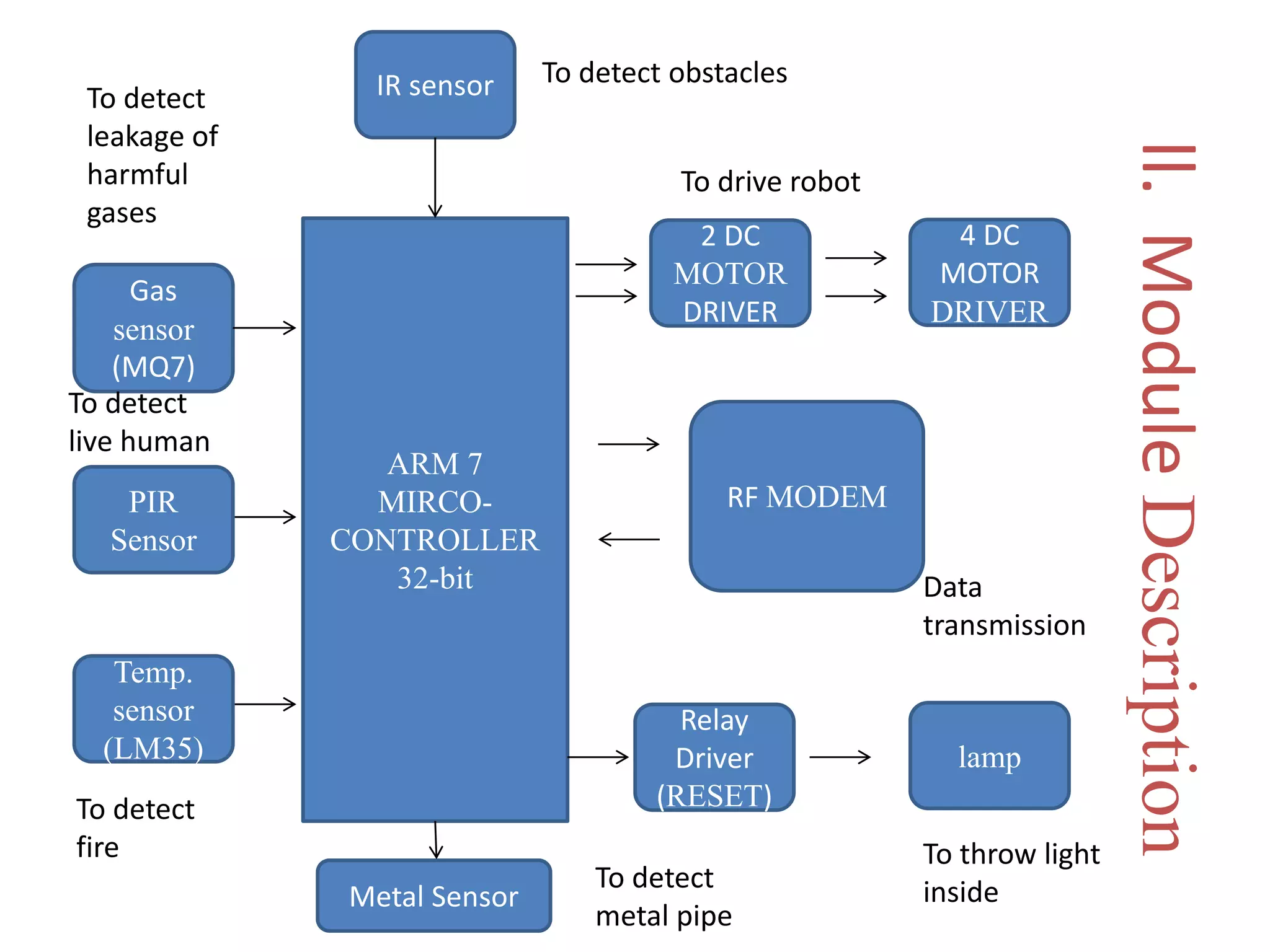
II. Module Description
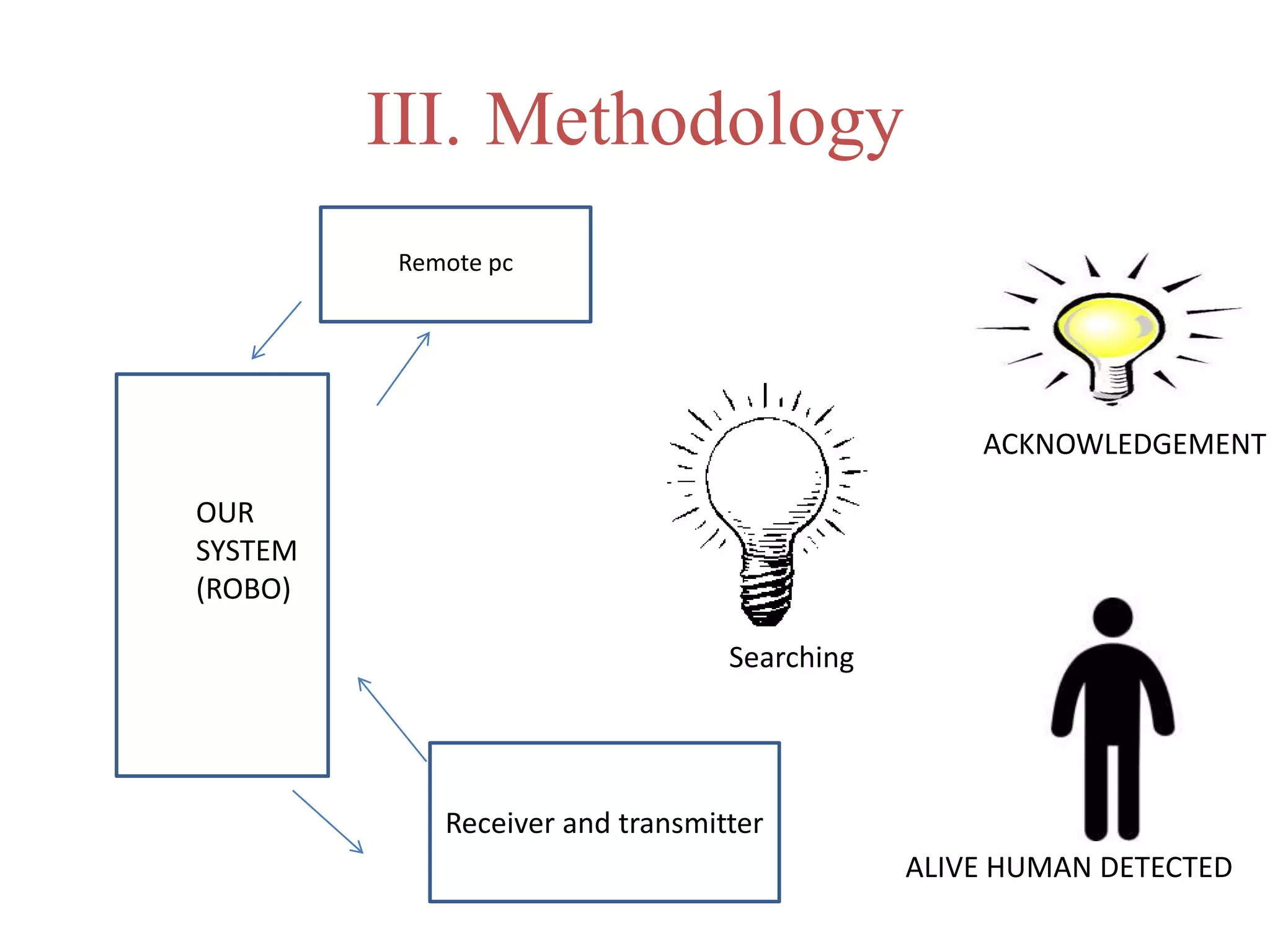
III. Methodology
IV.Our Contribution
V. Conclusion
VI.References
I. INTRODUCTION
• The basic aim is to design a cost effective Robot to work effortlessly
in critical circumstances.
• The goal of the RESCUE ROBOT basically a USAR(URBAN
SEARCH AND RESCUE) is to search the traces of the alive human
body where people are not able to reach.
• The important objective that are associated in using of Robotic
system in Rescue operation are:
1) Saving of manpower.
2) Improve the accuracy.
3) Ability to work in a hazardous environment.
• There is a 3D LAW which is followed by USAR robot.
where 3D’s are :
a. DIRTY
b. DANGEROUS
c. DULL TASKS
They can do what rescuers and rescue dogs do it.
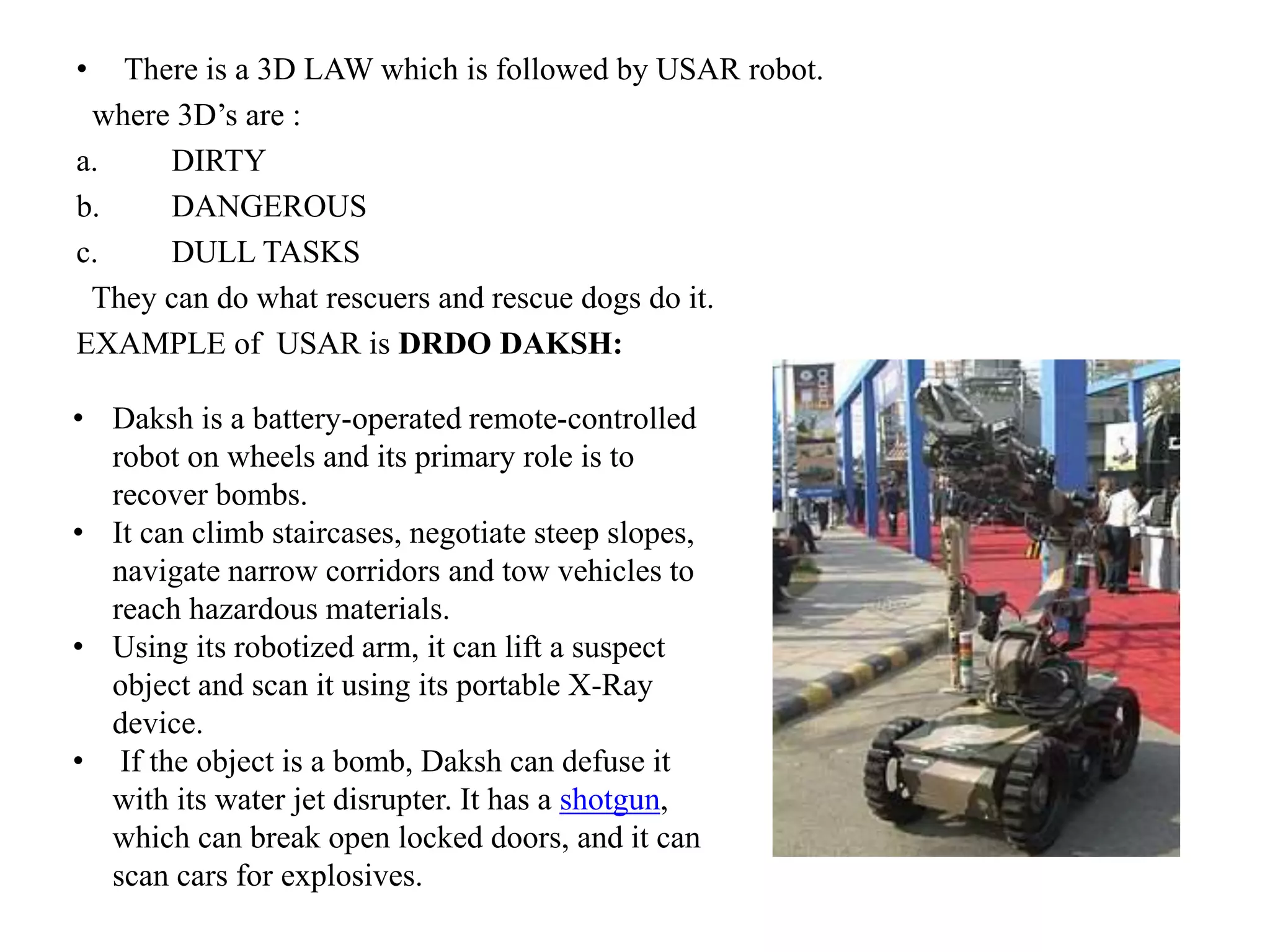
EXAMPLE of USAR is DRDO DAKSH:
• Daksh is a battery-operated remote-controlled
robot on wheels and its primary role is to
recover bombs.
• It can climb staircases, negotiate steep slopes,
navigate narrow corridors and tow vehicles to
reach hazardous materials.
• Using its robotized arm, it can lift a suspect
object and scan it using its portable X-Ray
device.
• If the object is a bomb, Daksh can defuse it
with its water jet disrupter. It has a shotgun,
which can break open locked doors, and it can
scan cars for explosives.
DAKSH IMPROVISATION
• The newer version of Daksh is made of aluminum alloy as against the older version.
• The use of new material has not just reduced the weight but has also made it more
rugged.
• To improve speed the new Daksh has used custom-made motors that can increased
the speed by three times.
• The new Daksh has been integrated with DRDO’s Unmanned Areal Vehicle (UAV)
Netra, and the integrated system is being called CBRN Remotely Operated
Platform (ROP).
• In case of a radiation hazard, the radiation detection unit fitted on Netra can be
flown to the affected area. Netra model being used for this platform has an
increased range of four kilometers and double the flying time.
• This system will not just be useful for the armed forces, but also the paramilitary
forces operating in areas where the nature of conflict is different. There will be
demand for this version of Daksh from the different security agencies.
• The Faster, lighter version of the ROV along with added advantage also has
enhanced capabilities that will be certainly useful in the backdrop of changing
nature of warfare in insurgency affected areas, especially with increased threat of
dirty bombs, which use radioactive material.
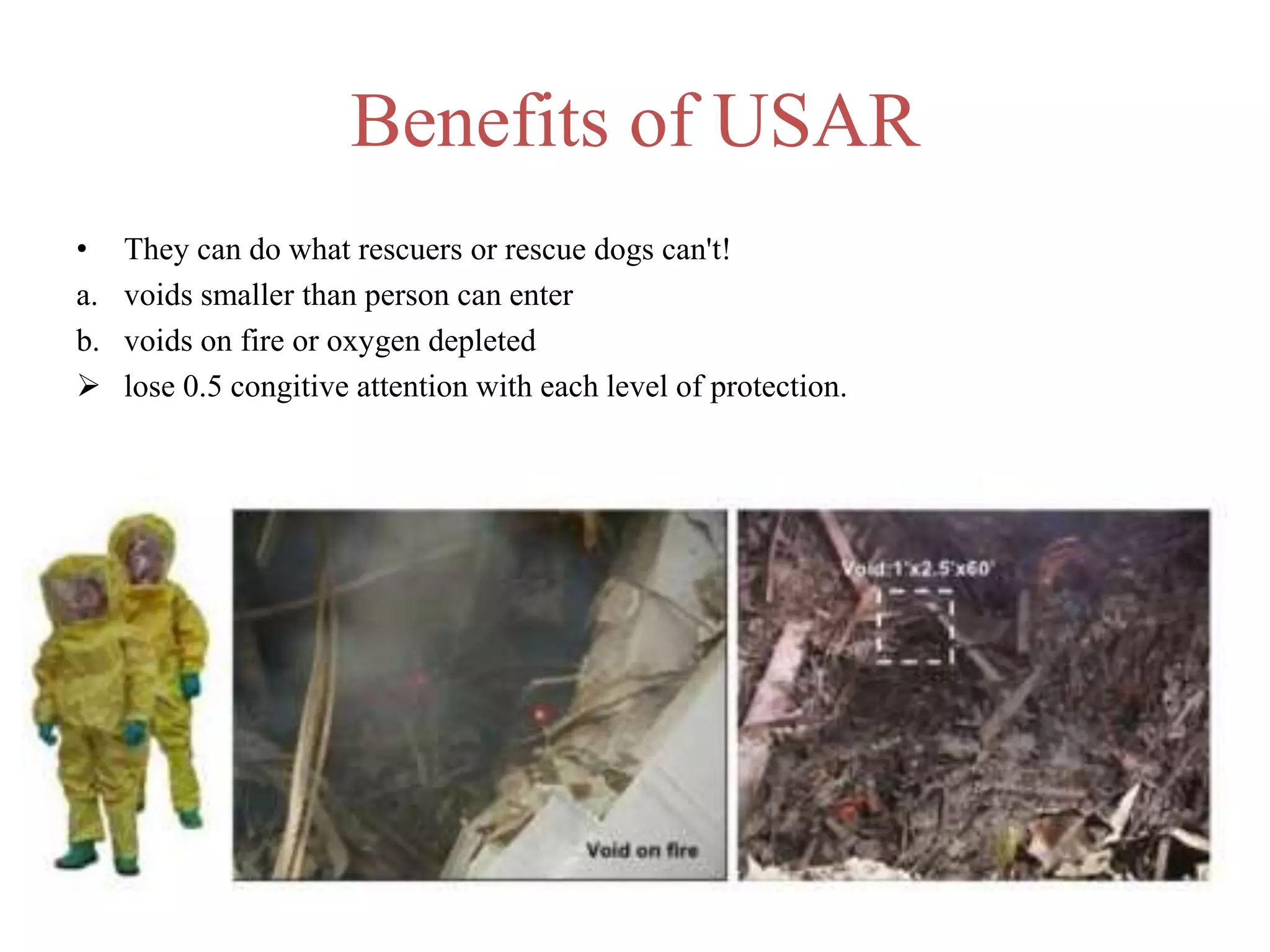
Benefits of USAR
• They can do what rescuers or rescue dogs can't!
a. voids smaller than person can enter
b. voids on fire or oxygen depleted
 lose 0.5 congitive attention with each level of protection.
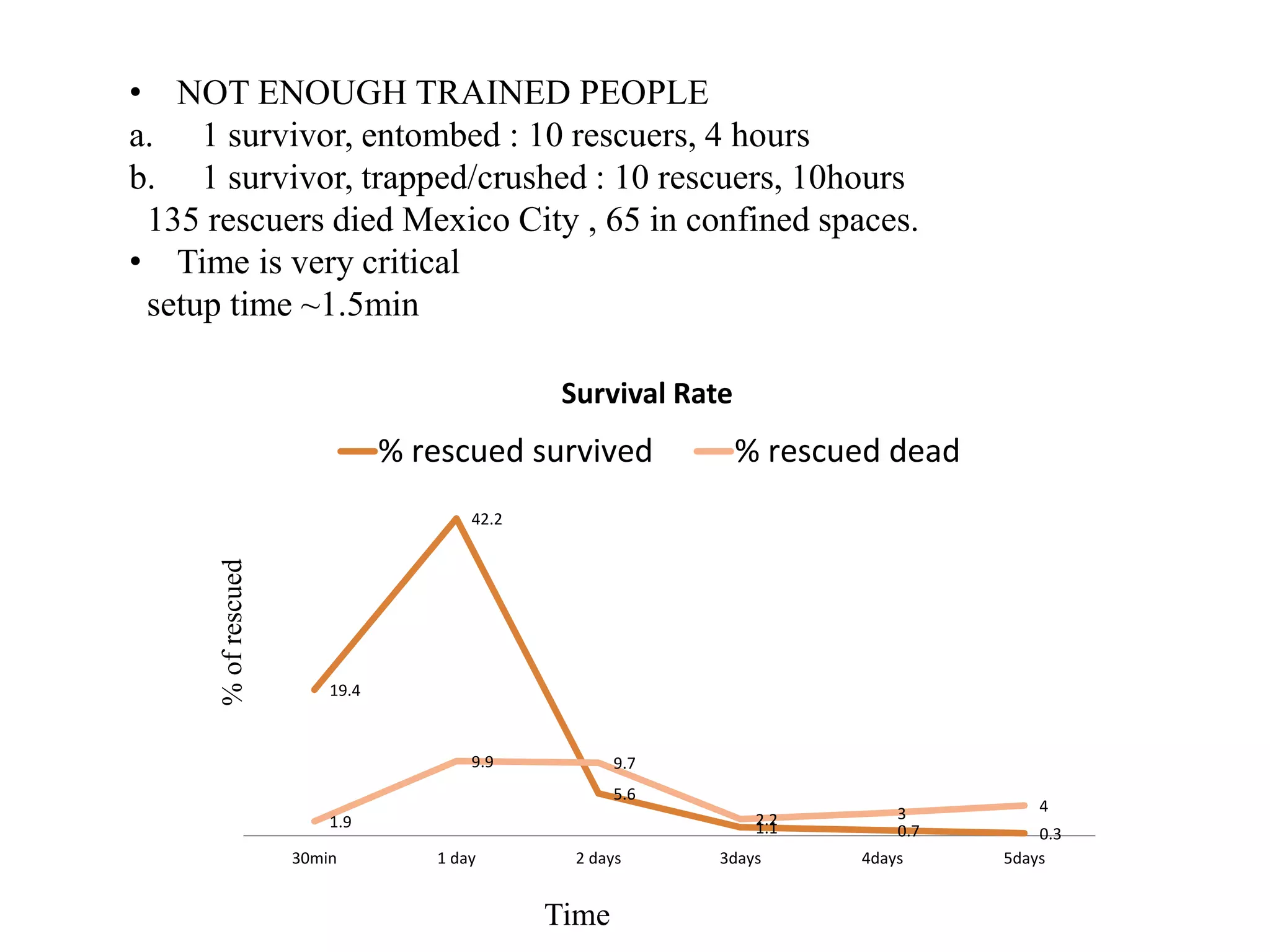
19.4
42.2
5.6
1.1 0.7 0.3
1.9
9.9 9.7
2.2 3 4
30min 1 day 2 days 3days 4days 5days
Survival Rate
% rescued survived % rescued dead
%ofrescued
• NOT ENOUGH TRAINED PEOPLE
a. 1 survivor, entombed : 10 rescuers, 4 hours
b. 1 survivor, trapped/crushed : 10 rescuers, 10hours
135 rescuers died Mexico City , 65 in confined spaces.
• Time is very critical
setup time ~1.5min
Time
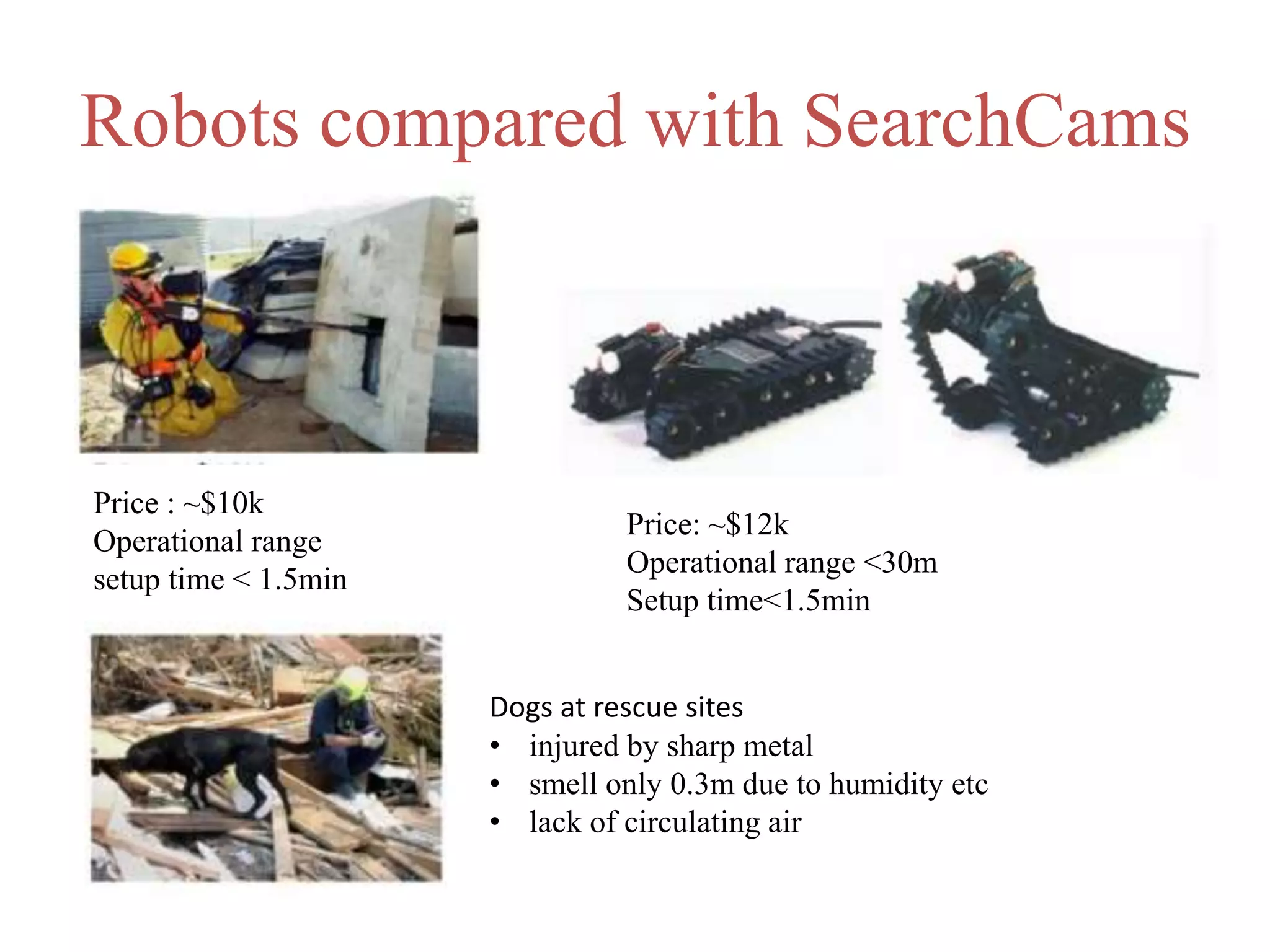
Robots compared with SearchCams
Price : ~$10k
Operational range
setup time < 1.5min
Dogs at rescue sites
• injured by sharp metal
• smell only 0.3m due to humidity etc
• lack of circulating air
Price: ~$12k
Operational range <30m
Setup time<1.5min
ll.ModuleDescription
ARM 7
MIRCO-
CONTROLLER
32-bit
Gas
sensor
(MQ7)
PIR
Sensor
Temp.
sensor
(LM35)
IR sensor
2 DC
MOTOR
DRIVER
4 DC
MOTOR
DRIVER
RF MODEM
Relay
Driver
(RESET)
lamp
To detect obstacles
To detect
leakage of
harmful
gases
To detect
live human
To detect
fire
Data
transmission
To drive robot
To throw light
insideMetal Sensor
To detect
metal pipe
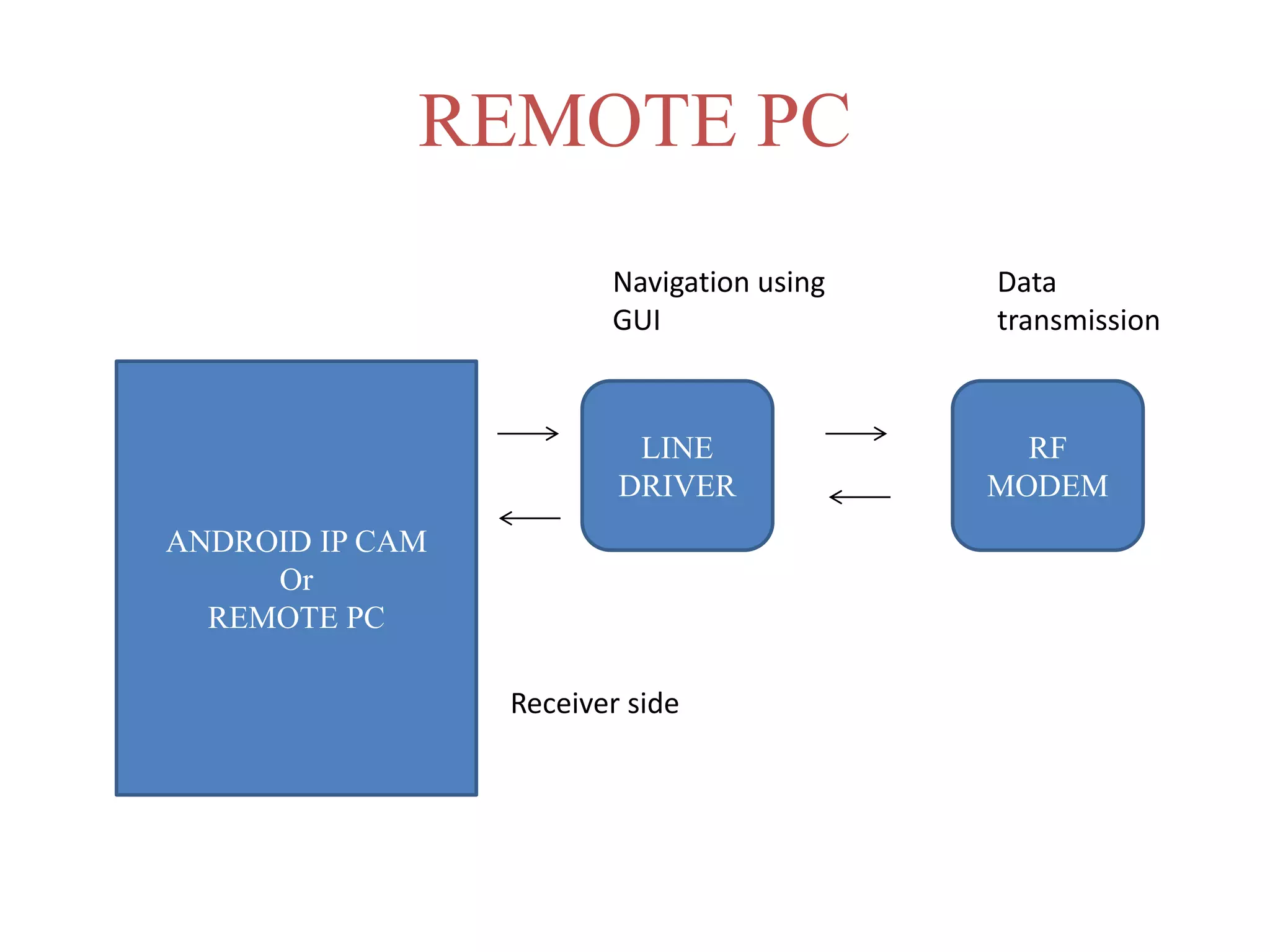
REMOTE PC
ANDROID IP CAM
Or
REMOTE PC
LINE
DRIVER
RF
MODEM
Receiver side
Navigation using
GUI
Data
transmission
III. Methodology
OUR
SYSTEM
(ROBO)
Remote pc
Receiver and transmitter
ALIVE HUMAN DETECTED
Searching
ACKNOWLEDGEMENT
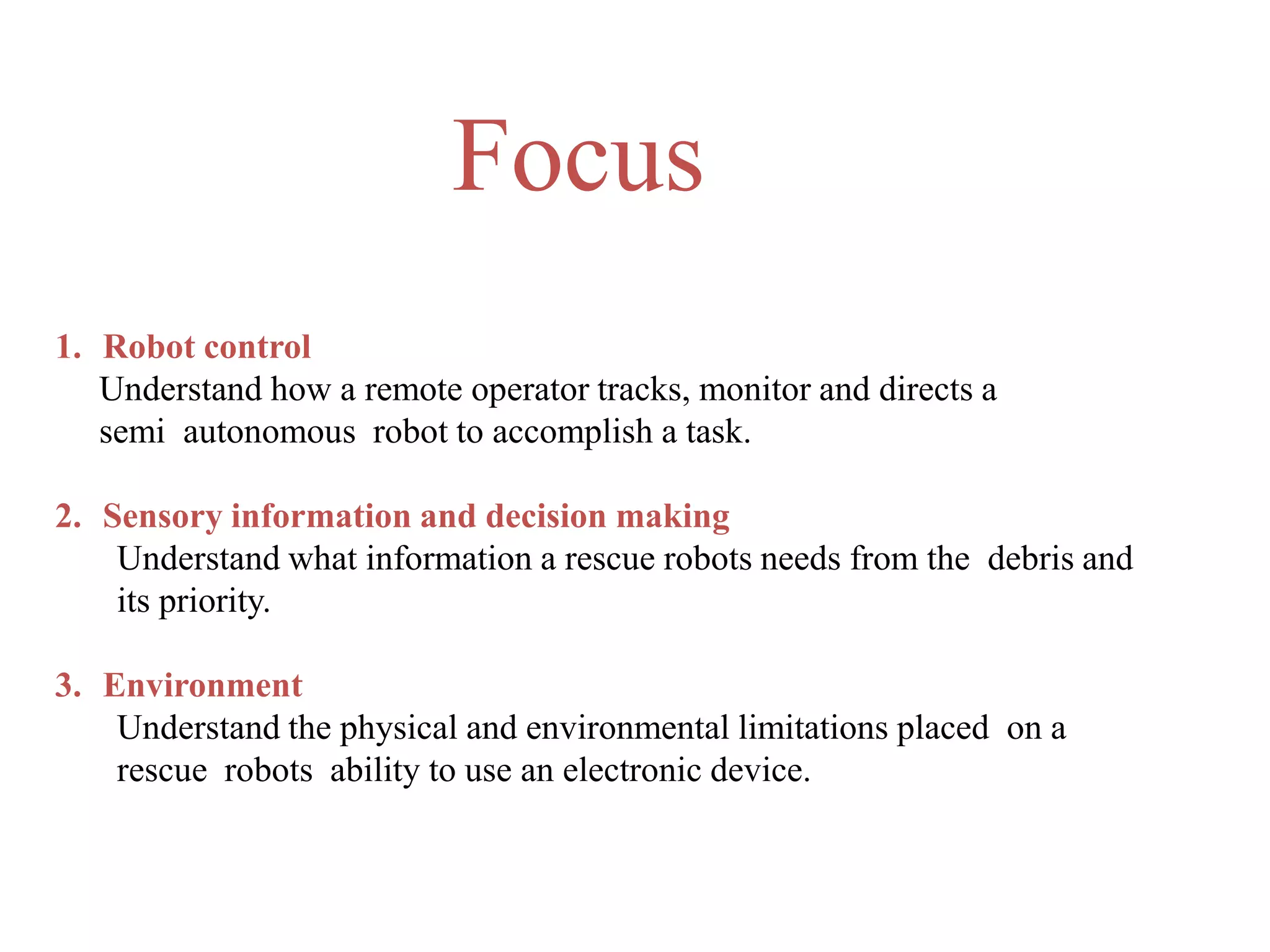
1. Robot control
Understand how a remote operator tracks, monitor and directs a
semi autonomous robot to accomplish a task.
2. Sensory information and decision making
Understand what information a rescue robots needs from the debris and
its priority.
3. Environment
Understand the physical and environmental limitations placed on a
rescue robots ability to use an electronic device.
Focus
IV. Our Contribution
• We have incorporated a camera module that captures
the location and condition of alive human body.
Hence enhanced monitoring.
• Reliability of our robot is enhanced by integrating 5
sensors in a single robot.
• Control of robot is done by using GUI. Hence easy
controllability.
V. Conclusion
• The unmanned robot is designed that efficiently using
ARM based controller to give maximum out of it.
• Sensors provide details which help unskilled
operators for easy understability.
• Increase in Survival rate after the use of such robots.
Being more helpful to mankind.
VI. References
• T. B. Bhondve, P. R. Satyanarayan, and P. M. Mukhedkar, “Mobile Rescue
Robot for Human Body Detection in Rescue Operation of Disaster,” Int. J.
Adv. Res. Electr. Electron. Instrum. Eng., vol. 3, no. 6, pp. 9876–9882,
2014.
• R. Joshi, P. C. Poudel, and P. Bhandari, “An Embedded Autonomous
Robotic System for Alive Human Body Detection and Rescue Operation,”
Int. J. Sci. Res. Publ., vol. 4, no. 5, pp. 1–4, 2014.
• S. Chakkath, S. Hariharansiddharath, and B. Hemalatha, “Mobile Robot in
Coal Mine Disaster Surveillance,” J. Eng., vol. 2, no. 10, pp. 77–82, 2012.
QUESTIONS ?
THANKYOU !!

rescue robot based on embedded and ROV

  • 1.
    RESCUE ROBOT Siddharth Bhatt KratikaNagar Jyoti Shinde N.B.Hulle PRESENTATION ON
  • 2.
    CONTENTS I. Introduction II. ModuleDescription III. Methodology IV.Our Contribution V. Conclusion VI.References
  • 3.
    I. INTRODUCTION • Thebasic aim is to design a cost effective Robot to work effortlessly in critical circumstances. • The goal of the RESCUE ROBOT basically a USAR(URBAN SEARCH AND RESCUE) is to search the traces of the alive human body where people are not able to reach. • The important objective that are associated in using of Robotic system in Rescue operation are: 1) Saving of manpower. 2) Improve the accuracy. 3) Ability to work in a hazardous environment.
  • 4.
    • There isa 3D LAW which is followed by USAR robot. where 3D’s are : a. DIRTY b. DANGEROUS c. DULL TASKS They can do what rescuers and rescue dogs do it. EXAMPLE of USAR is DRDO DAKSH: • Daksh is a battery-operated remote-controlled robot on wheels and its primary role is to recover bombs. • It can climb staircases, negotiate steep slopes, navigate narrow corridors and tow vehicles to reach hazardous materials. • Using its robotized arm, it can lift a suspect object and scan it using its portable X-Ray device. • If the object is a bomb, Daksh can defuse it with its water jet disrupter. It has a shotgun, which can break open locked doors, and it can scan cars for explosives.
  • 5.
    DAKSH IMPROVISATION • Thenewer version of Daksh is made of aluminum alloy as against the older version. • The use of new material has not just reduced the weight but has also made it more rugged. • To improve speed the new Daksh has used custom-made motors that can increased the speed by three times. • The new Daksh has been integrated with DRDO’s Unmanned Areal Vehicle (UAV) Netra, and the integrated system is being called CBRN Remotely Operated Platform (ROP). • In case of a radiation hazard, the radiation detection unit fitted on Netra can be flown to the affected area. Netra model being used for this platform has an increased range of four kilometers and double the flying time. • This system will not just be useful for the armed forces, but also the paramilitary forces operating in areas where the nature of conflict is different. There will be demand for this version of Daksh from the different security agencies. • The Faster, lighter version of the ROV along with added advantage also has enhanced capabilities that will be certainly useful in the backdrop of changing nature of warfare in insurgency affected areas, especially with increased threat of dirty bombs, which use radioactive material.
  • 6.
    Benefits of USAR •They can do what rescuers or rescue dogs can't! a. voids smaller than person can enter b. voids on fire or oxygen depleted  lose 0.5 congitive attention with each level of protection.
  • 7.
    19.4 42.2 5.6 1.1 0.7 0.3 1.9 9.99.7 2.2 3 4 30min 1 day 2 days 3days 4days 5days Survival Rate % rescued survived % rescued dead %ofrescued • NOT ENOUGH TRAINED PEOPLE a. 1 survivor, entombed : 10 rescuers, 4 hours b. 1 survivor, trapped/crushed : 10 rescuers, 10hours 135 rescuers died Mexico City , 65 in confined spaces. • Time is very critical setup time ~1.5min Time
  • 8.
    Robots compared withSearchCams Price : ~$10k Operational range setup time < 1.5min Dogs at rescue sites • injured by sharp metal • smell only 0.3m due to humidity etc • lack of circulating air Price: ~$12k Operational range <30m Setup time<1.5min
  • 9.
    ll.ModuleDescription ARM 7 MIRCO- CONTROLLER 32-bit Gas sensor (MQ7) PIR Sensor Temp. sensor (LM35) IR sensor 2DC MOTOR DRIVER 4 DC MOTOR DRIVER RF MODEM Relay Driver (RESET) lamp To detect obstacles To detect leakage of harmful gases To detect live human To detect fire Data transmission To drive robot To throw light insideMetal Sensor To detect metal pipe
  • 10.
    REMOTE PC ANDROID IPCAM Or REMOTE PC LINE DRIVER RF MODEM Receiver side Navigation using GUI Data transmission
  • 11.
    III. Methodology OUR SYSTEM (ROBO) Remote pc Receiverand transmitter ALIVE HUMAN DETECTED Searching ACKNOWLEDGEMENT
  • 12.
    1. Robot control Understandhow a remote operator tracks, monitor and directs a semi autonomous robot to accomplish a task. 2. Sensory information and decision making Understand what information a rescue robots needs from the debris and its priority. 3. Environment Understand the physical and environmental limitations placed on a rescue robots ability to use an electronic device. Focus
  • 13.
    IV. Our Contribution •We have incorporated a camera module that captures the location and condition of alive human body. Hence enhanced monitoring. • Reliability of our robot is enhanced by integrating 5 sensors in a single robot. • Control of robot is done by using GUI. Hence easy controllability.
  • 14.
    V. Conclusion • Theunmanned robot is designed that efficiently using ARM based controller to give maximum out of it. • Sensors provide details which help unskilled operators for easy understability. • Increase in Survival rate after the use of such robots. Being more helpful to mankind.
  • 15.
    VI. References • T.B. Bhondve, P. R. Satyanarayan, and P. M. Mukhedkar, “Mobile Rescue Robot for Human Body Detection in Rescue Operation of Disaster,” Int. J. Adv. Res. Electr. Electron. Instrum. Eng., vol. 3, no. 6, pp. 9876–9882, 2014. • R. Joshi, P. C. Poudel, and P. Bhandari, “An Embedded Autonomous Robotic System for Alive Human Body Detection and Rescue Operation,” Int. J. Sci. Res. Publ., vol. 4, no. 5, pp. 1–4, 2014. • S. Chakkath, S. Hariharansiddharath, and B. Hemalatha, “Mobile Robot in Coal Mine Disaster Surveillance,” J. Eng., vol. 2, no. 10, pp. 77–82, 2012.
  • 16.
  • 17.