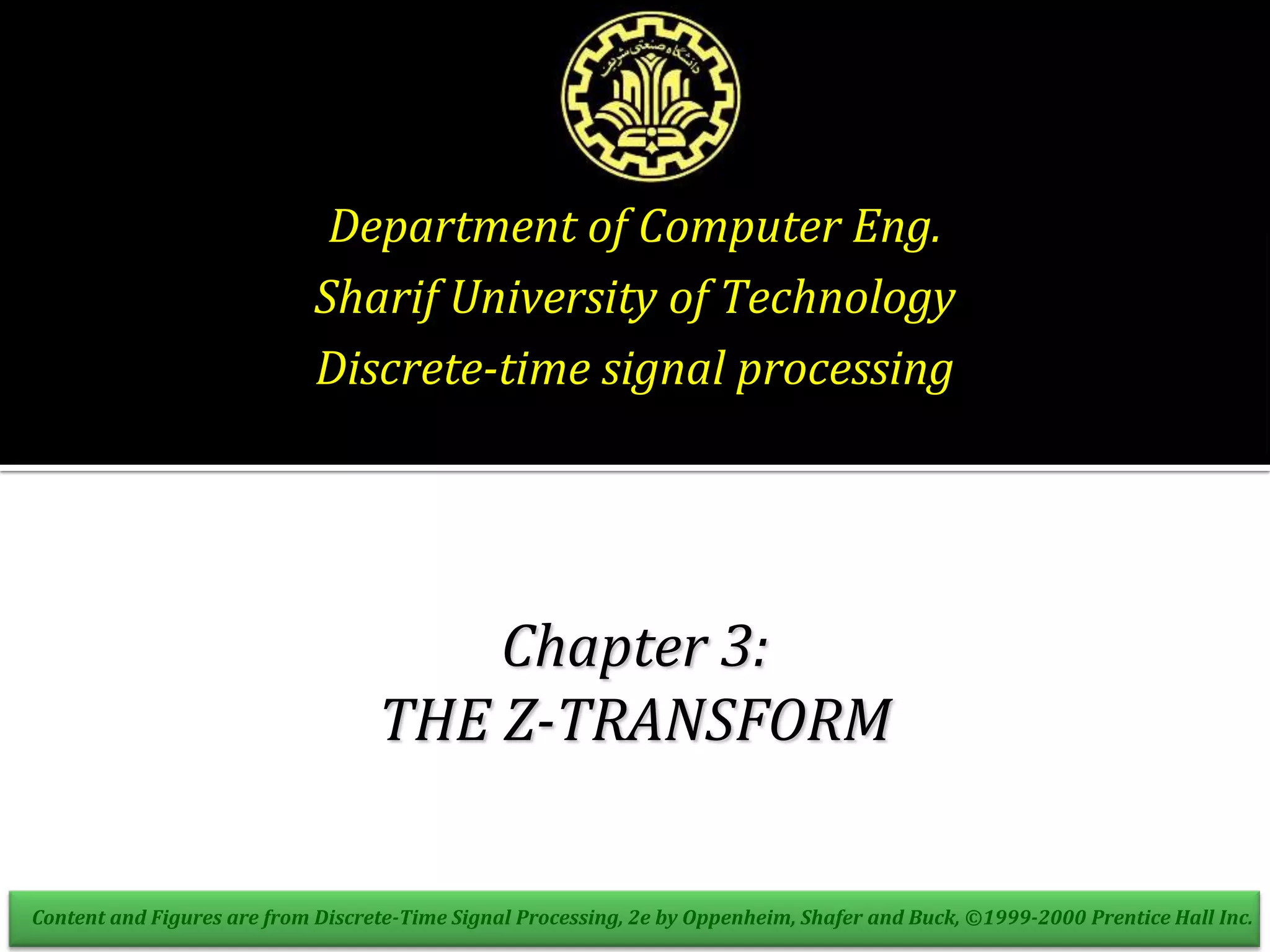
Department of Computer Eng.
Sharif University of Technology
Discrete-time signal processing
Chapter 3:
THE Z-TRANSFORM
Content and Figures are from Discrete-Time Signal Processing, 2e by Oppenheim, Shafer and Buck, ©1999-2000 Prentice Hall Inc.
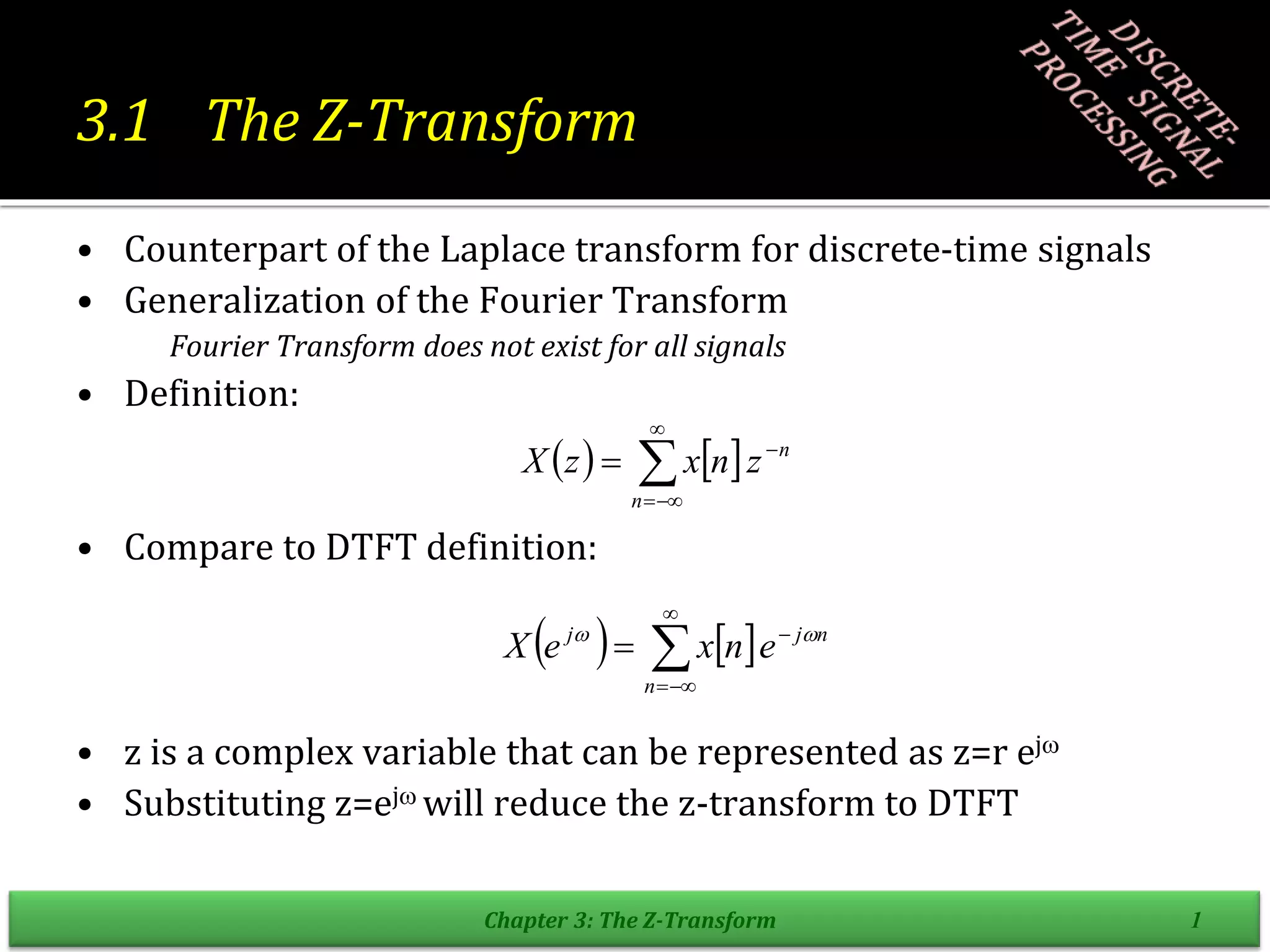
3.1 The Z-Transform
• Counterpart of the Laplace transform for discrete-time signals
• Generalization of the Fourier Transform
Fourier Transform does not exist for all signals
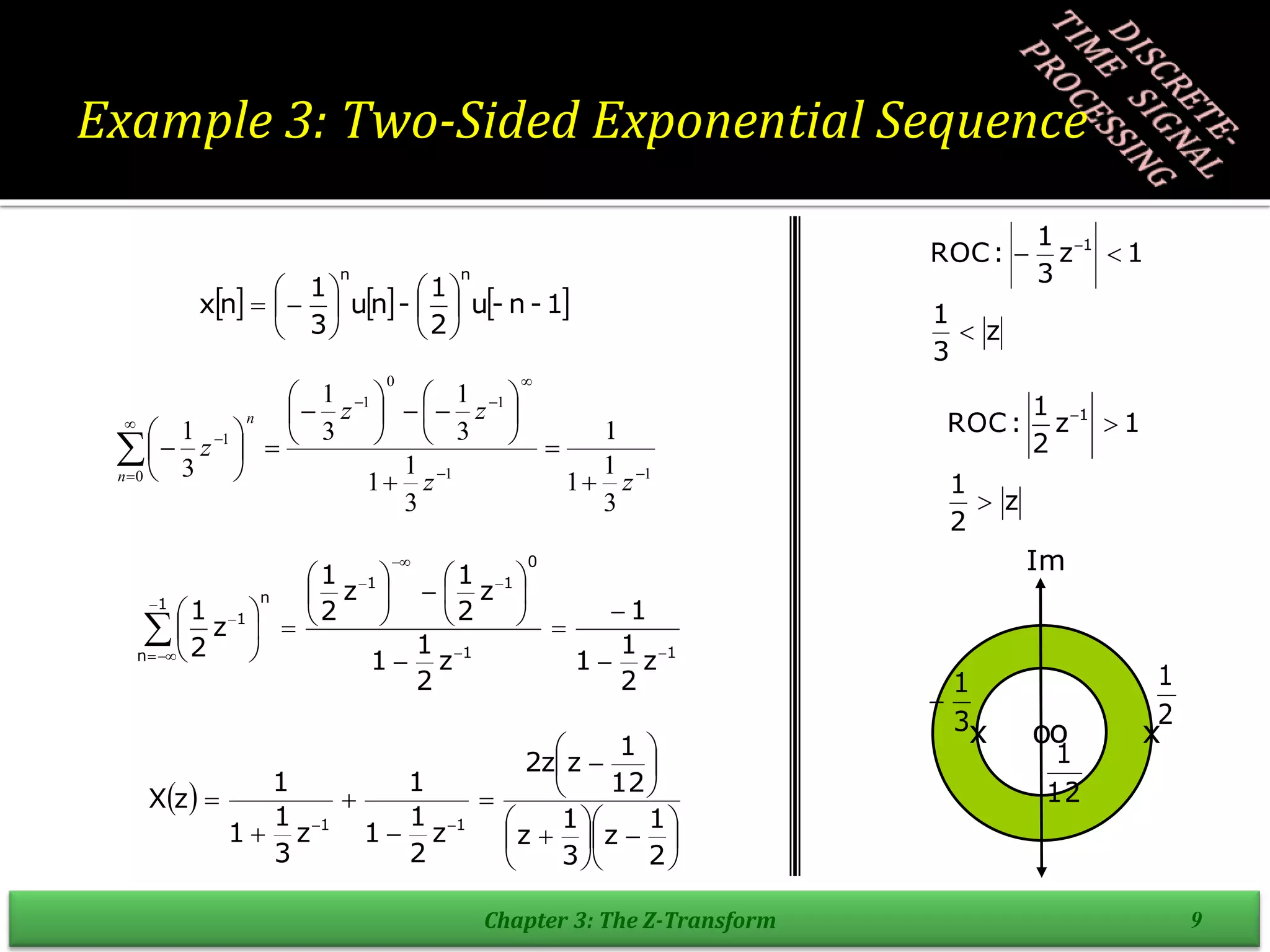
• Definition:
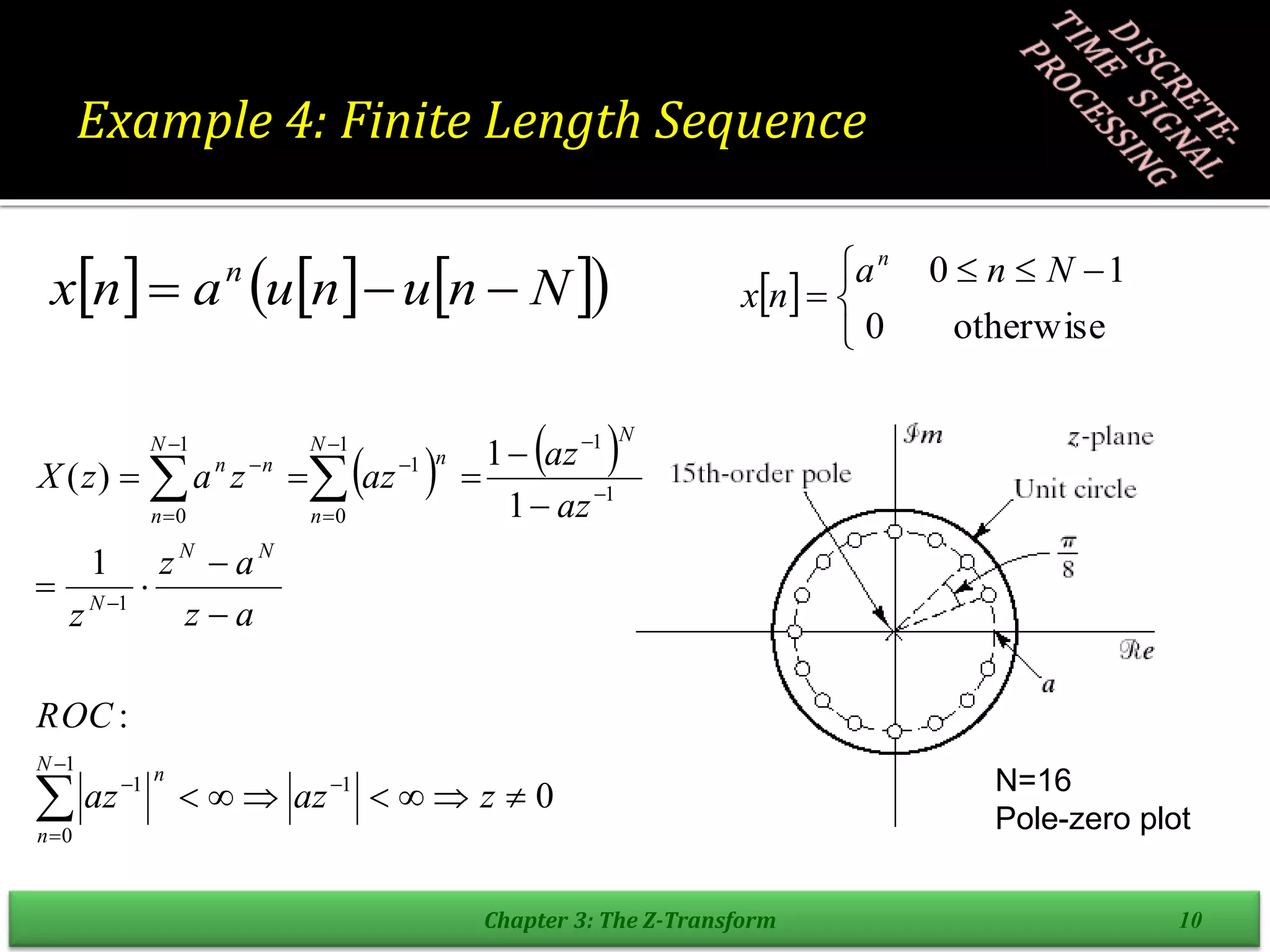
• Compare to DTFT definition:
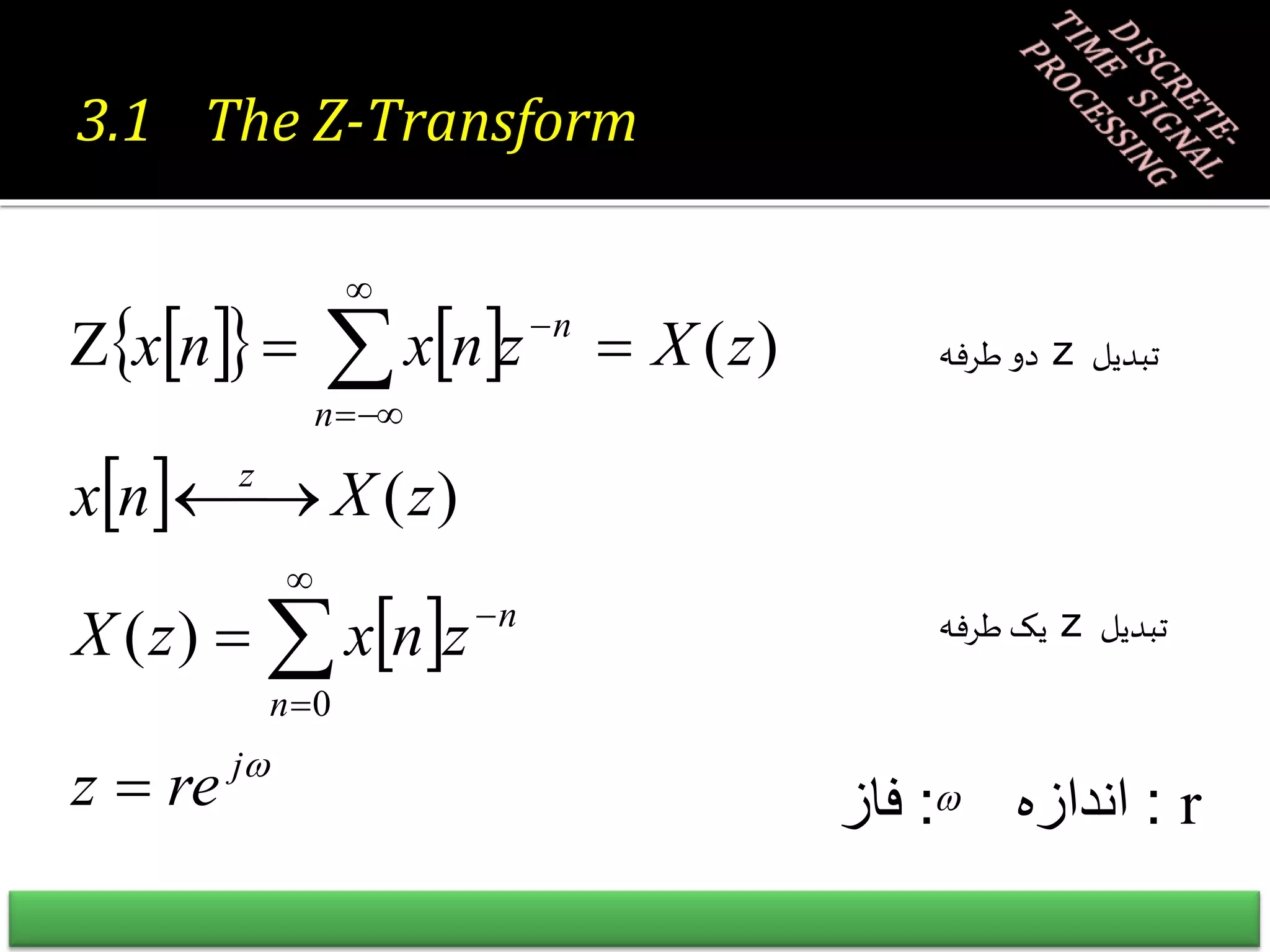
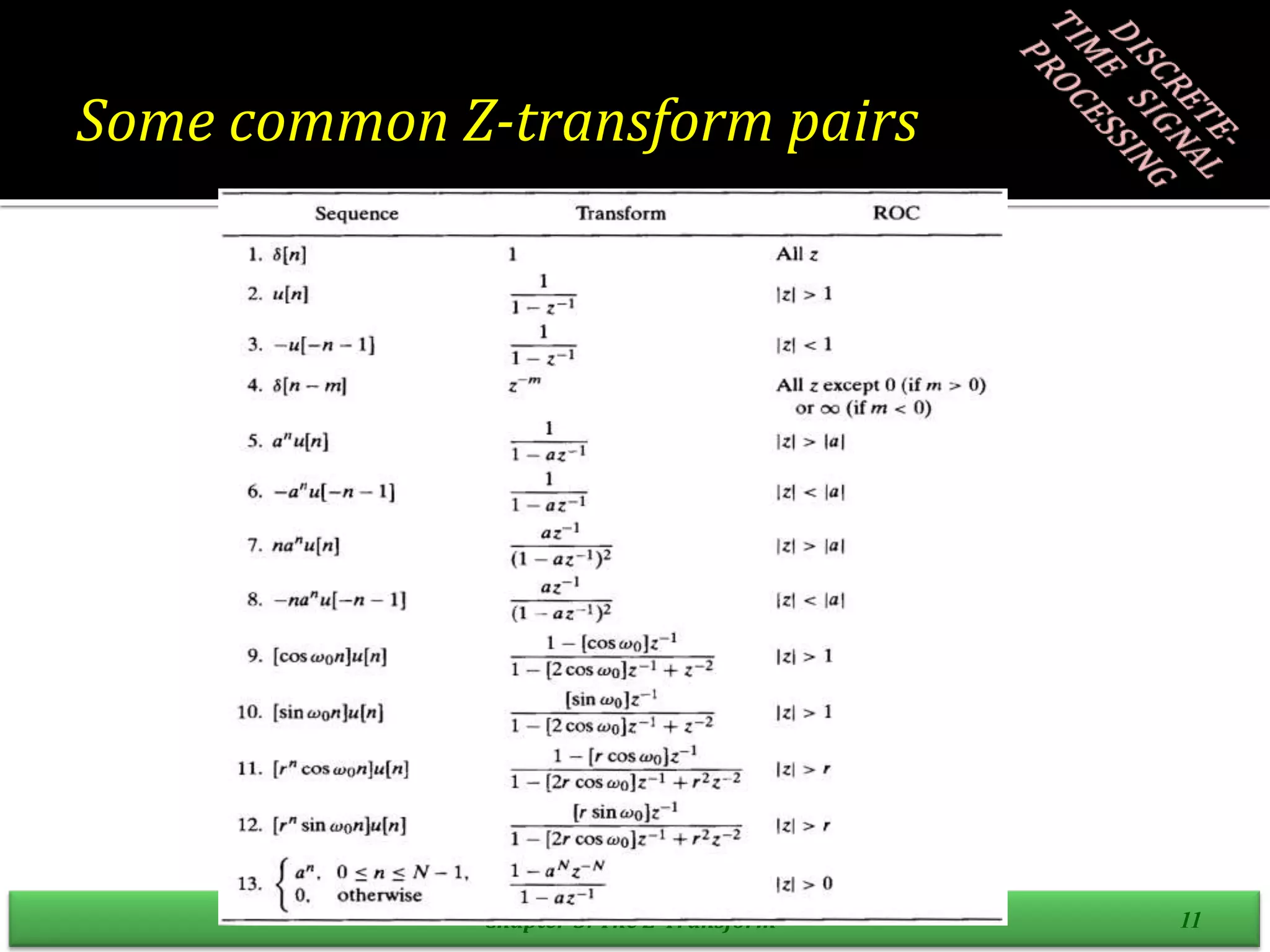
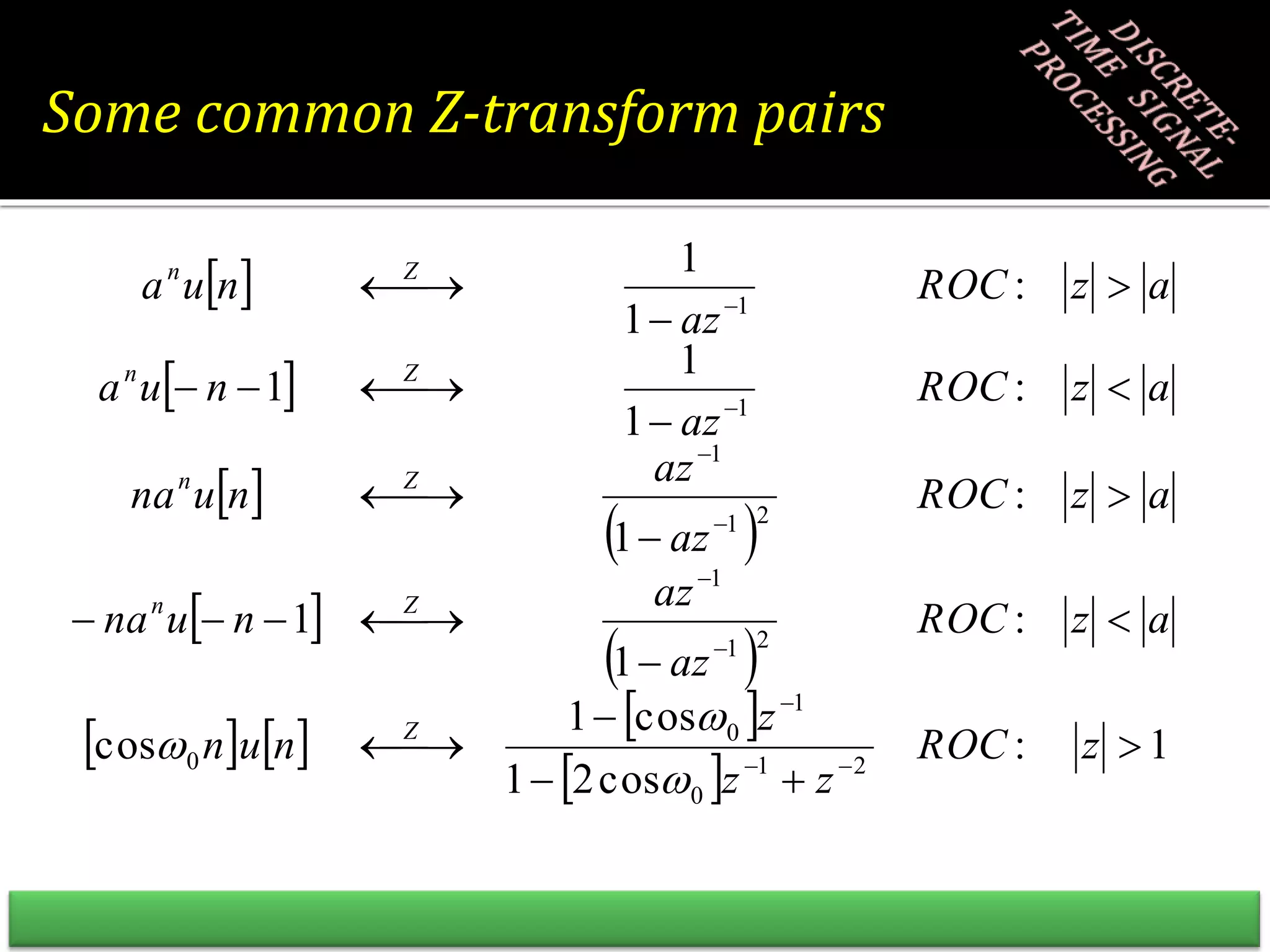
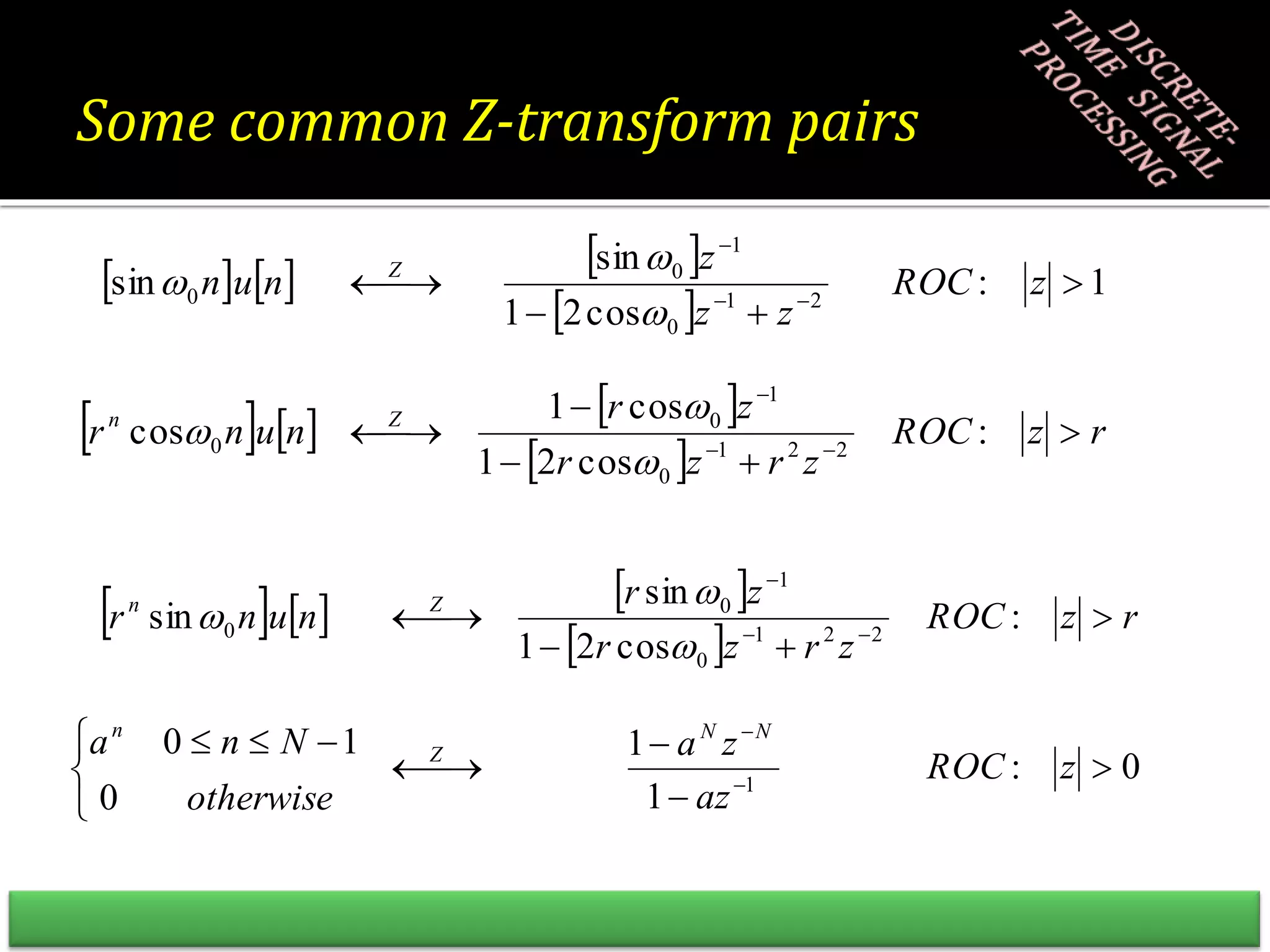
• z is a complex variable that can be represented as z=r ej
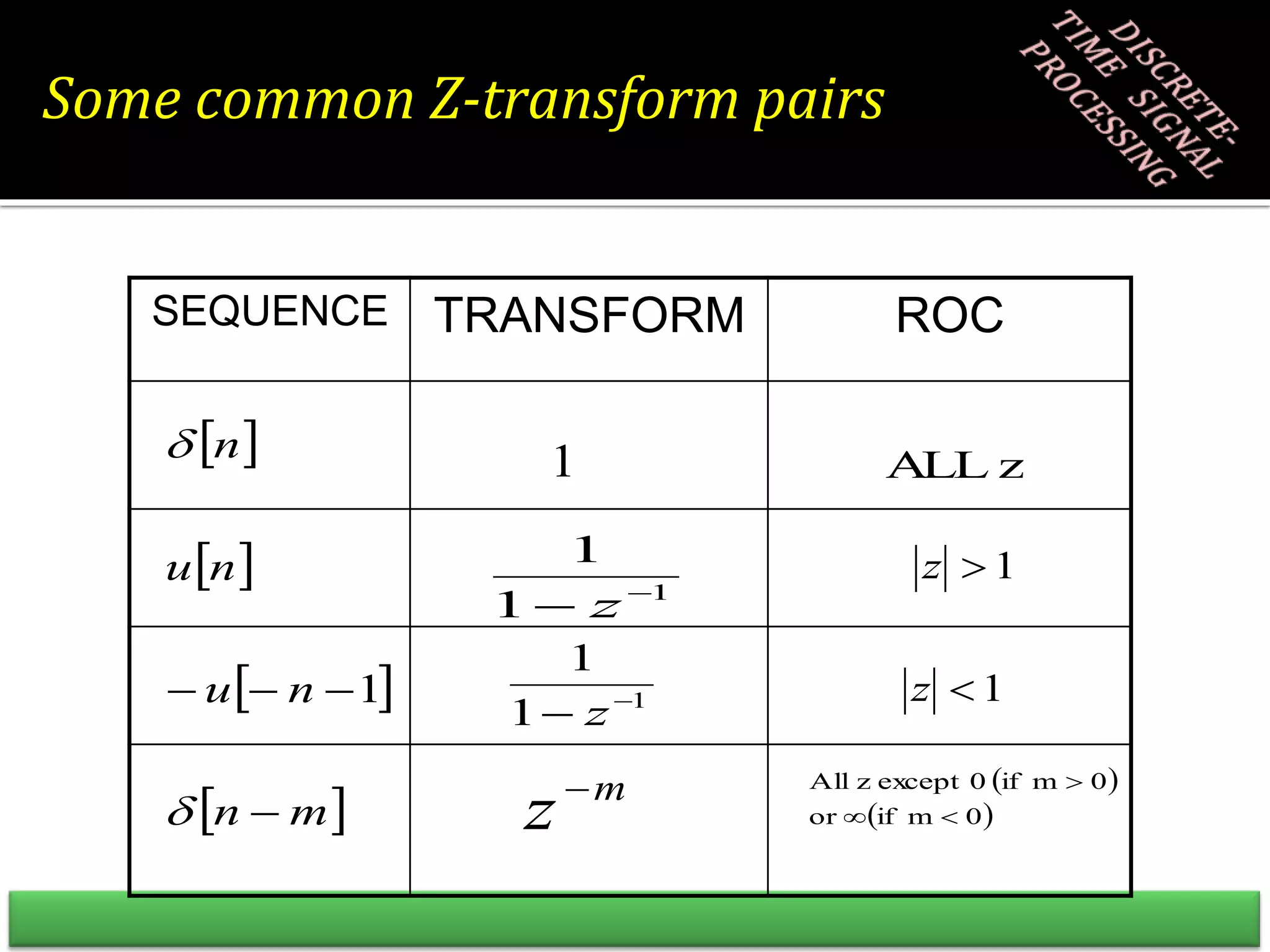
• Substituting z=ej will reduce the z-transform to DTFT
Chapter 3: The Z-Transform 1
   






n
n
z
n
x
z
X
    n
j
n
j
e
n
x
e
X 
 





 
   
 
 

j
n
n
z
n
n
re
z
z
n
x
z
X
z
X
n
x
z
X
z
n
x
n
x
















0
)
(
)
(
)
(
r
:
‫اندازه‬
:
‫فاز‬ 
‫تبدیل‬
z
‫طرفه‬‫یک‬
‫تبدیل‬
z
‫طرفه‬‫دو‬
3.1 The Z-Transform
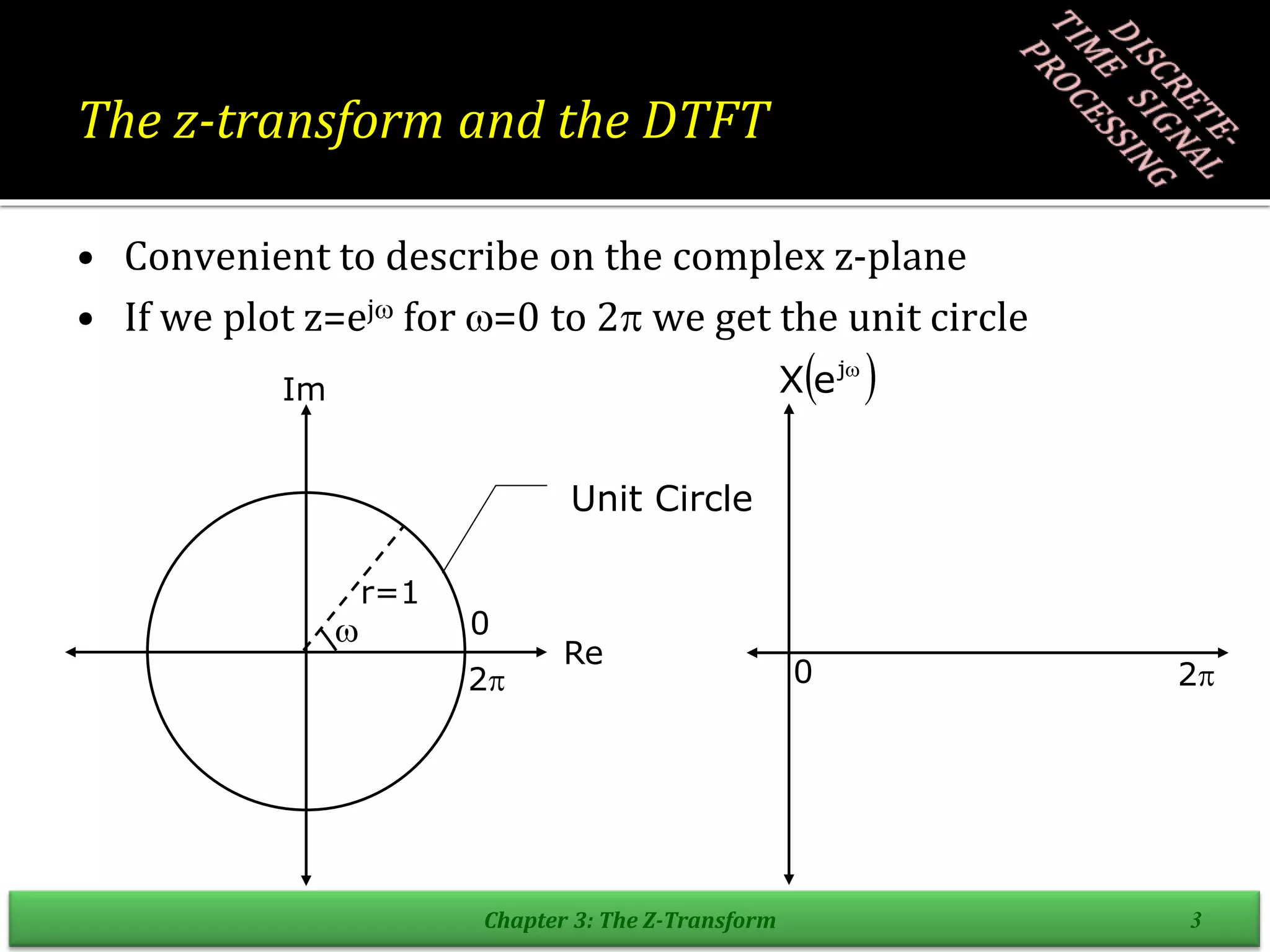
The z-transform and the DTFT
• Convenient to describe on the complex z-plane
• If we plot z=ej for =0 to 2 we get the unit circle
Chapter 3: The Z-Transform 3
Re
Im
Unit Circle

r=1
0
2 0 2
 

j
e
X
Convergence of the z-Transform
• DTFT does not always converge
Example: x[n] = anu[n] for |a|>1 does not have a DTFT
• Complex variable z can be written as r ej so the z-
transform
convert to the DTFT of x[n] multiplied with exponential
sequence r –n
• For certain choices of r the sum
maybe made finite
Chapter 3: The Z-Transform 4
      
 














n
n
j
n
n
n
j
j
e
n
x
e
n
x
re
X 


r
r
    n
j
n
j
e
n
x
e
X 
 





  





n
n
x r n
-
Region of Convergence (ROC)
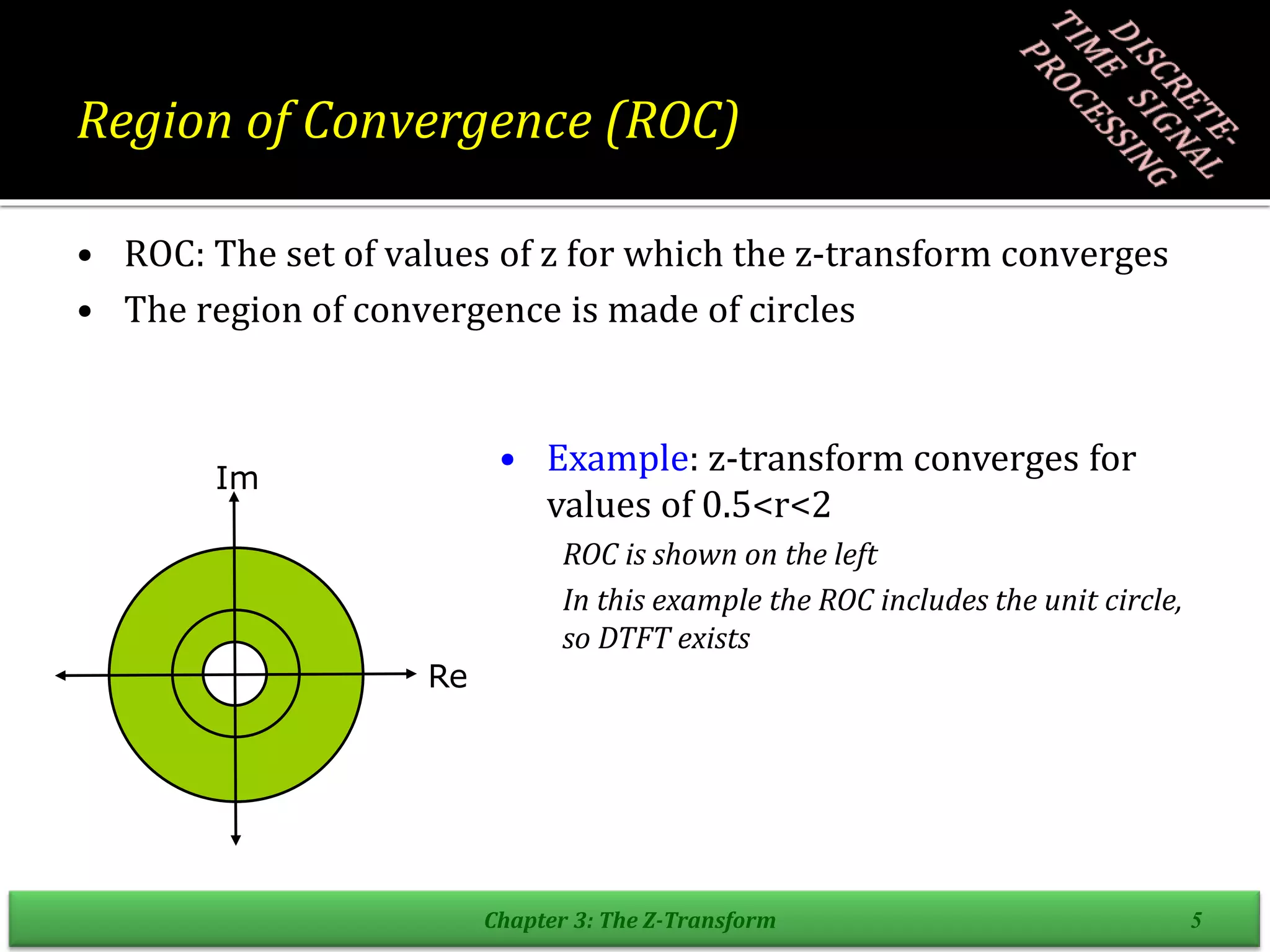
• ROC: The set of values of z for which the z-transform converges
• The region of convergence is made of circles
Chapter 3: The Z-Transform 5
Re
Im
• Example: z-transform converges for
values of 0.5<r<2
ROC is shown on the left
In this example the ROC includes the unit circle,
so DTFT exists
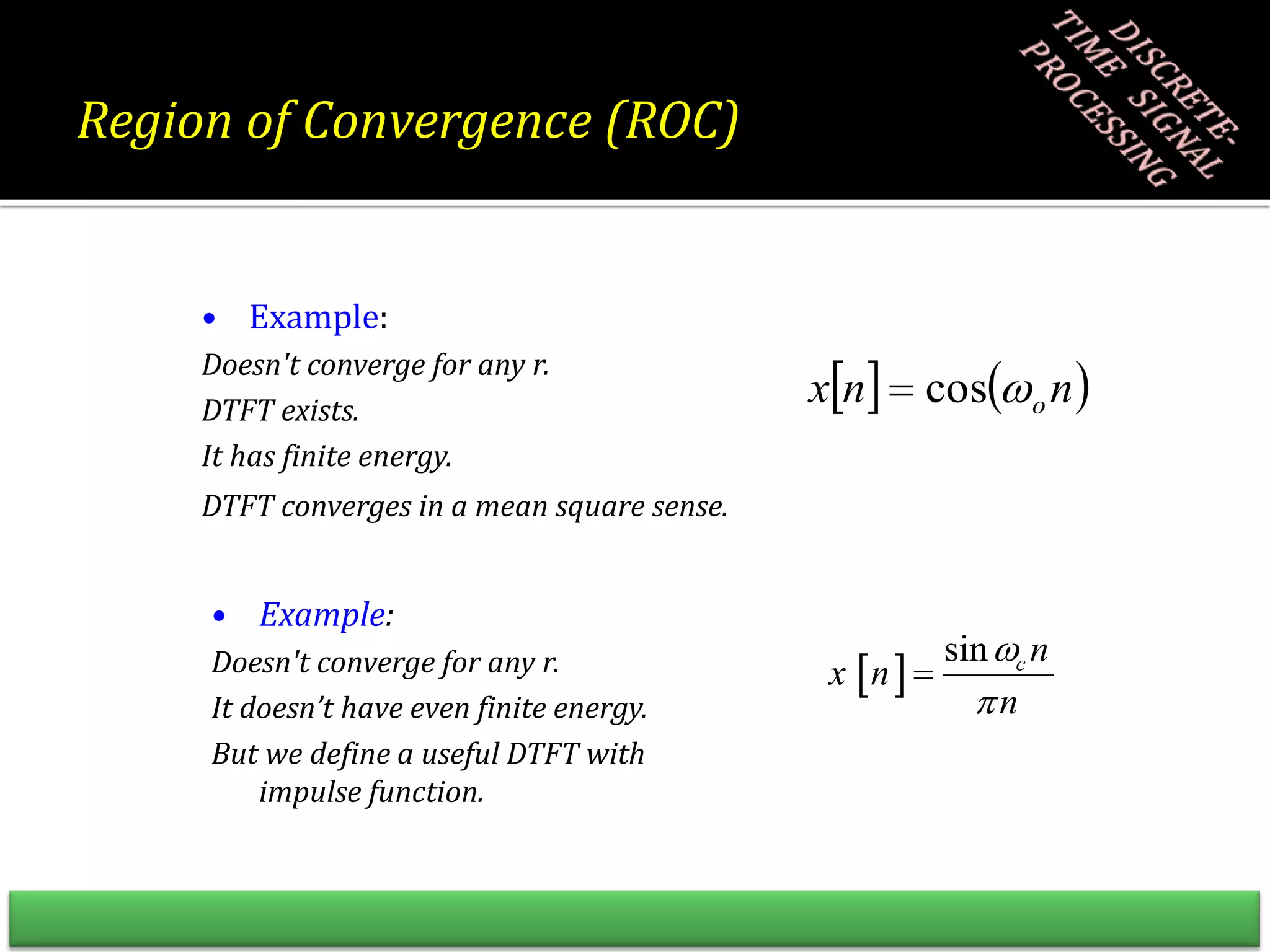
• Example:
Doesn't converge for any r.
DTFT exists.
It has finite energy.
DTFT converges in a mean square sense.
• Example:
Doesn't converge for any r.
It doesn’t have even finite energy.
But we define a useful DTFT with
impulse function.
   
n
n
x o

cos

 
sin c n
x n
n



Region of Convergence (ROC)
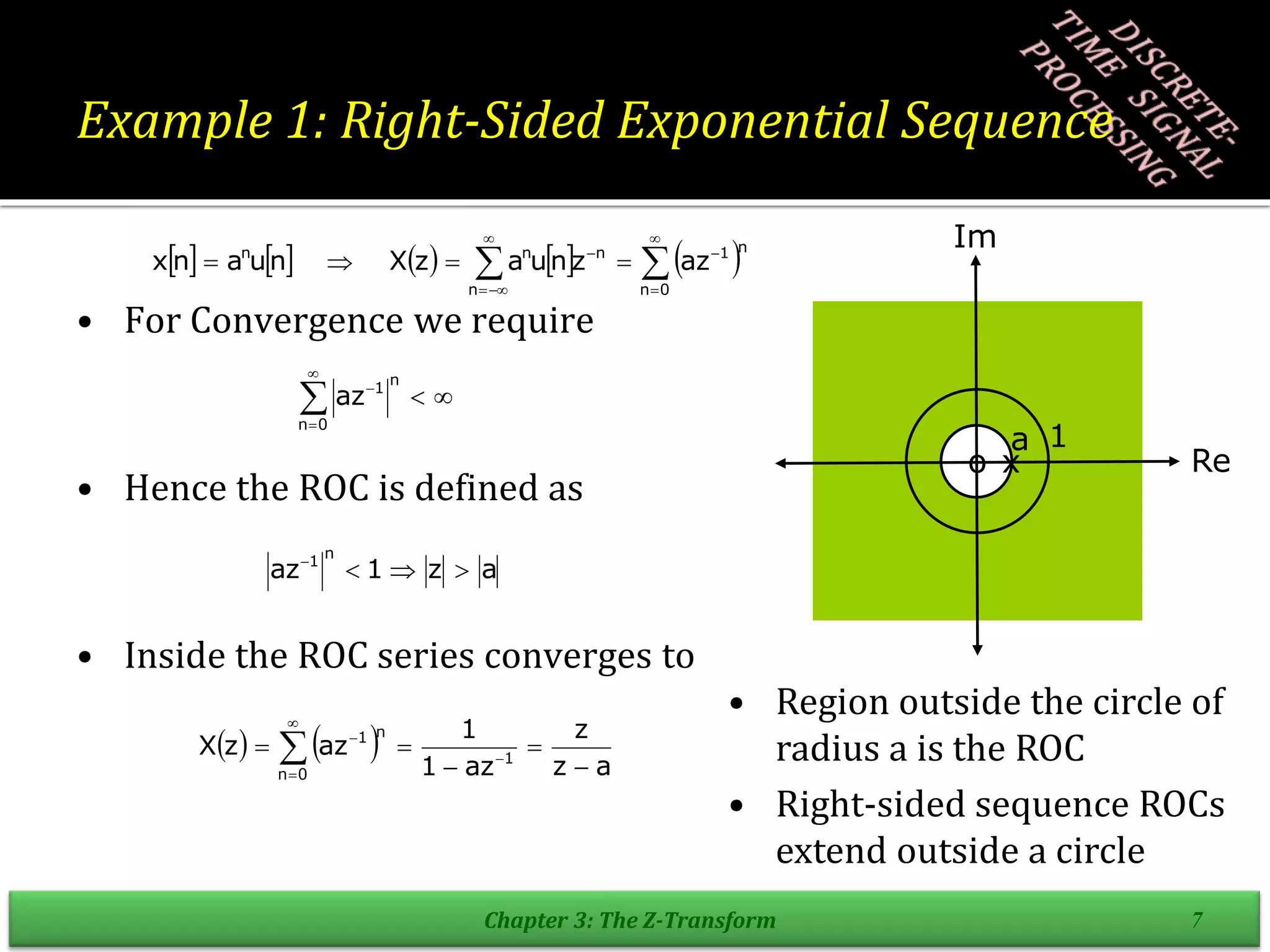
Example 1: Right-Sided Exponential Sequence
• For Convergence we require
• Hence the ROC is defined as
• Inside the ROC series converges to
Chapter 3: The Z-Transform 7
         













0
n
n
1
n
n
n
n
az
z
n
u
a
z
X
n
u
a
n
x






0
n
n
1
az
a
z
1
az
n
1




    a
z
z
az
1
1
az
z
X
0
n
1
n
1




 




Re
Im
a 1
o x
• Region outside the circle of
radius a is the ROC
• Right-sided sequence ROCs
extend outside a circle
(
‫ا‬‫ر‬‫چپگ‬‫دنباله‬
)
   
   
 
a
z
z
az
z
a
z
X
a
z
z
a
z
a
ROC
z
a
z
a
z
a
z
n
u
a
z
X
n
n
n n
n
n
n
n
n
n
n
n












































 


1
1
1
0
1
1 0
1
1
1
1
1
1
1
1
1
:
1
1
   
1



 n
u
a
n
x n
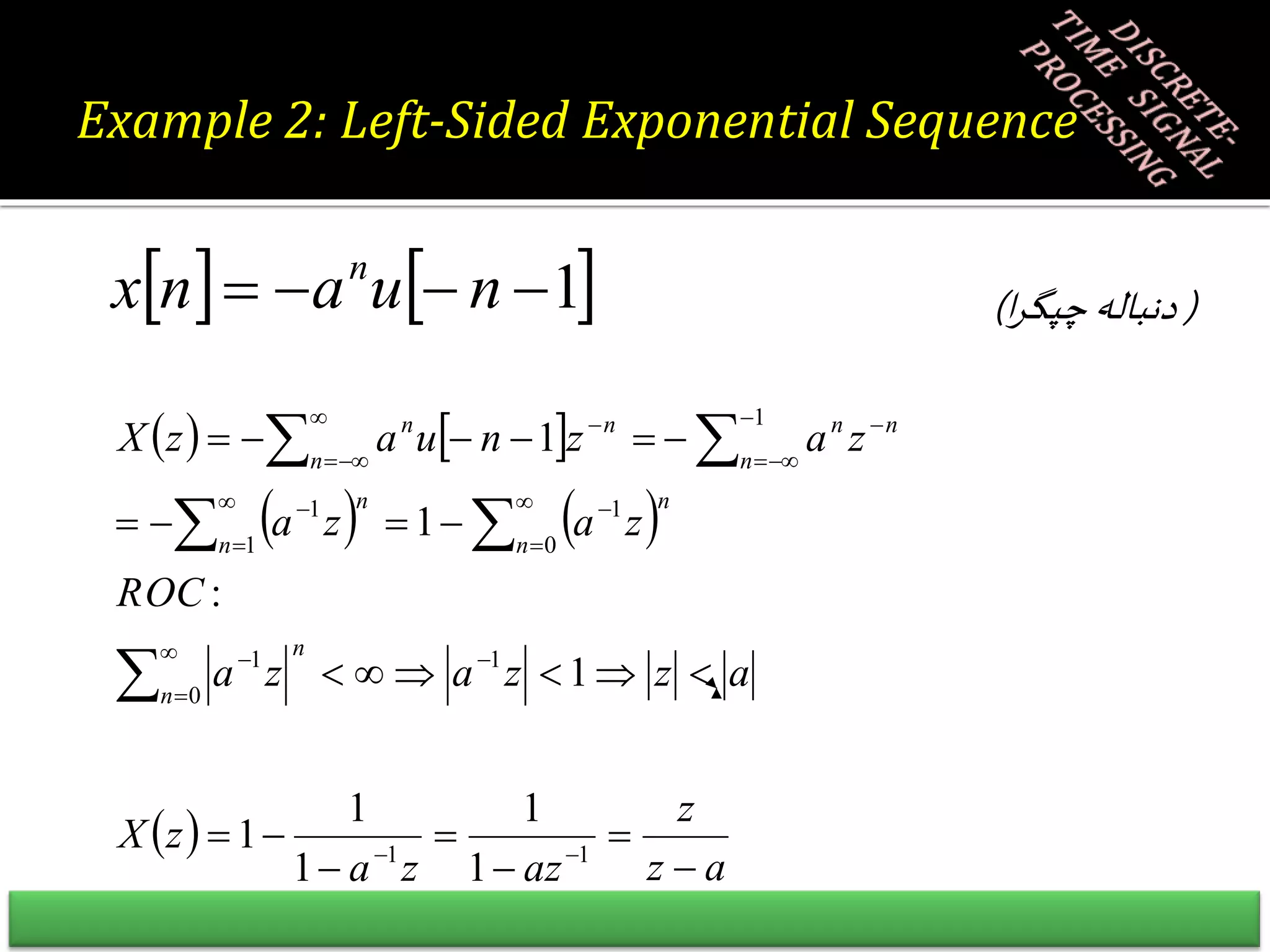
Example 2: Left-Sided Exponential Sequence
Example 3: Two-Sided Exponential Sequence
Chapter 3: The Z-Transform 9
     
1
-
n
-
u
2
1
-
n
u
3
1
n
x
n
n














1
1
1
0
1
0
1
3
1
1
1
3
1
1
3
1
3
1
3
1



































z
z
z
z
z
n
n
1
1
0
1
1
1
n
n
1
z
2
1
1
1
z
2
1
1
z
2
1
z
2
1
z
2
1


































z
3
1
1
z
3
1
:
ROC 1


 
z
2
1
1
z
2
1
:
ROC 1



 




























2
1
z
3
1
z
12
1
z
z
2
z
2
1
1
1
z
3
1
1
1
z
X
1
1
Im
2
1
oo
12
1
x
x
3
1

Example 4: Finite Length Sequence
Chapter 3: The Z-Transform 10
 


 



otherwise
0
1
0 N
n
a
n
x
n
N=16
Pole-zero plot
     
 
N
n
u
n
u
a
n
x n



   
0
:
1
1
1
)
(
1
0
1
1
1
1
1
1
0
1
1
0
































z
az
az
ROC
a
z
a
z
z
az
az
az
z
a
z
X
N
n
n
N
N
N
N
N
n
n
N
n
n
n
Some common Z-transform pairs
Chapter 3: The Z-Transform 11
SEQUENCE TRANSFORM ROC
1

z
 
 
0
m
if
or
0
m
if
0
except
z
All



1

z
1
1
1

 z
1
1
1

 z
m
z
 
 
 
 
m
n
n
u
n
u
n






1
1 z
ALL
Some common Z-transform pairs
 
 
 
 
 
 
     
 
1
:
cos
2
1
cos
1
cos
:
1
1
:
1
:
1
1
1
:
1
1
2
1
0
1
0
0
2
1
1
2
1
1
1
1




































z
ROC
z
z
z
n
u
n
a
z
ROC
az
az
n
u
na
a
z
ROC
az
az
n
u
na
a
z
ROC
az
n
u
a
a
z
ROC
az
n
u
a
Z
Z
n
Z
n
Z
n
Z
n



Some common Z-transform pairs
     
 
0
:
1
1
0
1
0
:
cos
2
1
sin
sin
1
2
2
1
0
1
0
0







 












z
ROC
az
z
a
otherwise
N
n
a
r
z
ROC
z
r
z
r
z
r
n
u
n
r
N
N
Z
n
Z
n



     
 
     
 
r
z
ROC
z
r
z
r
z
r
n
u
n
r
z
ROC
z
z
z
n
u
n
Z
n
Z

















:
cos
2
1
cos
1
cos
1
:
cos
2
1
sin
sin
2
2
1
0
1
0
0
2
1
0
1
0
0






Some common Z-transform pairs
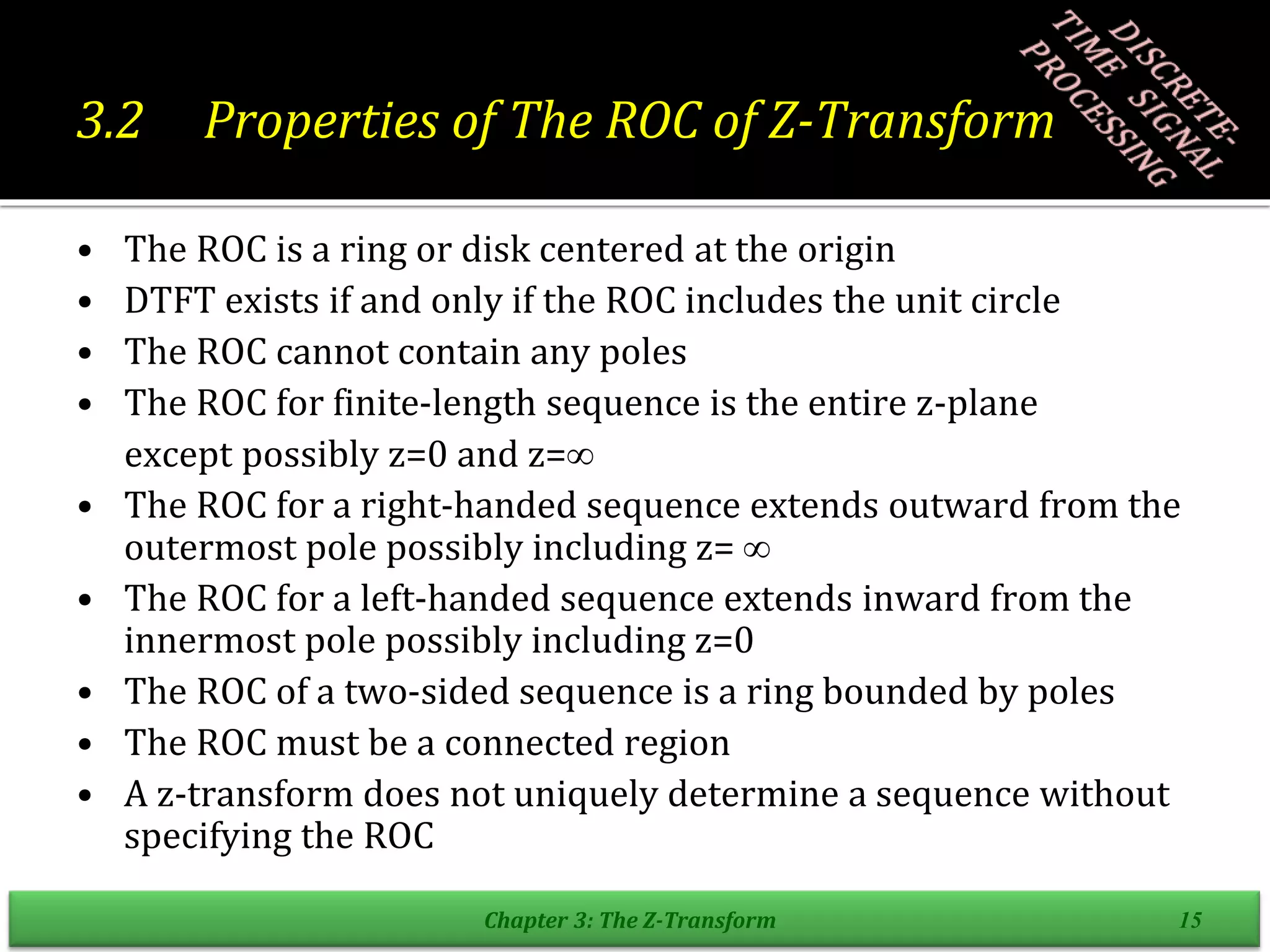
3.2 Properties of The ROC of Z-Transform
• The ROC is a ring or disk centered at the origin
• DTFT exists if and only if the ROC includes the unit circle
• The ROC cannot contain any poles
• The ROC for finite-length sequence is the entire z-plane
except possibly z=0 and z=
• The ROC for a right-handed sequence extends outward from the
outermost pole possibly including z= 
• The ROC for a left-handed sequence extends inward from the
innermost pole possibly including z=0
• The ROC of a two-sided sequence is a ring bounded by poles
• The ROC must be a connected region
• A z-transform does not uniquely determine a sequence without
specifying the ROC
Chapter 3: The Z-Transform 15
Stability, Causality, and the ROC
• Consider a system with impulse response h[n]
• The z-transform H(z) and the pole-zero plot shown below
• Without any other information h[n] is not uniquely determined
|z|>2 or |z|<½ or ½<|z|<2
• If system stable ROC must include unit-circle: ½<|z|<2
• If system is causal must be right sided: |z|>2
Chapter 3: The Z-Transform 16
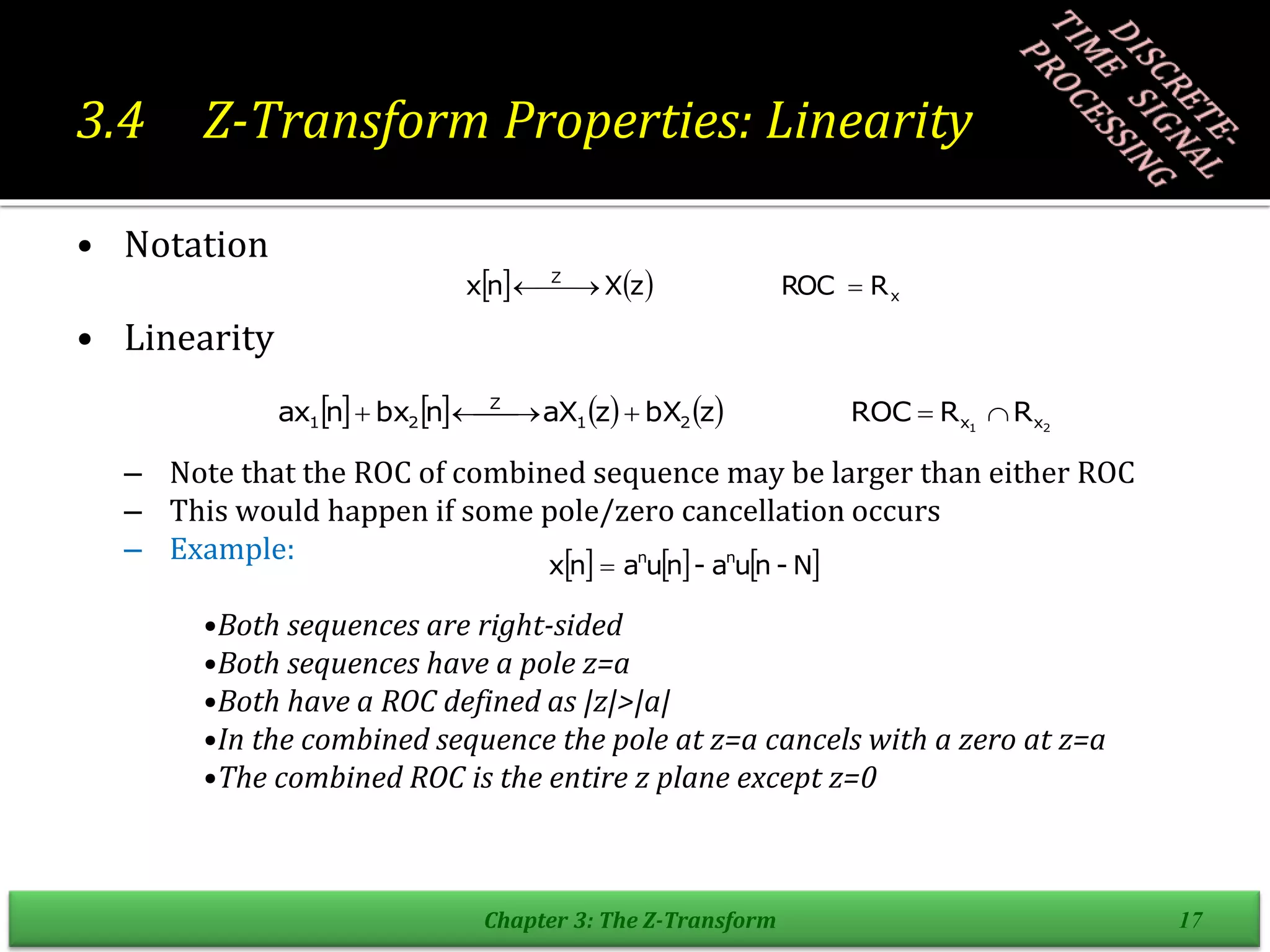
3.4 Z-Transform Properties: Linearity
• Notation
• Linearity
– Note that the ROC of combined sequence may be larger than either ROC
– This would happen if some pole/zero cancellation occurs
– Example:
•Both sequences are right-sided
•Both sequences have a pole z=a
•Both have a ROC defined as |z|>|a|
•In the combined sequence the pole at z=a cancels with a zero at z=a
•The combined ROC is the entire z plane except z=0
Chapter 3: The Z-Transform 17
    x
Z
R
ROC
z
X
n
x 

 

        2
1 x
x
2
1
Z
2
1 R
R
ROC
z
bX
z
aX
n
bx
n
ax 



 


     
N
-
n
u
a
-
n
u
a
n
x n
n

Z-Transform Properties: Time Shifting
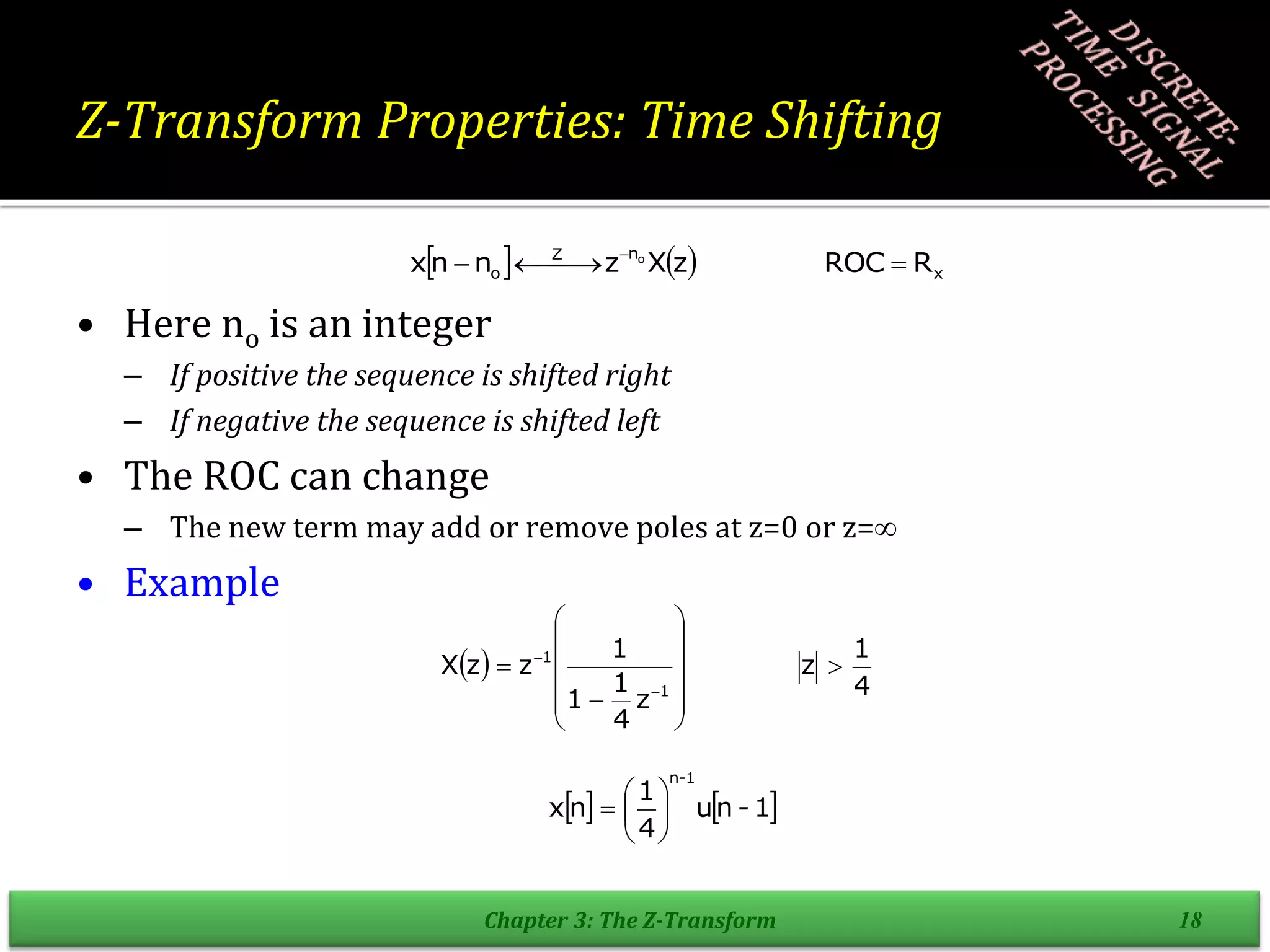
• Here no is an integer
– If positive the sequence is shifted right
– If negative the sequence is shifted left
• The ROC can change
– The new term may add or remove poles at z=0 or z=
• Example
Chapter 3: The Z-Transform 18
    x
n
Z
o R
ROC
z
X
z
n
n
x o


 

 
 
4
1
z
z
4
1
1
1
z
z
X
1
1

















   
1
-
n
u
4
1
n
x
1
-
n







Z-Transform Properties: Multiplication by
Exponential
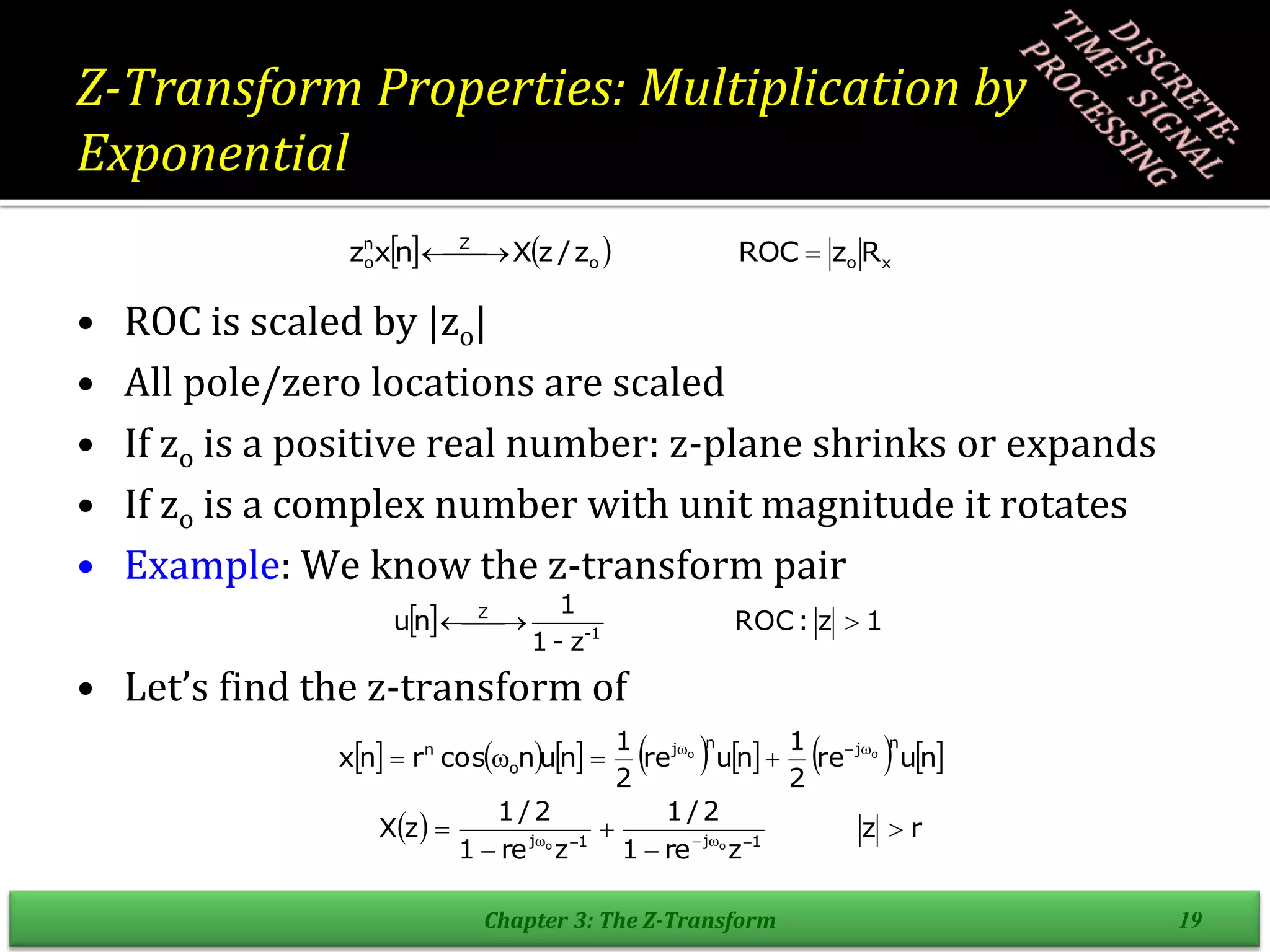
• ROC is scaled by |zo|
• All pole/zero locations are scaled
• If zo is a positive real number: z-plane shrinks or expands
• If zo is a complex number with unit magnitude it rotates
• Example: We know the z-transform pair
• Let’s find the z-transform of
Chapter 3: The Z-Transform 19
    x
o
o
Z
n
o R
z
ROC
z
/
z
X
n
x
z 

 

  1
z
:
ROC
z
-
1
1
n
u 1
-
Z


 

             
n
u
re
2
1
n
u
re
2
1
n
u
n
cos
r
n
x
n
j
n
j
o
n o
o 






  r
z
z
re
1
2
/
1
z
re
1
2
/
1
z
X 1
j
1
j o
o




 




Z-Transform Properties: Differentiation
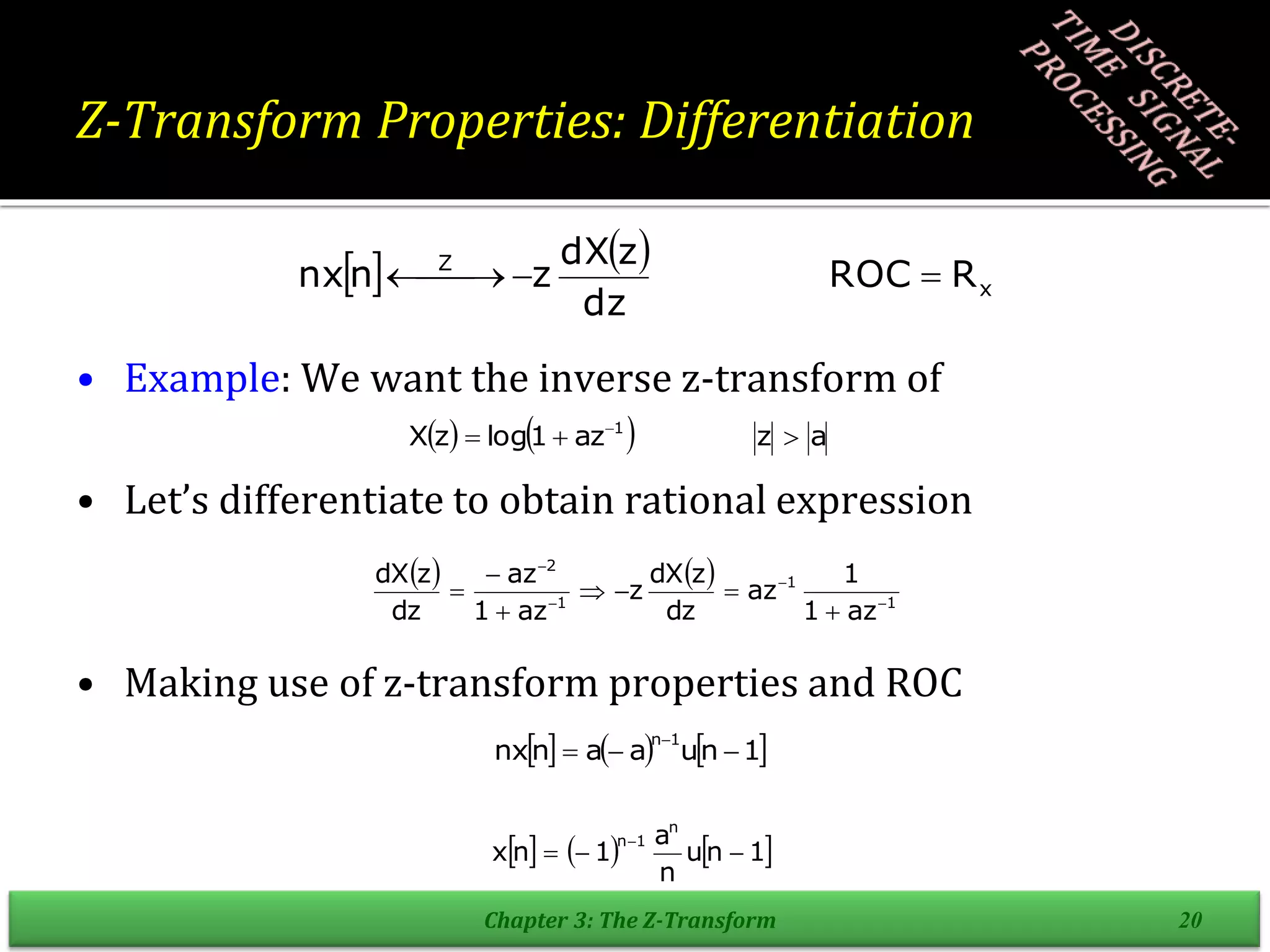
• Example: We want the inverse z-transform of
• Let’s differentiate to obtain rational expression
• Making use of z-transform properties and ROC
Chapter 3: The Z-Transform 20
   
x
Z
R
ROC
dz
z
dX
z
n
nx 


 

    a
z
az
1
log
z
X 1


 
   
1
1
1
2
az
1
1
az
dz
z
dX
z
az
1
az
dz
z
dX











     
1
n
u
a
a
n
nx
1
n




     
1
n
u
n
a
1
n
x
n
1
n




Z-Transform Properties: Conjugation
Chapter 3: The Z-Transform 21
    x
*
*
Z
*
R
ROC
z
X
n
x 

 

   
     
         
 
n
n
n n
n n
n n
n n
X z x n z
X z x n z x n z
X z x n z x n z Z x n




 
  
 
 

     
 

 
 
 
 
  

 
 
Z-Transform Properties: Time Reversal
• ROC is inverted
• Example:
• Time reversed version of
Chapter 3: The Z-Transform 22
   
x
Z
R
1
ROC
z
/
1
X
n
x 

 


   
n
u
a
n
x n

 
 
n
u
an
  1
1
1
-
1
-1
a
z
z
a
-
1
z
a
-
az
1
1
z
X 






Z-Transform Properties: Convolution
• Convolution in time domain is multiplication in z-domain
• Example: Let’s calculate the convolution of
• Multiplications of z-transforms is
• ROC: if |a|<1 ROC is |z|>1 if |a|>1 ROC is |z|>|a|
• Partial fractional expansion of Y(z)
Chapter 3: The Z-Transform 23
        2
x
1
x
2
1
Z
2
1 R
R
:
ROC
z
X
z
X
n
x
n
x 

 


       
n
u
n
x
and
n
u
a
n
x 2
n
1 

  a
z
:
ROC
az
1
1
z
X 1
1 

 
  1
z
:
ROC
z
1
1
z
X 1
2 

 
     
  
1
1
2
1
z
1
az
1
1
z
X
z
X
z
Y 





  1
z
:
ROC
assume
1
1
1
1
1
1
1











 

az
a
z
a
z
Y      
 
n
u
a
n
u
a
1
1
n
y 1
n



Some Z-transform properties
Chapter 3: The Z-Transform 24
3.3 The Inverse Z-Transform
• Formal inverse z-transform is based on a Cauchy integral
• Less formal ways sufficient most of the time
– Inspection method
– Partial fraction expansion
– Power series expansion
• Inspection Method
Make use of known z-transform pairs such as
Example: The inverse z-transform of
Chapter 3: The Z-Transform 25
  a
z
az
1
1
n
u
a 1
Z
n



 
 
     
n
u
2
1
n
x
2
1
z
z
2
1
1
1
z
X
n
1












Inverse Z-Transform by Partial Fraction
Expansion
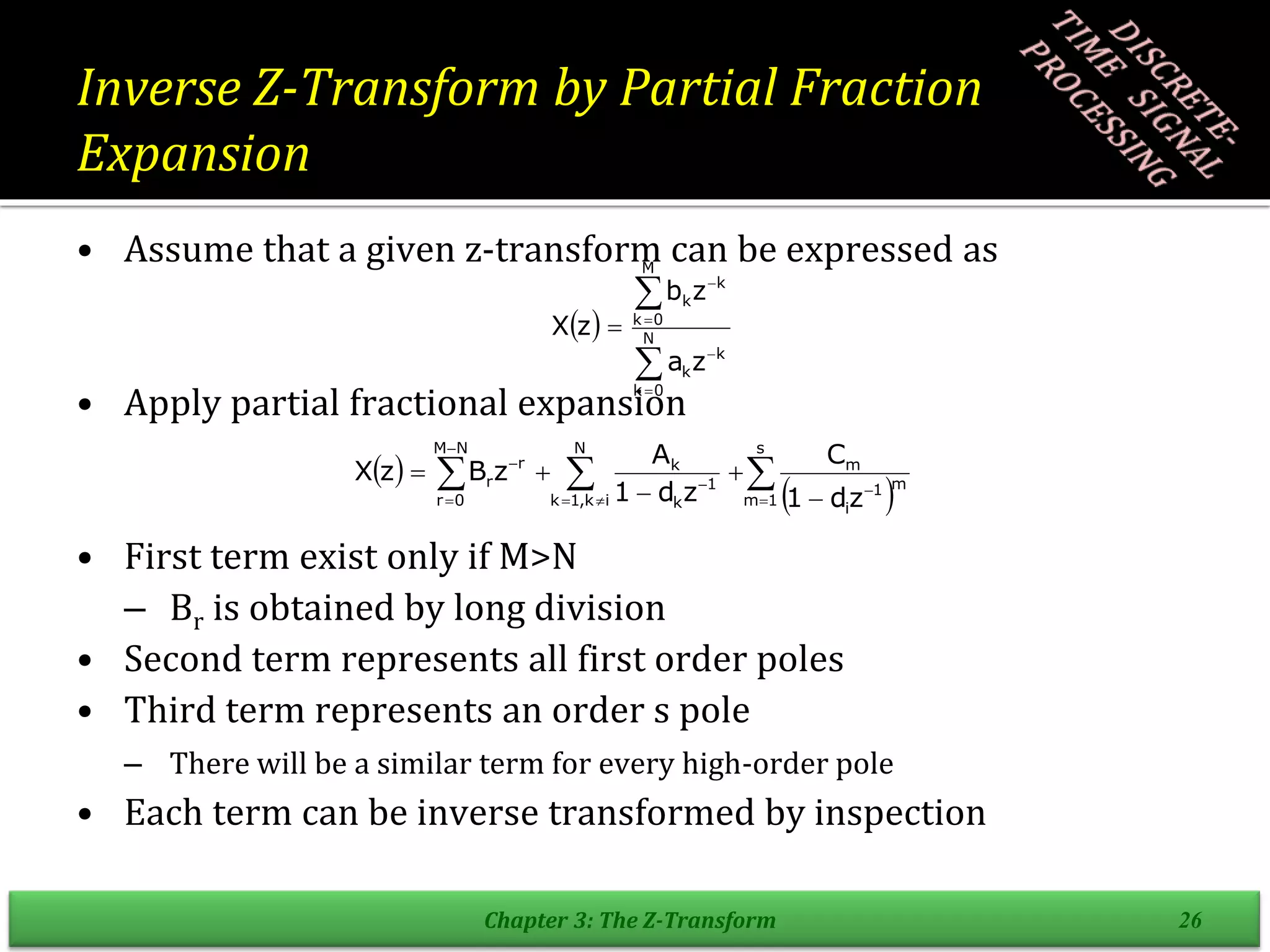
• Assume that a given z-transform can be expressed as
• Apply partial fractional expansion
• First term exist only if M>N
– Br is obtained by long division
• Second term represents all first order poles
• Third term represents an order s pole
– There will be a similar term for every high-order pole
• Each term can be inverse transformed by inspection
Chapter 3: The Z-Transform 26
 






 N
0
k
k
k
M
0
k
k
k
z
a
z
b
z
X
 
 


 












s
1
m
m
1
i
m
N
i
k
,
1
k
1
k
k
N
M
0
r
r
r
z
d
1
C
z
d
1
A
z
B
z
X
Inverse Z-Transform by Partial Fraction
Expansion
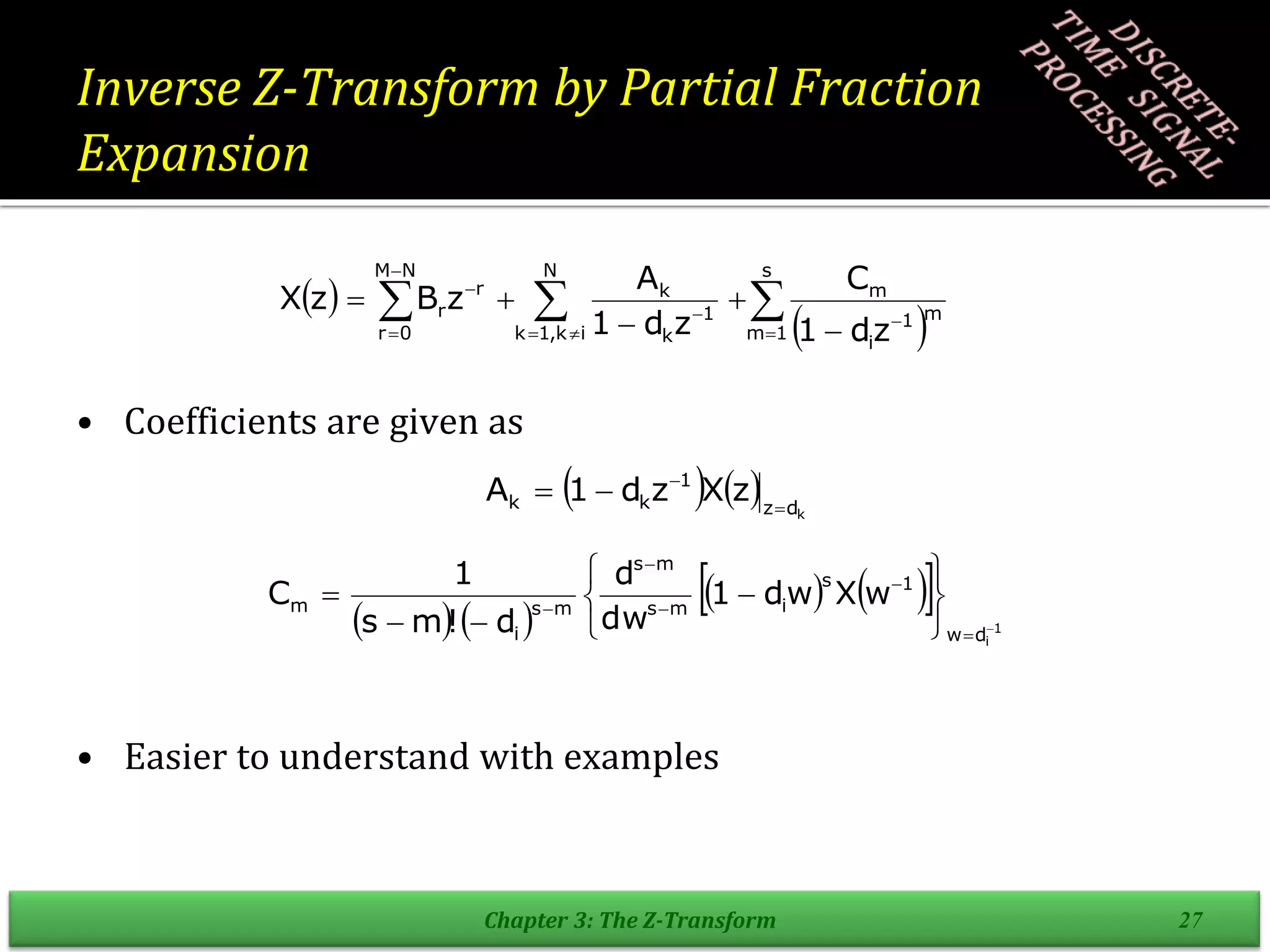
• Coefficients are given as
• Easier to understand with examples
Chapter 3: The Z-Transform 27
 
 


 












s
1
m
m
1
i
m
N
i
k
,
1
k
1
k
k
N
M
0
r
r
r
z
d
1
C
z
d
1
A
z
B
z
X
    k
d
z
1
k
k z
X
z
d
1
A 



   
   
  1
i
d
w
1
s
i
m
s
m
s
m
s
i
m w
X
w
d
1
dw
d
d
!
m
s
1
C
















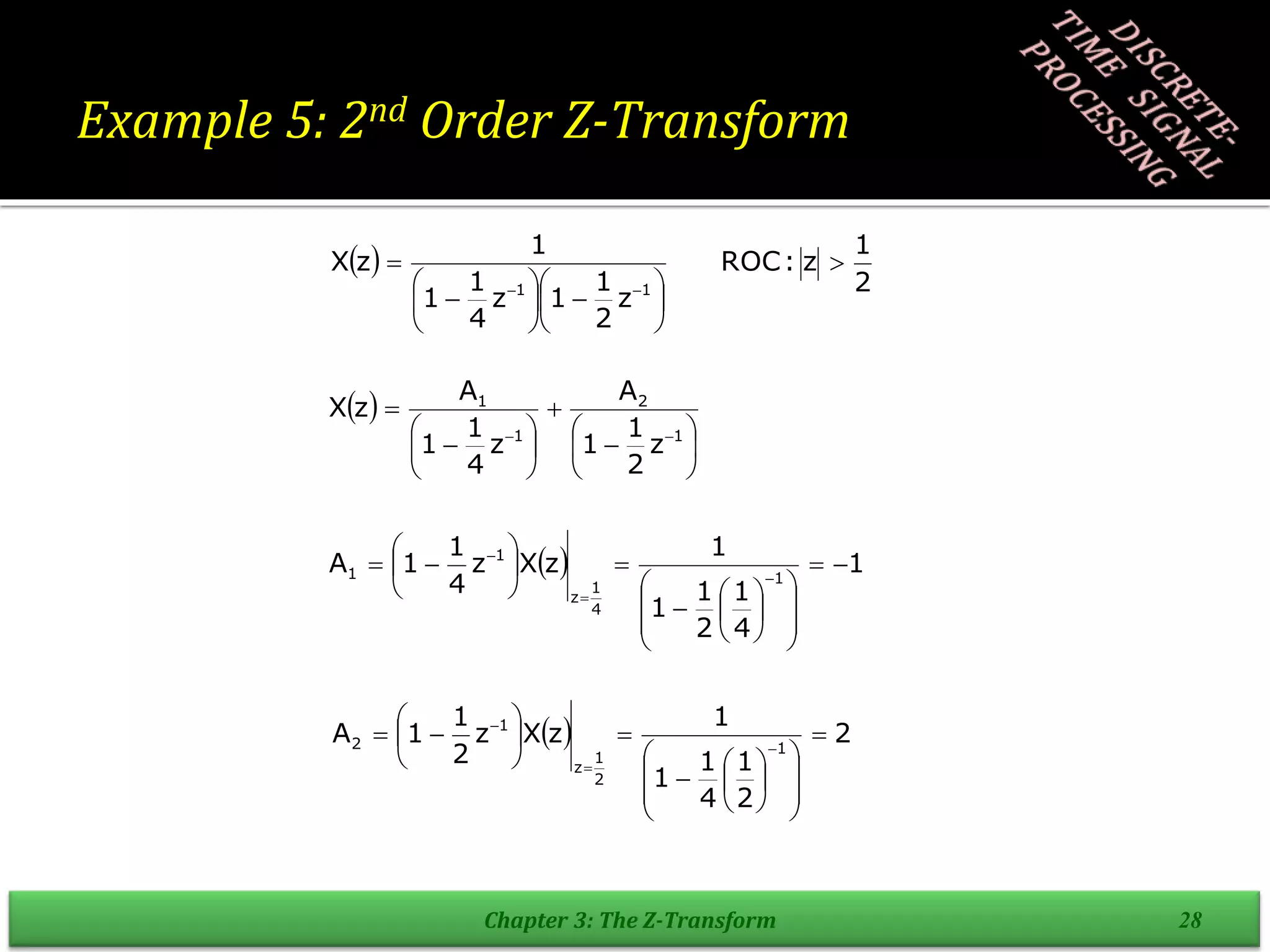
Example 5: 2nd Order Z-Transform
Chapter 3: The Z-Transform 28
 
2
1
z
:
ROC
z
2
1
1
z
4
1
1
1
z
X
1
1


















 

















 1
2
1
1
z
2
1
1
A
z
4
1
1
A
z
X
  1
4
1
2
1
1
1
z
X
z
4
1
1
A 1
4
1
z
1
1 
























 


  2
2
1
4
1
1
1
z
X
z
2
1
1
A 1
2
1
z
1
2 























 


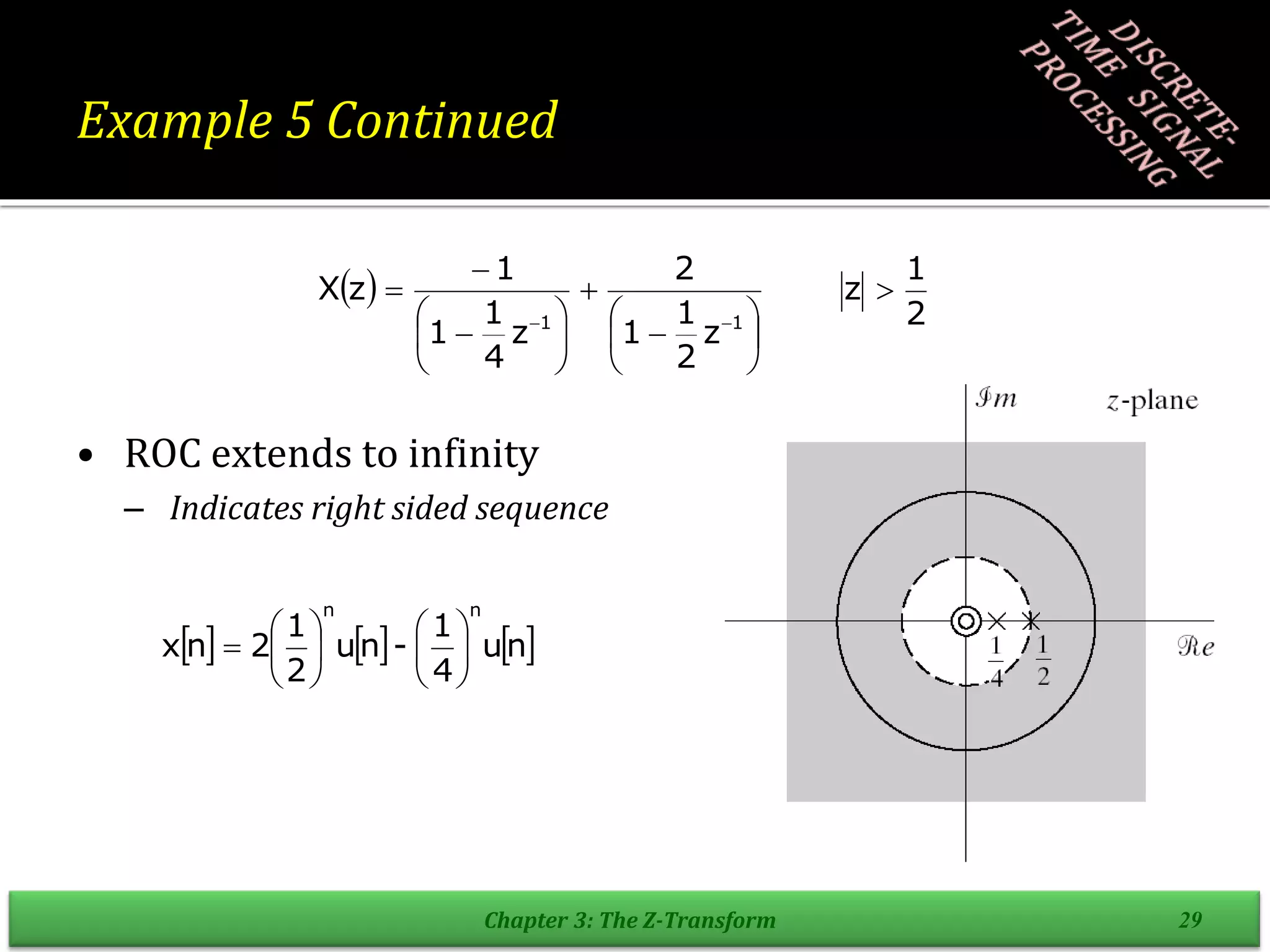
Example 5 Continued
• ROC extends to infinity
– Indicates right sided sequence
Chapter 3: The Z-Transform 29
 
2
1
z
z
2
1
1
2
z
4
1
1
1
z
X
1
1




















     
n
u
4
1
-
n
u
2
1
2
n
x
n
n













Example 6
• Long division to obtain Bo
Chapter 3: The Z-Transform 30
   
 
1
z
z
1
z
2
1
1
z
1
z
2
1
z
2
3
1
z
z
2
1
z
X
1
1
2
1
2
1
2
1























1
z
5
2
z
3
z
2
1
z
2
z
1
z
2
3
z
2
1
1
1
2
1
2
1
2














 
 
1
1
1
z
1
z
2
1
1
z
5
1
2
z
X















  1
2
1
1
z
1
A
z
2
1
1
A
2
z
X 
 




  9
z
X
z
2
1
1
A
2
1
z
1
1 











    8
z
X
z
1
A
1
z
1
2 




Example 5 Continued
• ROC extends to infinity
– Indicates right-sided sequence
Chapter 3: The Z-Transform 31
  1
z
z
1
8
z
2
1
1
9
2
z
X 1
1





 

       
n
8u
-
n
u
2
1
9
n
2
n
x
n









Inverse Z-Transform by Power Series
Expansion
• The z-transform is power series
• In expanded form
• Z-transforms of this form can generally be inversed easily
• Especially useful for finite-length series
Chapter 3: The Z-Transform 32
   






n
n
z
n
x
z
X
            
 







 
 2
1
1
2
2
1
0
1
2 z
x
z
x
x
z
x
z
x
z
X
    
1
2
1
1
1
2
z
2
1
1
z
2
1
z
z
1
z
1
z
2
1
1
z
z
X


















         
1
n
2
1
n
1
n
2
1
2
n
n
x 










 



















2
n
0
1
n
2
1
0
n
1
1
n
2
1
2
n
1
n
x
Example 6

Signals and systems3 ppt

  • 1.
    Department of ComputerEng. Sharif University of Technology Discrete-time signal processing Chapter 3: THE Z-TRANSFORM Content and Figures are from Discrete-Time Signal Processing, 2e by Oppenheim, Shafer and Buck, ©1999-2000 Prentice Hall Inc.
  • 2.
    3.1 The Z-Transform •Counterpart of the Laplace transform for discrete-time signals • Generalization of the Fourier Transform Fourier Transform does not exist for all signals • Definition: • Compare to DTFT definition: • z is a complex variable that can be represented as z=r ej • Substituting z=ej will reduce the z-transform to DTFT Chapter 3: The Z-Transform 1           n n z n x z X     n j n j e n x e X        
  • 3.
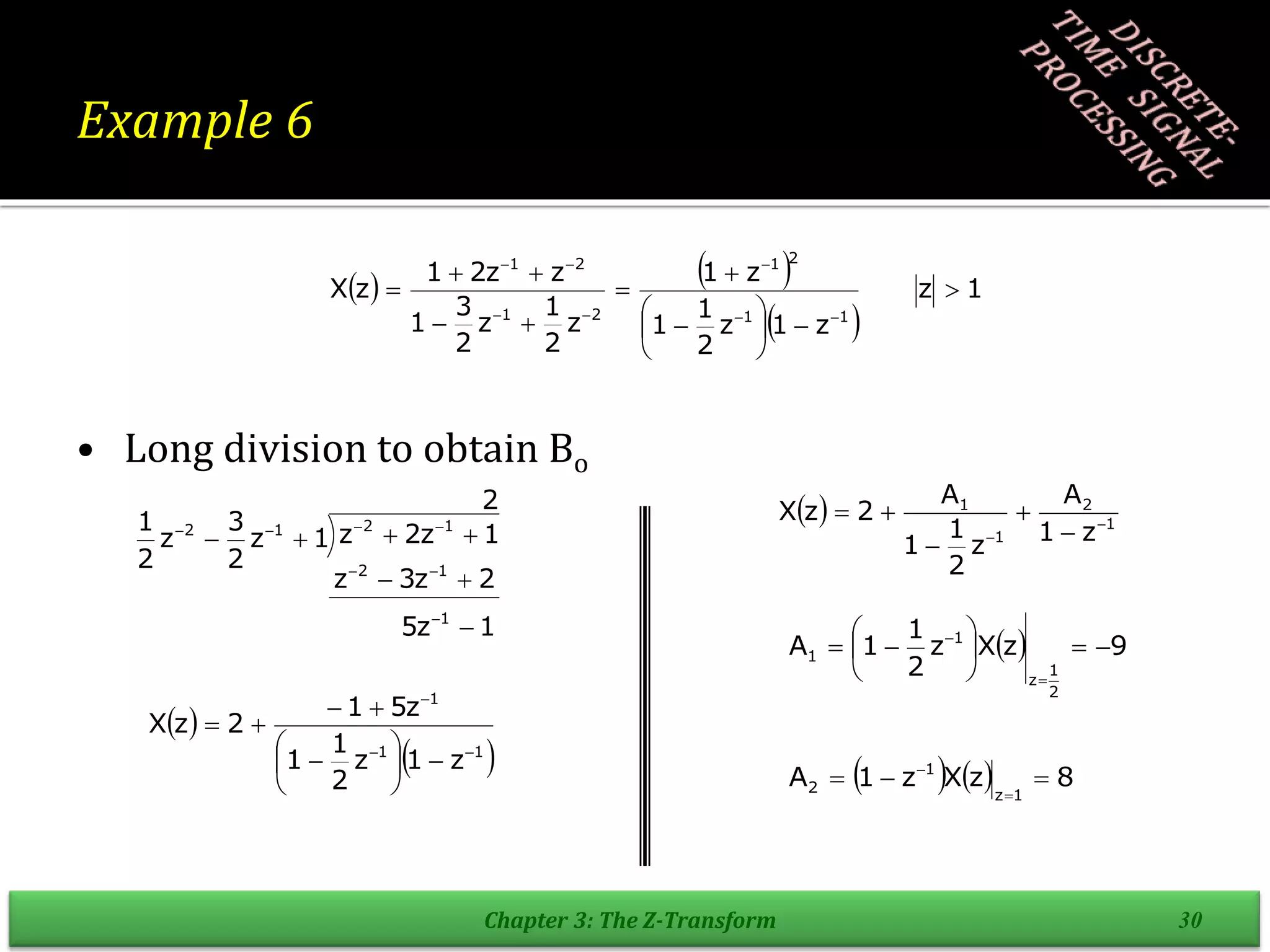
              j n n z n n re z z n x z X z X n x z X z n x n x                 0 ) ( ) ( ) ( r : ‫اندازه‬ : ‫فاز‬  ‫تبدیل‬ z ‫طرفه‬‫یک‬ ‫تبدیل‬ z ‫طرفه‬‫دو‬ 3.1 The Z-Transform
  • 4.
    The z-transform andthe DTFT • Convenient to describe on the complex z-plane • If we plot z=ej for =0 to 2 we get the unit circle Chapter 3: The Z-Transform 3 Re Im Unit Circle  r=1 0 2 0 2    j e X
  • 5.
    Convergence of thez-Transform • DTFT does not always converge Example: x[n] = anu[n] for |a|>1 does not have a DTFT • Complex variable z can be written as r ej so the z- transform convert to the DTFT of x[n] multiplied with exponential sequence r –n • For certain choices of r the sum maybe made finite Chapter 3: The Z-Transform 4                        n n j n n n j j e n x e n x re X    r r     n j n j e n x e X                 n n x r n -
  • 6.
    Region of Convergence(ROC) • ROC: The set of values of z for which the z-transform converges • The region of convergence is made of circles Chapter 3: The Z-Transform 5 Re Im • Example: z-transform converges for values of 0.5<r<2 ROC is shown on the left In this example the ROC includes the unit circle, so DTFT exists
  • 7.
    • Example: Doesn't convergefor any r. DTFT exists. It has finite energy. DTFT converges in a mean square sense. • Example: Doesn't converge for any r. It doesn’t have even finite energy. But we define a useful DTFT with impulse function.     n n x o  cos    sin c n x n n    Region of Convergence (ROC)
  • 8.
    Example 1: Right-SidedExponential Sequence • For Convergence we require • Hence the ROC is defined as • Inside the ROC series converges to Chapter 3: The Z-Transform 7                        0 n n 1 n n n n az z n u a z X n u a n x       0 n n 1 az a z 1 az n 1         a z z az 1 1 az z X 0 n 1 n 1           Re Im a 1 o x • Region outside the circle of radius a is the ROC • Right-sided sequence ROCs extend outside a circle
  • 9.
    ( ‫ا‬‫ر‬‫چپگ‬‫دنباله‬ )          a z z az z a z X a z z a z a ROC z a z a z a z n u a z X n n n n n n n n n n n n                                                 1 1 1 0 1 1 0 1 1 1 1 1 1 1 1 1 : 1 1     1     n u a n x n Example 2: Left-Sided Exponential Sequence
  • 10.
    Example 3: Two-SidedExponential Sequence Chapter 3: The Z-Transform 9       1 - n - u 2 1 - n u 3 1 n x n n               1 1 1 0 1 0 1 3 1 1 1 3 1 1 3 1 3 1 3 1                                    z z z z z n n 1 1 0 1 1 1 n n 1 z 2 1 1 1 z 2 1 1 z 2 1 z 2 1 z 2 1                                   z 3 1 1 z 3 1 : ROC 1     z 2 1 1 z 2 1 : ROC 1                                  2 1 z 3 1 z 12 1 z z 2 z 2 1 1 1 z 3 1 1 1 z X 1 1 Im 2 1 oo 12 1 x x 3 1 
  • 11.
    Example 4: FiniteLength Sequence Chapter 3: The Z-Transform 10          otherwise 0 1 0 N n a n x n N=16 Pole-zero plot         N n u n u a n x n        0 : 1 1 1 ) ( 1 0 1 1 1 1 1 1 0 1 1 0                                 z az az ROC a z a z z az az az z a z X N n n N N N N N n n N n n n
  • 12.
    Some common Z-transformpairs Chapter 3: The Z-Transform 11
  • 13.
    SEQUENCE TRANSFORM ROC 1  z    0 m if or 0 m if 0 except z All    1  z 1 1 1   z 1 1 1   z m z         m n n u n u n       1 1 z ALL Some common Z-transform pairs
  • 14.
                       1 : cos 2 1 cos 1 cos : 1 1 : 1 : 1 1 1 : 1 1 2 1 0 1 0 0 2 1 1 2 1 1 1 1                                     z ROC z z z n u n a z ROC az az n u na a z ROC az az n u na a z ROC az n u a a z ROC az n u a Z Z n Z n Z n Z n    Some common Z-transform pairs
  • 15.
           0 : 1 1 0 1 0 : cos 2 1 sin sin 1 2 2 1 0 1 0 0                      z ROC az z a otherwise N n a r z ROC z r z r z r n u n r N N Z n Z n                    r z ROC z r z r z r n u n r z ROC z z z n u n Z n Z                  : cos 2 1 cos 1 cos 1 : cos 2 1 sin sin 2 2 1 0 1 0 0 2 1 0 1 0 0       Some common Z-transform pairs
  • 16.
    3.2 Properties ofThe ROC of Z-Transform • The ROC is a ring or disk centered at the origin • DTFT exists if and only if the ROC includes the unit circle • The ROC cannot contain any poles • The ROC for finite-length sequence is the entire z-plane except possibly z=0 and z= • The ROC for a right-handed sequence extends outward from the outermost pole possibly including z=  • The ROC for a left-handed sequence extends inward from the innermost pole possibly including z=0 • The ROC of a two-sided sequence is a ring bounded by poles • The ROC must be a connected region • A z-transform does not uniquely determine a sequence without specifying the ROC Chapter 3: The Z-Transform 15
  • 17.
    Stability, Causality, andthe ROC • Consider a system with impulse response h[n] • The z-transform H(z) and the pole-zero plot shown below • Without any other information h[n] is not uniquely determined |z|>2 or |z|<½ or ½<|z|<2 • If system stable ROC must include unit-circle: ½<|z|<2 • If system is causal must be right sided: |z|>2 Chapter 3: The Z-Transform 16
  • 18.
    3.4 Z-Transform Properties:Linearity • Notation • Linearity – Note that the ROC of combined sequence may be larger than either ROC – This would happen if some pole/zero cancellation occurs – Example: •Both sequences are right-sided •Both sequences have a pole z=a •Both have a ROC defined as |z|>|a| •In the combined sequence the pole at z=a cancels with a zero at z=a •The combined ROC is the entire z plane except z=0 Chapter 3: The Z-Transform 17     x Z R ROC z X n x              2 1 x x 2 1 Z 2 1 R R ROC z bX z aX n bx n ax               N - n u a - n u a n x n n 
  • 19.
    Z-Transform Properties: TimeShifting • Here no is an integer – If positive the sequence is shifted right – If negative the sequence is shifted left • The ROC can change – The new term may add or remove poles at z=0 or z= • Example Chapter 3: The Z-Transform 18     x n Z o R ROC z X z n n x o          4 1 z z 4 1 1 1 z z X 1 1                      1 - n u 4 1 n x 1 - n       
  • 20.
    Z-Transform Properties: Multiplicationby Exponential • ROC is scaled by |zo| • All pole/zero locations are scaled • If zo is a positive real number: z-plane shrinks or expands • If zo is a complex number with unit magnitude it rotates • Example: We know the z-transform pair • Let’s find the z-transform of Chapter 3: The Z-Transform 19     x o o Z n o R z ROC z / z X n x z        1 z : ROC z - 1 1 n u 1 - Z                    n u re 2 1 n u re 2 1 n u n cos r n x n j n j o n o o          r z z re 1 2 / 1 z re 1 2 / 1 z X 1 j 1 j o o          
  • 21.
    Z-Transform Properties: Differentiation •Example: We want the inverse z-transform of • Let’s differentiate to obtain rational expression • Making use of z-transform properties and ROC Chapter 3: The Z-Transform 20     x Z R ROC dz z dX z n nx           a z az 1 log z X 1         1 1 1 2 az 1 1 az dz z dX z az 1 az dz z dX                  1 n u a a n nx 1 n           1 n u n a 1 n x n 1 n    
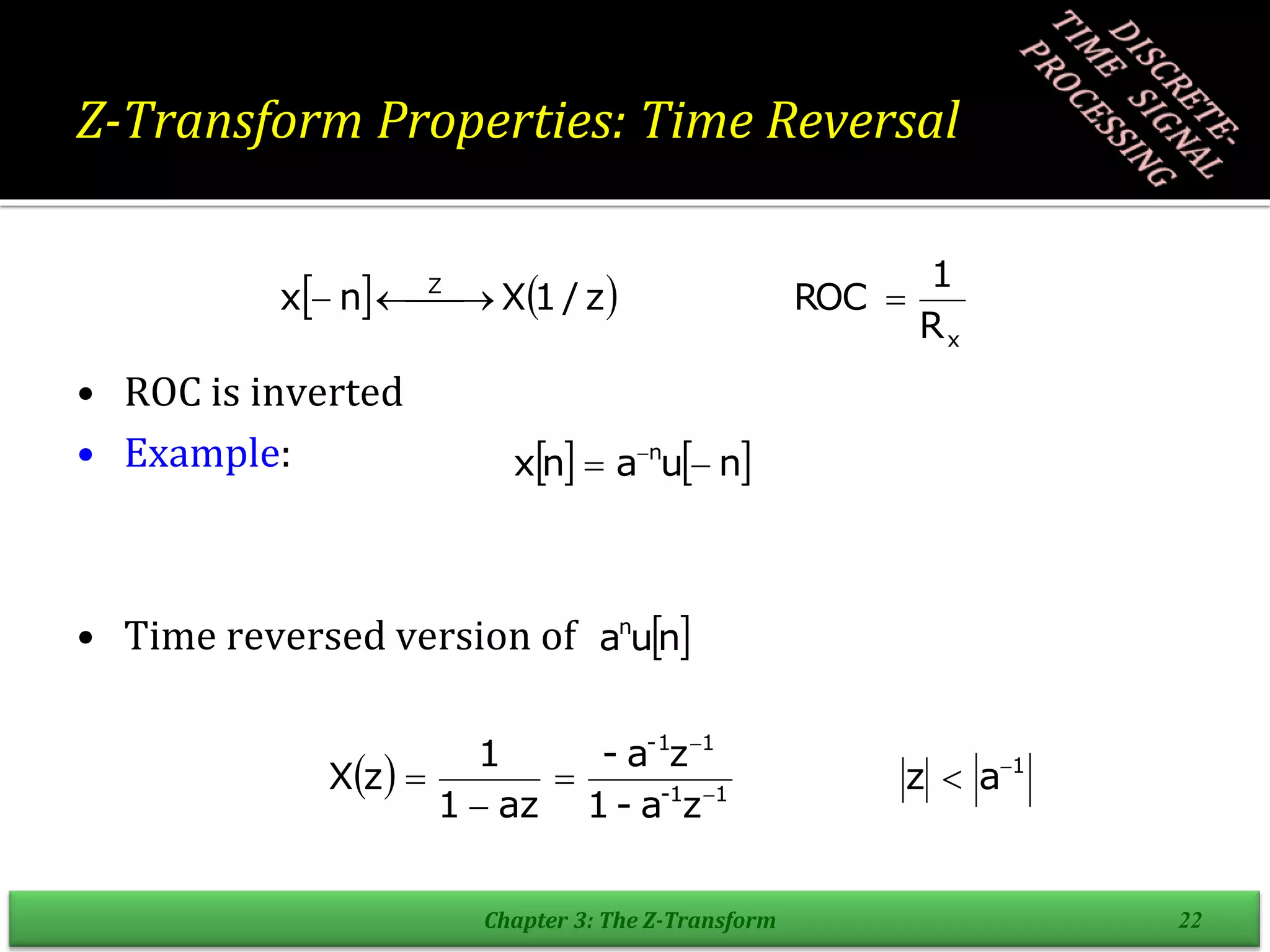
  • 22.
    Z-Transform Properties: Conjugation Chapter3: The Z-Transform 21     x * * Z * R ROC z X n x                            n n n n n n n n n n X z x n z X z x n z x n z X z x n z x n z Z x n                                       
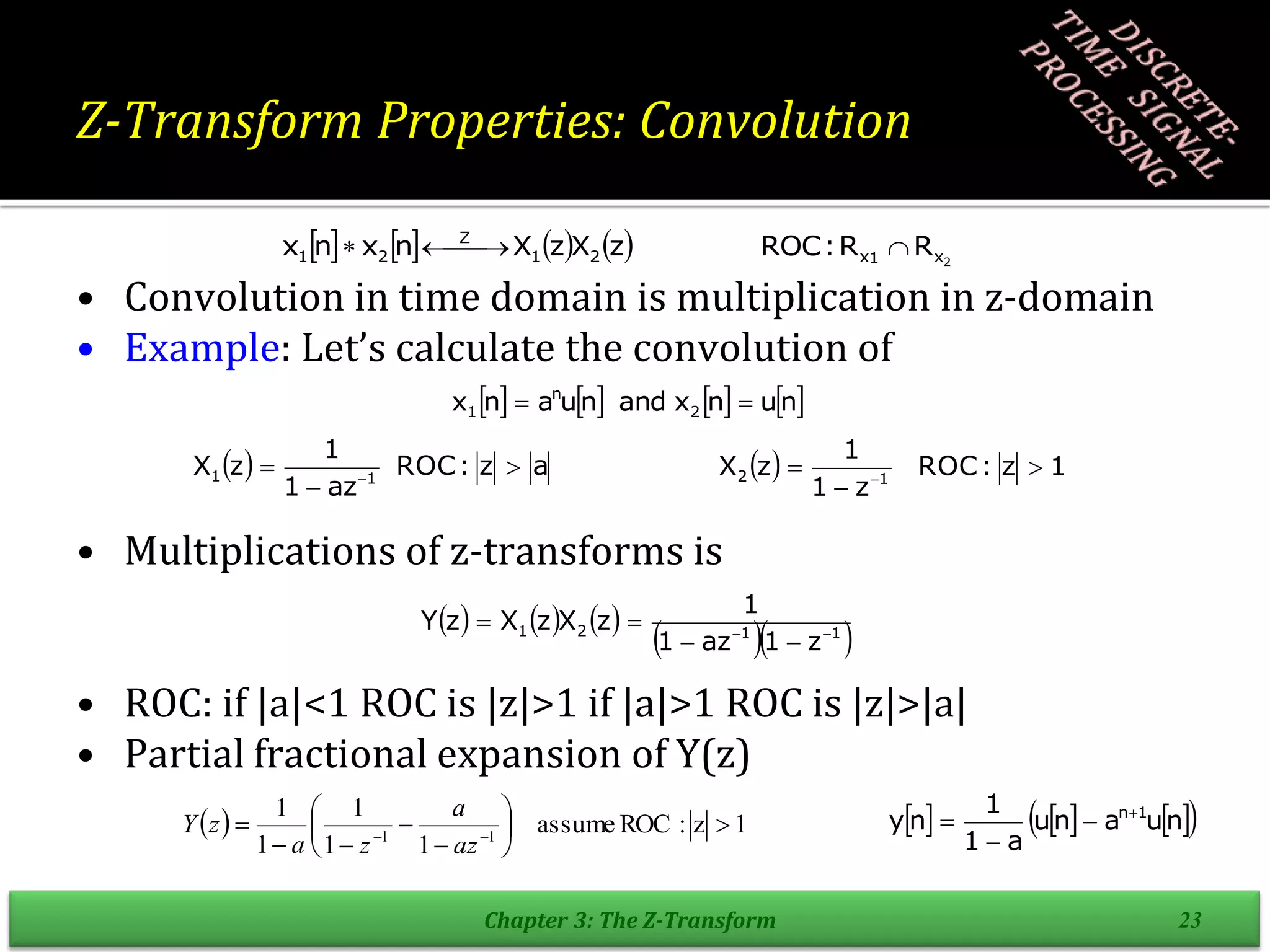
  • 23.
    Z-Transform Properties: TimeReversal • ROC is inverted • Example: • Time reversed version of Chapter 3: The Z-Transform 22     x Z R 1 ROC z / 1 X n x           n u a n x n      n u an   1 1 1 - 1 -1 a z z a - 1 z a - az 1 1 z X       
  • 24.
    Z-Transform Properties: Convolution •Convolution in time domain is multiplication in z-domain • Example: Let’s calculate the convolution of • Multiplications of z-transforms is • ROC: if |a|<1 ROC is |z|>1 if |a|>1 ROC is |z|>|a| • Partial fractional expansion of Y(z) Chapter 3: The Z-Transform 23         2 x 1 x 2 1 Z 2 1 R R : ROC z X z X n x n x               n u n x and n u a n x 2 n 1     a z : ROC az 1 1 z X 1 1       1 z : ROC z 1 1 z X 1 2              1 1 2 1 z 1 az 1 1 z X z X z Y         1 z : ROC assume 1 1 1 1 1 1 1               az a z a z Y         n u a n u a 1 1 n y 1 n   
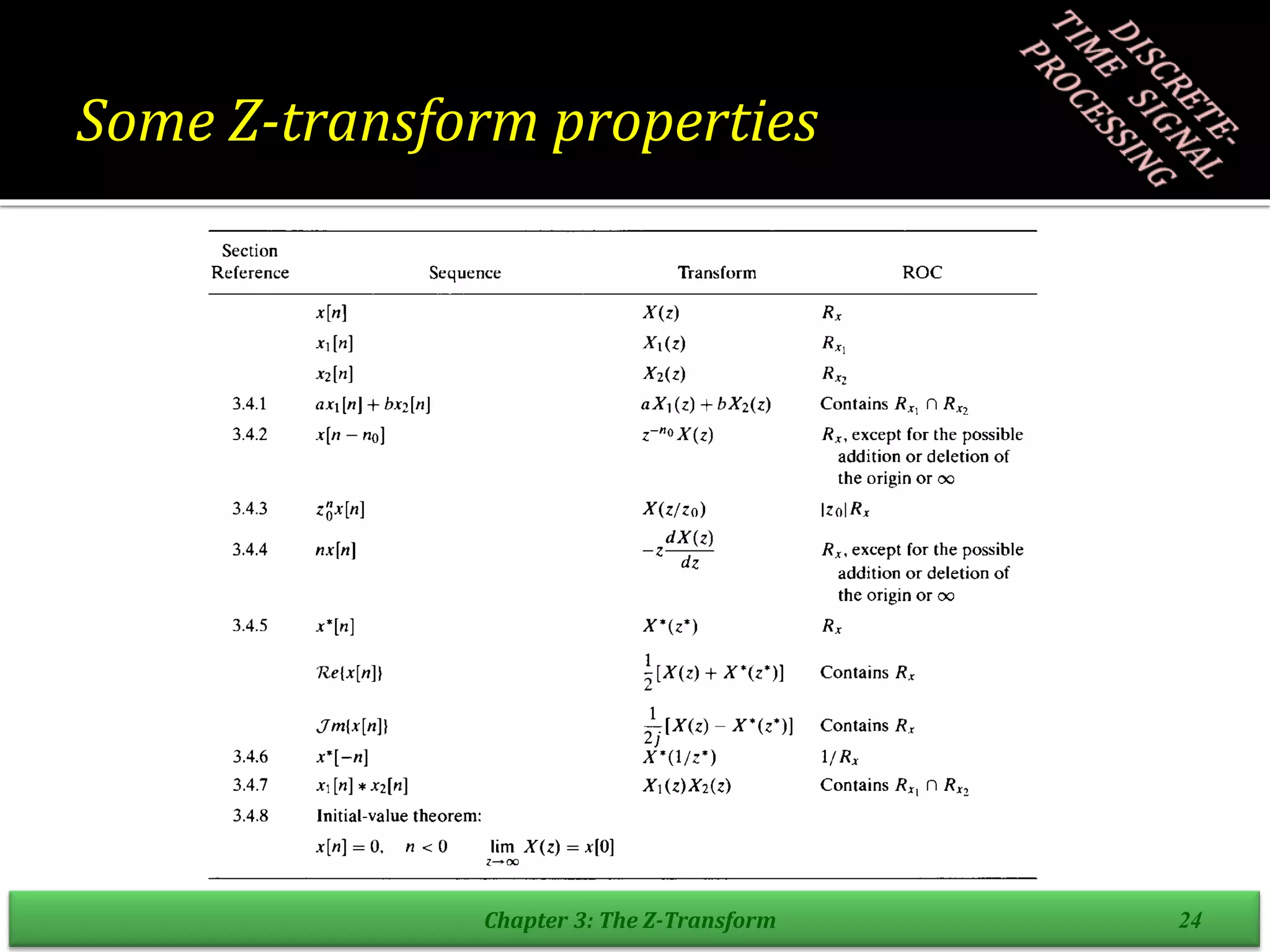
  • 25.
  • 26.
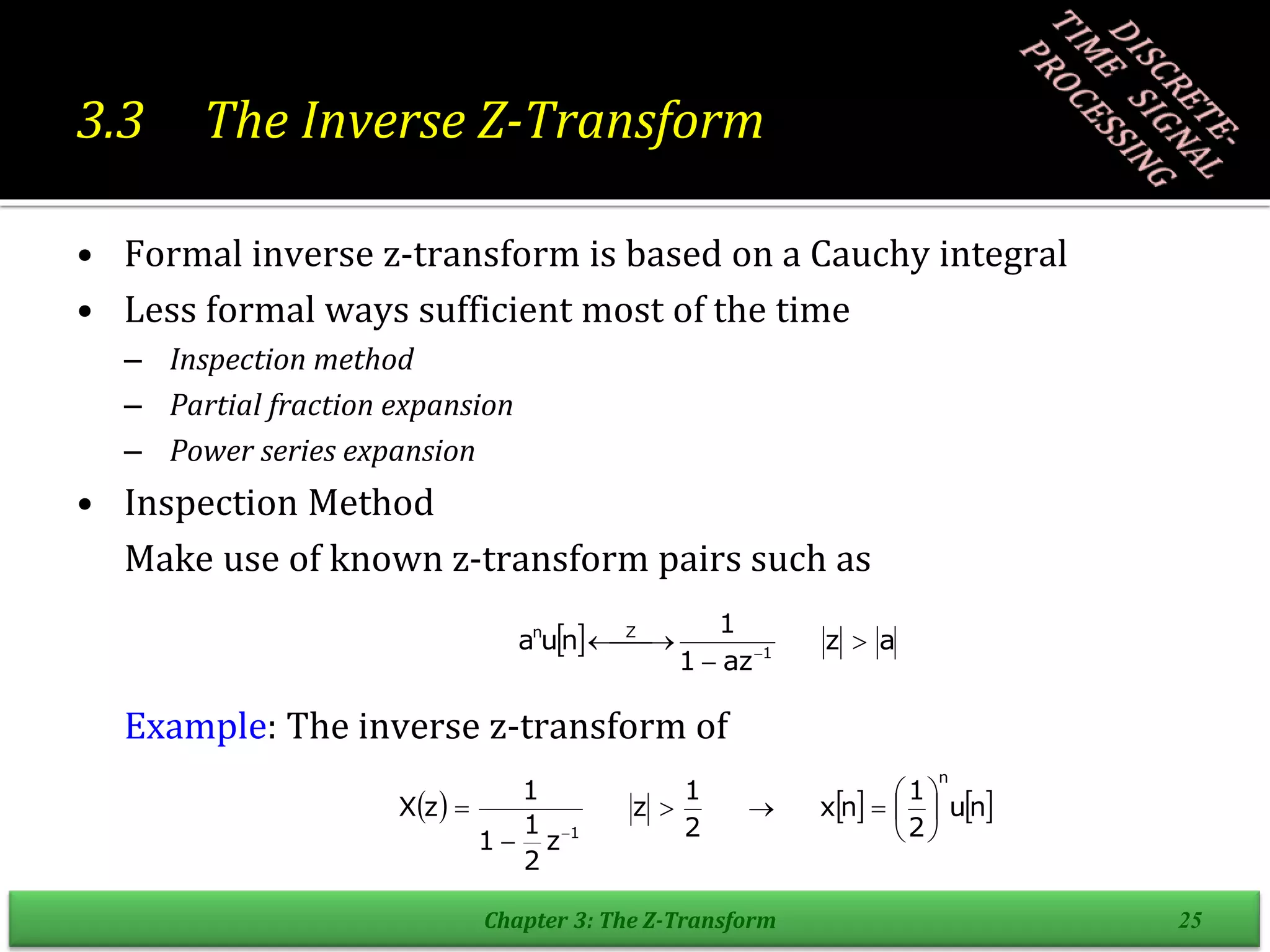
    3.3 The InverseZ-Transform • Formal inverse z-transform is based on a Cauchy integral • Less formal ways sufficient most of the time – Inspection method – Partial fraction expansion – Power series expansion • Inspection Method Make use of known z-transform pairs such as Example: The inverse z-transform of Chapter 3: The Z-Transform 25   a z az 1 1 n u a 1 Z n              n u 2 1 n x 2 1 z z 2 1 1 1 z X n 1            
  • 27.
    Inverse Z-Transform byPartial Fraction Expansion • Assume that a given z-transform can be expressed as • Apply partial fractional expansion • First term exist only if M>N – Br is obtained by long division • Second term represents all first order poles • Third term represents an order s pole – There will be a similar term for every high-order pole • Each term can be inverse transformed by inspection Chapter 3: The Z-Transform 26          N 0 k k k M 0 k k k z a z b z X                     s 1 m m 1 i m N i k , 1 k 1 k k N M 0 r r r z d 1 C z d 1 A z B z X
  • 28.
    Inverse Z-Transform byPartial Fraction Expansion • Coefficients are given as • Easier to understand with examples Chapter 3: The Z-Transform 27                     s 1 m m 1 i m N i k , 1 k 1 k k N M 0 r r r z d 1 C z d 1 A z B z X     k d z 1 k k z X z d 1 A               1 i d w 1 s i m s m s m s i m w X w d 1 dw d d ! m s 1 C                
  • 29.
    Example 5: 2ndOrder Z-Transform Chapter 3: The Z-Transform 28   2 1 z : ROC z 2 1 1 z 4 1 1 1 z X 1 1                                       1 2 1 1 z 2 1 1 A z 4 1 1 A z X   1 4 1 2 1 1 1 z X z 4 1 1 A 1 4 1 z 1 1                                2 2 1 4 1 1 1 z X z 2 1 1 A 1 2 1 z 1 2                            
  • 30.
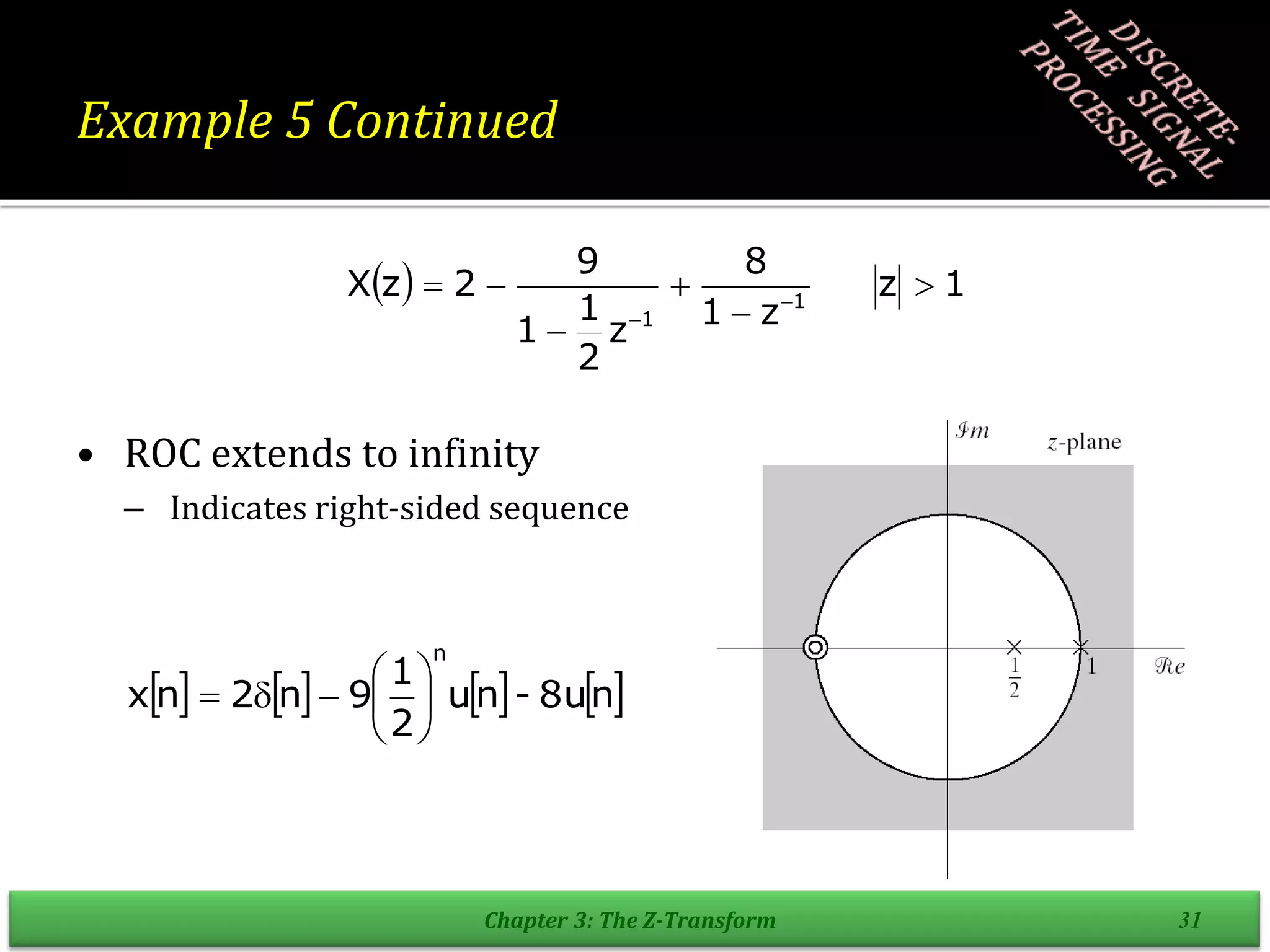
    Example 5 Continued •ROC extends to infinity – Indicates right sided sequence Chapter 3: The Z-Transform 29   2 1 z z 2 1 1 2 z 4 1 1 1 z X 1 1                           n u 4 1 - n u 2 1 2 n x n n             
  • 31.
    Example 6 • Longdivision to obtain Bo Chapter 3: The Z-Transform 30       1 z z 1 z 2 1 1 z 1 z 2 1 z 2 3 1 z z 2 1 z X 1 1 2 1 2 1 2 1                        1 z 5 2 z 3 z 2 1 z 2 z 1 z 2 3 z 2 1 1 1 2 1 2 1 2                   1 1 1 z 1 z 2 1 1 z 5 1 2 z X                  1 2 1 1 z 1 A z 2 1 1 A 2 z X          9 z X z 2 1 1 A 2 1 z 1 1                 8 z X z 1 A 1 z 1 2     
  • 32.
    Example 5 Continued •ROC extends to infinity – Indicates right-sided sequence Chapter 3: The Z-Transform 31   1 z z 1 8 z 2 1 1 9 2 z X 1 1                 n 8u - n u 2 1 9 n 2 n x n         
  • 33.
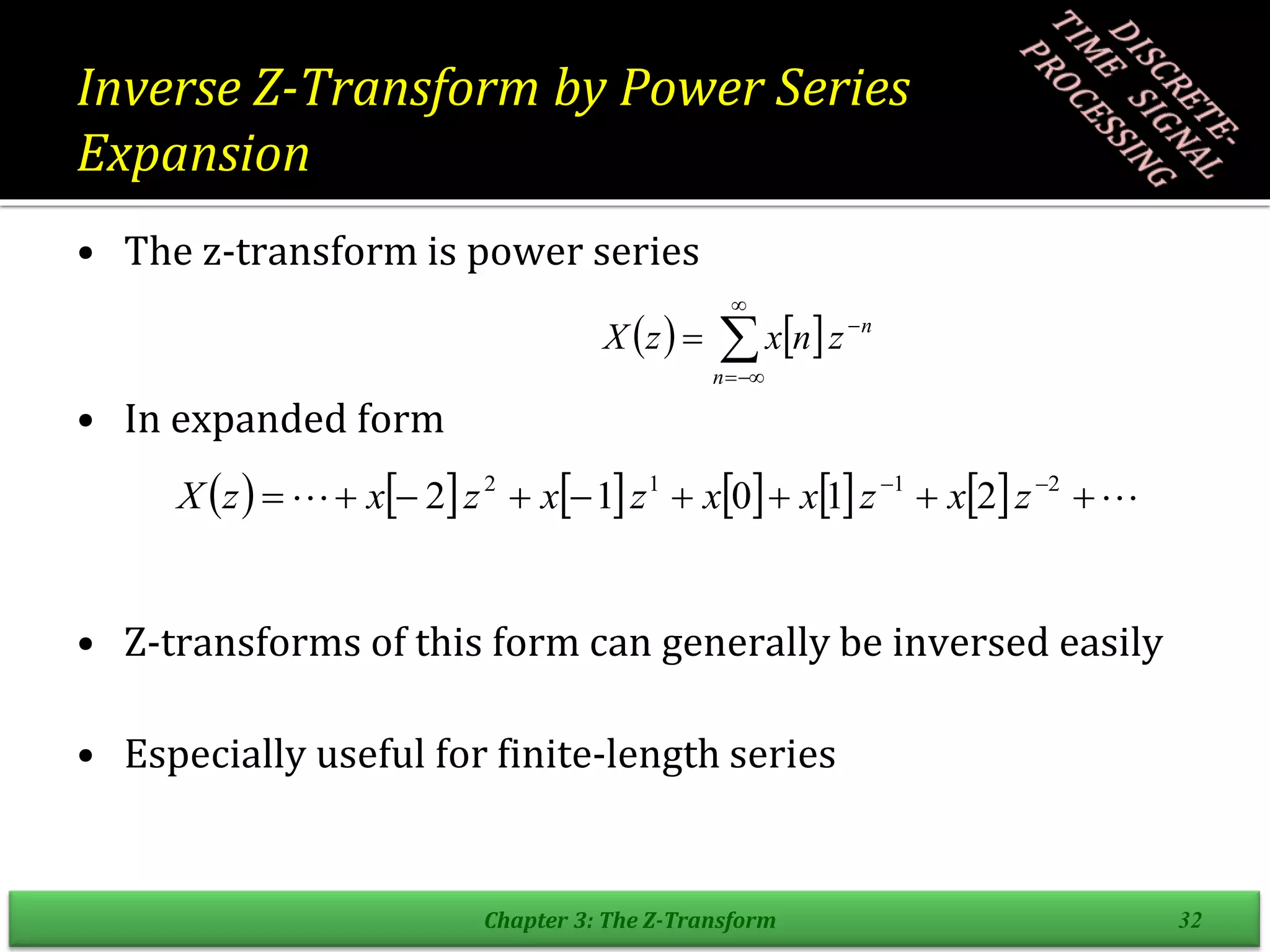
    Inverse Z-Transform byPower Series Expansion • The z-transform is power series • In expanded form • Z-transforms of this form can generally be inversed easily • Especially useful for finite-length series Chapter 3: The Z-Transform 32           n n z n x z X                          2 1 1 2 2 1 0 1 2 z x z x x z x z x z X
  • 34.
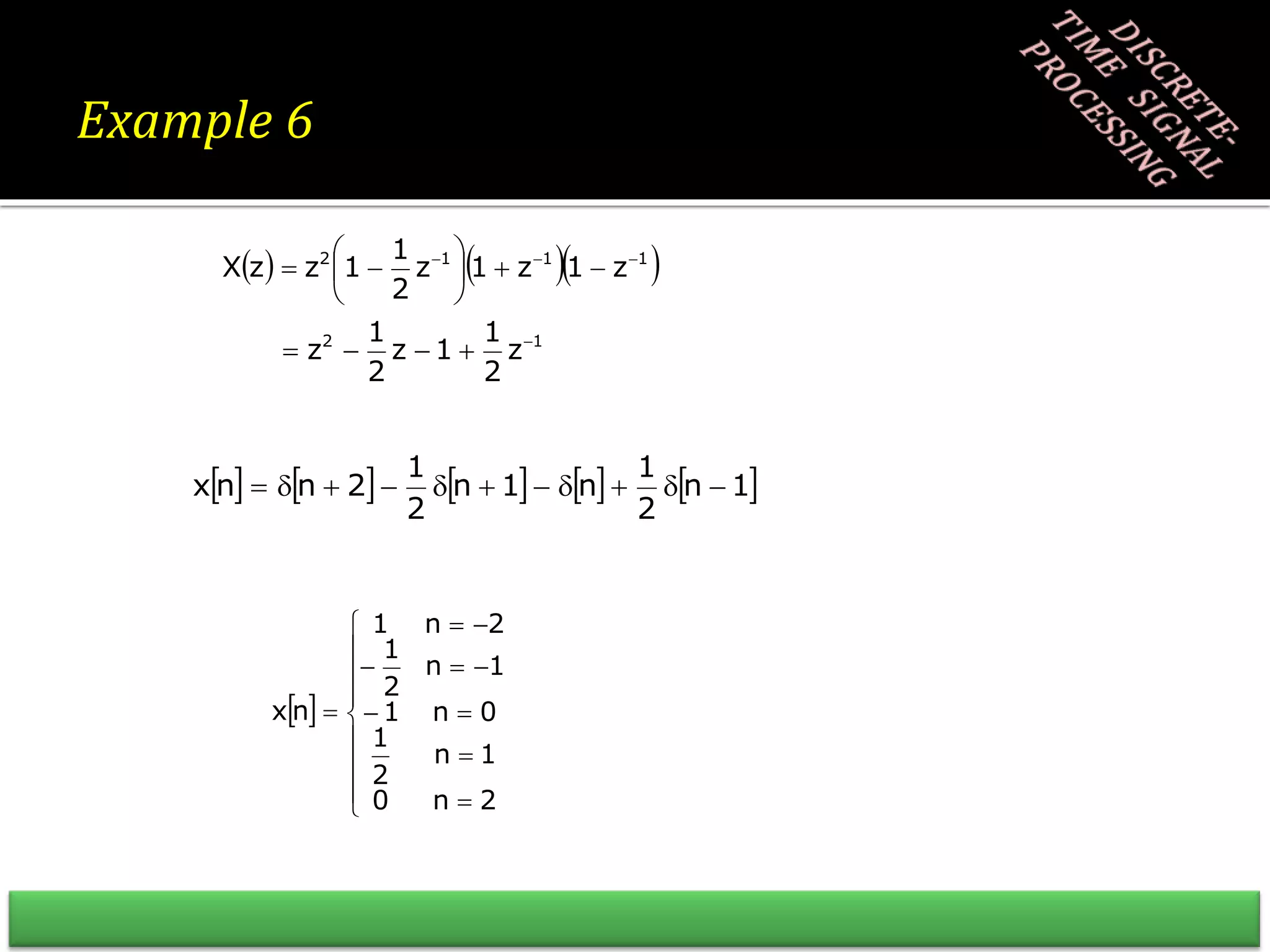
        1 2 1 1 1 2 z 2 1 1 z 2 1 z z 1 z 1 z 2 1 1 z z X                             1 n 2 1 n 1 n 2 1 2 n n x                                 2 n 0 1 n 2 1 0 n 1 1 n 2 1 2 n 1 n x Example 6