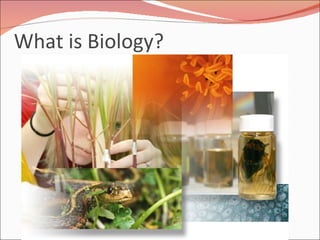
What is Biology?
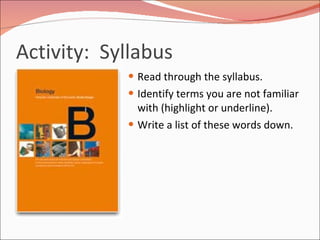
Activity:  Syllabus  Read through the syllabus.  Identify terms you are not familiar with (highlight or underline).  Write a list of these words down.
Biology Unit 1 Organisms & Their Environment Two Area of Studies (AOS): AOS1: Adaptations of Organisms AOS2: Dynamic Ecosystems Two SAC’s for each AOS
Assessment SAC’s for every Outcome OTHER Work Requirements (Assignments/Projects; Practical Reports; Biozone Pages; Topic Summaries; Glossary Words)  Mid – Year Exam
About the Exam Each Area of Study (AOS) has approximately equal weighting in terms of questions Questions that address key knowledge and science skills have approximately equal weighting
PART A: 25 Multiple - Choice Questions worth 1 mark each. Select correct response from four alternatives. PART B: Short Answer Questions worth 50 marks in total. Examples used in the exam will be unfamiliar – this is normal! You will be expected to apply knowledge of the concepts to unfamiliar settings.
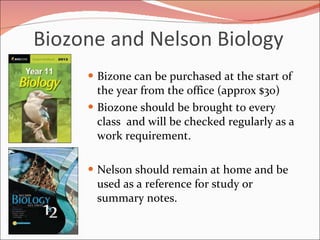
Biozone and Nelson Biology  Bizone can be purchased at the start of the year from the office (approx $30) Biozone should be brought to every class  and will be checked regularly as a work requirement.  Nelson should remain at home and be used as a reference for study or summary notes.
What makes a good VCE student?
What research says:  Use study techniques to make their learning time more productive. Eliminate procrastination. Determine and focus upon what you want to achieve in VCE and beyond. Lay out small, achievable steps to achieve your VCE goals. Prioritise work and goals into small easily achievable chunks and complete them in that order.  Achieve a balance across all areas of life to minimise stress and maximise performance. Continuously learn from their mistakes and refine their skills to improve their performance.
How to be a good VCE student: What research says:  Use study techniques to make their learning time more productive. Eliminate procrastination. Determine and focus upon what you want to achieve in VCE and beyond. Lay out small, achievable steps to achieve your VCE goals. Prioritise work and goals into small easily achievable chunks and complete them in that order.  Achieve a balance across all areas of life to minimise stress and maximise performance. Continuously learn from their mistakes and refine their skills to improve their performance.
 
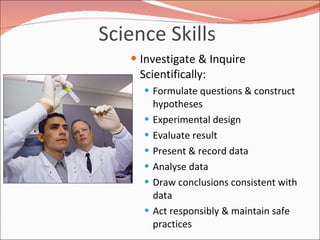
Science Skills Investigate & Inquire Scientifically: Formulate questions & construct hypotheses Experimental design Evaluate result Present & record data Analyse data Draw conclusions consistent with data Act responsibly & maintain safe practices
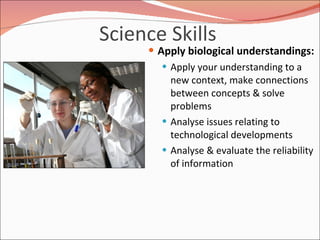
Science Skills Apply biological understandings: Apply your understanding to a new context, make connections between concepts & solve problems Analyse issues relating to technological developments Analyse & evaluate the reliability of information
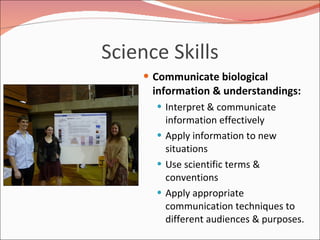
Science Skills Communicate biological information & understandings: Interpret & communicate information effectively Apply information to new situations Use scientific terms & conventions Apply appropriate communication techniques to different audiences & purposes.
 
 
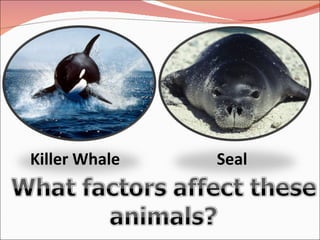
Killer Whale  Seal
 
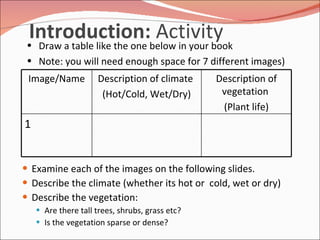
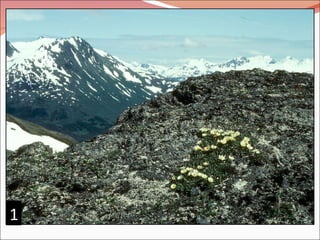
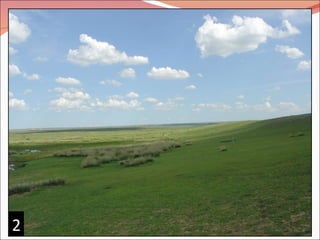
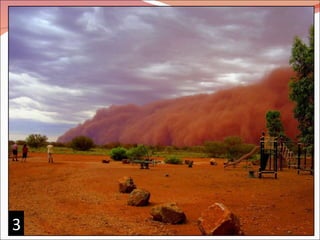
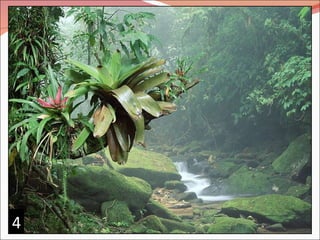
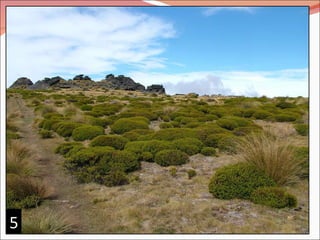
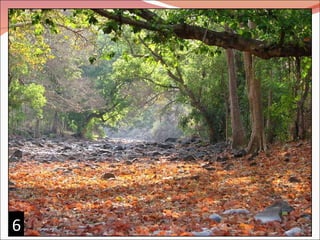
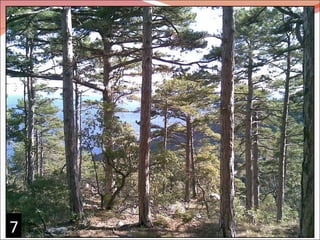
Introduction:  Activity Examine each of the images on the following slides.  Describe the climate (whether its hot or  cold, wet or dry)  Describe the vegetation: Are there tall trees, shrubs, grass etc?  Is the vegetation sparse or dense?  Draw a table like the one below in your book Note: you will need enough space for 7 different images) Image/Name Description of climate  (Hot/Cold, Wet/Dry) Description of vegetation  (Plant life) 1
1
2
3
4
5
6
7
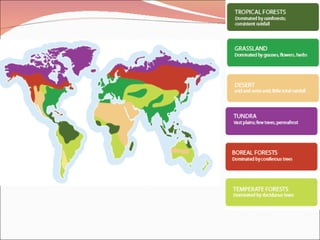
Definitions of a Biome “ A living community characterized by distinctive plants, animals  and climate conditions of a particular region ” “ A biome is a large geographical area of distinctive plant and animal groups, which are adapted to that particular environment. The climate and geography of a region determines what type of biome can exist in that region” Your Task:  In your note write  your own  definition of a biome
 
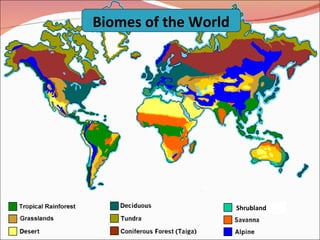
Shrubland Biomes of the World
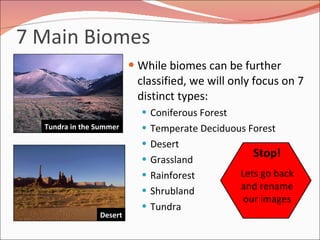
7 Main Biomes While biomes can be further classified, we will only focus on 7 distinct types:  Coniferous Forest Temperate Deciduous Forest Desert Grassland Rainforest Shrubland Tundra Tundra in the Summer Desert Stop! Lets go back and rename our images
 
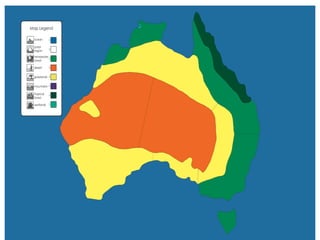
To understand a world biome, you need to know: What the  climate  of the region is like.  Where each biome is found and what its geography is like.  The special  adaptations of the vegetation .  The  types of animals  found in the biome and their  physical and behavioural adaptations  to their environment.

Yr 11 biology orientation 2011

  • 1.
  • 2.
  • 3.
    Activity: Syllabus Read through the syllabus. Identify terms you are not familiar with (highlight or underline). Write a list of these words down.
  • 4.
    Biology Unit 1Organisms & Their Environment Two Area of Studies (AOS): AOS1: Adaptations of Organisms AOS2: Dynamic Ecosystems Two SAC’s for each AOS
  • 5.
    Assessment SAC’s forevery Outcome OTHER Work Requirements (Assignments/Projects; Practical Reports; Biozone Pages; Topic Summaries; Glossary Words) Mid – Year Exam
  • 6.
    About the ExamEach Area of Study (AOS) has approximately equal weighting in terms of questions Questions that address key knowledge and science skills have approximately equal weighting
  • 7.
    PART A: 25Multiple - Choice Questions worth 1 mark each. Select correct response from four alternatives. PART B: Short Answer Questions worth 50 marks in total. Examples used in the exam will be unfamiliar – this is normal! You will be expected to apply knowledge of the concepts to unfamiliar settings.
  • 8.
    Biozone and NelsonBiology Bizone can be purchased at the start of the year from the office (approx $30) Biozone should be brought to every class and will be checked regularly as a work requirement. Nelson should remain at home and be used as a reference for study or summary notes.
  • 9.
    What makes agood VCE student?
  • 10.
    What research says: Use study techniques to make their learning time more productive. Eliminate procrastination. Determine and focus upon what you want to achieve in VCE and beyond. Lay out small, achievable steps to achieve your VCE goals. Prioritise work and goals into small easily achievable chunks and complete them in that order. Achieve a balance across all areas of life to minimise stress and maximise performance. Continuously learn from their mistakes and refine their skills to improve their performance.
  • 11.
    How to bea good VCE student: What research says: Use study techniques to make their learning time more productive. Eliminate procrastination. Determine and focus upon what you want to achieve in VCE and beyond. Lay out small, achievable steps to achieve your VCE goals. Prioritise work and goals into small easily achievable chunks and complete them in that order. Achieve a balance across all areas of life to minimise stress and maximise performance. Continuously learn from their mistakes and refine their skills to improve their performance.
  • 12.
  • 13.
    Science Skills Investigate& Inquire Scientifically: Formulate questions & construct hypotheses Experimental design Evaluate result Present & record data Analyse data Draw conclusions consistent with data Act responsibly & maintain safe practices
  • 14.
    Science Skills Applybiological understandings: Apply your understanding to a new context, make connections between concepts & solve problems Analyse issues relating to technological developments Analyse & evaluate the reliability of information
  • 15.
    Science Skills Communicatebiological information & understandings: Interpret & communicate information effectively Apply information to new situations Use scientific terms & conventions Apply appropriate communication techniques to different audiences & purposes.
  • 16.
  • 17.
  • 18.
  • 19.
  • 20.
    Introduction: ActivityExamine each of the images on the following slides. Describe the climate (whether its hot or cold, wet or dry) Describe the vegetation: Are there tall trees, shrubs, grass etc? Is the vegetation sparse or dense? Draw a table like the one below in your book Note: you will need enough space for 7 different images) Image/Name Description of climate (Hot/Cold, Wet/Dry) Description of vegetation (Plant life) 1
  • 21.
  • 22.
  • 23.
  • 24.
  • 25.
  • 26.
  • 27.
  • 28.
    Definitions of aBiome “ A living community characterized by distinctive plants, animals and climate conditions of a particular region ” “ A biome is a large geographical area of distinctive plant and animal groups, which are adapted to that particular environment. The climate and geography of a region determines what type of biome can exist in that region” Your Task: In your note write your own definition of a biome
  • 29.
  • 30.
  • 31.
    7 Main BiomesWhile biomes can be further classified, we will only focus on 7 distinct types: Coniferous Forest Temperate Deciduous Forest Desert Grassland Rainforest Shrubland Tundra Tundra in the Summer Desert Stop! Lets go back and rename our images
  • 32.
  • 33.
    To understand aworld biome, you need to know: What the climate of the region is like. Where each biome is found and what its geography is like. The special adaptations of the vegetation . The types of animals found in the biome and their physical and behavioural adaptations to their environment.

Editor's Notes

  • #3 Macro: Video- Frozen Planet – Killer whales hunting a seal (ep 1 frozen planet 34:10 – 29:28) Micro: Video - Inner Life of a Cell (3 min) -