REPRODUCTION
Human reproduction is when an egg cell from a woman and a sperm cell
from a man unite and develop in the womb to form a baby. A number of
organs and structures in both the woman and the man are needed in order
for this process to occur. These are called the reproductive organs and
genitals.
MALE’S
SPERM CELL
FEMALE’S
EGG CELL
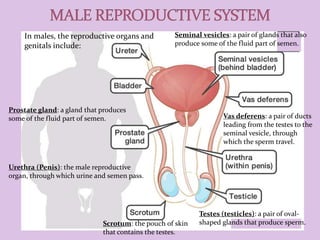
Testes (testicles): a pair of oval-
shaped glands that produce sperm.Scrotum: the pouch of skin
that contains the testes.
Urethra (Penis): the male reproductive
organ, through which urine and semen pass.
Prostate gland: a gland that produces
some of the fluid part of semen.
Seminal vesicles: a pair of glands that also
produce some of the fluid part of semen.
Vas deferens: a pair of ducts
leading from the testes to the
seminal vesicle, through
which the sperm travel.
In males, the reproductive organs and
genitals include:
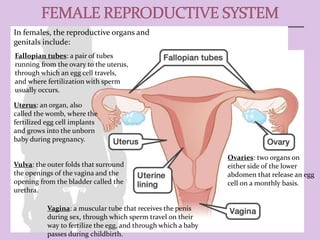
In females, the reproductive organs and
genitals include:
Ovaries: two organs on
either side of the lower
abdomen that release an egg
cell on a monthly basis.
Vagina: a muscular tube that receives the penis
during sex, through which sperm travel on their
way to fertilize the egg, and through which a baby
passes during childbirth.
Fallopian tubes: a pair of tubes
running from the ovary to the uterus,
through which an egg cell travels,
and where fertilization with sperm
usually occurs.
Uterus: an organ, also
called the womb, where the
fertilized egg cell implants
and grows into the unborn
baby during pregnancy.
Vulva: the outer folds that surround
the openings of the vagina and the
opening from the bladder called the
urethra.
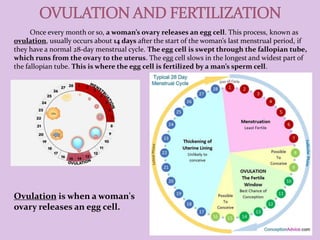
Once every month or so, a woman’s ovary releases an egg cell. This process, known as
ovulation, usually occurs about 14 days after the start of the woman’s last menstrual period, if
they have a normal 28-day menstrual cycle. The egg cell is swept through the fallopian tube,
which runs from the ovary to the uterus. The egg cell slows in the longest and widest part of
the fallopian tube. This is where the egg cell is fertilized by a man’s sperm cell.
Ovulation is when a woman's
ovary releases an egg cell.
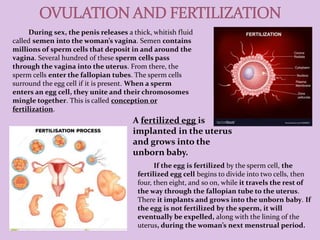
During sex, the penis releases a thick, whitish fluid
called semen into the woman’s vagina. Semen contains
millions of sperm cells that deposit in and around the
vagina. Several hundred of these sperm cells pass
through the vagina into the uterus. From there, the
sperm cells enter the fallopian tubes. The sperm cells
surround the egg cell if it is present. When a sperm
enters an egg cell, they unite and their chromosomes
mingle together. This is called conception or
fertilization.
If the egg is fertilized by the sperm cell, the
fertilized egg cell begins to divide into two cells, then
four, then eight, and so on, while it travels the rest of
the way through the fallopian tube to the uterus.
There it implants and grows into the unborn baby. If
the egg is not fertilized by the sperm, it will
eventually be expelled, along with the lining of the
uterus, during the woman’s next menstrual period.
A fertilized egg is
implanted in the uterus
and grows into the
unborn baby.
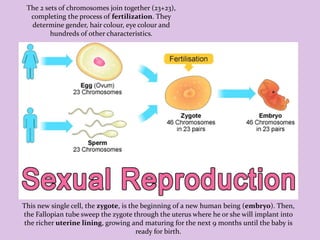
The 2 sets of chromosomes join together (23+23),
completing the process of fertilization. They
determine gender, hair colour, eye colour and
hundreds of other characteristics.
This new single cell, the zygote, is the beginning of a new human being (embryo). Then,
the Fallopian tube sweep the zygote through the uterus where he or she will implant into
the richer uterine lining, growing and maturing for the next 9 months until the baby is
ready for birth.
The placenta absorbs
nutrients and oxygen from
the mum’s blood and deliver
them to the baby via the
umbilical cord. Then, the
umbilical cord carries waste
products (poo and carbon
dioxide) away from the baby
down the umbilical cord and
through the placenta into
the mum’s body for her to
get rid of.
The amniotic sac is a bag of
fluid inside a woman's womb
(uterus) where the unborn
baby develops and grows.
The amniotic fluid is the
protective liquid contained
by the amniotic sac. This
fluid serves as a cushion for
the growing fetus, but also
serves to facilitate the
exchange of nutrients, water,
and biochemical products
between mother and fetus. It
is also called water or
waters.
Most babies are born
between 38 and 42
weeks of pregnancy
(9 months). Babies
born after 42 weeks are
described as 'post-term'
while those born before
37 completed weeks are
'preterm' or
'premature'

Reproduction

  • 1.
  • 2.
    Human reproduction iswhen an egg cell from a woman and a sperm cell from a man unite and develop in the womb to form a baby. A number of organs and structures in both the woman and the man are needed in order for this process to occur. These are called the reproductive organs and genitals. MALE’S SPERM CELL FEMALE’S EGG CELL
  • 3.
    Testes (testicles): apair of oval- shaped glands that produce sperm.Scrotum: the pouch of skin that contains the testes. Urethra (Penis): the male reproductive organ, through which urine and semen pass. Prostate gland: a gland that produces some of the fluid part of semen. Seminal vesicles: a pair of glands that also produce some of the fluid part of semen. Vas deferens: a pair of ducts leading from the testes to the seminal vesicle, through which the sperm travel. In males, the reproductive organs and genitals include:
  • 4.
    In females, thereproductive organs and genitals include: Ovaries: two organs on either side of the lower abdomen that release an egg cell on a monthly basis. Vagina: a muscular tube that receives the penis during sex, through which sperm travel on their way to fertilize the egg, and through which a baby passes during childbirth. Fallopian tubes: a pair of tubes running from the ovary to the uterus, through which an egg cell travels, and where fertilization with sperm usually occurs. Uterus: an organ, also called the womb, where the fertilized egg cell implants and grows into the unborn baby during pregnancy. Vulva: the outer folds that surround the openings of the vagina and the opening from the bladder called the urethra.
  • 5.
    Once every monthor so, a woman’s ovary releases an egg cell. This process, known as ovulation, usually occurs about 14 days after the start of the woman’s last menstrual period, if they have a normal 28-day menstrual cycle. The egg cell is swept through the fallopian tube, which runs from the ovary to the uterus. The egg cell slows in the longest and widest part of the fallopian tube. This is where the egg cell is fertilized by a man’s sperm cell. Ovulation is when a woman's ovary releases an egg cell.
  • 6.
    During sex, thepenis releases a thick, whitish fluid called semen into the woman’s vagina. Semen contains millions of sperm cells that deposit in and around the vagina. Several hundred of these sperm cells pass through the vagina into the uterus. From there, the sperm cells enter the fallopian tubes. The sperm cells surround the egg cell if it is present. When a sperm enters an egg cell, they unite and their chromosomes mingle together. This is called conception or fertilization. If the egg is fertilized by the sperm cell, the fertilized egg cell begins to divide into two cells, then four, then eight, and so on, while it travels the rest of the way through the fallopian tube to the uterus. There it implants and grows into the unborn baby. If the egg is not fertilized by the sperm, it will eventually be expelled, along with the lining of the uterus, during the woman’s next menstrual period. A fertilized egg is implanted in the uterus and grows into the unborn baby.
  • 7.
    The 2 setsof chromosomes join together (23+23), completing the process of fertilization. They determine gender, hair colour, eye colour and hundreds of other characteristics. This new single cell, the zygote, is the beginning of a new human being (embryo). Then, the Fallopian tube sweep the zygote through the uterus where he or she will implant into the richer uterine lining, growing and maturing for the next 9 months until the baby is ready for birth.
  • 8.
    The placenta absorbs nutrientsand oxygen from the mum’s blood and deliver them to the baby via the umbilical cord. Then, the umbilical cord carries waste products (poo and carbon dioxide) away from the baby down the umbilical cord and through the placenta into the mum’s body for her to get rid of. The amniotic sac is a bag of fluid inside a woman's womb (uterus) where the unborn baby develops and grows. The amniotic fluid is the protective liquid contained by the amniotic sac. This fluid serves as a cushion for the growing fetus, but also serves to facilitate the exchange of nutrients, water, and biochemical products between mother and fetus. It is also called water or waters. Most babies are born between 38 and 42 weeks of pregnancy (9 months). Babies born after 42 weeks are described as 'post-term' while those born before 37 completed weeks are 'preterm' or 'premature'