Multiword
Verbs
Wilson Carrión
https://www.facebook.com/EspanglishLoja-101719766865512/
Definition
Are verbs which consist of a verb and one or
two particles or prepositions (e.g. up, over, in,
down). There are three types of multi-word
verbs.
Phrasal verbs
Prepositional verbs
Phrasal-prepositional verbs.
Structure: verb+adverb
Phrasal verbs can be:

Transitive (direct object)

Intransitive (no direct object)
phrasal verbs
Separable phrasal verbs
When phrasal verbs are transitive (that is, they have a direct
object), we can usually separate the two parts. For example,
"turn down" is a separable phrasal verb. We can say: "turn
down my offer" or "turn my offer down". Look at these example
sentences:

They turned down my offer.

They turned my offer down.
Separable phrasal verbs
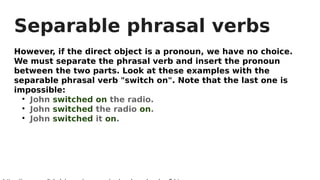
However, if the direct object is a pronoun, we have no choice.
We must separate the phrasal verb and insert the pronoun
between the two parts. Look at these examples with the
separable phrasal verb "switch on". Note that the last one is
impossible:

John switched on the radio.

John switched the radio on.

John switched it on.
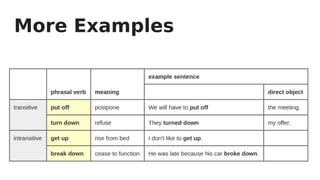
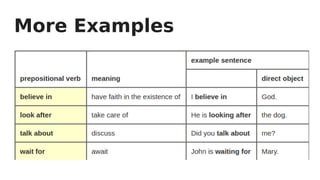
More Examples
Prepositional Verbs
structure: verb + preposition
Because a preposition always has an
object, all prepositional verbs have
direct objects.
Example
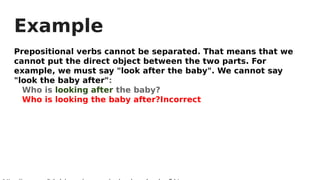
Prepositional verbs cannot be separated. That means that we
cannot put the direct object between the two parts. For
example, we must say "look after the baby". We cannot say
"look the baby after":
Who is looking after the baby?
Who is looking the baby after?Incorrect
More Examples
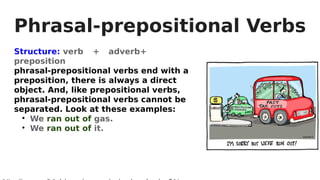
Phrasal-prepositional Verbs
Structure: verb + adverb+
preposition
phrasal-prepositional verbs end with a
preposition, there is always a direct
object. And, like prepositional verbs,
phrasal-prepositional verbs cannot be
separated. Look at these examples:

We ran out of gas.

We ran out of it.
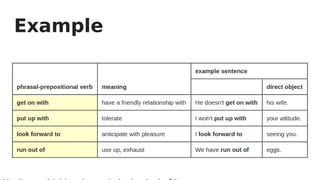
Example

Multiword verbs

  • 1.
  • 2.
    Definition Are verbs whichconsist of a verb and one or two particles or prepositions (e.g. up, over, in, down). There are three types of multi-word verbs. Phrasal verbs Prepositional verbs Phrasal-prepositional verbs.
  • 3.
    Structure: verb+adverb Phrasal verbscan be:  Transitive (direct object)  Intransitive (no direct object) phrasal verbs
  • 4.
    Separable phrasal verbs Whenphrasal verbs are transitive (that is, they have a direct object), we can usually separate the two parts. For example, "turn down" is a separable phrasal verb. We can say: "turn down my offer" or "turn my offer down". Look at these example sentences:  They turned down my offer.  They turned my offer down.
  • 5.
    Separable phrasal verbs However,if the direct object is a pronoun, we have no choice. We must separate the phrasal verb and insert the pronoun between the two parts. Look at these examples with the separable phrasal verb "switch on". Note that the last one is impossible:  John switched on the radio.  John switched the radio on.  John switched it on.
  • 6.
  • 7.
    Prepositional Verbs structure: verb+ preposition Because a preposition always has an object, all prepositional verbs have direct objects.
  • 8.
    Example Prepositional verbs cannotbe separated. That means that we cannot put the direct object between the two parts. For example, we must say "look after the baby". We cannot say "look the baby after": Who is looking after the baby? Who is looking the baby after?Incorrect
  • 9.
  • 10.
    Phrasal-prepositional Verbs Structure: verb+ adverb+ preposition phrasal-prepositional verbs end with a preposition, there is always a direct object. And, like prepositional verbs, phrasal-prepositional verbs cannot be separated. Look at these examples:  We ran out of gas.  We ran out of it.
  • 11.