Modal verbs
Probability
Must-Should-Might/May/Could-Can-Can`t
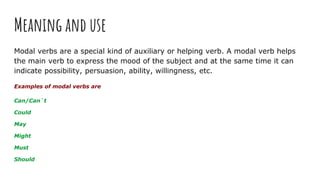
Meaning and use
Modal verbs are a special kind of auxiliary or helping verb. A modal verb helps
the main verb to express the mood of the subject and at the same time it can
indicate possibility, persuasion, ability, willingness, etc.
Examples of modal verbs are
Can/Can`t
Could
May
Might
Must
Should
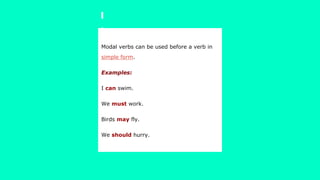
Modal verbs can be used before a verb in
simple form.
Examples:
I can swim.
We must work.
Birds may fly.
We should hurry.
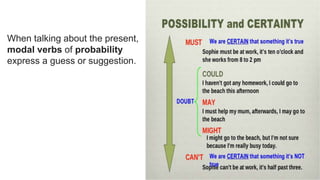
When talking about the present,
modal verbs of probability
express a guess or suggestion.
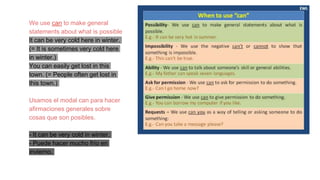
We use can to make general
statements about what is possible
It can be very cold here in winter.
(= It is sometimes very cold here
in winter.)
You can easily get lost in this
town. (= People often get lost in
this town.)
Usamos el modal can para hacer
afirmaciones generales sobre
cosas que son posibles.
- It can be very cold in winter.
- Puede hacer mucho frío en
invierno.
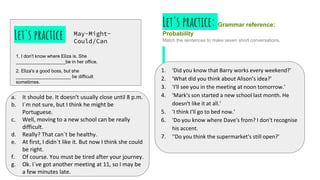
Let's practice
1. I don't know where Eliza is. She
___________________be in her office.
2. Eliza's a good boss, but she
_____________________ be difficult
sometimes.
May-Might-
Could/Can
1. 'Did you know that Barry works every weekend?'
2. 'What did you think about Alison's idea?'
3. 'I'll see you in the meeting at noon tomorrow.'
4. 'Mark's son started a new school last month. He
doesn't like it at all.'
5. 'I think I'll go to bed now.'
6. 'Do you know where Dave's from? I don't recognise
his accent.
7. ''Do you think the supermarket's still open?'
a. It should be. It doesn't usually close until 8 p.m.
b. I´m not sure, but I think he might be
Portuguese.
c. Well, moving to a new school can be really
difficult.
d. Really? That can´t be healthy.
e. At first, I didn´t like it. But now I think she could
be right.
f. Of course. You must be tired after your journey.
g. Ok. I´ve got another meeting at 11, so I may be
a few minutes late.
Let's practice: Grammar reference:
Probability
Match the sentences to make seven short conversations.

Probability possibility (1)

  • 1.
  • 2.
    Meaning and use Modalverbs are a special kind of auxiliary or helping verb. A modal verb helps the main verb to express the mood of the subject and at the same time it can indicate possibility, persuasion, ability, willingness, etc. Examples of modal verbs are Can/Can`t Could May Might Must Should
  • 3.
    Modal verbs canbe used before a verb in simple form. Examples: I can swim. We must work. Birds may fly. We should hurry.
  • 4.
    When talking aboutthe present, modal verbs of probability express a guess or suggestion.
  • 6.
    We use canto make general statements about what is possible It can be very cold here in winter. (= It is sometimes very cold here in winter.) You can easily get lost in this town. (= People often get lost in this town.) Usamos el modal can para hacer afirmaciones generales sobre cosas que son posibles. - It can be very cold in winter. - Puede hacer mucho frío en invierno.
  • 7.
    Let's practice 1. Idon't know where Eliza is. She ___________________be in her office. 2. Eliza's a good boss, but she _____________________ be difficult sometimes. May-Might- Could/Can 1. 'Did you know that Barry works every weekend?' 2. 'What did you think about Alison's idea?' 3. 'I'll see you in the meeting at noon tomorrow.' 4. 'Mark's son started a new school last month. He doesn't like it at all.' 5. 'I think I'll go to bed now.' 6. 'Do you know where Dave's from? I don't recognise his accent. 7. ''Do you think the supermarket's still open?' a. It should be. It doesn't usually close until 8 p.m. b. I´m not sure, but I think he might be Portuguese. c. Well, moving to a new school can be really difficult. d. Really? That can´t be healthy. e. At first, I didn´t like it. But now I think she could be right. f. Of course. You must be tired after your journey. g. Ok. I´ve got another meeting at 11, so I may be a few minutes late. Let's practice: Grammar reference: Probability Match the sentences to make seven short conversations.