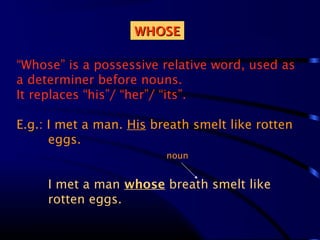
“Whose” is a possessive relative word, used as
a determiner before nouns.
It replaces “his”/ “her”/ “its”.
E.g.: I met a man. His breath smelt like rotten
eggs.
noun
I met a man whose breath smelt like
rotten eggs.
WHOSEWHOSE
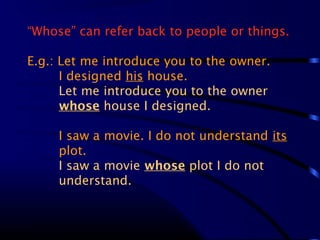
“Whose” can refer back to people or things.
E.g.: Let me introduce you to the owner.
I designed his house.
Let me introduce you to the owner
whose house I designed.
I saw a movie. I do not understand its
plot.
I saw a movie whose plot I do not
understand.
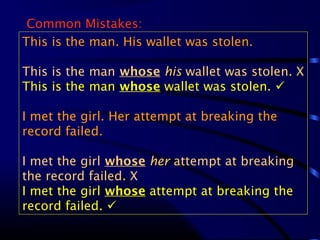
Common Mistakes:
This is the man. His wallet was stolen.
This is the man whose hishis wallet was stolen. X
This is the man whose wallet was stolen. 
I met the girl. Her attempt at breaking the
record failed.
I met the girl whose herher attempt at breaking
the record failed. X
I met the girl whose attempt at breaking the
record failed. 
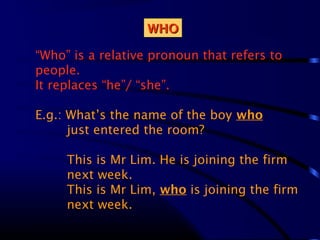
“Who” is a relative pronoun that refers to
people.
It replaces “he”/ “she”.
E.g.: What’s the name of the boy who
just entered the room?
This is Mr Lim. He is joining the firm
next week.
This is Mr Lim, who is joining the firm
next week.
WHOWHO
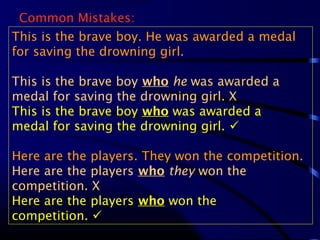
Common Mistakes:
This is the brave boy. He was awarded a medal
for saving the drowning girl.
This is the brave boy who he was awarded a
medal for saving the drowning girl. X
This is the brave boy who was awarded a
medal for saving the drowning girl. 
Here are the players. They won the competition.
Here are the players who they won the
competition. X
Here are the players who won the
competition. 
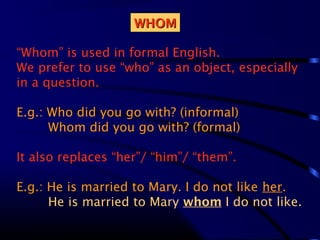
“Whom” is used in formal English.
We prefer to use “who” as an object, especially
in a question.
E.g.: Who did you go with? (informal)
Whom did you go with? (formal)
It also replaces “her”/ “him”/ “them”.
E.g.: He is married to Mary. I do not like her.
He is married to Mary whom I do not like.
WHOMWHOM
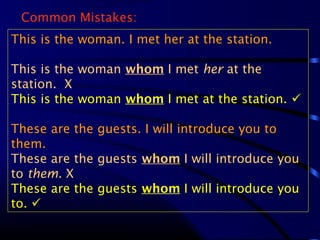
Common Mistakes:
This is the woman. I met her at the station.
This is the woman whom I met her at the
station. X
This is the woman whom I met at the station. 
These are the guests. I will introduce you to
them.
These are the guests whom I will introduce you
to them. X
These are the guests whom I will introduce you
to. 

Whose,who, whom

  • 2.
    “Whose” is apossessive relative word, used as a determiner before nouns. It replaces “his”/ “her”/ “its”. E.g.: I met a man. His breath smelt like rotten eggs. noun I met a man whose breath smelt like rotten eggs. WHOSEWHOSE
  • 3.
    “Whose” can referback to people or things. E.g.: Let me introduce you to the owner. I designed his house. Let me introduce you to the owner whose house I designed. I saw a movie. I do not understand its plot. I saw a movie whose plot I do not understand.
  • 4.
    Common Mistakes: This isthe man. His wallet was stolen. This is the man whose hishis wallet was stolen. X This is the man whose wallet was stolen.  I met the girl. Her attempt at breaking the record failed. I met the girl whose herher attempt at breaking the record failed. X I met the girl whose attempt at breaking the record failed. 
  • 5.
    “Who” is arelative pronoun that refers to people. It replaces “he”/ “she”. E.g.: What’s the name of the boy who just entered the room? This is Mr Lim. He is joining the firm next week. This is Mr Lim, who is joining the firm next week. WHOWHO
  • 6.
    Common Mistakes: This isthe brave boy. He was awarded a medal for saving the drowning girl. This is the brave boy who he was awarded a medal for saving the drowning girl. X This is the brave boy who was awarded a medal for saving the drowning girl.  Here are the players. They won the competition. Here are the players who they won the competition. X Here are the players who won the competition. 
  • 7.
    “Whom” is usedin formal English. We prefer to use “who” as an object, especially in a question. E.g.: Who did you go with? (informal) Whom did you go with? (formal) It also replaces “her”/ “him”/ “them”. E.g.: He is married to Mary. I do not like her. He is married to Mary whom I do not like. WHOMWHOM
  • 8.
    Common Mistakes: This isthe woman. I met her at the station. This is the woman whom I met her at the station. X This is the woman whom I met at the station.  These are the guests. I will introduce you to them. These are the guests whom I will introduce you to them. X These are the guests whom I will introduce you to. 