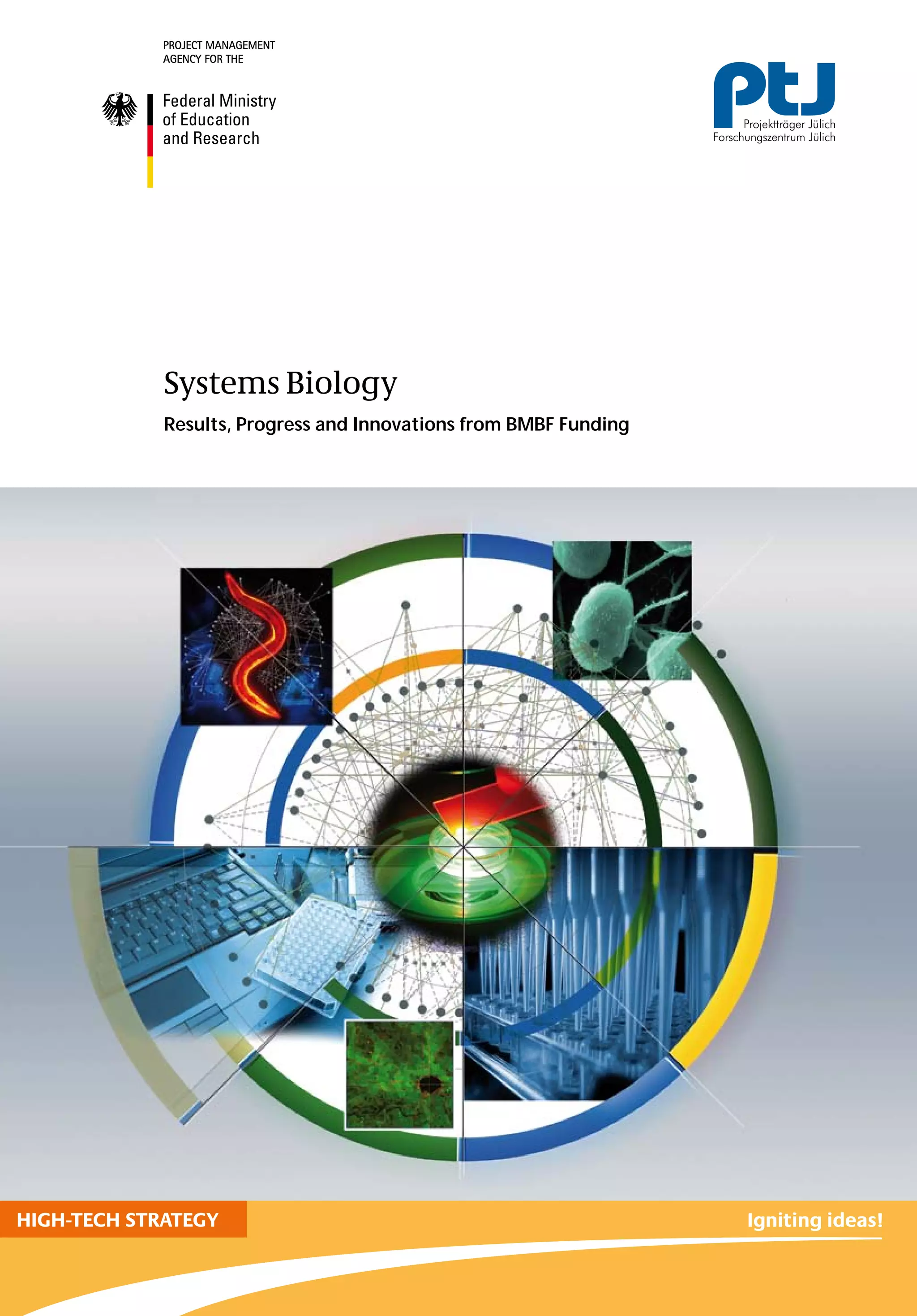
Systems Biology
Results, Progress and Innovations from BMBF Funding
Imprint


Published by

Forschungszentrum Jülich GmbH

Project Management Jülich (PtJ)

52425 Jülich


Orders

In writing to the publisher

Project Management Jülich (PtJ)

Außenstelle Berlin

PO Box 610247

10923 Berlin


Phone: +49-30-20199-457

Fax: +49-30-20199-470

E-Mail: ptj-bio@fz-juelich.de

Internet: www.fz-juelich/ptj/systembiologie


Supervision Contents

Dr. Sigrid Grolle, Dr. Gisela Miczka (PtJ), Jülich


Edited by

Dr. Stefanie Reinberger, Heidelberg


Translation

Language Services, Central Library, Forschungszentrum Jülich GmbH


Layout

FOCON GmbH, Aachen


Print

Bonifatius GmbH, Druck Buch Verlag, Paderborn


As of Jülich, Berlin 2008


Photo credits

Derichs Kommunikation GmbH, Jülich: Cover picture

Further photos and figures are provided from the respective authors (q.v.)
Systems Biology
Results, Progress and Innovations from BMBF Funding
2                                                                                                PReFace


Preface
Systems biology is working


     Systems biology began well before the turn of        The functioning of living organisms does not
the century in the USA and in Japan. Its empirical   only depend on their individual components but
molecular genetics/genomics roots were more          also on the interactions between these components,
American, its physical chemistry/mathematical        i.e. on dynamic networking. For good reasons,
biology roots, including non-equilibrium             molecular biology focuses on individual macro-
thermodynamics and metabolic control analy-          molecules. One paradox is therefore that systems
sis, more European. Hybridization arrays, QPCR,      biology needs to interface actively with molecular
2-D electrophoresis, chromatography plus 2-D         biology, which itself shies away from studying
mass spectrometry, and quantitative microscopy       interactions and networking. Systems biology
enable the quantification of changes in concen-      also needs to interface strongly with physiology,
trations of molecules and thus represent an ad-      which itself frowns upon an analytical approach
ditional basis for systems biology. Even if Europe   based on individual components. Tuned to the
has a historical lead in some of these, the major    simplest possible systems and linear approxima-
initiatives in systems biology started in the USA    tions thereof, mathematics and physics consider
and Japan. There the time was ripe for systems       biology a mere set of special cases, too complex
biology whilst Europe was more sceptical with        to resolve. Systems biology needs to integrate
respect to new research and development.             and add to these three paradoxical approaches.
     This barrier was overcome by the first major         Quite a number of research programmes
coherent systems biology research programme in       throughout the world call themselves systems
Europe, which started in 2004. The programme         biology, but do not integrate these three
was ‘HepatoSys’, funded by the Federal Ministry      approaches. Some merely calculate theoretical
of Education and Research (BMBF). In the follow-     behaviour that may not actually function. Others
ing year, the UK BBSRC and EPSRC funded research     collect data without interpreting how functions
centres and doctoral training centres for systems    arise from interactions. The BMBF research
biology. The BMBF then funded four such research     programmes, and certainly HepatoSys, integrate
centres (FORSYS) in 2007. Setting up further fund-   the three approaches, and with appreciable success.
ing priorities (QuantPro, FORSYS Partner), BMBF      The preparatory committees and the international
continued to propel German systems biology           steering committees worked hard to bring about
forward, also by supporting the training of young    this integration. The committees had to reject
scientists. At the same time BMBF announced a        excellent research that lacked integration per-
transnational research programme on microbial        spectives, and they insisted on the integration of
systems biology (SysMO) with the Netherlands,        distinct proposals. Both types of action are unusual
the UK, Austria, Norway and Spain. In 2008 many      in evaluating and advising on scientific research.
additional systems biology research programmes            The paradigm shift effected by systems biology
are now running in Europe, including Germany,        implies that the success of systems biology pro-
where the new funding priority MedSys will fund      grammes should be judged by more stringent
applied systems biology in medical research.         criteria than the success of traditional research
PReFace                                                                                                                        3


programmes. Of course, the research should be                BMBF is to be complimented on the important
excellent, as judged from the discoveries and ap-       role it has played in the emergence of systems
plications. In addition, the programmes should be       biology. Japan and the USA may have been first
distinguished from the traditional research pro-        to engage in systems biology, but BMBF has now
grammes in molecular biology, mathematics and           put Europe into a leading position with the first
physiology. Research that is excellent in terms of      and by far the largest, truly integrated systems
molecular biology but not in terms of mathematics       biology programmes. The integration of the
may not be regarded as excellent systems biol-          various disciplines dealing with various aspects of
ogy. On the other hand, the highest excellence in       the human cell is of tremendous importance for
systems biology may conflict with the paradoxical       health, disease and drug effectiveness. BMBF has
standards of the two neighbouring disciplines. For      also promoted the standardisation that is abso-
the steering committee, this makes life difficult,      lutely essential for the life sciences and for the
as the quality of research proposals/reports can-       ‘silicon human’ of the future. In addition, it has
not be assessed from the number of publications         enabled scientists to make scientific discoveries
in journals with high impact in molecular biology,      that could not otherwise have been made.
or in conference proceedings in engineering.                 I invite you to study this brochure, and to assess
    Another paradox relates to the involvement of       and enjoy the progress made by systems biology
industry in systems biology programmes. The phar-       in Germany. Systems biology is working, also in
maceutical industry understands why one should          Europe.
look at disease and drug safety from the perspective
of networks. However, since systems biology deals
with entire networks, the best expertise needs to be
engaged; involving too many research groups for
the intellectual property to remain exclusive. The
pharmaceutical industry will only become involved
when research starts to become applicable. Then         Hans V. Westerhoff
they plan defined bilateral projects with academic
research groups. These kinds of projects are ex-
pected for the funding priority MedSys, and may         Hans V. Westerhoff is AstraZeneca Professor of Systems Biology and
now also become possible for Hepatosys. Systems         Director of the Doctoral Training Centre for Integrative Systems
biology is a matter for large-scale public funding in   Biology from Molecules to Life (ISBML), Manchester, UK. Furthermore,
order to support new application-relevant research      he is Professor of Molecular Cell Physiology at the Free University
programmes in their early phases.                       Amsterdam and is Chairman of the “HepatoSys” Steering Committee.
4                                                                   contentS


Contents


Preface
Hans V. Westerhoff                                                    2

Contents                                                              4

Progress and Innovation through Systems Biology
G. Miczka                                                             6

HepatoSys – Systems Biology of Liver Cells

HepatoSys - Systems Biology Studies of Liver Cells (Introduction)
U. Heisner                                                            10

Robustness of the Drug Detoxification Metabolism in Liver Cells
M. Reuss, J. Bucher, U.M. Zanger                                      12

A Circuit Diagram for Biotransformation
K. Mauch                                                              14

High Tech for Liver Cells
M. Athelogou, G. Schmidt, F. Owen                                     16

The Endocytosis Transport Network/System
M. Zerial, J. McCaskill, A. Deutsch                                   18

Iron Network
J.G. Reich, M. Muckenthaler, M. Hentze                                20

Central Data Management
H.-P. Fischer, D. Bannasch                                            22

Liver Cells in Culture
J. G. Hengstler                                                       24

Feedback for Liver Regeneration
U. Klingmüller, S.Dooley, J. Timmer                                   26

Liver Regeneration – A Unique Phenomenon
D. Drasdo, S.Höhme                                                    28

HepatoNet - Modelling the Liver Metabolism
H.-G. Holzhütter, K. Hübner, S. Hoffmann                              30

FORSYS – Centres of Systems Biology

FORSYS – Research Units on Systems Biology (Introduction)
B. Regierer                                                           32
contentS                                                                                           5


Targeting Parkinson’s Disease
R. Baumeister, E. Schmidt                                                                     34

The Cell’s Suicide Programme
R. Eils                                                                                       36

On the Track of Molecular Synergisms
W. Weckwerth                                                                                  38

Microbes and Men – A Complicated Coexistence
M. Naumann, R. Poltz                                                                          40

QuantPro – Quantitative Analysis for the Description of Dynamic Processes in Living Systems

QuantPro – Quantitative Analysis for the Description of
Dynamic Processes in Living Systems, (Introduction)
Y. Pfeiffenschneider                                                                          42

Biomarkers for Potato Breeding
P. Geigenberger                                                                               44

Transport Systems in the Liver
U. Pehl                                                                                       46

The Light Processing Network
D. Osterhelt , M. Ueffing                                                                     48

SysMO – Systems Biology of Microorganisms

SysMO – Systems Biology of Microorganisms (Introduction)
M. Heidelberger                                                                               50

Lactic Acid Bacteria in Comparison
U. Kummer, B. Kreikemeyer                                                                     52

Stress in Bacteria
V. Martins dos Santos                                                                         54

Clostridium acetobutylicum – a Response to Dwindling Crude Oil Reserves
P. Dürre, A. Ehrenreich                                                                       56


ERASysBio – 13 Countries Coordinate their Funding Activities
V. Simons                                                                                     58

Data and Facts on Funding for Systems Biology in Germany
E. Stüttgen                                                                                   59
6                                                        PRogReSS and InnovatIon thRough SySteMS BIology


Progress and Innovation through Systems Biology


   In all societies, innovations form the basis for     is an iterative process between laboratory experi-
progress and development. Innovations ensure            ments and mathematical modelling. The result of
continuous growth, prosperity and international         this process is an optimised mathematical model
competitiveness. The Federal Government’s High-         describing the behaviour of a given biological
Tech Strategy for Germany is therefore specifically     system in a defined environment. This thus facili-
promoting research fields with a high innovation        tates predictions about the behaviour of the system
potential. This also includes the relatively young      under the influence of internal and external factors.
discipline of systems biology.

    After the widespread introduction of the               What is systems biology?
methods of molecular biology in medicine and               Systems biology is characterised as the quantita-
biology, systems biology is regarded as the second         tive analysis of dynamic interactions between the
key technology for achieving progress in the life          components of a biological system with the aim
sciences. At the same time, it forms the basis for         of understanding the behaviour of the system as a
exploiting new innovation potential in the                 whole and enabling predictions of its behaviour to
knowledge-based bioindustry.                               be made. to this end, mathematical concepts are
                                                           applied to biological systems so that an iterative
What is systems biology?                                   process takes place between laboratory experiments
                                                           and computer modelling.
     In the past, the individual research disciplines
in the life sciences primarily focused on investigat-
ing process flows down to the molecular details. In
a descriptive approach directed at achieving high       Benefits of systems biology
quality and molecular details, a wealth of data was
generated concerning single cell components or              With its new concept, systems biology has the
functions. However, the interaction of these mol-       potential to radically change the life sciences and
ecular structures is highly dynamic and is control-     to provide completely new findings for biomedical
led by cross-linkages with all cellular hierarchies.    research and for biotechnology in industry and
In order to understand such a biological system         agriculture. Working with models and computer
as a whole, it is necessary to have a quantitative      simulations offers the opportunity of proceed-
understanding of the processes taking place in          ing in a targeted manner. Instead of looking for
it. This is the starting point for systems biology.     the proverbial needle in a haystack, the most
The aim of the systems biology research approach        probable processes can be calculated and ex-
is to understand the behaviour, the dynamics of a       periments tailored accordingly. Systems biology
biological system, for example a metabolic path-        thus offers the opportunity of raising knowledge
way, a cell organelle or - in the distant future - a    of dynamics and the interaction of vital func-
whole cell or organism in its entirety. This requires   tions to a completely new plane and of exploit-
the linkage of all molecular biology data from the      ing new potential for innovation in medicine,
level of the genome, through the transcriptome          the pharmaceutical industry, the chemical
and the proteome, up to and including the met-          industry and the biotechnology industry.
abolome, the analysis of interaction patterns and       The application of computer models may in future,
also data integration with the aid of mathematical      for example, serve to find new targets for treating
methods. A basic prerequisite for systems biology       diseases or forecasting possible side effects of new
approaches is therefore the interdisciplinary           active substances. Drug development will thus
collaboration of researchers from the fields of         become more effective and safer and, moreover,
biology, chemistry, medicine, computer science,         permit animal experiments to be restricted to a
mathematics, systems science and also engineering.      minimum. In the same way, biological applications
The heart of the systems biology research approach      can be specifically optimised, for example increas-
PRogReSS and InnovatIon thRough SySteMS BIology                                                                      7


ing the productivity of cell systems for certain         biology in Germany. This support measure consists
systems and also the development of novel synthesis      of two components. The “FORSYS Cooperations”
techniques. First applications are already beginning     provide support for a transfer of know-how be-
to emerge in the ongoing research projects.              tween the existing FORSYS centres and partners
                                                         from academia and industry and lay the founda-
Support measures implemented by                          tion for the establishment of further competence
the Federal Ministry of education and Research           nodes for systems biology in Germany. The “FORSYS
                                                         Young Investigators Groups“ give young scientists
     Systems biology requires altered research           the opportunity to conduct independent research
structures in science and industry, new cooperation      and thus to exploit their creative potential.
models and a new quality of interdisciplinary and
interindustrial collaboration in a national and inter-
national framework. The Federal Ministry of Educa-          Peter gruss, President of the Max Planck Society
tion and Research (BMBF) recognised this at an early
point and is reacting to these constraints. As part         “the systems biology research approach in the life
of the Federal Government’s High-Tech Strategy,             sciences will have a decisive influence on progress in
it is undertaking a selective expansion of systems          biology and medicine.”
biology support measures and the establishment
of relevant research and funding structures on a
national and international level. These measures            The support measure “Medical Systems Biology –
are being taken within the context of lines of action    MedSys” announced early in 2008 focuses on the
planned or implemented by the federal states, the        application potential of systems biology for medi-
Helmholtz Association, the Max Planck Society and        cine and drug development. Apart from academic
other research and funding organisations in this         research groups, it therefore primarily targets cor-
field.                                                   porate research departments in the pharmaceutical
                                                         and biotechnology industries, which are concerned,
    Back in 2001, BMBF initialised funding of this       among other things, with the development of
innovative research field in Germany with its call       patient-related tools for diagnosis and treatment or
for proposals for “Living Systems – Systems Biology”.    the application of systems biology approaches for
The resulting pilot project “Systems Biology of the      increasing the efficiency of clinical trials.
Liver Cell - HepatoSys“ has now developed into a            Systems biology also plays a not inconsiderable
nationwide network of expertise which also enjoys        part in the support measure on the topic of
international recognition.                               “BioEnergy 2021 – Research on Utilising Biomass“
    The support programme “Research Units of             announced at the beginning of 2008. The “Systems
Systems Biology- FORSYS” created the decisive basis      Biology for Bioenergy” module will fund research
for systems biology in Germany. The establishment        projects that contribute towards optimising crops as
of the four FORSYS centres in Freiburg, Heidelberg,      energy plants.
Magdeburg and Potsdam in 2007 improved the
situation for systems biology, with respect to both          The discussion is currently focusing on further
structure and content. The FORSYS centres ensure         research measures including the expansion of the
that the interdisciplinary collaboration essential for   methodological and technological basis for systems
systems biology is available “under the same roof”,      biology, for which the foundation was laid by the
and that there is a local concentration of research      research priority “Quantitative Analysis to Describe
expertise that also provides training opportunities      the Dynamic Processes in Living Systems – Quant-
for young scientists.                                    Pro” that started in 2004. In addition, attention
    The support measure announced in 2007                is also being paid to exploiting the potential of
“Partners for Research Units of Systems Biology –        systems biology research for other fields of
FORSYS Partners” further strengthened systems            application (e.g. for health in ageing).
8                                                                    PRogReSS and InnovatIon thRough SySteMS BIology


    Apart from national commitments, the Federal                        The Federal Research Ministry is also involved in
Research Ministry is also involved in the develop-                  planning a large-scale European project on the
ment of European support measures for systems                       “Systems Biology of the Metabolic Syndrome” that is
biology. For example, in 2006 as part of the ERA-Net                scheduled to be launched in 2009.
ERASYSBIO, the transnational support measure                            The strategy paper “Systems Biology in the Euro-
SysMO (Systems Biology of Microorganisms) was                       pean Research Area” was published in April 2008
agreed jointly with six European partners. Funding                  by ERA-Net ERASYSBIO as a basis for the further
of the transnational collaborative projects began in                harmonisation of funding policy for systems biology
2007 and due to the success of these projects will be               in Europe.
continued beyond 2010.


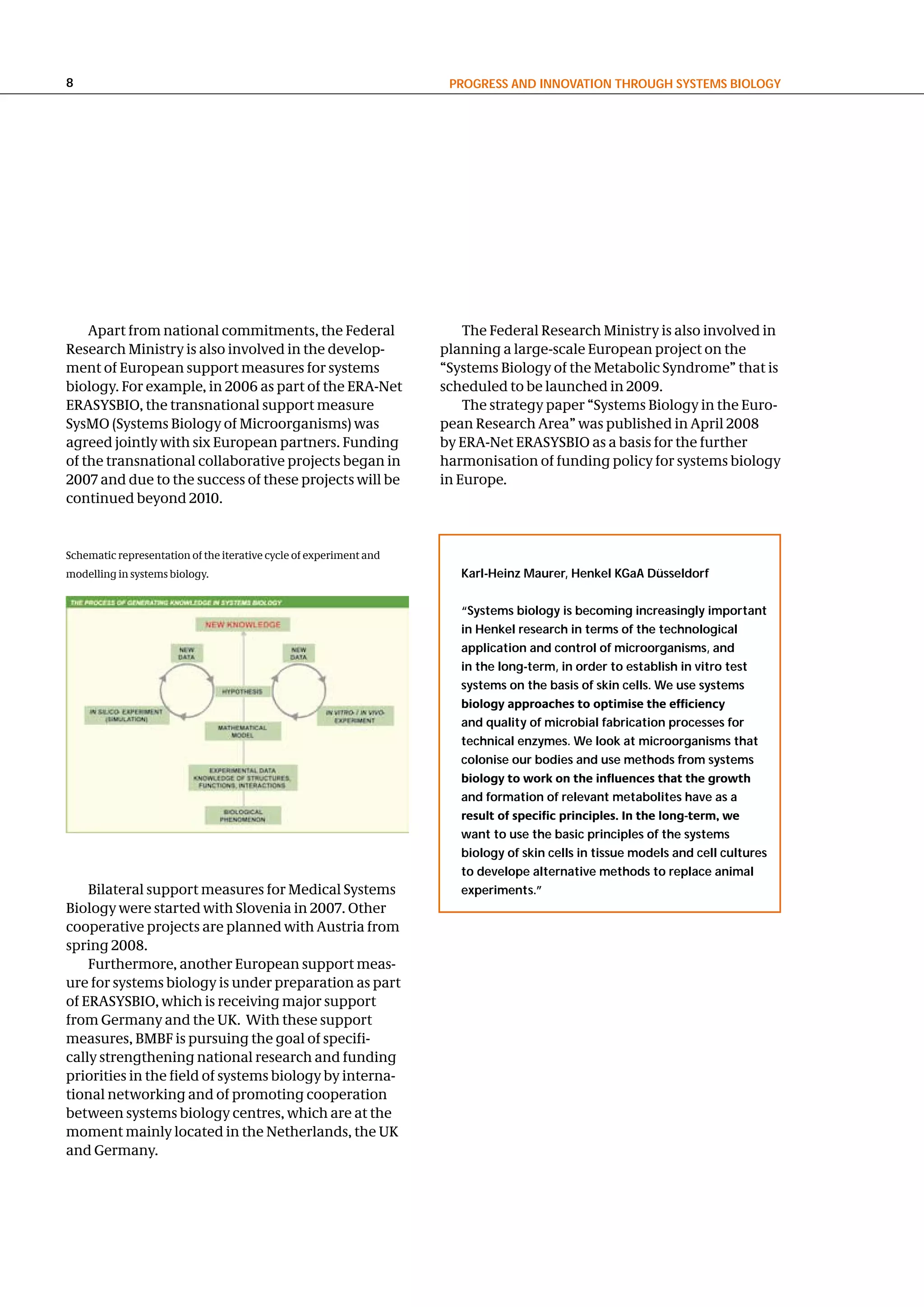
Schematic representation of the iterative cycle of experiment and
modelling in systems biology.                                          Karl-heinz Maurer, henkel Kgaa düsseldorf


                                                                       “Systems biology is becoming increasingly important
                                                                       in henkel research in terms of the technological
                                                                       application and control of microorganisms, and
                                                                       in the long-term, in order to establish in vitro test
                                                                       systems on the basis of skin cells. We use systems
                                                                       biology approaches to optimise the efficiency
                                                                       and quality of microbial fabrication processes for
                                                                       technical enzymes. We look at microorganisms that
                                                                       colonise our bodies and use methods from systems
                                                                       biology to work on the influences that the growth
                                                                       and formation of relevant metabolites have as a
                                                                       result of specific principles. In the long-term, we
                                                                       want to use the basic principles of the systems
                                                                       biology of skin cells in tissue models and cell cultures
                                                                       to develope alternative methods to replace animal
    Bilateral support measures for Medical Systems                     experiments.”
Biology were started with Slovenia in 2007. Other
cooperative projects are planned with Austria from
spring 2008.
    Furthermore, another European support meas-
ure for systems biology is under preparation as part
of ERASYSBIO, which is receiving major support
from Germany and the UK. With these support
measures, BMBF is pursuing the goal of specifi-
cally strengthening national research and funding
priorities in the field of systems biology by interna-
tional networking and of promoting cooperation
between systems biology centres, which are at the
moment mainly located in the Netherlands, the UK
and Germany.
PRogReSS and InnovatIon thRough SySteMS BIology                                                                                                       9


Summary                                                                         In this way, the competitiveness of Germany
                                                                            will be sustained in the field of the life sciences and
    With its early and comprehensive support for                            cooperation between academic and industrial
systems biology, BMBF has helped Germany to                                 research specifically promoted.
establish a leading position in this important                                  Practical applications of the systems biology
research field that has great future potential. The                         research approach are already foreseeable in the
total BMBF funding of systems biology is € 37 million                       fields of biotechnology and medicine. Since 2004,
per year for national and international support                             the first companies – mainly small and medium-
measures.                                                                   sized enterprises (SMEs) – have already become
    The aim of the BMBF’s coordinated research and                          involved in this research as pioneers in systems
funding measures is to support the establishment                            biology. The increasing maturity of systems biology
of the research infrastructure required for systems                         is manifested in the growing number of research
biology together with major actors in Germany and                           partners from the pharmaceutical industry, the
Europe. It is taking up central research fields and                         biotech industry and other sectors who recognise
topics which are of major significance for progress                         opportunities for the medium- and long-term
in the life sciences and for exploiting new inno-                           development of new areas of business.
vation potential and contributes significantly to the
training and encouragement of young scientists.                             Gisela Miczka, Projektträger Jülich (PtJ)

                                                                            On the Internet: www.fz-juelich.de/ptj/systembiologie


  Fascination Systems Biology


  Dr. Vytaute Starkuviene-Erfle has been head of the Young Inves-           chemistry or even quantum physics. This gives us an overall picture
  tigators Group “Screening of Cellular Networks” since autumn              of what’s going on – it doesn’t just show us how a single protein
  2007, which is part of the VIROQUANT centre in Heidelberg. She            behaves, but rather how the whole system or at least a part of it
  spoke about her enthusiasm for systems biology and the excellent          behaves. That’s absolutely fascinating. Systems biology has the
  opportunity to work in such a research centre.                            potential to help us understand every system, every organism in
                                                                            its entirety and complexity at some point in time. At the moment,
  When did you become interested in systems biology?                        we’ve only just begun, but the process of getting to this stage alone
  It was during my time as a postdoc at EMBL in Heidelberg. I had           is very captivating.
  established high-throughput assays for studies on trafficking
  mechanisms in mammalian cells. In doing so, I began to under-             What does it mean for you to head a Young Investigators Group
  stand the significance of being able to analyse many components           in the VIROQUANT centre?
  at the one time instead of concentrating on single proteins, which        As soon as they have penetrated the host cell, viruses become
  is what I was familiar with from my earlier work. So that’s why I         involved in a number of cellular processes and therefore influence
  decided to orient myself in the direction of systems biology.             the entire system of the cell. VIROQUANT investigates these pro-
                                                                            cesses and this information is what attracts me. In the BIOQUANT
  What is so fascinating about systems biology?                             building in Heidelberg, I work side-by-side with virologists and cell
  Systems biology throws light on a specific issue from all sides – both    biologists, as well as with mathematicians, bioinformaticians, and
  from the level of the gene and the protein right up to the effects in     modellers. We have lively discussions and our cooperations are ex-
  the system and vice versa. It accounts for a wide variety of factors in   tremely fruitful. This is the only way that systems biology can really
  this process, and can be expanded to areas where classical biology        function well. I believe that my research benefits from this to a large
  was not admitted in the past, such as biophysics, bioorganic              degree and I hope that I too can contribute a great deal.
10                                                                                                      hePatoSyS


HepatoSys
Systems biology studies of liver cells


    With its call for proposals for “Living Systems
– Systems Biology” in 2001, the Federal Ministry of          othmar Pfannes, genedata ag Basel
Education and Research (BMBF) gave the go-ahead
for the funding of systems biology in Germany.               “In the decades to come we will see many innova-
HepatoSys – a national network of expertise for re-          tions that are based on systems biology research.
search into liver cells – was initiated in 2004. Today,      these novel products and processes will have a
HepatoSys is the largest systems biology consortium          global impact on our way of life. Information and
working on interdisciplinary principles anywhere             communication technology in particular will have
in the world.                                                to solve enormous challenges, but also benefit from
    The liver is the central metabolic organ in verte-       very promising business opportunities. as a growing
brates and is in many respects a very special organ.         company with global focus, genedata concentrates
Each day, it synthesises, converts or degrades more          on establishing a strong position in this emerging
than 10,000 substances and thus contributes to the           systems biology based market. the hepatosys
utilisation of food and purifying the body of meta-          project is a key element in this strategy.”
bolic products, drugs, alcohol and other harmful
substances. As the largest gland in the body, in 24
hours it produces almost a litre of bile and thus as-     The HepatoSys network of expertise investigates
sists the body’s digestive system. The organ serves to    regeneration, differentiation, endocytosis, detoxi-
store glucose and vitamins and also produces vital        fication and the iron metabolism in liver cells. To
proteins such as the blood clotting factors. The liver    this end, experimental research teams from biol-
is furthermore characterised by its unique ability        ogy, chemistry, pharmacology and medicine work
to regenerate itself almost completely after dam-         hand in hand with representatives of theoretical
age by injury or toxic agents. Hepatocytes express        physics, mathematics and with computer scientists
more genes than most other types of tissue in the         and engineers. The long-term objective is to create
mammalian organism. They therefore have a very            a model for predicting vital processes in the liver,
wide range of enzymes and metabolic networks.             which would represent an enormous increase in
                                                          knowledge for medicine and pharmacology. Drugs
                                                          can be developed more efficiently and economi-
                                                          cally with the aid of such tools. In silico models
                                                          open up new possibilities of individualising treat-
                                                          ments and significantly reducing the number
                                                          of animal experiments in drug development.

                                                          no content without structure –
                                                          the development of hepatoSys

                                                              During the first funding phase of the Hepa-
                                                          toSys consortium from 2004 to 2006, attention
                                                          was initially focused on creating a functioning
                                                          infrastructure. Today, more than 40 teams work
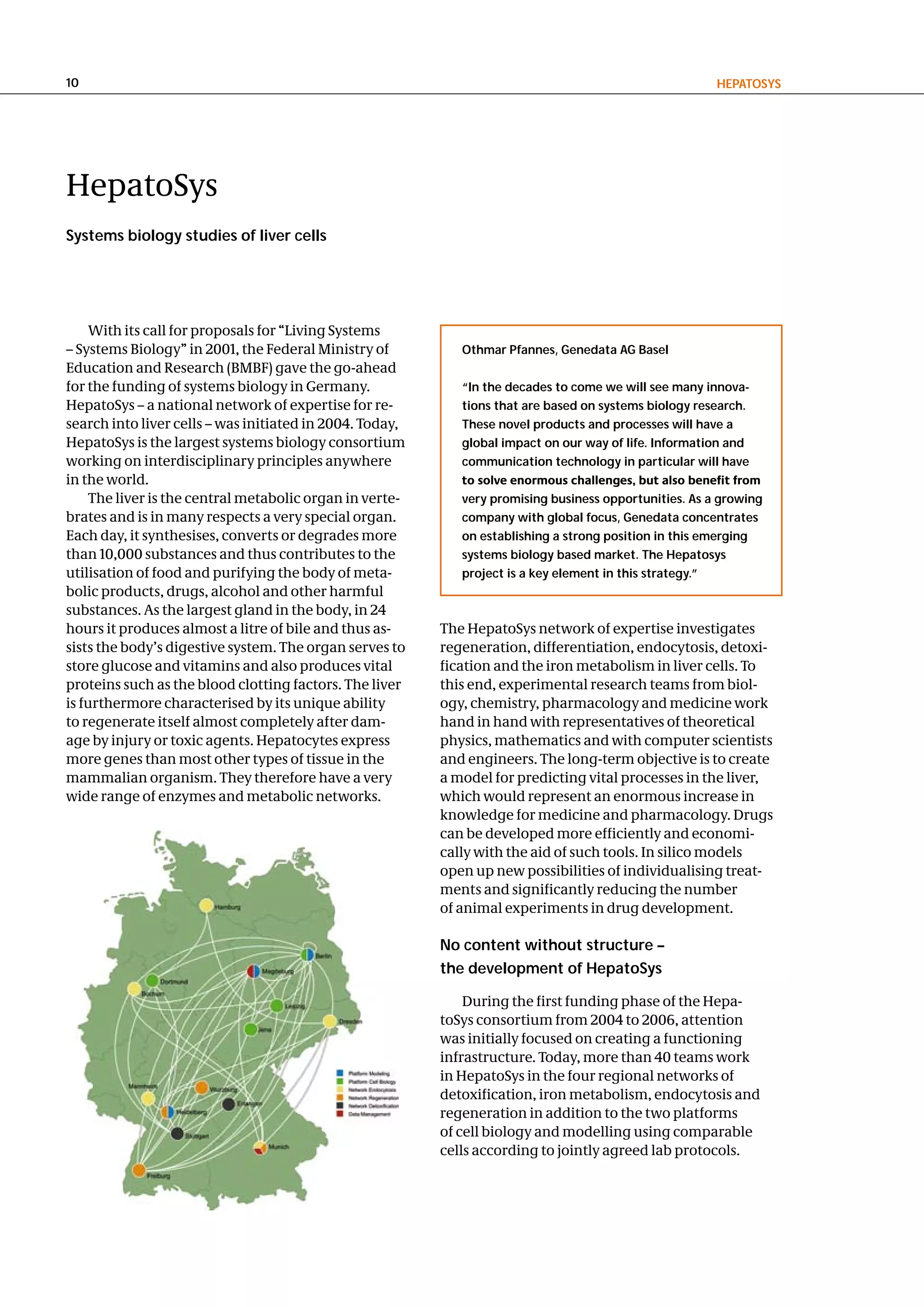
                                                          in HepatoSys in the four regional networks of
                                                          detoxification, iron metabolism, endocytosis and
                                                          regeneration in addition to the two platforms
                                                          of cell biology and modelling using comparable
                                                          cells according to jointly agreed lab protocols.
hePatoSyS                                                                                                                11


                                                          the other side of the fence

                                                              There is a very high level of knowledge trans-
                                                          fer in the HepatoSys consortium due to the inter-
                                                          disciplinary collaboration and the numerous
                                                          external cooperation. A steadily increasing number
                                                          of companies are joining the association. This devel-
                                                          opment is encouraged by the fact that the regional
                                                          networks are located at important biotechnology
                                                          sites throughout Germany. For example, the regen-
                                                          eration network has its main sites in Freiburg and
                                                          Heidelberg in the immediate vicinity of the world-
                                                          famous hospitals in Heidelberg and Freiburg and
                                                          also close to BioValley e.V., an association bringing
                                                          together industrial companies and research insti-
                                                          tutions in Germany, France and Switzerland. The
                                                          detoxification network maintains close contacts
                                                          with the process engineering industry in the
                                                          Stuttgart region. The iron regulation network col-
                                                          laborates closely with the Charité university hospi-
                                                          tal in Berlin and the Heidelberg university clinic.
                                                              The network of expertise is also very well known
                                                          outside Germany. In 2006, HepatoSys attracted
    The important results, laboratory regulations         international attention as the organiser of the first
and background information are made accessible to         “Systems Biology of Mammalian Cells” (SBMC)
all members of the network by means of central data       conference. At the beginning of 2008, the Health
and knowledge management. The second funding              Programme of the European Union granted
period started at the beginning of 2007. Until 2009,      funding for a HepatoSys project devoted to studying
all activities are focused on result-oriented research.   cancer of the liver. This project, which will be start-
    The project is monitored by an international          ing in October 2008, means that the HepatoSys
panel of high-calibre experts who provide valu-           network of expertise is extending its activities on
able stimulus for further developments. Hepato-           the European level.
Sys is steered by a project committee consisting
of the coordinators and representatives of the
networks and platforms. The project committee
takes up the recommendations of the steering
committee and is responsible for implementing
the milestone planning. The project committee
coordinates the interdisciplinary collaboration,            author:
organises the dates and keeps itself informed of
the scientific progress made in the consortium. In                              Dr. Ute Heisner
order to handle the wide range of organisational                                Systems Biology of Liver Cells - HepatoSys
tasks, the project committee has a central project                              Central Project Management
management unit. In addition, each network and                                  Institute for Physics, University Freiburg
platform has its own local project management.                                  Phone: +49(0)761-203 5803
                                                                                www.systembiologie.de
                                                                                www.hepatosys.de
                                                                                ute.heisner@fdm.uni-freiburg.de
12                                                                                                                             hePatoSyS


Robustness of the Drug
Detoxification Metabolism in Liver Cells
Compensation for genetic polymorphisms and environmental influences in
degrading xenobiotics in the liver


     Humans and animals are subjected to perma-                        the metabolic network structure
nent exposure to different kinds of xenobiotic
substances, including plant toxins, medicinal drugs,                       For the characterisation of the catalytic proper-
and environmental poisons. In vertebrates, the liver                   ties of the CYP450 system, we chose dextromethor-
has the task of making these substances water-solu-                    phan, a cough suppressant, and propafenone, an
ble and thus preparing them for excretion. In hepa-                    anti-arrhythmic agent as model substances. In order
tocytes, this process consists of a complex sequence                   to identify the CYP450 variants involved in convert-
of reaction steps (biotransformations) that are cata-                  ing these substances, we first conducted activity
lysed by an extensive enzyme system, in particular                     measurements of recombinant enzymes. On this
by the cytochrome P450 monooxygenases (CYP450).                        basis, we established the topological structure of
     Caused by a number of variations in genetic                       the metabolic system: it is a multi-reactive system in
make-up, so-called genetic polymorphisms, and as                       which individual isoenzymes have an overlapping
a result of illness or environmental factors such as                   substrate specificity.
the intake of food and drugs, these enzymes exhibit
a pronounced interindividual variability in their
expression and functionality, in other words in how
much of the effective enzyme is available in the cell.
     So that the metabolism of xenobiotic substances
progresses smoothly, it must be “robust” compared
to the individual factors of influence. Robustness
is a central concept in the systems-theory analysis
of networks. It describes how well a system can
compensate for disturbances that have either
been caused internally, for example as a result
of mutations, or externally, for example through
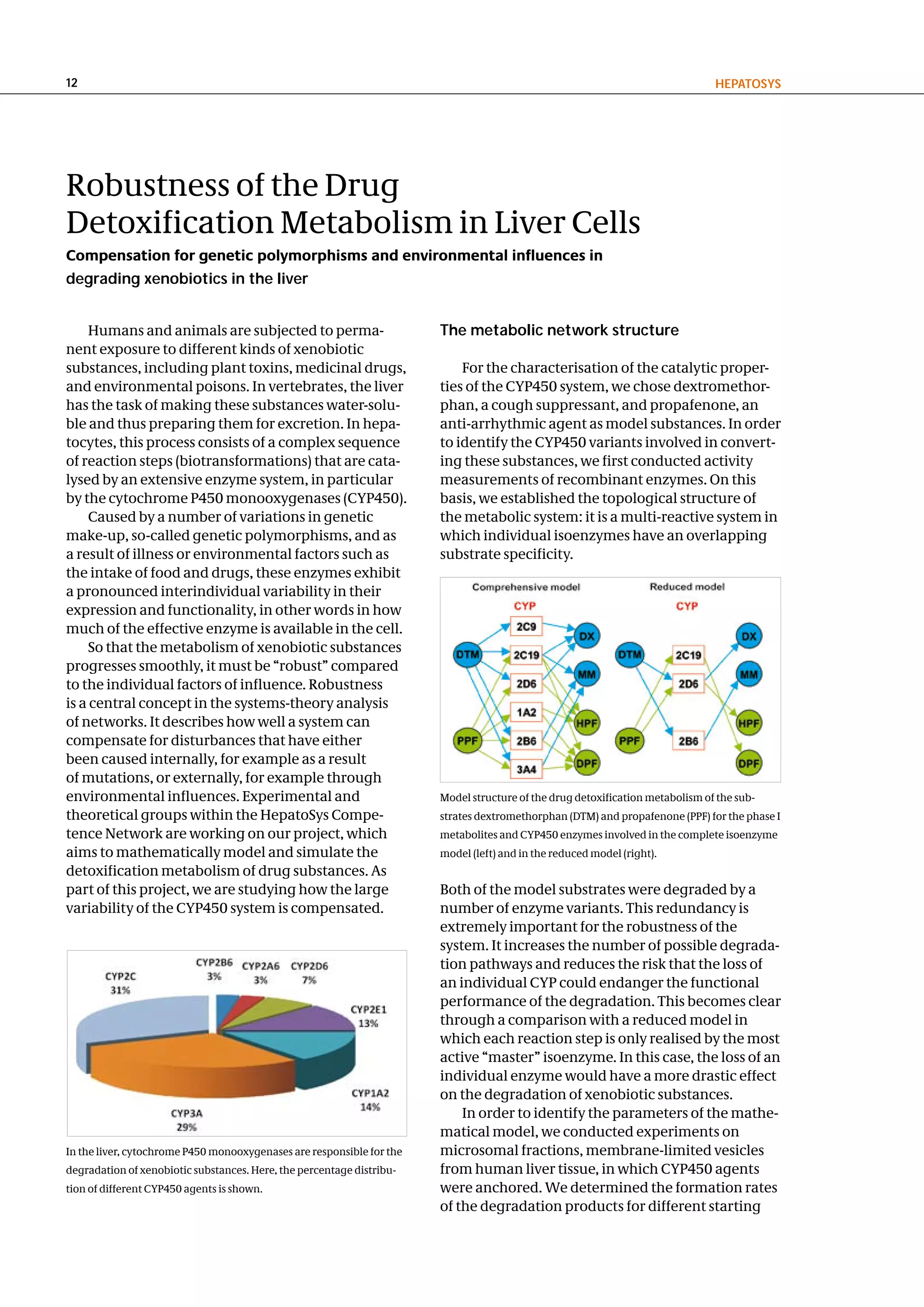
environmental influences. Experimental and                             Model structure of the drug detoxification metabolism of the sub-
theoretical groups within the HepatoSys Compe-                         strates dextromethorphan (DTM) and propafenone (PPF) for the phase I
tence Network are working on our project, which                        metabolites and CYP450 enzymes involved in the complete isoenzyme
aims to mathematically model and simulate the                          model (left) and in the reduced model (right).
detoxification metabolism of drug substances. As
part of this project, we are studying how the large                    Both of the model substrates were degraded by a
variability of the CYP450 system is compensated.                       number of enzyme variants. This redundancy is
                                                                       extremely important for the robustness of the
                                                                       system. It increases the number of possible degrada-
                                                                       tion pathways and reduces the risk that the loss of
                                                                       an individual CYP could endanger the functional
                                                                       performance of the degradation. This becomes clear
                                                                       through a comparison with a reduced model in
                                                                       which each reaction step is only realised by the most
                                                                       active “master” isoenzyme. In this case, the loss of an
                                                                       individual enzyme would have a more drastic effect
                                                                       on the degradation of xenobiotic substances.
                                                                           In order to identify the parameters of the mathe-
                                                                       matical model, we conducted experiments on
In the liver, cytochrome P450 monooxygenases are responsible for the   microsomal fractions, membrane-limited vesicles
degradation of xenobiotic substances. Here, the percentage distribu-   from human liver tissue, in which CYP450 agents
tion of different CYP450 agents is shown.                              were anchored. We determined the formation rates
                                                                       of the degradation products for different starting
hePatoSyS                                                                                                                                  13


                                                                          new. The advantage of systems biology analyses lies
                                                                          in the fact that many different conditions can be
                                                                          simulated with the models created. In the future,
                                                                          this could help us to gain a better understanding
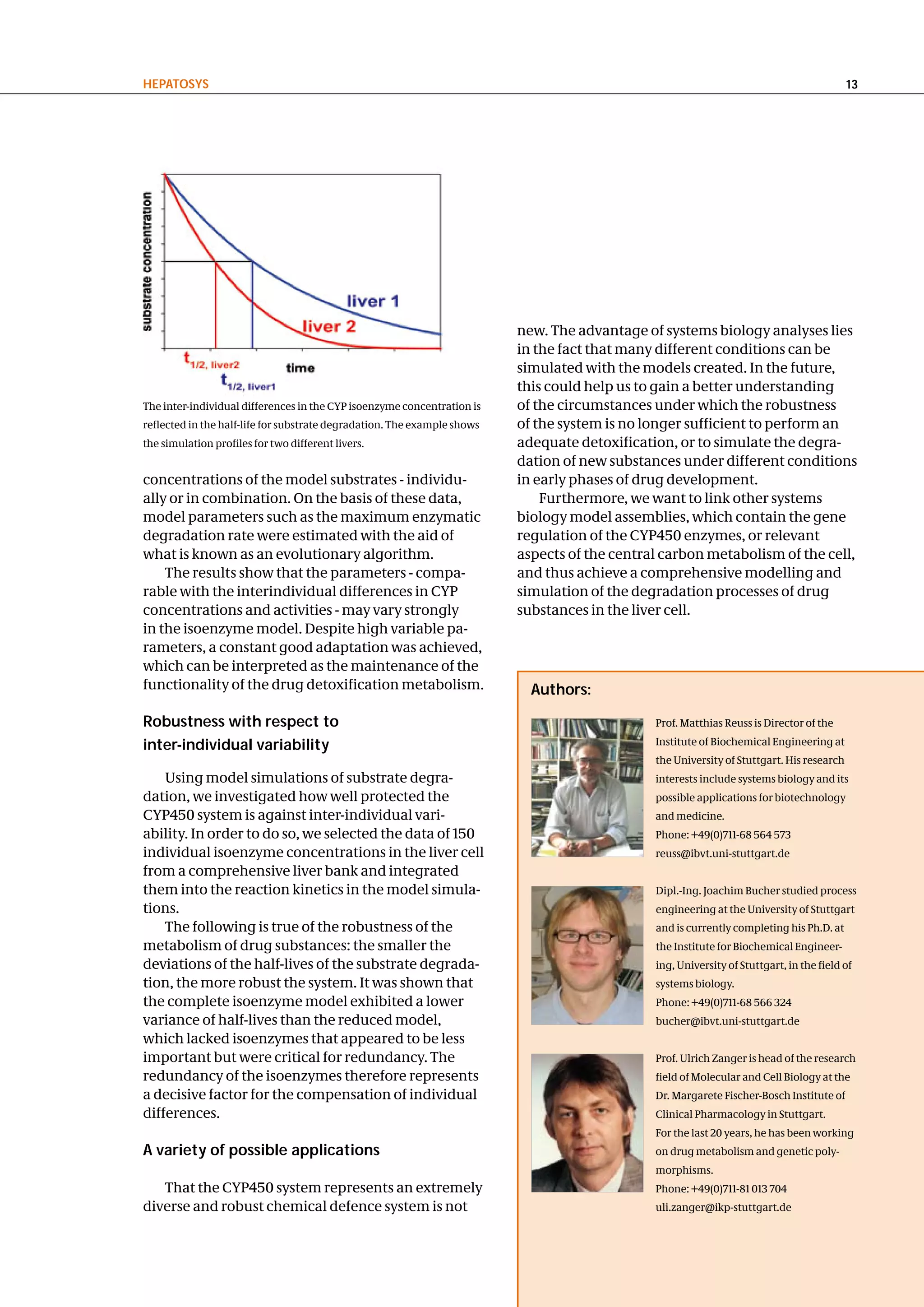
The inter-individual differences in the CYP isoenzyme concentration is    of the circumstances under which the robustness
reflected in the half-life for substrate degradation. The example shows   of the system is no longer sufficient to perform an
the simulation profiles for two different livers.                         adequate detoxification, or to simulate the degra-
                                                                          dation of new substances under different conditions
concentrations of the model substrates - individu-                        in early phases of drug development.
ally or in combination. On the basis of these data,                           Furthermore, we want to link other systems
model parameters such as the maximum enzymatic                            biology model assemblies, which contain the gene
degradation rate were estimated with the aid of                           regulation of the CYP450 enzymes, or relevant
what is known as an evolutionary algorithm.                               aspects of the central carbon metabolism of the cell,
    The results show that the parameters - compa-                         and thus achieve a comprehensive modelling and
rable with the interindividual differences in CYP                         simulation of the degradation processes of drug
concentrations and activities - may vary strongly                         substances in the liver cell.
in the isoenzyme model. Despite high variable pa-
rameters, a constant good adaptation was achieved,
which can be interpreted as the maintenance of the
functionality of the drug detoxification metabolism.                        authors:

Robustness with respect to                                                                     Prof. Matthias Reuss is Director of the

inter-individual variability                                                                   Institute of Biochemical Engineering at
                                                                                               the University of Stuttgart. His research
    Using model simulations of substrate degra-                                                interests include systems biology and its
dation, we investigated how well protected the                                                 possible applications for biotechnology
CYP450 system is against inter-individual vari-                                                and medicine.
ability. In order to do so, we selected the data of 150                                        Phone: +49(0)711-68 564 573
individual isoenzyme concentrations in the liver cell                                          reuss@ibvt.uni-stuttgart.de
from a comprehensive liver bank and integrated
them into the reaction kinetics in the model simula-                                           Dipl.-Ing. Joachim Bucher studied process
tions.                                                                                         engineering at the University of Stuttgart
    The following is true of the robustness of the                                             and is currently completing his Ph.D. at
metabolism of drug substances: the smaller the                                                 the Institute for Biochemical Engineer-
deviations of the half-lives of the substrate degrada-                                         ing, University of Stuttgart, in the field of
tion, the more robust the system. It was shown that                                            systems biology.
the complete isoenzyme model exhibited a lower                                                 Phone: +49(0)711-68 566 324
variance of half-lives than the reduced model,                                                 bucher@ibvt.uni-stuttgart.de
which lacked isoenzymes that appeared to be less
important but were critical for redundancy. The                                                Prof. Ulrich Zanger is head of the research
redundancy of the isoenzymes therefore represents                                              field of Molecular and Cell Biology at the
a decisive factor for the compensation of individual                                           Dr. Margarete Fischer-Bosch Institute of
differences.                                                                                   Clinical Pharmacology in Stuttgart.
                                                                                               For the last 20 years, he has been working
a variety of possible applications                                                             on drug metabolism and genetic poly-
                                                                                               morphisms.
   That the CYP450 system represents an extremely                                              Phone: +49(0)711-81 013 704
diverse and robust chemical defence system is not                                              uli.zanger@ikp-stuttgart.de
14                                                                                                                                 hePatoSyS


A Circuit Diagram for Biotransformation
Dynamic flux analysis of the central metabolism in human hepatocytes


    The enzyme system of the central metabolism                          results reflect the actual situation at a selected
plays an important role in the functioning of an                         point in time. For this purpose, researchers at the
organism. It supplies energy equivalents that make                       Institute of Biochemical Engineering in the Uni-
it possible for vital processes to occur and it also                     versity of Stuttgart apply an ingenious procedure
allows the biotransformation of endogenous and                           which involves briefly treating hepatocytes that
foreign substances so that these can be eliminated                       have been quickly separated from the medium
from the body. The mathematical description of                           with water at a temperature of over 90 degrees
this enzyme system represents a decisive basic                           Celsius. This inactivates enzymes ensuring that the
principle for predicting the dosage of medications.                      metabolites are not degraded further. With the
The objective of our research project is therefore to                    heat treatment, we simultaneously achieve a cell
create a type of circuit diagram that quantitatively                     disruption that releases intracellular metabolites.
records the transformation of the components                                 Following this, colleagues in the Dr. Margarete
involved in the central metabolism. Coordinated                          Fischer-Bosch Institute of Clinical Pharmacology,
by Insilico Biotechnology AG, Stuttgart, a team                          Stuttgart, determine the amount of metabolites
of chemists, biologists, engineers, and computer                         in the samples. In order to do so, they combine gas
scientists analyse the activities of the central                         chromatography and high performance liquid
metabolism and integrate the data into a computer                        chromatography with mass spectrometry. The
model before they simulate the behaviour of the                          highly sensitive measuring procedure does not just
metabolism with the aid of supercomputers.                               guarantee a precise determination of the metabo-
                                                                         lites; it also allows the detection of isotopes, which
                                                                         are labelled compounds that only differ from
                                                                         unlabelled compounds by their mass numbers.
                                                                         In this manner, it is also possible to investigate
                                                                         conversions in parallel metabolic pathways.


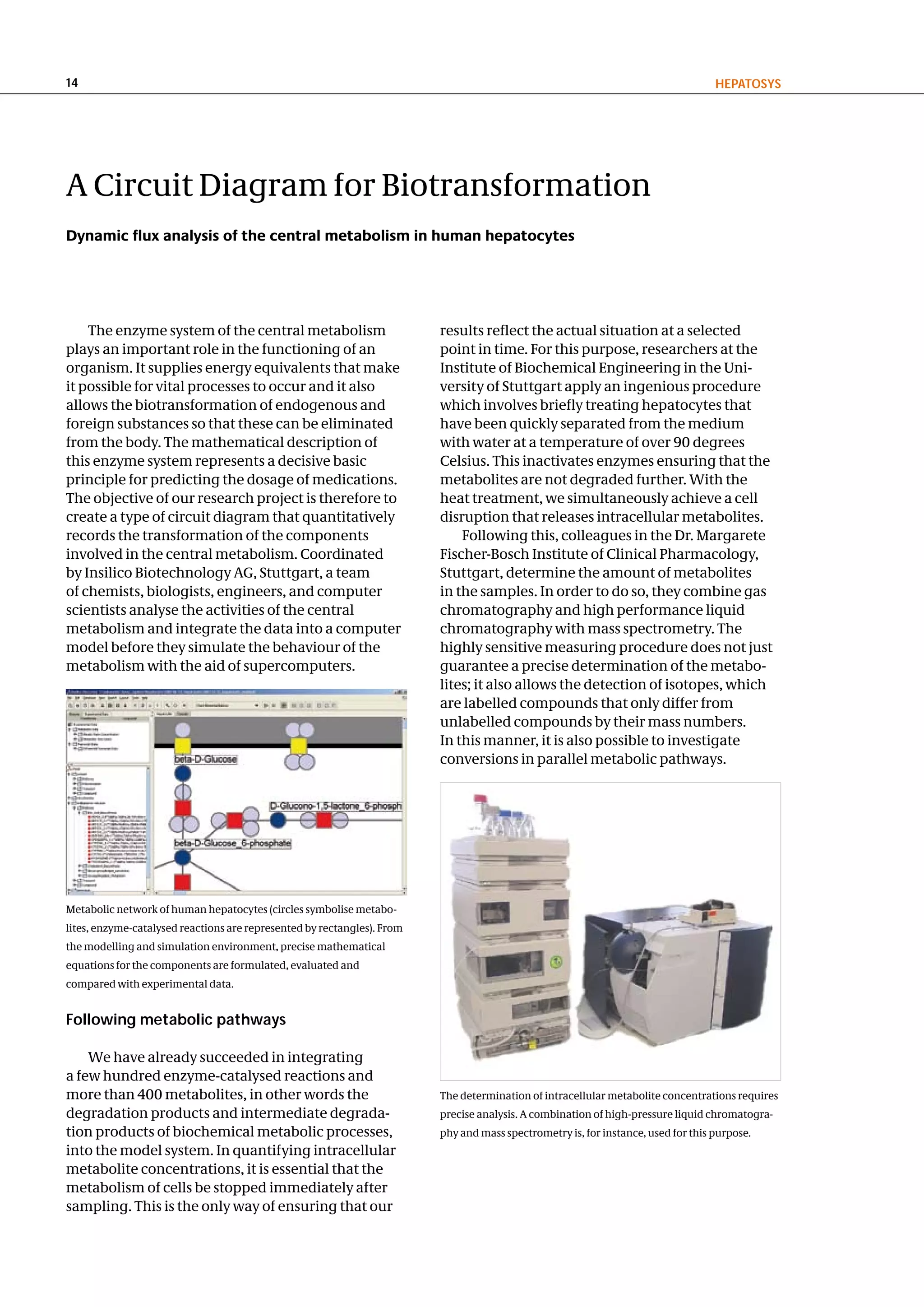
Metabolic network of human hepatocytes (circles symbolise metabo-
lites, enzyme-catalysed reactions are represented by rectangles). From
the modelling and simulation environment, precise mathematical
equations for the components are formulated, evaluated and
compared with experimental data.


Following metabolic pathways

    We have already succeeded in integrating
a few hundred enzyme-catalysed reactions and
more than 400 metabolites, in other words the                            The determination of intracellular metabolite concentrations requires
degradation products and intermediate degrada-                           precise analysis. A combination of high-pressure liquid chromatogra-
tion products of biochemical metabolic processes,                        phy and mass spectrometry is, for instance, used for this purpose.
into the model system. In quantifying intracellular
metabolite concentrations, it is essential that the
metabolism of cells be stopped immediately after
sampling. This is the only way of ensuring that our
hePatoSyS                                                                                                                    15


    For example, we use glucose labelled with
13C carbon atoms and trace the distribution dy-
namics of the heavy isotope in the glucose deg-
radation products. Computer simulations on the
basis of these studies then allow us to calculate
metabolic fluxes in parallel pathways and reac-
tion cycles. Using this method, we succeeded for
the first time in determining the production rates
of NADPH - an important cosubstrate for medi-
cation degradation in the liver - in hepatocytes
using the pentose phosphate pathway. We now
know that NADPH is not a limiting factor for the
application and disposal of therapeutic agents.

Metabolic dynamics after
the administration of medication

    During the first project phase in the period 2004
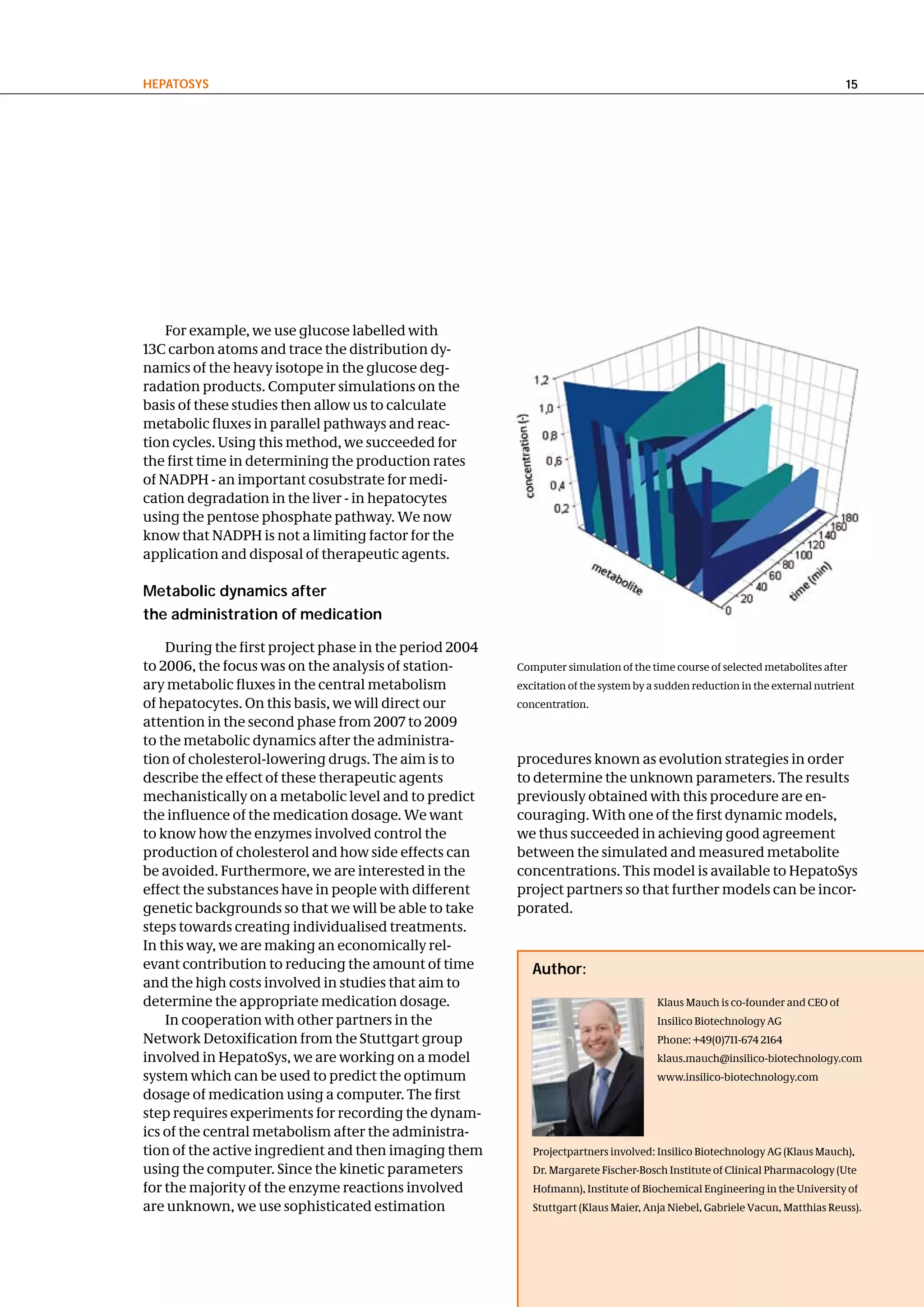
to 2006, the focus was on the analysis of station-      Computer simulation of the time course of selected metabolites after
ary metabolic fluxes in the central metabolism          excitation of the system by a sudden reduction in the external nutrient
of hepatocytes. On this basis, we will direct our       concentration.
attention in the second phase from 2007 to 2009
to the metabolic dynamics after the administra-
tion of cholesterol-lowering drugs. The aim is to       procedures known as evolution strategies in order
describe the effect of these therapeutic agents         to determine the unknown parameters. The results
mechanistically on a metabolic level and to predict     previously obtained with this procedure are en-
the influence of the medication dosage. We want         couraging. With one of the first dynamic models,
to know how the enzymes involved control the            we thus succeeded in achieving good agreement
production of cholesterol and how side effects can      between the simulated and measured metabolite
be avoided. Furthermore, we are interested in the       concentrations. This model is available to HepatoSys
effect the substances have in people with different     project partners so that further models can be incor-
genetic backgrounds so that we will be able to take     porated.
steps towards creating individualised treatments.
In this way, we are making an economically rel-
evant contribution to reducing the amount of time          author:
and the high costs involved in studies that aim to
determine the appropriate medication dosage.                                         Klaus Mauch is co-founder and CEO of
    In cooperation with other partners in the                                        Insilico Biotechnology AG
Network Detoxification from the Stuttgart group                                      Phone: +49(0)711-674 2164
involved in HepatoSys, we are working on a model                                     klaus.mauch@insilico-biotechnology.com
system which can be used to predict the optimum                                      www.insilico-biotechnology.com
dosage of medication using a computer. The first
step requires experiments for recording the dynam-
ics of the central metabolism after the administra-
tion of the active ingredient and then imaging them        Projectpartners involved: Insilico Biotechnology AG (Klaus Mauch),
using the computer. Since the kinetic parameters           Dr. Margarete Fischer-Bosch Institute of Clinical Pharmacology (Ute
for the majority of the enzyme reactions involved          Hofmann), Institute of Biochemical Engineering in the University of
are unknown, we use sophisticated estimation               Stuttgart (Klaus Maier, Anja Niebel, Gabriele Vacun, Matthias Reuss).
16                                                                                                                 hePatoSyS


High Tech for Liver Cells
automated image analysis of endocytosis


    As part of the HepatoSys initiative, the Endocy-                   erating semantic networks that describe objects.
tosis Network (EndoSys) focuses upon analysis of                       In simple terms, a cell, for example, is represented
endocytosis and its influence on signal transduction                   together with its properties such as size or shape,
using systems biology. The members of the con-                         and these attributes are linked hierarchically (“the
sortium, for instance, investigate the formation of                    cell is large, elongated and granulated”). These
vesicles (cell compartments enclosed by the cyto-                      hierarchies are then in turn linked and they collec-
plasmic membrane with which membrane proteins                          tively form a network - the cognition network.
or nutrients are ingested into the cell), and how                          Considering the example of a liver cell, im-
the vesicles are transported within the cell. These                    aged with the aid of a confocal microscope, the
investigations produce large quantities of very                        network has the following structure: the lowest
heterogeneous image data, such as two- or three-                       level contains pixels as objects, which are com-
dimensional microscopic images of hepatocytes                          bined on the next higher hierarchical level to form
and their components, as well as simulated image                       larger units such as cell nuclei, endosomes and
data of different biological processes. Relevant                       cytoplasm; these are further combined into ob-
parameters for investigation are simultaneously de-                    jects representing individual hepatocytes, which
termined using both experiments and simulations.                       are finally combined into groups of liver cells. This
    As the technology partner of the HepatoSys                         procedure can be further continued, for example,
network, Definiens AG Munich has the task of                           by combining clusters of cells into organs and
generating automated image analysis so as: to en-                      organs into organisms. If the necessary data is not
able these heterogeneous datasets to be combined;                      present in a single image, it is possible to relate
to generate parameters from the experimental                           the contents of several images. Metadata such as
image files; and, conversely, to produce simulated                     measurement information can also be utilised.
images from the experimental measurements.
                                                                       From the image to the parameter and
                                                                       simulation – and back again

                                                                          Cognition Network Technology can be used to
                                                                       analyse both image data (e.g. three-dimensional
                                                                       images of hepatocytes) and results from modelling
                                                                       and simulations (e.g. the modelling of endocytotic
                                                                       processes).
                                                                          In the case of microscopic images, information is
                                                                       recorded such as the following:

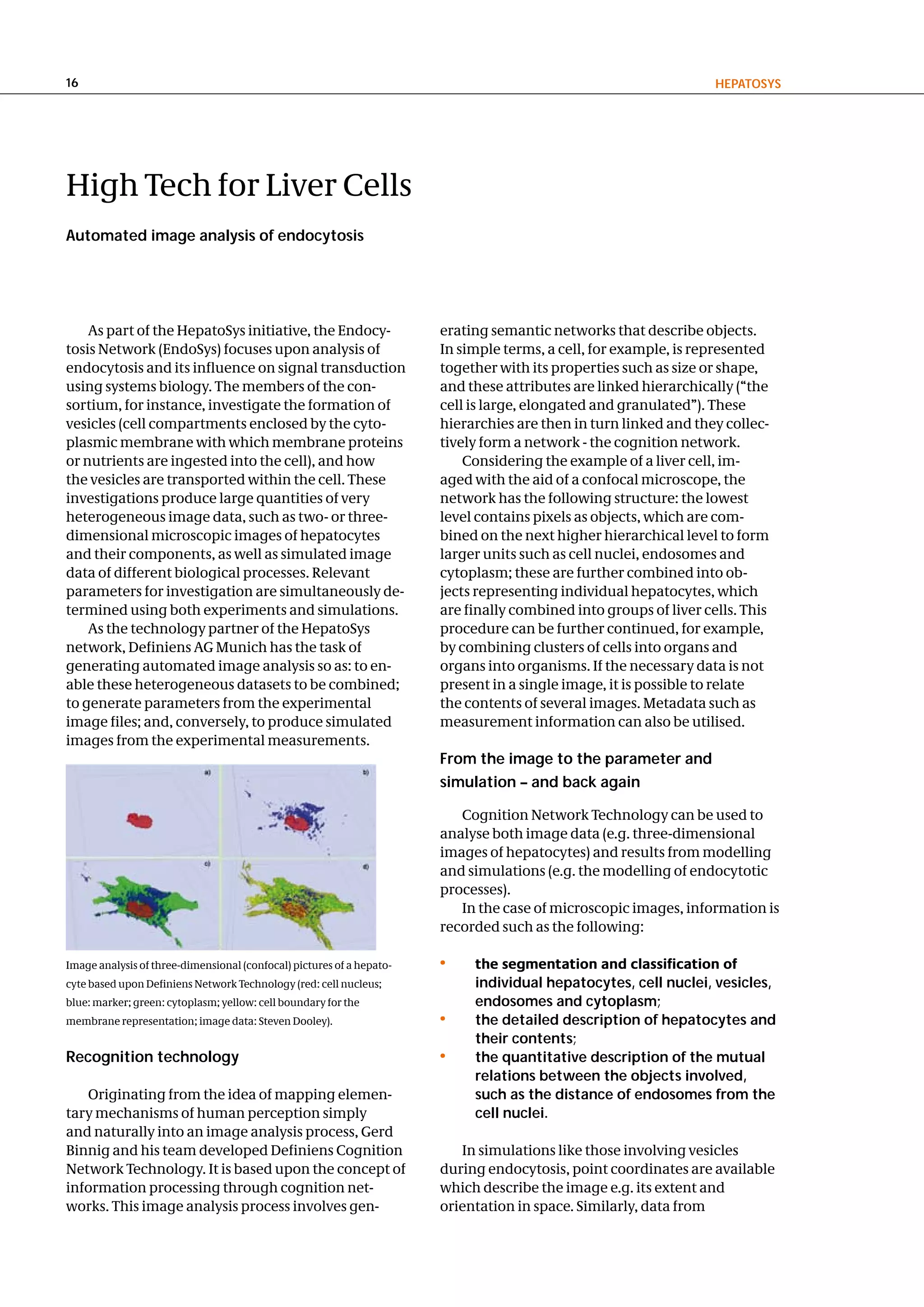
Image analysis of three-dimensional (confocal) pictures of a hepato-   •    the segmentation and classification of
cyte based upon Definiens Network Technology (red: cell nucleus;            individual hepatocytes, cell nuclei, vesicles,
blue: marker; green: cytoplasm; yellow: cell boundary for the               endosomes and cytoplasm;
membrane representation; image data: Steven Dooley).                   •    the detailed description of hepatocytes and
                                                                            their contents;
Recognition technology                                                 •    the quantitative description of the mutual
                                                                            relations between the objects involved,
   Originating from the idea of mapping elemen-                             such as the distance of endosomes from the
tary mechanisms of human perception simply                                  cell nuclei.
and naturally into an image analysis process, Gerd
Binnig and his team developed Definiens Cognition                         In simulations like those involving vesicles
Network Technology. It is based upon the concept of                    during endocytosis, point coordinates are available
information processing through cognition net-                          which describe the image e.g. its extent and
works. This image analysis process involves gen-                       orientation in space. Similarly, data from
hePatoSyS                                                                                                                                17


                                                                         developed by Definiens are used to analyse these
                                                                         data sets, to record them quantitatively and to
                                                                         extract information from them. The algorithms,
                                                                         which were first developed for small volumes of
                                                                         data, can then be adapted to the requirements of
                                                                         large volumes of data. Benefits of this approach
                                                                         using Cognitive Network Technology include: good
                                                                         transferability and high precision in applying the
                                                                         image analysis approach to a large number of im-
                                                                         age files; full-automation; user-friendly software
                                                                         that is easy to operate; and an implementation
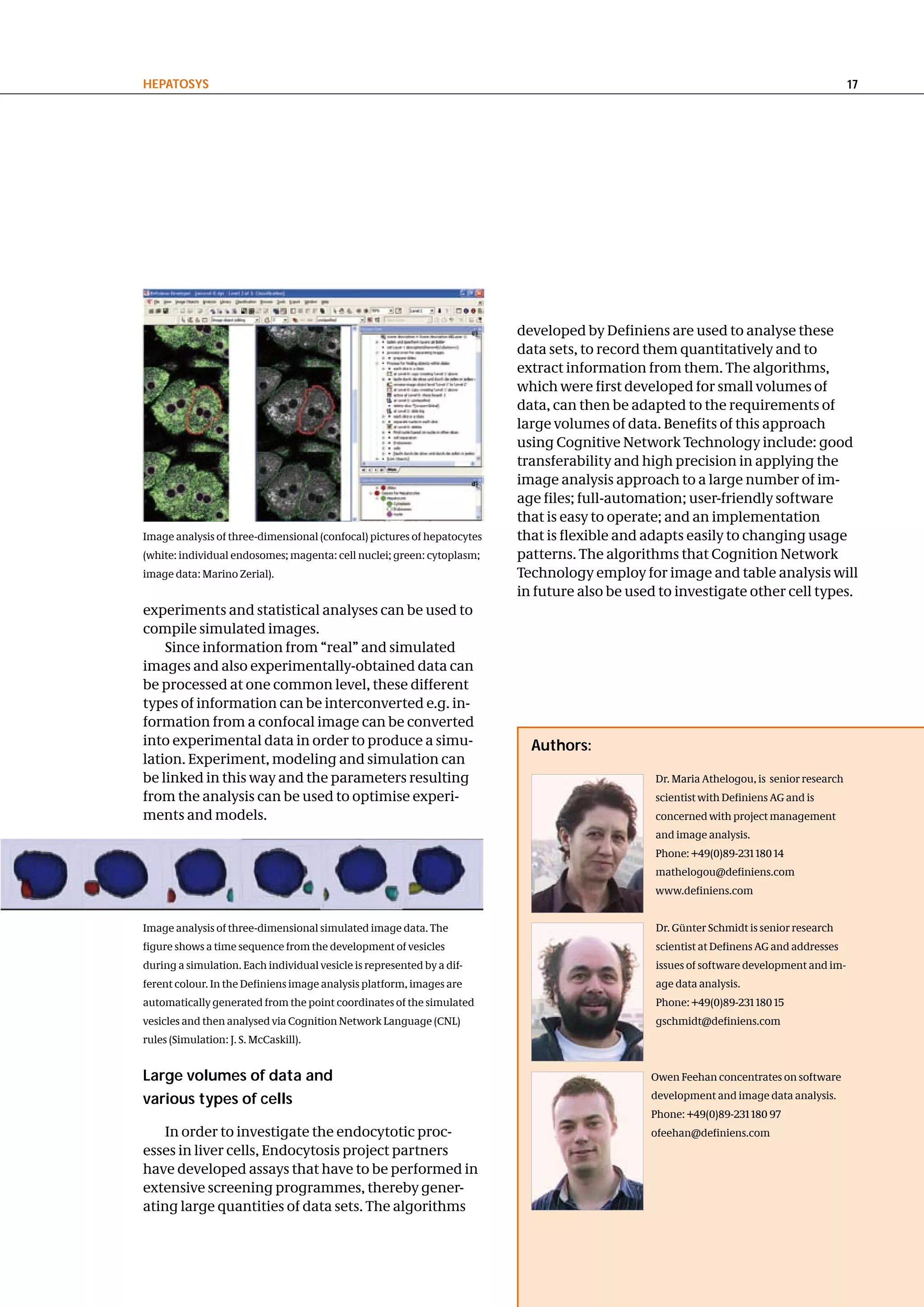
Image analysis of three-dimensional (confocal) pictures of hepatocytes   that is flexible and adapts easily to changing usage
(white: individual endosomes; magenta: cell nuclei; green: cytoplasm;    patterns. The algorithms that Cognition Network
image data: Marino Zerial).                                              Technology employ for image and table analysis will
                                                                         in future also be used to investigate other cell types.
experiments and statistical analyses can be used to
compile simulated images.
    Since information from “real” and simulated
images and also experimentally-obtained data can
be processed at one common level, these different
types of information can be interconverted e.g. in-
formation from a confocal image can be converted
into experimental data in order to produce a simu-                         authors:
lation. Experiment, modeling and simulation can
be linked in this way and the parameters resulting                                             Dr. Maria Athelogou, is senior research
from the analysis can be used to optimise experi-                                              scientist with Definiens AG and is
ments and models.                                                                              concerned with project management
                                                                                               and image analysis.
                                                                                               Phone: +49(0)89-231 180 14
                                                                                               mathelogou@definiens.com
                                                                                               www.definiens.com


Image analysis of three-dimensional simulated image data. The                                  Dr. Günter Schmidt is senior research
figure shows a time sequence from the development of vesicles                                  scientist at Definens AG and addresses
during a simulation. Each individual vesicle is represented by a dif-                          issues of software development and im-
ferent colour. In the Definiens image analysis platform, images are                            age data analysis.
automatically generated from the point coordinates of the simulated                            Phone: +49(0)89-231 180 15
vesicles and then analysed via Cognition Network Language (CNL)                                gschmidt@definiens.com
rules (Simulation: J. S. McCaskill).


large volumes of data and                                                                     Owen Feehan concentrates on software

various types of cells                                                                        development and image data analysis.
                                                                                              Phone: +49(0)89-231 180 97
    In order to investigate the endocytotic proc-                                             ofeehan@definiens.com
esses in liver cells, Endocytosis project partners
have developed assays that have to be performed in
extensive screening programmes, thereby gener-
ating large quantities of data sets. The algorithms
18                                                                                                                 hePatoSyS


The Endocytosis Transport System
Molecular switches control material transport inside the cell


    Endocytosis is a central cellular process in which     for example, collections of proteins at the molecular
membrane components and dissolved substances               level and surface elements of vesicle membranes at
are taken up by the cell surface. In this process, the     the next higher level – are regarded as a hierarchy
cell membrane folds around the object thus form-           of container systems. The individual containers are
ing vesicles which transfer their cargo to a set of        loaded with molecular structures of the next lower
intracellular membrane compartments that consti-           level. The simulation therefore bridges the gap
tute the endosomal transport system. Depending             between molecular processes such as the
on the purpose, the endocytosed cargo, it is either        interaction of proteins on the vesicle membrane
recycled or degraded within the cell. Endocytosis          and the dynamic processes on the level of complete
controls processes such as nutrient uptake, protein        endosomes, for instance for the processes of
transport within the cell and the signalling response      membrane deformation, membrane fusion and
to growth factors and hormones. Diseases such as           protein exchange. For the first time, a systematic
Alzheimer’s, asthma or viral and bacterial infections      and molecular-based simulation platform has been
have been associated with defects in this transport        established combining the chemical kinetics and
system, which makes endocytosis important and              physical self-organisation of structures for a spatial-
interesting from a biomedical perspective.                 ly and temporally resolved investigation of cellular
    To date, the mechanisms underlying endocytosis         processes. This method will be of major importance
remain largely unexplored. At present, there is no         for future computer-based studies of endocytosis in
possibility of predicting the course of endocytosis        liver cells in systems biology but the simulations can
under different physiological and pathological             also be systematically adapted to many different
conditions. Within the general frame of Hepato-            problems.
Sys, the aim of the EndoSys network is to analyse
endocytosis and its influence on cellular signalling
networks by a systems biology approach, focus-
ing on liver cells. The ultimate goal is to develop
both specific mathematical models and a general
simulation platform. This will serve for a quantita-
tive prediction of endocytotic processes and signal
transduction in hepatocytes under predefined
physiological or pathological conditions.
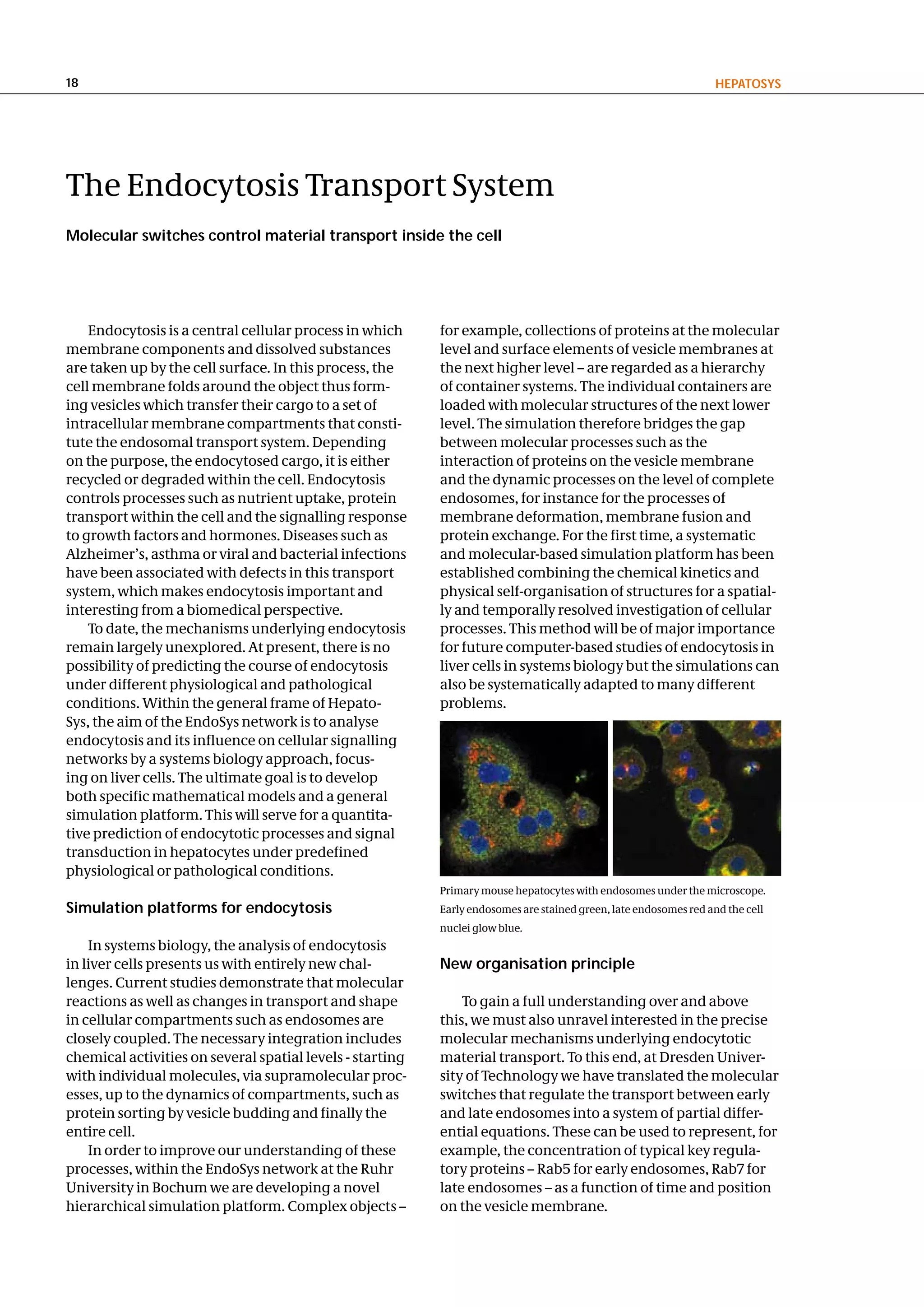
                                                           Primary mouse hepatocytes with endosomes under the microscope.
Simulation platforms for endocytosis                       Early endosomes are stained green, late endosomes red and the cell
                                                           nuclei glow blue.
    In systems biology, the analysis of endocytosis
in liver cells presents us with entirely new chal-         new organisation principle
lenges. Current studies demonstrate that molecular
reactions as well as changes in transport and shape            To gain a full understanding over and above
in cellular compartments such as endosomes are             this, we must also unravel interested in the precise
closely coupled. The necessary integration includes        molecular mechanisms underlying endocytotic
chemical activities on several spatial levels - starting   material transport. To this end, at Dresden Univer-
with individual molecules, via supramolecular proc-        sity of Technology we have translated the molecular
esses, up to the dynamics of compartments, such as         switches that regulate the transport between early
protein sorting by vesicle budding and finally the         and late endosomes into a system of partial differ-
entire cell.                                               ential equations. These can be used to represent, for
    In order to improve our understanding of these         example, the concentration of typical key regula-
processes, within the EndoSys network at the Ruhr          tory proteins – Rab5 for early endosomes, Rab7 for
University in Bochum we are developing a novel             late endosomes – as a function of time and position
hierarchical simulation platform. Complex objects –        on the vesicle membrane.
hePatoSyS                                                                                                                              19


                                                                           By a combination of modelling, model analysis,
                                                                       simulation, living cell microscopy and observation
                                                                       of individual endosomes in image sequences we
                                                                       succeeded in unravelling the organisation principle
                                                                       that enables the directed and effective transport of
                                                                       material via the endocytotic pathway. We term this
                                                                       principle the “cut-out switch”, and it may also play a
                                                                       part in other biological contexts.
                                                                           Our simulations and the detailed investigation
                                                                       of the mechanisms and organisation principles of
                                                                       endocytosis will make a contribution towards a
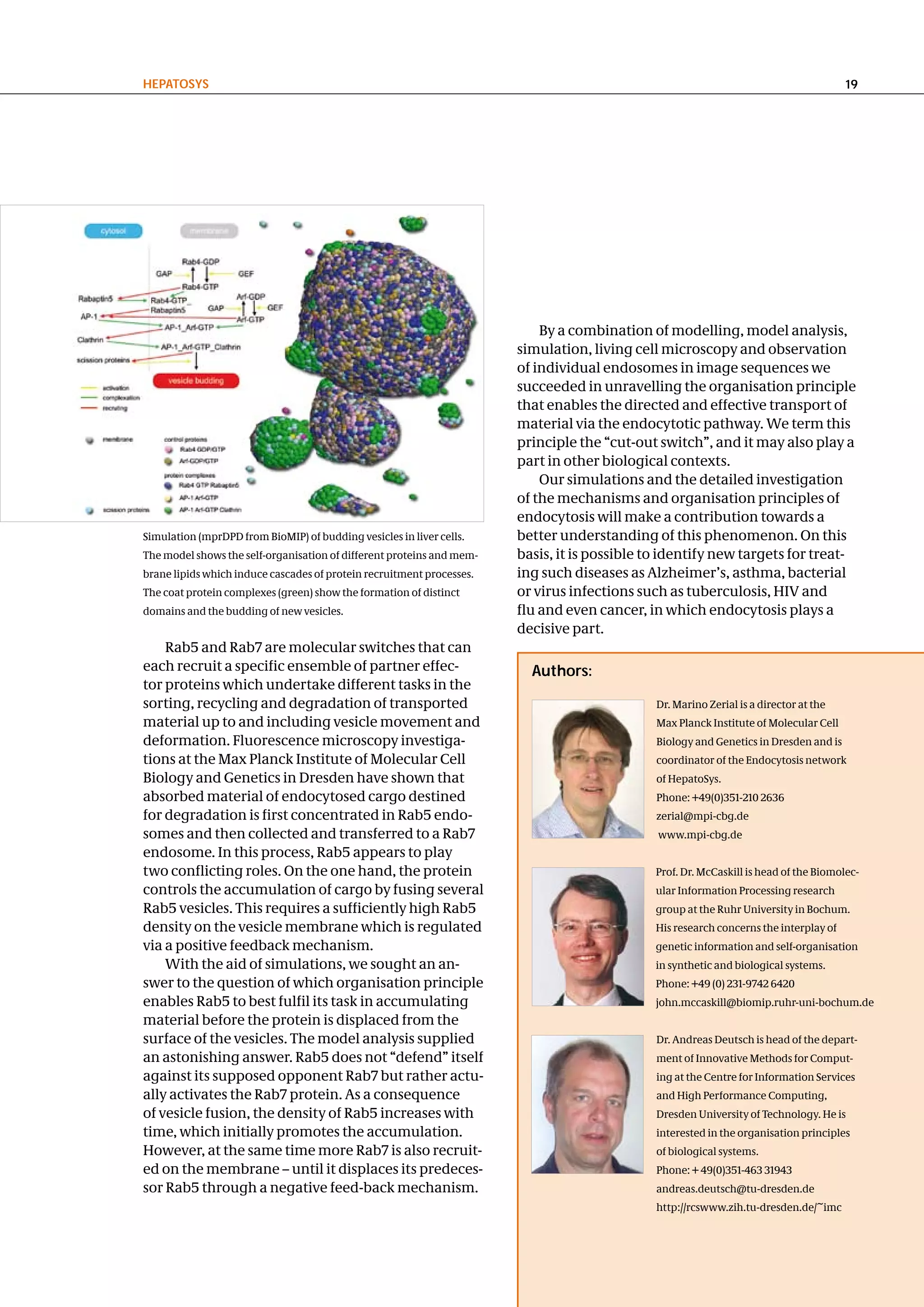
Simulation (mprDPD from BioMIP) of budding vesicles in liver cells.    better understanding of this phenomenon. On this
The model shows the self-organisation of different proteins and mem-   basis, it is possible to identify new targets for treat-
brane lipids which induce cascades of protein recruitment processes.   ing such diseases as Alzheimer’s, asthma, bacterial
The coat protein complexes (green) show the formation of distinct      or virus infections such as tuberculosis, HIV and
domains and the budding of new vesicles.                               flu and even cancer, in which endocytosis plays a
                                                                       decisive part.
    Rab5 and Rab7 are molecular switches that can
each recruit a specific ensemble of partner effec-                       authors:
tor proteins which undertake different tasks in the
sorting, recycling and degradation of transported                                             Dr. Marino Zerial is a director at the
material up to and including vesicle movement and                                             Max Planck Institute of Molecular Cell
deformation. Fluorescence microscopy investiga-                                               Biology and Genetics in Dresden and is
tions at the Max Planck Institute of Molecular Cell                                           coordinator of the Endocytosis network
Biology and Genetics in Dresden have shown that                                               of HepatoSys.
absorbed material of endocytosed cargo destined                                               Phone: +49(0)351-210 2636
for degradation is first concentrated in Rab5 endo-                                           zerial@mpi-cbg.de
somes and then collected and transferred to a Rab7                                            www.mpi-cbg.de
endosome. In this process, Rab5 appears to play
two conflicting roles. On the one hand, the protein                                          Prof. Dr. McCaskill is head of the Biomolec-
controls the accumulation of cargo by fusing several                                         ular Information Processing research
Rab5 vesicles. This requires a sufficiently high Rab5                                        group at the Ruhr University in Bochum.
density on the vesicle membrane which is regulated                                           His research concerns the interplay of
via a positive feedback mechanism.                                                           genetic information and self-organisation
    With the aid of simulations, we sought an an-                                            in synthetic and biological systems.
swer to the question of which organisation principle                                         Phone: +49 (0) 231-9742 6420
enables Rab5 to best fulfil its task in accumulating                                         john.mccaskill@biomip.ruhr-uni-bochum.de
material before the protein is displaced from the
surface of the vesicles. The model analysis supplied                                          Dr. Andreas Deutsch is head of the depart-
an astonishing answer. Rab5 does not “defend” itself                                          ment of Innovative Methods for Comput-
against its supposed opponent Rab7 but rather actu-                                           ing at the Centre for Information Services
ally activates the Rab7 protein. As a consequence                                             and High Performance Computing,
of vesicle fusion, the density of Rab5 increases with                                         Dresden University of Technology. He is
time, which initially promotes the accumulation.                                              interested in the organisation principles
However, at the same time more Rab7 is also recruit-                                          of biological systems.
ed on the membrane – until it displaces its predeces-                                         Phone: + 49(0)351-463 31943
sor Rab5 through a negative feed-back mechanism.                                              andreas.deutsch@tu-dresden.de
                                                                                              http://rcswww.zih.tu-dresden.de/~imc
20                                                                                                                       hePatoSyS


Iron Network
Systems analyses of iron metabolism in the liver


     Ionic iron is an essential trace element but
also a dangerous poison. Ionic iron mediates the                             leroy hood, President of the Institute of
electron transfer during cellular respiration, as                            Systems Biology in Seattle
required for energy supply to the body. Moreover,
it is indispensable for detoxification of foreign                            “the new era of predictive, preventive and perso-
substances by the liver. Above all, however, iron                            nalised medicine made possible by systems biology
is an important component of hemoglobin,                                     represents a radical change in medicine and will
the red blood pigment, without which oxygen                                  have an impact on many aspects of our lives.”
could not be supplied to the body´s organs.
     Iron depletion - as a result of illness, of unbal-
anced diet, or during growth phases and pregnancy,
as well as after repeated blood donation - is there-                      the liver as control centre of iron metabolism
fore a serious health problem which afflicts about
500 million people world-wide. However, excess                                Iron metabolism is therefore of central sig-
of iron is also problematic, for example in patients                      nificance. It is controlled by a complex regulatory
who due to certain other diseases depend on regu-                         system that steers absorption, distribution and
lar blood transfusion therapy, or even in the case of                     excretion of the trace element. The intestinal tract,
a certain genetic disease, an iron overload disorder,                     the liver, the spleen, several kinds of macrophages
which causes excessive accumulation of iron in the                        and also the muscular system play a key role in this
liver, and can lead to liver cirrhosis, liver cancer,                     system. A special coordination task is performed
and ultimately even to death. Nowadays, iron can                          by the small intestine as the organ that absorbs
be flushed out by application of certain drugs but                        iron, and the liver as the control centre. The liver
then again an iron deficiency must be avoided.                            has sensors for the iron requirement of the entire
                                                                          organism and sends an appropriate dose of the
                                                                          peptide hormone hepcidin as a signal to the small
                                                                          intestine and macrophages, which fine-tunes
                                                                          absorption and distribution of iron in accordance
                                                                          with the overall requirements of the organism.
                                                                              The “IronLiver” collaborative project com-
                                                                          bines a theoretical working group (Max Delbrück
                                                                          Centre, Berlin) with two experimental working
                                                                          groups (EMBL and University Clinic Heidelberg).
                                                                          Their objective is to study the regulatory processes
                                                                          of the iron metabolism in more detail. We are
                                                                          developing a computer model of iron regulation
                                                                          which reflects the interactions of the liver with
                                                                          other organs of the body in the form of a dynamic
                                                                          network integrating absorption, transport, inter-
                                                                          conversion and excretion of iron-related proteins.


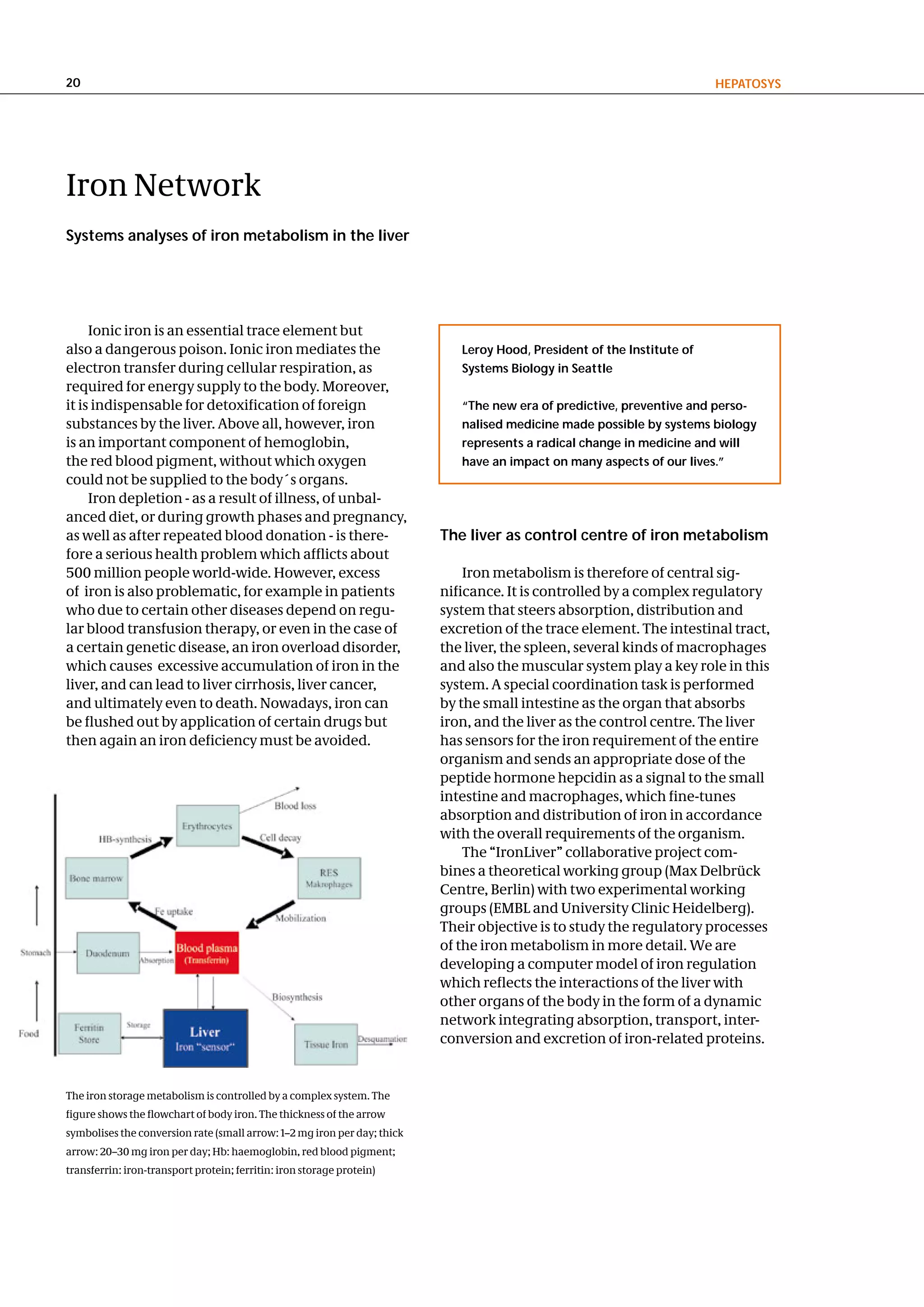
The iron storage metabolism is controlled by a complex system. The
figure shows the flowchart of body iron. The thickness of the arrow
symbolises the conversion rate (small arrow: 1–2 mg iron per day; thick
arrow: 20–30 mg iron per day; Hb: haemoglobin, red blood pigment;
transferrin: iron-transport protein; ferritin: iron storage protein)
hePatoSyS                                                                                                                         21


the mouse as model animal

     We use mice for the physiological studies - the
basis for developing the model. Using genetic
modifications, we selectively inhibit or switch off
certain components in the iron metabolic system.
We then analyse the iron content in the various
organs involved in the network in these animals,
for example in the liver and the intestines, as well
as in the blood. In this way, we elucidate the regu-
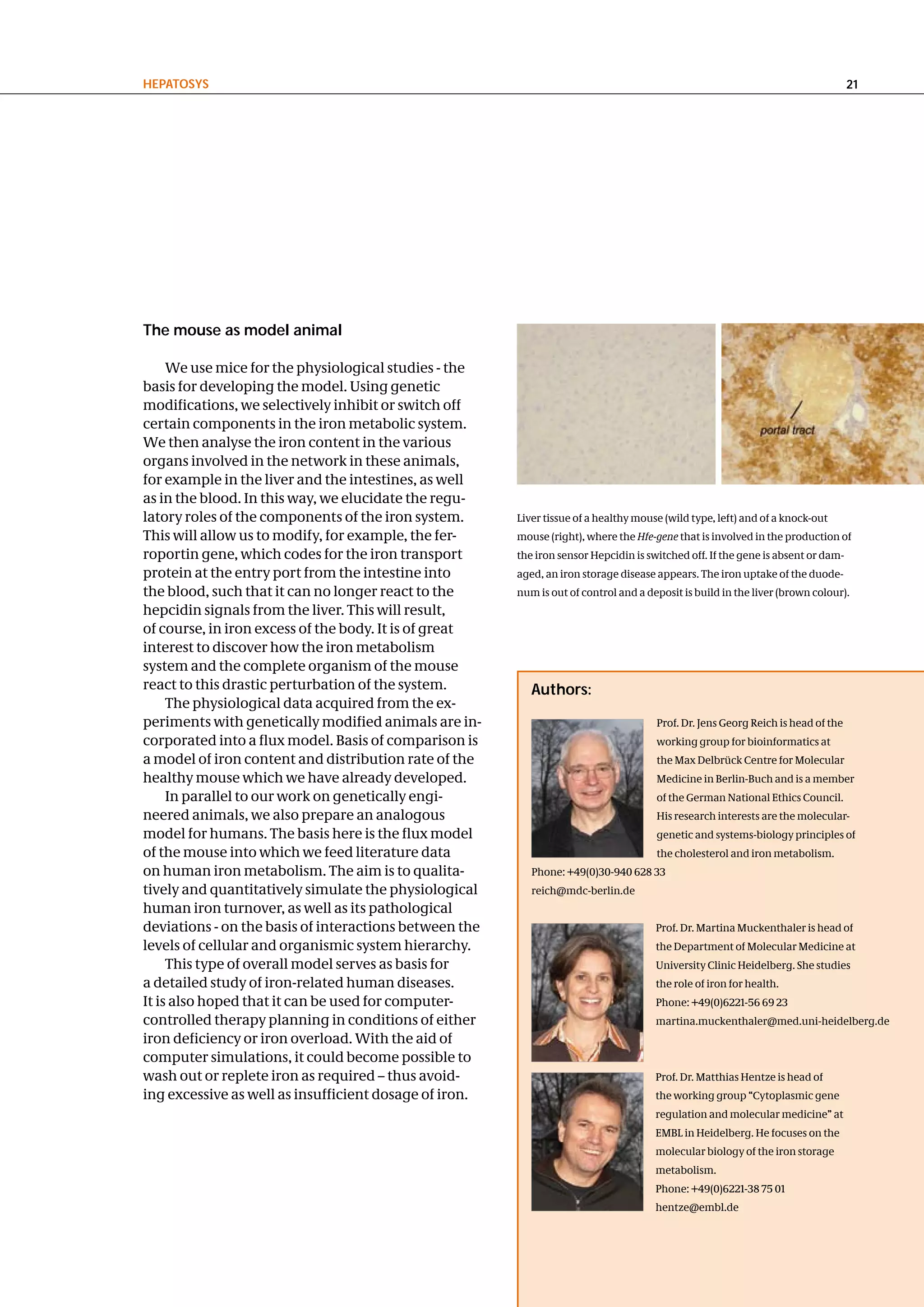
latory roles of the components of the iron system.      Liver tissue of a healthy mouse (wild type, left) and of a knock-out
This will allow us to modify, for example, the fer-     mouse (right), where the Hfe-gene that is involved in the production of
roportin gene, which codes for the iron transport       the iron sensor Hepcidin is switched off. If the gene is absent or dam-
protein at the entry port from the intestine into       aged, an iron storage disease appears. The iron uptake of the duode-
the blood, such that it can no longer react to the      num is out of control and a deposit is build in the liver (brown colour).
hepcidin signals from the liver. This will result,
of course, in iron excess of the body. It is of great
interest to discover how the iron metabolism
system and the complete organism of the mouse
react to this drastic perturbation of the system.          authors:
     The physiological data acquired from the ex-
periments with genetically modified animals are in-                                   Prof. Dr. Jens Georg Reich is head of the
corporated into a flux model. Basis of comparison is                                  working group for bioinformatics at
a model of iron content and distribution rate of the                                  the Max Delbrück Centre for Molecular
healthy mouse which we have already developed.                                        Medicine in Berlin-Buch and is a member
     In parallel to our work on genetically engi-                                     of the German National Ethics Council.
neered animals, we also prepare an analogous                                          His research interests are the molecular-
model for humans. The basis here is the flux model                                    genetic and systems-biology principles of
of the mouse into which we feed literature data                                       the cholesterol and iron metabolism.
on human iron metabolism. The aim is to qualita-           Phone: +49(0)30-940 628 33
tively and quantitatively simulate the physiological       reich@mdc-berlin.de
human iron turnover, as well as its pathological
deviations - on the basis of interactions between the                                 Prof. Dr. Martina Muckenthaler is head of
levels of cellular and organismic system hierarchy.                                   the Department of Molecular Medicine at
     This type of overall model serves as basis for                                   University Clinic Heidelberg. She studies
a detailed study of iron-related human diseases.                                      the role of iron for health.
It is also hoped that it can be used for computer-                                    Phone: +49(0)6221-56 69 23
controlled therapy planning in conditions of either                                   martina.muckenthaler@med.uni-heidelberg.de
iron deficiency or iron overload. With the aid of
computer simulations, it could become possible to
wash out or replete iron as required – thus avoid-                                    Prof. Dr. Matthias Hentze is head of
ing excessive as well as insufficient dosage of iron.                                 the working group “Cytoplasmic gene
                                                                                      regulation and molecular medicine” at
                                                                                      EMBL in Heidelberg. He focuses on the
                                                                                      molecular biology of the iron storage
                                                                                      metabolism.
                                                                                      Phone: +49(0)6221-38 75 01
                                                                                      hentze@embl.de
22                                                                                                           hePatoSyS


Central Data Management
The scientific communications platform of the HepatoSys consortium


    The main aim of the HepatoSys network is to                   into practice by Genedata, a company providing
use the methods of systems biology to achieve as                  computational systems for life sciences research.
comprehensive an understanding as possible of the                 The system is administered by the coordinators for
cellular processes in hepatocytes. This requires close            central data management within the HepatoSys
interdisciplinary collaborations between scientists               consortium at the Max Planck Institute for Dynam-
from widely differing disciplines. More than forty                ics of Complex Technical Systems in Magdeburg.
groups from universities, clinics and other research
institutions and industry throughout Germany                      three components for data management
conduct research within the framework of a large
alliance. In order to allow the various teams to                     A significant function of the central data
collaborate efficiently, a central infrastructure is re-          management system is to create a joint com-
quired to collect essential research data and allow it            munications platform for the partners in the
to be exchanged between the groups. This function                 research network through which they can
is fulfilled by the central data management system.               exchange data, findings and information on
                                                                  models. To this end, the application was installed
                                                                  on a central server at the Max Planck Institute
                                                                  in Magdeburg. All HepatoSys groups have
                                                                  password-protected access via the Internet.
                                                                  The system is composed of three modules:

                                                                  •    the experiment block allows experimental
                                                                       findings obtained within the consortium to
                                                                       be stored centrally.
                                                                  •    the component block is used to store
                                                                       information on the genes, mRnas,
                                                                       proteins and signalling pathways under
                                                                       investigation.
Design of the central data management system: the data within     •    In the model block, in silico models of the
(1) the experiment block, (2) the component and reaction block,        simulation of the dynamics of the
and (3) the model block are linked to each other and centrally         metabolic and signalling pathways in the
managed and retrieved.                                                 liver cells are stored, linked with the
                                                                       individual components and exchanged
    In the planning phase of HepatoSys, it had                         between the hepatoSys partners.
already become clear that the volumes of data gen-                •    While the experiment and component
erated in the research network are considerable,                       blocks are based on software already
particularly as a result of the application of high-                   available from genedata, the model block
throughput processes. The central data manage-                         had to be developed from scratch.
ment system therefore had to be designed in such a
way that it could scale with large volumes of data.               data management for the
    Furthermore, the central storage of the data                  systems biology research process
in a relational database was essential, as was the
systematic structuring and integration of different                  Systems biology research requires the defini-
types of data on the level of the gene, RNA and                   tion and application of new standards, such as
protein, and also tools in order to biologically                  standard operating procedures (SOPs) for in vivo
interpret the various types of data in the context                experiments, the unified processing and nor-
of the liver cell. The concept of the central data                malisation of data, and the introduction of joint
management system was developed by the mem-                       data formats within the research consortium. The
bers of the HepytoSys consortium and then put                     central data management system is therefore
hePatoSyS                                                                                                                                     23


                                                                            The systems biology investigation into liver
                                                                       cells also requires tools for the analysis and inter-
                                                                       pretation of data within a biological context. This
                                                                       demands a technology-independent data analy-
                                                                       sis, which is also performed by the central data
                                                                       management system. Specialised “cross-omics”
                                                                       analyses were developed for this purpose, which
                                                                       help us to analyse and gain a better understand-
                                                                       ing of signal transduction pathways and the
                                                                       underlying regulation processes in hepatocytes.

                                                                       data management in the future

                                                                           The HepatoSys consortium has taken on a
                                                                       pioneering role in developing and establishing
                                                                       data management software for systems biology
                                                                       research processes in cooperation with Genedata.
                                                                       The central data management system currently
                                                                       supports systems biology investigations into liver
                                                                       cells. The functionalities of the system, however, will
                                                                       also be used to address other challenges in systems
                                                                       biology in the future.
Database in use: a screenshot of the user interface shows the gene
expression of hepatocytes stimulated with rifampicin from three
patients (HH26, HH27, HH44). (1) The raw data were loaded, processed
and the quality of the data was evaluated. (2) The data were then
analysed further with the functions of the data management system.
The analyses show that the expression of the gene CYP3A4 is much         authors:
higher after treatment with rifampicin, while the other genes,
for example from PXR(NR1I2) and from HNF4a, remain largely                                           Dr. Detlev Bannasch is responsible for
unaltered. (The diagrams were provided courtesy of Thomas Reichart,                                  the central data management within the
ITB, University of Stuttgart).                                                                       HepatoSys network. He focuses on
                                                                                                     designing and monitoring the develop-
based on established IT Community Standards,                                                         ment and administration of the database,
such as Systems Biology Markup Language (SBML)                                                       user support and cooperations with exter-
for the exchange of mathematical models that                                                         nal data providers and database providers
represent molecular biology cellular processes.                                                      for HepatoSys.
    The central data management system also has                          Phone: +49(0)391-6110 216
analysis software for processing systems biology                         bannasch@mpi-magdeburg.mpg.de
data and for interpreting data. Of critical impor-
tance here is the automated, computer-assisted data                                              Dr. Hans Peter Fischer has been head
quality and consistency control. Only after quality                                              of Genedata Phylosopher, biology data
control and the subsequent steps for normalising                                                 management and data analysis,
and standardising the data, can the different types                                              since 1999.
of biological data be compared to each other. For                                                hans-peter.fischer@genedata.com
instance, this allows an informative comparison of                                               www.genedata.com
the expression of the gene that codes for a particu-
lar enzyme with the intrinsic enzyme activity.
24                                                                                                                                        hePatoSyS


Liver Cells in Culture
Standardised techniques for isolating and cultivating primary hepatocytes


    Hepatocytes isolated from liver tissue represent                            Standard requirements for the induction of
an in vitro system that is widely used in the phar-                             signal transduction pathways
maceutical industry. For example, they are used to
investigate the metabolism of a new substance, or                                   In order to work in a quantitative and reproduc-
to be more specific, how it is converted in the liver                           ible manner, it is essential that the liver cells first be
in order to be excreted in bile or urine. There is very                         put into a ground state after they have been ex-
good agreement between the findings from cell                                   tracted and cultured. In this ground state, the signal
culture experiments and the situation in the human                              transduction factors exhibit little basal activity but
organism here. This was the decisive factor in focus-                           we should still be able to stimulate them intensively
ing attention on primary hepatocytes in the systems                             and reproducibly. The cultures are deprived of
biology research network HepatoSys. A wide range                                growth factors for this purpose. This is referred to as
of prerequisites must first be fulfilled before cells                           cell “starvation”. On this basis, we can use specific
can be used for systems biology investigations. For                             simulations to investigate signalling pathways that
example, the mathematical modelling of signal                                   are relevant for the liver. An example of this process
transduction networks requires a quantitative and                               is the phosphorylation of a protein known as ERK1/2
highly reproducible analysis of the signal transduc-                            induced by the hepatocyte growth factor (HGF),
ing components and also of their phosphorylation.                               which can cause the liver cells to divide or increase
Against this background, the partners of the cell                               their motion. A second example is the so-called
biology platform and the HepatoSys consortium                                   JAK-STAT signalling pathway, which plays a role in
have developed an in vitro system with mouse                                    the differentiation and proliferation of cells. Other
hepatocytes allowing aspects of the proliferation of                            interesting protein molecules, whose phosphoryla-
liver cells to be investigated - and in such a way that                         tion state and activity are important for prolifera-
the findings can be applied to the situation in living                          tion and are therefore the focus of our interest, are
animals.                                                                        SMAD, P13 kinase, MAP kinase, NFkB and Wnt/ß-
                                                                                catenin.


(A) Primary mouse hepatocytes in a confluent state. (B) If these cells are stimulated with IL6 for example, the phosphorylation of the signal transducing
protein STAT3 temporarily increases. (C) This increase can be quantified with the aid of a suitable standard.
hePatoSyS                                                                                                                                          25


                                                                             comparable with the amount of proliferating cells
                                                                             in a mouse liver regenerating after damage by
                                                                             carbon tetrachloride (CCl4). The processes of signal
                                                                             transduction also progress in a similar manner in
                                                                             both culture and living animals. We confirmed this
                                                                             using experiments, for example, those with isolated
                                                                             perfused livers - in other words whole organs that
                                                                             were kept in culture. If such an organ is stimulated
                                                                             with the HGF or EGF growth factors, the induced
                                                                             phosphorylation kinetics of factors such as ERK1/2
                                                                             or the Akt kinase, another important nodal point in
Proliferation of hepatocytes in vivo and in vitro. Cells with brown nuclei   the system, are similar to those in cultivated hepa-
(BrdU insertion) have gone through the S phase of the cell cycle and         tocytes. This confirms that research with primary
are therefore about to divide. Left: Cultivated hepatocytes 48 h after       mouse hepatocytes leads to findings that reflect
cytokine stimulation. Right: The culture cells exhibit a proliferation       the situation in living organisms well. The system is
that is comparable with the situation in a mouse liver 48 hours after        therefore suitable for use as an experimental basis
treatment with the liver toxin CCl4.                                         for the modelling of signal transduction processes
                                                                             in hepatocyte proliferation. It is applied by the
                                                                             scientists involved in the HepatoSys consortium
    The use of appropriate standards such as                                 in accordance with mutually agreed standardised
recombinant proteins allows us to calibrate our                              working conditions and culture protocols.
investigations. This does not just make it possible                              We expect that these studies will lead to a basic
to determine the proportion of phosphorylated                                understanding of the regulation of signal transduc-
factors but also the number of molecules.                                    tion networks as well as an understanding of the
    Knowledge and control of interfering param-                              complex and dynamic processes that lead to the de-
eters, which include cell density for example, are                           cision on whether hepatocytes proliferate or remain
also important for quantitative and reproducible                             dormant. This knowledge provides the foundation
work with this type of system. We discovered that                            for therapies that will improve liver regeneration in
confluent, i.e. densely growing, hepatocytes react                           the future.
in a different manner to stimulation with cytokines
than less densely growing subconfluent cells. For
example, the phosphorylation of the proteins ERK1
and ERK2 is weaker and briefer in confluent cells
after the HGF growth factor has been added. This ef-
fect can be attributed to the stronger expression of
phosphates in the confluent cultures. In order to be                           author:
able to generate reproducible results, it is therefore
essential that we establish an exactly defined stan-                                                   Prof. Jan G. Hengstler is head of the re-
dard protocol for experiments with our cell culture                                                    search group “Susceptibility to Toxicants”
system, which would then hold for all of the work-                                                     at the Leibniz Research Centre for Work-
ing groups involved in the network.                                                                    ing Environment and Human Factors
                                                                                                       at the University of Dortmund. He is the
good agreement with the in vivo situation                                                              coordinator of the cell biology platform
                                                                                                       in the HepatoSys Network of Excellence.
    With the aid of suitable cytokines, such as HGF
or the epidermal growth factor EGF, proliferation                              Phone: +49(0)231-1084 348
can be induced in the cell cultures. The percentage                            hengstler@ifado.de
of hepatocytes that proliferate in the culture is                              www.ifado.de
26                                                                                                                         hePatoSyS


Feedback for Liver Regeneration
Modelling the control mechanisms for hepatocyte proliferation


    The liver boasts the astonishing property of be-            are subsequently cultivated on collagen-coated
ing able to regenerate itself after injury and dam-             plates and “starved”, in other words, we remove
ages caused by toxic agents so that it is once more             growth factors so that all of the signalling pathways
in full working order. This process is coordinated by           can adopt a ground state. On the first or second day
the complex interaction between different growth                after preparation, the hepatocytes are stimulated
factors. For the regeneration, differentiated but dor-          with TGFß. They are subsequently lysed at different
mant hepatocytes gain the ability to multiply. Once             points in time in order to obtain protein extracts
the liver mass has been restored, the proliferation is          or RNA. We use this standardised sample material
disabled in a controlled manner.                                to investigate the control mechanisms of the TGFß
    A master regulator of this process is the neuro-            signalling pathway.
transmitter TGFß. It is responsible for stopping the                In order to generate appropriate data for math-
proliferation of the liver cells and thus preventing            ematical modelling and to quantitatively inves-
excessive growth. An excess of TGFß can lead to                 tigate the TGFß-mediated signal transduction in
inflammatory processes and scarring in the liver                hepatocytes, we also developed strategies to reduce
right up to fibrosis, a pathological proliferation of           the errors associated with identifying proteins. One
the connective tissue, and can thus encourage the               example is that we study the specimens of a time se-
formation of hepatocellular tumours.                            quence experiment in random order. This prevents
                                                                deviations, which can occur simply as a result of
                             The generation of quantitative,    direct proximity in immunoblotting.
                             time-resolved data with the            With the aid of GelInspector computer software,
                             LumiImager. The chemilumines-      the data obtained can be automatically processed
                             cence detected with the aid of     and combined. By using the software, we are in a
                             the LumiImager’s CCD camera        position to produce very extensive data sets for the
                             is linear over a large area and    first time with a high temporal resolution, which
                             therefore particularly accurate.   represents significant progress for dynamic
                                                                modelling.
    Interestingly, TGFß is already secreted in an early
phase of liver regeneration. This sounds paradoxical
and gives rise to the question of what mechanisms               Primary hepatocytes that were cultivated after isolation for 16 hours
are responsible for the fact that hepatocytes can               in collagen-coated cell culture dishes. In order to make the cell nuclei
multiply despite TGFß when this neurotransmitter                and plasma membrane visible, they were coloured with Hoechst 33342
later ensures that the proliferation ends - without             (blue) and Dil (red) and studied with the aid of confocal microscopy.
the danger of a fibrotic response. We investigate
this phenomenon on the basis of data generated
experimentally and with the aid of a mathematical
modelling of the TGFß signalling cascade.

the best prerequisites for modelling

   For systems biology investigations, we require
quantitative time-resolved data of the highest
quality. An important prerequisite for this is work-
ing with a standard cell system. In cooperation
with other HepatoSys groups, we have developed
standard operating procedures (SOPs) with which
we can obtain primary hepatocytes from male BL6
mice aged between 6 and 12 weeks as a matter of
routine in a two-stage collagenase perfusion. They
hePatoSyS                                                                                                                                   27


                                                                        In this way, we have an opportunity of clarifying
                                                                        for the first time the effect that reducing or increas-
                                                                        ing individual components has on the dynamic
                                                                        behaviour of the entire system. In the long-term,
                                                                        the model will be used to identify approaches that
                                                                        can be used to selectively control the termination of
                                                                        hepatocyte regeneration and to prevent damage.


Dynamic modelling of the TGFß signal transduction. (A) Schematic
of the TGFbeta signal transduction. (B) Time-resolved analysis of the
Smad2 phosphorylation in primary hepatocytes using immunoblot-
ting. (C) Mathematical modelling of experimental data.                    authors:

the search for feedback mechanisms                                                                PD Dr. Ursula Klingmüller is head of Systems
                                                                                                  Biology of Cellular Signal Transduction at
    The proteins Smad2 and Smad3 are important                                                    the German Cancer Research Center in
information carriers in the TGFß signalling cas-                                                  Heidelberg. Her work centres on the
cade. If TGFß binds to its receptor on the surface                                                combination of quantitative data and
of the cell, these proteins are phosphorylated and                                                mathematical modelling for the analysis
they undergo trimerisation with another protein                                                   of the dynamic behaviour of signalling
called Smad4, and then migrate to the cell nucleus.                                               pathways.
A multitude of target genes are activated there,                          Phone: +49(0)6221-42 4481
which in turn influence the dynamic behaviour                             u.klingmueller@dkfz-heidelberg.de
of the signalling cascade. A number of feedback
mechanisms for controlling this type of informa-                                                  Prof. Dr. Steven Dooley, as head of the section
tion transfer can be found in the literature. It can                                              of Molecular Alcohol Research in Gastro-
therefore be assumed that this type of mechanism                                                  enterology at the Medical Clinic of the Uni-
also exists for fine-tuning the TGFß cascade. This                                                versity of Heidelberg, focuses on explaining
is the reason why we stimulate hepatocytes with                                                   the molecular mechanisms of chronic liver
TGFß and use microarray analyses to investigate                                                   disease. Priority areas are the signal trans-
the transcription of the target genes. Genes from                                                 duction of the master fibrosis cytokine TGFb
potential control proteins, which are more strongly                                               and the development of treatments.
expressed after the TGFß stimulation, are potential                       Phone: +49(0)621-383 3768
candidates for the fine-tuning of the signalling                          steven.dooley@med.ma.uni-heidelberg.de
cascade. The first results suggest that a protein
takes over control here, which is something that                                                  Prof. Dr. Jens Timmer is spokesman for
was not apparent in earlier investigations using                                                  the HepatoSys project committee. As
the traditional methods of molecular biology.                                                     head of Data Analysis and Modeling of
                                                                                                  Dynamic Processes in the Life Sciences at
Quantitative predictions on                                                                       the Institute of Physics in the University

intervention options                                                                              of Freiburg, he develops mathematical
                                                                                                  methods for the analysis and modelling
    Our data-based mathematical model allows us                                                   of biomedical data.
to investigate processes of the TGFß signal transduc-                     Phone: +49(0)761-203 5829
tion in silico and to plan promising experiments.                         jens.timmer@fdm.uni-freiburg.de
28                                                                                                                   hePatoSyS


Liver Regeneration – A Unique Phenomenon
the regeneration of complex organ architecture in a spatio-temporal model


    The liver is a very special organ. It is capable of   which line the sinusoids. Also those cells which
almost complete regeneration after damage even            are proliferating can be detected with the aid of
if more than 50 percent of its total mass is affected.    suitable staining techniques. In several image
This is of central significance since the liver is a      processing steps, we then determine the position
very important metabolic organ – amongst other            and size of the cells and blood vessels. We meas-
functions, for the detoxification of the blood. It        ure parameters such as the radius and density of
has a complex anatomy. The lobes of the liver are         the sinusoids, the size and direction of the hepa-
composed of a large number of lobules with a              tocytes, and also the distance of the hepatocytes
maximum size of one to two millimetres, which             from each other and from the central vein.
mainly consist of liver cells known as hepatocytes.
The special structure of the lobule ensures that
during its passage through the liver the blood
comes into optimum contact with the liver cells.
The portal vein collects the blood and transport it
to the liver lobules where it flows through small
vessels called sinusoids along one to two cells
thick layers of hepatocytes to the central vein.
    In liver cirrhosis, caused by drugs, alcohol or
virus infections, the complex architecture of the
liver lobules is destroyed and the liver can no longer
function properly. This also affects the regenerative
capacity of this organ. In the case of advanced cir-
rhosis the only treatment is liver transplantation.
Since the transplantation of an organ can involve a
wide range of complications there is great interest
in developing alternative, drug-based treatments.
    For this reason, it is important to analyse more
precisely the processes that take place during the        From tissue section to computer simulation (A) Liver cells around a cen-
regeneration of the liver on the level of the indi-       tral vein under a confocal microscope. (B) Visualisation of the sinusoids.
vidual cells. The aim of our project is to reconstruct    (C) Section of a liver lobule in the computer simulation with hepatocytes
these processes on the basis of animal experiments        (pink) and sinusoidal structures (red). (D) Sinusoidal network.
and then mathematically model them in order to
better understand the underlying mechanisms.                  From this information, we calculate a “statisti-
                                                          cal liver lobule” for the computer simulation. In
From tissue section to regeneration model                 this simulation, each hepatocyte is represented as
                                                          an isotropic, homogeneous, elastic object, which
    In our detailed investigation of the regenera-        interacts with adjacent hepatocytes or sinusoids.
tion processes, we inject mice with the hepatotoxin       This interaction is modelled by forces composed of
carbon tetrachloride (CCl4) by which necrosis             the forces arising during the deformation, com-
of the hepatocytes in the vicinity of the central         pression and adhesion of the cells. Mathematical
vein in induced. We then reconstruct the regen-           equations describe the movement of each cell.
eration process from tissue sections, which we            We apply the same concept to the modelling of
evaluate statistically in several image processing        the sinudoid deformations and displacements.
steps, and use the data to model the process.                 Cell division is simulated in two phases
    For image processing, we first perform fluores-       within the model. The diameter of the cell first
cence staining of the tissue samples according to         increases until its volume is doubled. At a constant
characteristic cell properties in order to distinguish    volume, the cell is then deformed until two
between hepatocytes and the endothelial cells             separate cell bodies are formed from one cell.
hePatoSyS                                                                                                                                            29


                                                                           migrate towards the central vein until the de-
                                                                           stroyed region is completely regenerated.
                                                                                We are currently working on integrating mo-
                                                                           lecular models of the metabolism into each model
                                                                           cell. It thus becomes possible to directly simulate
                                                                           the influence of regeneration on the liver metabo-
                                                                           lism. In the next steps, we intend to investigate
                                                                           the role of growth factors in regeneration and also
                                                                           to search for ways of improving the regenerative
                                                                           capacity of the liver by means of molecular agents.
                                                                           It is furthermore planned to extend the simulation
Various models of liver regeneration. Experimental results confirm         model to include the regeneration of the whole
that complete regeneration requires a reorientation of the daughter        liver after surgical removal of a part of it. In future,
cells towards the sinusoids. (A) Complete regeneration scenario after      it will also be possible to use the model to investi-
damage with CCl4 (day 0). If no reorientation takes place (B) or if cell   gate the development of liver tumours from the
migration is too slow (C), the simulated regeneration is incomplete        degenerated cell up to the macroscopic tumour.
after 10 days.


    In the model, we vary different additional                               authors:
parameters in order to investigate their possible
influence on the regeneration process. These pa-                                                         Dr. habil. Dirk Drasdo is head of the Multicel-
rameters include the spatio-temporal cell division                                                       lular Systems Research Group at the IZBI in
pattern, the strength of the cell-cell and cell-sinu-                                                    Leipzig and research director at the French
soid adhesion, the rigidity of the sinusoids, as well                                                    National Institute for Research in Computer
as mechanisms that control the orientation of the                                                        Science and Control (INRIA) at Le Chesnay
daughter cells after cell division, for example, along                                                   near Paris. His main research interests are in
the sinusoid structures, towards the destroyed area                                                      the mathematical modelling of processes of
of the liver lobule, towards the central vein, or into                                                   tissue organisation.
a random direction. All the parameters are quanti-                           http://ms.izbi.uni-leipzig.de/drasdo.html
tatively estimated, either directly from the experi-                         Phone: +33(0)139-635 036
ments or from the published literature.                                      dirk.drasdo@inria.fr


verifying the simulations                                                                                Stefan Höhme is working on his PhD at the
                                                                                                         University of Leipzig in the “Multicellular
    The calculated models of liver regeneration are                                                      Systems” research group. His main focus
subsequently experimentally validated so that the                                                        is on the visualisation of simulations of
computer model can be improved in the next step.                                                         multicellular systems, image processing and
In this way, we have already been able to rule out an                                                    the development of algorithms for optimis-
orientation of cell division towards the central vein.                                                   ing the run time of simulations of complex
    On the other hand, it was possible to experimen-                                                     biological processes.
tally observe another mechanism predicted by                                 Phone: +49(0)134-9716 696
the simulations. It is based on the assumption                               hoeme@izbi.uni-leipzig.de
that the sinusoidal cells secrete cytokines, i.e.
molecules, which can influence the orientation                               Projectpartners involved:
of the liver cells. In the simulation, the daughter                          Alexander Bauer, Dr. Marc Brulport and
cells re-arrange after cell division in such a way                           Prof. Dr. Jan G. Hengstler, (Ifado, Dortmund)
that their connection line orients parallel to                               Prof. Rolf Gebhardt and Dr. Marc Schäfer
the adjacent sinusoid. In this orientation, they                             (Institute of Biochemistry, University of Leipzig)
30                                                                                                                 hePatoSyS


HepatoNet - Modelling the Liver Metabolism
Reconstruction and analysis of the metabolism of liver cells under different conditions


    The liver is the central metabolic organ of the      biochemical enzyme assays – we search for evidence
human organism and plays a decisive part in the          of the presence of all known liver cell enzymes.
detoxification of ingested foreign substances such           Starting from the reaction network, we calcu-
as alcohol, nicotine and medicinal drugs. The            late the material flow for each reaction, that is to
various tasks are distributed spatially. Depending       say the mass transfer per unit time. This results in
on their localisation along the bloodstream, the         the flow distribution for the entire network. The
liver cells have different enzymatic properties and      network structure itself initially permits a large
metabolic functions. This is known as metabolic          number of possible flow distributions under physi-
zoning. Periportal hepatocytes are those that are        ological conditions. In order to select an optimum
located behind the porta hepatis through which           flow distribution from the evolutionary perspec-
the blood enters and they undertake different tasks      tive, we use an optimisation calculation method,
than the perivenous hepatocytes that are grouped         known as a flow-balance analysis (FBA). A suitable
in front of the hepatic vein through which the blood     criterion is, for example, the economical fulfil-
leaves the organ. In this way, the extremely toxic       ment of all liver-specific activities with a parsi-
ammonia (NH3), which arises from the degradation         monious application of enzymes and nutrients.
of amino acids, is converted periportally to urea
and thus detoxified. Perivenous cells, in contrast,
incorporate NH3 into the amino acid glutamine.
    The modelling platform in the HepatoSys
consortium, which includes research groups in
Berlin, Heidelberg, Magdeburg and Jena, therefore
has the objective of mapping all the reactions of
the liver metabolism as a comprehensive network
in a stoichiometric model. To this end, we are
analysing both the structural network properties
and static flow distributions and also the dynamic
behaviour as a function of different external factors
such as diet, pathologies or pharmacotherapy.

Reactions in the network
                                                         Levels of metabolic modelling for hepatocytes. Level 1: Stoichiometric
    The metabolic network (HepatoNet) that we are        model with comprehensive reaction network of the liver metabolism.
reconstructing in our project currently contains         Level 2: Calculation of optimum flow distributions in the reaction
1139 different substances, which are degraded,           network. Level 3: Analysis of dynamic behaviour by means of kinetic
converted or synthesised in a total of 1414 reactions.   modelling.
Another 458 reactions describe intracellular trans-
port processes between the different cell compart-
ments and also the exchange of substances with               The flow distribution calculated on the basis of
the bloodstream and thus integrate the liver cells       this assumption is dependent on the localisation
into their natural environment. In reconstructing        of the hepatocytes relative to the bloodstream and
the metabolism, we make use of software (MetAn-          the nutrient availability in the blood, which may
noGen) specially developed in the Department of          vary considerably as a consequence of poor nutri-
Mathematical Systems Biochemistry at the Institute       tion, hunger or alcohol abuse. Added to this are
of Biochemistry of the Charité (University Medicine      factors such as the ingestion of medicinal drugs,
Berlin), which permits the integration of various        genetically related enzyme defects or acute liver
sources of information such as biological databases      damage. Using our model calculations we intend
and original publications. In this way – on the basis    to make a quantitative estimate of the impact of
of genomic sequences, expression profiles and            such individual influences on liver performance.
hePatoSyS                                                                                                                                       31


                                                                          ence the overall behaviour of the metabolism most
                                                                          strongly and to only set up detailed mechanistic
                                                                          enzyme kinetics for these reactions. The remaining
                                                                          reactions will be described by simplified kinetics.
                                                                               The aim of this ambitious project is to pre-
                                                                          dict the optimum nutrient supply to the liver
                                                                          even under critical ambient conditions in which
                                                                          all the vital functions of the human organism
                                                                          must be maintained. In future, we hope to be
                                                                          able to develop a computer program that will
                                                                          help doctors to quantitatively assess the sever-
                                                                          ity of a disturbance of the liver metabolism
                                                                          and to select the optimum treatment plan.


                                                                            authors:

Metabolic zoning with the example of ammonia detoxification.                                         Prof. Dr. Hermann-Georg Holzhütter is head
Whereas ammonia is converted into urea in periportal hepatocytes,                                    of the Department of Mathematical Systems
perivenous cells incorporate ammonia into glutamine (Gln).                                           Biology in the Institute of Biochemistry at the
(A) flow distribution; (B) and (C) kinetic simulation of periportal and                              Charité (University Medicine Berlin). His main
perivenous hepatocytes.                                                                              interest is the mathematical modelling of
                                                                                                     metabolic systems.
                                                                                                     Phone: +49 (0)30-450 528 166
Simulating the dynamics of reaction networks                                                         hergo@charite.de


    In contrast to static flow distribution, changes                                                 Katrin Hübner is working on her PhD thesis
of the metabolite concentrations and fluxes over                                                     at the Humboldt University, Berlin, in the
time reflect the dynamic behaviour of the liver                                                      field of theoretical biology and is at present
metabolism. In this way, concentrations of me-                                                       conducting research at the BIOQUANT
tabolites change after the addition of ammonia                                                       Centre of the University of Heidelberg.
– depending on the localisation of the respective                                                    She is mainly concerned with the kinetic
liver cells. Whereas the periportal hepatocytes                                                      modelling and simulation of metabolic
produce increased amounts of urea, in the pe-                                                        and signal transduction systems.
rivenous region the glutamine concentration                                 Phone: +49 (0)6221-54 51 276
rises due to the incorporation of ammonia into                              katrin.huebner@bioquant.uni-heidelberg.de
the glutamate. In order to simulate such changes
over time, kinetic models are indispensable since                                                    Sabrina Hoffmann is a PhD student at the
they permit the mechanism of enzymatic catalysis,                                                    Humboldt University, Berlin, in the field
which has been elucidated in experiments, to be                                                      of theoretical biology. Her work focuses
described as precisely as possible by appropriate                                                    on the reconstruction and validation of
formulae. However, at the moment there is a lack                                                     large metabolic networks and the further
of detailed information on liver-specific reaction                                                   methodological development of flow bal-
kinetics for many of the enzymes and transport                                                       ance analysis.
processes involved. In a novel approach, we there-                                                   sabrina.hoffmann@charite.de
fore intend to identify the reactions which influ-                          Phone: +49 (0)30-450 528 456
32                                                                                                       FoRSyS


FORSYS
Research units on Systems Biology


    With “FORSYS – Research Units of Systems Biolo-      MacS – Magdeburg centre for Systems Biology
gy”, the Federal Ministry of Education and Research
(BMBF) aims to expand and strengthen topic-based             The Magdeburg Centre for Systems Biology
systems biology research in Germany. Its main ob-        (MaCS) is an initiative of the University of Magde-
jective is to improve the existing infrastructure and    burg in cooperation with the Max Planck Institute
thus create the ideal basis for the further develop-     for Dynamics of Complex Technical Systems. MaCS
ment of this pioneering branch of research. Four         is embedded in the Research Centre for Dynamic
centres located in Freiburg, Heidelberg, Magdeburg       Systems in Biomedicine and Process Engineering,
and Potsdam will receive funding for the period          which is supported by the federal state of Saxony-
2007 – 2011 amounting to a total of € 45 million.        Anhalt.
They are heavily integrated into the infrastructure          Thirteen working groups, including five Young
already in place in the local universities and re-       Investigators Groups, are engaged in MaCS projects.
search institutions. An important element in the         The intensive cooperation between the theoretical
FORSYS centres is support for young scientists. In ad-   and experimental working groups means
dition to establishing Young Investigators Groups,       that molecular cell research is combined with the
attention will also be devoted to educating and          methods of systems theory and discrete mathemat-
training students and Ph.D. candidates (see table).      ics. The focus of the activities lies on the develop-
                                                         ment of new systems biology approaches and their
FRISyS – Freiburg Initiative for Systems Biology         application for the analysis and reconstruction of
                                                         molecular networks of signal transduction and
    In their project “Signalling in Growth and Dif-      regulation on a cellular level. The aim is to establish
ferentiation”, the Freiburg Initiative for Systems       new, widely applicable concepts for modelling and
Biology (FRISYS) investigates specific aspects of cel-   systems analysis, which work reliably at different
lular signal transduction in relation to the growth      levels of molecular and functional complexity.
and differentiation of cells. Thirteen working
groups are investigating the mechanisms of signal        goFoRSyS: Photosynthesis and growth –
transduction in different prokaryotic and eukary-        a Systems Biology approach
otic organisms from the animal and plant king-
doms, such as the thale cress Arabidopsis thaliana,           On the basis of a cooperation between the
the moss Physcomitrella patens, the cyanobacterium       University of Postdam, the Max Planck Institutes
Synechocystis, the threadworm Caenorhabditis             (MPIs) in Potsdam – MPI of Molecular Plant Physi-
elegans, and the zebra fish Danio rerio. They are also   ology and MPI of Colloids and Interfaces – and
using different cell and organ cultures. The variety     Metanomics GmbH as an industrial partner,
of the model organisms offers a unique opportunity       GoFORSYS unites a unique team of experts in the
to investigate the signal-processing systems and         field of the systems biology of plants in a total
their development over the course of evolution.          of 18 working groups and two Young Investiga-
    The FRISYS centre works closely with the             tors Groups. The objective of the initiative is to
Freiburg Centre for Biosystems Analysis (ZBSA). Four     achieve a better understanding of photosynthe-
other centres are linked to ZBSA, and with their         sis, its regulation in response to selected envi-
expertise, they contribute to the development of the     ronmental factors and the resulting influences
field locally: the Freiburg Centre for Data Analysis     on growth. The single-cell alga Chlamydomonas
and Modelling, the Bernstein Centre for Compu-           reinhardtii has been chosen as a model organism.
tational Neuroscience Freiburg, the Centre for Ap-       The evolutionary highly conserved processes of
plied Biosciences, and the Centre for Bioinformatics.    photosynthesis allow the knowledge gained to be
                                                         transferred to higher plants. In this way, GoFORSYS
                                                         creates new possibilities for optimising crops.
FoRSyS                                                                                                                                       33


 Centre                                 Programmes

                                        •       Masters course in bioinformatics and systems biology (from winter semester 2008/2009)
 FRISYS/University of Freiburg
                                        •       PhD programme with a variety of theoretical and practical courses

 MaCS/University of Magdeburg
                                        •       Diploma course in biosystems engineering (since 2004)
                                        •       Bachelor course (since winter semester 2007/2008)
                                        •       Masters course (from 2011) with new expertise. It is aimed at teams from
                                        •       PhD programme with colloquiums by visiting scientists, workshops and a summer school
                                        •       Cooperation with the “International Max Planck Research School for Analysis,
                                                Design and Optimization”

 GoFORSYS/University of Potsdam         •       Masters programme in bioinformatics with a focus on systems biology
                                                (from winter semester 2008/2009)
                                        •       PhD programme in cooperation with the “International Max-Planck Research School
                                                for Primary Metabolism and Plant Growth”
                                        •       Training for PhD students supported through the Potsdam Graduate School and
                                                 the Potsdam Welcome Centre
                                        •       Masters course in “Molecular Biosciences” with a major in systems biology (since 2007)
 VIROQUANT/University of                •       PhD training (in cooperation with graduate programmes offered by
                                                the excellence cluster)
 Heidelberg
                                        •       Graduate Academy (since 2005)

The training of young scientists is a key component of the FORSYS programme.
All four universities are establishing courses and special PhD programmes.


vIRoQuant: Systems Biology of                                                universities and non-university research institutions
virus-cell Interactions                                                      as well as those from industry. The aim behind
                                                                             integrating industrial partners is to create clear
    The Heidelberg research initiative VIROQUANT                             practical applications for the research at an early
brings together 31 working groups from the Uni-                              stage. Young Investigators Groups support the cen-
versity of Heidelberg and the university clinic, the                         tres, for example, by developing and contributing
German Cancer Research Center (DKFZ) and the                                 outstanding know-how that has been inadequately
European Molecular Biology Laboratories (EMBL).                              represented at the various research locations so far.
VIROQUANT is an integral part of BIOQUANT, the                                   All FORSYS Partners have the opportunity to fall
Centre for the Quantitative Analysis of Molecular                            back on the know-how of the FORSYS centres, to
and Cellular Biosystems at the University of Hei-                            create research networks, and simultaneously to
delberg. Furthermore, two industrial partners                                put their own research ideas into practice. They can
are involved in the network: the Nikon Imag-                                 thus prepare themselves for involvement in future
ing Center and the SUN Center of Excellence.                                 research and funding priorities on systems biology
    The aim of scientific research in VIROQUANT is                           and successfully position themselves on the national
the comprehensive characterisation of the cel-                               and international stage. Ten collaborative projects
lular networks that are largely responsible for                              and thirteen Young Investigators Groups will begin
virus replication and propagation in infected                                work under the scope of FORSYS Partners in 2008.
host cells. The focus here lies on the human im-
munodeficiency virus (HIV) and the hepatitis
C virus. An improved understanding of the in-                                  author:
fection cycles of these viruses will benefit the
development of new treatment approaches.                                                            Dr. Babette Regierer
                                                                                                    University of Potsdam
FoRSyS Partners                                                                                     Dr. Babette Regierer is scientific coordina-
                                                                                                    tor of the FORSYS Initiative since January
     With the call for proposals for FORSYS Partners,                                               2008.
BMBF added another initiative to the research prior-
ity. It exploits the expertise of the research units                                                regierer@uni-potsdam.de
set up and simultaneously expands this know-how                                                     Phone: +49 (0)331-977 28 11
34                                                                                                                     FoRSyS


Targeting Parkinson’s Disease
Systems biology of ageing and age-related diseases with the example of Parkinson’s disease


   Life expectancy is continuously increasing in                        Parkinson’s disease as stress in the brain
our society – this is one of the most astounding
human phenomena and is undoubtedly one of the                               After Alzheimer’s disease, Parkinson’s disease
great successes of modern medicine. At the same                         is the second most common neurodegenerative ill-
time, the increasing life span can be regarded as                       ness. About four million people are affected world-
the greatest risk factor for a number of diseases                       wide – 200,000 of them in Germany. The progressive
such as stroke, coronary heart diseases, various                        loss of dopaminergic neurons in the patient’s mid-
types of cancer and neurodegenerative processes.                        brain leads to the typical symptoms such as slowing
                                                                        of physical movements, tremor of the hands, mask-
                                                                        like facial expression and stooped, shuffling gait.
                                                                            In the past ten years, scientists have described
                                                                        mutations in eight genes that lead to genetic
                                                                        forms of Parkinson’s disease. Some of the mutated
                                                                        proteins trigger cellular stress or change the reac-
                                                                        tions of the neurons to stress. They may therefore
                                                                        be involved in the loss of the neurons. In order
                                                                        to investigate the underlying mechanisms more
                                                                        closely, it is necessary to study the precise function
                                                                        of the mutated proteins and their many and varied
                                                                        interaction partners and the dynamic interac-
C. elegans is ideally suited for systems biology approaches. The 1 mm   tion of the various components in the enzyme
long nematode can be genetically manipulated in a very easy way and     cascades and signal paths of the organism.
was 1998 the first multicellular organism whose entire genome was
sequenced.                                                              Seeking interaction partners in
                                                                        parkinson’s disease
As has been convincingly demonstrated by research
in the past 15 years, ageing processes and the associ-                      In order to better understand the protein and
ated diseases are the result of multifactorial interac-                 functional networks and the influence of natural
tion between environmental influences and genetic                       ageing processes on this interaction and thus on
mechanisms. Thus, for example, more than 100                            the origin of the disease, our working group has
genes are known that influence age-related changes                      designed a technology platform with a systems
in the body. Many of these genes were discovered in                     biology approach in collaboration with the core
studies with the nematode Caenorhabditis elegans.                       competence laboratory for proteomics, genomics
    The multitude of factors involved represents                        and imaging at the Centre for Biosystems Analysis
a problem for an understanding of ageing – espe-                        (ZBSA) in Freiburg. In this work we are initially con-
cially since in the classical experimental approach                     centrating on characterizing the relation between
scientists so far have typically been restricted to the                 the well-known factors of Parkinson’s disease.
investigation of individual components, substeps                            The starting point for our project was the protein
and submechanisms. In order to grasp and correctly                      products of the five most important human Par-
assess the involvement of natural ageing processes                      kinson’s genes. In cooperation with GPC Biotech
in the origin and course of age-related illnesses it                    AG, Martinsried, we established a split ubiquitin
is necessary, however, to gain an overall picture of                    system in our laboratory in order to make a high-
events. This could be possible with systems biology                     throughput analysis of the interactions of these
since this approach aims to investigate the relations                   proteins with the human proteome. We verified
between the manifold mechanisms and functions in                        the interactions found by appropriate in vitro
an organism – taking into consideration the dynam-                      experiments and also in cell cultures. In parallel,
ics of the complex interaction between gene and                         we performed all the experiments with the cor-
protein functions.                                                      responding factors of the model organism
FoRSyS                                                                                                                                     35


                                                                        universally applicable method for
                                                                        network analysis

                                                                            The resulting network contains factors that play
                                                                        a part in the natural ageing process of the body and
                                                                        it can be expanded without difficulty to include oth-
                                                                        er components. In this way, we intend to extend our
                                                                        understanding of the influence of ageing on age-
                                                                        dependent diseases. Furthermore, on the basis of
                                                                        the predictions of our modelling and with the aid of
                                                                        microtitre-based high-throughput pharmaceutical
                                                                        screening in C. elegans, it is possible to search for
                                                                        substances which may help to relieve or prevent the
Flow chart for the analysis of signalling pathways involving ageing     observed neural deficiencies. Finally, our approach
and disease genes A reiterative process couples experimental data and   can also be modified for the investigation of other
modelling processes for the understanding of functional relationships   biological problems and diseases.
between disease-related genes and their encoded proteins.               To this end, methods are currently being developed
                                                                        to accelerate the interaction analysis and protein
C. elegans. In this way, we identified more than                        libraries are being generated which also permit
one hundred proteins whose interaction is                               investigations of protein networks in other model
evolutionarily conserved and which thus represent                       systems.
promising candidates for further studies.
    With the aid of text and pattern recognition
software, we analysed the collected results in a
computer-aided network. The aim was to integrate
data that had already been published and thus to
create a complex interaction network with the
aid of which in silico predictions could be made                          authors:
for further interconnections. The next step was
to experimentally confirm the interactions pre-                                                  Prof. Dr. Ralf Baumeister is director of the
dicted in the simulation, for example with the aid                                               Centre for Systems Biology and Professor of
of suitable high-throughput processes with the                                                   Bioinformatics and Molecular Genetics at the
model organism C. elegans, in the course of which                                                Faculties of Biology and Medicine of the Uni-
the consequences of a disturbance, for example a                                                 versity of Freiburg. Together with his team,
mutated gene, or the reinforcing or attenuating                                                  he has developed models for Alzheimer’s
influences of other components, were determined                                                  and Parkinson‘s disease, muscular dystrophy
quantitatively throughout the genome in order to                                                 and insulin signal pathways.
thus understand the interaction in the network.                           Phone: +49(0)761-203 8350
    One surprising result of the systems biology                          baumeister@celegans.de
analysis was that the Parkinson’s factors investigat-
ed play a joint part in controlling the intercellular                                           Dr. Enrico Schmidt heads the Laboratory for
dynamics of neurons and thus regulate, amongst                                                  Parkinson’s Research in the Department of
other aspects, cytolysis or synapse formation. We                                               Bioinformatics and Molecular Genetics. At
expect that a more detailed investigation of the                                                ZBSA of the University of Freiburg, he super-
dynamic interaction between the proteins involved                                               vises work in the Laboratory for Protein
will provide us with a better understanding of the                                              Interactions.
pathological process and thus perhaps a new                                                     www.celegans.de
starting point for treatment.                                                                   Phone: +49(0)761-203 83 64
36                                                                                                      FoRSyS


The Cell’s Suicide Programme
using mathematical models to gain a better understanding of
programmed cell death and its contribution to life


    A molecular suicide programme, apoptosis,           Suicide in a model
allows cells to die and yet at the same time is a
process essential to life. It is of elementary sig-          The phenomenon of programmed cell death is
nificance, for example, for the development of          the object of very intensive research. Despite this,
organisms, for the rebuilding of tissues, and for       we still do not fully understand it. For example, we
the correct functioning of the immune system.           still have to answer the question of how apoptosis
Scientists assume that all cells are in principle       is controlled. The triggers include ultraviolet rays
equipped for apoptosis. The process is strictly         and X-rays, chemotherapeutic agents, pathogens,
regulated and follows a predictable pattern, which      the inhibition of growth factors, and the activa-
is why we also speak of programmed cell death.          tion of what are known as death receptors on the
In the embryonic development of the thread-             cell surface. Interestingly, many of these stimuli set
worm Caenorhabditis elegans, for example, exactly       apoptosis in motion at a certain intensity. How-
131 cells always die in a controlled manner.            ever, at a high intensity, they lead to necrosis - an
    During the development of the human foetus,         uncontrolled, pathological form of cell death.
apoptosis also plays a role, and in the adult body,          Inside the cell, two different signalling path-
many millions of cells perish in this way every sec-    ways are known to result in programmed cell
ond and are replaced by new cells. Apoptosis makes      death: the “extrinsic signalling pathway” begins
it possible for superfluous, old, or damaged cells to   with death receptors on the cell membrane, while
be removed in a controlled manner. If                   the “intrinsic signalling pathway” leads through
programmed cell death does not function correctly,      the mitochondria, the cell’s power plants. In both
it can cause serious diseases. Insufficient apoptosis   signalling pathways, certain enzymes known as
can lead to cancer or autoimmune diseases, while        caspases act as the executive molecules. The apop-
excessive apoptosis plays a role in acquired immune     tosis triggered by the death receptors is one of the
deficiency syndrome (AIDS) and other infectious         signalling pathways in the cell that is best under-
diseases, as well as in heart attacks and strokes.      stood. However, a systematic understanding of the
                                                        complex process that is regulated by many factors
                                                        acting simultaneously has yet to be achieved.

                                                        Mathematics would be useful

                                                            Currently, there is no experimental approach
                                                        that allows the short- and long-term changes of all
                                                        molecules involved in apoptosis to be observed. A
                                                        mathematical model of apoptosis summarising the
                                                        current heterogeneous state of knowledge would
                                                        be extremely useful here. Computer simulations
                                                        help to identify critical signalling molecules and to
                                                        predict an apoptotic active chain - for example, as
                                                        the reaction of the cell to chemotherapeutic agents.
                                                        A mathematical model would also be hugely
                                                        beneficial for designing new experiments in order
                                                        to investigate apoptosis.


A cell dying as “programmed” under the microscope.
FoRSyS                                                                                                                                      37


                                                                    expanding the network

                                                                         In the future, we want to expand the model of
                                                                    apoptosis currently being developed. In doing so,
                                                                    we will also take into account the interplay with
                                                                    other signal transduction networks and include
                                                                    processes that affect the cellular metabolism, such
                                                                    as those processes involved in the response of the
                                                                    cell to a stress factor. A priority will continue to be
                                                                    understanding the signal transduction pathways of
                                                                    apoptosis in the spatial relation of a single cell. The
                                                                    basis for this will be provided by the considerable
                                                                    expertise available within BIOQUANT in the field of
                                                                    high-resolution microscopy of the smallest struc-
                                                                    tures of the living cell and of quantitative image
                                                                    analysis. In this way, it will be possible to understand
                                                                    the individual responses of cells to apoptotic stimu-
                                                                    lation and to predict these in the model. In combi-
                                                                    nation with biochemical experiments, mathemati-
                                                                    cal modelling is thus considerably expanding our
                                                                    still currently limited understanding of apoptosis.
A simplified but mathematically complex model of receptor-induced
programmed cell death (graphics by LANGE + PFLANZ Werbeagentur
GmbH, Speyer).


    Members of the BIOQUANT network have de-
veloped an approach for modelling signal trans-
duction networks. This approach made it possible
to present a comprehensive model of apoptosis
for the first time. It describes the interaction of
41 molecules that interact with each other in 32
reactions. One of the advantages of this model is
that despite the large number of almost 60 un-                        author:
known parameters in the model, it was still possible
to achieve precise agreement with the molecule                                                    Prof. Dr. Roland Eils is head of “Intelligent
concentrations measured experimentally.                                                           Bioinformatics Systems” at the German Cancer
    A central prediction was the threshold value                                                  Research Center and is the founding director
behaviour during apoptosis. According to this, a                                                  of BIOQUANT. He develops computer-assisted
critical concentration threshold of the ligands that                                              procedures for analysing, modelling and
trigger programmed cell death must be exceeded                                                    simulating biological processes with a special
for the cell to die. Below this threshold, the cell is                                            focus on signal transduction pathways in the
in a position to escape programmed cell death.                                                    context of cancerous diseases.
This prediction has been defined and supported                        Phone: +49(0)6221-42 36 01
by experiments. Furthermore, we identified the                        r.eils@dkfz-heidelberg.de
key molecule c-FLIP, which plays a decisive role
in the regulation of this threshold mechanism.
38                                                                                                                                 FoRSyS


On the Track of Molecular Synergisms
Metabolomics and data integration for systems biology analysis


    The term “metabolome” was coined in analogy                   three platforms: metabolomics, proteomics
to “genome” and “proteome” and relates to the                     and data integration
metabolism. The metabolome contains all the
characteristic metabolic activities of a cell or tissue               In recent years, we have set up a metabolomics
and can be described on the basis of conversion                   platform based on gas chromatography and liquid
rates, enzyme activities and intermediates – the set              chromatography-mass spectrometry, which can
of metabolites.                                                   be used to measure more than 1000 compounds
    In order to study a cell, tissue or an organism               per sample simultaneously. As a model organism
in its entirety it is not sufficient to merely consider           we are first using thale cress (Arabidopsis thaliana),
its metabolome alone. Only the interactions and                   in which the metabolome is determined under
synergisms between the genome, transcriptome                      various stress situations and environmental con-
– the set of all gene products - the proteome and                 ditions. Furthermore, we are studying the meta-
finally the metabolome will furnish the key to                    bolic products of genetically different plants.
a functioning living system. We have therefore                        These samples are then evaluated by means of
designed a systems biology approach, in which                     univariate and multivariate statistics and classi-
we analyse and characterise the metabolome, the                   fied on the basis of correspondences in the data.
proteome and the transcriptome of plants in order                 This procedure then also takes into considera-
to integrate the information into one overall model.              tion the degree of interlinkage/covariance of all
                                                                  the variables in the metabolism. On the basis
                                                                  of this evaluation, the data can be biologically
                                                                  interpreted. For example, genotypes can be clas-
                                                                  sified and at the same time their sensitivity to
                                                                  temperature stress determined. In parallel to
                                                                  this, we simulate the interactions of the studied
                                                                  metabolites in computer-generated networks,
                                                                  resulting in new findings on metabolic pathways.
                                                                      On a second level, we consider the plant’s
                                                                  proteome. In order to achieve a high sample
                                                                  throughput, we apply so-called shotgun prote-
The single-cell green alga Chlamydomonas reinhardtii is a model   omics. To this end, the total set of all the proteins
organism frequently used in basic plant research.                 in the sample are enzymatically cleaved into small
                                                                  pieces, analysed by mass spectrometric methods
    This approach does not only promise to provide                and identified with the aid of genomic databases.
an improved picture of the metabolic processes
and the interaction between the proteome, tran-                   In the same way as C. reinhardtii, thale cress (Arabidopsis thaliana) has
scriptome and metabolome in different plants. In                  also been fully sequenced and can therefore be used as a model organ-
this way, we also hope to understand the function of              ism for higher plants, especially crops.
genes with hitherto unknown gene products and to
characterise substances contained in plants which
are of interest for food production and medicine.
Finally, computer models for making predictions of
the metabolic network and their linkage to experi-
mental data via the interaction of proteins and
metabolic processes may contribute to studying
fundamental mechanisms of metabolism and
resistance – for example biotic and abiotic stresses,
certain pests and diseases – and thus help to in-
crease crop yields.
FoRSyS                                                                                                                                  39


                                                                       for the respective reaction. They are candidate
                                                                       biomarkers which can be used to determine the
                                                                       reaction to temperature stress or - depending on the
                                                                       properties investigated - other characteristics of the
                                                                       plant such as growth and development.

                                                                       From technology to increased yields

                                                                           Our methods for genome-wide metabolite and
                                                                       protein analysis are being applied in a research
                                                                       project on the systems biology of plants at Golm, a
                                                                       suburb of Potsdam (GoFORSYS; www.goforsys.de).
                                                                       With the example of Chlamydomonas reinhardtii
                                                                       (model organism for single-cell plants) and
                                                                       Arabidopsis thaliana (model organism for multi-
              After the integration of metabolome and proteome         cellular plants), we are investigating the basic
              data, multivariate statistics were prepared for sam-     mechanisms of the relation between photosynthesis
              ple pattern recognition. Two different genotypes         and growth. The aim is to use the findings and the
              – the wild type ( ) and a starch-deficient mutant        approach for increasing crop quality and yield.
              ( ) – were kept at different temperatures for three      The platform we established for data integration
              days. In the plots, the samples can be classified into   is currently also being used for the identification
              distinct groups. On the basis of this visualisation      of suitable biomarkers for potato breeding.
              most important metabolite/protein correlations can
              be determined. (for details Weckwerth, 2008, Physi-
              ologia Plantarum).


    This technology makes it possible for the first
time to accurately combine metabolomics and
proteomics data since both methods work with a
comparable sample throughput. We additionally
add results from transcriptome analysis so that we
obtain an overall picture of the metabolic processes.
In order to avoid technical inaccuracies in integrat-
ing these data we have developed a process in which                      author:
we obtain metabolites, proteins and transcripts
from a sample sequentially. These are identified and                                             PD Dr. Wolfram Weckerth is head of the
quantified with the aid of mass spectrometric or                                                 Systems Biology Laboratory at the BMBF’s
other methods and converted into multivariate data                                               GoFORSYS collaborative project at the Max
matrices which can be analysed as described above.                                               Planck Institute of Molecular Plant Physiology
                                                                                                 and lectures in systems biology at the University
    The result then serves for recognition of the                                                of Potsdam. His major research priorities are
sample pattern. The data enable various genotypes                                                metabolomics, proteomics, data integration
to be distinguished, which, for example, react                                                   and modelling of metabolic networks.
differently to temperature stress. Pattern recog-                        Phone: +49(0)331-5678 109
nition identifies certain groups of metabolites,                         weckwerth@mpimp-golm.mpg.de
proteins and transcripts, which are responsible                          www-de.mpimp-golm.mpg.de/information/Gruppenleiter/Weckwerth
40                                                                                                                     FoRSyS


Microbes and Men –
A Complicated Coexistence
Researching the impact of human pathogenic microorganisms on humans using systems biology


    When humans become infected with a patho-                          humans and helicobacter – a complex network
gen, their defence mechanisms kick into action
in an effort to fight the invader. These invaders                           Approximately 50 % of the world’s population
in turn have a number of strategies that they use                      are infected with Helicobacter pylori. The human
to avoid or suppress the immune response. For                          pathogen colonises the lining of the stomach and
example, microorganisms use their host’s proteins                      is a significant risk factor for stomach ulcers and
to manipulate signalling pathways in order to                          tumours. One of its most important virulence fac-
multiply more efficiently. Our knowledge of these                      tors is the protein molecule CagA. A high cancer
particular interactions between human organ-                           risk is associated with the bacterial strains that
isms and pathogens is steadily increasing and we                       have this protein. CagA is injected into the host cell
are accumulating very complex information. An                          and attaches itself to the c-Met receptor inside the
enormous amount of data exists on virulence fac-                       cell. The c-Met protein plays a role in controlling
tors which regulate a whole range of host proteins.                    the morphogenesis and proliferation of cells and
    In a new systems biology approach, we re-                          is normally regulated by the hepatocyte growth
produce the interaction between human and                              factor (HGF). In the case of a H. pylori infection, the
microbe in qualitative models. The knowledge                           virulence protein modulates the c-Met activity and
gained contributes to a better understanding                           influences its function. The ERK kinase is modu-
of complex pathophysiological relationships.                           lated in this manner, which leads to a changed
Furthermore, computer-simulated interac-                               morphology and an increased migration of cells.
tion mechanisms help us to find new targets                                 Within the framework of our network analysis,
for treatments and to develop new active in-                           we reproduced all protein interactions regulated
gredients for fighting infectious diseases.                            by c-Met after they have been activated by HGF
                                                                       or H. pylori. The description of all interactions in
                                                                       the network model is based on Boolean algebra
                                                                       and is realised with the aid of the logical operators
                                                                       AND (two proteins interact with each other), OR (a
                                                                       number of possibilities, for example, the interac-
                                                                       tion of one protein with different partners), and
                                                                       NOT (no interaction). The studies were conducted
                                                                       in cooperation with the working group headed by
                                                                       Prof. Ernst D. Gilles, Max Planck Institute for Dynam-
                                                                       ics of Complex Technical Systems in Magdeburg.
                                                                            The result of this analysis is a model consisting
                                                                       of 54 proteins and molecules, known as nodes in a
                                                                       network, which are linked to each other via a total
                                                                       of 62 different interactions. Here, the elements of
                                                                       the input layer, in other words HGF and H. pylori,
The hepatocyte growth factor HGF and the human pathogenic              which initiate the signal transduction, are differen-
Helicobacter pylori activate the membrane receptor c-Met               tiated from those of the intermediate layer, namely
(“input layer”) on different ways. The proteins of the “intermediate   molecules such as the Ca2+ ion that are involved
layer” transfer the incoming signals to the transcriptional factors    in the transmission of the command. A third level
(“output layer”) in a signal cascade.                                  is represented by the elements in the output layer.
                                                                       This layer contains the final receptors of the signal
                                                                       such as the transcription factors NF-kB and c-Jun.
FoRSyS                                                                                                                                      41


                                                                         stimulated by HGF, PLCy1 then plays a subordinate
                                                                         role in these processes. The simulations showed
                                                                         that PLCy1 plays a key role in H. pylori infections
                                                                         and that the inhibition of this enzyme causes
                                                                         decreased cell migration. These in silico predic-
                                                                         tions were confirmed by means of experiment
                                                                         through the pharmacological inhibition of PLCy1.

                                                                         on the way to the next level

                                                                             Future activities will focus on expanding our
                                                                         model. The objective is to obtain detailed informa-
                                                                         tion on the dynamics of the transmission and
                                                                         processing of signals in the interaction between
                                                                         host and pathogen. An important role is played
                                                                         by the post-translational modification of proteins,
Helicobacter pylori is an important risk-factor for stomach ulcers and   which considerably expands the repertoire of differ-
tumours. Approximately 50 % of the world’s population are infected       ent types of protein in the cell. This approach is par-
with this human pathogen.                                                ticularly attractive from a therapeutic point of view
                                                                         because it could lead to new options for targeted
                                                                         medicinal interventions with fewer side effects.

    The mathematic modelling of the interaction
between host and microorganism on a microbio-
logical level allows complex cellular networks to
be visualised. The strengths of this approach lie in
what are known as in silico analyses, which make it
possible to predict different interactions. With the                       authors:
aid of CellNetAnalyzer software, individual net-
work components, for example, can be selectively                                                   Prof. Dr. Michael Naumann is Director of the
switched off (knock-out) or activated (knock-in).                                                  Institute of Experimental Internal Medicine at
This allows us to model the possible consequences                                                  the Otto-von-Guericke University Magdeburg.
associated with therapeutic measures. Using a com-                                                 He specialises in studies on the molecular and
puter, we can make a statement on how a potential                                                  cell biological mechanisms of intracellular
active ingredient encroaches upon the process as                                                   signal transduction in inflammation pro-
a whole and what side effects can be expected. The                                                 cesses and tumour diseases. He also focuses
model therefore aids the speedy development of                                                     on systems biology network analyses.
new and effective treatment strategies - an aspect                         Phone: +49(0)391-671 32 27
that is particularly important against the back-                           Naumann@med.ovgu.de
ground of an increasing resistance to antibiotics.
    Our working group succeeded in using this                                                      Dipl.-Biologe Rainer Poltz is a PhD student
approach to identify the phospholipase Cy1 as a                                                    and member of Prof. Naumann’s working
possible target for the treatment of stomach ulcers                                                group. He uses mathematical modelling
and tumours caused by infections. This enzyme                                                      strategies to investigate protein functions
is responsible for activating ERK - at least in the                                                in intracellular signalling processes.
case of infection with Helicobacter - and there-                                                   Phone: +49(0)391-67 17 855
fore plays a role in the increased migration of                                                    rainer.poltz@med.ovgu.de
epithelial cells. However, if the c-Met receptor is
42                                                                                                                    QuantPRo


QuantPro
Quantitative analysis for the description of dynamic processes in living systems


    Understanding the processes of life is the chal-        order to improve technology transfer and thus
lenge that faces the life sciences. In order to rise to     the economic performance and competitive-
this challenge, it is extremely important that we go        ness of Germany. For this reason, close coopera-
one step beyond the hitherto more static and sys-           tion with partners from industry is supported.
tematic analysis of cellular components and ascend
to the next highest level: the quantitative analysis        Fourteen interdisciplinary
of the dynamic interaction of cellular processes. If        collaborative projects
this is to be achieved, existing technologies must
be optimised and new bioinformatics tools must be               Scientific work on the QuantPro projects be-
developed. Against this background, the German              gan in the middle of 2006/beginning of 2007. An
Federal Ministry for Education and Research (BMBF)          independent panel of experts recommended that
launched the “QuantPro” funding priority in August          fourteen interdisciplinary collaborative projects,
2005.                                                       consisting of 48 individual projects to be conducted
                                                            by 63 working groups, be funded initially for a pe-
                                                            riod of three years. BMBF has provided € 26 million
     etienne Sokal, université de louvain, Brussels         for this purpose. An additional € 5.7 million comes
                                                            from the fourteen industrial companies involved
     “Systems biology is one of the most active fields      - three of which are large corporations and eleven
     of research in germany. Since it is not the static     are classed as small and medium enterprises. Their
     genome but the dynamic proteome that regulates         main focus is on the development of technologies
     the enormous changes occurring in an organism          and the development of pharmaceutics. Further-
     between conception and death, systems biology is       more, a plant breeder and a starch-producing com-
     the successor to molecular biology. In the long run,   pany from the food industry are also participating.
     integral mathematical models describing functions
     of the hepatocyte and embedding it in the biologi-     Red, green and white biotechnology
     cal context of the liver will help to understand and
     successfully treat liver disease.”                         In their announcement, BMBF named medicine,
                                                            agriculture, biotechnology, and environmental
                                                            protection as possible fields of application, and
QuantPro supports projects that are dedicated to            in doing so left the choice of models for the study
the quantitative analysis of the dynamics of cellular       open. The projects funded therefore focus on very
processes. Funded research projects are based on            different areas.
findings from genome, proteome and metabolome
research, as well as bioinformatics. A central aim is       Percentage distribution of funding in the different application areas
to build a bridge between the “omics” technologies
and systems biology. In the long term, QuantPro
projects contribute to combating diseases in hu-
mans, animals and plants in a more targeted man-
ner, breeding higher-yielding crops, and developing
more effective and more environmentally friendly
biotechnological methods and products, and thus
replacing chemical industrial processes. In the field
of environmental protection, the aim is to develop
strategies for accurately targeted bacteriological
environmental remediation.
    At the same time, the cooperation between
industry and science is to be expanded within the
framework of the QuantPro funding measure in
QuantPRo                                                                                                             43


                                                              as a basis for the development of immunotherapies
                                                              for cancer. Another project is dedicated to gaining
                                                              a better understanding of the transport system in
                                                              the liver, which in turn should help to minimise the
                                                              risks and side effects associated with drugs. Adult
                                                              stem cells are also the focus of investigations with
                                                              the objective of better exploiting their potential for
                                                              medicine. Another research project concentrates on
                                                              using 3D-based laser microdissection to significant-
                                                              ly improve the preparation of biological samples.

Percentage part of the research organisations and companies   taking advantage of synergies
funded within QuantPro.
MPI: Max Planck institute                                          Once a year, the coordinators of the fourteen
DKFZ: German Cancer Research Centre Heidelberg                collaborative projects meet in order to present
EMBL: European Molecular Biology Laboratory Heidelberg        the current results in a small group. Despite the
                                                              heterogeneity of the investigations or perhaps
                                                              directly because of this, synergies were identified
                                                              within the framework of these meetings and new
    Two collaborations concentrate on white bio-              cooperations between individual working groups
technology - industrial production making use of              were created. Already, the first results reveal that
enzymes, cells and microorganisms. One of these               the new technologies developed here help make
projects focuses on the dynamics of membrane                  access to new data on dynamic processes a real-
proteins in the production strain Corynebacterium             ity. Thanks to new theoretical approaches and
glutamicum in order to optimise this strain for the           mathematical models, biological systems can
production of amino acids. The second research                be better described and understood. In this way,
project in this area concentrates on the fabrication          the funding measure makes a significant contri-
of complex oligosaccharides in Escherichia coli as            bution to issues that arise in systems biology.
the basis for the development of drugs and vaccines.
    The three collaborative projects in the field of
green biotechnology are mainly oriented towards
increasing crop yields and research on herbicides.
Using completely new methodological approaches,
two of the research projects aim to understand and
optimise the breeding characteristics of potato tu-
bers and barley. A third project focuses on the iden-
tification of new targets for potential pesticides.
    With a total of nine collaborative projects, red or
medically oriented biotechnology accounts for the
largest part of the QuantPro research priority. The
scientists involved pursue a variety of new meth-
odological approaches in order to describe and ana-             author:
lyse dynamic cellular processes quantitatively. For
example, membrane protein networks, transport                   Dr. Yvonne Pfeiffenschneider
proteins, specific cell surface molecules and inhibi-           Forschungszentrum Jülich GmbH
tors are the centre of intensive investigations. One            Project Management Jülich (PtJ)
of the aims is to identify new and better biomarkers            Phone: +49(0)2461-61 38 52
for diagnostics, as well as specific surface molecules          y.pfeiffenschneider@fz-juelich.de
44                                                                                                                  QuantPRo


Biomarkers for Potato Breeding
Systems biology approaches for a more targeted breeding process


     The potato is one of the most important crops                          The aim of our project is to identify biomarkers
throughout the world. It is extremely important for                     for such characteristics in order to allow a more
the economy, since it is used not just as a foodstuff                   targeted and effective breeding of potato varieties
but also as a renewable raw material for industry.                      with the desired characteristics. For this purpose,
It is used to produce starch and high-quality                           we have joined forces with breeders (Böhm-Nord-
proteins with enzymatic and probiotic proper-                           kartoffel Agrarproduktion OHG), representatives
ties, as well as fibre that is added to foodstuffs to                   from consultancy and industry (Lower Saxony
provide roughage. In order to effectively use the                       Chamber of Agriculture, Proteome Factory AG,
potato, it is important that the varieties planted are                  Emsland-Stärke GmbH) and academic partners
not just high-yielding, but that they also produce                      (University of Potsdam, Max Planck Institute for
a high-quality crop that is, for example, resistant                     Molecular Plant Physiology, Golm, Institute of
to black spot bruise, discolorations that can occur                     Vegetable and Ornamental Crops, Grossbeeren) to
during harvesting, storing, and processing. Other                       form a multidisciplinary alliance. With the aid of
important characteristics are the amount and                            a systems biology approach, we investigate meta-
composition of the substances contained in the                          bolic processes in potato varieties which differ in
potato, such as the protein content, and a resist-                      important target features. The basis is provided
ance to starch conversion to reducing sugars which                      by proteome, metabolome and transcriptome
changes the frying characteristics of the tuber.                        analyses. The aim is to use bioinformatic meth-
                                                                        ods to identify characteristic proteins, metabo-
                                                                        lites and transcripts which are associated with a
                                                                        characteristic that is interesting for breeding.

                                                                        Metabolomic signature for
                                                                        black-spot resistance

                                                                            In a field study, we cultivated 20 selected potato
                                                                        varieties with different relevant target features in
                                                                        two geographically different locations in Germany
                                                                        (Böhlendorf, Mecklenburg-Western Pomerania,
                                                                        and Ebsdorf, Lower Saxony). With the aid of
                                                                        various “-omics” methods, which are capable of
                                                                        describing as many characteristics of the metab-
                                                                        olism as possible in parallel in one measurement,
                                                                        we studied the proteome and the metabolome
                                                                        of the tuber. The analysis of the protein profiles
                                                                        was performed on the basis of a newly developed
                                                                        method known as shotgun proteomics. All of the
                                                                        proteins in a sample are enzymatically digested in
                                                                        this process and analysed using mass spectrometry
                                                                        coupled with liquid chromatography. The analy-
                                                                        sis of the metabolite profile was conducted after
                                                                        the extraction of a combined soluble fraction of
Using systems biology approaches, we identify transcripts, proteins     primary and secondary metabolites using mass
and metabolites in potatoes that are associated with a characteristic   spectrometry coupled with gas chromatography.
that is interesting for breeding, such as black-spot resistance or
improved frying characteristics.
QuantPRo                                                                                                                                        45


                                                                            other in this reduced coordinate system. In this way,
                                                                            we succeeded in identifying the first proteins and
                                                                            metabolites as potential candidates for biomark-
                                                                            ers. Certain metabolite patterns, for example,
                                                                            point towards the characteristic of “black-spot
                                                                            resistance”. It is important that the patterns were
                                                                            identical for both of the locations investigated, so
                                                                            that they are therefore independent of geographi-
                                                                            cal circumstances and growing conditions.

                                                                            Quick tests for breeders

                                                                                In order to ensure that the biomarkers that have
                                                                            been identified and are considered ready for practi-
                                                                            cal application will actually make potato breeding
                                                                            more effective, quick and simple test procedures
                                                                            must be developed. ELISA- and PCR-based systems
                                                                            are an option, for example, if they are optimised as
                                                                            an assay kit or a dip stick. These tests allow young
                                                                            plants to be examined and the presence of certain
                                                                            characteristics determined, which in turn will allow
                                                                            breeders to choose clones that have the desired
                                                                            properties at a very early stage. The otherwise
                                                                            long selection process involved in the breeding
                                                                            of crops is significantly reduced in this manner.
                                                                            Furthermore, this type of test system makes better
                                                                            quality assessment of crops a reality for farms, and
                                                                            as a result ensures a more targeted marketing.
In selected potato varieties showing characteristic differences in
important target features, we analysed protein and metabolite pro-
files. A statistical method makes the different variety groupings visible
(independent component [IC] analysis). In this way, we can identify
candidates for biomarkers in order to distinguish these variety charac-
teristics important for breeding.


    In order to be able to describe the large set of                          author:
experimental data in a condensed form, we studied
the metabolome and proteome data separately                                                           PD Dr. Peter Geigenberger is coordinator of
using what is known as independent component                                                          the collaborative project. He is working at
analysis (ICA). ICA is a statistical method that                                                      the Institute of Vegetable- and Ornamental
simplifies and reduces the size of large sets of data.                                                Crops, Großbeeren / Erfurt e.V. (IGZ).
The components are based on linear combina-                                                           Systems biological analyses are used to
tions of weighting factors for the proteins and                                                       investigate the storage metabolism and to
metabolites measured. They can be used to depict                                                      improve crops.
the variety characteristics in a two-dimensional
coordinate system. This analysis shows that the                               Phone: +49(0)33701-78220
different variety classes clearly differ from each                            geigenberger@igzev.de
46                                                                                                                 QuantPRo


Transport Systems in the Liver
Quantliver – investigating and modelling transport mechanisms for the excretion of drugs


    Active transport, above all in the organ systems    genes of the hepatobiliary system, that is to say
of liver and intestines – represents a serious prob-    the liver, gall bladder and bile ducts, on a molecu-
lem for drug development. The transport-related         lar and functional level. The findings can then
excretion of drugs leads to a drop in the level of      be analyzed further using physiologically based
active substance in the organism. The pharmacoki-       pharmacokinetic (PBPK) modelling. This systems
netic properties of a drug are therefore decisive       biology approach therefore helps to achieve a bet-
for its efficacy. Pharmacokinetics describes the        ter understanding of the transport phenomena of
concentration profile of active substances and          drugs in the liver and enables quantitative predic-
their degradation products in body fluids and tis-      tions to be made on the efficacy of medicinal drugs.
sues. Only a restricted range of high-throughput
methods are currently available for investigating
the transport proteins involved, which also limits
the molecular understanding of the associated
processes. The aim of QuantLiver is therefore to
develop a method for the quantitative analysis of
the transport mechanisms as well as their represen-
tation using a modeling software. It is hoped that
predictions on pharmacokinetics can be improved
thus also assisting the selection of promising
candidate active substances in preclinical research.


                                                        Enterohepatic circulation with the transport systems of hepatocytes,
                                                        cholangiocytes (bile duct epithelial cells) and enterocytes (epithelial
                                                        cells of the small intestine).


                                                        tracking down variations

                                                            Literature data served as the basis for incor-
                                                        porating the effects of active transport into the
                                                        pharmacokinetic models that have been generated
                                                        by Bayer Technology Services with their PBPK
                                                        software PK-Sim®. In this way, it has already been
                                                        successful to create a detailed simulation of adsorp-
SURFE2R Workstation 500.                                tion, distribution, metabolisation, and excretion of
                                                        drugs in the human body. Thus, in a next step it is
    A further objective is to provide a building        possible to qualitatively predict the effects of poly-
block for so-called personalized medicine. Ef-          morphisms on the basis of these validated models.
ficacy and tolerability of drugs are different for          In the search for variations in transporter genes,
every individual. This is the result, in particular,    we investigated DNA material from 24 individuals
of individual genetic variations, so-called poly-       of European ancestry (popgen Project) and also 12
morphisms, which are frequently restricted to a         individuals each of Chinese and African ancestry
single base substitution and are therefore termed       (International HapMap Project). The analysis of the
single nucleotide polymorphisms (SNPs). The aim         sodium-dependent bile acid transporters, NTCP and
is to quantitatively describe interindividual differ-   ISBT, led to the identification of, respectively, four
ences on the basis of variations in the transporter     and two SNPs, which also change the amino acid
QuantPRo                                                                                                                                 47


sequence of the transport proteins. In the case of                      testing active substances and
OATP2 (organic anion transporting polypeptide 2),                       understanding mechanisms
there were nine such SNPs and eight for the bile salt
export pump, BSEP.                                                           The expertise with respect to genetic, molecular
                                                                        and functional analyses that is represented in this
                                                                        project leads to a unique combination of methods
                                                                        bringing about a significant improvement in the
                                                                        preclinical search for active substances with regard
                                                                        to their pharmacokinetic properties. In this way,
                                                                        it is possible to select suitable candidate active
                                                                        substances already when screening substance
                                                                        libraries. Furthermore, together with targeted
                                                                        mutagenesis the screening technology offers
                                                                        the possibility to characterize transport proteins
                                                                        biochemically and biophysically in order to thus
                                                                        obtain a detailed understanding of their molecular
                                                                        function. In this way, the integrative approach
                                                                        of experiments together with modeling makes a
Modeling the plasma concentration of an active substance was            contribution towards understanding the mecha-
optimized by including an active transport process. The time curve      nisms by means of which the mutations in the
simulated with PK-Sim ® assuming a passive distribution of the active   transporter genes lead to diseases of the hepatobil-
substance diverges significantly from the data obtained experimen-      iary system. The PBPK models additionally support
tally. The incorporation of active transport processes into the model   personalized medicine by an improved efficacy
leads to good agreement.                                                of drug therapies with reduced side effects.

     In order to effectively analyze any functional
effects of these genetic variations, we are currently
developing functional high-throughput assays
on the basis of the SURFE2R (SURFace Electrogenic
Event Reader) sensor technology. This technology
enables electrically active membrane proteins
to be studied without use of fluorescent dyes or
radioactive labelling. In this method, the transport
proteins to be investigated are applied to a special
sensor surface via vesicles or membrane fragments.
A solid-supported hybrid membrane is used
consisting of a synthetic lipid layer on a thiolated                      author:
gold layer. The activation of the transport proteins
by charged substrate molecules results in electric                                               Dr. Ulrich Pehl is with IonGate Biosciences
signals, so that the activity of the proteins can be                                             GmbH, Frankfurt, and is responsible
detected by electrical measurements. The aim is to                                               for the development of new assays and
use this technology to analyse the effects of the SNPs                                           applications. IonGate Biosciences de-
on transport and to integrate the findings of these                                              velops, produces and markets innovative
functional studies into the models. In a further step,                                           screening technologies in the search for
it is planned to investigate pharmaceuticals which                                               active substances and the investigation of
have been identified as entering into interactions                                               transport proteins.
with the transport systems of the liver and adversely                     Phone: +49(0)69-305 85400
affecting drug efficacy.                                                  info@iongate.net
48                                                                                                              QuantPRo


The Light Processing Network
Quantitative proteome analysis of the signal reception and
transduction on membrane protein complexes


    Membrane proteins are the target structures                    Reactions to light
for more than 70 % of all drugs in use worldwide.
Investigating these proteins and the dynamics of                       Halobacteriaceae are a group of archaebacteria
their signalling pathways is therefore extremely                   that are capable of employing a single visual
important for R&D in the pharmaceutical industry.                  pigment, retinene, to utilize light for the production
The dynamics in signalling pathways are primarily                  of energy using photosynthesis, as well as for the
achieved through temporary alterations in protein                  perception of light and phototaxis. In this process,
networks. An important role is played here by                      the two light-driven ion pumps, bacteriorhodopsin
protein interactions, changes in post-translational                and halorhodopsin, are used for photosynthesis,
modifications of proteins and alterations in their                 while phototaxis is based on the activity of two
localisation. These processes are integrated in                    photoreceptors, namely sensory rhodopsin I and II.
highly adapted regulatory networks.                                Both of these initiate a type of colour vision – similar
    Using the example of the signal processing of                  to sight in higher animals. Orange represents a posi-
light – in human sight, as well as in phototaxis,                  tive stimulus and initiates an active movement of
which is the light-oriented movement of archae-                    the cell towards the light source, while UV and blue
bacteria – we investigate membrane receptors and                   light are negative stimuli that induce a reaction
the downstream protein networks. Bacterial and                     away from the light. Both of the sensory rhodopsins
mammalian rhodopsin were the first structurally                    are involved in this process: SRI is a receptor for
resolved G-protein coupled receptors and can be                    orange and UV light and SRII is a blue-light recep-
considered as an archetype GPCRs. These proteins                   tor. The activation state of all receptors is com-
form the largest family of cell surface receptors                  municated to the downstream protein network by
and are found in all eukaryotes. They currently                    the proteins CheA and CheY. A signalling cascade
account for around 50 % of all target structures for               – mediated by phosphorylations in the network
drugs. Using proteomic methods we first identified                 – transmits the light information to the flagellar mo-
the molecular composition of the protein com-                      tor that controls the activity of the flagellum, which
plexes and network architecture of rhodopsin,                      is the organ that propels the archaebacterium. This
define critical post-translational modifications                   allows the cell to swim in regions with good illumi-
and further on record kinetic data. On the basis                   nation for maximum energy generation on the one
of quantitative data thereof, in silico models are                 hand, and to avoid areas with dangerous UV light
then generated. They describe network composi-                     or suboptimal light conditions on the other hand.
tion (as a scale free network) as well as functional                   With the aid of quantitative proteomics, the
principles (logical network; Petri network) down-                  project first focuses on the analysis of regulative
stream of rhodopsin. A long term goal is to predict                protein modifications of the signalling network,
network properties and reactions due to intrinsic                  for example the attachment of the phosphate or
disturbances caused by mutations or extrinsic                      methyl groups. The quantitative measurement of
disturbances due to environmental influences.                      these modifications by mass spectrometry form the
                                                                   basis for modelling the regulative dynamics of the
Halobacteriaceae absorb through specific receptors and different   signalling network, which is used to perceive sur-
environmental signals and induce a signalling cascade whose        roundings, consider risks, and control movement.
biochemical reactions control the switching of the direction of
rotation of the flagellar motor.                                   the principle of sight

                                                                       Perceiving surroundings is the basic function
                                                                   of the process of vision in higher organisms. In the
                                                                   human eye, specially differentiated photoreceptors
                                                                   make it possible to recognise structures and objects
                                                                   either under dim light conditions (nightsight)
                                                                   or in colour (daysight) with high sensitivity.
QuantPRo                                                                                                                       49


                                                                                             Light reaction of photoreceptors
                                                                                             in the retina. Rhodopsin absorbs
                                                                                             the incoming light and activates
                                                                                             a signalling cascade that binds
                                                                                             with the G protein transducin and
                                                                                             ultimately leads to a change in
                                                                                             the membrane potential and the
                                                                                             processing of the light signal in
                                                                                             the brain.


Despite the fact that the signal transduction of light   known as GTPases, rac and rho. In cooperation
(visual cascade) is already quite well understood,       with industrial partners Becton Dickinson, Toplab
we still lack information on the diverse signal-         and Boehringer Ingelheim, quantitative analytical
ling routes as well as divergent biological outputs      methods and technology are further developed to
resulting thereof apart from the visual cascade.         meet the specific requirements for model building.
    Considering rhodopsin as a typical GPCR,             A long-term objective is gain of knowledge that sup-
the in-depth study of its signalling is of princi-       ports rational therapy and drug development for
pal interest. In addition, rhodopsin as well as          degenerative diseases of the eye that could not be
other genes expressed in photoreceptors is struck        adequately treated in the past, for example retinal
by mutations that lead to hereditary forms of            detachment or age-related macular degeneration.
blindness. There is therefore a huge medical
interest in understanding signal transduction and
disturbances that accompany the mutations.
    By combining biochemical separation, affinity          authors:
based isolation and mass spectrometry we were able
to identify the core proteome around rhodopsin                                       Prof. Dr. Dieter Oesterhelt is Director of the
comprising 72 different proteins. In collaboration                                   Department of Membrane Biochemistry
with Gianni Cesareni’s group in Rome, this primary                                   at the Max Planck Institute of Biochemistry
dataset was filtered against the human interactome                                   in Martinsried near Munich. His research
deposited in the MINT database. The resulting                                        focuses on investigating the biology –
network was then merged with own experimental                                        photophysiology in particular – of
interaction data to further qualify a virtual interac-                               Halobacterium salinarum and other
tion network containing 150 nodes and 395 edges.                                     halophilic organisms.
In collaboration with Ernst Dieter Gilles and Holger       Phone: +49 (0)89-8578 2387
Conzelmann, MPI for Dynamics of Complex Tech-              oesterhe@biochem.mpg.de
nical Systems, Magdeburg, the focus is now on
describing the dynamics involved in the regulation                                  Dr. Marius Ueffing is Head of an inde-
of protein interaction and protein activity start-                                  pendent group within the Helmholtz
ing from the reception of light, wired through this                                 Centre Munich and Head of the Proteom-
network. A model of discrete signal transduction                                    ics Core Facility at the Helmholtz Centre
patterns is to be created on the basis of quantitative                              Munich. Among other things, he focuses
proteome data, which are acquired in the QuantPro                                   on systems biology approaches for inves-
research priority. Research here concentrates                                       tigating mechanisms of retinal degenera-
predominantly on the light-dependent regulation                                     tion and neurodegenerative diseases.
of light adaptation as well as photoreceptor struc-        Phone: +49(0)89-709 95 25 / 318 735 67
ture and polarity mediated by two small enzymes            marius.ueffing@gsf.de
50                                                                                                         SySMo


SysMO
Systems Biology of Microorganisms


     Microorganisms are important in medicine               eleven interdisciplinary and multinational consor-
- as pathogens but also as natural habitants of             tia within the framework of SysMO. These projects
skin as intestinal flora. At the same time, they are        unite European scientists from the fields of biology,
enormously relevant in economic terms for bio-              computer science, physics, chemistry, mathematics,
technological production processes and they play            engineering, and medicine in a total of 85 different
a role in environmental protection, for example,            working groups. Moreover, teams of researchers
in the degradation of harmful substances. There-            from France, Switzerland, and the Czech Republic
fore, microorganisms are the subject of intensive           are also involved in SysMO consortia as external
research. In comparison to higher organisms,                partners.
they are ideal research objects for systems biol-               The transnational structure is the key note
ogy. As single-cell organisms, they are organised           behind the SysMO initiative: at least three working
in a less complicated manner and can therefore be           groups from different partner countries are
understood more easily than a complete system.              represented in every collaborative project in accord-
     A systems biology understanding of micro-              ance with the funding guidelines. German partners
organisms opens new opportunities for applications          from a total of 32 different working groups are
in biotechnology, medicine, and ecology.                    represented in each of the eleven SysMO collabora-
Production processes can be optimised, mecha-               tive projects. They will receive funding from BMBF
nisms of pathogenesis and targets for new treat-            totalling € 11.5 million over a period of three years.
ments can be predicted, and microorganisms can                  Three of the collaborative projects are being
be used in a more specific and effective manner to          coordinated by scientists of the Federal Republic of
reduce environmental damage.                                Germany. Furthermore, the central coordination
                                                            office - the SysMO Office - is located at Project Man-
expanding systems biology research in germa-                agement Jülich in Germany and is funded by BMBF.
ny and europe

    Against this background, the BMBF initialised
the funding initiative “Systems Biology of Micro-
organisms (SysMO)” in 2005. SysMO is a European
initiative supported by funding organisations in the
United Kingdom, the Netherlands, Norway, Austria,
Spain, and Germany. SysMO focuses microorgan-
isms that are highly relevant for biotechnology,
health, nutrition, and environmental protection.
As a joint activity with six partner countries from
the European Research Area on Systems Biology
(ERASysBio, see page 58), SysMO pools European
research capacities and know-how in this field in
order to strengthen Europe’s competitiveness in
the long-term and to set future trends. Over € 28
million is available within the first funding phase.
    In the field of systems biology, SysMO is currently
one of the largest and most ambitious funding
initiatives in Europe. A specific feature is its transna-
tional structure - not only in terms of scientific coop-
erations, but in particular at the level of funding and
organisation. Together with the partner organisa-
tions, the German Federal Ministry of Education and
Research (BMBF) granted funding in March 2007 to
SySMo                                                                                                                                 51


complex networks and central structures                      the SysMo consortia:

     Understanding complex networks in                       COSMIC: Systems Biology of Clostridium acetobutylicum – a possible
                                                             answer to dwindling crude oil reserves (coordination: Prof. Peter
microorganisms is the grand challenge that sci-              Duerre, University of Ulm, Germany)
entists in the SysMO consortia have set themselves
and hope to solve with the aid of systems biology.           PSySMO: Systems analysis of process-induced stresses: towards a
                                                             quantum increase in performance of the cell factory Pseudomonas
Besides species often used in biotechnology, namely          putida (coordination: Professor Vitor Martins de Santos, Helmholtz-
E. coli, Bacillus subtilis, and the baker‘s yeast, Saccha-   Centre for Infection Research Brunswick, Germany)
romyces cerevisiae, also solvent-producing bacteria
                                                             MOSES: MicroOrganism Systems Biology: Energy and Saccharomyces
(Clostridium acetobutylicum), lactic acid bacteria           cerevisiae (coordination: Professor Hans Westerhoff, University of
(Lactococcus lactis), intestinal bacteria (Enterococ-        Manchester, UK)
cus faecalis), and human pathogens (Pseudomonas,
                                                             SUMO: Systems Understanding of Microbial Oxygen Responses
Streptococcus pyogenes) are subject of the systems           (coordination: Professor Robert K. Poole, University of Sheffield, UK)
biology investigations. The long-term goal of the
SysMO projects is not only to describe the network           SysMO-LAB: Comparative Systems Biology – Lactic Acid Bacteria
                                                             (coordination: Professor Jeroen Hugenholtz, University of Amsterdam,
characteristics, but also to understand their dynam-         The Netherlands)
ics in detail, and to use computer models to predict
the behaviour of individual microorganisms. This             BaCell-SysMO: The transition from growing to non-growing
                                                             Bacillus subtilis cells (coordination: Professor Michael Hecker,
provides the basis for the identification of new start-      University of Greifswald, Germany
ing points for biotechnological production and for
the improvement of existing processes. This will in          Systems biology of a genetically engineered Pseudomonas fluo-
                                                             rescence with inducible exopoly-saccharide production
turn lead to a more                                          (coordination: Professor Svein Valla, Norwegian University of Science
effective use of microorganisms in the biopro-               and Technology, Norway)
duction of biofuels and antibiotics as well as in the
                                                             TRANSLUCENT: Gene interaction networksand models of cation
bioremediation of soils and in the improvement of            homeostasis in Saccharomyces cerevisiae (coordination: Professor
strategies for the treatment of pathogenic species.          Joaquín Ariño, University of Barcelona, Spain)
Whether the systems biology know-how can be used
                                                             KOSMOBAC: Ion and solute homeostasis in enteric bacteria
and interpreted across the borders of organisms and          (coordination: Professor Ian Booth, University of Edinburgh, UK)
strains is also the topic of the SysMO investigations.
     To support the transnational work of the SysMO          Global metabolic switching in Streptomyces coelicolor (coordination:
                                                             Professor Elizabeth Wellington, University of Warwick, UK)
consortia and to make it more efficiently, structures
are being established that go beyond the scientific          Silicon cell model for the central carbon metabolism of the archeon
work itself. These structures aim at the direct and          Sulfolobus solfataricus under temperature variation
                                                             (coordination: Professor Christa Schleper, University of Bergen, Norway)
continuous exchange of the scientific data and
models and the joint usage beyond the borders of             Please see www.sysmo.net for more detailed
projects and nations. The projects and the progress          information about the projects.

of each participating group are to be made trans-
parent for the entire SysMO consortium so that all
partners can profit directly from the results and the           author:
know-how acquired. For this reason, the scientists
involved in SysMO are jointly developing a central              Dr. Maike Heidelberger
data management, which will be implemented in                   Forschungszentrum Jülich GmbH
2008.                                                           Project Management Jülich (PtJ)
                                                                Phone: +49(0)2461-61 8704
                                                                m.heidelberger@fz-juelich.de
                                                                www.sysmo.net
                                                                www.fz-juelich.de/ptj/sysmo/
52                                                                                                                           SySMo


Lactic Acid Bacteria in Comparison
Facilitating model development through comparative systems biology approaches


    An advantage of systems biology approaches
is the integration of both experimental and com-
putational methods. The modelling of biological
systems is of particularly great interest. This method
makes it possible to simulate relationships and
interactions and to predict certain responses in the
network, and thus to specifically plan experimental
procedures. The development of such a model is
very time-consuming. However, the time involved
could be reduced if we could fall back on existing
models when creating a new one. Therefore, the
main goal of the SYSMO-LAB project is to develop
methods for easier model development based on a          Scanning electron microscope picture of Streptococcus pyogenes
comparative approach.                                    from a 72-hour old culture.


lactic acid bacteria as models
                                                             By developing a basic model for investigating
    We chose lactic acid bacteria for the case           related microorganisms, we aim to explore the
study. The different species of this family are very     differences in the central sugar metabolism
similar, but they are also specialised in many           between these bacteria and how this metabolism
different environmental situations. Moreover,            is differentially regulated. Finally, we will also deal
they are of great importance for humans both             with the question of how the findings obtained can
in a biotechnological and medical sense.                 be used in biotechnology or for the development of
    Our approach takes three different ho-               novel therapy strategies against species of human
mofermentative organisms into account,                   pathogens.
which exclusively produce lactic acid:

•    lactococcus lactis, a biotechnologically            Growth process of E. faecalis, L. lactis and S. pyogenes in aerobic, static
     relevant species, which plays a role in the         cultures in CDM-LAB (chemically defined medium for lactic acid
     production of milk products such as yoghurt         bacteria) at 37 °C. Here, the growth rates (µ) and generation times (g)
     and kefir;                                          refer to the exponential growth phase, ODmax indicates the maximum
                                                         optical density of the cultures.
•    enterococcus faecalis, which is
     biotechnologically important (some strains
     are used as so-called probiotics), and which
     is an important part of the human
     intestinal flora, but can also cause severe
     infections in people with immunodeficiency;

•    Streptococcus pyogenes, a lactic acid
     bacteria that is exclusively pathogenic for
     humans and causes scarlet fever and other
     severe infectious diseases.
SySMo                                                                                                                                   53


                                                                   collections of strains, and will be grown and treated
                                                                   using the same methods. Experiments will be
                                                                   conducted with standard devices as far as possible.
                                                                        As an important part of the standardisation
                                                                   process, we developed a joint growth medium
                                                                   for all three bacteria species. This is a chemically
                                                                   defined minimal medium (CDM), which was rebuilt
                                                                   based on protocols from the different laboratories.
                                                                   The establishment of this medium, with which
                                                                   all three investigated species can be cultivated
                                                                   with comparable growth rates, is one of the first
                                                                   important findings gained through coopera-
Copasi user interface with a simulation of a pyruvate metabolism   tion within the SYSMO-LAB project and it forms
model of Lactococcus lactis, which was developed in Wageningen     the basis for further experimental procedures.
(Hoefnagel et al., 2002).


    Based on experiments conducted by different                      authors:
partners in the consortium, we will create computer
models of the central metabolism of the different                                             Prof. Dr. Ursula Kummer is head of the
lactic acid bacteria for systems biology investiga-                                           Department for Modeling of Biological
tions. Based on fermentation experiments, we will                                             Processes at the Faculty of Biosciences of
investigate the central carbon metabolism of the                                              Heidelberg University. She focuses on
three species. Here, we will consider regulatory                                              developing new methods for computer-
processes at the genomic, transcription, transla-                                             based systems biology and their application
tion, enzyme and metabolomic levels. They will                                                to different complex biological issues.
be quantitatively recorded and integrated into
the models in iterative processes. Conversely, we                    Phone: +49(0)6221-545 12 78
will use experiments to examine predictions that                     ursula.kummer@bioquant.uni-heidelberg.de
we made on the basis of our computer simula-
tions. This will enable us to refine our models.                                               PD Dr. Bernd Kreikemeyer is head of the
    Furthermore, we aim to develop algorithms                                                  Molecular Pathogenicity Research working
which can be implemented in future for further                                                 group at the Institute of Medical Microbiol-
model development processes. These will then be                                                ogy, Virology and Hygiene at University
integrated into existing software solutions, which                                             Hospital Rostock. His research activities
are used in systems biology. An example of this is                                             include the development of systems biology
COPASI (www.copasi.org), a program that permits                                                approaches to gain a better understanding of
the modelling, simulation and analysis of biochemi-                                            the pathogenicity of Streptococcus pyogenes.
cal networks.                                                        Phone: +49(0)381-494 59 12
                                                                     bernd.kreikemeyer@med.uni-rostock.de
creating a shared foundation
                                                                     Project partners involved: Prof. Jeroen Hugenholtz (coordinator) and
   To integrate experimental data from the dif-                      Dr. Joost Teixeira de Mattos (BioCentrum Amsterdam, Netherlands),
ferent consortium members into joint models,                         Prof. Willem de Vos and Dr. Bas Teusink (University of Wageningen,
comparability of the working conditions and the                      Netherlands), Dr. Isabel Rojas and Dr. Rebecca Wade (EML Research
resulting findings is of major importance. This is                   gGmbH, Heidelberg), PD Dr. Bernd Kreikemeyer (University of Rostock),
achieved by developing standard operating pro-                       Prof. Hans Westerhoff (University of Manchester, UK), Prof. Ingolf Nes
cedures (SOP). For this purpose, bacteria from all                   (University of Ås, Norway) and Prof. Ursula Kummer (University of
groups involved will be kept in a similar manner in                  Heidelberg).
54                                                                                                                   SySMo


Stress in Bacteria
Systems biology analysis of the stress-induced cellular processes of Pseudomonas putida


    Bacteria react to stress such as extreme tem-                         PSYSMO is an international and interdisci-
peratures, altered pH, toxins in their environment,                   plinary project – the consortium consists of 17
the accumulation of metabolic products inside                         scientific partners from leading institutions in
the cell or a lack of nutrients. An understanding of                  Germany, Spain and the United Kingdom – which
the way in which microorganisms adapt to vari-                        combines functional genomics, bioinformatics
able environmental conditions is essential for the                    and the establishment of mathematical models
development and improvement of biotechnol-                            in order to develop a systems understanding of
ogical processes or to find new points of attack                      this key microorganism. Interest is focused on
against pathogens. The aim of the PSYSMO project                      stress factors which occur in a number of bio-
is therefore the development of a systems biol-                       technological processes. The aim is to decisively
ogy strategy for analysing the stress reaction of                     improve the performance of the bacterium.
Pseudomonas putida, (strain KT2440). This Gram-
negative soil bacterium plays an important part                       analysing stress reactions as a network
in a whole number of biotechnological processes
such as the production of fine chemicals, enzymes                         Biotechnological applications all represent un-
and biopolymers, and also for pesticides and the                      natural and sometimes critical stress situations for
biological degradation of environmental toxicants.                    the cell and may result in a significant reduction
                                                                      in performance. P. putida is unusually resist-
                                                                      ant to physico-chemical conditions in industrial
Schematic representation of the systems biology strategy underlying   processes such as toxic solvents, hydrophobic
the PSYSMO project. Modelling and experimentation are intertwined     substances, low pH, low or high temperatures
at every stage of the iterative process.                              or chaotropic compounds such as urea.
SySMo                                                                                                                           55


                                                           using models for improved yields and
                                                           novel processes
    alfred oberholz, evonik degussa gmbh halle
                                                               Genome-wide models of the metabolic network
    “For evonik, systems biology is already a research     of P. putida represent a means of simulating its
    approach that is indispensable for maintaining our     metabolism under various conditions and also of
    innovative strength in the production of amino acids   describing in detail specific sequences that are of
    and other fine chemicals and its significance will     interest for biotechnological production. The
    continue to increase.”                                 systems biology analysis of the bacterium provides
                                                           new insights into its cell functions.
                                                               The long-term goal of the project is to link
                                                           systems biology to synthetic biology. The results of
                                                           the in silico simulations serve to predict the
    The PSYSMO project envisages the following             reactions to process-relevant internal stress such as
steps in order to develop a systems biology under-         the hyperproduction of metabolites, enzymes and
standing of the metabolic and regulatory parame-           polymers, and also external disturbances. The
ters which control cellular reactions to stress factors:   findings can also be used for in vivo reprogramming,
                                                           that is to say for the design-based genetic modifica-
•     the identification and quantitative analysis         tion of the bacteria and their industrially relevant
      of critical structural and regulatory                metabolic components. This will lead to improved
      components;                                          yields and enables new biotechnological applica-
                                                           tions to be implemented.
•     the development of blueprints and new
      design concepts for the essential and
      biotechnologically interesting properties of
      the bacterium under different conditions;

•     the use of prediction models to selectively
      improve the model bioprocesses.

    To this end, “classical bottom-up” approaches
based on genetics, microbiology and biochemistry
will be combined with novel “reverse engineering”
methods, in which we analyse the interaction of the
regulatory and metabolic networks starting from              author:
the bacterium and its reactions to cellular stress –
both experimentally and also theoretically. This is                                   Dr. Vítor Martins dos Santos is head of the
done on the basis of an integrated analysis of global                                 Synthetic and Systems Biology research
cellular reactions by high-throughput methods,                                        group at the Helmholtz Centre for
transcriptomics, proteomics, metabolomics,                                            Infection Research in Braunschweig. His
interatomics and fluxomics.                                                           research focuses on microorganisms with
                                                                                      respect to their industrial and medical
                                                                                      applications.


                                                             Phone: +49 (0)531-618 140 08
                                                             vds@helmholtz-hzi.de
56                                                                                                               SySMo


Clostridium acetobutylicum –
a Response to Dwindling Crude Oil Reserves
Systems biology approaches for improved biotechnological processes


    Clostridium acetobutylicum is an anaerobic                        The dramatic rise in oil prices and dwindling
bacterium that grows exclusively in the absence                   crude oil reserves means that the fermentative
of oxygen. It has a fermentative metabolism                       production of acetone and butanol with the aid of
by which it converts sugar (glucose) into acetic                  C. acetobutylicum is now attracting more interest
and butyric acid. However, the accumulation of                    again. New methodological developments in
excreted acids in the environment represents a                    molecular biology – the so-called “omics” technolo-
problem for the bacterium and inhibits its bolic                  gies and also systems biology approaches – can be
activities. In order to avoid this situation it begins            exploited for the selective and effective construc-
to take up the acids again and converts them                      tion of tailor-made production strains. This thus
into acetone and butanol – and in this way it can                 makes it possible to obtain acetone and butanol as
ensure that it survives for several more reproduc-                bulk materials for chemical synthesis more eco-
tive cycles. However, this metabolic pathway                      nomically and, moreover, in a CO2-neutral manner.
ultimately represents a dead end for C. acetobutyli-
cum since the butanol attacks the cell membrane.                  Shift mechanism unknown
    The bacterium is of great interest for industry
due to its ability to produce acetone and butanol.                     The aim of our project is to model and under-
These two solvents are applied in the chemical                    stand on a molecular and cellular level the mecha-
industry. Butanol is, moreover, also of interest as               nisms that lead to the switching from acidogenesis
an alternative and renewable biofuel. It can be                   to solventogenesis in the metabolism of C. aceto-
mixed with petrol in any concentration without                    butylicum. The individual processes in the cell – i.e.
impairing engine operation. Butanol is less cor-                  the metabolic pathways from the sugar substrate
rosive than ethanol, which is already being                       to the final products of acetic and butyric acid or
used for this purpose; it is easier to handle and                 butanol and acetone – are already well known. On
also has a better mileage/consumption ratio.                      this basis, we create computer models which can be
    Until the middle of the last century, acetone                 used under certain conditions to make predictions
and butanol were produced on a large scale by                     of the metabolic processes. In doing so, we also con-
biotechnological methods. In fact, this is the                    sider the influence of other cells in the environment,
most important and largest-scale industrial                       i.e. the communication between bacteria (quorum
fermentation process that has been applied                        sensing), the glycosylation of proteins in the cell,
anywhere is the world to date. After about 1950,                  substrates of different oxidation stages and external
crude oil was considered to be a much more                        stress factors such as heat or the product butanol.
economical starting material, which led to bio-                        Transcription analyses with DNA microarrays
technological production being abandoned.                         serve as the starting point for the studies. In
                                                                  addition to the other methods of functional
                                                                  genomics, such as proteomics or metabolomics,
                                                                  they are particularly well-suited for identifying
                            Electron microscopy (thin sec-        the relevant components of a system and also to
                            tion) of a C. acetobutylicum cell.    simultaneously perform the required measure-
                            Clearly visible are the developing    ments of as many single components as possible.
                            endospore (oval structure at one      Work with DNA microarrays makes it possible to
                            cell pole), the formation of which    quantitatively record the transcription of all the
                            is induced at the same time as        genes of a genome. With the aid of the techniques
                            solvent production, and several       of proteomics and metablomics, we also determine
                            spheres of the storage compound       which transcripts are actually converted into
                            granulose (bright spheres at the      functional proteins and how active they are.
                            other cell pole), a polysaccharide,        In order to first investigate the two extreme
                            whose degradation serves as an        points in the metabolism, we cultivate C. aceto-
                            energy source for sporulation.        butylicum under defined conditions in a continuous
SySMo                                                                                                                           57


culture in which the final products are continuously
withdrawn. In this way we achieve, on the one hand,
sustained acidogenesis and, on the other hand,
permanent production of solvents. After identifying
the genes, which are expressed differently in the
two extreme states, i.e. which belong either to the
acid or to the solvent metabolism, the next step is to    Part of a DNA microarray of C. acetobutylicum, comparing gene
selectively identify the shift mechanism. To this end,    expression during acidogenesis and solventogenesis. Each gene of the
we alter the pH of the cultures, both in distinct steps   organism is represented on this DNA microarray by two adjacent spots.
and also dynamically, take samples and perform            Shades of red mean that the respective gene shows higher expression
transcription analyses. In this way, it is possible to    during solventogenesis, while shades of green indicate higher expres-
monitor the expression of the genes involved in           sion during acidogenesis. Yellow spots indicate genes with unaltered
the switch between the two metabolic pathways.            expression under both sets of growth conditions, and blanks result
    In analogy to this approach, we plan to investi-      from genes which are not expressed under either of these conditions.
gate other factors in addition to the pH, for example
the influence of glycerol as a substrate, which is        increases the flexibility for commercial applications,
more reduced than glucose, and also different             in which, for example, alternative substrates are
phosphate concentrations.                                 used or the final products are permanently with-
                                                          drawn during the fermentation process. These
Increasing the butanol production                         findings will contribute to improving the biotech-
                                                          nological production of acetone and butanol by cre-
    Apart from analysing the genes and gene               ating ideal culture conditions and possibly also by
products directly involved in solventogenesis,            manipulating the relevant key proteins in the cell.
we are also interested in those genes and gene
products that increase the bacterium’s toler-
ance to butanol. This is the property that is of            authors:
particularly great interest for a high production
yield on an industrial scale. To this end, we use                                     Prof. Dr. Peter Dürre is the Director of the
transcriptome or proteome analyses to identify                                        Institute of Microbiology and Biotechnol-
those genes and proteins in C. acetobutylicum                                         ogy and also Vice President for Research
which are of special significance for elevated                                        at the University of Ulm. His research
butanol concentrations. These genes and proteins                                      priorities comprise physiology and
could possibly have a key function in this organ-                                     molecular biology of anaerobic bacteria
ism’s tolerance of high butanol concentrations.                                       and their adaptation for industrial ap-
    From the experimentally determined data we                                        plications.
create a quantitative model containing the infor-           Phone: +49(0)731-50 22710
mation we have collected on the transcriptome,              peter.duerre@uni-ulm.de
proteome and metabolome, and in part also on
enzyme activities under different conditions and                                      Dr. Armin Ehrenreich is head of a working
metabolic situations. We supplement our findings                                      group at the Institute of Microbiology and
with data already published in the literature.                                        Genetics at the University of Göttingen and
    With the aid of the model, we investigate the                                     at the Transcriptional Analysis Laboratory
shift mechanism in the changeover from acid to sol-                                   which he set up there. He is concerned with
vent production. In this way we hope to identify the                                  the regulation of the central metabolism of
central sensors and switches between the two alter-                                   various industrially significant bacteria such
native metabolic pathways. Furthermore, a suitable                                    as clostridia, bacilli and acetic acid bacteria.
model enables predictions to be made concerning              Phone: +49(0)551-39 38 33
production under altered conditions and thus                 aehrenr@gwdg.de
58                                                                                                                     eRaSySBIo


ERASysBio
13 countries coordinate their funding activities


    Above and beyond the national funding strategy
of the Federal Research Ministry (BMBF) in the                 Partner                    Funding Management organisation
research field of systems biology, BMBF has also               Belgium                    National Fund for Scientific Research (FNRS)
launched two funding initiatives on a European                 Germany                    Federal Ministry of Education and Research (BMBF)
level, namely ERASysBio and SysMO, and has under-                                         Project Management Jülich (PtJ)
taken to coordinate both. In this way, Germany
                                                               Finland                    Academy of Finland (AKA)
is making a decisive contribution to the further
development of systems biology in Europe, as well              France                     French National Centre for
as to the coordination of the research and fund-                                          Scientific Research (CNRS)
ing activities of European funding organisations.                                         Agence Nationale de la Recherche (ANR)
                                                               United Kingdom             Biotechnology and
                                                                                          Biological Sciences Research Council (BBSRC)
                                                               Israel                     Israeli Science Foundation (ISF)
                                                               Netherlands                Netherlands Organisation for
                                                                                          Scientific Research (NWO)
                                                                                          Netherlands Council for Health and
                                   The Strategy Paper of
                                                                                          Development (ZonMw)
                                   the ERASysBio initiative
                                                               Norway                     The Research Council of Norway (RCN)
                                   describes their mis-
                                   sion, which is to carry     Austria                    Federal Ministry of Science and Research
                                                                                          (BMWF)
                                   out fundamental and
                                   strategic collaboration     Slovenia                   Ministry of Higher Education, Science and
                                                                                          Technology (MHEST)
                                   in the funding of systems
                                   approaches to biological    Spain                      Ministry of Education and Science (MEC)
                                   research.                   Trento, Italy              Autonomous Province of Trento (PAT),
                                                                                          Department of University and Scientific Research
    ERASysBio is a transnational initiative of funding
                                                               Russia                     Russian Foundation for Basic Research (RFBR)
organisations committed to supporting the estab-
lishment the “European Research Area” (ERA) in                 associated Partners        Funding Management organisation
systems biology.
                                                               Luxembourg                 National Research Fund of Luxembourg (FNR)

    ERASysBio brings together 16 ministries and                Switzerland                Swiss National Science Foundation (SNF)
funding agencies from 13 countries - EU member
states and associated countries - to coordinate                stimulating and facilitating programme coordina-
their national funding programmes in the field of              tion and joint activities. The first transnational call
systems biology. The partners agreed on a common               for proposals in this framework, in which six partner
European research agenda, drafted through and in               countries are participating, is SysMO “Systems
dialogue with the scientific community. The result-            Biology of Microorganisms”.
ing strategy paper “Systems Biology in the European
Research Area” represents the views of the scientific
community and funding organisations on present                   author:
and future directions of systems biology in Europe.
It was first published in November 2007. The revised             Dr. Veronika Simons
and final version can be downloaded from the ERA-                Forschungszentrum Jülich GmbH
SysBio website www.erasysbio.net since April 2008.               Project Management Jülich (PtJ)
    The objective of the ERASysBio partners is to                Phone: +49(0)2461-61-3883
strengthen the ERA in the field of systems biology by            v.simons@fz-juelich.de
                                                                 www.erasysbio.net
data and FactS                                                                                                59


Data and Facts on Funding for
Systems Biology in Germany


The funding of research in systems biology in              The financial participation of industry varies ac-
Germany by the Federal Ministry of Education and           cording to the individual funding measures. Over-
Research (BMBF) began in 2004 with the funding             all, however, particularly for HepatoSys, interest
priority “Systems Biology of Liver Cells - HepatoSys”.     in participating in research projects appears to be
A total of 21 research projects - in three collaborative   increasing on the part of industry. The financial par-
projects and two platforms - were supported in the         ticipation of industry in the total funding sum rose
first phase of funding from 2004 to 2006 with a total      from 3.5 % in the first phase of funding for HepatoSys
of € 14 million. The working groups involved came          to 7.9 % in phase two.
mainly from university and non-university research
institutions as well as from three small and medium        Erich Stüttgen, Project Management Jülich (PtJ)
enterprises (SMEs).
In the years that followed, the funding of research
activities in the field of systems biology was succes-     distribution of grants between different
sively expanded. In addition to the approval of a          institutions (in million euro)
second funding phase for HepatoSys (2007 - 2009),
further programmes were launched for systems bi-
ology research. Table 1 provides an overview of the
current funding of the different BMBF activities on
systems biology as well as the breakdown of funds
according to funding measures.
The majority of research activities are organised in
collaborative projects which are each composed of a
number of individual projects. The only exception is
the research priority “FORSYS Partner”. Here, in
addition to the collaborative projects, thirteen
Young Investigators Groups are supported as indi-
vidual projects.

The major proportion of the funding - € 112.9 mil-
lion out of a total sum of € 158 million - is invested
in university research. This high proportion can be
traced to the establishment of four research centres
at the universities within the framework of the
FORSYS funding measure. The remaining funds are
distributed as follows: € 16.9 million for Max Planck
institutes, € 17.7 million for other facilities such as
Helmholtz institutes, Blue-List research facilities,
Frauenhofer institutes and foundations, and
€ 10.7 for companies. While BMBF offers projects at
university and non-university facilities full
financing (100 %), industry must cover an average of
50 % of the total costs from their own funds. A total
of 29 companies are supported within the frame-
work of the funding measures for systems biology.
60                                                                                                            data and FactS


  table 1: Survey of BMBF funding activities in systems biology

               BMBF-                  start            duration         grants       number of cooperation projects
               funding priority                        (years)          (Mio. €)     funded

               HepatoSys              2004             3+3              36           4+2

               FORSYS                 2006             3+2              51           4

               QuantPro               2006             3                27           14

               SysMO                  2007             3+2              11           11

               FORSYS-Partner         2008             3                32           10 cooperation projects

                                                                                     13 young investigator groups


  table 2: number of projects in systems biology

                                       HepatoSys   FORSYS         QuantPro   SysMO   FORSYS-Partner

               cooperation projects    6           4              14         11      10

               subprojects             32          0              48         34      52


  Participation of industry in the different funding priorities
% participation of industry
This publication is distributed free of charge. It is not intended for commercial sale.
It may not be used by political parties, candidates or electoral assistants during an
election campaign. This applies to parliamentary, state assembly and local
government elections as well as to elections to the European Parliament.
In particular the distribution of this publication at election events and at the
information stands of political parties, as well as the insertion, printing or affixing
of party political information, are regarded as improper use. The distribution of
this publication to third parties as a form of campaign publicity is also prohibited.
Regardless of how recipients came into possession of this publication and how
many copies of it they may have, it may not be used in a manner that may be
considered as showing the partisanship in favour of individual political groups,
even if not within the context of an upcoming election.

Report on System Biology Funding from BMBF

  • 1.
    Systems Biology Results, Progressand Innovations from BMBF Funding
  • 2.
    Imprint Published by Forschungszentrum JülichGmbH Project Management Jülich (PtJ) 52425 Jülich Orders In writing to the publisher Project Management Jülich (PtJ) Außenstelle Berlin PO Box 610247 10923 Berlin Phone: +49-30-20199-457 Fax: +49-30-20199-470 E-Mail: ptj-bio@fz-juelich.de Internet: www.fz-juelich/ptj/systembiologie Supervision Contents Dr. Sigrid Grolle, Dr. Gisela Miczka (PtJ), Jülich Edited by Dr. Stefanie Reinberger, Heidelberg Translation Language Services, Central Library, Forschungszentrum Jülich GmbH Layout FOCON GmbH, Aachen Print Bonifatius GmbH, Druck Buch Verlag, Paderborn As of Jülich, Berlin 2008 Photo credits Derichs Kommunikation GmbH, Jülich: Cover picture Further photos and figures are provided from the respective authors (q.v.)
  • 3.
    Systems Biology Results, Progressand Innovations from BMBF Funding
  • 4.
    2 PReFace Preface Systems biology is working Systems biology began well before the turn of The functioning of living organisms does not the century in the USA and in Japan. Its empirical only depend on their individual components but molecular genetics/genomics roots were more also on the interactions between these components, American, its physical chemistry/mathematical i.e. on dynamic networking. For good reasons, biology roots, including non-equilibrium molecular biology focuses on individual macro- thermodynamics and metabolic control analy- molecules. One paradox is therefore that systems sis, more European. Hybridization arrays, QPCR, biology needs to interface actively with molecular 2-D electrophoresis, chromatography plus 2-D biology, which itself shies away from studying mass spectrometry, and quantitative microscopy interactions and networking. Systems biology enable the quantification of changes in concen- also needs to interface strongly with physiology, trations of molecules and thus represent an ad- which itself frowns upon an analytical approach ditional basis for systems biology. Even if Europe based on individual components. Tuned to the has a historical lead in some of these, the major simplest possible systems and linear approxima- initiatives in systems biology started in the USA tions thereof, mathematics and physics consider and Japan. There the time was ripe for systems biology a mere set of special cases, too complex biology whilst Europe was more sceptical with to resolve. Systems biology needs to integrate respect to new research and development. and add to these three paradoxical approaches. This barrier was overcome by the first major Quite a number of research programmes coherent systems biology research programme in throughout the world call themselves systems Europe, which started in 2004. The programme biology, but do not integrate these three was ‘HepatoSys’, funded by the Federal Ministry approaches. Some merely calculate theoretical of Education and Research (BMBF). In the follow- behaviour that may not actually function. Others ing year, the UK BBSRC and EPSRC funded research collect data without interpreting how functions centres and doctoral training centres for systems arise from interactions. The BMBF research biology. The BMBF then funded four such research programmes, and certainly HepatoSys, integrate centres (FORSYS) in 2007. Setting up further fund- the three approaches, and with appreciable success. ing priorities (QuantPro, FORSYS Partner), BMBF The preparatory committees and the international continued to propel German systems biology steering committees worked hard to bring about forward, also by supporting the training of young this integration. The committees had to reject scientists. At the same time BMBF announced a excellent research that lacked integration per- transnational research programme on microbial spectives, and they insisted on the integration of systems biology (SysMO) with the Netherlands, distinct proposals. Both types of action are unusual the UK, Austria, Norway and Spain. In 2008 many in evaluating and advising on scientific research. additional systems biology research programmes The paradigm shift effected by systems biology are now running in Europe, including Germany, implies that the success of systems biology pro- where the new funding priority MedSys will fund grammes should be judged by more stringent applied systems biology in medical research. criteria than the success of traditional research
  • 5.
    PReFace 3 programmes. Of course, the research should be BMBF is to be complimented on the important excellent, as judged from the discoveries and ap- role it has played in the emergence of systems plications. In addition, the programmes should be biology. Japan and the USA may have been first distinguished from the traditional research pro- to engage in systems biology, but BMBF has now grammes in molecular biology, mathematics and put Europe into a leading position with the first physiology. Research that is excellent in terms of and by far the largest, truly integrated systems molecular biology but not in terms of mathematics biology programmes. The integration of the may not be regarded as excellent systems biol- various disciplines dealing with various aspects of ogy. On the other hand, the highest excellence in the human cell is of tremendous importance for systems biology may conflict with the paradoxical health, disease and drug effectiveness. BMBF has standards of the two neighbouring disciplines. For also promoted the standardisation that is abso- the steering committee, this makes life difficult, lutely essential for the life sciences and for the as the quality of research proposals/reports can- ‘silicon human’ of the future. In addition, it has not be assessed from the number of publications enabled scientists to make scientific discoveries in journals with high impact in molecular biology, that could not otherwise have been made. or in conference proceedings in engineering. I invite you to study this brochure, and to assess Another paradox relates to the involvement of and enjoy the progress made by systems biology industry in systems biology programmes. The phar- in Germany. Systems biology is working, also in maceutical industry understands why one should Europe. look at disease and drug safety from the perspective of networks. However, since systems biology deals with entire networks, the best expertise needs to be engaged; involving too many research groups for the intellectual property to remain exclusive. The pharmaceutical industry will only become involved when research starts to become applicable. Then Hans V. Westerhoff they plan defined bilateral projects with academic research groups. These kinds of projects are ex- pected for the funding priority MedSys, and may Hans V. Westerhoff is AstraZeneca Professor of Systems Biology and now also become possible for Hepatosys. Systems Director of the Doctoral Training Centre for Integrative Systems biology is a matter for large-scale public funding in Biology from Molecules to Life (ISBML), Manchester, UK. Furthermore, order to support new application-relevant research he is Professor of Molecular Cell Physiology at the Free University programmes in their early phases. Amsterdam and is Chairman of the “HepatoSys” Steering Committee.
  • 6.
    4 contentS Contents Preface Hans V. Westerhoff 2 Contents 4 Progress and Innovation through Systems Biology G. Miczka 6 HepatoSys – Systems Biology of Liver Cells HepatoSys - Systems Biology Studies of Liver Cells (Introduction) U. Heisner 10 Robustness of the Drug Detoxification Metabolism in Liver Cells M. Reuss, J. Bucher, U.M. Zanger 12 A Circuit Diagram for Biotransformation K. Mauch 14 High Tech for Liver Cells M. Athelogou, G. Schmidt, F. Owen 16 The Endocytosis Transport Network/System M. Zerial, J. McCaskill, A. Deutsch 18 Iron Network J.G. Reich, M. Muckenthaler, M. Hentze 20 Central Data Management H.-P. Fischer, D. Bannasch 22 Liver Cells in Culture J. G. Hengstler 24 Feedback for Liver Regeneration U. Klingmüller, S.Dooley, J. Timmer 26 Liver Regeneration – A Unique Phenomenon D. Drasdo, S.Höhme 28 HepatoNet - Modelling the Liver Metabolism H.-G. Holzhütter, K. Hübner, S. Hoffmann 30 FORSYS – Centres of Systems Biology FORSYS – Research Units on Systems Biology (Introduction) B. Regierer 32
  • 7.
    contentS 5 Targeting Parkinson’s Disease R. Baumeister, E. Schmidt 34 The Cell’s Suicide Programme R. Eils 36 On the Track of Molecular Synergisms W. Weckwerth 38 Microbes and Men – A Complicated Coexistence M. Naumann, R. Poltz 40 QuantPro – Quantitative Analysis for the Description of Dynamic Processes in Living Systems QuantPro – Quantitative Analysis for the Description of Dynamic Processes in Living Systems, (Introduction) Y. Pfeiffenschneider 42 Biomarkers for Potato Breeding P. Geigenberger 44 Transport Systems in the Liver U. Pehl 46 The Light Processing Network D. Osterhelt , M. Ueffing 48 SysMO – Systems Biology of Microorganisms SysMO – Systems Biology of Microorganisms (Introduction) M. Heidelberger 50 Lactic Acid Bacteria in Comparison U. Kummer, B. Kreikemeyer 52 Stress in Bacteria V. Martins dos Santos 54 Clostridium acetobutylicum – a Response to Dwindling Crude Oil Reserves P. Dürre, A. Ehrenreich 56 ERASysBio – 13 Countries Coordinate their Funding Activities V. Simons 58 Data and Facts on Funding for Systems Biology in Germany E. Stüttgen 59
  • 8.
    6 PRogReSS and InnovatIon thRough SySteMS BIology Progress and Innovation through Systems Biology In all societies, innovations form the basis for is an iterative process between laboratory experi- progress and development. Innovations ensure ments and mathematical modelling. The result of continuous growth, prosperity and international this process is an optimised mathematical model competitiveness. The Federal Government’s High- describing the behaviour of a given biological Tech Strategy for Germany is therefore specifically system in a defined environment. This thus facili- promoting research fields with a high innovation tates predictions about the behaviour of the system potential. This also includes the relatively young under the influence of internal and external factors. discipline of systems biology. After the widespread introduction of the What is systems biology? methods of molecular biology in medicine and Systems biology is characterised as the quantita- biology, systems biology is regarded as the second tive analysis of dynamic interactions between the key technology for achieving progress in the life components of a biological system with the aim sciences. At the same time, it forms the basis for of understanding the behaviour of the system as a exploiting new innovation potential in the whole and enabling predictions of its behaviour to knowledge-based bioindustry. be made. to this end, mathematical concepts are applied to biological systems so that an iterative What is systems biology? process takes place between laboratory experiments and computer modelling. In the past, the individual research disciplines in the life sciences primarily focused on investigat- ing process flows down to the molecular details. In a descriptive approach directed at achieving high Benefits of systems biology quality and molecular details, a wealth of data was generated concerning single cell components or With its new concept, systems biology has the functions. However, the interaction of these mol- potential to radically change the life sciences and ecular structures is highly dynamic and is control- to provide completely new findings for biomedical led by cross-linkages with all cellular hierarchies. research and for biotechnology in industry and In order to understand such a biological system agriculture. Working with models and computer as a whole, it is necessary to have a quantitative simulations offers the opportunity of proceed- understanding of the processes taking place in ing in a targeted manner. Instead of looking for it. This is the starting point for systems biology. the proverbial needle in a haystack, the most The aim of the systems biology research approach probable processes can be calculated and ex- is to understand the behaviour, the dynamics of a periments tailored accordingly. Systems biology biological system, for example a metabolic path- thus offers the opportunity of raising knowledge way, a cell organelle or - in the distant future - a of dynamics and the interaction of vital func- whole cell or organism in its entirety. This requires tions to a completely new plane and of exploit- the linkage of all molecular biology data from the ing new potential for innovation in medicine, level of the genome, through the transcriptome the pharmaceutical industry, the chemical and the proteome, up to and including the met- industry and the biotechnology industry. abolome, the analysis of interaction patterns and The application of computer models may in future, also data integration with the aid of mathematical for example, serve to find new targets for treating methods. A basic prerequisite for systems biology diseases or forecasting possible side effects of new approaches is therefore the interdisciplinary active substances. Drug development will thus collaboration of researchers from the fields of become more effective and safer and, moreover, biology, chemistry, medicine, computer science, permit animal experiments to be restricted to a mathematics, systems science and also engineering. minimum. In the same way, biological applications The heart of the systems biology research approach can be specifically optimised, for example increas-
  • 9.
    PRogReSS and InnovatIonthRough SySteMS BIology 7 ing the productivity of cell systems for certain biology in Germany. This support measure consists systems and also the development of novel synthesis of two components. The “FORSYS Cooperations” techniques. First applications are already beginning provide support for a transfer of know-how be- to emerge in the ongoing research projects. tween the existing FORSYS centres and partners from academia and industry and lay the founda- Support measures implemented by tion for the establishment of further competence the Federal Ministry of education and Research nodes for systems biology in Germany. The “FORSYS Young Investigators Groups“ give young scientists Systems biology requires altered research the opportunity to conduct independent research structures in science and industry, new cooperation and thus to exploit their creative potential. models and a new quality of interdisciplinary and interindustrial collaboration in a national and inter- national framework. The Federal Ministry of Educa- Peter gruss, President of the Max Planck Society tion and Research (BMBF) recognised this at an early point and is reacting to these constraints. As part “the systems biology research approach in the life of the Federal Government’s High-Tech Strategy, sciences will have a decisive influence on progress in it is undertaking a selective expansion of systems biology and medicine.” biology support measures and the establishment of relevant research and funding structures on a national and international level. These measures The support measure “Medical Systems Biology – are being taken within the context of lines of action MedSys” announced early in 2008 focuses on the planned or implemented by the federal states, the application potential of systems biology for medi- Helmholtz Association, the Max Planck Society and cine and drug development. Apart from academic other research and funding organisations in this research groups, it therefore primarily targets cor- field. porate research departments in the pharmaceutical and biotechnology industries, which are concerned, Back in 2001, BMBF initialised funding of this among other things, with the development of innovative research field in Germany with its call patient-related tools for diagnosis and treatment or for proposals for “Living Systems – Systems Biology”. the application of systems biology approaches for The resulting pilot project “Systems Biology of the increasing the efficiency of clinical trials. Liver Cell - HepatoSys“ has now developed into a Systems biology also plays a not inconsiderable nationwide network of expertise which also enjoys part in the support measure on the topic of international recognition. “BioEnergy 2021 – Research on Utilising Biomass“ The support programme “Research Units of announced at the beginning of 2008. The “Systems Systems Biology- FORSYS” created the decisive basis Biology for Bioenergy” module will fund research for systems biology in Germany. The establishment projects that contribute towards optimising crops as of the four FORSYS centres in Freiburg, Heidelberg, energy plants. Magdeburg and Potsdam in 2007 improved the situation for systems biology, with respect to both The discussion is currently focusing on further structure and content. The FORSYS centres ensure research measures including the expansion of the that the interdisciplinary collaboration essential for methodological and technological basis for systems systems biology is available “under the same roof”, biology, for which the foundation was laid by the and that there is a local concentration of research research priority “Quantitative Analysis to Describe expertise that also provides training opportunities the Dynamic Processes in Living Systems – Quant- for young scientists. Pro” that started in 2004. In addition, attention The support measure announced in 2007 is also being paid to exploiting the potential of “Partners for Research Units of Systems Biology – systems biology research for other fields of FORSYS Partners” further strengthened systems application (e.g. for health in ageing).
  • 10.
    8 PRogReSS and InnovatIon thRough SySteMS BIology Apart from national commitments, the Federal The Federal Research Ministry is also involved in Research Ministry is also involved in the develop- planning a large-scale European project on the ment of European support measures for systems “Systems Biology of the Metabolic Syndrome” that is biology. For example, in 2006 as part of the ERA-Net scheduled to be launched in 2009. ERASYSBIO, the transnational support measure The strategy paper “Systems Biology in the Euro- SysMO (Systems Biology of Microorganisms) was pean Research Area” was published in April 2008 agreed jointly with six European partners. Funding by ERA-Net ERASYSBIO as a basis for the further of the transnational collaborative projects began in harmonisation of funding policy for systems biology 2007 and due to the success of these projects will be in Europe. continued beyond 2010. Schematic representation of the iterative cycle of experiment and modelling in systems biology. Karl-heinz Maurer, henkel Kgaa düsseldorf “Systems biology is becoming increasingly important in henkel research in terms of the technological application and control of microorganisms, and in the long-term, in order to establish in vitro test systems on the basis of skin cells. We use systems biology approaches to optimise the efficiency and quality of microbial fabrication processes for technical enzymes. We look at microorganisms that colonise our bodies and use methods from systems biology to work on the influences that the growth and formation of relevant metabolites have as a result of specific principles. In the long-term, we want to use the basic principles of the systems biology of skin cells in tissue models and cell cultures to develope alternative methods to replace animal Bilateral support measures for Medical Systems experiments.” Biology were started with Slovenia in 2007. Other cooperative projects are planned with Austria from spring 2008. Furthermore, another European support meas- ure for systems biology is under preparation as part of ERASYSBIO, which is receiving major support from Germany and the UK. With these support measures, BMBF is pursuing the goal of specifi- cally strengthening national research and funding priorities in the field of systems biology by interna- tional networking and of promoting cooperation between systems biology centres, which are at the moment mainly located in the Netherlands, the UK and Germany.
  • 11.
    PRogReSS and InnovatIonthRough SySteMS BIology 9 Summary In this way, the competitiveness of Germany will be sustained in the field of the life sciences and With its early and comprehensive support for cooperation between academic and industrial systems biology, BMBF has helped Germany to research specifically promoted. establish a leading position in this important Practical applications of the systems biology research field that has great future potential. The research approach are already foreseeable in the total BMBF funding of systems biology is € 37 million fields of biotechnology and medicine. Since 2004, per year for national and international support the first companies – mainly small and medium- measures. sized enterprises (SMEs) – have already become The aim of the BMBF’s coordinated research and involved in this research as pioneers in systems funding measures is to support the establishment biology. The increasing maturity of systems biology of the research infrastructure required for systems is manifested in the growing number of research biology together with major actors in Germany and partners from the pharmaceutical industry, the Europe. It is taking up central research fields and biotech industry and other sectors who recognise topics which are of major significance for progress opportunities for the medium- and long-term in the life sciences and for exploiting new inno- development of new areas of business. vation potential and contributes significantly to the training and encouragement of young scientists. Gisela Miczka, Projektträger Jülich (PtJ) On the Internet: www.fz-juelich.de/ptj/systembiologie Fascination Systems Biology Dr. Vytaute Starkuviene-Erfle has been head of the Young Inves- chemistry or even quantum physics. This gives us an overall picture tigators Group “Screening of Cellular Networks” since autumn of what’s going on – it doesn’t just show us how a single protein 2007, which is part of the VIROQUANT centre in Heidelberg. She behaves, but rather how the whole system or at least a part of it spoke about her enthusiasm for systems biology and the excellent behaves. That’s absolutely fascinating. Systems biology has the opportunity to work in such a research centre. potential to help us understand every system, every organism in its entirety and complexity at some point in time. At the moment, When did you become interested in systems biology? we’ve only just begun, but the process of getting to this stage alone It was during my time as a postdoc at EMBL in Heidelberg. I had is very captivating. established high-throughput assays for studies on trafficking mechanisms in mammalian cells. In doing so, I began to under- What does it mean for you to head a Young Investigators Group stand the significance of being able to analyse many components in the VIROQUANT centre? at the one time instead of concentrating on single proteins, which As soon as they have penetrated the host cell, viruses become is what I was familiar with from my earlier work. So that’s why I involved in a number of cellular processes and therefore influence decided to orient myself in the direction of systems biology. the entire system of the cell. VIROQUANT investigates these pro- cesses and this information is what attracts me. In the BIOQUANT What is so fascinating about systems biology? building in Heidelberg, I work side-by-side with virologists and cell Systems biology throws light on a specific issue from all sides – both biologists, as well as with mathematicians, bioinformaticians, and from the level of the gene and the protein right up to the effects in modellers. We have lively discussions and our cooperations are ex- the system and vice versa. It accounts for a wide variety of factors in tremely fruitful. This is the only way that systems biology can really this process, and can be expanded to areas where classical biology function well. I believe that my research benefits from this to a large was not admitted in the past, such as biophysics, bioorganic degree and I hope that I too can contribute a great deal.
  • 12.
    10 hePatoSyS HepatoSys Systems biology studies of liver cells With its call for proposals for “Living Systems – Systems Biology” in 2001, the Federal Ministry of othmar Pfannes, genedata ag Basel Education and Research (BMBF) gave the go-ahead for the funding of systems biology in Germany. “In the decades to come we will see many innova- HepatoSys – a national network of expertise for re- tions that are based on systems biology research. search into liver cells – was initiated in 2004. Today, these novel products and processes will have a HepatoSys is the largest systems biology consortium global impact on our way of life. Information and working on interdisciplinary principles anywhere communication technology in particular will have in the world. to solve enormous challenges, but also benefit from The liver is the central metabolic organ in verte- very promising business opportunities. as a growing brates and is in many respects a very special organ. company with global focus, genedata concentrates Each day, it synthesises, converts or degrades more on establishing a strong position in this emerging than 10,000 substances and thus contributes to the systems biology based market. the hepatosys utilisation of food and purifying the body of meta- project is a key element in this strategy.” bolic products, drugs, alcohol and other harmful substances. As the largest gland in the body, in 24 hours it produces almost a litre of bile and thus as- The HepatoSys network of expertise investigates sists the body’s digestive system. The organ serves to regeneration, differentiation, endocytosis, detoxi- store glucose and vitamins and also produces vital fication and the iron metabolism in liver cells. To proteins such as the blood clotting factors. The liver this end, experimental research teams from biol- is furthermore characterised by its unique ability ogy, chemistry, pharmacology and medicine work to regenerate itself almost completely after dam- hand in hand with representatives of theoretical age by injury or toxic agents. Hepatocytes express physics, mathematics and with computer scientists more genes than most other types of tissue in the and engineers. The long-term objective is to create mammalian organism. They therefore have a very a model for predicting vital processes in the liver, wide range of enzymes and metabolic networks. which would represent an enormous increase in knowledge for medicine and pharmacology. Drugs can be developed more efficiently and economi- cally with the aid of such tools. In silico models open up new possibilities of individualising treat- ments and significantly reducing the number of animal experiments in drug development. no content without structure – the development of hepatoSys During the first funding phase of the Hepa- toSys consortium from 2004 to 2006, attention was initially focused on creating a functioning infrastructure. Today, more than 40 teams work in HepatoSys in the four regional networks of detoxification, iron metabolism, endocytosis and regeneration in addition to the two platforms of cell biology and modelling using comparable cells according to jointly agreed lab protocols.
  • 13.
    hePatoSyS 11 the other side of the fence There is a very high level of knowledge trans- fer in the HepatoSys consortium due to the inter- disciplinary collaboration and the numerous external cooperation. A steadily increasing number of companies are joining the association. This devel- opment is encouraged by the fact that the regional networks are located at important biotechnology sites throughout Germany. For example, the regen- eration network has its main sites in Freiburg and Heidelberg in the immediate vicinity of the world- famous hospitals in Heidelberg and Freiburg and also close to BioValley e.V., an association bringing together industrial companies and research insti- tutions in Germany, France and Switzerland. The detoxification network maintains close contacts with the process engineering industry in the Stuttgart region. The iron regulation network col- laborates closely with the Charité university hospi- tal in Berlin and the Heidelberg university clinic. The network of expertise is also very well known outside Germany. In 2006, HepatoSys attracted The important results, laboratory regulations international attention as the organiser of the first and background information are made accessible to “Systems Biology of Mammalian Cells” (SBMC) all members of the network by means of central data conference. At the beginning of 2008, the Health and knowledge management. The second funding Programme of the European Union granted period started at the beginning of 2007. Until 2009, funding for a HepatoSys project devoted to studying all activities are focused on result-oriented research. cancer of the liver. This project, which will be start- The project is monitored by an international ing in October 2008, means that the HepatoSys panel of high-calibre experts who provide valu- network of expertise is extending its activities on able stimulus for further developments. Hepato- the European level. Sys is steered by a project committee consisting of the coordinators and representatives of the networks and platforms. The project committee takes up the recommendations of the steering committee and is responsible for implementing the milestone planning. The project committee coordinates the interdisciplinary collaboration, author: organises the dates and keeps itself informed of the scientific progress made in the consortium. In Dr. Ute Heisner order to handle the wide range of organisational Systems Biology of Liver Cells - HepatoSys tasks, the project committee has a central project Central Project Management management unit. In addition, each network and Institute for Physics, University Freiburg platform has its own local project management. Phone: +49(0)761-203 5803 www.systembiologie.de www.hepatosys.de ute.heisner@fdm.uni-freiburg.de
  • 14.
    12 hePatoSyS Robustness of the Drug Detoxification Metabolism in Liver Cells Compensation for genetic polymorphisms and environmental influences in degrading xenobiotics in the liver Humans and animals are subjected to perma- the metabolic network structure nent exposure to different kinds of xenobiotic substances, including plant toxins, medicinal drugs, For the characterisation of the catalytic proper- and environmental poisons. In vertebrates, the liver ties of the CYP450 system, we chose dextromethor- has the task of making these substances water-solu- phan, a cough suppressant, and propafenone, an ble and thus preparing them for excretion. In hepa- anti-arrhythmic agent as model substances. In order tocytes, this process consists of a complex sequence to identify the CYP450 variants involved in convert- of reaction steps (biotransformations) that are cata- ing these substances, we first conducted activity lysed by an extensive enzyme system, in particular measurements of recombinant enzymes. On this by the cytochrome P450 monooxygenases (CYP450). basis, we established the topological structure of Caused by a number of variations in genetic the metabolic system: it is a multi-reactive system in make-up, so-called genetic polymorphisms, and as which individual isoenzymes have an overlapping a result of illness or environmental factors such as substrate specificity. the intake of food and drugs, these enzymes exhibit a pronounced interindividual variability in their expression and functionality, in other words in how much of the effective enzyme is available in the cell. So that the metabolism of xenobiotic substances progresses smoothly, it must be “robust” compared to the individual factors of influence. Robustness is a central concept in the systems-theory analysis of networks. It describes how well a system can compensate for disturbances that have either been caused internally, for example as a result of mutations, or externally, for example through environmental influences. Experimental and Model structure of the drug detoxification metabolism of the sub- theoretical groups within the HepatoSys Compe- strates dextromethorphan (DTM) and propafenone (PPF) for the phase I tence Network are working on our project, which metabolites and CYP450 enzymes involved in the complete isoenzyme aims to mathematically model and simulate the model (left) and in the reduced model (right). detoxification metabolism of drug substances. As part of this project, we are studying how the large Both of the model substrates were degraded by a variability of the CYP450 system is compensated. number of enzyme variants. This redundancy is extremely important for the robustness of the system. It increases the number of possible degrada- tion pathways and reduces the risk that the loss of an individual CYP could endanger the functional performance of the degradation. This becomes clear through a comparison with a reduced model in which each reaction step is only realised by the most active “master” isoenzyme. In this case, the loss of an individual enzyme would have a more drastic effect on the degradation of xenobiotic substances. In order to identify the parameters of the mathe- matical model, we conducted experiments on In the liver, cytochrome P450 monooxygenases are responsible for the microsomal fractions, membrane-limited vesicles degradation of xenobiotic substances. Here, the percentage distribu- from human liver tissue, in which CYP450 agents tion of different CYP450 agents is shown. were anchored. We determined the formation rates of the degradation products for different starting
  • 15.
    hePatoSyS 13 new. The advantage of systems biology analyses lies in the fact that many different conditions can be simulated with the models created. In the future, this could help us to gain a better understanding The inter-individual differences in the CYP isoenzyme concentration is of the circumstances under which the robustness reflected in the half-life for substrate degradation. The example shows of the system is no longer sufficient to perform an the simulation profiles for two different livers. adequate detoxification, or to simulate the degra- dation of new substances under different conditions concentrations of the model substrates - individu- in early phases of drug development. ally or in combination. On the basis of these data, Furthermore, we want to link other systems model parameters such as the maximum enzymatic biology model assemblies, which contain the gene degradation rate were estimated with the aid of regulation of the CYP450 enzymes, or relevant what is known as an evolutionary algorithm. aspects of the central carbon metabolism of the cell, The results show that the parameters - compa- and thus achieve a comprehensive modelling and rable with the interindividual differences in CYP simulation of the degradation processes of drug concentrations and activities - may vary strongly substances in the liver cell. in the isoenzyme model. Despite high variable pa- rameters, a constant good adaptation was achieved, which can be interpreted as the maintenance of the functionality of the drug detoxification metabolism. authors: Robustness with respect to Prof. Matthias Reuss is Director of the inter-individual variability Institute of Biochemical Engineering at the University of Stuttgart. His research Using model simulations of substrate degra- interests include systems biology and its dation, we investigated how well protected the possible applications for biotechnology CYP450 system is against inter-individual vari- and medicine. ability. In order to do so, we selected the data of 150 Phone: +49(0)711-68 564 573 individual isoenzyme concentrations in the liver cell reuss@ibvt.uni-stuttgart.de from a comprehensive liver bank and integrated them into the reaction kinetics in the model simula- Dipl.-Ing. Joachim Bucher studied process tions. engineering at the University of Stuttgart The following is true of the robustness of the and is currently completing his Ph.D. at metabolism of drug substances: the smaller the the Institute for Biochemical Engineer- deviations of the half-lives of the substrate degrada- ing, University of Stuttgart, in the field of tion, the more robust the system. It was shown that systems biology. the complete isoenzyme model exhibited a lower Phone: +49(0)711-68 566 324 variance of half-lives than the reduced model, bucher@ibvt.uni-stuttgart.de which lacked isoenzymes that appeared to be less important but were critical for redundancy. The Prof. Ulrich Zanger is head of the research redundancy of the isoenzymes therefore represents field of Molecular and Cell Biology at the a decisive factor for the compensation of individual Dr. Margarete Fischer-Bosch Institute of differences. Clinical Pharmacology in Stuttgart. For the last 20 years, he has been working a variety of possible applications on drug metabolism and genetic poly- morphisms. That the CYP450 system represents an extremely Phone: +49(0)711-81 013 704 diverse and robust chemical defence system is not uli.zanger@ikp-stuttgart.de
  • 16.
    14 hePatoSyS A Circuit Diagram for Biotransformation Dynamic flux analysis of the central metabolism in human hepatocytes The enzyme system of the central metabolism results reflect the actual situation at a selected plays an important role in the functioning of an point in time. For this purpose, researchers at the organism. It supplies energy equivalents that make Institute of Biochemical Engineering in the Uni- it possible for vital processes to occur and it also versity of Stuttgart apply an ingenious procedure allows the biotransformation of endogenous and which involves briefly treating hepatocytes that foreign substances so that these can be eliminated have been quickly separated from the medium from the body. The mathematical description of with water at a temperature of over 90 degrees this enzyme system represents a decisive basic Celsius. This inactivates enzymes ensuring that the principle for predicting the dosage of medications. metabolites are not degraded further. With the The objective of our research project is therefore to heat treatment, we simultaneously achieve a cell create a type of circuit diagram that quantitatively disruption that releases intracellular metabolites. records the transformation of the components Following this, colleagues in the Dr. Margarete involved in the central metabolism. Coordinated Fischer-Bosch Institute of Clinical Pharmacology, by Insilico Biotechnology AG, Stuttgart, a team Stuttgart, determine the amount of metabolites of chemists, biologists, engineers, and computer in the samples. In order to do so, they combine gas scientists analyse the activities of the central chromatography and high performance liquid metabolism and integrate the data into a computer chromatography with mass spectrometry. The model before they simulate the behaviour of the highly sensitive measuring procedure does not just metabolism with the aid of supercomputers. guarantee a precise determination of the metabo- lites; it also allows the detection of isotopes, which are labelled compounds that only differ from unlabelled compounds by their mass numbers. In this manner, it is also possible to investigate conversions in parallel metabolic pathways. Metabolic network of human hepatocytes (circles symbolise metabo- lites, enzyme-catalysed reactions are represented by rectangles). From the modelling and simulation environment, precise mathematical equations for the components are formulated, evaluated and compared with experimental data. Following metabolic pathways We have already succeeded in integrating a few hundred enzyme-catalysed reactions and more than 400 metabolites, in other words the The determination of intracellular metabolite concentrations requires degradation products and intermediate degrada- precise analysis. A combination of high-pressure liquid chromatogra- tion products of biochemical metabolic processes, phy and mass spectrometry is, for instance, used for this purpose. into the model system. In quantifying intracellular metabolite concentrations, it is essential that the metabolism of cells be stopped immediately after sampling. This is the only way of ensuring that our
  • 17.
    hePatoSyS 15 For example, we use glucose labelled with 13C carbon atoms and trace the distribution dy- namics of the heavy isotope in the glucose deg- radation products. Computer simulations on the basis of these studies then allow us to calculate metabolic fluxes in parallel pathways and reac- tion cycles. Using this method, we succeeded for the first time in determining the production rates of NADPH - an important cosubstrate for medi- cation degradation in the liver - in hepatocytes using the pentose phosphate pathway. We now know that NADPH is not a limiting factor for the application and disposal of therapeutic agents. Metabolic dynamics after the administration of medication During the first project phase in the period 2004 to 2006, the focus was on the analysis of station- Computer simulation of the time course of selected metabolites after ary metabolic fluxes in the central metabolism excitation of the system by a sudden reduction in the external nutrient of hepatocytes. On this basis, we will direct our concentration. attention in the second phase from 2007 to 2009 to the metabolic dynamics after the administra- tion of cholesterol-lowering drugs. The aim is to procedures known as evolution strategies in order describe the effect of these therapeutic agents to determine the unknown parameters. The results mechanistically on a metabolic level and to predict previously obtained with this procedure are en- the influence of the medication dosage. We want couraging. With one of the first dynamic models, to know how the enzymes involved control the we thus succeeded in achieving good agreement production of cholesterol and how side effects can between the simulated and measured metabolite be avoided. Furthermore, we are interested in the concentrations. This model is available to HepatoSys effect the substances have in people with different project partners so that further models can be incor- genetic backgrounds so that we will be able to take porated. steps towards creating individualised treatments. In this way, we are making an economically rel- evant contribution to reducing the amount of time author: and the high costs involved in studies that aim to determine the appropriate medication dosage. Klaus Mauch is co-founder and CEO of In cooperation with other partners in the Insilico Biotechnology AG Network Detoxification from the Stuttgart group Phone: +49(0)711-674 2164 involved in HepatoSys, we are working on a model klaus.mauch@insilico-biotechnology.com system which can be used to predict the optimum www.insilico-biotechnology.com dosage of medication using a computer. The first step requires experiments for recording the dynam- ics of the central metabolism after the administra- tion of the active ingredient and then imaging them Projectpartners involved: Insilico Biotechnology AG (Klaus Mauch), using the computer. Since the kinetic parameters Dr. Margarete Fischer-Bosch Institute of Clinical Pharmacology (Ute for the majority of the enzyme reactions involved Hofmann), Institute of Biochemical Engineering in the University of are unknown, we use sophisticated estimation Stuttgart (Klaus Maier, Anja Niebel, Gabriele Vacun, Matthias Reuss).
  • 18.
    16 hePatoSyS High Tech for Liver Cells automated image analysis of endocytosis As part of the HepatoSys initiative, the Endocy- erating semantic networks that describe objects. tosis Network (EndoSys) focuses upon analysis of In simple terms, a cell, for example, is represented endocytosis and its influence on signal transduction together with its properties such as size or shape, using systems biology. The members of the con- and these attributes are linked hierarchically (“the sortium, for instance, investigate the formation of cell is large, elongated and granulated”). These vesicles (cell compartments enclosed by the cyto- hierarchies are then in turn linked and they collec- plasmic membrane with which membrane proteins tively form a network - the cognition network. or nutrients are ingested into the cell), and how Considering the example of a liver cell, im- the vesicles are transported within the cell. These aged with the aid of a confocal microscope, the investigations produce large quantities of very network has the following structure: the lowest heterogeneous image data, such as two- or three- level contains pixels as objects, which are com- dimensional microscopic images of hepatocytes bined on the next higher hierarchical level to form and their components, as well as simulated image larger units such as cell nuclei, endosomes and data of different biological processes. Relevant cytoplasm; these are further combined into ob- parameters for investigation are simultaneously de- jects representing individual hepatocytes, which termined using both experiments and simulations. are finally combined into groups of liver cells. This As the technology partner of the HepatoSys procedure can be further continued, for example, network, Definiens AG Munich has the task of by combining clusters of cells into organs and generating automated image analysis so as: to en- organs into organisms. If the necessary data is not able these heterogeneous datasets to be combined; present in a single image, it is possible to relate to generate parameters from the experimental the contents of several images. Metadata such as image files; and, conversely, to produce simulated measurement information can also be utilised. images from the experimental measurements. From the image to the parameter and simulation – and back again Cognition Network Technology can be used to analyse both image data (e.g. three-dimensional images of hepatocytes) and results from modelling and simulations (e.g. the modelling of endocytotic processes). In the case of microscopic images, information is recorded such as the following: Image analysis of three-dimensional (confocal) pictures of a hepato- • the segmentation and classification of cyte based upon Definiens Network Technology (red: cell nucleus; individual hepatocytes, cell nuclei, vesicles, blue: marker; green: cytoplasm; yellow: cell boundary for the endosomes and cytoplasm; membrane representation; image data: Steven Dooley). • the detailed description of hepatocytes and their contents; Recognition technology • the quantitative description of the mutual relations between the objects involved, Originating from the idea of mapping elemen- such as the distance of endosomes from the tary mechanisms of human perception simply cell nuclei. and naturally into an image analysis process, Gerd Binnig and his team developed Definiens Cognition In simulations like those involving vesicles Network Technology. It is based upon the concept of during endocytosis, point coordinates are available information processing through cognition net- which describe the image e.g. its extent and works. This image analysis process involves gen- orientation in space. Similarly, data from
  • 19.
    hePatoSyS 17 developed by Definiens are used to analyse these data sets, to record them quantitatively and to extract information from them. The algorithms, which were first developed for small volumes of data, can then be adapted to the requirements of large volumes of data. Benefits of this approach using Cognitive Network Technology include: good transferability and high precision in applying the image analysis approach to a large number of im- age files; full-automation; user-friendly software that is easy to operate; and an implementation Image analysis of three-dimensional (confocal) pictures of hepatocytes that is flexible and adapts easily to changing usage (white: individual endosomes; magenta: cell nuclei; green: cytoplasm; patterns. The algorithms that Cognition Network image data: Marino Zerial). Technology employ for image and table analysis will in future also be used to investigate other cell types. experiments and statistical analyses can be used to compile simulated images. Since information from “real” and simulated images and also experimentally-obtained data can be processed at one common level, these different types of information can be interconverted e.g. in- formation from a confocal image can be converted into experimental data in order to produce a simu- authors: lation. Experiment, modeling and simulation can be linked in this way and the parameters resulting Dr. Maria Athelogou, is senior research from the analysis can be used to optimise experi- scientist with Definiens AG and is ments and models. concerned with project management and image analysis. Phone: +49(0)89-231 180 14 mathelogou@definiens.com www.definiens.com Image analysis of three-dimensional simulated image data. The Dr. Günter Schmidt is senior research figure shows a time sequence from the development of vesicles scientist at Definens AG and addresses during a simulation. Each individual vesicle is represented by a dif- issues of software development and im- ferent colour. In the Definiens image analysis platform, images are age data analysis. automatically generated from the point coordinates of the simulated Phone: +49(0)89-231 180 15 vesicles and then analysed via Cognition Network Language (CNL) gschmidt@definiens.com rules (Simulation: J. S. McCaskill). large volumes of data and Owen Feehan concentrates on software various types of cells development and image data analysis. Phone: +49(0)89-231 180 97 In order to investigate the endocytotic proc- ofeehan@definiens.com esses in liver cells, Endocytosis project partners have developed assays that have to be performed in extensive screening programmes, thereby gener- ating large quantities of data sets. The algorithms
  • 20.
    18 hePatoSyS The Endocytosis Transport System Molecular switches control material transport inside the cell Endocytosis is a central cellular process in which for example, collections of proteins at the molecular membrane components and dissolved substances level and surface elements of vesicle membranes at are taken up by the cell surface. In this process, the the next higher level – are regarded as a hierarchy cell membrane folds around the object thus form- of container systems. The individual containers are ing vesicles which transfer their cargo to a set of loaded with molecular structures of the next lower intracellular membrane compartments that consti- level. The simulation therefore bridges the gap tute the endosomal transport system. Depending between molecular processes such as the on the purpose, the endocytosed cargo, it is either interaction of proteins on the vesicle membrane recycled or degraded within the cell. Endocytosis and the dynamic processes on the level of complete controls processes such as nutrient uptake, protein endosomes, for instance for the processes of transport within the cell and the signalling response membrane deformation, membrane fusion and to growth factors and hormones. Diseases such as protein exchange. For the first time, a systematic Alzheimer’s, asthma or viral and bacterial infections and molecular-based simulation platform has been have been associated with defects in this transport established combining the chemical kinetics and system, which makes endocytosis important and physical self-organisation of structures for a spatial- interesting from a biomedical perspective. ly and temporally resolved investigation of cellular To date, the mechanisms underlying endocytosis processes. This method will be of major importance remain largely unexplored. At present, there is no for future computer-based studies of endocytosis in possibility of predicting the course of endocytosis liver cells in systems biology but the simulations can under different physiological and pathological also be systematically adapted to many different conditions. Within the general frame of Hepato- problems. Sys, the aim of the EndoSys network is to analyse endocytosis and its influence on cellular signalling networks by a systems biology approach, focus- ing on liver cells. The ultimate goal is to develop both specific mathematical models and a general simulation platform. This will serve for a quantita- tive prediction of endocytotic processes and signal transduction in hepatocytes under predefined physiological or pathological conditions. Primary mouse hepatocytes with endosomes under the microscope. Simulation platforms for endocytosis Early endosomes are stained green, late endosomes red and the cell nuclei glow blue. In systems biology, the analysis of endocytosis in liver cells presents us with entirely new chal- new organisation principle lenges. Current studies demonstrate that molecular reactions as well as changes in transport and shape To gain a full understanding over and above in cellular compartments such as endosomes are this, we must also unravel interested in the precise closely coupled. The necessary integration includes molecular mechanisms underlying endocytotic chemical activities on several spatial levels - starting material transport. To this end, at Dresden Univer- with individual molecules, via supramolecular proc- sity of Technology we have translated the molecular esses, up to the dynamics of compartments, such as switches that regulate the transport between early protein sorting by vesicle budding and finally the and late endosomes into a system of partial differ- entire cell. ential equations. These can be used to represent, for In order to improve our understanding of these example, the concentration of typical key regula- processes, within the EndoSys network at the Ruhr tory proteins – Rab5 for early endosomes, Rab7 for University in Bochum we are developing a novel late endosomes – as a function of time and position hierarchical simulation platform. Complex objects – on the vesicle membrane.
  • 21.
    hePatoSyS 19 By a combination of modelling, model analysis, simulation, living cell microscopy and observation of individual endosomes in image sequences we succeeded in unravelling the organisation principle that enables the directed and effective transport of material via the endocytotic pathway. We term this principle the “cut-out switch”, and it may also play a part in other biological contexts. Our simulations and the detailed investigation of the mechanisms and organisation principles of endocytosis will make a contribution towards a Simulation (mprDPD from BioMIP) of budding vesicles in liver cells. better understanding of this phenomenon. On this The model shows the self-organisation of different proteins and mem- basis, it is possible to identify new targets for treat- brane lipids which induce cascades of protein recruitment processes. ing such diseases as Alzheimer’s, asthma, bacterial The coat protein complexes (green) show the formation of distinct or virus infections such as tuberculosis, HIV and domains and the budding of new vesicles. flu and even cancer, in which endocytosis plays a decisive part. Rab5 and Rab7 are molecular switches that can each recruit a specific ensemble of partner effec- authors: tor proteins which undertake different tasks in the sorting, recycling and degradation of transported Dr. Marino Zerial is a director at the material up to and including vesicle movement and Max Planck Institute of Molecular Cell deformation. Fluorescence microscopy investiga- Biology and Genetics in Dresden and is tions at the Max Planck Institute of Molecular Cell coordinator of the Endocytosis network Biology and Genetics in Dresden have shown that of HepatoSys. absorbed material of endocytosed cargo destined Phone: +49(0)351-210 2636 for degradation is first concentrated in Rab5 endo- zerial@mpi-cbg.de somes and then collected and transferred to a Rab7 www.mpi-cbg.de endosome. In this process, Rab5 appears to play two conflicting roles. On the one hand, the protein Prof. Dr. McCaskill is head of the Biomolec- controls the accumulation of cargo by fusing several ular Information Processing research Rab5 vesicles. This requires a sufficiently high Rab5 group at the Ruhr University in Bochum. density on the vesicle membrane which is regulated His research concerns the interplay of via a positive feedback mechanism. genetic information and self-organisation With the aid of simulations, we sought an an- in synthetic and biological systems. swer to the question of which organisation principle Phone: +49 (0) 231-9742 6420 enables Rab5 to best fulfil its task in accumulating john.mccaskill@biomip.ruhr-uni-bochum.de material before the protein is displaced from the surface of the vesicles. The model analysis supplied Dr. Andreas Deutsch is head of the depart- an astonishing answer. Rab5 does not “defend” itself ment of Innovative Methods for Comput- against its supposed opponent Rab7 but rather actu- ing at the Centre for Information Services ally activates the Rab7 protein. As a consequence and High Performance Computing, of vesicle fusion, the density of Rab5 increases with Dresden University of Technology. He is time, which initially promotes the accumulation. interested in the organisation principles However, at the same time more Rab7 is also recruit- of biological systems. ed on the membrane – until it displaces its predeces- Phone: + 49(0)351-463 31943 sor Rab5 through a negative feed-back mechanism. andreas.deutsch@tu-dresden.de http://rcswww.zih.tu-dresden.de/~imc
  • 22.
    20 hePatoSyS Iron Network Systems analyses of iron metabolism in the liver Ionic iron is an essential trace element but also a dangerous poison. Ionic iron mediates the leroy hood, President of the Institute of electron transfer during cellular respiration, as Systems Biology in Seattle required for energy supply to the body. Moreover, it is indispensable for detoxification of foreign “the new era of predictive, preventive and perso- substances by the liver. Above all, however, iron nalised medicine made possible by systems biology is an important component of hemoglobin, represents a radical change in medicine and will the red blood pigment, without which oxygen have an impact on many aspects of our lives.” could not be supplied to the body´s organs. Iron depletion - as a result of illness, of unbal- anced diet, or during growth phases and pregnancy, as well as after repeated blood donation - is there- the liver as control centre of iron metabolism fore a serious health problem which afflicts about 500 million people world-wide. However, excess Iron metabolism is therefore of central sig- of iron is also problematic, for example in patients nificance. It is controlled by a complex regulatory who due to certain other diseases depend on regu- system that steers absorption, distribution and lar blood transfusion therapy, or even in the case of excretion of the trace element. The intestinal tract, a certain genetic disease, an iron overload disorder, the liver, the spleen, several kinds of macrophages which causes excessive accumulation of iron in the and also the muscular system play a key role in this liver, and can lead to liver cirrhosis, liver cancer, system. A special coordination task is performed and ultimately even to death. Nowadays, iron can by the small intestine as the organ that absorbs be flushed out by application of certain drugs but iron, and the liver as the control centre. The liver then again an iron deficiency must be avoided. has sensors for the iron requirement of the entire organism and sends an appropriate dose of the peptide hormone hepcidin as a signal to the small intestine and macrophages, which fine-tunes absorption and distribution of iron in accordance with the overall requirements of the organism. The “IronLiver” collaborative project com- bines a theoretical working group (Max Delbrück Centre, Berlin) with two experimental working groups (EMBL and University Clinic Heidelberg). Their objective is to study the regulatory processes of the iron metabolism in more detail. We are developing a computer model of iron regulation which reflects the interactions of the liver with other organs of the body in the form of a dynamic network integrating absorption, transport, inter- conversion and excretion of iron-related proteins. The iron storage metabolism is controlled by a complex system. The figure shows the flowchart of body iron. The thickness of the arrow symbolises the conversion rate (small arrow: 1–2 mg iron per day; thick arrow: 20–30 mg iron per day; Hb: haemoglobin, red blood pigment; transferrin: iron-transport protein; ferritin: iron storage protein)
  • 23.
    hePatoSyS 21 the mouse as model animal We use mice for the physiological studies - the basis for developing the model. Using genetic modifications, we selectively inhibit or switch off certain components in the iron metabolic system. We then analyse the iron content in the various organs involved in the network in these animals, for example in the liver and the intestines, as well as in the blood. In this way, we elucidate the regu- latory roles of the components of the iron system. Liver tissue of a healthy mouse (wild type, left) and of a knock-out This will allow us to modify, for example, the fer- mouse (right), where the Hfe-gene that is involved in the production of roportin gene, which codes for the iron transport the iron sensor Hepcidin is switched off. If the gene is absent or dam- protein at the entry port from the intestine into aged, an iron storage disease appears. The iron uptake of the duode- the blood, such that it can no longer react to the num is out of control and a deposit is build in the liver (brown colour). hepcidin signals from the liver. This will result, of course, in iron excess of the body. It is of great interest to discover how the iron metabolism system and the complete organism of the mouse react to this drastic perturbation of the system. authors: The physiological data acquired from the ex- periments with genetically modified animals are in- Prof. Dr. Jens Georg Reich is head of the corporated into a flux model. Basis of comparison is working group for bioinformatics at a model of iron content and distribution rate of the the Max Delbrück Centre for Molecular healthy mouse which we have already developed. Medicine in Berlin-Buch and is a member In parallel to our work on genetically engi- of the German National Ethics Council. neered animals, we also prepare an analogous His research interests are the molecular- model for humans. The basis here is the flux model genetic and systems-biology principles of of the mouse into which we feed literature data the cholesterol and iron metabolism. on human iron metabolism. The aim is to qualita- Phone: +49(0)30-940 628 33 tively and quantitatively simulate the physiological reich@mdc-berlin.de human iron turnover, as well as its pathological deviations - on the basis of interactions between the Prof. Dr. Martina Muckenthaler is head of levels of cellular and organismic system hierarchy. the Department of Molecular Medicine at This type of overall model serves as basis for University Clinic Heidelberg. She studies a detailed study of iron-related human diseases. the role of iron for health. It is also hoped that it can be used for computer- Phone: +49(0)6221-56 69 23 controlled therapy planning in conditions of either martina.muckenthaler@med.uni-heidelberg.de iron deficiency or iron overload. With the aid of computer simulations, it could become possible to wash out or replete iron as required – thus avoid- Prof. Dr. Matthias Hentze is head of ing excessive as well as insufficient dosage of iron. the working group “Cytoplasmic gene regulation and molecular medicine” at EMBL in Heidelberg. He focuses on the molecular biology of the iron storage metabolism. Phone: +49(0)6221-38 75 01 hentze@embl.de
  • 24.
    22 hePatoSyS Central Data Management The scientific communications platform of the HepatoSys consortium The main aim of the HepatoSys network is to into practice by Genedata, a company providing use the methods of systems biology to achieve as computational systems for life sciences research. comprehensive an understanding as possible of the The system is administered by the coordinators for cellular processes in hepatocytes. This requires close central data management within the HepatoSys interdisciplinary collaborations between scientists consortium at the Max Planck Institute for Dynam- from widely differing disciplines. More than forty ics of Complex Technical Systems in Magdeburg. groups from universities, clinics and other research institutions and industry throughout Germany three components for data management conduct research within the framework of a large alliance. In order to allow the various teams to A significant function of the central data collaborate efficiently, a central infrastructure is re- management system is to create a joint com- quired to collect essential research data and allow it munications platform for the partners in the to be exchanged between the groups. This function research network through which they can is fulfilled by the central data management system. exchange data, findings and information on models. To this end, the application was installed on a central server at the Max Planck Institute in Magdeburg. All HepatoSys groups have password-protected access via the Internet. The system is composed of three modules: • the experiment block allows experimental findings obtained within the consortium to be stored centrally. • the component block is used to store information on the genes, mRnas, proteins and signalling pathways under investigation. Design of the central data management system: the data within • In the model block, in silico models of the (1) the experiment block, (2) the component and reaction block, simulation of the dynamics of the and (3) the model block are linked to each other and centrally metabolic and signalling pathways in the managed and retrieved. liver cells are stored, linked with the individual components and exchanged In the planning phase of HepatoSys, it had between the hepatoSys partners. already become clear that the volumes of data gen- • While the experiment and component erated in the research network are considerable, blocks are based on software already particularly as a result of the application of high- available from genedata, the model block throughput processes. The central data manage- had to be developed from scratch. ment system therefore had to be designed in such a way that it could scale with large volumes of data. data management for the Furthermore, the central storage of the data systems biology research process in a relational database was essential, as was the systematic structuring and integration of different Systems biology research requires the defini- types of data on the level of the gene, RNA and tion and application of new standards, such as protein, and also tools in order to biologically standard operating procedures (SOPs) for in vivo interpret the various types of data in the context experiments, the unified processing and nor- of the liver cell. The concept of the central data malisation of data, and the introduction of joint management system was developed by the mem- data formats within the research consortium. The bers of the HepytoSys consortium and then put central data management system is therefore
  • 25.
    hePatoSyS 23 The systems biology investigation into liver cells also requires tools for the analysis and inter- pretation of data within a biological context. This demands a technology-independent data analy- sis, which is also performed by the central data management system. Specialised “cross-omics” analyses were developed for this purpose, which help us to analyse and gain a better understand- ing of signal transduction pathways and the underlying regulation processes in hepatocytes. data management in the future The HepatoSys consortium has taken on a pioneering role in developing and establishing data management software for systems biology research processes in cooperation with Genedata. The central data management system currently supports systems biology investigations into liver cells. The functionalities of the system, however, will also be used to address other challenges in systems biology in the future. Database in use: a screenshot of the user interface shows the gene expression of hepatocytes stimulated with rifampicin from three patients (HH26, HH27, HH44). (1) The raw data were loaded, processed and the quality of the data was evaluated. (2) The data were then analysed further with the functions of the data management system. The analyses show that the expression of the gene CYP3A4 is much authors: higher after treatment with rifampicin, while the other genes, for example from PXR(NR1I2) and from HNF4a, remain largely Dr. Detlev Bannasch is responsible for unaltered. (The diagrams were provided courtesy of Thomas Reichart, the central data management within the ITB, University of Stuttgart). HepatoSys network. He focuses on designing and monitoring the develop- based on established IT Community Standards, ment and administration of the database, such as Systems Biology Markup Language (SBML) user support and cooperations with exter- for the exchange of mathematical models that nal data providers and database providers represent molecular biology cellular processes. for HepatoSys. The central data management system also has Phone: +49(0)391-6110 216 analysis software for processing systems biology bannasch@mpi-magdeburg.mpg.de data and for interpreting data. Of critical impor- tance here is the automated, computer-assisted data Dr. Hans Peter Fischer has been head quality and consistency control. Only after quality of Genedata Phylosopher, biology data control and the subsequent steps for normalising management and data analysis, and standardising the data, can the different types since 1999. of biological data be compared to each other. For hans-peter.fischer@genedata.com instance, this allows an informative comparison of www.genedata.com the expression of the gene that codes for a particu- lar enzyme with the intrinsic enzyme activity.
  • 26.
    24 hePatoSyS Liver Cells in Culture Standardised techniques for isolating and cultivating primary hepatocytes Hepatocytes isolated from liver tissue represent Standard requirements for the induction of an in vitro system that is widely used in the phar- signal transduction pathways maceutical industry. For example, they are used to investigate the metabolism of a new substance, or In order to work in a quantitative and reproduc- to be more specific, how it is converted in the liver ible manner, it is essential that the liver cells first be in order to be excreted in bile or urine. There is very put into a ground state after they have been ex- good agreement between the findings from cell tracted and cultured. In this ground state, the signal culture experiments and the situation in the human transduction factors exhibit little basal activity but organism here. This was the decisive factor in focus- we should still be able to stimulate them intensively ing attention on primary hepatocytes in the systems and reproducibly. The cultures are deprived of biology research network HepatoSys. A wide range growth factors for this purpose. This is referred to as of prerequisites must first be fulfilled before cells cell “starvation”. On this basis, we can use specific can be used for systems biology investigations. For simulations to investigate signalling pathways that example, the mathematical modelling of signal are relevant for the liver. An example of this process transduction networks requires a quantitative and is the phosphorylation of a protein known as ERK1/2 highly reproducible analysis of the signal transduc- induced by the hepatocyte growth factor (HGF), ing components and also of their phosphorylation. which can cause the liver cells to divide or increase Against this background, the partners of the cell their motion. A second example is the so-called biology platform and the HepatoSys consortium JAK-STAT signalling pathway, which plays a role in have developed an in vitro system with mouse the differentiation and proliferation of cells. Other hepatocytes allowing aspects of the proliferation of interesting protein molecules, whose phosphoryla- liver cells to be investigated - and in such a way that tion state and activity are important for prolifera- the findings can be applied to the situation in living tion and are therefore the focus of our interest, are animals. SMAD, P13 kinase, MAP kinase, NFkB and Wnt/ß- catenin. (A) Primary mouse hepatocytes in a confluent state. (B) If these cells are stimulated with IL6 for example, the phosphorylation of the signal transducing protein STAT3 temporarily increases. (C) This increase can be quantified with the aid of a suitable standard.
  • 27.
    hePatoSyS 25 comparable with the amount of proliferating cells in a mouse liver regenerating after damage by carbon tetrachloride (CCl4). The processes of signal transduction also progress in a similar manner in both culture and living animals. We confirmed this using experiments, for example, those with isolated perfused livers - in other words whole organs that were kept in culture. If such an organ is stimulated with the HGF or EGF growth factors, the induced phosphorylation kinetics of factors such as ERK1/2 or the Akt kinase, another important nodal point in Proliferation of hepatocytes in vivo and in vitro. Cells with brown nuclei the system, are similar to those in cultivated hepa- (BrdU insertion) have gone through the S phase of the cell cycle and tocytes. This confirms that research with primary are therefore about to divide. Left: Cultivated hepatocytes 48 h after mouse hepatocytes leads to findings that reflect cytokine stimulation. Right: The culture cells exhibit a proliferation the situation in living organisms well. The system is that is comparable with the situation in a mouse liver 48 hours after therefore suitable for use as an experimental basis treatment with the liver toxin CCl4. for the modelling of signal transduction processes in hepatocyte proliferation. It is applied by the scientists involved in the HepatoSys consortium The use of appropriate standards such as in accordance with mutually agreed standardised recombinant proteins allows us to calibrate our working conditions and culture protocols. investigations. This does not just make it possible We expect that these studies will lead to a basic to determine the proportion of phosphorylated understanding of the regulation of signal transduc- factors but also the number of molecules. tion networks as well as an understanding of the Knowledge and control of interfering param- complex and dynamic processes that lead to the de- eters, which include cell density for example, are cision on whether hepatocytes proliferate or remain also important for quantitative and reproducible dormant. This knowledge provides the foundation work with this type of system. We discovered that for therapies that will improve liver regeneration in confluent, i.e. densely growing, hepatocytes react the future. in a different manner to stimulation with cytokines than less densely growing subconfluent cells. For example, the phosphorylation of the proteins ERK1 and ERK2 is weaker and briefer in confluent cells after the HGF growth factor has been added. This ef- fect can be attributed to the stronger expression of phosphates in the confluent cultures. In order to be author: able to generate reproducible results, it is therefore essential that we establish an exactly defined stan- Prof. Jan G. Hengstler is head of the re- dard protocol for experiments with our cell culture search group “Susceptibility to Toxicants” system, which would then hold for all of the work- at the Leibniz Research Centre for Work- ing groups involved in the network. ing Environment and Human Factors at the University of Dortmund. He is the good agreement with the in vivo situation coordinator of the cell biology platform in the HepatoSys Network of Excellence. With the aid of suitable cytokines, such as HGF or the epidermal growth factor EGF, proliferation Phone: +49(0)231-1084 348 can be induced in the cell cultures. The percentage hengstler@ifado.de of hepatocytes that proliferate in the culture is www.ifado.de
  • 28.
    26 hePatoSyS Feedback for Liver Regeneration Modelling the control mechanisms for hepatocyte proliferation The liver boasts the astonishing property of be- are subsequently cultivated on collagen-coated ing able to regenerate itself after injury and dam- plates and “starved”, in other words, we remove ages caused by toxic agents so that it is once more growth factors so that all of the signalling pathways in full working order. This process is coordinated by can adopt a ground state. On the first or second day the complex interaction between different growth after preparation, the hepatocytes are stimulated factors. For the regeneration, differentiated but dor- with TGFß. They are subsequently lysed at different mant hepatocytes gain the ability to multiply. Once points in time in order to obtain protein extracts the liver mass has been restored, the proliferation is or RNA. We use this standardised sample material disabled in a controlled manner. to investigate the control mechanisms of the TGFß A master regulator of this process is the neuro- signalling pathway. transmitter TGFß. It is responsible for stopping the In order to generate appropriate data for math- proliferation of the liver cells and thus preventing ematical modelling and to quantitatively inves- excessive growth. An excess of TGFß can lead to tigate the TGFß-mediated signal transduction in inflammatory processes and scarring in the liver hepatocytes, we also developed strategies to reduce right up to fibrosis, a pathological proliferation of the errors associated with identifying proteins. One the connective tissue, and can thus encourage the example is that we study the specimens of a time se- formation of hepatocellular tumours. quence experiment in random order. This prevents deviations, which can occur simply as a result of The generation of quantitative, direct proximity in immunoblotting. time-resolved data with the With the aid of GelInspector computer software, LumiImager. The chemilumines- the data obtained can be automatically processed cence detected with the aid of and combined. By using the software, we are in a the LumiImager’s CCD camera position to produce very extensive data sets for the is linear over a large area and first time with a high temporal resolution, which therefore particularly accurate. represents significant progress for dynamic modelling. Interestingly, TGFß is already secreted in an early phase of liver regeneration. This sounds paradoxical and gives rise to the question of what mechanisms Primary hepatocytes that were cultivated after isolation for 16 hours are responsible for the fact that hepatocytes can in collagen-coated cell culture dishes. In order to make the cell nuclei multiply despite TGFß when this neurotransmitter and plasma membrane visible, they were coloured with Hoechst 33342 later ensures that the proliferation ends - without (blue) and Dil (red) and studied with the aid of confocal microscopy. the danger of a fibrotic response. We investigate this phenomenon on the basis of data generated experimentally and with the aid of a mathematical modelling of the TGFß signalling cascade. the best prerequisites for modelling For systems biology investigations, we require quantitative time-resolved data of the highest quality. An important prerequisite for this is work- ing with a standard cell system. In cooperation with other HepatoSys groups, we have developed standard operating procedures (SOPs) with which we can obtain primary hepatocytes from male BL6 mice aged between 6 and 12 weeks as a matter of routine in a two-stage collagenase perfusion. They
  • 29.
    hePatoSyS 27 In this way, we have an opportunity of clarifying for the first time the effect that reducing or increas- ing individual components has on the dynamic behaviour of the entire system. In the long-term, the model will be used to identify approaches that can be used to selectively control the termination of hepatocyte regeneration and to prevent damage. Dynamic modelling of the TGFß signal transduction. (A) Schematic of the TGFbeta signal transduction. (B) Time-resolved analysis of the Smad2 phosphorylation in primary hepatocytes using immunoblot- ting. (C) Mathematical modelling of experimental data. authors: the search for feedback mechanisms PD Dr. Ursula Klingmüller is head of Systems Biology of Cellular Signal Transduction at The proteins Smad2 and Smad3 are important the German Cancer Research Center in information carriers in the TGFß signalling cas- Heidelberg. Her work centres on the cade. If TGFß binds to its receptor on the surface combination of quantitative data and of the cell, these proteins are phosphorylated and mathematical modelling for the analysis they undergo trimerisation with another protein of the dynamic behaviour of signalling called Smad4, and then migrate to the cell nucleus. pathways. A multitude of target genes are activated there, Phone: +49(0)6221-42 4481 which in turn influence the dynamic behaviour u.klingmueller@dkfz-heidelberg.de of the signalling cascade. A number of feedback mechanisms for controlling this type of informa- Prof. Dr. Steven Dooley, as head of the section tion transfer can be found in the literature. It can of Molecular Alcohol Research in Gastro- therefore be assumed that this type of mechanism enterology at the Medical Clinic of the Uni- also exists for fine-tuning the TGFß cascade. This versity of Heidelberg, focuses on explaining is the reason why we stimulate hepatocytes with the molecular mechanisms of chronic liver TGFß and use microarray analyses to investigate disease. Priority areas are the signal trans- the transcription of the target genes. Genes from duction of the master fibrosis cytokine TGFb potential control proteins, which are more strongly and the development of treatments. expressed after the TGFß stimulation, are potential Phone: +49(0)621-383 3768 candidates for the fine-tuning of the signalling steven.dooley@med.ma.uni-heidelberg.de cascade. The first results suggest that a protein takes over control here, which is something that Prof. Dr. Jens Timmer is spokesman for was not apparent in earlier investigations using the HepatoSys project committee. As the traditional methods of molecular biology. head of Data Analysis and Modeling of Dynamic Processes in the Life Sciences at Quantitative predictions on the Institute of Physics in the University intervention options of Freiburg, he develops mathematical methods for the analysis and modelling Our data-based mathematical model allows us of biomedical data. to investigate processes of the TGFß signal transduc- Phone: +49(0)761-203 5829 tion in silico and to plan promising experiments. jens.timmer@fdm.uni-freiburg.de
  • 30.
    28 hePatoSyS Liver Regeneration – A Unique Phenomenon the regeneration of complex organ architecture in a spatio-temporal model The liver is a very special organ. It is capable of which line the sinusoids. Also those cells which almost complete regeneration after damage even are proliferating can be detected with the aid of if more than 50 percent of its total mass is affected. suitable staining techniques. In several image This is of central significance since the liver is a processing steps, we then determine the position very important metabolic organ – amongst other and size of the cells and blood vessels. We meas- functions, for the detoxification of the blood. It ure parameters such as the radius and density of has a complex anatomy. The lobes of the liver are the sinusoids, the size and direction of the hepa- composed of a large number of lobules with a tocytes, and also the distance of the hepatocytes maximum size of one to two millimetres, which from each other and from the central vein. mainly consist of liver cells known as hepatocytes. The special structure of the lobule ensures that during its passage through the liver the blood comes into optimum contact with the liver cells. The portal vein collects the blood and transport it to the liver lobules where it flows through small vessels called sinusoids along one to two cells thick layers of hepatocytes to the central vein. In liver cirrhosis, caused by drugs, alcohol or virus infections, the complex architecture of the liver lobules is destroyed and the liver can no longer function properly. This also affects the regenerative capacity of this organ. In the case of advanced cir- rhosis the only treatment is liver transplantation. Since the transplantation of an organ can involve a wide range of complications there is great interest in developing alternative, drug-based treatments. For this reason, it is important to analyse more precisely the processes that take place during the From tissue section to computer simulation (A) Liver cells around a cen- regeneration of the liver on the level of the indi- tral vein under a confocal microscope. (B) Visualisation of the sinusoids. vidual cells. The aim of our project is to reconstruct (C) Section of a liver lobule in the computer simulation with hepatocytes these processes on the basis of animal experiments (pink) and sinusoidal structures (red). (D) Sinusoidal network. and then mathematically model them in order to better understand the underlying mechanisms. From this information, we calculate a “statisti- cal liver lobule” for the computer simulation. In From tissue section to regeneration model this simulation, each hepatocyte is represented as an isotropic, homogeneous, elastic object, which In our detailed investigation of the regenera- interacts with adjacent hepatocytes or sinusoids. tion processes, we inject mice with the hepatotoxin This interaction is modelled by forces composed of carbon tetrachloride (CCl4) by which necrosis the forces arising during the deformation, com- of the hepatocytes in the vicinity of the central pression and adhesion of the cells. Mathematical vein in induced. We then reconstruct the regen- equations describe the movement of each cell. eration process from tissue sections, which we We apply the same concept to the modelling of evaluate statistically in several image processing the sinudoid deformations and displacements. steps, and use the data to model the process. Cell division is simulated in two phases For image processing, we first perform fluores- within the model. The diameter of the cell first cence staining of the tissue samples according to increases until its volume is doubled. At a constant characteristic cell properties in order to distinguish volume, the cell is then deformed until two between hepatocytes and the endothelial cells separate cell bodies are formed from one cell.
  • 31.
    hePatoSyS 29 migrate towards the central vein until the de- stroyed region is completely regenerated. We are currently working on integrating mo- lecular models of the metabolism into each model cell. It thus becomes possible to directly simulate the influence of regeneration on the liver metabo- lism. In the next steps, we intend to investigate the role of growth factors in regeneration and also to search for ways of improving the regenerative capacity of the liver by means of molecular agents. It is furthermore planned to extend the simulation Various models of liver regeneration. Experimental results confirm model to include the regeneration of the whole that complete regeneration requires a reorientation of the daughter liver after surgical removal of a part of it. In future, cells towards the sinusoids. (A) Complete regeneration scenario after it will also be possible to use the model to investi- damage with CCl4 (day 0). If no reorientation takes place (B) or if cell gate the development of liver tumours from the migration is too slow (C), the simulated regeneration is incomplete degenerated cell up to the macroscopic tumour. after 10 days. In the model, we vary different additional authors: parameters in order to investigate their possible influence on the regeneration process. These pa- Dr. habil. Dirk Drasdo is head of the Multicel- rameters include the spatio-temporal cell division lular Systems Research Group at the IZBI in pattern, the strength of the cell-cell and cell-sinu- Leipzig and research director at the French soid adhesion, the rigidity of the sinusoids, as well National Institute for Research in Computer as mechanisms that control the orientation of the Science and Control (INRIA) at Le Chesnay daughter cells after cell division, for example, along near Paris. His main research interests are in the sinusoid structures, towards the destroyed area the mathematical modelling of processes of of the liver lobule, towards the central vein, or into tissue organisation. a random direction. All the parameters are quanti- http://ms.izbi.uni-leipzig.de/drasdo.html tatively estimated, either directly from the experi- Phone: +33(0)139-635 036 ments or from the published literature. dirk.drasdo@inria.fr verifying the simulations Stefan Höhme is working on his PhD at the University of Leipzig in the “Multicellular The calculated models of liver regeneration are Systems” research group. His main focus subsequently experimentally validated so that the is on the visualisation of simulations of computer model can be improved in the next step. multicellular systems, image processing and In this way, we have already been able to rule out an the development of algorithms for optimis- orientation of cell division towards the central vein. ing the run time of simulations of complex On the other hand, it was possible to experimen- biological processes. tally observe another mechanism predicted by Phone: +49(0)134-9716 696 the simulations. It is based on the assumption hoeme@izbi.uni-leipzig.de that the sinusoidal cells secrete cytokines, i.e. molecules, which can influence the orientation Projectpartners involved: of the liver cells. In the simulation, the daughter Alexander Bauer, Dr. Marc Brulport and cells re-arrange after cell division in such a way Prof. Dr. Jan G. Hengstler, (Ifado, Dortmund) that their connection line orients parallel to Prof. Rolf Gebhardt and Dr. Marc Schäfer the adjacent sinusoid. In this orientation, they (Institute of Biochemistry, University of Leipzig)
  • 32.
    30 hePatoSyS HepatoNet - Modelling the Liver Metabolism Reconstruction and analysis of the metabolism of liver cells under different conditions The liver is the central metabolic organ of the biochemical enzyme assays – we search for evidence human organism and plays a decisive part in the of the presence of all known liver cell enzymes. detoxification of ingested foreign substances such Starting from the reaction network, we calcu- as alcohol, nicotine and medicinal drugs. The late the material flow for each reaction, that is to various tasks are distributed spatially. Depending say the mass transfer per unit time. This results in on their localisation along the bloodstream, the the flow distribution for the entire network. The liver cells have different enzymatic properties and network structure itself initially permits a large metabolic functions. This is known as metabolic number of possible flow distributions under physi- zoning. Periportal hepatocytes are those that are ological conditions. In order to select an optimum located behind the porta hepatis through which flow distribution from the evolutionary perspec- the blood enters and they undertake different tasks tive, we use an optimisation calculation method, than the perivenous hepatocytes that are grouped known as a flow-balance analysis (FBA). A suitable in front of the hepatic vein through which the blood criterion is, for example, the economical fulfil- leaves the organ. In this way, the extremely toxic ment of all liver-specific activities with a parsi- ammonia (NH3), which arises from the degradation monious application of enzymes and nutrients. of amino acids, is converted periportally to urea and thus detoxified. Perivenous cells, in contrast, incorporate NH3 into the amino acid glutamine. The modelling platform in the HepatoSys consortium, which includes research groups in Berlin, Heidelberg, Magdeburg and Jena, therefore has the objective of mapping all the reactions of the liver metabolism as a comprehensive network in a stoichiometric model. To this end, we are analysing both the structural network properties and static flow distributions and also the dynamic behaviour as a function of different external factors such as diet, pathologies or pharmacotherapy. Reactions in the network Levels of metabolic modelling for hepatocytes. Level 1: Stoichiometric The metabolic network (HepatoNet) that we are model with comprehensive reaction network of the liver metabolism. reconstructing in our project currently contains Level 2: Calculation of optimum flow distributions in the reaction 1139 different substances, which are degraded, network. Level 3: Analysis of dynamic behaviour by means of kinetic converted or synthesised in a total of 1414 reactions. modelling. Another 458 reactions describe intracellular trans- port processes between the different cell compart- ments and also the exchange of substances with The flow distribution calculated on the basis of the bloodstream and thus integrate the liver cells this assumption is dependent on the localisation into their natural environment. In reconstructing of the hepatocytes relative to the bloodstream and the metabolism, we make use of software (MetAn- the nutrient availability in the blood, which may noGen) specially developed in the Department of vary considerably as a consequence of poor nutri- Mathematical Systems Biochemistry at the Institute tion, hunger or alcohol abuse. Added to this are of Biochemistry of the Charité (University Medicine factors such as the ingestion of medicinal drugs, Berlin), which permits the integration of various genetically related enzyme defects or acute liver sources of information such as biological databases damage. Using our model calculations we intend and original publications. In this way – on the basis to make a quantitative estimate of the impact of of genomic sequences, expression profiles and such individual influences on liver performance.
  • 33.
    hePatoSyS 31 ence the overall behaviour of the metabolism most strongly and to only set up detailed mechanistic enzyme kinetics for these reactions. The remaining reactions will be described by simplified kinetics. The aim of this ambitious project is to pre- dict the optimum nutrient supply to the liver even under critical ambient conditions in which all the vital functions of the human organism must be maintained. In future, we hope to be able to develop a computer program that will help doctors to quantitatively assess the sever- ity of a disturbance of the liver metabolism and to select the optimum treatment plan. authors: Metabolic zoning with the example of ammonia detoxification. Prof. Dr. Hermann-Georg Holzhütter is head Whereas ammonia is converted into urea in periportal hepatocytes, of the Department of Mathematical Systems perivenous cells incorporate ammonia into glutamine (Gln). Biology in the Institute of Biochemistry at the (A) flow distribution; (B) and (C) kinetic simulation of periportal and Charité (University Medicine Berlin). His main perivenous hepatocytes. interest is the mathematical modelling of metabolic systems. Phone: +49 (0)30-450 528 166 Simulating the dynamics of reaction networks hergo@charite.de In contrast to static flow distribution, changes Katrin Hübner is working on her PhD thesis of the metabolite concentrations and fluxes over at the Humboldt University, Berlin, in the time reflect the dynamic behaviour of the liver field of theoretical biology and is at present metabolism. In this way, concentrations of me- conducting research at the BIOQUANT tabolites change after the addition of ammonia Centre of the University of Heidelberg. – depending on the localisation of the respective She is mainly concerned with the kinetic liver cells. Whereas the periportal hepatocytes modelling and simulation of metabolic produce increased amounts of urea, in the pe- and signal transduction systems. rivenous region the glutamine concentration Phone: +49 (0)6221-54 51 276 rises due to the incorporation of ammonia into katrin.huebner@bioquant.uni-heidelberg.de the glutamate. In order to simulate such changes over time, kinetic models are indispensable since Sabrina Hoffmann is a PhD student at the they permit the mechanism of enzymatic catalysis, Humboldt University, Berlin, in the field which has been elucidated in experiments, to be of theoretical biology. Her work focuses described as precisely as possible by appropriate on the reconstruction and validation of formulae. However, at the moment there is a lack large metabolic networks and the further of detailed information on liver-specific reaction methodological development of flow bal- kinetics for many of the enzymes and transport ance analysis. processes involved. In a novel approach, we there- sabrina.hoffmann@charite.de fore intend to identify the reactions which influ- Phone: +49 (0)30-450 528 456
  • 34.
    32 FoRSyS FORSYS Research units on Systems Biology With “FORSYS – Research Units of Systems Biolo- MacS – Magdeburg centre for Systems Biology gy”, the Federal Ministry of Education and Research (BMBF) aims to expand and strengthen topic-based The Magdeburg Centre for Systems Biology systems biology research in Germany. Its main ob- (MaCS) is an initiative of the University of Magde- jective is to improve the existing infrastructure and burg in cooperation with the Max Planck Institute thus create the ideal basis for the further develop- for Dynamics of Complex Technical Systems. MaCS ment of this pioneering branch of research. Four is embedded in the Research Centre for Dynamic centres located in Freiburg, Heidelberg, Magdeburg Systems in Biomedicine and Process Engineering, and Potsdam will receive funding for the period which is supported by the federal state of Saxony- 2007 – 2011 amounting to a total of € 45 million. Anhalt. They are heavily integrated into the infrastructure Thirteen working groups, including five Young already in place in the local universities and re- Investigators Groups, are engaged in MaCS projects. search institutions. An important element in the The intensive cooperation between the theoretical FORSYS centres is support for young scientists. In ad- and experimental working groups means dition to establishing Young Investigators Groups, that molecular cell research is combined with the attention will also be devoted to educating and methods of systems theory and discrete mathemat- training students and Ph.D. candidates (see table). ics. The focus of the activities lies on the develop- ment of new systems biology approaches and their FRISyS – Freiburg Initiative for Systems Biology application for the analysis and reconstruction of molecular networks of signal transduction and In their project “Signalling in Growth and Dif- regulation on a cellular level. The aim is to establish ferentiation”, the Freiburg Initiative for Systems new, widely applicable concepts for modelling and Biology (FRISYS) investigates specific aspects of cel- systems analysis, which work reliably at different lular signal transduction in relation to the growth levels of molecular and functional complexity. and differentiation of cells. Thirteen working groups are investigating the mechanisms of signal goFoRSyS: Photosynthesis and growth – transduction in different prokaryotic and eukary- a Systems Biology approach otic organisms from the animal and plant king- doms, such as the thale cress Arabidopsis thaliana, On the basis of a cooperation between the the moss Physcomitrella patens, the cyanobacterium University of Postdam, the Max Planck Institutes Synechocystis, the threadworm Caenorhabditis (MPIs) in Potsdam – MPI of Molecular Plant Physi- elegans, and the zebra fish Danio rerio. They are also ology and MPI of Colloids and Interfaces – and using different cell and organ cultures. The variety Metanomics GmbH as an industrial partner, of the model organisms offers a unique opportunity GoFORSYS unites a unique team of experts in the to investigate the signal-processing systems and field of the systems biology of plants in a total their development over the course of evolution. of 18 working groups and two Young Investiga- The FRISYS centre works closely with the tors Groups. The objective of the initiative is to Freiburg Centre for Biosystems Analysis (ZBSA). Four achieve a better understanding of photosynthe- other centres are linked to ZBSA, and with their sis, its regulation in response to selected envi- expertise, they contribute to the development of the ronmental factors and the resulting influences field locally: the Freiburg Centre for Data Analysis on growth. The single-cell alga Chlamydomonas and Modelling, the Bernstein Centre for Compu- reinhardtii has been chosen as a model organism. tational Neuroscience Freiburg, the Centre for Ap- The evolutionary highly conserved processes of plied Biosciences, and the Centre for Bioinformatics. photosynthesis allow the knowledge gained to be transferred to higher plants. In this way, GoFORSYS creates new possibilities for optimising crops.
  • 35.
    FoRSyS 33 Centre Programmes • Masters course in bioinformatics and systems biology (from winter semester 2008/2009) FRISYS/University of Freiburg • PhD programme with a variety of theoretical and practical courses MaCS/University of Magdeburg • Diploma course in biosystems engineering (since 2004) • Bachelor course (since winter semester 2007/2008) • Masters course (from 2011) with new expertise. It is aimed at teams from • PhD programme with colloquiums by visiting scientists, workshops and a summer school • Cooperation with the “International Max Planck Research School for Analysis, Design and Optimization” GoFORSYS/University of Potsdam • Masters programme in bioinformatics with a focus on systems biology (from winter semester 2008/2009) • PhD programme in cooperation with the “International Max-Planck Research School for Primary Metabolism and Plant Growth” • Training for PhD students supported through the Potsdam Graduate School and the Potsdam Welcome Centre • Masters course in “Molecular Biosciences” with a major in systems biology (since 2007) VIROQUANT/University of • PhD training (in cooperation with graduate programmes offered by the excellence cluster) Heidelberg • Graduate Academy (since 2005) The training of young scientists is a key component of the FORSYS programme. All four universities are establishing courses and special PhD programmes. vIRoQuant: Systems Biology of universities and non-university research institutions virus-cell Interactions as well as those from industry. The aim behind integrating industrial partners is to create clear The Heidelberg research initiative VIROQUANT practical applications for the research at an early brings together 31 working groups from the Uni- stage. Young Investigators Groups support the cen- versity of Heidelberg and the university clinic, the tres, for example, by developing and contributing German Cancer Research Center (DKFZ) and the outstanding know-how that has been inadequately European Molecular Biology Laboratories (EMBL). represented at the various research locations so far. VIROQUANT is an integral part of BIOQUANT, the All FORSYS Partners have the opportunity to fall Centre for the Quantitative Analysis of Molecular back on the know-how of the FORSYS centres, to and Cellular Biosystems at the University of Hei- create research networks, and simultaneously to delberg. Furthermore, two industrial partners put their own research ideas into practice. They can are involved in the network: the Nikon Imag- thus prepare themselves for involvement in future ing Center and the SUN Center of Excellence. research and funding priorities on systems biology The aim of scientific research in VIROQUANT is and successfully position themselves on the national the comprehensive characterisation of the cel- and international stage. Ten collaborative projects lular networks that are largely responsible for and thirteen Young Investigators Groups will begin virus replication and propagation in infected work under the scope of FORSYS Partners in 2008. host cells. The focus here lies on the human im- munodeficiency virus (HIV) and the hepatitis C virus. An improved understanding of the in- author: fection cycles of these viruses will benefit the development of new treatment approaches. Dr. Babette Regierer University of Potsdam FoRSyS Partners Dr. Babette Regierer is scientific coordina- tor of the FORSYS Initiative since January With the call for proposals for FORSYS Partners, 2008. BMBF added another initiative to the research prior- ity. It exploits the expertise of the research units regierer@uni-potsdam.de set up and simultaneously expands this know-how Phone: +49 (0)331-977 28 11
  • 36.
    34 FoRSyS Targeting Parkinson’s Disease Systems biology of ageing and age-related diseases with the example of Parkinson’s disease Life expectancy is continuously increasing in Parkinson’s disease as stress in the brain our society – this is one of the most astounding human phenomena and is undoubtedly one of the After Alzheimer’s disease, Parkinson’s disease great successes of modern medicine. At the same is the second most common neurodegenerative ill- time, the increasing life span can be regarded as ness. About four million people are affected world- the greatest risk factor for a number of diseases wide – 200,000 of them in Germany. The progressive such as stroke, coronary heart diseases, various loss of dopaminergic neurons in the patient’s mid- types of cancer and neurodegenerative processes. brain leads to the typical symptoms such as slowing of physical movements, tremor of the hands, mask- like facial expression and stooped, shuffling gait. In the past ten years, scientists have described mutations in eight genes that lead to genetic forms of Parkinson’s disease. Some of the mutated proteins trigger cellular stress or change the reac- tions of the neurons to stress. They may therefore be involved in the loss of the neurons. In order to investigate the underlying mechanisms more closely, it is necessary to study the precise function of the mutated proteins and their many and varied interaction partners and the dynamic interac- C. elegans is ideally suited for systems biology approaches. The 1 mm tion of the various components in the enzyme long nematode can be genetically manipulated in a very easy way and cascades and signal paths of the organism. was 1998 the first multicellular organism whose entire genome was sequenced. Seeking interaction partners in parkinson’s disease As has been convincingly demonstrated by research in the past 15 years, ageing processes and the associ- In order to better understand the protein and ated diseases are the result of multifactorial interac- functional networks and the influence of natural tion between environmental influences and genetic ageing processes on this interaction and thus on mechanisms. Thus, for example, more than 100 the origin of the disease, our working group has genes are known that influence age-related changes designed a technology platform with a systems in the body. Many of these genes were discovered in biology approach in collaboration with the core studies with the nematode Caenorhabditis elegans. competence laboratory for proteomics, genomics The multitude of factors involved represents and imaging at the Centre for Biosystems Analysis a problem for an understanding of ageing – espe- (ZBSA) in Freiburg. In this work we are initially con- cially since in the classical experimental approach centrating on characterizing the relation between scientists so far have typically been restricted to the the well-known factors of Parkinson’s disease. investigation of individual components, substeps The starting point for our project was the protein and submechanisms. In order to grasp and correctly products of the five most important human Par- assess the involvement of natural ageing processes kinson’s genes. In cooperation with GPC Biotech in the origin and course of age-related illnesses it AG, Martinsried, we established a split ubiquitin is necessary, however, to gain an overall picture of system in our laboratory in order to make a high- events. This could be possible with systems biology throughput analysis of the interactions of these since this approach aims to investigate the relations proteins with the human proteome. We verified between the manifold mechanisms and functions in the interactions found by appropriate in vitro an organism – taking into consideration the dynam- experiments and also in cell cultures. In parallel, ics of the complex interaction between gene and we performed all the experiments with the cor- protein functions. responding factors of the model organism
  • 37.
    FoRSyS 35 universally applicable method for network analysis The resulting network contains factors that play a part in the natural ageing process of the body and it can be expanded without difficulty to include oth- er components. In this way, we intend to extend our understanding of the influence of ageing on age- dependent diseases. Furthermore, on the basis of the predictions of our modelling and with the aid of microtitre-based high-throughput pharmaceutical screening in C. elegans, it is possible to search for substances which may help to relieve or prevent the Flow chart for the analysis of signalling pathways involving ageing observed neural deficiencies. Finally, our approach and disease genes A reiterative process couples experimental data and can also be modified for the investigation of other modelling processes for the understanding of functional relationships biological problems and diseases. between disease-related genes and their encoded proteins. To this end, methods are currently being developed to accelerate the interaction analysis and protein C. elegans. In this way, we identified more than libraries are being generated which also permit one hundred proteins whose interaction is investigations of protein networks in other model evolutionarily conserved and which thus represent systems. promising candidates for further studies. With the aid of text and pattern recognition software, we analysed the collected results in a computer-aided network. The aim was to integrate data that had already been published and thus to create a complex interaction network with the aid of which in silico predictions could be made authors: for further interconnections. The next step was to experimentally confirm the interactions pre- Prof. Dr. Ralf Baumeister is director of the dicted in the simulation, for example with the aid Centre for Systems Biology and Professor of of suitable high-throughput processes with the Bioinformatics and Molecular Genetics at the model organism C. elegans, in the course of which Faculties of Biology and Medicine of the Uni- the consequences of a disturbance, for example a versity of Freiburg. Together with his team, mutated gene, or the reinforcing or attenuating he has developed models for Alzheimer’s influences of other components, were determined and Parkinson‘s disease, muscular dystrophy quantitatively throughout the genome in order to and insulin signal pathways. thus understand the interaction in the network. Phone: +49(0)761-203 8350 One surprising result of the systems biology baumeister@celegans.de analysis was that the Parkinson’s factors investigat- ed play a joint part in controlling the intercellular Dr. Enrico Schmidt heads the Laboratory for dynamics of neurons and thus regulate, amongst Parkinson’s Research in the Department of other aspects, cytolysis or synapse formation. We Bioinformatics and Molecular Genetics. At expect that a more detailed investigation of the ZBSA of the University of Freiburg, he super- dynamic interaction between the proteins involved vises work in the Laboratory for Protein will provide us with a better understanding of the Interactions. pathological process and thus perhaps a new www.celegans.de starting point for treatment. Phone: +49(0)761-203 83 64
  • 38.
    36 FoRSyS The Cell’s Suicide Programme using mathematical models to gain a better understanding of programmed cell death and its contribution to life A molecular suicide programme, apoptosis, Suicide in a model allows cells to die and yet at the same time is a process essential to life. It is of elementary sig- The phenomenon of programmed cell death is nificance, for example, for the development of the object of very intensive research. Despite this, organisms, for the rebuilding of tissues, and for we still do not fully understand it. For example, we the correct functioning of the immune system. still have to answer the question of how apoptosis Scientists assume that all cells are in principle is controlled. The triggers include ultraviolet rays equipped for apoptosis. The process is strictly and X-rays, chemotherapeutic agents, pathogens, regulated and follows a predictable pattern, which the inhibition of growth factors, and the activa- is why we also speak of programmed cell death. tion of what are known as death receptors on the In the embryonic development of the thread- cell surface. Interestingly, many of these stimuli set worm Caenorhabditis elegans, for example, exactly apoptosis in motion at a certain intensity. How- 131 cells always die in a controlled manner. ever, at a high intensity, they lead to necrosis - an During the development of the human foetus, uncontrolled, pathological form of cell death. apoptosis also plays a role, and in the adult body, Inside the cell, two different signalling path- many millions of cells perish in this way every sec- ways are known to result in programmed cell ond and are replaced by new cells. Apoptosis makes death: the “extrinsic signalling pathway” begins it possible for superfluous, old, or damaged cells to with death receptors on the cell membrane, while be removed in a controlled manner. If the “intrinsic signalling pathway” leads through programmed cell death does not function correctly, the mitochondria, the cell’s power plants. In both it can cause serious diseases. Insufficient apoptosis signalling pathways, certain enzymes known as can lead to cancer or autoimmune diseases, while caspases act as the executive molecules. The apop- excessive apoptosis plays a role in acquired immune tosis triggered by the death receptors is one of the deficiency syndrome (AIDS) and other infectious signalling pathways in the cell that is best under- diseases, as well as in heart attacks and strokes. stood. However, a systematic understanding of the complex process that is regulated by many factors acting simultaneously has yet to be achieved. Mathematics would be useful Currently, there is no experimental approach that allows the short- and long-term changes of all molecules involved in apoptosis to be observed. A mathematical model of apoptosis summarising the current heterogeneous state of knowledge would be extremely useful here. Computer simulations help to identify critical signalling molecules and to predict an apoptotic active chain - for example, as the reaction of the cell to chemotherapeutic agents. A mathematical model would also be hugely beneficial for designing new experiments in order to investigate apoptosis. A cell dying as “programmed” under the microscope.
  • 39.
    FoRSyS 37 expanding the network In the future, we want to expand the model of apoptosis currently being developed. In doing so, we will also take into account the interplay with other signal transduction networks and include processes that affect the cellular metabolism, such as those processes involved in the response of the cell to a stress factor. A priority will continue to be understanding the signal transduction pathways of apoptosis in the spatial relation of a single cell. The basis for this will be provided by the considerable expertise available within BIOQUANT in the field of high-resolution microscopy of the smallest struc- tures of the living cell and of quantitative image analysis. In this way, it will be possible to understand the individual responses of cells to apoptotic stimu- lation and to predict these in the model. In combi- nation with biochemical experiments, mathemati- cal modelling is thus considerably expanding our still currently limited understanding of apoptosis. A simplified but mathematically complex model of receptor-induced programmed cell death (graphics by LANGE + PFLANZ Werbeagentur GmbH, Speyer). Members of the BIOQUANT network have de- veloped an approach for modelling signal trans- duction networks. This approach made it possible to present a comprehensive model of apoptosis for the first time. It describes the interaction of 41 molecules that interact with each other in 32 reactions. One of the advantages of this model is that despite the large number of almost 60 un- author: known parameters in the model, it was still possible to achieve precise agreement with the molecule Prof. Dr. Roland Eils is head of “Intelligent concentrations measured experimentally. Bioinformatics Systems” at the German Cancer A central prediction was the threshold value Research Center and is the founding director behaviour during apoptosis. According to this, a of BIOQUANT. He develops computer-assisted critical concentration threshold of the ligands that procedures for analysing, modelling and trigger programmed cell death must be exceeded simulating biological processes with a special for the cell to die. Below this threshold, the cell is focus on signal transduction pathways in the in a position to escape programmed cell death. context of cancerous diseases. This prediction has been defined and supported Phone: +49(0)6221-42 36 01 by experiments. Furthermore, we identified the r.eils@dkfz-heidelberg.de key molecule c-FLIP, which plays a decisive role in the regulation of this threshold mechanism.
  • 40.
    38 FoRSyS On the Track of Molecular Synergisms Metabolomics and data integration for systems biology analysis The term “metabolome” was coined in analogy three platforms: metabolomics, proteomics to “genome” and “proteome” and relates to the and data integration metabolism. The metabolome contains all the characteristic metabolic activities of a cell or tissue In recent years, we have set up a metabolomics and can be described on the basis of conversion platform based on gas chromatography and liquid rates, enzyme activities and intermediates – the set chromatography-mass spectrometry, which can of metabolites. be used to measure more than 1000 compounds In order to study a cell, tissue or an organism per sample simultaneously. As a model organism in its entirety it is not sufficient to merely consider we are first using thale cress (Arabidopsis thaliana), its metabolome alone. Only the interactions and in which the metabolome is determined under synergisms between the genome, transcriptome various stress situations and environmental con- – the set of all gene products - the proteome and ditions. Furthermore, we are studying the meta- finally the metabolome will furnish the key to bolic products of genetically different plants. a functioning living system. We have therefore These samples are then evaluated by means of designed a systems biology approach, in which univariate and multivariate statistics and classi- we analyse and characterise the metabolome, the fied on the basis of correspondences in the data. proteome and the transcriptome of plants in order This procedure then also takes into considera- to integrate the information into one overall model. tion the degree of interlinkage/covariance of all the variables in the metabolism. On the basis of this evaluation, the data can be biologically interpreted. For example, genotypes can be clas- sified and at the same time their sensitivity to temperature stress determined. In parallel to this, we simulate the interactions of the studied metabolites in computer-generated networks, resulting in new findings on metabolic pathways. On a second level, we consider the plant’s proteome. In order to achieve a high sample throughput, we apply so-called shotgun prote- The single-cell green alga Chlamydomonas reinhardtii is a model omics. To this end, the total set of all the proteins organism frequently used in basic plant research. in the sample are enzymatically cleaved into small pieces, analysed by mass spectrometric methods This approach does not only promise to provide and identified with the aid of genomic databases. an improved picture of the metabolic processes and the interaction between the proteome, tran- In the same way as C. reinhardtii, thale cress (Arabidopsis thaliana) has scriptome and metabolome in different plants. In also been fully sequenced and can therefore be used as a model organ- this way, we also hope to understand the function of ism for higher plants, especially crops. genes with hitherto unknown gene products and to characterise substances contained in plants which are of interest for food production and medicine. Finally, computer models for making predictions of the metabolic network and their linkage to experi- mental data via the interaction of proteins and metabolic processes may contribute to studying fundamental mechanisms of metabolism and resistance – for example biotic and abiotic stresses, certain pests and diseases – and thus help to in- crease crop yields.
  • 41.
    FoRSyS 39 for the respective reaction. They are candidate biomarkers which can be used to determine the reaction to temperature stress or - depending on the properties investigated - other characteristics of the plant such as growth and development. From technology to increased yields Our methods for genome-wide metabolite and protein analysis are being applied in a research project on the systems biology of plants at Golm, a suburb of Potsdam (GoFORSYS; www.goforsys.de). With the example of Chlamydomonas reinhardtii (model organism for single-cell plants) and Arabidopsis thaliana (model organism for multi- After the integration of metabolome and proteome cellular plants), we are investigating the basic data, multivariate statistics were prepared for sam- mechanisms of the relation between photosynthesis ple pattern recognition. Two different genotypes and growth. The aim is to use the findings and the – the wild type ( ) and a starch-deficient mutant approach for increasing crop quality and yield. ( ) – were kept at different temperatures for three The platform we established for data integration days. In the plots, the samples can be classified into is currently also being used for the identification distinct groups. On the basis of this visualisation of suitable biomarkers for potato breeding. most important metabolite/protein correlations can be determined. (for details Weckwerth, 2008, Physi- ologia Plantarum). This technology makes it possible for the first time to accurately combine metabolomics and proteomics data since both methods work with a comparable sample throughput. We additionally add results from transcriptome analysis so that we obtain an overall picture of the metabolic processes. In order to avoid technical inaccuracies in integrat- ing these data we have developed a process in which author: we obtain metabolites, proteins and transcripts from a sample sequentially. These are identified and PD Dr. Wolfram Weckerth is head of the quantified with the aid of mass spectrometric or Systems Biology Laboratory at the BMBF’s other methods and converted into multivariate data GoFORSYS collaborative project at the Max matrices which can be analysed as described above. Planck Institute of Molecular Plant Physiology and lectures in systems biology at the University The result then serves for recognition of the of Potsdam. His major research priorities are sample pattern. The data enable various genotypes metabolomics, proteomics, data integration to be distinguished, which, for example, react and modelling of metabolic networks. differently to temperature stress. Pattern recog- Phone: +49(0)331-5678 109 nition identifies certain groups of metabolites, weckwerth@mpimp-golm.mpg.de proteins and transcripts, which are responsible www-de.mpimp-golm.mpg.de/information/Gruppenleiter/Weckwerth
  • 42.
    40 FoRSyS Microbes and Men – A Complicated Coexistence Researching the impact of human pathogenic microorganisms on humans using systems biology When humans become infected with a patho- humans and helicobacter – a complex network gen, their defence mechanisms kick into action in an effort to fight the invader. These invaders Approximately 50 % of the world’s population in turn have a number of strategies that they use are infected with Helicobacter pylori. The human to avoid or suppress the immune response. For pathogen colonises the lining of the stomach and example, microorganisms use their host’s proteins is a significant risk factor for stomach ulcers and to manipulate signalling pathways in order to tumours. One of its most important virulence fac- multiply more efficiently. Our knowledge of these tors is the protein molecule CagA. A high cancer particular interactions between human organ- risk is associated with the bacterial strains that isms and pathogens is steadily increasing and we have this protein. CagA is injected into the host cell are accumulating very complex information. An and attaches itself to the c-Met receptor inside the enormous amount of data exists on virulence fac- cell. The c-Met protein plays a role in controlling tors which regulate a whole range of host proteins. the morphogenesis and proliferation of cells and In a new systems biology approach, we re- is normally regulated by the hepatocyte growth produce the interaction between human and factor (HGF). In the case of a H. pylori infection, the microbe in qualitative models. The knowledge virulence protein modulates the c-Met activity and gained contributes to a better understanding influences its function. The ERK kinase is modu- of complex pathophysiological relationships. lated in this manner, which leads to a changed Furthermore, computer-simulated interac- morphology and an increased migration of cells. tion mechanisms help us to find new targets Within the framework of our network analysis, for treatments and to develop new active in- we reproduced all protein interactions regulated gredients for fighting infectious diseases. by c-Met after they have been activated by HGF or H. pylori. The description of all interactions in the network model is based on Boolean algebra and is realised with the aid of the logical operators AND (two proteins interact with each other), OR (a number of possibilities, for example, the interac- tion of one protein with different partners), and NOT (no interaction). The studies were conducted in cooperation with the working group headed by Prof. Ernst D. Gilles, Max Planck Institute for Dynam- ics of Complex Technical Systems in Magdeburg. The result of this analysis is a model consisting of 54 proteins and molecules, known as nodes in a network, which are linked to each other via a total of 62 different interactions. Here, the elements of the input layer, in other words HGF and H. pylori, The hepatocyte growth factor HGF and the human pathogenic which initiate the signal transduction, are differen- Helicobacter pylori activate the membrane receptor c-Met tiated from those of the intermediate layer, namely (“input layer”) on different ways. The proteins of the “intermediate molecules such as the Ca2+ ion that are involved layer” transfer the incoming signals to the transcriptional factors in the transmission of the command. A third level (“output layer”) in a signal cascade. is represented by the elements in the output layer. This layer contains the final receptors of the signal such as the transcription factors NF-kB and c-Jun.
  • 43.
    FoRSyS 41 stimulated by HGF, PLCy1 then plays a subordinate role in these processes. The simulations showed that PLCy1 plays a key role in H. pylori infections and that the inhibition of this enzyme causes decreased cell migration. These in silico predic- tions were confirmed by means of experiment through the pharmacological inhibition of PLCy1. on the way to the next level Future activities will focus on expanding our model. The objective is to obtain detailed informa- tion on the dynamics of the transmission and processing of signals in the interaction between host and pathogen. An important role is played by the post-translational modification of proteins, Helicobacter pylori is an important risk-factor for stomach ulcers and which considerably expands the repertoire of differ- tumours. Approximately 50 % of the world’s population are infected ent types of protein in the cell. This approach is par- with this human pathogen. ticularly attractive from a therapeutic point of view because it could lead to new options for targeted medicinal interventions with fewer side effects. The mathematic modelling of the interaction between host and microorganism on a microbio- logical level allows complex cellular networks to be visualised. The strengths of this approach lie in what are known as in silico analyses, which make it possible to predict different interactions. With the authors: aid of CellNetAnalyzer software, individual net- work components, for example, can be selectively Prof. Dr. Michael Naumann is Director of the switched off (knock-out) or activated (knock-in). Institute of Experimental Internal Medicine at This allows us to model the possible consequences the Otto-von-Guericke University Magdeburg. associated with therapeutic measures. Using a com- He specialises in studies on the molecular and puter, we can make a statement on how a potential cell biological mechanisms of intracellular active ingredient encroaches upon the process as signal transduction in inflammation pro- a whole and what side effects can be expected. The cesses and tumour diseases. He also focuses model therefore aids the speedy development of on systems biology network analyses. new and effective treatment strategies - an aspect Phone: +49(0)391-671 32 27 that is particularly important against the back- Naumann@med.ovgu.de ground of an increasing resistance to antibiotics. Our working group succeeded in using this Dipl.-Biologe Rainer Poltz is a PhD student approach to identify the phospholipase Cy1 as a and member of Prof. Naumann’s working possible target for the treatment of stomach ulcers group. He uses mathematical modelling and tumours caused by infections. This enzyme strategies to investigate protein functions is responsible for activating ERK - at least in the in intracellular signalling processes. case of infection with Helicobacter - and there- Phone: +49(0)391-67 17 855 fore plays a role in the increased migration of rainer.poltz@med.ovgu.de epithelial cells. However, if the c-Met receptor is
  • 44.
    42 QuantPRo QuantPro Quantitative analysis for the description of dynamic processes in living systems Understanding the processes of life is the chal- order to improve technology transfer and thus lenge that faces the life sciences. In order to rise to the economic performance and competitive- this challenge, it is extremely important that we go ness of Germany. For this reason, close coopera- one step beyond the hitherto more static and sys- tion with partners from industry is supported. tematic analysis of cellular components and ascend to the next highest level: the quantitative analysis Fourteen interdisciplinary of the dynamic interaction of cellular processes. If collaborative projects this is to be achieved, existing technologies must be optimised and new bioinformatics tools must be Scientific work on the QuantPro projects be- developed. Against this background, the German gan in the middle of 2006/beginning of 2007. An Federal Ministry for Education and Research (BMBF) independent panel of experts recommended that launched the “QuantPro” funding priority in August fourteen interdisciplinary collaborative projects, 2005. consisting of 48 individual projects to be conducted by 63 working groups, be funded initially for a pe- riod of three years. BMBF has provided € 26 million etienne Sokal, université de louvain, Brussels for this purpose. An additional € 5.7 million comes from the fourteen industrial companies involved “Systems biology is one of the most active fields - three of which are large corporations and eleven of research in germany. Since it is not the static are classed as small and medium enterprises. Their genome but the dynamic proteome that regulates main focus is on the development of technologies the enormous changes occurring in an organism and the development of pharmaceutics. Further- between conception and death, systems biology is more, a plant breeder and a starch-producing com- the successor to molecular biology. In the long run, pany from the food industry are also participating. integral mathematical models describing functions of the hepatocyte and embedding it in the biologi- Red, green and white biotechnology cal context of the liver will help to understand and successfully treat liver disease.” In their announcement, BMBF named medicine, agriculture, biotechnology, and environmental protection as possible fields of application, and QuantPro supports projects that are dedicated to in doing so left the choice of models for the study the quantitative analysis of the dynamics of cellular open. The projects funded therefore focus on very processes. Funded research projects are based on different areas. findings from genome, proteome and metabolome research, as well as bioinformatics. A central aim is Percentage distribution of funding in the different application areas to build a bridge between the “omics” technologies and systems biology. In the long term, QuantPro projects contribute to combating diseases in hu- mans, animals and plants in a more targeted man- ner, breeding higher-yielding crops, and developing more effective and more environmentally friendly biotechnological methods and products, and thus replacing chemical industrial processes. In the field of environmental protection, the aim is to develop strategies for accurately targeted bacteriological environmental remediation. At the same time, the cooperation between industry and science is to be expanded within the framework of the QuantPro funding measure in
  • 45.
    QuantPRo 43 as a basis for the development of immunotherapies for cancer. Another project is dedicated to gaining a better understanding of the transport system in the liver, which in turn should help to minimise the risks and side effects associated with drugs. Adult stem cells are also the focus of investigations with the objective of better exploiting their potential for medicine. Another research project concentrates on using 3D-based laser microdissection to significant- ly improve the preparation of biological samples. Percentage part of the research organisations and companies taking advantage of synergies funded within QuantPro. MPI: Max Planck institute Once a year, the coordinators of the fourteen DKFZ: German Cancer Research Centre Heidelberg collaborative projects meet in order to present EMBL: European Molecular Biology Laboratory Heidelberg the current results in a small group. Despite the heterogeneity of the investigations or perhaps directly because of this, synergies were identified within the framework of these meetings and new Two collaborations concentrate on white bio- cooperations between individual working groups technology - industrial production making use of were created. Already, the first results reveal that enzymes, cells and microorganisms. One of these the new technologies developed here help make projects focuses on the dynamics of membrane access to new data on dynamic processes a real- proteins in the production strain Corynebacterium ity. Thanks to new theoretical approaches and glutamicum in order to optimise this strain for the mathematical models, biological systems can production of amino acids. The second research be better described and understood. In this way, project in this area concentrates on the fabrication the funding measure makes a significant contri- of complex oligosaccharides in Escherichia coli as bution to issues that arise in systems biology. the basis for the development of drugs and vaccines. The three collaborative projects in the field of green biotechnology are mainly oriented towards increasing crop yields and research on herbicides. Using completely new methodological approaches, two of the research projects aim to understand and optimise the breeding characteristics of potato tu- bers and barley. A third project focuses on the iden- tification of new targets for potential pesticides. With a total of nine collaborative projects, red or medically oriented biotechnology accounts for the largest part of the QuantPro research priority. The scientists involved pursue a variety of new meth- odological approaches in order to describe and ana- author: lyse dynamic cellular processes quantitatively. For example, membrane protein networks, transport Dr. Yvonne Pfeiffenschneider proteins, specific cell surface molecules and inhibi- Forschungszentrum Jülich GmbH tors are the centre of intensive investigations. One Project Management Jülich (PtJ) of the aims is to identify new and better biomarkers Phone: +49(0)2461-61 38 52 for diagnostics, as well as specific surface molecules y.pfeiffenschneider@fz-juelich.de
  • 46.
    44 QuantPRo Biomarkers for Potato Breeding Systems biology approaches for a more targeted breeding process The potato is one of the most important crops The aim of our project is to identify biomarkers throughout the world. It is extremely important for for such characteristics in order to allow a more the economy, since it is used not just as a foodstuff targeted and effective breeding of potato varieties but also as a renewable raw material for industry. with the desired characteristics. For this purpose, It is used to produce starch and high-quality we have joined forces with breeders (Böhm-Nord- proteins with enzymatic and probiotic proper- kartoffel Agrarproduktion OHG), representatives ties, as well as fibre that is added to foodstuffs to from consultancy and industry (Lower Saxony provide roughage. In order to effectively use the Chamber of Agriculture, Proteome Factory AG, potato, it is important that the varieties planted are Emsland-Stärke GmbH) and academic partners not just high-yielding, but that they also produce (University of Potsdam, Max Planck Institute for a high-quality crop that is, for example, resistant Molecular Plant Physiology, Golm, Institute of to black spot bruise, discolorations that can occur Vegetable and Ornamental Crops, Grossbeeren) to during harvesting, storing, and processing. Other form a multidisciplinary alliance. With the aid of important characteristics are the amount and a systems biology approach, we investigate meta- composition of the substances contained in the bolic processes in potato varieties which differ in potato, such as the protein content, and a resist- important target features. The basis is provided ance to starch conversion to reducing sugars which by proteome, metabolome and transcriptome changes the frying characteristics of the tuber. analyses. The aim is to use bioinformatic meth- ods to identify characteristic proteins, metabo- lites and transcripts which are associated with a characteristic that is interesting for breeding. Metabolomic signature for black-spot resistance In a field study, we cultivated 20 selected potato varieties with different relevant target features in two geographically different locations in Germany (Böhlendorf, Mecklenburg-Western Pomerania, and Ebsdorf, Lower Saxony). With the aid of various “-omics” methods, which are capable of describing as many characteristics of the metab- olism as possible in parallel in one measurement, we studied the proteome and the metabolome of the tuber. The analysis of the protein profiles was performed on the basis of a newly developed method known as shotgun proteomics. All of the proteins in a sample are enzymatically digested in this process and analysed using mass spectrometry coupled with liquid chromatography. The analy- sis of the metabolite profile was conducted after the extraction of a combined soluble fraction of Using systems biology approaches, we identify transcripts, proteins primary and secondary metabolites using mass and metabolites in potatoes that are associated with a characteristic spectrometry coupled with gas chromatography. that is interesting for breeding, such as black-spot resistance or improved frying characteristics.
  • 47.
    QuantPRo 45 other in this reduced coordinate system. In this way, we succeeded in identifying the first proteins and metabolites as potential candidates for biomark- ers. Certain metabolite patterns, for example, point towards the characteristic of “black-spot resistance”. It is important that the patterns were identical for both of the locations investigated, so that they are therefore independent of geographi- cal circumstances and growing conditions. Quick tests for breeders In order to ensure that the biomarkers that have been identified and are considered ready for practi- cal application will actually make potato breeding more effective, quick and simple test procedures must be developed. ELISA- and PCR-based systems are an option, for example, if they are optimised as an assay kit or a dip stick. These tests allow young plants to be examined and the presence of certain characteristics determined, which in turn will allow breeders to choose clones that have the desired properties at a very early stage. The otherwise long selection process involved in the breeding of crops is significantly reduced in this manner. Furthermore, this type of test system makes better quality assessment of crops a reality for farms, and as a result ensures a more targeted marketing. In selected potato varieties showing characteristic differences in important target features, we analysed protein and metabolite pro- files. A statistical method makes the different variety groupings visible (independent component [IC] analysis). In this way, we can identify candidates for biomarkers in order to distinguish these variety charac- teristics important for breeding. In order to be able to describe the large set of author: experimental data in a condensed form, we studied the metabolome and proteome data separately PD Dr. Peter Geigenberger is coordinator of using what is known as independent component the collaborative project. He is working at analysis (ICA). ICA is a statistical method that the Institute of Vegetable- and Ornamental simplifies and reduces the size of large sets of data. Crops, Großbeeren / Erfurt e.V. (IGZ). The components are based on linear combina- Systems biological analyses are used to tions of weighting factors for the proteins and investigate the storage metabolism and to metabolites measured. They can be used to depict improve crops. the variety characteristics in a two-dimensional coordinate system. This analysis shows that the Phone: +49(0)33701-78220 different variety classes clearly differ from each geigenberger@igzev.de
  • 48.
    46 QuantPRo Transport Systems in the Liver Quantliver – investigating and modelling transport mechanisms for the excretion of drugs Active transport, above all in the organ systems genes of the hepatobiliary system, that is to say of liver and intestines – represents a serious prob- the liver, gall bladder and bile ducts, on a molecu- lem for drug development. The transport-related lar and functional level. The findings can then excretion of drugs leads to a drop in the level of be analyzed further using physiologically based active substance in the organism. The pharmacoki- pharmacokinetic (PBPK) modelling. This systems netic properties of a drug are therefore decisive biology approach therefore helps to achieve a bet- for its efficacy. Pharmacokinetics describes the ter understanding of the transport phenomena of concentration profile of active substances and drugs in the liver and enables quantitative predic- their degradation products in body fluids and tis- tions to be made on the efficacy of medicinal drugs. sues. Only a restricted range of high-throughput methods are currently available for investigating the transport proteins involved, which also limits the molecular understanding of the associated processes. The aim of QuantLiver is therefore to develop a method for the quantitative analysis of the transport mechanisms as well as their represen- tation using a modeling software. It is hoped that predictions on pharmacokinetics can be improved thus also assisting the selection of promising candidate active substances in preclinical research. Enterohepatic circulation with the transport systems of hepatocytes, cholangiocytes (bile duct epithelial cells) and enterocytes (epithelial cells of the small intestine). tracking down variations Literature data served as the basis for incor- porating the effects of active transport into the pharmacokinetic models that have been generated by Bayer Technology Services with their PBPK software PK-Sim®. In this way, it has already been successful to create a detailed simulation of adsorp- SURFE2R Workstation 500. tion, distribution, metabolisation, and excretion of drugs in the human body. Thus, in a next step it is A further objective is to provide a building possible to qualitatively predict the effects of poly- block for so-called personalized medicine. Ef- morphisms on the basis of these validated models. ficacy and tolerability of drugs are different for In the search for variations in transporter genes, every individual. This is the result, in particular, we investigated DNA material from 24 individuals of individual genetic variations, so-called poly- of European ancestry (popgen Project) and also 12 morphisms, which are frequently restricted to a individuals each of Chinese and African ancestry single base substitution and are therefore termed (International HapMap Project). The analysis of the single nucleotide polymorphisms (SNPs). The aim sodium-dependent bile acid transporters, NTCP and is to quantitatively describe interindividual differ- ISBT, led to the identification of, respectively, four ences on the basis of variations in the transporter and two SNPs, which also change the amino acid
  • 49.
    QuantPRo 47 sequence of the transport proteins. In the case of testing active substances and OATP2 (organic anion transporting polypeptide 2), understanding mechanisms there were nine such SNPs and eight for the bile salt export pump, BSEP. The expertise with respect to genetic, molecular and functional analyses that is represented in this project leads to a unique combination of methods bringing about a significant improvement in the preclinical search for active substances with regard to their pharmacokinetic properties. In this way, it is possible to select suitable candidate active substances already when screening substance libraries. Furthermore, together with targeted mutagenesis the screening technology offers the possibility to characterize transport proteins biochemically and biophysically in order to thus obtain a detailed understanding of their molecular function. In this way, the integrative approach of experiments together with modeling makes a Modeling the plasma concentration of an active substance was contribution towards understanding the mecha- optimized by including an active transport process. The time curve nisms by means of which the mutations in the simulated with PK-Sim ® assuming a passive distribution of the active transporter genes lead to diseases of the hepatobil- substance diverges significantly from the data obtained experimen- iary system. The PBPK models additionally support tally. The incorporation of active transport processes into the model personalized medicine by an improved efficacy leads to good agreement. of drug therapies with reduced side effects. In order to effectively analyze any functional effects of these genetic variations, we are currently developing functional high-throughput assays on the basis of the SURFE2R (SURFace Electrogenic Event Reader) sensor technology. This technology enables electrically active membrane proteins to be studied without use of fluorescent dyes or radioactive labelling. In this method, the transport proteins to be investigated are applied to a special sensor surface via vesicles or membrane fragments. A solid-supported hybrid membrane is used consisting of a synthetic lipid layer on a thiolated author: gold layer. The activation of the transport proteins by charged substrate molecules results in electric Dr. Ulrich Pehl is with IonGate Biosciences signals, so that the activity of the proteins can be GmbH, Frankfurt, and is responsible detected by electrical measurements. The aim is to for the development of new assays and use this technology to analyse the effects of the SNPs applications. IonGate Biosciences de- on transport and to integrate the findings of these velops, produces and markets innovative functional studies into the models. In a further step, screening technologies in the search for it is planned to investigate pharmaceuticals which active substances and the investigation of have been identified as entering into interactions transport proteins. with the transport systems of the liver and adversely Phone: +49(0)69-305 85400 affecting drug efficacy. info@iongate.net
  • 50.
    48 QuantPRo The Light Processing Network Quantitative proteome analysis of the signal reception and transduction on membrane protein complexes Membrane proteins are the target structures Reactions to light for more than 70 % of all drugs in use worldwide. Investigating these proteins and the dynamics of Halobacteriaceae are a group of archaebacteria their signalling pathways is therefore extremely that are capable of employing a single visual important for R&D in the pharmaceutical industry. pigment, retinene, to utilize light for the production The dynamics in signalling pathways are primarily of energy using photosynthesis, as well as for the achieved through temporary alterations in protein perception of light and phototaxis. In this process, networks. An important role is played here by the two light-driven ion pumps, bacteriorhodopsin protein interactions, changes in post-translational and halorhodopsin, are used for photosynthesis, modifications of proteins and alterations in their while phototaxis is based on the activity of two localisation. These processes are integrated in photoreceptors, namely sensory rhodopsin I and II. highly adapted regulatory networks. Both of these initiate a type of colour vision – similar Using the example of the signal processing of to sight in higher animals. Orange represents a posi- light – in human sight, as well as in phototaxis, tive stimulus and initiates an active movement of which is the light-oriented movement of archae- the cell towards the light source, while UV and blue bacteria – we investigate membrane receptors and light are negative stimuli that induce a reaction the downstream protein networks. Bacterial and away from the light. Both of the sensory rhodopsins mammalian rhodopsin were the first structurally are involved in this process: SRI is a receptor for resolved G-protein coupled receptors and can be orange and UV light and SRII is a blue-light recep- considered as an archetype GPCRs. These proteins tor. The activation state of all receptors is com- form the largest family of cell surface receptors municated to the downstream protein network by and are found in all eukaryotes. They currently the proteins CheA and CheY. A signalling cascade account for around 50 % of all target structures for – mediated by phosphorylations in the network drugs. Using proteomic methods we first identified – transmits the light information to the flagellar mo- the molecular composition of the protein com- tor that controls the activity of the flagellum, which plexes and network architecture of rhodopsin, is the organ that propels the archaebacterium. This define critical post-translational modifications allows the cell to swim in regions with good illumi- and further on record kinetic data. On the basis nation for maximum energy generation on the one of quantitative data thereof, in silico models are hand, and to avoid areas with dangerous UV light then generated. They describe network composi- or suboptimal light conditions on the other hand. tion (as a scale free network) as well as functional With the aid of quantitative proteomics, the principles (logical network; Petri network) down- project first focuses on the analysis of regulative stream of rhodopsin. A long term goal is to predict protein modifications of the signalling network, network properties and reactions due to intrinsic for example the attachment of the phosphate or disturbances caused by mutations or extrinsic methyl groups. The quantitative measurement of disturbances due to environmental influences. these modifications by mass spectrometry form the basis for modelling the regulative dynamics of the Halobacteriaceae absorb through specific receptors and different signalling network, which is used to perceive sur- environmental signals and induce a signalling cascade whose roundings, consider risks, and control movement. biochemical reactions control the switching of the direction of rotation of the flagellar motor. the principle of sight Perceiving surroundings is the basic function of the process of vision in higher organisms. In the human eye, specially differentiated photoreceptors make it possible to recognise structures and objects either under dim light conditions (nightsight) or in colour (daysight) with high sensitivity.
  • 51.
    QuantPRo 49 Light reaction of photoreceptors in the retina. Rhodopsin absorbs the incoming light and activates a signalling cascade that binds with the G protein transducin and ultimately leads to a change in the membrane potential and the processing of the light signal in the brain. Despite the fact that the signal transduction of light known as GTPases, rac and rho. In cooperation (visual cascade) is already quite well understood, with industrial partners Becton Dickinson, Toplab we still lack information on the diverse signal- and Boehringer Ingelheim, quantitative analytical ling routes as well as divergent biological outputs methods and technology are further developed to resulting thereof apart from the visual cascade. meet the specific requirements for model building. Considering rhodopsin as a typical GPCR, A long-term objective is gain of knowledge that sup- the in-depth study of its signalling is of princi- ports rational therapy and drug development for pal interest. In addition, rhodopsin as well as degenerative diseases of the eye that could not be other genes expressed in photoreceptors is struck adequately treated in the past, for example retinal by mutations that lead to hereditary forms of detachment or age-related macular degeneration. blindness. There is therefore a huge medical interest in understanding signal transduction and disturbances that accompany the mutations. By combining biochemical separation, affinity authors: based isolation and mass spectrometry we were able to identify the core proteome around rhodopsin Prof. Dr. Dieter Oesterhelt is Director of the comprising 72 different proteins. In collaboration Department of Membrane Biochemistry with Gianni Cesareni’s group in Rome, this primary at the Max Planck Institute of Biochemistry dataset was filtered against the human interactome in Martinsried near Munich. His research deposited in the MINT database. The resulting focuses on investigating the biology – network was then merged with own experimental photophysiology in particular – of interaction data to further qualify a virtual interac- Halobacterium salinarum and other tion network containing 150 nodes and 395 edges. halophilic organisms. In collaboration with Ernst Dieter Gilles and Holger Phone: +49 (0)89-8578 2387 Conzelmann, MPI for Dynamics of Complex Tech- oesterhe@biochem.mpg.de nical Systems, Magdeburg, the focus is now on describing the dynamics involved in the regulation Dr. Marius Ueffing is Head of an inde- of protein interaction and protein activity start- pendent group within the Helmholtz ing from the reception of light, wired through this Centre Munich and Head of the Proteom- network. A model of discrete signal transduction ics Core Facility at the Helmholtz Centre patterns is to be created on the basis of quantitative Munich. Among other things, he focuses proteome data, which are acquired in the QuantPro on systems biology approaches for inves- research priority. Research here concentrates tigating mechanisms of retinal degenera- predominantly on the light-dependent regulation tion and neurodegenerative diseases. of light adaptation as well as photoreceptor struc- Phone: +49(0)89-709 95 25 / 318 735 67 ture and polarity mediated by two small enzymes marius.ueffing@gsf.de
  • 52.
    50 SySMo SysMO Systems Biology of Microorganisms Microorganisms are important in medicine eleven interdisciplinary and multinational consor- - as pathogens but also as natural habitants of tia within the framework of SysMO. These projects skin as intestinal flora. At the same time, they are unite European scientists from the fields of biology, enormously relevant in economic terms for bio- computer science, physics, chemistry, mathematics, technological production processes and they play engineering, and medicine in a total of 85 different a role in environmental protection, for example, working groups. Moreover, teams of researchers in the degradation of harmful substances. There- from France, Switzerland, and the Czech Republic fore, microorganisms are the subject of intensive are also involved in SysMO consortia as external research. In comparison to higher organisms, partners. they are ideal research objects for systems biol- The transnational structure is the key note ogy. As single-cell organisms, they are organised behind the SysMO initiative: at least three working in a less complicated manner and can therefore be groups from different partner countries are understood more easily than a complete system. represented in every collaborative project in accord- A systems biology understanding of micro- ance with the funding guidelines. German partners organisms opens new opportunities for applications from a total of 32 different working groups are in biotechnology, medicine, and ecology. represented in each of the eleven SysMO collabora- Production processes can be optimised, mecha- tive projects. They will receive funding from BMBF nisms of pathogenesis and targets for new treat- totalling € 11.5 million over a period of three years. ments can be predicted, and microorganisms can Three of the collaborative projects are being be used in a more specific and effective manner to coordinated by scientists of the Federal Republic of reduce environmental damage. Germany. Furthermore, the central coordination office - the SysMO Office - is located at Project Man- expanding systems biology research in germa- agement Jülich in Germany and is funded by BMBF. ny and europe Against this background, the BMBF initialised the funding initiative “Systems Biology of Micro- organisms (SysMO)” in 2005. SysMO is a European initiative supported by funding organisations in the United Kingdom, the Netherlands, Norway, Austria, Spain, and Germany. SysMO focuses microorgan- isms that are highly relevant for biotechnology, health, nutrition, and environmental protection. As a joint activity with six partner countries from the European Research Area on Systems Biology (ERASysBio, see page 58), SysMO pools European research capacities and know-how in this field in order to strengthen Europe’s competitiveness in the long-term and to set future trends. Over € 28 million is available within the first funding phase. In the field of systems biology, SysMO is currently one of the largest and most ambitious funding initiatives in Europe. A specific feature is its transna- tional structure - not only in terms of scientific coop- erations, but in particular at the level of funding and organisation. Together with the partner organisa- tions, the German Federal Ministry of Education and Research (BMBF) granted funding in March 2007 to
  • 53.
    SySMo 51 complex networks and central structures the SysMo consortia: Understanding complex networks in COSMIC: Systems Biology of Clostridium acetobutylicum – a possible answer to dwindling crude oil reserves (coordination: Prof. Peter microorganisms is the grand challenge that sci- Duerre, University of Ulm, Germany) entists in the SysMO consortia have set themselves and hope to solve with the aid of systems biology. PSySMO: Systems analysis of process-induced stresses: towards a quantum increase in performance of the cell factory Pseudomonas Besides species often used in biotechnology, namely putida (coordination: Professor Vitor Martins de Santos, Helmholtz- E. coli, Bacillus subtilis, and the baker‘s yeast, Saccha- Centre for Infection Research Brunswick, Germany) romyces cerevisiae, also solvent-producing bacteria MOSES: MicroOrganism Systems Biology: Energy and Saccharomyces (Clostridium acetobutylicum), lactic acid bacteria cerevisiae (coordination: Professor Hans Westerhoff, University of (Lactococcus lactis), intestinal bacteria (Enterococ- Manchester, UK) cus faecalis), and human pathogens (Pseudomonas, SUMO: Systems Understanding of Microbial Oxygen Responses Streptococcus pyogenes) are subject of the systems (coordination: Professor Robert K. Poole, University of Sheffield, UK) biology investigations. The long-term goal of the SysMO projects is not only to describe the network SysMO-LAB: Comparative Systems Biology – Lactic Acid Bacteria (coordination: Professor Jeroen Hugenholtz, University of Amsterdam, characteristics, but also to understand their dynam- The Netherlands) ics in detail, and to use computer models to predict the behaviour of individual microorganisms. This BaCell-SysMO: The transition from growing to non-growing Bacillus subtilis cells (coordination: Professor Michael Hecker, provides the basis for the identification of new start- University of Greifswald, Germany ing points for biotechnological production and for the improvement of existing processes. This will in Systems biology of a genetically engineered Pseudomonas fluo- rescence with inducible exopoly-saccharide production turn lead to a more (coordination: Professor Svein Valla, Norwegian University of Science effective use of microorganisms in the biopro- and Technology, Norway) duction of biofuels and antibiotics as well as in the TRANSLUCENT: Gene interaction networksand models of cation bioremediation of soils and in the improvement of homeostasis in Saccharomyces cerevisiae (coordination: Professor strategies for the treatment of pathogenic species. Joaquín Ariño, University of Barcelona, Spain) Whether the systems biology know-how can be used KOSMOBAC: Ion and solute homeostasis in enteric bacteria and interpreted across the borders of organisms and (coordination: Professor Ian Booth, University of Edinburgh, UK) strains is also the topic of the SysMO investigations. To support the transnational work of the SysMO Global metabolic switching in Streptomyces coelicolor (coordination: Professor Elizabeth Wellington, University of Warwick, UK) consortia and to make it more efficiently, structures are being established that go beyond the scientific Silicon cell model for the central carbon metabolism of the archeon work itself. These structures aim at the direct and Sulfolobus solfataricus under temperature variation (coordination: Professor Christa Schleper, University of Bergen, Norway) continuous exchange of the scientific data and models and the joint usage beyond the borders of Please see www.sysmo.net for more detailed projects and nations. The projects and the progress information about the projects. of each participating group are to be made trans- parent for the entire SysMO consortium so that all partners can profit directly from the results and the author: know-how acquired. For this reason, the scientists involved in SysMO are jointly developing a central Dr. Maike Heidelberger data management, which will be implemented in Forschungszentrum Jülich GmbH 2008. Project Management Jülich (PtJ) Phone: +49(0)2461-61 8704 m.heidelberger@fz-juelich.de www.sysmo.net www.fz-juelich.de/ptj/sysmo/
  • 54.
    52 SySMo Lactic Acid Bacteria in Comparison Facilitating model development through comparative systems biology approaches An advantage of systems biology approaches is the integration of both experimental and com- putational methods. The modelling of biological systems is of particularly great interest. This method makes it possible to simulate relationships and interactions and to predict certain responses in the network, and thus to specifically plan experimental procedures. The development of such a model is very time-consuming. However, the time involved could be reduced if we could fall back on existing models when creating a new one. Therefore, the main goal of the SYSMO-LAB project is to develop methods for easier model development based on a Scanning electron microscope picture of Streptococcus pyogenes comparative approach. from a 72-hour old culture. lactic acid bacteria as models By developing a basic model for investigating We chose lactic acid bacteria for the case related microorganisms, we aim to explore the study. The different species of this family are very differences in the central sugar metabolism similar, but they are also specialised in many between these bacteria and how this metabolism different environmental situations. Moreover, is differentially regulated. Finally, we will also deal they are of great importance for humans both with the question of how the findings obtained can in a biotechnological and medical sense. be used in biotechnology or for the development of Our approach takes three different ho- novel therapy strategies against species of human mofermentative organisms into account, pathogens. which exclusively produce lactic acid: • lactococcus lactis, a biotechnologically Growth process of E. faecalis, L. lactis and S. pyogenes in aerobic, static relevant species, which plays a role in the cultures in CDM-LAB (chemically defined medium for lactic acid production of milk products such as yoghurt bacteria) at 37 °C. Here, the growth rates (µ) and generation times (g) and kefir; refer to the exponential growth phase, ODmax indicates the maximum optical density of the cultures. • enterococcus faecalis, which is biotechnologically important (some strains are used as so-called probiotics), and which is an important part of the human intestinal flora, but can also cause severe infections in people with immunodeficiency; • Streptococcus pyogenes, a lactic acid bacteria that is exclusively pathogenic for humans and causes scarlet fever and other severe infectious diseases.
  • 55.
    SySMo 53 collections of strains, and will be grown and treated using the same methods. Experiments will be conducted with standard devices as far as possible. As an important part of the standardisation process, we developed a joint growth medium for all three bacteria species. This is a chemically defined minimal medium (CDM), which was rebuilt based on protocols from the different laboratories. The establishment of this medium, with which all three investigated species can be cultivated with comparable growth rates, is one of the first important findings gained through coopera- Copasi user interface with a simulation of a pyruvate metabolism tion within the SYSMO-LAB project and it forms model of Lactococcus lactis, which was developed in Wageningen the basis for further experimental procedures. (Hoefnagel et al., 2002). Based on experiments conducted by different authors: partners in the consortium, we will create computer models of the central metabolism of the different Prof. Dr. Ursula Kummer is head of the lactic acid bacteria for systems biology investiga- Department for Modeling of Biological tions. Based on fermentation experiments, we will Processes at the Faculty of Biosciences of investigate the central carbon metabolism of the Heidelberg University. She focuses on three species. Here, we will consider regulatory developing new methods for computer- processes at the genomic, transcription, transla- based systems biology and their application tion, enzyme and metabolomic levels. They will to different complex biological issues. be quantitatively recorded and integrated into the models in iterative processes. Conversely, we Phone: +49(0)6221-545 12 78 will use experiments to examine predictions that ursula.kummer@bioquant.uni-heidelberg.de we made on the basis of our computer simula- tions. This will enable us to refine our models. PD Dr. Bernd Kreikemeyer is head of the Furthermore, we aim to develop algorithms Molecular Pathogenicity Research working which can be implemented in future for further group at the Institute of Medical Microbiol- model development processes. These will then be ogy, Virology and Hygiene at University integrated into existing software solutions, which Hospital Rostock. His research activities are used in systems biology. An example of this is include the development of systems biology COPASI (www.copasi.org), a program that permits approaches to gain a better understanding of the modelling, simulation and analysis of biochemi- the pathogenicity of Streptococcus pyogenes. cal networks. Phone: +49(0)381-494 59 12 bernd.kreikemeyer@med.uni-rostock.de creating a shared foundation Project partners involved: Prof. Jeroen Hugenholtz (coordinator) and To integrate experimental data from the dif- Dr. Joost Teixeira de Mattos (BioCentrum Amsterdam, Netherlands), ferent consortium members into joint models, Prof. Willem de Vos and Dr. Bas Teusink (University of Wageningen, comparability of the working conditions and the Netherlands), Dr. Isabel Rojas and Dr. Rebecca Wade (EML Research resulting findings is of major importance. This is gGmbH, Heidelberg), PD Dr. Bernd Kreikemeyer (University of Rostock), achieved by developing standard operating pro- Prof. Hans Westerhoff (University of Manchester, UK), Prof. Ingolf Nes cedures (SOP). For this purpose, bacteria from all (University of Ås, Norway) and Prof. Ursula Kummer (University of groups involved will be kept in a similar manner in Heidelberg).
  • 56.
    54 SySMo Stress in Bacteria Systems biology analysis of the stress-induced cellular processes of Pseudomonas putida Bacteria react to stress such as extreme tem- PSYSMO is an international and interdisci- peratures, altered pH, toxins in their environment, plinary project – the consortium consists of 17 the accumulation of metabolic products inside scientific partners from leading institutions in the cell or a lack of nutrients. An understanding of Germany, Spain and the United Kingdom – which the way in which microorganisms adapt to vari- combines functional genomics, bioinformatics able environmental conditions is essential for the and the establishment of mathematical models development and improvement of biotechnol- in order to develop a systems understanding of ogical processes or to find new points of attack this key microorganism. Interest is focused on against pathogens. The aim of the PSYSMO project stress factors which occur in a number of bio- is therefore the development of a systems biol- technological processes. The aim is to decisively ogy strategy for analysing the stress reaction of improve the performance of the bacterium. Pseudomonas putida, (strain KT2440). This Gram- negative soil bacterium plays an important part analysing stress reactions as a network in a whole number of biotechnological processes such as the production of fine chemicals, enzymes Biotechnological applications all represent un- and biopolymers, and also for pesticides and the natural and sometimes critical stress situations for biological degradation of environmental toxicants. the cell and may result in a significant reduction in performance. P. putida is unusually resist- ant to physico-chemical conditions in industrial Schematic representation of the systems biology strategy underlying processes such as toxic solvents, hydrophobic the PSYSMO project. Modelling and experimentation are intertwined substances, low pH, low or high temperatures at every stage of the iterative process. or chaotropic compounds such as urea.
  • 57.
    SySMo 55 using models for improved yields and novel processes alfred oberholz, evonik degussa gmbh halle Genome-wide models of the metabolic network “For evonik, systems biology is already a research of P. putida represent a means of simulating its approach that is indispensable for maintaining our metabolism under various conditions and also of innovative strength in the production of amino acids describing in detail specific sequences that are of and other fine chemicals and its significance will interest for biotechnological production. The continue to increase.” systems biology analysis of the bacterium provides new insights into its cell functions. The long-term goal of the project is to link systems biology to synthetic biology. The results of the in silico simulations serve to predict the The PSYSMO project envisages the following reactions to process-relevant internal stress such as steps in order to develop a systems biology under- the hyperproduction of metabolites, enzymes and standing of the metabolic and regulatory parame- polymers, and also external disturbances. The ters which control cellular reactions to stress factors: findings can also be used for in vivo reprogramming, that is to say for the design-based genetic modifica- • the identification and quantitative analysis tion of the bacteria and their industrially relevant of critical structural and regulatory metabolic components. This will lead to improved components; yields and enables new biotechnological applica- tions to be implemented. • the development of blueprints and new design concepts for the essential and biotechnologically interesting properties of the bacterium under different conditions; • the use of prediction models to selectively improve the model bioprocesses. To this end, “classical bottom-up” approaches based on genetics, microbiology and biochemistry will be combined with novel “reverse engineering” methods, in which we analyse the interaction of the regulatory and metabolic networks starting from author: the bacterium and its reactions to cellular stress – both experimentally and also theoretically. This is Dr. Vítor Martins dos Santos is head of the done on the basis of an integrated analysis of global Synthetic and Systems Biology research cellular reactions by high-throughput methods, group at the Helmholtz Centre for transcriptomics, proteomics, metabolomics, Infection Research in Braunschweig. His interatomics and fluxomics. research focuses on microorganisms with respect to their industrial and medical applications. Phone: +49 (0)531-618 140 08 vds@helmholtz-hzi.de
  • 58.
    56 SySMo Clostridium acetobutylicum – a Response to Dwindling Crude Oil Reserves Systems biology approaches for improved biotechnological processes Clostridium acetobutylicum is an anaerobic The dramatic rise in oil prices and dwindling bacterium that grows exclusively in the absence crude oil reserves means that the fermentative of oxygen. It has a fermentative metabolism production of acetone and butanol with the aid of by which it converts sugar (glucose) into acetic C. acetobutylicum is now attracting more interest and butyric acid. However, the accumulation of again. New methodological developments in excreted acids in the environment represents a molecular biology – the so-called “omics” technolo- problem for the bacterium and inhibits its bolic gies and also systems biology approaches – can be activities. In order to avoid this situation it begins exploited for the selective and effective construc- to take up the acids again and converts them tion of tailor-made production strains. This thus into acetone and butanol – and in this way it can makes it possible to obtain acetone and butanol as ensure that it survives for several more reproduc- bulk materials for chemical synthesis more eco- tive cycles. However, this metabolic pathway nomically and, moreover, in a CO2-neutral manner. ultimately represents a dead end for C. acetobutyli- cum since the butanol attacks the cell membrane. Shift mechanism unknown The bacterium is of great interest for industry due to its ability to produce acetone and butanol. The aim of our project is to model and under- These two solvents are applied in the chemical stand on a molecular and cellular level the mecha- industry. Butanol is, moreover, also of interest as nisms that lead to the switching from acidogenesis an alternative and renewable biofuel. It can be to solventogenesis in the metabolism of C. aceto- mixed with petrol in any concentration without butylicum. The individual processes in the cell – i.e. impairing engine operation. Butanol is less cor- the metabolic pathways from the sugar substrate rosive than ethanol, which is already being to the final products of acetic and butyric acid or used for this purpose; it is easier to handle and butanol and acetone – are already well known. On also has a better mileage/consumption ratio. this basis, we create computer models which can be Until the middle of the last century, acetone used under certain conditions to make predictions and butanol were produced on a large scale by of the metabolic processes. In doing so, we also con- biotechnological methods. In fact, this is the sider the influence of other cells in the environment, most important and largest-scale industrial i.e. the communication between bacteria (quorum fermentation process that has been applied sensing), the glycosylation of proteins in the cell, anywhere is the world to date. After about 1950, substrates of different oxidation stages and external crude oil was considered to be a much more stress factors such as heat or the product butanol. economical starting material, which led to bio- Transcription analyses with DNA microarrays technological production being abandoned. serve as the starting point for the studies. In addition to the other methods of functional genomics, such as proteomics or metabolomics, they are particularly well-suited for identifying Electron microscopy (thin sec- the relevant components of a system and also to tion) of a C. acetobutylicum cell. simultaneously perform the required measure- Clearly visible are the developing ments of as many single components as possible. endospore (oval structure at one Work with DNA microarrays makes it possible to cell pole), the formation of which quantitatively record the transcription of all the is induced at the same time as genes of a genome. With the aid of the techniques solvent production, and several of proteomics and metablomics, we also determine spheres of the storage compound which transcripts are actually converted into granulose (bright spheres at the functional proteins and how active they are. other cell pole), a polysaccharide, In order to first investigate the two extreme whose degradation serves as an points in the metabolism, we cultivate C. aceto- energy source for sporulation. butylicum under defined conditions in a continuous
  • 59.
    SySMo 57 culture in which the final products are continuously withdrawn. In this way we achieve, on the one hand, sustained acidogenesis and, on the other hand, permanent production of solvents. After identifying the genes, which are expressed differently in the two extreme states, i.e. which belong either to the acid or to the solvent metabolism, the next step is to Part of a DNA microarray of C. acetobutylicum, comparing gene selectively identify the shift mechanism. To this end, expression during acidogenesis and solventogenesis. Each gene of the we alter the pH of the cultures, both in distinct steps organism is represented on this DNA microarray by two adjacent spots. and also dynamically, take samples and perform Shades of red mean that the respective gene shows higher expression transcription analyses. In this way, it is possible to during solventogenesis, while shades of green indicate higher expres- monitor the expression of the genes involved in sion during acidogenesis. Yellow spots indicate genes with unaltered the switch between the two metabolic pathways. expression under both sets of growth conditions, and blanks result In analogy to this approach, we plan to investi- from genes which are not expressed under either of these conditions. gate other factors in addition to the pH, for example the influence of glycerol as a substrate, which is increases the flexibility for commercial applications, more reduced than glucose, and also different in which, for example, alternative substrates are phosphate concentrations. used or the final products are permanently with- drawn during the fermentation process. These Increasing the butanol production findings will contribute to improving the biotech- nological production of acetone and butanol by cre- Apart from analysing the genes and gene ating ideal culture conditions and possibly also by products directly involved in solventogenesis, manipulating the relevant key proteins in the cell. we are also interested in those genes and gene products that increase the bacterium’s toler- ance to butanol. This is the property that is of authors: particularly great interest for a high production yield on an industrial scale. To this end, we use Prof. Dr. Peter Dürre is the Director of the transcriptome or proteome analyses to identify Institute of Microbiology and Biotechnol- those genes and proteins in C. acetobutylicum ogy and also Vice President for Research which are of special significance for elevated at the University of Ulm. His research butanol concentrations. These genes and proteins priorities comprise physiology and could possibly have a key function in this organ- molecular biology of anaerobic bacteria ism’s tolerance of high butanol concentrations. and their adaptation for industrial ap- From the experimentally determined data we plications. create a quantitative model containing the infor- Phone: +49(0)731-50 22710 mation we have collected on the transcriptome, peter.duerre@uni-ulm.de proteome and metabolome, and in part also on enzyme activities under different conditions and Dr. Armin Ehrenreich is head of a working metabolic situations. We supplement our findings group at the Institute of Microbiology and with data already published in the literature. Genetics at the University of Göttingen and With the aid of the model, we investigate the at the Transcriptional Analysis Laboratory shift mechanism in the changeover from acid to sol- which he set up there. He is concerned with vent production. In this way we hope to identify the the regulation of the central metabolism of central sensors and switches between the two alter- various industrially significant bacteria such native metabolic pathways. Furthermore, a suitable as clostridia, bacilli and acetic acid bacteria. model enables predictions to be made concerning Phone: +49(0)551-39 38 33 production under altered conditions and thus aehrenr@gwdg.de
  • 60.
    58 eRaSySBIo ERASysBio 13 countries coordinate their funding activities Above and beyond the national funding strategy of the Federal Research Ministry (BMBF) in the Partner Funding Management organisation research field of systems biology, BMBF has also Belgium National Fund for Scientific Research (FNRS) launched two funding initiatives on a European Germany Federal Ministry of Education and Research (BMBF) level, namely ERASysBio and SysMO, and has under- Project Management Jülich (PtJ) taken to coordinate both. In this way, Germany Finland Academy of Finland (AKA) is making a decisive contribution to the further development of systems biology in Europe, as well France French National Centre for as to the coordination of the research and fund- Scientific Research (CNRS) ing activities of European funding organisations. Agence Nationale de la Recherche (ANR) United Kingdom Biotechnology and Biological Sciences Research Council (BBSRC) Israel Israeli Science Foundation (ISF) Netherlands Netherlands Organisation for Scientific Research (NWO) Netherlands Council for Health and The Strategy Paper of Development (ZonMw) the ERASysBio initiative Norway The Research Council of Norway (RCN) describes their mis- sion, which is to carry Austria Federal Ministry of Science and Research (BMWF) out fundamental and strategic collaboration Slovenia Ministry of Higher Education, Science and Technology (MHEST) in the funding of systems approaches to biological Spain Ministry of Education and Science (MEC) research. Trento, Italy Autonomous Province of Trento (PAT), Department of University and Scientific Research ERASysBio is a transnational initiative of funding Russia Russian Foundation for Basic Research (RFBR) organisations committed to supporting the estab- lishment the “European Research Area” (ERA) in associated Partners Funding Management organisation systems biology. Luxembourg National Research Fund of Luxembourg (FNR) ERASysBio brings together 16 ministries and Switzerland Swiss National Science Foundation (SNF) funding agencies from 13 countries - EU member states and associated countries - to coordinate stimulating and facilitating programme coordina- their national funding programmes in the field of tion and joint activities. The first transnational call systems biology. The partners agreed on a common for proposals in this framework, in which six partner European research agenda, drafted through and in countries are participating, is SysMO “Systems dialogue with the scientific community. The result- Biology of Microorganisms”. ing strategy paper “Systems Biology in the European Research Area” represents the views of the scientific community and funding organisations on present author: and future directions of systems biology in Europe. It was first published in November 2007. The revised Dr. Veronika Simons and final version can be downloaded from the ERA- Forschungszentrum Jülich GmbH SysBio website www.erasysbio.net since April 2008. Project Management Jülich (PtJ) The objective of the ERASysBio partners is to Phone: +49(0)2461-61-3883 strengthen the ERA in the field of systems biology by v.simons@fz-juelich.de www.erasysbio.net
  • 61.
    data and FactS 59 Data and Facts on Funding for Systems Biology in Germany The funding of research in systems biology in The financial participation of industry varies ac- Germany by the Federal Ministry of Education and cording to the individual funding measures. Over- Research (BMBF) began in 2004 with the funding all, however, particularly for HepatoSys, interest priority “Systems Biology of Liver Cells - HepatoSys”. in participating in research projects appears to be A total of 21 research projects - in three collaborative increasing on the part of industry. The financial par- projects and two platforms - were supported in the ticipation of industry in the total funding sum rose first phase of funding from 2004 to 2006 with a total from 3.5 % in the first phase of funding for HepatoSys of € 14 million. The working groups involved came to 7.9 % in phase two. mainly from university and non-university research institutions as well as from three small and medium Erich Stüttgen, Project Management Jülich (PtJ) enterprises (SMEs). In the years that followed, the funding of research activities in the field of systems biology was succes- distribution of grants between different sively expanded. In addition to the approval of a institutions (in million euro) second funding phase for HepatoSys (2007 - 2009), further programmes were launched for systems bi- ology research. Table 1 provides an overview of the current funding of the different BMBF activities on systems biology as well as the breakdown of funds according to funding measures. The majority of research activities are organised in collaborative projects which are each composed of a number of individual projects. The only exception is the research priority “FORSYS Partner”. Here, in addition to the collaborative projects, thirteen Young Investigators Groups are supported as indi- vidual projects. The major proportion of the funding - € 112.9 mil- lion out of a total sum of € 158 million - is invested in university research. This high proportion can be traced to the establishment of four research centres at the universities within the framework of the FORSYS funding measure. The remaining funds are distributed as follows: € 16.9 million for Max Planck institutes, € 17.7 million for other facilities such as Helmholtz institutes, Blue-List research facilities, Frauenhofer institutes and foundations, and € 10.7 for companies. While BMBF offers projects at university and non-university facilities full financing (100 %), industry must cover an average of 50 % of the total costs from their own funds. A total of 29 companies are supported within the frame- work of the funding measures for systems biology.
  • 62.
    60 data and FactS table 1: Survey of BMBF funding activities in systems biology BMBF- start duration grants number of cooperation projects funding priority (years) (Mio. €) funded HepatoSys 2004 3+3 36 4+2 FORSYS 2006 3+2 51 4 QuantPro 2006 3 27 14 SysMO 2007 3+2 11 11 FORSYS-Partner 2008 3 32 10 cooperation projects 13 young investigator groups table 2: number of projects in systems biology HepatoSys FORSYS QuantPro SysMO FORSYS-Partner cooperation projects 6 4 14 11 10 subprojects 32 0 48 34 52 Participation of industry in the different funding priorities % participation of industry
  • 63.
    This publication isdistributed free of charge. It is not intended for commercial sale. It may not be used by political parties, candidates or electoral assistants during an election campaign. This applies to parliamentary, state assembly and local government elections as well as to elections to the European Parliament. In particular the distribution of this publication at election events and at the information stands of political parties, as well as the insertion, printing or affixing of party political information, are regarded as improper use. The distribution of this publication to third parties as a form of campaign publicity is also prohibited. Regardless of how recipients came into possession of this publication and how many copies of it they may have, it may not be used in a manner that may be considered as showing the partisanship in favour of individual political groups, even if not within the context of an upcoming election.