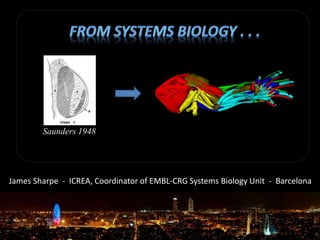
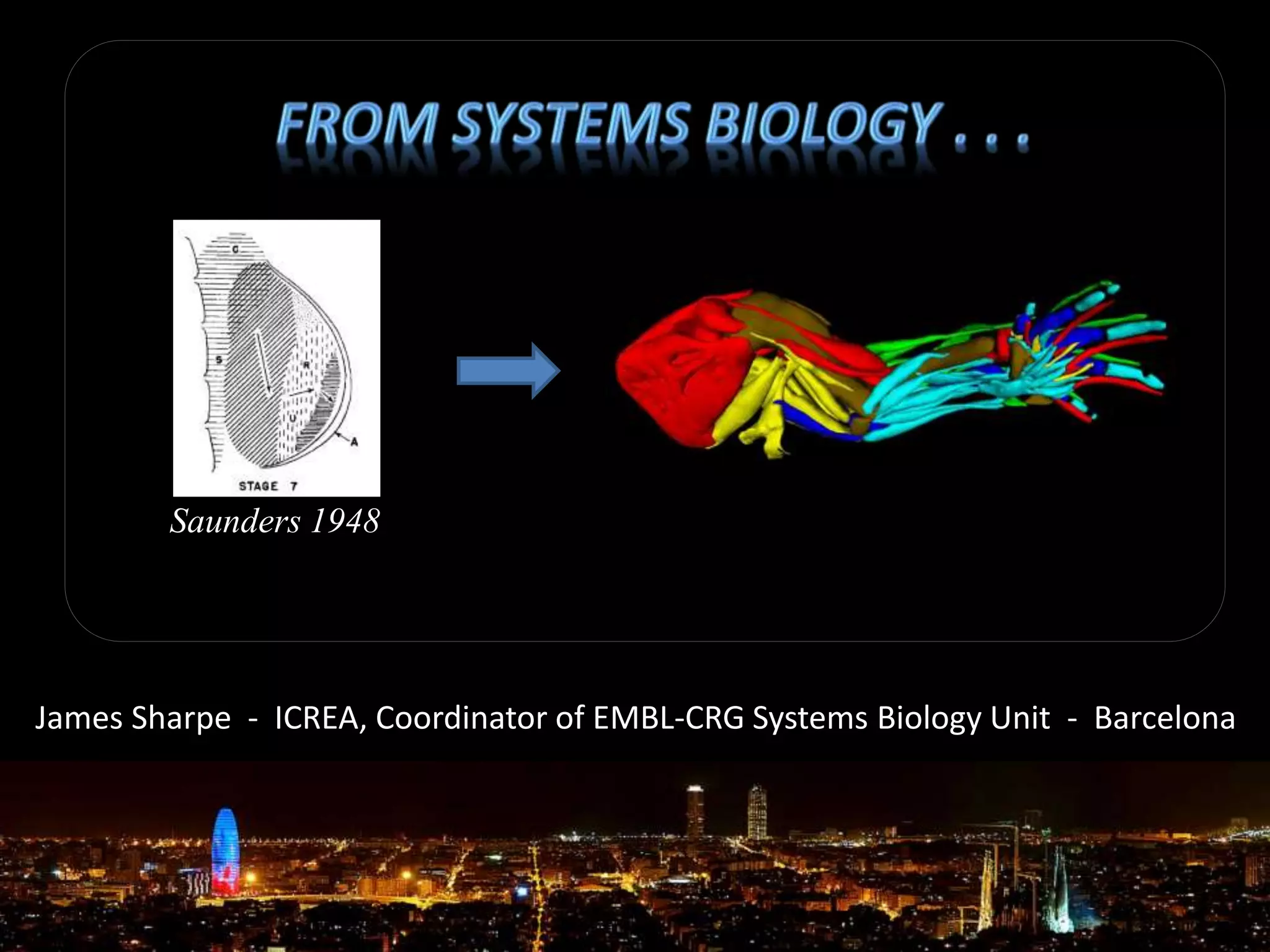
James Sharpe - ICREA, Coordinator of EMBL-CRG Systems Biology Unit - Barcelona
Saunders 1948
. . .
James Sharpe
Coordinator of the EMBL-CRG Systems Biology Unit
ICREA Research Professor
Barcelona
• Going beyond correlations
• But very challenging
• For the moment, we have more success with correlations than systems modelling
• Biology = “more than the sum of its parts”
• This is due to COMPLEXITY: non-linearities, feedbacks, dynamics
• Requires dynamical models, which make predictions about dynamical behaviour
• Requires testing these predictions with experimental perturbations
• Therefore, requires experimentally accessible model systems (mice, flies, worms, cells)
• Cannot experiment on people
• Patient data can be used for correlations, mapping, extrapolations, pharmacogenomics …
. . .
Page 11
. . .
“Why is it so difficult to come up with a concise
definition of systems biology?”
“FROM SYSTEMS BIOLOGY TO PERSONALIZED MEDICINE”
“Systems biology means different things to
different people”
Nat. Rev. Mol. Cell Bio. 7:188 (2006)
“Although there is a growing consensus about
the importance of systems biology, there are
almost as many definitions as there are
practitioners.”
The Biochemist, April 2005
“… it is therefore in danger of losing it’s
meaning.”
Williamson (2005)
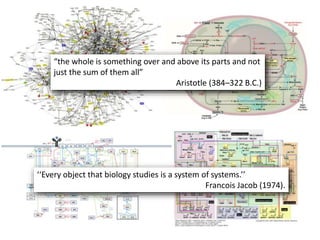
“the whole is something over and above its parts and not
just the sum of them all”
Aristotle (384–322 B.C.)
‘‘Every object that biology studies is a system of systems.’’
Francois Jacob (1974).
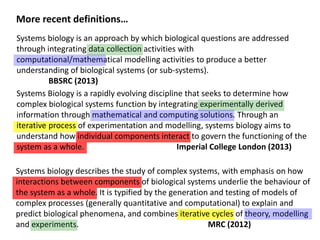
Systems biology is an approach by which biological questions are addressed
through integrating data collection activities with
computational/mathematical modelling activities to produce a better
understanding of biological systems (or sub-systems).
BBSRC (2013)
Systems Biology is a rapidly evolving discipline that seeks to determine how
complex biological systems function by integrating experimentally derived
information through mathematical and computing solutions. Through an
iterative process of experimentation and modelling, systems biology aims to
understand how individual components interact to govern the functioning of the
system as a whole. Imperial College London (2013)
More recent definitions…
Systems biology describes the study of complex systems, with emphasis on how
interactions between components of biological systems underlie the behaviour of
the system as a whole. It is typified by the generation and testing of models of
complex processes (generally quantitative and computational) to explain and
predict biological phenomena, and combines iterative cycles of theory, modelling
and experiments. MRC (2012)
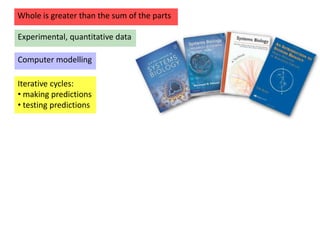
Whole is greater than the sum of the parts
Iterative cycles:
• making predictions
• testing predictions
Experimental, quantitative data
Computer modelling
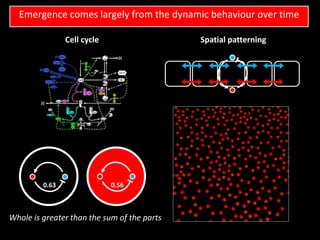
Whole is greater than the sum of the parts
“the whole is something over and above its parts and not
just the sum of them all”
Aristotle (384–322 B.C.)
“EMERGENCE”
0.560.63
Cell cycle Spatial patterning
Whole is greater than the sum of the parts
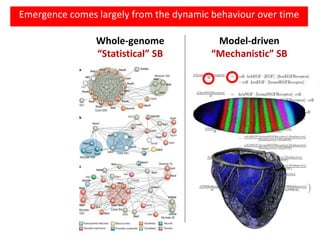
Emergence comes largely from the dynamic behaviour over time
Whole-genome
“Statistical” SB
Model-driven
“Mechanistic” SB
Emergence comes largely from the dynamic behaviour over time
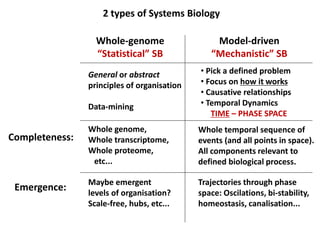
Completeness:
Emergence:
Whole-genome
“Statistical” SB
Model-driven
“Mechanistic” SB
General or abstract
principles of organisation
Data-mining
Whole genome,
Whole transcriptome,
Whole proteome,
etc...
Maybe emergent
levels of organisation?
Scale-free, hubs, etc...
Whole temporal sequence of
events (and all points in space).
All components relevant to
defined biological process.
Trajectories through phase
space: Oscilations, bi-stability,
homeostasis, canalisation...
• Pick a defined problem
• Focus on how it works
• Causative relationships
• Temporal Dynamics
TIME – PHASE SPACE
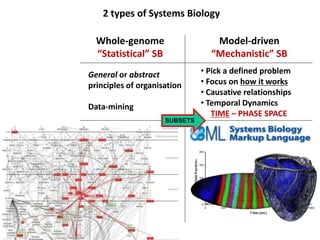
2 types of Systems Biology
Whole-genome
“Statistical” SB
Model-driven
“Mechanistic” SB
• Pick a defined problem
• Focus on how it works
• Causative relationships
• Temporal Dynamics
TIME – PHASE SPACE
General or abstract
principles of organisation
Data-mining
SUBSETS
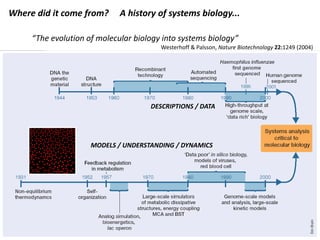
Westerhoff & Palsson, Nature Biotechnology 22:1249 (2004)
“The evolution of molecular biology into systems biology”
Where did it come from? A history of systems biology...
DESCRIPTIONS / DATA
MODELS / UNDERSTANDING / DYNAMICS
Westerhoff & Palsson, Nature Biotechnology 22:1249 (2004)
“The evolution of molecular biology into systems biology”
Where did it come from? A history of systems biology...
DESCRIPTIONS / DATA
MODELS / UNDERSTANDING / DYNAMICS
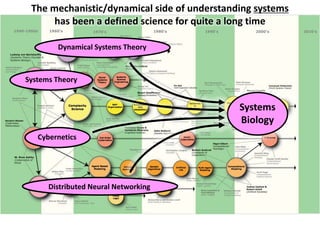
The mechanistic/dynamical side of understanding systems
has been a defined science for quite a long time
Dynamical Systems Theory
Systems Theory
Cybernetics
Distributed Neural Networking
Systems
Biology
Whole-genome
“Statistical” SB
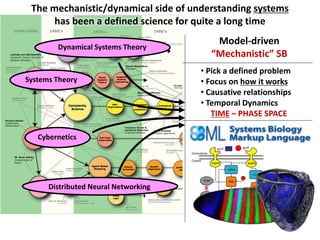
Model-driven
“Mechanistic” SB
• Pick a defined problem
• Focus on how it works
• Causative relationships
• Temporal Dynamics
TIME – PHASE SPACE
General or abstract
principles of organisation
Data-mining
Dynamical Systems Theory
Systems Theory
Cybernetics
Distributed Neural Networking
The mechanistic/dynamical side of understanding systems
has been a defined science for quite a long time
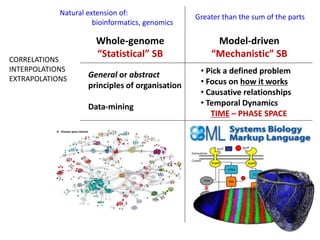
Whole-genome
“Statistical” SB
Model-driven
“Mechanistic” SB
• Pick a defined problem
• Focus on how it works
• Causative relationships
• Temporal Dynamics
TIME – PHASE SPACE
General or abstract
principles of organisation
Data-mining
Natural extension of:
bioinformatics, genomics
CORRELATIONS
INTERPOLATIONS
EXTRAPOLATIONS
Greater than the sum of the parts
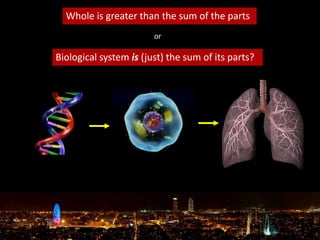
Whole is greater than the sum of the parts
Biological system is (just) the sum of its parts?
or
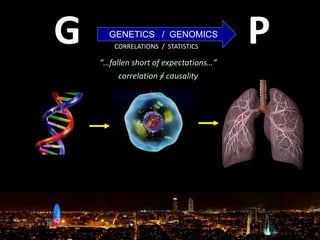
G PGENETICS / GENOMICS
“…fallen short of expectations…”
correlation = causality/
CORRELATIONS / STATISTICS
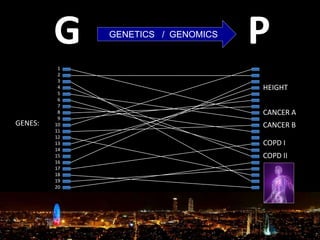
G PGENETICS / GENOMICS
GENES:
1
2
3
4
5
6
7
8
9
10
11
12
13
14
15
16
17
18
19
20
HEIGHT
CANCER A
COPD II
CANCER B
COPD I
GENES:
1
2
3
4
5
6
7
8
9
10
11
12
13
14
15
16
17
18
19
20
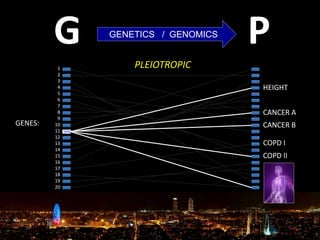
G PGENETICS / GENOMICS
PLEIOTROPIC
HEIGHT
CANCER A
COPD II
CANCER B
COPD I
GENES:
1
2
3
4
5
6
7
8
9
10
11
12
13
14
15
16
17
18
19
20
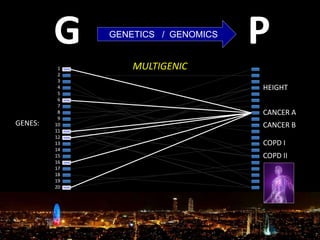
G PGENETICS / GENOMICS
MULTIGENIC
HEIGHT
CANCER A
COPD II
CANCER B
COPD I
GENES:
1
2
3
4
5
6
7
8
9
10
11
12
13
14
15
16
17
18
19
20
G PGENETICS / GENOMICS
DIFFICULT, BUT THEORETICALLY STATISTICALLY POSSIBLE . . .
HEIGHT
CANCER A
COPD II
CANCER B
COPD I
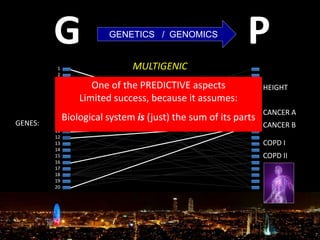
One of the PREDICTIVE aspects
But limited success
GENES:
1
2
3
4
5
6
7
8
9
10
11
12
13
14
15
16
17
18
19
20
G PGENETICS / GENOMICS
MULTIGENIC
HEIGHT
CANCER A
COPD II
CANCER B
COPD I
One of the PREDICTIVE aspects
Limited success, because it assumes:
Biological system is (just) the sum of its parts
GENES:
1
2
3
4
5
6
7
8
9
10
11
12
13
14
15
16
17
18
19
20
G PGENETICS / GENOMICS
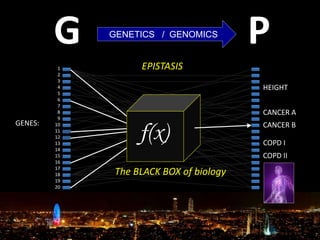
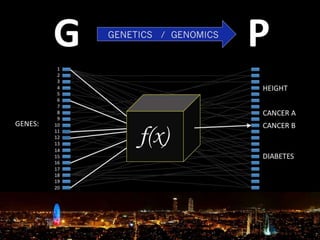
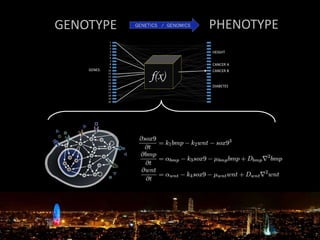
f(x)
EPISTASIS
The BLACK BOX of biology
HEIGHT
CANCER A
COPD II
CANCER B
COPD I
GENOTYPE PHENOTYPE
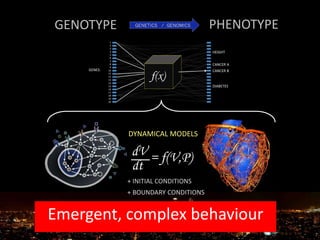
dV
dt
= f(V,P)
+ INITIAL CONDITIONS
+ BOUNDARY CONDITIONS
DYNAMICAL MODELS
Emergent, complex behaviour
GENOTYPE PHENOTYPE
GENOTYPE PHENOTYPE
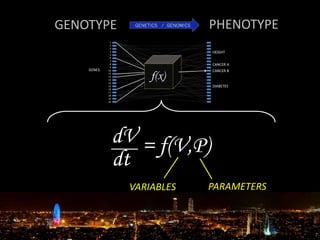
dV
dt
= f(V,P)
VARIABLES PARAMETERS
GENOTYPE PHENOTYPE
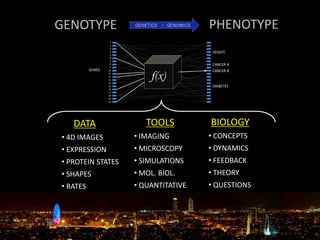
BIOLOGY
• CONCEPTS
• DYNAMICS
• FEEDBACK
• THEORY
• QUESTIONS
TOOLS
• IMAGING
• MICROSCOPY
• SIMULATIONS
• MOL. BIOL.
• QUANTITATIVE
DATA
• 4D IMAGES
• EXPRESSION
• PROTEIN STATES
• SHAPES
• RATES
GENOTYPE PHENOTYPE
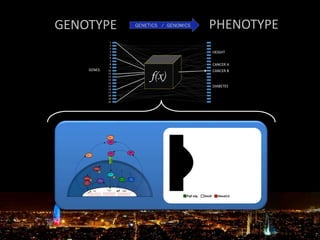
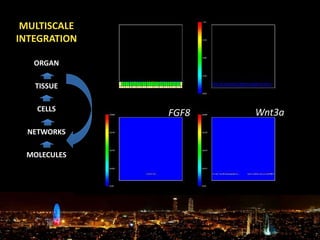
FGF8 Wnt3a
MULTISCALE
INTEGRATION
ORGAN
TISSUE
CELLS
NETWORKS
MOLECULES
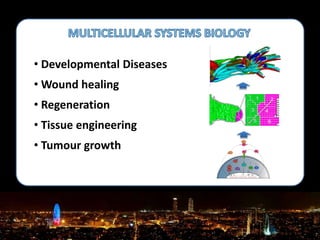
• Developmental Diseases
• Wound healing
• Regeneration
• Tissue engineering
• Tumour growth
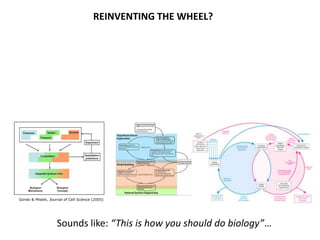
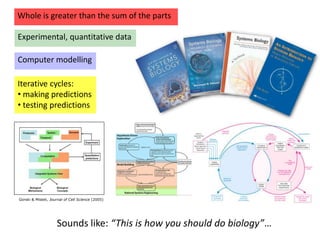
Gorski & Misteli, Journal of Cell Science (2005)
Sounds like: “This is how you should do biology”…
Iterative cycles:
• making predictions
• testing predictions
Whole is greater than the sum of the parts
Experimental, quantitative data
Computer modelling
Gorski & Misteli, Journal of Cell Science (2005)
Sounds like: “This is how you should do biology”…
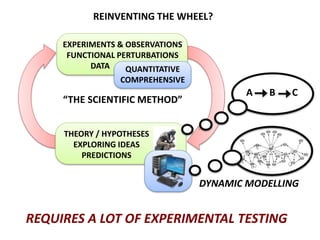
REINVENTING THE WHEEL?
EXPERIMENTS & OBSERVATIONS
FUNCTIONAL PERTURBATIONS
DATA
THEORY / HYPOTHESES
EXPLORING IDEAS
PREDICTIONS
“THE SCIENTIFIC METHOD”
QUANTITATIVE
COMPREHENSIVE
REINVENTING THE WHEEL?
A B C
REQUIRES A LOT OF EXPERIMENTAL TESTING
DYNAMIC MODELLING
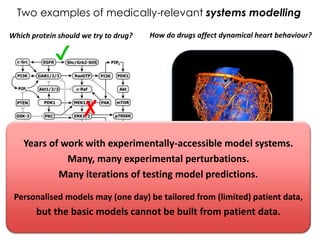
Which protein should we try to drug?
The Mammalian MAPK/ERK Pathway Exhibits
Properties of a Negative Feedback Amplifier. Oliver E.
Sturm, Richard Orton, Joan Grindlay, Marc Birtwistle,
Vladislav Vyshemirsky, David Gilbert, Muffy Calder,
Andrew Pitt, Boris Kholodenko and Walter Kolch (21
December 2010) Science Signaling 3 (153), ra90
Two examples of medically-relevant systems modelling
How do drugs affect dynamical heart behaviour?
Helped understand the impacts of:
• Ivabradine
• Ranolazine
Dennis Noble et al.
Years of work with experimentally-accessible model systems.
Many, many experimental perturbations.
Many iterations of testing model predictions.
Personalised models may (one day) be tailored from (limited) patient data,
but the basic models cannot be built from patient data.
✔
✘
• Going beyond correlations
• But very challenging
• For the moment, we have more success with correlations than systems modelling
• Biology = “more than the sum of its parts”
• This is due to COMPLEXITY: non-linearities, feedbacks, dynamics
• Requires dynamical models, which make predictions about dynamical behaviour
• Requires testing these predictions with experimental perturbations
• Therefore, requires experimentally accessible model systems (mice, flies, worms, cells)
• Cannot experiment on people
• Patient data can be used for correlations, mapping, extrapolations, pharmacogenomics …
. . .
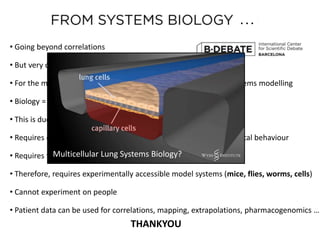
Multicellular Lung Systems Biology?
THANKYOU

BRN Seminar 12/06/14 From Systems Biology

  • 1.
    James Sharpe -ICREA, Coordinator of EMBL-CRG Systems Biology Unit - Barcelona Saunders 1948
  • 2.
    . . . JamesSharpe Coordinator of the EMBL-CRG Systems Biology Unit ICREA Research Professor Barcelona
  • 3.
    • Going beyondcorrelations • But very challenging • For the moment, we have more success with correlations than systems modelling • Biology = “more than the sum of its parts” • This is due to COMPLEXITY: non-linearities, feedbacks, dynamics • Requires dynamical models, which make predictions about dynamical behaviour • Requires testing these predictions with experimental perturbations • Therefore, requires experimentally accessible model systems (mice, flies, worms, cells) • Cannot experiment on people • Patient data can be used for correlations, mapping, extrapolations, pharmacogenomics … . . .
  • 4.
  • 5.
    “Why is itso difficult to come up with a concise definition of systems biology?” “FROM SYSTEMS BIOLOGY TO PERSONALIZED MEDICINE” “Systems biology means different things to different people” Nat. Rev. Mol. Cell Bio. 7:188 (2006) “Although there is a growing consensus about the importance of systems biology, there are almost as many definitions as there are practitioners.” The Biochemist, April 2005 “… it is therefore in danger of losing it’s meaning.” Williamson (2005)
  • 6.
    “the whole issomething over and above its parts and not just the sum of them all” Aristotle (384–322 B.C.) ‘‘Every object that biology studies is a system of systems.’’ Francois Jacob (1974).
  • 7.
    Systems biology isan approach by which biological questions are addressed through integrating data collection activities with computational/mathematical modelling activities to produce a better understanding of biological systems (or sub-systems). BBSRC (2013) Systems Biology is a rapidly evolving discipline that seeks to determine how complex biological systems function by integrating experimentally derived information through mathematical and computing solutions. Through an iterative process of experimentation and modelling, systems biology aims to understand how individual components interact to govern the functioning of the system as a whole. Imperial College London (2013) More recent definitions… Systems biology describes the study of complex systems, with emphasis on how interactions between components of biological systems underlie the behaviour of the system as a whole. It is typified by the generation and testing of models of complex processes (generally quantitative and computational) to explain and predict biological phenomena, and combines iterative cycles of theory, modelling and experiments. MRC (2012)
  • 8.
    Whole is greaterthan the sum of the parts Iterative cycles: • making predictions • testing predictions Experimental, quantitative data Computer modelling
  • 9.
    Whole is greaterthan the sum of the parts “the whole is something over and above its parts and not just the sum of them all” Aristotle (384–322 B.C.) “EMERGENCE”
  • 10.
    0.560.63 Cell cycle Spatialpatterning Whole is greater than the sum of the parts Emergence comes largely from the dynamic behaviour over time
  • 11.
  • 12.
    Completeness: Emergence: Whole-genome “Statistical” SB Model-driven “Mechanistic” SB Generalor abstract principles of organisation Data-mining Whole genome, Whole transcriptome, Whole proteome, etc... Maybe emergent levels of organisation? Scale-free, hubs, etc... Whole temporal sequence of events (and all points in space). All components relevant to defined biological process. Trajectories through phase space: Oscilations, bi-stability, homeostasis, canalisation... • Pick a defined problem • Focus on how it works • Causative relationships • Temporal Dynamics TIME – PHASE SPACE 2 types of Systems Biology
  • 13.
    2 types ofSystems Biology Whole-genome “Statistical” SB Model-driven “Mechanistic” SB • Pick a defined problem • Focus on how it works • Causative relationships • Temporal Dynamics TIME – PHASE SPACE General or abstract principles of organisation Data-mining SUBSETS
  • 14.
    Westerhoff & Palsson,Nature Biotechnology 22:1249 (2004) “The evolution of molecular biology into systems biology” Where did it come from? A history of systems biology... DESCRIPTIONS / DATA MODELS / UNDERSTANDING / DYNAMICS
  • 15.
    Westerhoff & Palsson,Nature Biotechnology 22:1249 (2004) “The evolution of molecular biology into systems biology” Where did it come from? A history of systems biology... DESCRIPTIONS / DATA MODELS / UNDERSTANDING / DYNAMICS
  • 16.
    The mechanistic/dynamical sideof understanding systems has been a defined science for quite a long time Dynamical Systems Theory Systems Theory Cybernetics Distributed Neural Networking Systems Biology
  • 17.
    Whole-genome “Statistical” SB Model-driven “Mechanistic” SB •Pick a defined problem • Focus on how it works • Causative relationships • Temporal Dynamics TIME – PHASE SPACE General or abstract principles of organisation Data-mining Dynamical Systems Theory Systems Theory Cybernetics Distributed Neural Networking The mechanistic/dynamical side of understanding systems has been a defined science for quite a long time
  • 18.
    Whole-genome “Statistical” SB Model-driven “Mechanistic” SB •Pick a defined problem • Focus on how it works • Causative relationships • Temporal Dynamics TIME – PHASE SPACE General or abstract principles of organisation Data-mining Natural extension of: bioinformatics, genomics CORRELATIONS INTERPOLATIONS EXTRAPOLATIONS Greater than the sum of the parts
  • 19.
    Whole is greaterthan the sum of the parts Biological system is (just) the sum of its parts? or
  • 20.
    G PGENETICS /GENOMICS “…fallen short of expectations…” correlation = causality/ CORRELATIONS / STATISTICS
  • 21.
    G PGENETICS /GENOMICS GENES: 1 2 3 4 5 6 7 8 9 10 11 12 13 14 15 16 17 18 19 20 HEIGHT CANCER A COPD II CANCER B COPD I
  • 22.
    GENES: 1 2 3 4 5 6 7 8 9 10 11 12 13 14 15 16 17 18 19 20 G PGENETICS /GENOMICS PLEIOTROPIC HEIGHT CANCER A COPD II CANCER B COPD I
  • 23.
    GENES: 1 2 3 4 5 6 7 8 9 10 11 12 13 14 15 16 17 18 19 20 G PGENETICS /GENOMICS MULTIGENIC HEIGHT CANCER A COPD II CANCER B COPD I
  • 24.
    GENES: 1 2 3 4 5 6 7 8 9 10 11 12 13 14 15 16 17 18 19 20 G PGENETICS /GENOMICS DIFFICULT, BUT THEORETICALLY STATISTICALLY POSSIBLE . . . HEIGHT CANCER A COPD II CANCER B COPD I One of the PREDICTIVE aspects But limited success
  • 25.
    GENES: 1 2 3 4 5 6 7 8 9 10 11 12 13 14 15 16 17 18 19 20 G PGENETICS /GENOMICS MULTIGENIC HEIGHT CANCER A COPD II CANCER B COPD I One of the PREDICTIVE aspects Limited success, because it assumes: Biological system is (just) the sum of its parts
  • 26.
    GENES: 1 2 3 4 5 6 7 8 9 10 11 12 13 14 15 16 17 18 19 20 G PGENETICS /GENOMICS f(x) EPISTASIS The BLACK BOX of biology HEIGHT CANCER A COPD II CANCER B COPD I
  • 28.
    GENOTYPE PHENOTYPE dV dt = f(V,P) +INITIAL CONDITIONS + BOUNDARY CONDITIONS DYNAMICAL MODELS Emergent, complex behaviour
  • 29.
  • 30.
  • 31.
    GENOTYPE PHENOTYPE BIOLOGY • CONCEPTS •DYNAMICS • FEEDBACK • THEORY • QUESTIONS TOOLS • IMAGING • MICROSCOPY • SIMULATIONS • MOL. BIOL. • QUANTITATIVE DATA • 4D IMAGES • EXPRESSION • PROTEIN STATES • SHAPES • RATES
  • 32.
  • 33.
  • 37.
    • Developmental Diseases •Wound healing • Regeneration • Tissue engineering • Tumour growth
  • 38.
    Gorski & Misteli,Journal of Cell Science (2005) Sounds like: “This is how you should do biology”… Iterative cycles: • making predictions • testing predictions Whole is greater than the sum of the parts Experimental, quantitative data Computer modelling
  • 39.
    Gorski & Misteli,Journal of Cell Science (2005) Sounds like: “This is how you should do biology”… REINVENTING THE WHEEL?
  • 40.
    EXPERIMENTS & OBSERVATIONS FUNCTIONALPERTURBATIONS DATA THEORY / HYPOTHESES EXPLORING IDEAS PREDICTIONS “THE SCIENTIFIC METHOD” QUANTITATIVE COMPREHENSIVE REINVENTING THE WHEEL? A B C REQUIRES A LOT OF EXPERIMENTAL TESTING DYNAMIC MODELLING
  • 41.
    Which protein shouldwe try to drug? The Mammalian MAPK/ERK Pathway Exhibits Properties of a Negative Feedback Amplifier. Oliver E. Sturm, Richard Orton, Joan Grindlay, Marc Birtwistle, Vladislav Vyshemirsky, David Gilbert, Muffy Calder, Andrew Pitt, Boris Kholodenko and Walter Kolch (21 December 2010) Science Signaling 3 (153), ra90 Two examples of medically-relevant systems modelling How do drugs affect dynamical heart behaviour? Helped understand the impacts of: • Ivabradine • Ranolazine Dennis Noble et al. Years of work with experimentally-accessible model systems. Many, many experimental perturbations. Many iterations of testing model predictions. Personalised models may (one day) be tailored from (limited) patient data, but the basic models cannot be built from patient data. ✔ ✘
  • 42.
    • Going beyondcorrelations • But very challenging • For the moment, we have more success with correlations than systems modelling • Biology = “more than the sum of its parts” • This is due to COMPLEXITY: non-linearities, feedbacks, dynamics • Requires dynamical models, which make predictions about dynamical behaviour • Requires testing these predictions with experimental perturbations • Therefore, requires experimentally accessible model systems (mice, flies, worms, cells) • Cannot experiment on people • Patient data can be used for correlations, mapping, extrapolations, pharmacogenomics … . . . Multicellular Lung Systems Biology? THANKYOU

Editor's Notes

  • #2 Primary goal – build a realistic computer model of an example of mammalian organogenesis – limb development. Firstly – intro, mention the range of projects Then focus on one of these projects
  • #21 Primary goal – build a realistic computer model of an example of mammalian organogenesis – limb development. Firstly – intro, mention the range of projects Then focus on one of these projects
  • #22 Primary goal – build a realistic computer model of an example of mammalian organogenesis – limb development. Firstly – intro, mention the range of projects Then focus on one of these projects
  • #23 Primary goal – build a realistic computer model of an example of mammalian organogenesis – limb development. Firstly – intro, mention the range of projects Then focus on one of these projects
  • #24 Primary goal – build a realistic computer model of an example of mammalian organogenesis – limb development. Firstly – intro, mention the range of projects Then focus on one of these projects
  • #25 Primary goal – build a realistic computer model of an example of mammalian organogenesis – limb development. Firstly – intro, mention the range of projects Then focus on one of these projects
  • #26 Primary goal – build a realistic computer model of an example of mammalian organogenesis – limb development. Firstly – intro, mention the range of projects Then focus on one of these projects
  • #27 Primary goal – build a realistic computer model of an example of mammalian organogenesis – limb development. Firstly – intro, mention the range of projects Then focus on one of these projects
  • #28 Primary goal – build a realistic computer model of an example of mammalian organogenesis – limb development. Firstly – intro, mention the range of projects Then focus on one of these projects
  • #29 Primary goal – build a realistic computer model of an example of mammalian organogenesis – limb development. Firstly – intro, mention the range of projects Then focus on one of these projects
  • #30 Primary goal – build a realistic computer model of an example of mammalian organogenesis – limb development. Firstly – intro, mention the range of projects Then focus on one of these projects
  • #31 Primary goal – build a realistic computer model of an example of mammalian organogenesis – limb development. Firstly – intro, mention the range of projects Then focus on one of these projects
  • #32 Primary goal – build a realistic computer model of an example of mammalian organogenesis – limb development. Firstly – intro, mention the range of projects Then focus on one of these projects
  • #33 Primary goal – build a realistic computer model of an example of mammalian organogenesis – limb development. Firstly – intro, mention the range of projects Then focus on one of these projects
  • #34 Primary goal – build a realistic computer model of an example of mammalian organogenesis – limb development. Firstly – intro, mention the range of projects Then focus on one of these projects
  • #35 Primary goal – build a realistic computer model of an example of mammalian organogenesis – limb development. Firstly – intro, mention the range of projects Then focus on one of these projects
  • #36 Primary goal – build a realistic computer model of an example of mammalian organogenesis – limb development. Firstly – intro, mention the range of projects Then focus on one of these projects
  • #37 Primary goal – build a realistic computer model of an example of mammalian organogenesis – limb development. Firstly – intro, mention the range of projects Then focus on one of these projects
  • #38 Primary goal – build a realistic computer model of an example of mammalian organogenesis – limb development. Firstly – intro, mention the range of projects Then focus on one of these projects
  • #39 Primary goal – build a realistic computer model of an example of mammalian organogenesis – limb development. Firstly – intro, mention the range of projects Then focus on one of these projects