Teri Manolio 
Director, Office for Population Genomics, 
National Human Genome Institute (NHGRI), 
USA 
Perspective from a Global Leader
Applying Genomics to Clinical Care: The Global Genomic Medicine Collaborative (G2MC) 
National Human Genome Research Institute 
National Institutes of Health 
U.S. Department of Health and Human Services 
U.S. Department of Health and Human Services National Institutes of Health National Human Genome Research Institute 
Teri Manolio, M.D., Ph.D. 
EuroBioForum Personalised Medicine 2014 
September 22, 2014
Sunrise in Washington DC 
http://iqdc.com/pics/sunrise.jpg
Discovery Research 
Clinical 
Validation 
Clinical Implementation 
Assess genotype- phenotype associations 
Assess outcomes after using genetics to direct therapy 
Develop processes for performing genetic testing and using results in care 
•Identify persons at increased risk of disease based on their genetic variants 
•Assess impact on health outcomes and care utilization of reporting genomic findings 
•Develop clinical informatics systems for reporting genomic results and decision support 
•Find all variants related to given phenotype or disease 
•Identify causes of rare or undiagnosed diseases 
•Educate clinicians and patients in clinical use of genomic results 
•Characterize variation in genes known to be related to disease or treatment response 
•Validate drug targets and develop improved therapeutic agents 
•Define and disseminate information on actionable clinical variants and relevant evidence base 
Spectrum of Disease-Related Genomics Research
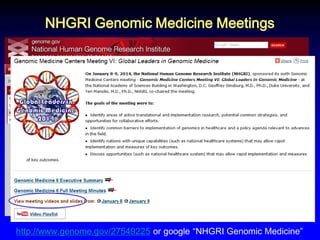
NHGRI Genomic Medicine Meetings 
http://www.genome.gov/27549225 or google “NHGRI Genomic Medicine”
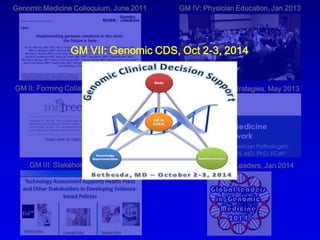
Genomic Medicine Colloquium, June 2011 
GM II: Forming Collaborations, Dec 2011 
GM III: Stakeholders, May 2012 
GM IV: Physician Education, Jan 2013 
GM V: Federal Strategies, May 2013 
GM VI: Global Leaders, Jan 2014 
GM VII: Genomic CDS, Oct 2-3, 2014
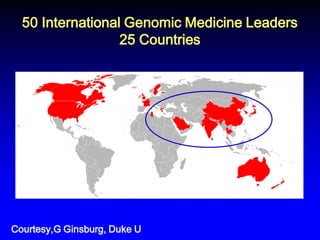
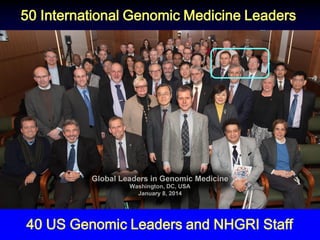
50 International Genomic Medicine Leaders 25 Countries 
Courtesy,G Ginsburg, Duke U
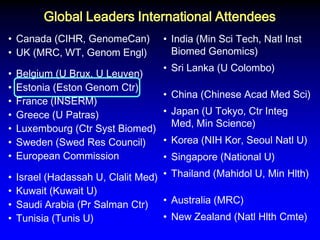
Global Leaders International Attendees 
•Canada (CIHR, GenomeCan) 
•UK (MRC, WT, Genom Engl) 
•Belgium (U Brux, U Leuven) 
•Estonia (Eston Genom Ctr) 
•France (INSERM) 
•Greece (U Patras) 
•Luxembourg (Ctr Syst Biomed) 
•Sweden (Swed Res Council) 
•European Commission 
•Israel (Hadassah U, Clalit Med) 
•Kuwait (Kuwait U) 
•Saudi Arabia (Pr Salman Ctr) 
•Tunisia (Tunis U) 
•India (Min Sci Tech, Natl Inst Biomed Genomics) 
•Sri Lanka (U Colombo) 
•China (Chinese Acad Med Sci) 
•Japan (U Tokyo, Ctr Integ Med, Min Science) 
•Korea (NIH Kor, Seoul Natl U) 
•Singapore (National U) 
•Thailand (Mahidol U, Min Hlth) 
•Australia (MRC) 
•New Zealand (Natl Hlth Cmte)
Objectives of GMVI: Global Leaders in Genomic Medicine 
•Identify areas of active translation and implementation 
•Prioritize common barriers to implementation in healthcare 
•Frame a policy agenda to advance the field 
•Highlight nations with unique capabilities 
•Discuss opportunities for international collaborations
Plethora of Genomics Implementation Efforts 
•UK: Genomics England to sequence 100K whole genomes and link to NHS medical record 
•Japan: Implementation of Genomic Medicine Project including genomic prediction of drug response, efficacy and cost-effectiveness studies 
•Estonia: proposed project for personal medicine 
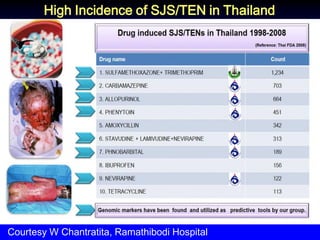
•Thailand: PGx card identifying risk for top ten SJS-TEN drugs, clinical exomes and genomes
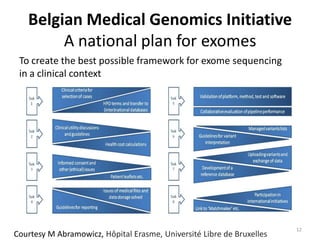
Belgian Medical Genomics Initiative A national plan for exomes 
12 
To create the best possible framework for exome sequencing in a clinical context 
Courtesy M Abramowicz, Hôpital Erasme, Université Libre de Bruxelles
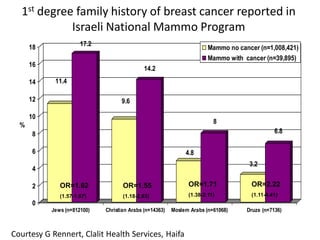
1st degree family history of breast cancer reported in 
Israeli National Mammo Program 
11.4 
17.2 
9.6 
14.2 
4.8 
8 
3.2 
6.8 
0 
2 
4 
6 
8 
10 
12 
14 
16 
18 
% 
Jews (n=812100) Christian Arabs (n=14363) Moslem Arabs (n=61068) Druze (n=7136) 
Mammo no cancer (n=1,008,421) 
Mammo with cancer (n=39,895) 
OR=1.62 
(1.57-1.67) 
OR=1.55 
(1.18-2.03) 
OR=1.71 
(1.38-2.11) 
OR=2.22 
(1.11-4.41) 
Courtesy G Rennert, Clalit Health Services, Haifa
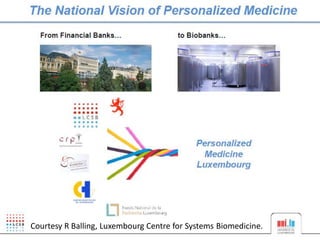
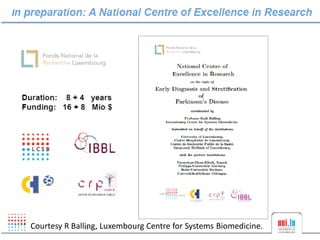
Courtesy R Balling, Luxembourg Centre for Systems Biomedicine.
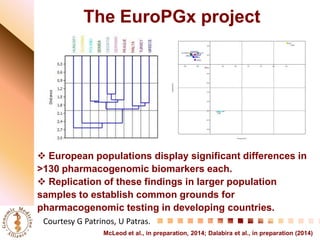
The EuroPGx project 
McLeod et al., in preparation, 2014; Dalabira et al., in preparation (2014) 
 European populations display significant differences in >130 pharmacogenomic biomarkers each. 
 Replication of these findings in larger population samples to establish common grounds for pharmacogenomic testing in developing countries. 
Courtesy G Patrinos, U Patras.
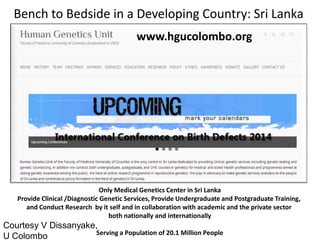
www.hgucolombo.org 
Only Medical Genetics Center in Sri Lanka Provide Clinical /Diagnostic Genetic Services, Provide Undergraduate and Postgraduate Training, and Conduct Research by it self and in collaboration with academic and the private sector both nationally and internationally Serving a Population of 20.1 Million People 
Courtesy V Dissanyake, 
U Colombo 
Bench to Bedside in a Developing Country: Sri Lanka
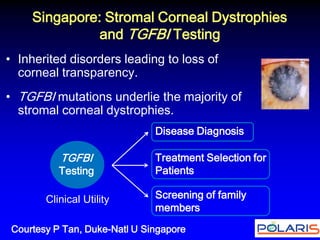
Singapore: Stromal Corneal Dystrophies and TGFBI Testing 
•Inherited disorders leading to loss of corneal transparency. 
•TGFBI mutations underlie the majority of stromal corneal dystrophies. 
Screening of family members 
Disease Diagnosis 
Treatment Selection for Patients 
TGFBI Testing 
Clinical Utility 
Courtesy P Tan, Duke-Natl U Singapore
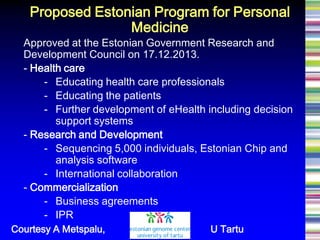
Approved at the Estonian Government Research and Development Council on 17.12.2013. - Health care - Educating health care professionals - Educating the patients - Further development of eHealth including decision support systems 
- Research and Development - Sequencing 5,000 individuals, Estonian Chip and analysis software - International collaboration 
- Commercialization - Business agreements - IPR 
Proposed Estonian Program for Personal Medicine 
Courtesy A Metspalu, U Tartu
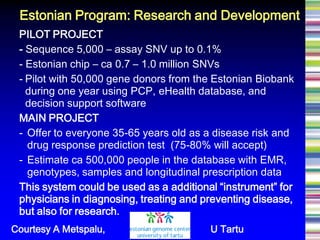
Estonian Program: Research and Development 
Courtesy A Metspalu, U Tartu 
PILOT PROJECT - Sequence 5,000 – assay SNV up to 0.1% - Estonian chip – ca 0.7 – 1.0 million SNVs - Pilot with 50,000 gene donors from the Estonian Biobank during one year using PCP, eHealth database, and decision support software MAIN PROJECT 
-Offer to everyone 35-65 years old as a disease risk and drug response prediction test (75-80% will accept) 
-Estimate ca 500,000 people in the database with EMR, genotypes, samples and longitudinal prescription data This system could be used as a additional “instrument” for physicians in diagnosing, treating and preventing disease, but also for research.
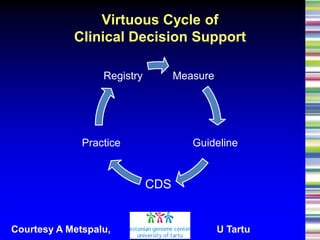
Virtuous Cycle of Clinical Decision Support 
Measure 
Guideline 
CDS 
Practice 
Registry 
http://www2.eerp.usp.br/Nepien/DisponibilizarArquivos/tomada_de_decis%C3%A3o.pdf 
Courtesy A Metspalu, U Tartu
Evidence Generating Medicine 
•The next step beyond evidence-based medicine 
•The systematic incorporation of research and quality improvement considerations into the organization and practice of healthcare 
•To advance biomedical science and thereby improve the health of individuals and populations. 
Courtesy A Metspalu, U Tartu
Partly supported by 
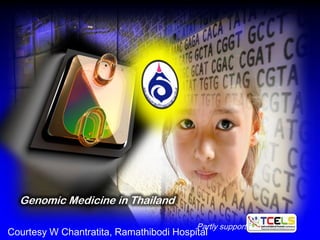
Genomic Medicine in Thailand 
Courtesy W Chantratita, Ramathibodi Hospital
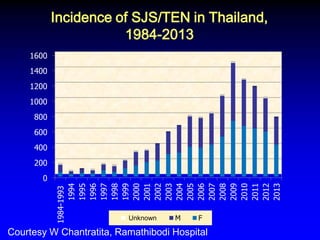
High Incidence of SJS/TEN in Thailand 
Courtesy W Chantratita, Ramathibodi Hospital
Carbamazepine: SJS/TEN B*1502 
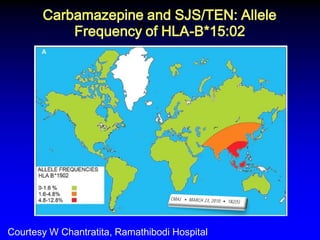
Carbamazepine and SJS/TEN: Allele Frequency of HLA-B*15:02 
Courtesy W Chantratita, Ramathibodi Hospital
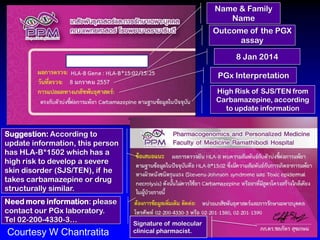
Name & Family Name Outcome of the PGX assay 
PGx Interpretation 
8 Jan 2014 High Risk of SJS/TEN from Carbamazepine, according to update information Suggestion: According to update information, this person has HLA-B*1502 which has a high risk to develop a severe skin disorder (SJS/TEN), if he takes carbamazepine or drug structurally similar. 
Need more information: please contact our PGx laboratory. Tel 02-200-4330-3… 
Signature of molecular clinical pharmacist. 
Courtesy W Chantratita
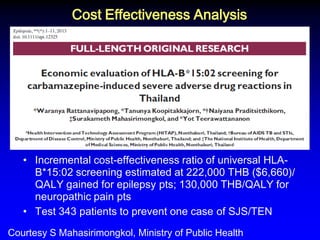
Cost Effectiveness Analysis 
•Incremental cost-effectiveness ratio of universal HLA- B*15:02 screening estimated at 222,000 THB ($6,660)/ QALY gained for epilepsy pts; 130,000 THB/QALY for neuropathic pain pts 
•Test 343 patients to prevent one case of SJS/TEN 
Courtesy S Mahasirimongkol, Ministry of Public Health
National Academy of Sciences Bldg 
2101 Constitution Avenue, NW 
Washington, DC
Opportunities for International Collaboration 
•Bioinformatics/Health IT 
•Education 
•Evidence Generation 
•Pharmacogenomics 
•Policy 
G2MC
Goals of the Global Genomic Medicine Collaborative (G2MC) 
An international genomic medicine community hosted by the Institute of Medicine and formed to: 
•Serve as nexus, clearinghouse, and knowledge base for GM activities globally 
•Develop opportunities for global GM demonstration projects (implementation and outcomes research) 
•Capture and disseminate best practices for GM (IT, education, evidence, Pgx, policy) across the global GM community 
•Develop a financial model for sustained efforts
G2MC Steering Committee Geoff Ginsburg (US), Robyn Ward (Australia) 
Marc Abramowicz Belgium Fahd Al-Mulla Kuwait Adam Berger US Steve Bleyl US Wasun Chantratita Thailand Vajira Dissanayake Sri Lanka Thierry Frebourg France Anne Kolbe New Zealand John Wong Singapore 
Bruce Korf US Michiaki Kubo Japan Erkki Leego Estonia Teri Manolio US Gert Matthijs Belgium Yaakov Naparstek Israel Irene Norstedt Belgium George P. Patrinos Greece Gad Rennert Israel
G2MC Bioinformatics/Health IT Working Group Steve Bleyl (US), Erkki Leego (Estonia) 
Goal Adopt (or develop) and implement standards for storing individual, discrete, coded genomic features as transmitted from labs for databases or EHRs Use Case Copy number variant transmitted from lab and stored as discrete features in EHR, containing all pertinent data (patient identifiers, test indication, chromosomal anomalies, actionability, array used) Collaboration with GA4GH Define requirements for a global database of clinically actionable variants
G2MC Pharmacogenetics Working Group Wasun Chantratita (Thailand), George Patrinos (Greece) 
Goal: implement broad program internationally to eradicate preventable SJS/TEN using PGx assays 
•Biorepository for identifying additional markers, modifiers, recurrence risk, non-genetic factors 
•Pharmacy practice guidelines for preventing recurrence 
•Health economic and cost-effectiveness analyses 
•In vitro diagnostic tests for causative drugs 
•Clinical trials of treatment
G2MC Policy Working Group Anne Kolbe (New Zealand), Yaakov Naparstek (Israel) 
Goal: assess and address needs of health technology assessors, regulators, industry, policy writers, funders and decision makers including governments 
•Identify major issues facing health and social services sectors in next 5, 10 and 15 years, based on global burden of disease 
•Determine genomic/epigenetic applications currently available and those in R&D pipeline (gap analysis) 
•Bring fit-for-purpose genomic technologies into routine adoption quickly and efficiently 
•Map research and R&D activities and investments, gaps 
•Work with industry and regulators to bring technologies into effective use
What are the next big questions in genomic medicine implementation? 
•Can it be done: accuracy, turnaround (warfarin genotyping) burden 
•Is it interpretable: 
•Can experts interpret it: VUS, penetrance 
•Can clinicians interpret it: education and CDS 
•Is it actionable: treatment, family at risk 
•Does it cause harm: anxiety, unnecessary procedures, diversion of resources 
•Can we learn from it: learning healthcare systems 
•Does it work (help patients), does it reduce cost
50 International Genomic Medicine Leaders 
40 US Genomic Leaders and NHGRI Staff
Larson, G. The Complete Far Side. 2003.
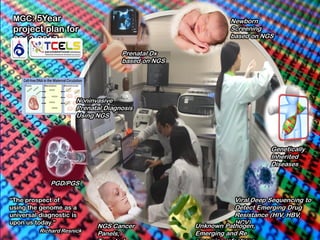
“The prospect of using the genome as a universal diagnostic is upon us today.” 
Richard Resnick 
Genetically Inherited Diseases NGS Cancer Panels; Targeted PGD/PGS Prenatal Dx based on NGS 
Newborn Screening based on NGS MGC: 5Year project plan for 2013-2017 
Viral Deep Sequencing to Detect Emerging Drug Resistance (HIV, HBV, HCV) Unknown Pathogen, Emerging and Re emerging infectious Noninvasive Prenatal Diagnosis Using NGS
Courtesy R Balling, Luxembourg Centre for Systems Biomedicine.
Incidence of SJS/TEN in Thailand, 1984-2013 
0 
200 
400 
600 
800 
1000 
1200 
1400 
1600 
1984-1993 
1994 
1995 
1996 
1997 
1998 
1999 
2000 
2001 
2002 
2003 
2004 
2005 
2006 
2007 
2008 
2009 
2010 
2011 
2012 
2013 
ไม่ระบุเพศ 
M 
F 
Unknown 
Courtesy W Chantratita, Ramathibodi Hospital
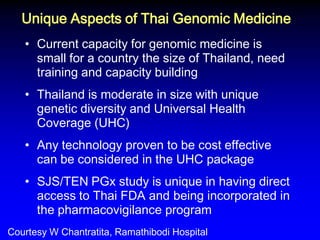
•Current capacity for genomic medicine is small for a country the size of Thailand, need training and capacity building 
•Thailand is moderate in size with unique genetic diversity and Universal Health Coverage (UHC) 
•Any technology proven to be cost effective can be considered in the UHC package 
•SJS/TEN PGx study is unique in having direct access to Thai FDA and being incorporated in the pharmacovigilance program 
Unique Aspects of Thai Genomic Medicine 
Courtesy W Chantratita, Ramathibodi Hospital
Top Ideas in Five Key Areas 
•IT/bioinformatics 
•Define key elements to be stored in EMR 
•Identify most robust and generalizable solutions for potential wider adoption 
•Global resource for actionable variants 
•Education: 
•Define workforce needs 
•Develop existing/new educational tools that can be widely shared 
•Develop region-specific teaching materials, perhaps common templates
Five Break-out Groups’ Top Ideas 
•Evidence Generation 
•Catalog evidence-generating projects 
•Identify poolable/extendable projects 
•Develop systems to capture evidence; federated network, standardized APIs (e-tools) 
•Pharmacogenomics 
•Global eradication of SJS/TEN 
•PGx card 
•Policy 
•Share efforts in consent, results reporting 
•Study economics, cost-effectiveness
Economic Evaluation 
• Cost-effectiveness and cost-utility analyses of various genetic-based medical treatments by reducing the incidence of adverse drug reactions, and reciprocally healthcare expenditure at the national level. 
Current projects focus on anticoagulation treatment of warfarin (Croatia), acenocoumarol (Serbia, Greece) and clopidogrel (Serbia) and nicotine addiction treatment (Greece). 
• Endorsement of the production of the textbook “Economic Evaluation in Genomic Medicine” by Elsevier/Academic Press in early 2015. 
Courtesy G Patrinos, U Patras.
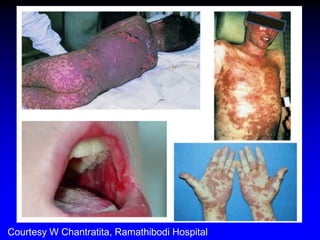
•Stevens-Johnson syndrome (SJS) is a rare in other countries, but not in Thailand. 
•In Thailand, we interviewed many who survived SJS/TEN 
–They felt that their bodies were burning and that someone had poured acid into their eyes 
–The pain was so extreme that they wish to die, but they could not 
•Eradication of SJS/TEN in Thailand is a priority for our Thai medical genomics team 
A Fate Worse than Death 
Courtesy W Chantratita, Ramathibodi Hospital
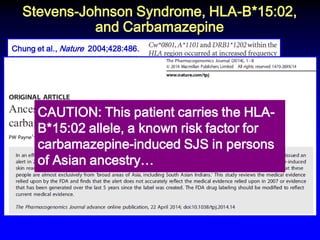
Stevens-Johnson Syndrome, HLA-B*15:02, and Carbamazepine 
Chung et al., Nature 2004;428:486. 
N Engl J Med. 2011;364:1134-43. 
Clin Pharm Therap 2012;92:757-65. 
“Clinicians must determine if a patient has ancestry across broad areas of Asia. This requires clinicians to know what ‘Asian ancestry’ means and use a consistent, reliable method to figure out which 
patients have this ancestry.” 
CAUTION: This patient carries the HLA- B*15:02 allele, a known risk factor for carbamazepine-induced SJS in persons of Asian ancestry…

EuroBioForum2014_speaker_Manolio

  • 1.
    Teri Manolio Director,Office for Population Genomics, National Human Genome Institute (NHGRI), USA Perspective from a Global Leader
  • 2.
    Applying Genomics toClinical Care: The Global Genomic Medicine Collaborative (G2MC) National Human Genome Research Institute National Institutes of Health U.S. Department of Health and Human Services U.S. Department of Health and Human Services National Institutes of Health National Human Genome Research Institute Teri Manolio, M.D., Ph.D. EuroBioForum Personalised Medicine 2014 September 22, 2014
  • 3.
    Sunrise in WashingtonDC http://iqdc.com/pics/sunrise.jpg
  • 4.
    Discovery Research Clinical Validation Clinical Implementation Assess genotype- phenotype associations Assess outcomes after using genetics to direct therapy Develop processes for performing genetic testing and using results in care •Identify persons at increased risk of disease based on their genetic variants •Assess impact on health outcomes and care utilization of reporting genomic findings •Develop clinical informatics systems for reporting genomic results and decision support •Find all variants related to given phenotype or disease •Identify causes of rare or undiagnosed diseases •Educate clinicians and patients in clinical use of genomic results •Characterize variation in genes known to be related to disease or treatment response •Validate drug targets and develop improved therapeutic agents •Define and disseminate information on actionable clinical variants and relevant evidence base Spectrum of Disease-Related Genomics Research
  • 5.
    NHGRI Genomic MedicineMeetings http://www.genome.gov/27549225 or google “NHGRI Genomic Medicine”
  • 6.
    Genomic Medicine Colloquium,June 2011 GM II: Forming Collaborations, Dec 2011 GM III: Stakeholders, May 2012 GM IV: Physician Education, Jan 2013 GM V: Federal Strategies, May 2013 GM VI: Global Leaders, Jan 2014 GM VII: Genomic CDS, Oct 2-3, 2014
  • 8.
    50 International GenomicMedicine Leaders 25 Countries Courtesy,G Ginsburg, Duke U
  • 9.
    Global Leaders InternationalAttendees •Canada (CIHR, GenomeCan) •UK (MRC, WT, Genom Engl) •Belgium (U Brux, U Leuven) •Estonia (Eston Genom Ctr) •France (INSERM) •Greece (U Patras) •Luxembourg (Ctr Syst Biomed) •Sweden (Swed Res Council) •European Commission •Israel (Hadassah U, Clalit Med) •Kuwait (Kuwait U) •Saudi Arabia (Pr Salman Ctr) •Tunisia (Tunis U) •India (Min Sci Tech, Natl Inst Biomed Genomics) •Sri Lanka (U Colombo) •China (Chinese Acad Med Sci) •Japan (U Tokyo, Ctr Integ Med, Min Science) •Korea (NIH Kor, Seoul Natl U) •Singapore (National U) •Thailand (Mahidol U, Min Hlth) •Australia (MRC) •New Zealand (Natl Hlth Cmte)
  • 10.
    Objectives of GMVI:Global Leaders in Genomic Medicine •Identify areas of active translation and implementation •Prioritize common barriers to implementation in healthcare •Frame a policy agenda to advance the field •Highlight nations with unique capabilities •Discuss opportunities for international collaborations
  • 11.
    Plethora of GenomicsImplementation Efforts •UK: Genomics England to sequence 100K whole genomes and link to NHS medical record •Japan: Implementation of Genomic Medicine Project including genomic prediction of drug response, efficacy and cost-effectiveness studies •Estonia: proposed project for personal medicine •Thailand: PGx card identifying risk for top ten SJS-TEN drugs, clinical exomes and genomes
  • 12.
    Belgian Medical GenomicsInitiative A national plan for exomes 12 To create the best possible framework for exome sequencing in a clinical context Courtesy M Abramowicz, Hôpital Erasme, Université Libre de Bruxelles
  • 13.
    1st degree familyhistory of breast cancer reported in Israeli National Mammo Program 11.4 17.2 9.6 14.2 4.8 8 3.2 6.8 0 2 4 6 8 10 12 14 16 18 % Jews (n=812100) Christian Arabs (n=14363) Moslem Arabs (n=61068) Druze (n=7136) Mammo no cancer (n=1,008,421) Mammo with cancer (n=39,895) OR=1.62 (1.57-1.67) OR=1.55 (1.18-2.03) OR=1.71 (1.38-2.11) OR=2.22 (1.11-4.41) Courtesy G Rennert, Clalit Health Services, Haifa
  • 14.
    Courtesy R Balling,Luxembourg Centre for Systems Biomedicine.
  • 15.
    The EuroPGx project McLeod et al., in preparation, 2014; Dalabira et al., in preparation (2014)  European populations display significant differences in >130 pharmacogenomic biomarkers each.  Replication of these findings in larger population samples to establish common grounds for pharmacogenomic testing in developing countries. Courtesy G Patrinos, U Patras.
  • 16.
    www.hgucolombo.org Only MedicalGenetics Center in Sri Lanka Provide Clinical /Diagnostic Genetic Services, Provide Undergraduate and Postgraduate Training, and Conduct Research by it self and in collaboration with academic and the private sector both nationally and internationally Serving a Population of 20.1 Million People Courtesy V Dissanyake, U Colombo Bench to Bedside in a Developing Country: Sri Lanka
  • 17.
    Singapore: Stromal CornealDystrophies and TGFBI Testing •Inherited disorders leading to loss of corneal transparency. •TGFBI mutations underlie the majority of stromal corneal dystrophies. Screening of family members Disease Diagnosis Treatment Selection for Patients TGFBI Testing Clinical Utility Courtesy P Tan, Duke-Natl U Singapore
  • 18.
    Approved at theEstonian Government Research and Development Council on 17.12.2013. - Health care - Educating health care professionals - Educating the patients - Further development of eHealth including decision support systems - Research and Development - Sequencing 5,000 individuals, Estonian Chip and analysis software - International collaboration - Commercialization - Business agreements - IPR Proposed Estonian Program for Personal Medicine Courtesy A Metspalu, U Tartu
  • 19.
    Estonian Program: Researchand Development Courtesy A Metspalu, U Tartu PILOT PROJECT - Sequence 5,000 – assay SNV up to 0.1% - Estonian chip – ca 0.7 – 1.0 million SNVs - Pilot with 50,000 gene donors from the Estonian Biobank during one year using PCP, eHealth database, and decision support software MAIN PROJECT -Offer to everyone 35-65 years old as a disease risk and drug response prediction test (75-80% will accept) -Estimate ca 500,000 people in the database with EMR, genotypes, samples and longitudinal prescription data This system could be used as a additional “instrument” for physicians in diagnosing, treating and preventing disease, but also for research.
  • 20.
    Virtuous Cycle ofClinical Decision Support Measure Guideline CDS Practice Registry http://www2.eerp.usp.br/Nepien/DisponibilizarArquivos/tomada_de_decis%C3%A3o.pdf Courtesy A Metspalu, U Tartu
  • 21.
    Evidence Generating Medicine •The next step beyond evidence-based medicine •The systematic incorporation of research and quality improvement considerations into the organization and practice of healthcare •To advance biomedical science and thereby improve the health of individuals and populations. Courtesy A Metspalu, U Tartu
  • 22.
    Partly supported by Genomic Medicine in Thailand Courtesy W Chantratita, Ramathibodi Hospital
  • 23.
    High Incidence ofSJS/TEN in Thailand Courtesy W Chantratita, Ramathibodi Hospital
  • 24.
    Carbamazepine: SJS/TEN B*1502 Carbamazepine and SJS/TEN: Allele Frequency of HLA-B*15:02 Courtesy W Chantratita, Ramathibodi Hospital
  • 25.
    Name & FamilyName Outcome of the PGX assay PGx Interpretation 8 Jan 2014 High Risk of SJS/TEN from Carbamazepine, according to update information Suggestion: According to update information, this person has HLA-B*1502 which has a high risk to develop a severe skin disorder (SJS/TEN), if he takes carbamazepine or drug structurally similar. Need more information: please contact our PGx laboratory. Tel 02-200-4330-3… Signature of molecular clinical pharmacist. Courtesy W Chantratita
  • 26.
    Cost Effectiveness Analysis •Incremental cost-effectiveness ratio of universal HLA- B*15:02 screening estimated at 222,000 THB ($6,660)/ QALY gained for epilepsy pts; 130,000 THB/QALY for neuropathic pain pts •Test 343 patients to prevent one case of SJS/TEN Courtesy S Mahasirimongkol, Ministry of Public Health
  • 27.
    National Academy ofSciences Bldg 2101 Constitution Avenue, NW Washington, DC
  • 28.
    Opportunities for InternationalCollaboration •Bioinformatics/Health IT •Education •Evidence Generation •Pharmacogenomics •Policy G2MC
  • 29.
    Goals of theGlobal Genomic Medicine Collaborative (G2MC) An international genomic medicine community hosted by the Institute of Medicine and formed to: •Serve as nexus, clearinghouse, and knowledge base for GM activities globally •Develop opportunities for global GM demonstration projects (implementation and outcomes research) •Capture and disseminate best practices for GM (IT, education, evidence, Pgx, policy) across the global GM community •Develop a financial model for sustained efforts
  • 30.
    G2MC Steering CommitteeGeoff Ginsburg (US), Robyn Ward (Australia) Marc Abramowicz Belgium Fahd Al-Mulla Kuwait Adam Berger US Steve Bleyl US Wasun Chantratita Thailand Vajira Dissanayake Sri Lanka Thierry Frebourg France Anne Kolbe New Zealand John Wong Singapore Bruce Korf US Michiaki Kubo Japan Erkki Leego Estonia Teri Manolio US Gert Matthijs Belgium Yaakov Naparstek Israel Irene Norstedt Belgium George P. Patrinos Greece Gad Rennert Israel
  • 31.
    G2MC Bioinformatics/Health ITWorking Group Steve Bleyl (US), Erkki Leego (Estonia) Goal Adopt (or develop) and implement standards for storing individual, discrete, coded genomic features as transmitted from labs for databases or EHRs Use Case Copy number variant transmitted from lab and stored as discrete features in EHR, containing all pertinent data (patient identifiers, test indication, chromosomal anomalies, actionability, array used) Collaboration with GA4GH Define requirements for a global database of clinically actionable variants
  • 32.
    G2MC Pharmacogenetics WorkingGroup Wasun Chantratita (Thailand), George Patrinos (Greece) Goal: implement broad program internationally to eradicate preventable SJS/TEN using PGx assays •Biorepository for identifying additional markers, modifiers, recurrence risk, non-genetic factors •Pharmacy practice guidelines for preventing recurrence •Health economic and cost-effectiveness analyses •In vitro diagnostic tests for causative drugs •Clinical trials of treatment
  • 33.
    G2MC Policy WorkingGroup Anne Kolbe (New Zealand), Yaakov Naparstek (Israel) Goal: assess and address needs of health technology assessors, regulators, industry, policy writers, funders and decision makers including governments •Identify major issues facing health and social services sectors in next 5, 10 and 15 years, based on global burden of disease •Determine genomic/epigenetic applications currently available and those in R&D pipeline (gap analysis) •Bring fit-for-purpose genomic technologies into routine adoption quickly and efficiently •Map research and R&D activities and investments, gaps •Work with industry and regulators to bring technologies into effective use
  • 34.
    What are thenext big questions in genomic medicine implementation? •Can it be done: accuracy, turnaround (warfarin genotyping) burden •Is it interpretable: •Can experts interpret it: VUS, penetrance •Can clinicians interpret it: education and CDS •Is it actionable: treatment, family at risk •Does it cause harm: anxiety, unnecessary procedures, diversion of resources •Can we learn from it: learning healthcare systems •Does it work (help patients), does it reduce cost
  • 35.
    50 International GenomicMedicine Leaders 40 US Genomic Leaders and NHGRI Staff
  • 37.
    Larson, G. TheComplete Far Side. 2003.
  • 38.
    “The prospect ofusing the genome as a universal diagnostic is upon us today.” Richard Resnick Genetically Inherited Diseases NGS Cancer Panels; Targeted PGD/PGS Prenatal Dx based on NGS Newborn Screening based on NGS MGC: 5Year project plan for 2013-2017 Viral Deep Sequencing to Detect Emerging Drug Resistance (HIV, HBV, HCV) Unknown Pathogen, Emerging and Re emerging infectious Noninvasive Prenatal Diagnosis Using NGS
  • 39.
    Courtesy R Balling,Luxembourg Centre for Systems Biomedicine.
  • 40.
    Incidence of SJS/TENin Thailand, 1984-2013 0 200 400 600 800 1000 1200 1400 1600 1984-1993 1994 1995 1996 1997 1998 1999 2000 2001 2002 2003 2004 2005 2006 2007 2008 2009 2010 2011 2012 2013 ไม่ระบุเพศ M F Unknown Courtesy W Chantratita, Ramathibodi Hospital
  • 41.
    •Current capacity forgenomic medicine is small for a country the size of Thailand, need training and capacity building •Thailand is moderate in size with unique genetic diversity and Universal Health Coverage (UHC) •Any technology proven to be cost effective can be considered in the UHC package •SJS/TEN PGx study is unique in having direct access to Thai FDA and being incorporated in the pharmacovigilance program Unique Aspects of Thai Genomic Medicine Courtesy W Chantratita, Ramathibodi Hospital
  • 42.
    Top Ideas inFive Key Areas •IT/bioinformatics •Define key elements to be stored in EMR •Identify most robust and generalizable solutions for potential wider adoption •Global resource for actionable variants •Education: •Define workforce needs •Develop existing/new educational tools that can be widely shared •Develop region-specific teaching materials, perhaps common templates
  • 43.
    Five Break-out Groups’Top Ideas •Evidence Generation •Catalog evidence-generating projects •Identify poolable/extendable projects •Develop systems to capture evidence; federated network, standardized APIs (e-tools) •Pharmacogenomics •Global eradication of SJS/TEN •PGx card •Policy •Share efforts in consent, results reporting •Study economics, cost-effectiveness
  • 44.
    Economic Evaluation •Cost-effectiveness and cost-utility analyses of various genetic-based medical treatments by reducing the incidence of adverse drug reactions, and reciprocally healthcare expenditure at the national level. Current projects focus on anticoagulation treatment of warfarin (Croatia), acenocoumarol (Serbia, Greece) and clopidogrel (Serbia) and nicotine addiction treatment (Greece). • Endorsement of the production of the textbook “Economic Evaluation in Genomic Medicine” by Elsevier/Academic Press in early 2015. Courtesy G Patrinos, U Patras.
  • 45.
    •Stevens-Johnson syndrome (SJS)is a rare in other countries, but not in Thailand. •In Thailand, we interviewed many who survived SJS/TEN –They felt that their bodies were burning and that someone had poured acid into their eyes –The pain was so extreme that they wish to die, but they could not •Eradication of SJS/TEN in Thailand is a priority for our Thai medical genomics team A Fate Worse than Death Courtesy W Chantratita, Ramathibodi Hospital
  • 46.
    Courtesy W Chantratita,Ramathibodi Hospital
  • 47.
    Stevens-Johnson Syndrome, HLA-B*15:02,and Carbamazepine Chung et al., Nature 2004;428:486. N Engl J Med. 2011;364:1134-43. Clin Pharm Therap 2012;92:757-65. “Clinicians must determine if a patient has ancestry across broad areas of Asia. This requires clinicians to know what ‘Asian ancestry’ means and use a consistent, reliable method to figure out which patients have this ancestry.” CAUTION: This patient carries the HLA- B*15:02 allele, a known risk factor for carbamazepine-induced SJS in persons of Asian ancestry…