Graham Love 
Chief Executive, Ireland Health Research Board, Ireland 
National perspective Ireland
Whither Personalised Medicine in Ireland? 
Graham Love Chief Executive Health Research Board (Ireland) 
Presentation to EuroBioForum 2014, Tallinn
3
4
Health Research Board 
5 
•State agency under Department of Health. 
– Budget €43m, funding portfolio €150 - €200m, staff of 61 
•Funding health research. 
–Infrastructure, capacity building, specific projects. 
•Providing evidence for policy. 
–Public Health Alcohol Bill, Food Pyramid, Fluoridation. 
•Information for service planning. 
–Drug use, disability, mental health.
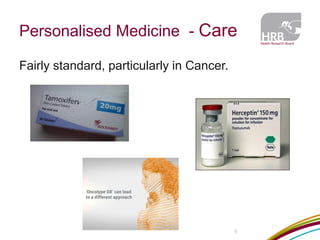
Personalised Medicine - Care 
6 
Fairly standard, particularly in Cancer.
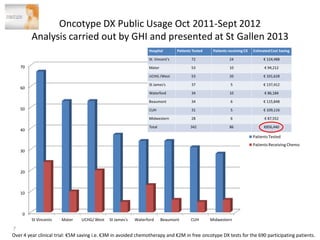
Oncotype DX Public Usage Oct 2011-Sept 2012 Analysis carried out by GHI and presented at St Gallen 2013 
7 
0 
10 
20 
30 
40 
50 
60 
70 
St Vincents 
Mater 
UCHG/ West 
St James's 
Waterford 
Beaumont 
CUH 
Midwestern 
Patients Tested 
Patients Receiving Chemo 
Over 4 year clinical trial: €5M saving i.e. €3M in avoided chemotherapy and €2M in free oncotype DX tests for the 690 participating patients.
Personalised Medicine – in future 
8 
•Moving from Personalised Medicine Care to Personalised Medicine Research
9
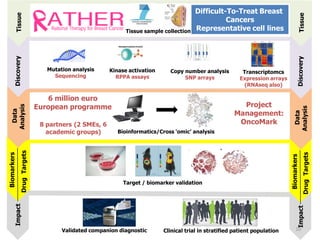
Mutation analysis 
Sequencing 
Kinase activation 
RPPA assays 
Copy number analysis 
SNP arrays 
Transcriptomcs 
Expression arrays 
(RNAseq also) 
Bioinformatics/Cross ‘omic’ analysis 
Target / biomarker validation 
Discovery 
Data 
Analysis 
Biomarkers 
Impact 
Validated companion diagnostic Clinical trial in stratified patient population 
Tissue sample collection 
Tissue 
Discovery 
Data 
Analysis 
Biomarkers 
Drug Targets 
Impact Tissue 
Drug Targets 
Difficult-To-Treat Breast 
Cancers 
Representative cell lines 
6 million euro 
European programme 
8 partners (2 SMEs, 6 
academic groups) 
Project 
Management: 
OncoMark 
10
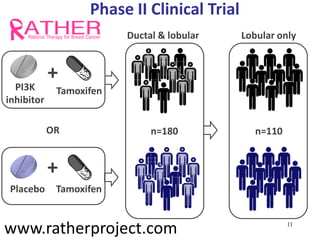
+ 
PI3K inhibitor 
Tamoxifen 
Placebo 
Tamoxifen 
+ 
OR 
Ductal & lobular 
Lobular only 
Phase II Clinical Trial 
n=180 
n=110 
www.ratherproject.com 
11
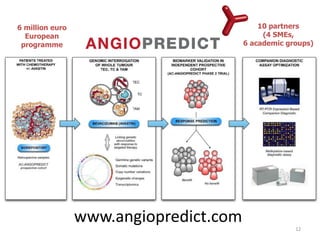
6 million euro 
European programme 
10 partners 
(4 SMEs, 
6 academic groups) 
www.angiopredict.com 
12
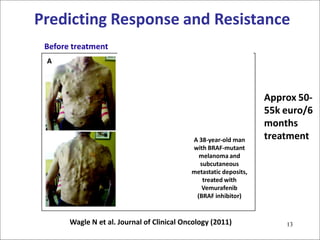
Wagle N et al. Journal of Clinical Oncology (2011) 
Before treatment 
After 15 weeks 
After 23 weeks 
A 38-year-old man with BRAF-mutant melanoma and subcutaneous metastatic deposits, treated with Vemurafenib 
(BRAF inhibitor) 
Predicting Response and Resistance 
Approx 50- 55k euro/6 months treatment 
13
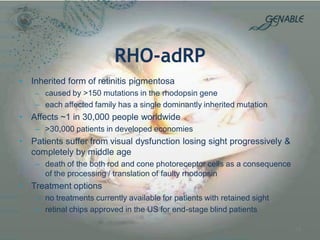
RHO-adRP 
•Inherited form of retinitis pigmentosa 
–caused by >150 mutations in the rhodopsin gene 
–each affected family has a single dominantly inherited mutation 
•Affects ~1 in 30,000 people worldwide 
–>30,000 patients in developed economies 
•Patients suffer from visual dysfunction losing sight progressively & completely by middle age 
–death of the both rod and cone photoreceptor cells as a consequence of the processing / translation of faulty rhodopsin 
•Treatment options 
–no treatments currently available for patients with retained sight 
–retinal chips approved in the US for end-stage blind patients 
14
•Single dose, sub-retinal injection containing two independent AAV 2/5 vectors encoding: 
–RNAi to down-regulate mutant rhodopsin 
–replacement rhodopsin gene with a modified nucleotide sequence to escape suppression & provide functional rhodopsin 
•25+ patents granted across all key territories 
–other key IPR licensed from Spark, Benitec (shRNAi) and NIH (AAV) 
•US & EU orphan drug designation granted 
15 
GT038 – lead therapeutic 
For the treatment of rhodopsin linked autosomal dominant retinitis pigmentosa (RHO-adRP)
16 
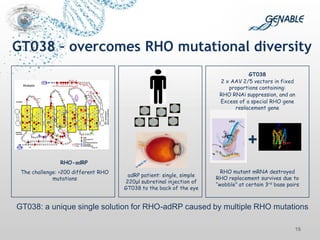
GT038 – overcomes RHO mutational diversity 
RHO-adRP 
The challenge: >200 different RHO mutations 
adRP patient: single, simple 220μl subretinal injection of GT038 to the back of the eye 
GT038 
2 x AAV 2/5 vectors in fixed proportions containing: 
RHO RNAi suppression, and an 
Excess of a special RHO gene replacement gene 
RHO mutant mRNA destroyed 
RHO replacement survives due to “wobble” at certain 3rd base pairs 
+ 
GT038: a unique single solution for RHO-adRP caused by multiple RHO mutations
GT038 Development 
•Proof of concept established in mouse and rat models 
•Toxicology & biodistribution studies to commence in Q1 2015 
•Manufacturing agreements signed with Spark Therapeutics (US) and 1st GLP batches expected in Q12015 
•Phase I clinical trial to commence in 2017 
17
18 
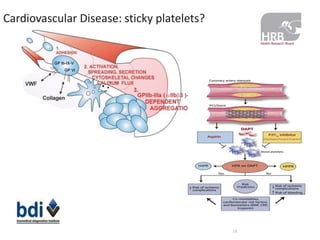
Cardiovascular Disease: sticky platelets?
40 s 
120 s 
200 s 
280 s 
360 s 
40 s 
120 s 
200 s 
280 s 
360 s 
CVD Patients 
Control 
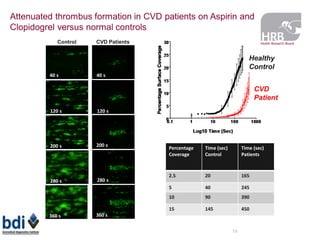
Percentage Coverage 
Time (sec) Control 
Time (sec) Patients 
2.5 
20 
165 
5 
40 
245 
10 
90 
390 
15 
145 
450 
Attenuated thrombus formation in CVD patients on Aspirin and Clopidogrel versus normal controls 
Healthy Control 
CVD Patient 
19
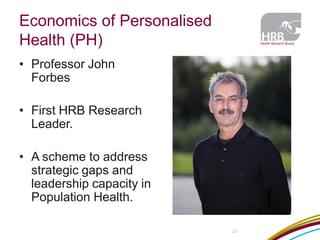
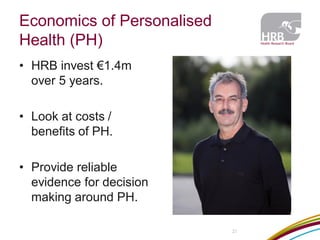
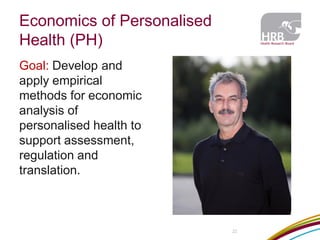
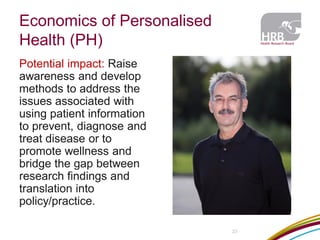
Economics of Personalised Health (PH) 
•Professor John Forbes 
•First HRB Research Leader. 
•A scheme to address strategic gaps and leadership capacity in Population Health. 
20
Economics of Personalised Health (PH) 
•HRB invest €1.4m over 5 years. 
•Look at costs / benefits of PH. 
•Provide reliable evidence for decision making around PH. 
21
Economics of Personalised Health (PH) 
Goal: Develop and apply empirical methods for economic analysis of personalised health to support assessment, regulation and translation. 
22
Economics of Personalised Health (PH) 
Potential impact: Raise awareness and develop methods to address the issues associated with using patient information to prevent, diagnose and treat disease or to promote wellness and bridge the gap between research findings and translation into policy/practice. 
23
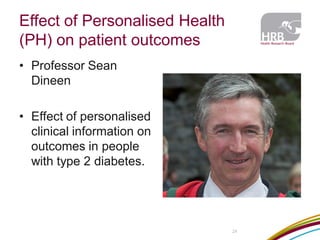
Effect of Personalised Health (PH) on patient outcomes 
•Professor Sean Dineen 
•Effect of personalised clinical information on outcomes in people with type 2 diabetes. 
24
Effect of Personalised Health (PH) on patient outcomes 
•Goal: Establish best level of information to share with patients so they can be more proactive about their care, increase their confidence in managing their diabetes and leads to improvements in their blood sugar control. 
25
Effect of Personalised Health (PH) on patient outcomes 
•Potential impact: Personalised health through increasing the patients awareness, knowledge and ability to make decisions regarding prevention, treatment and care options specifically selected and targeted at their risk profiles. 
26
Moving from Personalised Medicine Research to Policy 
27 
How did all this happen? By design? By accident?
How did it happen? 
28 
•Bottom Up. 
•Principal Investigator-driven. 
•Personal interest. 
•Open funding calls.
How did it happen? 
29 
•There is no ‘top down’ policy position on Personalised Medicine. 
•The funding instruments driving all of this are NOT Personalised Medicine-specific. 
•Which is a great argument for bottom up funding instruments (creates capacity, starts the process)…..BUT
How did it happen? 
30 
•The capacity, skills and infrastructure we have built by the bottom up approach is largely by accident (or serendipitous design…) 
•So, there is a big gap between the Health Policy layer and the Health Research(Care) layer in Ireland (& elsewhere?)
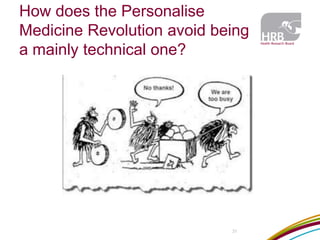
How does the Personalise Medicine Revolution avoid being a mainly technical one? 
31
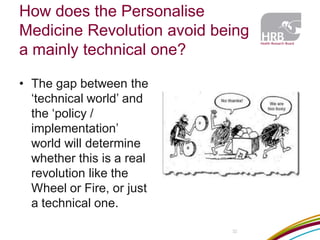
How does the Personalise Medicine Revolution avoid being a mainly technical one? 
•The gap between the ‘technical world’ and the ‘policy / implementation’ world will determine whether this is a real revolution like the Wheel or Fire, or just a technical one. 
32
IT: Another ‘technology’ that transformed the world: 
33 
•Information Technology (IT) took quite a while to move from the lab to the real world. 
•From Turing in the 40s to PCs in the 1980s, it wasn’t until the 90s that the real IT revolution took place.
IT: Another ‘technology’ that transformed the world: 
34 
•Its adoption spread exponentially and drove massive economic expansion in the 90s. 
•The 00s saw this spread to the consumer world and now it is Business & Consumer: Everyone/Everywhere! 
•Looked at through this lens, Personalised Medicine has a long way to go…
Whither Personalised Medicine in Ireland? 
35 
•The key roadblock to large scale adoption (revolution) is persuading key decision makers in Public Administration and Business of the merits & potential of PM. 
•We still largely talk an insider’s language. 
•9 out of 10 people probably don’t know what Personalised Medicine means?
Whither Personalised Medicine in Ireland? 
36 
•How can you enable a revolution if most people don’t know what you are talking about? 
•A lot more effort is required in ‘making the case’ if this is to happen!
Whither Personalised Medicine in Ireland? 
37 
•The Solution? 
•As a first step: assemble the arguments (with supporting evidence), in plain language, and priortise existing resources towards influencing key decision makers; 
–to enable real top-down policy measures targeting personalised medicine realisation. 
–and thus give reality to (..accelerate adoption of) personalised medicine.

EuroBioForum2014_speaker_Love

  • 1.
    Graham Love ChiefExecutive, Ireland Health Research Board, Ireland National perspective Ireland
  • 2.
    Whither Personalised Medicinein Ireland? Graham Love Chief Executive Health Research Board (Ireland) Presentation to EuroBioForum 2014, Tallinn
  • 3.
  • 4.
  • 5.
    Health Research Board 5 •State agency under Department of Health. – Budget €43m, funding portfolio €150 - €200m, staff of 61 •Funding health research. –Infrastructure, capacity building, specific projects. •Providing evidence for policy. –Public Health Alcohol Bill, Food Pyramid, Fluoridation. •Information for service planning. –Drug use, disability, mental health.
  • 6.
    Personalised Medicine -Care 6 Fairly standard, particularly in Cancer.
  • 7.
    Oncotype DX PublicUsage Oct 2011-Sept 2012 Analysis carried out by GHI and presented at St Gallen 2013 7 0 10 20 30 40 50 60 70 St Vincents Mater UCHG/ West St James's Waterford Beaumont CUH Midwestern Patients Tested Patients Receiving Chemo Over 4 year clinical trial: €5M saving i.e. €3M in avoided chemotherapy and €2M in free oncotype DX tests for the 690 participating patients.
  • 8.
    Personalised Medicine –in future 8 •Moving from Personalised Medicine Care to Personalised Medicine Research
  • 9.
  • 10.
    Mutation analysis Sequencing Kinase activation RPPA assays Copy number analysis SNP arrays Transcriptomcs Expression arrays (RNAseq also) Bioinformatics/Cross ‘omic’ analysis Target / biomarker validation Discovery Data Analysis Biomarkers Impact Validated companion diagnostic Clinical trial in stratified patient population Tissue sample collection Tissue Discovery Data Analysis Biomarkers Drug Targets Impact Tissue Drug Targets Difficult-To-Treat Breast Cancers Representative cell lines 6 million euro European programme 8 partners (2 SMEs, 6 academic groups) Project Management: OncoMark 10
  • 11.
    + PI3K inhibitor Tamoxifen Placebo Tamoxifen + OR Ductal & lobular Lobular only Phase II Clinical Trial n=180 n=110 www.ratherproject.com 11
  • 12.
    6 million euro European programme 10 partners (4 SMEs, 6 academic groups) www.angiopredict.com 12
  • 13.
    Wagle N etal. Journal of Clinical Oncology (2011) Before treatment After 15 weeks After 23 weeks A 38-year-old man with BRAF-mutant melanoma and subcutaneous metastatic deposits, treated with Vemurafenib (BRAF inhibitor) Predicting Response and Resistance Approx 50- 55k euro/6 months treatment 13
  • 14.
    RHO-adRP •Inherited formof retinitis pigmentosa –caused by >150 mutations in the rhodopsin gene –each affected family has a single dominantly inherited mutation •Affects ~1 in 30,000 people worldwide –>30,000 patients in developed economies •Patients suffer from visual dysfunction losing sight progressively & completely by middle age –death of the both rod and cone photoreceptor cells as a consequence of the processing / translation of faulty rhodopsin •Treatment options –no treatments currently available for patients with retained sight –retinal chips approved in the US for end-stage blind patients 14
  • 15.
    •Single dose, sub-retinalinjection containing two independent AAV 2/5 vectors encoding: –RNAi to down-regulate mutant rhodopsin –replacement rhodopsin gene with a modified nucleotide sequence to escape suppression & provide functional rhodopsin •25+ patents granted across all key territories –other key IPR licensed from Spark, Benitec (shRNAi) and NIH (AAV) •US & EU orphan drug designation granted 15 GT038 – lead therapeutic For the treatment of rhodopsin linked autosomal dominant retinitis pigmentosa (RHO-adRP)
  • 16.
    16 GT038 –overcomes RHO mutational diversity RHO-adRP The challenge: >200 different RHO mutations adRP patient: single, simple 220μl subretinal injection of GT038 to the back of the eye GT038 2 x AAV 2/5 vectors in fixed proportions containing: RHO RNAi suppression, and an Excess of a special RHO gene replacement gene RHO mutant mRNA destroyed RHO replacement survives due to “wobble” at certain 3rd base pairs + GT038: a unique single solution for RHO-adRP caused by multiple RHO mutations
  • 17.
    GT038 Development •Proofof concept established in mouse and rat models •Toxicology & biodistribution studies to commence in Q1 2015 •Manufacturing agreements signed with Spark Therapeutics (US) and 1st GLP batches expected in Q12015 •Phase I clinical trial to commence in 2017 17
  • 18.
    18 Cardiovascular Disease:sticky platelets?
  • 19.
    40 s 120s 200 s 280 s 360 s 40 s 120 s 200 s 280 s 360 s CVD Patients Control Percentage Coverage Time (sec) Control Time (sec) Patients 2.5 20 165 5 40 245 10 90 390 15 145 450 Attenuated thrombus formation in CVD patients on Aspirin and Clopidogrel versus normal controls Healthy Control CVD Patient 19
  • 20.
    Economics of PersonalisedHealth (PH) •Professor John Forbes •First HRB Research Leader. •A scheme to address strategic gaps and leadership capacity in Population Health. 20
  • 21.
    Economics of PersonalisedHealth (PH) •HRB invest €1.4m over 5 years. •Look at costs / benefits of PH. •Provide reliable evidence for decision making around PH. 21
  • 22.
    Economics of PersonalisedHealth (PH) Goal: Develop and apply empirical methods for economic analysis of personalised health to support assessment, regulation and translation. 22
  • 23.
    Economics of PersonalisedHealth (PH) Potential impact: Raise awareness and develop methods to address the issues associated with using patient information to prevent, diagnose and treat disease or to promote wellness and bridge the gap between research findings and translation into policy/practice. 23
  • 24.
    Effect of PersonalisedHealth (PH) on patient outcomes •Professor Sean Dineen •Effect of personalised clinical information on outcomes in people with type 2 diabetes. 24
  • 25.
    Effect of PersonalisedHealth (PH) on patient outcomes •Goal: Establish best level of information to share with patients so they can be more proactive about their care, increase their confidence in managing their diabetes and leads to improvements in their blood sugar control. 25
  • 26.
    Effect of PersonalisedHealth (PH) on patient outcomes •Potential impact: Personalised health through increasing the patients awareness, knowledge and ability to make decisions regarding prevention, treatment and care options specifically selected and targeted at their risk profiles. 26
  • 27.
    Moving from PersonalisedMedicine Research to Policy 27 How did all this happen? By design? By accident?
  • 28.
    How did ithappen? 28 •Bottom Up. •Principal Investigator-driven. •Personal interest. •Open funding calls.
  • 29.
    How did ithappen? 29 •There is no ‘top down’ policy position on Personalised Medicine. •The funding instruments driving all of this are NOT Personalised Medicine-specific. •Which is a great argument for bottom up funding instruments (creates capacity, starts the process)…..BUT
  • 30.
    How did ithappen? 30 •The capacity, skills and infrastructure we have built by the bottom up approach is largely by accident (or serendipitous design…) •So, there is a big gap between the Health Policy layer and the Health Research(Care) layer in Ireland (& elsewhere?)
  • 31.
    How does thePersonalise Medicine Revolution avoid being a mainly technical one? 31
  • 32.
    How does thePersonalise Medicine Revolution avoid being a mainly technical one? •The gap between the ‘technical world’ and the ‘policy / implementation’ world will determine whether this is a real revolution like the Wheel or Fire, or just a technical one. 32
  • 33.
    IT: Another ‘technology’that transformed the world: 33 •Information Technology (IT) took quite a while to move from the lab to the real world. •From Turing in the 40s to PCs in the 1980s, it wasn’t until the 90s that the real IT revolution took place.
  • 34.
    IT: Another ‘technology’that transformed the world: 34 •Its adoption spread exponentially and drove massive economic expansion in the 90s. •The 00s saw this spread to the consumer world and now it is Business & Consumer: Everyone/Everywhere! •Looked at through this lens, Personalised Medicine has a long way to go…
  • 35.
    Whither Personalised Medicinein Ireland? 35 •The key roadblock to large scale adoption (revolution) is persuading key decision makers in Public Administration and Business of the merits & potential of PM. •We still largely talk an insider’s language. •9 out of 10 people probably don’t know what Personalised Medicine means?
  • 36.
    Whither Personalised Medicinein Ireland? 36 •How can you enable a revolution if most people don’t know what you are talking about? •A lot more effort is required in ‘making the case’ if this is to happen!
  • 37.
    Whither Personalised Medicinein Ireland? 37 •The Solution? •As a first step: assemble the arguments (with supporting evidence), in plain language, and priortise existing resources towards influencing key decision makers; –to enable real top-down policy measures targeting personalised medicine realisation. –and thus give reality to (..accelerate adoption of) personalised medicine.