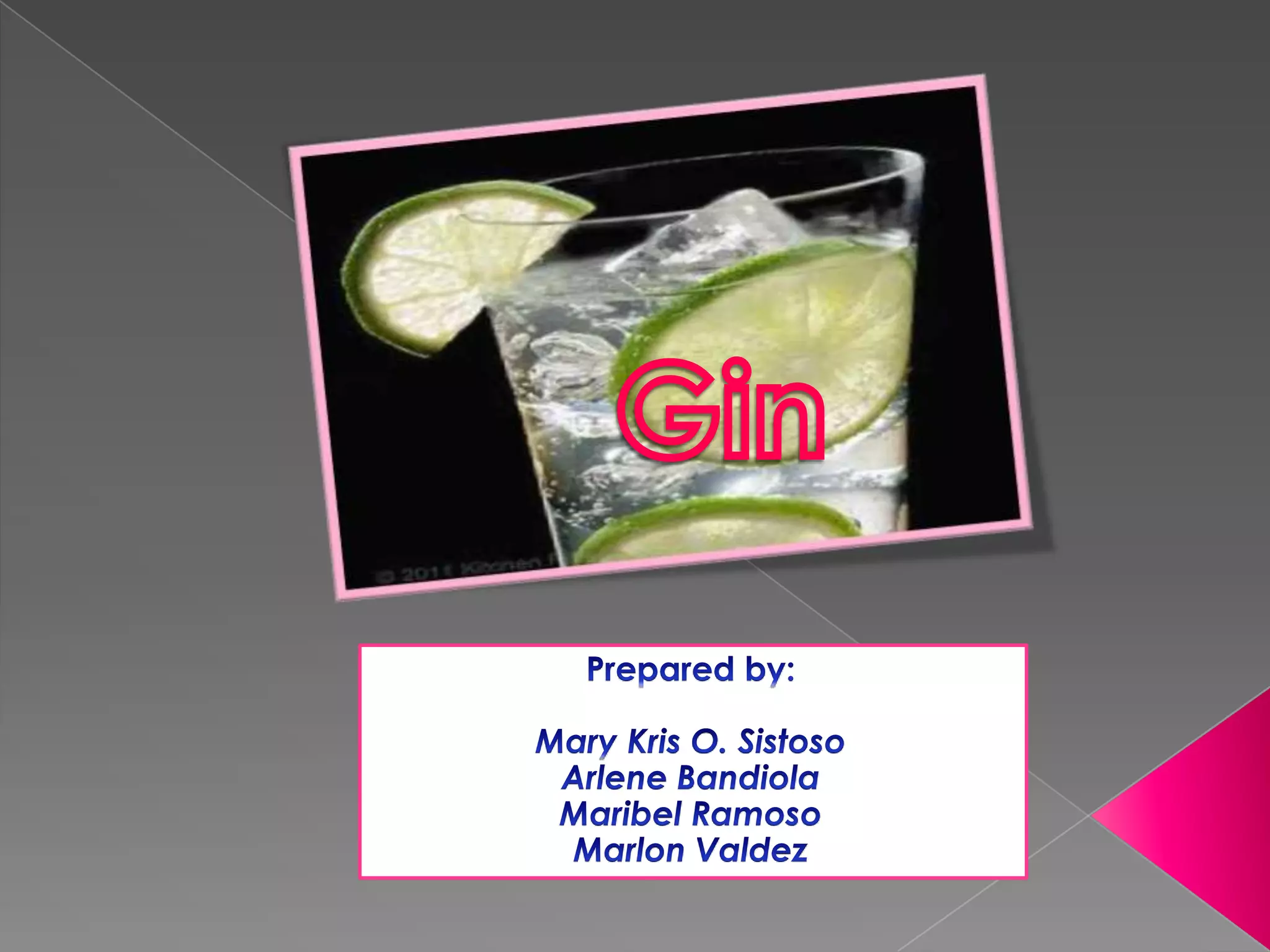
 Gin is a hard alcohol flavored with the seeds of the
Juniper bush. It is a rather dry alcohol and is rarely
drunk on its own, but used instead as a base for
many different types of drinks. Good gin is very
smooth, with a strong juniper flavor exciting the
senses.
 The name is most likely a derivation of the Dutch
word genever, which simply means "juniper." This
word comes from the Latin juniperus via Old
French genevre. Others hold that the name is a
shortening of the city name Geneva in Switzerland.
 The invention of gin is usually attributed to a Dutch physician
in the 17th century, though there is some contention in this
area, with many claiming that the Italians had been drinking
a nearly identical liquor for some time before this. Whatever
the case may be, it was in Holland that it first achieved real
popularity, being widely sold as a tonic to treat gallstones,
rheumatism, and stomach aches. Juniper was added not
only for flavor, but because the berries have a number of
healing properties, including acting as a diuretic and helping
with arthritis.
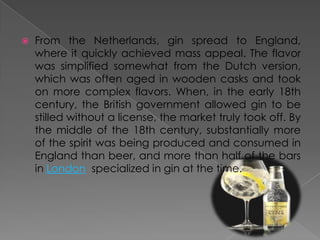
 From the Netherlands, gin spread to England,
where it quickly achieved mass appeal. The flavor
was simplified somewhat from the Dutch version,
which was often aged in wooden casks and took
on more complex flavors. When, in the early 18th
century, the British government allowed gin to be
stilled without a license, the market truly took off. By
the middle of the 18th century, substantially more
of the spirit was being produced and consumed in
England than beer, and more than half of the bars
in London specialized in gin at the time.
 In the 19th century, the most popular modern style,
the London dry gin, was perfected. The majority
produced these days is in this style — no matter
where it is produced — though some companies
still produce a more traditional Dutch or Old
Tom gin.
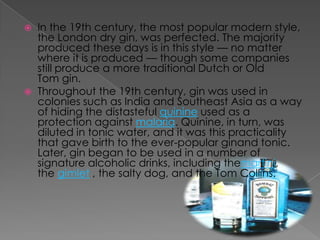
 Throughout the 19th century, gin was used in
colonies such as India and Southeast Asia as a way
of hiding the distasteful quinine used as a
protection against malaria. Quinine, in turn, was
diluted in tonic water, and it was this practicality
that gave birth to the ever-popular ginand tonic.
Later, gin began to be used in a number of
signature alcoholic drinks, including themartini,
the gimlet , the salty dog, and the Tom Collins.
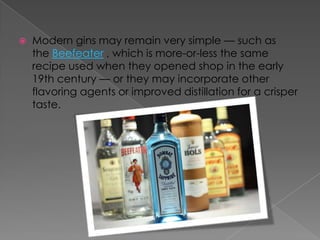
 Modern gins may remain very simple — such as
the Beefeater , which is more-or-less the same
recipe used when they opened shop in the early
19th century — or they may incorporate other
flavoring agents or improved distillation for a crisper
taste.
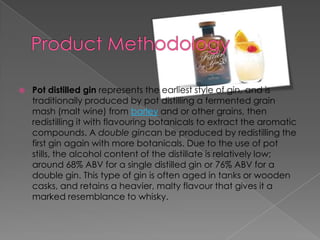
 Pot distilled gin represents the earliest style of gin, and is
traditionally produced by pot distilling a fermented grain
mash (malt wine) from barley and or other grains, then
redistilling it with flavouring botanicals to extract the aromatic
compounds. A double gincan be produced by redistilling the
first gin again with more botanicals. Due to the use of pot
stills, the alcohol content of the distillate is relatively low;
around 68% ABV for a single distilled gin or 76% ABV for a
double gin. This type of gin is often aged in tanks or wooden
casks, and retains a heavier, malty flavour that gives it a
marked resemblance to whisky.
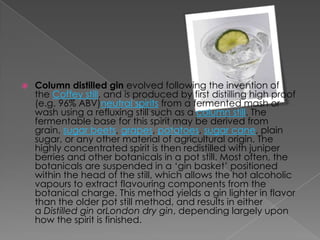
 Column distilled gin evolved following the invention of
the Coffey still, and is produced by first distilling high proof
(e.g. 96% ABV)neutral spirits from a fermented mash or
wash using a refluxing still such as a column still. The
fermentable base for this spirit may be derived from
grain, sugar beets, grapes, potatoes, sugar cane, plain
sugar, or any other material of agricultural origin. The
highly concentrated spirit is then redistilled with juniper
berries and other botanicals in a pot still. Most often, the
botanicals are suspended in a ‘gin basket’ positioned
within the head of the still, which allows the hot alcoholic
vapours to extract flavouring components from the
botanical charge. This method yields a gin lighter in flavor
than the older pot still method, and results in either
a Distilled gin orLondon dry gin, depending largely upon
how the spirit is finished.
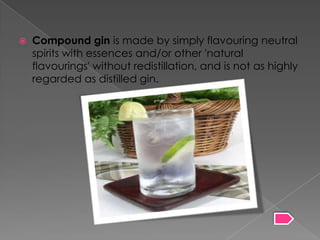
 Compound gin is made by simply flavouring neutral
spirits with essences and/or other 'natural
flavourings' without redistillation, and is not as highly
regarded as distilled gin.
Thank you for listening!
Have a nice day!

Report on gin

  • 2.
     Gin isa hard alcohol flavored with the seeds of the Juniper bush. It is a rather dry alcohol and is rarely drunk on its own, but used instead as a base for many different types of drinks. Good gin is very smooth, with a strong juniper flavor exciting the senses.  The name is most likely a derivation of the Dutch word genever, which simply means "juniper." This word comes from the Latin juniperus via Old French genevre. Others hold that the name is a shortening of the city name Geneva in Switzerland.
  • 3.
     The inventionof gin is usually attributed to a Dutch physician in the 17th century, though there is some contention in this area, with many claiming that the Italians had been drinking a nearly identical liquor for some time before this. Whatever the case may be, it was in Holland that it first achieved real popularity, being widely sold as a tonic to treat gallstones, rheumatism, and stomach aches. Juniper was added not only for flavor, but because the berries have a number of healing properties, including acting as a diuretic and helping with arthritis.
  • 4.
     From theNetherlands, gin spread to England, where it quickly achieved mass appeal. The flavor was simplified somewhat from the Dutch version, which was often aged in wooden casks and took on more complex flavors. When, in the early 18th century, the British government allowed gin to be stilled without a license, the market truly took off. By the middle of the 18th century, substantially more of the spirit was being produced and consumed in England than beer, and more than half of the bars in London specialized in gin at the time.
  • 5.
     In the19th century, the most popular modern style, the London dry gin, was perfected. The majority produced these days is in this style — no matter where it is produced — though some companies still produce a more traditional Dutch or Old Tom gin.  Throughout the 19th century, gin was used in colonies such as India and Southeast Asia as a way of hiding the distasteful quinine used as a protection against malaria. Quinine, in turn, was diluted in tonic water, and it was this practicality that gave birth to the ever-popular ginand tonic. Later, gin began to be used in a number of signature alcoholic drinks, including themartini, the gimlet , the salty dog, and the Tom Collins.
  • 6.
     Modern ginsmay remain very simple — such as the Beefeater , which is more-or-less the same recipe used when they opened shop in the early 19th century — or they may incorporate other flavoring agents or improved distillation for a crisper taste.
  • 7.
     Pot distilledgin represents the earliest style of gin, and is traditionally produced by pot distilling a fermented grain mash (malt wine) from barley and or other grains, then redistilling it with flavouring botanicals to extract the aromatic compounds. A double gincan be produced by redistilling the first gin again with more botanicals. Due to the use of pot stills, the alcohol content of the distillate is relatively low; around 68% ABV for a single distilled gin or 76% ABV for a double gin. This type of gin is often aged in tanks or wooden casks, and retains a heavier, malty flavour that gives it a marked resemblance to whisky.
  • 8.
     Column distilledgin evolved following the invention of the Coffey still, and is produced by first distilling high proof (e.g. 96% ABV)neutral spirits from a fermented mash or wash using a refluxing still such as a column still. The fermentable base for this spirit may be derived from grain, sugar beets, grapes, potatoes, sugar cane, plain sugar, or any other material of agricultural origin. The highly concentrated spirit is then redistilled with juniper berries and other botanicals in a pot still. Most often, the botanicals are suspended in a ‘gin basket’ positioned within the head of the still, which allows the hot alcoholic vapours to extract flavouring components from the botanical charge. This method yields a gin lighter in flavor than the older pot still method, and results in either a Distilled gin orLondon dry gin, depending largely upon how the spirit is finished.
  • 9.
     Compound ginis made by simply flavouring neutral spirits with essences and/or other 'natural flavourings' without redistillation, and is not as highly regarded as distilled gin.
  • 10.
    Thank you forlistening! Have a nice day!