ALCOHOLIC BEVERAGES
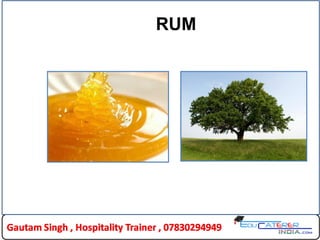
RUM
RUM
 Session Objectives-
 After completion one would be able to
recall what is a rum, how it is made, types
and list the popular international brands
CONTENTS
DEFINITION
INTRODUCTION
ETYMOLOGY
HISTORY
MANUFACTURING
TYPES
BRANDS
DEFINITION
 Rum is a spirit drink obtained exclusively by
alcoholic fermentation and distillation of
sugar cane molasses, sugar cane syrups,
sugar cane juices or cane sugar produced
during the processing of sugar cane
INTRODUCTION
 Rum, is made by distilling fermented sugar
cane molasses or concentrated cane juice
 The distillate is a clear liquid, usually aged
in oak and other barrels
INTRODUCTION
 Molasses is sweet, sticky residue that
remains after sugar cane juice is boiled and
the crystallized sugar is extracted
 Rum cannot be less than 80° proof
ETYMOLOGY
 Other etymologists have mentioned the
Romani word rum, meaning "strong" or
"potent."
 These words have been linked to the
ramboozle and rumfustian, both popular
British drinks in the mid-seventeenth
century
ETYMOLOGY
 The most probable origin is as a truncated
version of rumbullion or rumbustion.“
 Both words surfaced in English about the
same time as rum did, and were slang
terms for "tumult" or "uproar."
HISTORY
 The history of Rum is the history of sugar.
 In 1493 Christopher Columbus picked up
cane cuttings from the Canaries while on
his second voyage to the Americas and
transplanted them to Hispaniola, the island
in the Caribbean
HISTORY
 The insatiable demand in Europe for sugar
soon led to the establishment of hundreds
of sugar cane plantations and mills these
crushed the harvested cane and extracted
the juice
 Boiling this juice caused chunks of
crystallized sugar to form
HISTORY
 The remaining unsolidified juice was called
melazas (from"miel," the Spanish word for
honey); in English this became molasses
 Molasses is a sticky syrup that still contains
a significant amount of sugar
HISTORY
 Sugar mill operators soon noticed that
when it was mixed with water and left out in
the sun it would ferment
 By the 1650s this former waste product was
being distilled into a spirit
HISTORY
 In the English colonies it was called Kill
Devil or rumbullion
 This was shortened over the years to our
modern word Rum
RUM
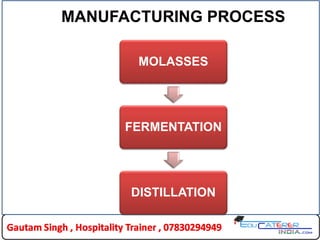
MANUFACTURING PROCESS
MOLASSES
FERMENTATION
DISTILLATION
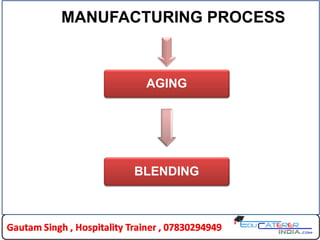
MANUFACTURING PROCESS
AGING
BLENDING
MANUFACTURING
 Molasses is the most widely used raw
material for rum production
 Its composition varies and depends on the
quality of the cane, composition of soil,
climatic conditions, handling and storage of
molasses etc.
MANUFACTURING
 The composition of molasses is referred
to as the “quality of the molasses” and is
what contributes to quality and intensity
of the rum flavor
 Fermentation is a living process
MANUFACTURING
 The molasses is diluted with water to
reduce the sugar content to
approximately 15% and a pure yeast
culture is added to the mixture.
 The yeast cells convert the available
sucrose to ethyl alcohol (C2H5OH) and
carbon dioxide (CO2)
MANUFACTURING
 This mixture is called the “live wash”
 Fermentation takes approximately 30
hours to be completed
MANUFACTURING
 During fermentation, a number of congeners
are also manufactured
 These congeners are the major constituents
of the heavy type rums
 They are necessary when blending because
they give flavor and character to the rum
MANUFACTURING
 After fermentation, the fermented wash is
fed to the still
 Distillation is the process of boiling the
“wash” and condensing its vapor to
produce the alcohol that is collected, it is
done in a column still
MANUFACTURING
 During this process, the undesirable
congeners are removed and the desirable
ones that add to the taste and aroma of the
raw rum
MANUFACTURING
 After distillation, the rum is drawn off into
large stainless steel vessels for storage
before being barreled off into forty gallon
oak barrels that have been previously used
to age Bourbon/ Cognac/ Wine and moved
to the warehouse for ageing
MANUFACTURING
 Although the ageing process is not fully
understood, it is considered to be the
most significant aspect of the rum
manufacturing process because the rum
improves with age
MANUFACTURING
 Blending is the secret of fine rum.
 It allows the master bender to use many
different types and styles of rums to
create a particular blend or brand
 The barrels of rum used for a particular
blend are selected with age as the major
selection criteria
MANUFACTURING
 After the rum is blended it is stored in
bottling vats and reduced to bottling
strength by the addition of distilled water.
 It is then passed through filters and
polishers before being bottled and
packaged for sale
CLASSIFICATION OF RUM
 White Rums
 are generally light-bodied
 they are usually clear and have a very
subtle flavor profile
CLASSIFICATION OF RUM
 White Rums are primarily used as mixers
and blend particularly well with fruit flavors
 Eg. Puerto Rican Rums
CLASSIFICATION OF RUM
 Golden Rums, also known as Amber
Rums
 are generally medium-bodied
 most have spent several years aging in oak
casks, which give them smooth, mellow
palates
CLASSIFICATION OF RUM
 Dark Rums
 are traditionally full-bodied, rich, caramel-
dominated Rums
 the best are produced mostly from pot stills
and frequently aged in oak casks for
extended periods
 E.g. Jamaican Rums
CLASSIFICATION OF RUM
 Flavored / Spiced Rum
 Some manufacturers have begun to sell
rums which they have infused with flavors
of fruits such as mango, orange, citrus,
coconut, and limke which is a lime rum
found in Sweden
CLASSIFICATION OF RUM
 Añejo and Age-Dated Rums
 are aged Rums from different vintages or
batches that are mixed together to insure a
continuity of flavor in brands of Rum from
year to year
 Some aged Rums will give age statements
stating the youngest Rum in the blend
BRANDS
 Dark Rums
 Appleton
 Captain Morgan
 Lambs navy
 Mount Gay
 Bacardi
 Myers's Dark
BRANDS
 Light Rums
 Bacardi Silver
 Ronrico
 Barilla
 Dry Cane
 El Dorado White
BRANDS
 Amber Rums
 Mount Gay Eclipse
 Bacardi Gold
 Appleton Estate VX
 Flavored Rum
 Malibu
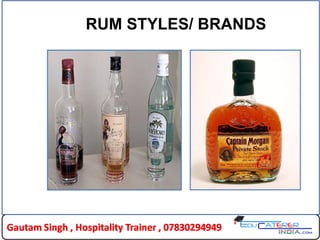
RUM STYLES/ BRANDS
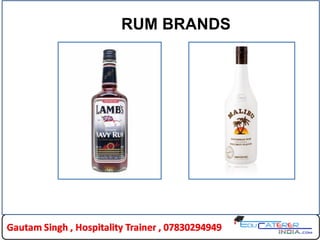
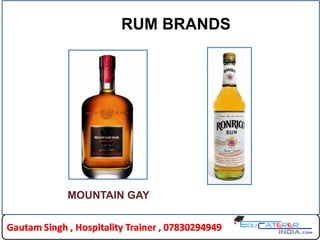
RUM BRANDS
MOUNTAIN GAY
RUM BRANDS
REFERENCES
 www.wikipedia.com
 www.tastings.com
 www.in-the-spirit.com
 www.buzzle.com
 www.tulleho.com
 Text book of Food and Beverage Service by
Anita Sharma and S. N. Bagchi
 Food and Beverage Service by Sandeep
Chatterjee
THANK YOU

Rum

  • 1.
  • 2.
    RUM  Session Objectives- After completion one would be able to recall what is a rum, how it is made, types and list the popular international brands
  • 3.
  • 4.
    DEFINITION  Rum isa spirit drink obtained exclusively by alcoholic fermentation and distillation of sugar cane molasses, sugar cane syrups, sugar cane juices or cane sugar produced during the processing of sugar cane
  • 5.
    INTRODUCTION  Rum, ismade by distilling fermented sugar cane molasses or concentrated cane juice  The distillate is a clear liquid, usually aged in oak and other barrels
  • 6.
    INTRODUCTION  Molasses issweet, sticky residue that remains after sugar cane juice is boiled and the crystallized sugar is extracted  Rum cannot be less than 80° proof
  • 7.
    ETYMOLOGY  Other etymologistshave mentioned the Romani word rum, meaning "strong" or "potent."  These words have been linked to the ramboozle and rumfustian, both popular British drinks in the mid-seventeenth century
  • 8.
    ETYMOLOGY  The mostprobable origin is as a truncated version of rumbullion or rumbustion.“  Both words surfaced in English about the same time as rum did, and were slang terms for "tumult" or "uproar."
  • 9.
    HISTORY  The historyof Rum is the history of sugar.  In 1493 Christopher Columbus picked up cane cuttings from the Canaries while on his second voyage to the Americas and transplanted them to Hispaniola, the island in the Caribbean
  • 10.
    HISTORY  The insatiabledemand in Europe for sugar soon led to the establishment of hundreds of sugar cane plantations and mills these crushed the harvested cane and extracted the juice  Boiling this juice caused chunks of crystallized sugar to form
  • 11.
    HISTORY  The remainingunsolidified juice was called melazas (from"miel," the Spanish word for honey); in English this became molasses  Molasses is a sticky syrup that still contains a significant amount of sugar
  • 12.
    HISTORY  Sugar milloperators soon noticed that when it was mixed with water and left out in the sun it would ferment  By the 1650s this former waste product was being distilled into a spirit
  • 13.
    HISTORY  In theEnglish colonies it was called Kill Devil or rumbullion  This was shortened over the years to our modern word Rum
  • 14.
  • 15.
  • 16.
  • 17.
    MANUFACTURING  Molasses isthe most widely used raw material for rum production  Its composition varies and depends on the quality of the cane, composition of soil, climatic conditions, handling and storage of molasses etc.
  • 18.
    MANUFACTURING  The compositionof molasses is referred to as the “quality of the molasses” and is what contributes to quality and intensity of the rum flavor  Fermentation is a living process
  • 19.
    MANUFACTURING  The molassesis diluted with water to reduce the sugar content to approximately 15% and a pure yeast culture is added to the mixture.  The yeast cells convert the available sucrose to ethyl alcohol (C2H5OH) and carbon dioxide (CO2)
  • 20.
    MANUFACTURING  This mixtureis called the “live wash”  Fermentation takes approximately 30 hours to be completed
  • 21.
    MANUFACTURING  During fermentation,a number of congeners are also manufactured  These congeners are the major constituents of the heavy type rums  They are necessary when blending because they give flavor and character to the rum
  • 22.
    MANUFACTURING  After fermentation,the fermented wash is fed to the still  Distillation is the process of boiling the “wash” and condensing its vapor to produce the alcohol that is collected, it is done in a column still
  • 23.
    MANUFACTURING  During thisprocess, the undesirable congeners are removed and the desirable ones that add to the taste and aroma of the raw rum
  • 24.
    MANUFACTURING  After distillation,the rum is drawn off into large stainless steel vessels for storage before being barreled off into forty gallon oak barrels that have been previously used to age Bourbon/ Cognac/ Wine and moved to the warehouse for ageing
  • 25.
    MANUFACTURING  Although theageing process is not fully understood, it is considered to be the most significant aspect of the rum manufacturing process because the rum improves with age
  • 26.
    MANUFACTURING  Blending isthe secret of fine rum.  It allows the master bender to use many different types and styles of rums to create a particular blend or brand  The barrels of rum used for a particular blend are selected with age as the major selection criteria
  • 27.
    MANUFACTURING  After therum is blended it is stored in bottling vats and reduced to bottling strength by the addition of distilled water.  It is then passed through filters and polishers before being bottled and packaged for sale
  • 28.
    CLASSIFICATION OF RUM White Rums  are generally light-bodied  they are usually clear and have a very subtle flavor profile
  • 29.
    CLASSIFICATION OF RUM White Rums are primarily used as mixers and blend particularly well with fruit flavors  Eg. Puerto Rican Rums
  • 30.
    CLASSIFICATION OF RUM Golden Rums, also known as Amber Rums  are generally medium-bodied  most have spent several years aging in oak casks, which give them smooth, mellow palates
  • 31.
    CLASSIFICATION OF RUM Dark Rums  are traditionally full-bodied, rich, caramel- dominated Rums  the best are produced mostly from pot stills and frequently aged in oak casks for extended periods  E.g. Jamaican Rums
  • 32.
    CLASSIFICATION OF RUM Flavored / Spiced Rum  Some manufacturers have begun to sell rums which they have infused with flavors of fruits such as mango, orange, citrus, coconut, and limke which is a lime rum found in Sweden
  • 33.
    CLASSIFICATION OF RUM Añejo and Age-Dated Rums  are aged Rums from different vintages or batches that are mixed together to insure a continuity of flavor in brands of Rum from year to year  Some aged Rums will give age statements stating the youngest Rum in the blend
  • 34.
    BRANDS  Dark Rums Appleton  Captain Morgan  Lambs navy  Mount Gay  Bacardi  Myers's Dark
  • 35.
    BRANDS  Light Rums Bacardi Silver  Ronrico  Barilla  Dry Cane  El Dorado White
  • 36.
    BRANDS  Amber Rums Mount Gay Eclipse  Bacardi Gold  Appleton Estate VX  Flavored Rum  Malibu
  • 37.
  • 38.
  • 39.
  • 40.
    REFERENCES  www.wikipedia.com  www.tastings.com www.in-the-spirit.com  www.buzzle.com  www.tulleho.com  Text book of Food and Beverage Service by Anita Sharma and S. N. Bagchi  Food and Beverage Service by Sandeep Chatterjee
  • 41.