
GIN
DESINGED BY

Sunil Kumar
Research Scholar/ Food Production Faculty
Institute of Hotel and Tourism Management,
MAHARSHI DAYANAND UNIVERSITY, ROHTAK
Haryana- 124001 INDIA Ph. No. 09996000499
email: skihm86@yahoo.com ,
balhara86@gmail.com
linkedin:- in.linkedin.com/in/ihmsunilkumar
facebook: www.facebook.com/ihmsunilkumar
webpage: chefsunilkumar.tripod.com
GIN

• Gin first reached England in the 16th century
through the English soldiers.
• Geniever

Ginever

Gin

• Gin reached the ports of Bristol, Plymouth,
Portsmouth and then to other big cities.
• By the first decade of 17th century, it was
challenging the sales of Rum & Brandy.
GIN
• Gin consumption
1690
5,00,000 gallons
1727
5,000,000 gallons
1733
11,000,000 gallons
• In 1736 parliament passed first of the Gin
Acts, to reduce the number of gin shops and
to make it expensive for the working class.
• 1736 Gin act
– Forbade selling of gin in quantities
under 2 gallons.
– Introduced 50 pound license to sell
spirits.
– Put a tax of 1 pound per gallon of
gin.
• The act was repelled in 1743, by the
production had soared to 20,000,000
gallons.
• In 1751 parliament introduced another
Gin Act in which reasonable taxes were
levied and production of quality gin was
encouraged.
• To everyone in the 1850’s Gin still
meant Holland, a pungent sweet
distillation.
• Introduction of the Dry Gin.
PRODUCTION OF GIN
• The first step is to produce a neutral spirit,
usually done in a continuous still, either
from maize or molasses.

• The next stage is the infusion of the
botanicals into the neutral spirit.
PRODUCTION OF GIN
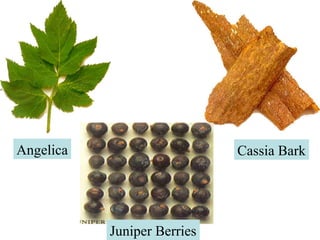
All gins contain junipers. The ingredients
could be:
–Coriander
–Angelica
–Cassia bark
–Orrice root
–Calmus root
–Orange or Lemon peel
Angelica

Cassia Bark

Juniper Berries
METHOD OF FLAVOURING
Head Mix
The traditional system
botanicals is distilled with
enclosing the botanicals
(mesh ) in the neck of
Beefeater’s

wherein the
the spirit by
in a head
the still. Eg
METHOD OF FLAVOURING
Cold Mix
The botanicals ( 2 kg for 100 liters of
spirit) is soaked in the spirit, and then
distilled in a pot still to give a strong
flavour. Later diluted with unflavoured
neutral spirit until the correct proportions
of alcohol & ingredients is achieved .
AGING
Gin , being a rectified spirit does not
require
to be aged / matured in wood either
legally or
technically.
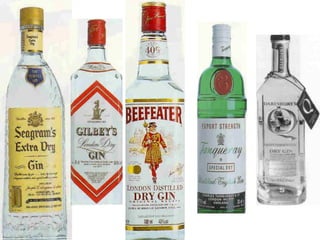
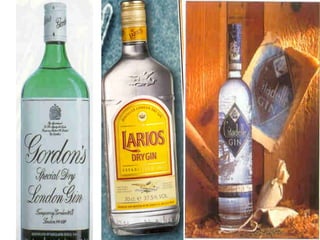
SOME BRANDS
•
•
•
•
•
•
•
•
•

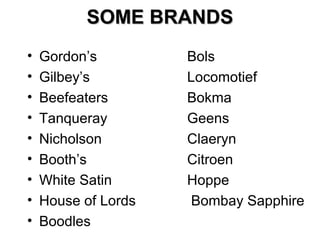
Gordon’s
Gilbey’s
Beefeaters
Tanqueray
Nicholson
Booth’s
White Satin
House of Lords
Boodles

Bols
Locomotief
Bokma
Geens
Claeryn
Citroen
Hoppe
Bombay Sapphire
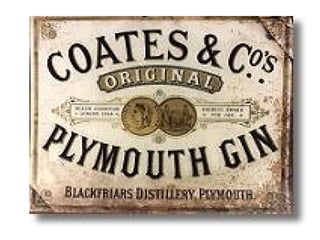
PLYMOUTH GIN
• Historically associated with the Royal
Navy
• Has an advantage for the distillers - the
softness of the water.
• The first major distillery was operated
by the Coates family in 1793, which
operates even today.
PLYMOUTH GIN
• Unlike London Gin, the Plymouth gin is
diluted using water direct from the
source, which adds to the smoothness
& softness of the gin.
FLAVOURED GIN
• Pimms No 1 - Gin, compounded with
herbs & essences. Recipe largely a
secret.
• Old Tom - Gin sweetened with sugar
syrup ( between 2 - 6 %)
• Sloe Gin - flavoured with Sloe berries.
Other flavourings
• Lemon
• Orange
• Blackcurrants.
DESINGED BY

Sunil Kumar
Research Scholar/ Food Production Faculty
Institute of Hotel and Tourism Management,
MAHARSHI DAYANAND UNIVERSITY, ROHTAK
Haryana- 124001 INDIA Ph. No. 09996000499
email: skihm86@yahoo.com ,
balhara86@gmail.com
linkedin:- in.linkedin.com/in/ihmsunilkumar
facebook: www.facebook.com/ihmsunilkumar
webpage: chefsunilkumar.tripod.com

English gin

  • 1.
    GIN DESINGED BY Sunil Kumar ResearchScholar/ Food Production Faculty Institute of Hotel and Tourism Management, MAHARSHI DAYANAND UNIVERSITY, ROHTAK Haryana- 124001 INDIA Ph. No. 09996000499 email: skihm86@yahoo.com , balhara86@gmail.com linkedin:- in.linkedin.com/in/ihmsunilkumar facebook: www.facebook.com/ihmsunilkumar webpage: chefsunilkumar.tripod.com
  • 2.
    GIN • Gin firstreached England in the 16th century through the English soldiers. • Geniever Ginever Gin • Gin reached the ports of Bristol, Plymouth, Portsmouth and then to other big cities. • By the first decade of 17th century, it was challenging the sales of Rum & Brandy.
  • 3.
    GIN • Gin consumption 1690 5,00,000gallons 1727 5,000,000 gallons 1733 11,000,000 gallons • In 1736 parliament passed first of the Gin Acts, to reduce the number of gin shops and to make it expensive for the working class.
  • 4.
    • 1736 Ginact – Forbade selling of gin in quantities under 2 gallons. – Introduced 50 pound license to sell spirits. – Put a tax of 1 pound per gallon of gin. • The act was repelled in 1743, by the production had soared to 20,000,000 gallons.
  • 5.
    • In 1751parliament introduced another Gin Act in which reasonable taxes were levied and production of quality gin was encouraged. • To everyone in the 1850’s Gin still meant Holland, a pungent sweet distillation. • Introduction of the Dry Gin.
  • 6.
    PRODUCTION OF GIN •The first step is to produce a neutral spirit, usually done in a continuous still, either from maize or molasses. • The next stage is the infusion of the botanicals into the neutral spirit.
  • 7.
    PRODUCTION OF GIN Allgins contain junipers. The ingredients could be: –Coriander –Angelica –Cassia bark –Orrice root –Calmus root –Orange or Lemon peel
  • 8.
  • 9.
    METHOD OF FLAVOURING HeadMix The traditional system botanicals is distilled with enclosing the botanicals (mesh ) in the neck of Beefeater’s wherein the the spirit by in a head the still. Eg
  • 10.
    METHOD OF FLAVOURING ColdMix The botanicals ( 2 kg for 100 liters of spirit) is soaked in the spirit, and then distilled in a pot still to give a strong flavour. Later diluted with unflavoured neutral spirit until the correct proportions of alcohol & ingredients is achieved .
  • 11.
    AGING Gin , beinga rectified spirit does not require to be aged / matured in wood either legally or technically.
  • 12.
  • 15.
    PLYMOUTH GIN • Historicallyassociated with the Royal Navy • Has an advantage for the distillers - the softness of the water. • The first major distillery was operated by the Coates family in 1793, which operates even today.
  • 16.
    PLYMOUTH GIN • UnlikeLondon Gin, the Plymouth gin is diluted using water direct from the source, which adds to the smoothness & softness of the gin.
  • 19.
    FLAVOURED GIN • PimmsNo 1 - Gin, compounded with herbs & essences. Recipe largely a secret. • Old Tom - Gin sweetened with sugar syrup ( between 2 - 6 %) • Sloe Gin - flavoured with Sloe berries. Other flavourings • Lemon • Orange • Blackcurrants.
  • 20.
    DESINGED BY Sunil Kumar ResearchScholar/ Food Production Faculty Institute of Hotel and Tourism Management, MAHARSHI DAYANAND UNIVERSITY, ROHTAK Haryana- 124001 INDIA Ph. No. 09996000499 email: skihm86@yahoo.com , balhara86@gmail.com linkedin:- in.linkedin.com/in/ihmsunilkumar facebook: www.facebook.com/ihmsunilkumar webpage: chefsunilkumar.tripod.com