ALCOHOLIC BEVERAGES
GIN
GIN
 Session Objectives-
 After completion one would be able to
recall what is a gin, how it is made, types
and list the popular international brands
CONTENTS
DEFINITION
INTRODUCTION
ETYMOLOGY
HISTORY
MANUFACTURING
TYPES
BRANDS
DEFINITION
 Gin is a white spirit that is flavored with
juniper berries and so-called botanicals (a
varied assortment of herbs and spices)
DEFINITION
 The spirit base of Gin is primarily grain
(usually wheat or rye), which results in a
light-bodied spirit (usually referred as a
grain neutral spirit) having 40% ABV
INTRODUCTION
 In the late 1580s a juniper-flavored spirit of
was found in Holland by British troops who
were fighting against the Spanish in the
Dutch War of Independence
 They drank it & called it "Dutch courage"
in battle
ETYMOLOGY
 The word is an English shortening of
‘Genever’, or ‘Genievere; the Dutch and
French words for juniper berries
HISTORY
 The origins of Gin are rather murky
 In the late 1580s a juniper-flavored spirit of
some sort was found in Holland by British
troops who were fighting against the Spanish
in the Dutch War of Independence
HISTORY
 They gratefully drank it to give them what
they soon came to call "Dutch courage" in
battle
HISTORY
 A clearer beginning was a few decades
later in the 1600s when a Dr. Franciscus
de la Boë (called Dr Sylvius in latin) in
the university town of Leiden who created
a juniper and spice-flavored medicinal
spirit that he promoted as a diuretic
HISTORY
 The Dutch themselves were encouraged
by their government to favor such grain
spirits over imported wine and brandy by
lack of excise taxes on such local drinks
HISTORY
 Genever soon found favor across the
English Channel; first as a medicine
(Samuel Pepys wrote in 1660 of curing a
case of "colic" with a dose of "strong water
made with juniper") and then as a
beverage.
GIN
JUNIPER BERRIES BITTER ORANGE
GIN
ANISE ANGELICA PLANT
GIN
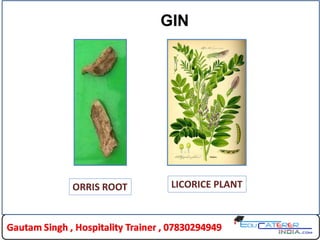
ORRIS ROOT LICORICE PLANT
GIN
GRAPEFRUIT SAFFRON
GIN
FRANKINCENSE CASSIA ROOT
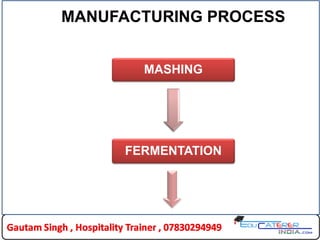
MANUFACTURING PROCESS
MASHING
FERMENTATION
MANUFACTURING PROCESS
DISTILLATION
RE-DISTILLATION
MANUFACTURING
 The chief flavoring agent in Gin is the
highly aromatic blue-green berry of the
juniper, a low-slung evergreen bush (genus
Juniperus)
MANUFACTURING
 Federal law permits gin to be produced
from any of the following base materials;
corn, rye, wheat, barley, malt, sugarcane
and others
MANUFACTURING
 Additional botanicals can include anise,
angelica root, cinnamon, orange peel,
coriander, and cassia bark
MANUFACTURING
 Gin makers have their own secret
combination of botanicals, the number of
which can range from as few as four to as
many as 15
MANUFACTURING
 Most Gin is initially distilled in efficient
column stills
 The resulting spirit is high-proof, light-
bodied, and clean with a minimal amount of
congeners (flavor compounds) and
flavoring agents
MANUFACTURING
 Top-quality gins are flavored in a unique
manner
 After one or more distillations the base
spirit is redistilled one last time
MANUFACTURING
 During this final distillation the alcohol
vapor wafts through a chamber in which
the dried juniper berries and botanicals are
suspended
MANUFACTURING
 The vapor gently extracts aromatic and
flavoring oils and compounds from the
berries and spices as it travels through the
chamber on its way to the condenser
 The resulting flavored spirit has a
noticeable degree of complexity
GIN VARIETES
 American Dry gin, often termed soft gin,
tends to be lower proof — 80 proof or 40%
alcohol — and less flavorful than its
English counterparts
 Excellent for use in mixing drinks
GIN VARIETES
 Old Tom Gin is dry gin usually sweetened
by the addition of sugar syrup
 Golden Gin are gins aged in wood for a
short period and have a light golden brown
color
GIN VARIETES
 Sloe gin is not a true gin
 Sloe gin is a sweet, often gin-based liqueur
flavored with blackthorn plums (sloe plums)
 It is aged on wood-barrels, has a red color
and is bottled at 57° proof, 28.5% alcohol
GIN VARIETES
 English/Dry/London Dry gin is based on
highly-rectified spirit, made from 75%
grain, 15% barley malt and 10% of other
grains
 English Gins are lightly balanced with
juniper flavor
GIN VARIETIES
 Dutch/Genever/Sweet/Holland gin-
characterized by its high flavor intensity
derived mostly from juniper berries and
cereal grains (equal parts of corn, rye,
barley malt), is produced by immersing the
botanical mixture directly into the grain
mash prior to distillation
GIN VARIETIES
 Plymouth gin- Plymouth Gin is relatively
full-bodied (when compared to London Dry
Gin)
 It is clear, slightly fruity, and very aromatic
 Originally the local Gin style of the English
Channel port of Plymouth
BRANDS
 Beefeater - first produced in 1820
 Bombay Sapphire - distilled with ten
botanicals
 Booth's - first produced in 1790 by Sir Felix
Booth
 Gilbey's Gin
 Gordon's - "by appointment to Her Majesty
Queen Elizabeth II of Great Britain”
BRANDS
 Hendricks's Gin - infused with cucumber,
coriander, citrus peel and rose petals.
 Martin Miller's Gin - London dry gin
 Plymouth - first distilled in 1793
 Seagram's Gin
 Steinhäger
 Tanqueray
GIN
GIN
REFERENCES
 www.wikipedia.com
 www.tastings.com
 www.in-the-spirit.com
 www.buzzle.com
 www.tulleho.com
 Text book of Food and Beverage Service by
Anita Sharma and S. N. Bagchi
 Food and Beverage Service by Sandeep
Chatterjee
THANK YOU

Gin

  • 1.
  • 2.
    GIN  Session Objectives- After completion one would be able to recall what is a gin, how it is made, types and list the popular international brands
  • 3.
  • 4.
    DEFINITION  Gin isa white spirit that is flavored with juniper berries and so-called botanicals (a varied assortment of herbs and spices)
  • 5.
    DEFINITION  The spiritbase of Gin is primarily grain (usually wheat or rye), which results in a light-bodied spirit (usually referred as a grain neutral spirit) having 40% ABV
  • 6.
    INTRODUCTION  In thelate 1580s a juniper-flavored spirit of was found in Holland by British troops who were fighting against the Spanish in the Dutch War of Independence  They drank it & called it "Dutch courage" in battle
  • 7.
    ETYMOLOGY  The wordis an English shortening of ‘Genever’, or ‘Genievere; the Dutch and French words for juniper berries
  • 8.
    HISTORY  The originsof Gin are rather murky  In the late 1580s a juniper-flavored spirit of some sort was found in Holland by British troops who were fighting against the Spanish in the Dutch War of Independence
  • 9.
    HISTORY  They gratefullydrank it to give them what they soon came to call "Dutch courage" in battle
  • 10.
    HISTORY  A clearerbeginning was a few decades later in the 1600s when a Dr. Franciscus de la Boë (called Dr Sylvius in latin) in the university town of Leiden who created a juniper and spice-flavored medicinal spirit that he promoted as a diuretic
  • 11.
    HISTORY  The Dutchthemselves were encouraged by their government to favor such grain spirits over imported wine and brandy by lack of excise taxes on such local drinks
  • 12.
    HISTORY  Genever soonfound favor across the English Channel; first as a medicine (Samuel Pepys wrote in 1660 of curing a case of "colic" with a dose of "strong water made with juniper") and then as a beverage.
  • 13.
  • 14.
  • 15.
  • 16.
  • 17.
  • 18.
  • 19.
  • 20.
    MANUFACTURING  The chiefflavoring agent in Gin is the highly aromatic blue-green berry of the juniper, a low-slung evergreen bush (genus Juniperus)
  • 21.
    MANUFACTURING  Federal lawpermits gin to be produced from any of the following base materials; corn, rye, wheat, barley, malt, sugarcane and others
  • 22.
    MANUFACTURING  Additional botanicalscan include anise, angelica root, cinnamon, orange peel, coriander, and cassia bark
  • 23.
    MANUFACTURING  Gin makershave their own secret combination of botanicals, the number of which can range from as few as four to as many as 15
  • 24.
    MANUFACTURING  Most Ginis initially distilled in efficient column stills  The resulting spirit is high-proof, light- bodied, and clean with a minimal amount of congeners (flavor compounds) and flavoring agents
  • 25.
    MANUFACTURING  Top-quality ginsare flavored in a unique manner  After one or more distillations the base spirit is redistilled one last time
  • 26.
    MANUFACTURING  During thisfinal distillation the alcohol vapor wafts through a chamber in which the dried juniper berries and botanicals are suspended
  • 27.
    MANUFACTURING  The vaporgently extracts aromatic and flavoring oils and compounds from the berries and spices as it travels through the chamber on its way to the condenser  The resulting flavored spirit has a noticeable degree of complexity
  • 28.
    GIN VARIETES  AmericanDry gin, often termed soft gin, tends to be lower proof — 80 proof or 40% alcohol — and less flavorful than its English counterparts  Excellent for use in mixing drinks
  • 29.
    GIN VARIETES  OldTom Gin is dry gin usually sweetened by the addition of sugar syrup  Golden Gin are gins aged in wood for a short period and have a light golden brown color
  • 30.
    GIN VARIETES  Sloegin is not a true gin  Sloe gin is a sweet, often gin-based liqueur flavored with blackthorn plums (sloe plums)  It is aged on wood-barrels, has a red color and is bottled at 57° proof, 28.5% alcohol
  • 31.
    GIN VARIETES  English/Dry/LondonDry gin is based on highly-rectified spirit, made from 75% grain, 15% barley malt and 10% of other grains  English Gins are lightly balanced with juniper flavor
  • 32.
    GIN VARIETIES  Dutch/Genever/Sweet/Hollandgin- characterized by its high flavor intensity derived mostly from juniper berries and cereal grains (equal parts of corn, rye, barley malt), is produced by immersing the botanical mixture directly into the grain mash prior to distillation
  • 33.
    GIN VARIETIES  Plymouthgin- Plymouth Gin is relatively full-bodied (when compared to London Dry Gin)  It is clear, slightly fruity, and very aromatic  Originally the local Gin style of the English Channel port of Plymouth
  • 34.
    BRANDS  Beefeater -first produced in 1820  Bombay Sapphire - distilled with ten botanicals  Booth's - first produced in 1790 by Sir Felix Booth  Gilbey's Gin  Gordon's - "by appointment to Her Majesty Queen Elizabeth II of Great Britain”
  • 35.
    BRANDS  Hendricks's Gin- infused with cucumber, coriander, citrus peel and rose petals.  Martin Miller's Gin - London dry gin  Plymouth - first distilled in 1793  Seagram's Gin  Steinhäger  Tanqueray
  • 36.
  • 37.
  • 38.
    REFERENCES  www.wikipedia.com  www.tastings.com www.in-the-spirit.com  www.buzzle.com  www.tulleho.com  Text book of Food and Beverage Service by Anita Sharma and S. N. Bagchi  Food and Beverage Service by Sandeep Chatterjee
  • 39.