Story Scott Murphy
Gin is on the upswing, and distillers
are exploring new ways of crafting the
world’s most versatile spirit.
GAGA
FOR
GIN
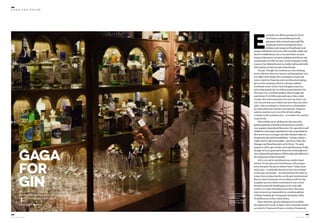
Head bartender
and bar manager
Gerry Olino
peruse the 250
gin varieties at Dr.
Fern's.
E
venbeforeitsofficialopening,Dr.Fern’s
GinParlour,asecrethideawayinthe
basementoftheCentral-basedmallThe
Landmark,hasbeenbesiegedbythose
lookingtogetajumponHongKong’snext
hotspot.Behindthetwodoors,thatresembleahigh-end
doctor’sestablishment,liesacityoasisthat’sonepart
botanicallaboratory,twopartssophisticatedlibraryand
occasionallyaDJchilloutzone.Atthecentrepieceofthe
roomisabar.Behindthebarisavisiblewallstockedwith
250varietiesofonlyonetypeofalcohol:gin.
Yes, gin. Though city residents are now drinking
more craft beer then ever and are continuing their new
love affair with whisky, the consumption of gin and
tonics, martinis, Negronis and even flavoured sipping
gin is on the upswing, which is echoing a definite
worldwide trend. In the United Kingdom last year,
sales of gin passed the one billion pound mark for the
first time ever, as British drinkers alone bought the
equivalent of 1.12 billion gin and tonics. Sales of gin
in pubs, bars and restaurants were also up 19 per cent
over the previous year, which was more than any other
spirit. And, according to a world survey of bartenders
by trade publication Drinks International, Negronis
and dry martinis were two of the 10 best-selling
cocktails in the world last year – at number two and five
respectively.
Muchofthiscanbeattributedtotheriseinthe
globalpopularityofBritishtelevisionshowsandthe
ever-popularJamesBondfilmseries.Yetagrowthincraft
distilleriesanduniqueingredientsisalsoresponsiblefor
thecurrentrise,asyoungerandolderdrinkersalikeare
intriguedbythespirit’spossibilities.“Ialwayscallgina
vodka,butit’saflavouredvodka,”saysGerryOlino,Bar
ManagerandHeadBartenderatDr.Fern’s.“Itneeds
junipertocallitagin,buttherestisjustflavouring.Today
though,we’reinagenerationwherethetechnologiesare
moreadvancedandbalanced.Whatmakesgindifferentis
theuniquenessofthebotanicals.”
At its core, gin is, and always was, a grain-based
alcohol. It’s the pine and citrus flavour of the juniper
berry that gives the gin its distinct taste. Today, those
seed cones – technically, the berries are more related
to the pine cone family – are still picked in the wild. As
long as those juniper berries are the gin’s predominant
flavour, other botanicals can be added at will. It’s this
simplistic process which contributed to one in four
British households distilling gin in the early 18th
century. A couple of hundred years later, that same
basic process was responsible for countless gallons
of illegal ‘bathtub gin’ being made during the 1920s
Prohibition era in the United States.
Since that time, gin has displayed its versatility
throughout the world. In Spain, where domestic brands
account for 75 percent of sales, a variety of botanicals
1 1 4 th e p e ak th e p e ak 1 1 5
f o o d a n d d r i n k
“We can make
guava gin,
lemongrass gin
or pandan gin.
We now have 35
different bottles
with different
varieties”
– Antonio Lai, Ori-Gin
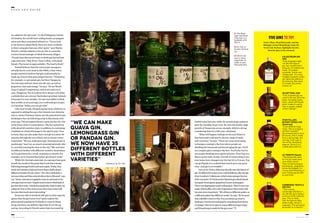
01 The Blind
Tiger and Fever
Tree tonic is a
highlight at Dr.
Fern's.
02 Ori-Gin co-
founder Antonio
Lai.
03-04 Ori-Gin
uses a rotary
evaporator to
make its own
flavoured gins.
are added to the ‘gin tonic’. In the Philippines, bottles
of Ginebra, the world’s best-selling brand, are popped
open and often consumed without ice. “If you look
at the Savoy Cocktail Book, there are more cocktails
in there using gin than any other spirit,” says Martin
Newell, a drinks industry veteran who is currently
a senior brand manager at Moët Hennessy Diageo.
“People have discovered ways to drink gin beyond just
a gin and tonic. They’ll try a Tom Collins, a Gin Basil
Smash. The lemon is approachable. The basil is fresh.”
Newell believes that the current gin resurgence
actually has its roots back in the 1980s, a time when
people started to believe that gin could actually be
made up of more than just juniper berries. “Tanqueray,
for example, is a premium gin, but then Tanqueray
Ten introduced fresh citrus into the mix, as well as
grapefruit, lime and orange,” he says. “At our World
Class Cocktail Competitions, which are held every
year, Tanqueray Ten is in about 35 to 40 per cent of the
cocktails that are entered. Bartenders gravitate towards
it because it’s very mixable. It’s also incredible to think
that as little as six years ago, you could only get six gins
in a back bar. Today, you can get 400.”
Like most trends, Hong Kong has been a follower as
opposed to setting the pace. But Antonio Lai claims he
and co-owner Charlene Dawes saw the potential for gin
drinking in the city following a trip to Barcelona a few
years ago. This prompted them to open the bar Ori-Gin
in the heart of the Central district. The bar started out
with about 60 varieties of gin, in addition to containing
a bathtub as a kind of homage to the spirit’s past. True
to form, they can also make their own gin in a mere 90
minutes through the use of their own in-house rotary
evaporator. “We can make guava gin, lemongrass gin or
pandan gin,” says Lai, an award-winning bartender who
is currently running five bars in the city. “We now have
35 different bottles with different varieties. Sometimes
we’ll experiment for a week, sometimes a month. For
example, we’ve learned that lychee gin doesn’t work.”
WhileOri-Ginhadaslowstart,itscustomerbasegrew
month-by-monthtothepointthatitnowhasasteady
followingamongstbothlocalsandexpats.Today,they
stock150varietiesofginandmorethanahalfadozen
differentbrandsoftonicwater.“Ori-Ginisdefinitelya
successtodayandthenseveralothershavefollowed,”says
Lai.“Somecustomersregularlycomeinandwanttotry
newginsthatwehave.Expatstendtoknowwhatkindof
ginthattheywant.Ithinkthepopularityofgininthiscity
willgoforfourorfivemoreyears,thentonicwaterwill
becomethatmuchmoreinteresting.”
Everyone who is involved with gin in some capacity
agrees that the gin boom won’t quite replace the
phenomenal popularity of whisky or wine in Hong
Kong, but there are definite signs that it’s on the up
and up. According to Newell, sales of gin increased by
33,000 cases last year, while the premium gin segment
grew by a healthy 16 per cent. He cites the double-digit
growth of Tanqueray as one example, which is strong
considering that it’s a 200-year-old brand.
“What will happen with gin in the near future is
that bartenders will stock a diverse range of styles
and countries,” he says. “There are some interesting
techniques coming to the fore where people are
distilling the botanicals and barrel aging the gin. You’ll
see complex gins coming to the fore. You’ll also start to
see people drinking more spirits at home. They’ll go to a
dinner party with a bottle. Overall, it’s interesting to see
how tastes have changed over the last 10 to 15 years. You
can get liquids in a cocktail that match up to any great
wine. And gin is so versatile.”
OveratDr.Fern’s,Olinohasalreadyseenthefutureof
gin.It’sfilledwithmanymorecraftdistilleries,likethegin
fromLondon’sColdstream,whichmixesjuniperberries
withcoriander.OrhisfavouriteSpanishginwhichblends
kumquat,lemongrass,grapefruit,lemonandpepper.
Therearesippingginsmadewithgrapes.There’sevenone
madewithtruffles.He’salsoabigbelieverthattonicswill
becomemoreimportant.“Weallhaveadifferentpalate,so
adifferentpalatehasdifferentneeds,”hesays.“Soit’sgood
thatadistillercaterstothis.Youcanalwaysgobackto
BeefeaterGinifyou’relookingforsomethingthat’sheavy
onjuniper.Butwe’reopentomanydifferenttypesofgin
andHongKongisreadyforthegincraze.”
CAMBRIDGE TRUFFLE
GIN (UK)
“This is exotic.
Cambridge Distillery in
the UK has been doing a
lot of out of the ordinary
gins. This is made
with the famous Alba
white truffle, which is
seasonal. This gin would
be perfect in a martini.”
FIVE GINS TO TRY
Gerry Olino, Head Bartender and Bar
Manager at new Hong Kong venue Dr.
Fern’s Gin Parlour, highlights his five
favorite gins at the moment.
COLDSTREAM GIN
(UK)
“A lot of people might
not like this type of
gin, but I myself like it
because it’s traditionally
made. It’s juniper,
coriander, lemon and
orange peel. It’s a very
straight-forward London
gin, quite dry without a
lot of aroma. But when
it’s mixed, the aroma
comes out.”
LE TRIBUTE (Spain)
“The botanicals used
for this gin have more
of an Asian punch.
They include kumquat,
lemongrass, grapefruit,
lemon and pepper. It’s
citrusy and refreshing. It
even comes paired with
its own tonic.”
SILENT POOL (UK)
“A lot of botanicals are
used in this one (24 to be
exact, including cassia
bark, cubeb and honey),
which makes it earthy.
This is a good, middle-
of-the-road gin.”
FOUR PILLARS
BLOODY SHIRAZ GIN
(Australia)
“A very different type
of gin. This is a sipping
gin that I wouldn’t
recommend with a tonic.
Of course, this is made
from a wine grape, but
turning it into a gin is
one of the interesting
aspects. Drink it in a
crystal glass with ice.”
01 03
02 04
1 1 6 th e p e ak th e p e ak 1 1 7
f o o d a n d d r i n k

Gaga For Gin

  • 1.
    Story Scott Murphy Ginis on the upswing, and distillers are exploring new ways of crafting the world’s most versatile spirit. GAGA FOR GIN Head bartender and bar manager Gerry Olino peruse the 250 gin varieties at Dr. Fern's. E venbeforeitsofficialopening,Dr.Fern’s GinParlour,asecrethideawayinthe basementoftheCentral-basedmallThe Landmark,hasbeenbesiegedbythose lookingtogetajumponHongKong’snext hotspot.Behindthetwodoors,thatresembleahigh-end doctor’sestablishment,liesacityoasisthat’sonepart botanicallaboratory,twopartssophisticatedlibraryand occasionallyaDJchilloutzone.Atthecentrepieceofthe roomisabar.Behindthebarisavisiblewallstockedwith 250varietiesofonlyonetypeofalcohol:gin. Yes, gin. Though city residents are now drinking more craft beer then ever and are continuing their new love affair with whisky, the consumption of gin and tonics, martinis, Negronis and even flavoured sipping gin is on the upswing, which is echoing a definite worldwide trend. In the United Kingdom last year, sales of gin passed the one billion pound mark for the first time ever, as British drinkers alone bought the equivalent of 1.12 billion gin and tonics. Sales of gin in pubs, bars and restaurants were also up 19 per cent over the previous year, which was more than any other spirit. And, according to a world survey of bartenders by trade publication Drinks International, Negronis and dry martinis were two of the 10 best-selling cocktails in the world last year – at number two and five respectively. Muchofthiscanbeattributedtotheriseinthe globalpopularityofBritishtelevisionshowsandthe ever-popularJamesBondfilmseries.Yetagrowthincraft distilleriesanduniqueingredientsisalsoresponsiblefor thecurrentrise,asyoungerandolderdrinkersalikeare intriguedbythespirit’spossibilities.“Ialwayscallgina vodka,butit’saflavouredvodka,”saysGerryOlino,Bar ManagerandHeadBartenderatDr.Fern’s.“Itneeds junipertocallitagin,buttherestisjustflavouring.Today though,we’reinagenerationwherethetechnologiesare moreadvancedandbalanced.Whatmakesgindifferentis theuniquenessofthebotanicals.” At its core, gin is, and always was, a grain-based alcohol. It’s the pine and citrus flavour of the juniper berry that gives the gin its distinct taste. Today, those seed cones – technically, the berries are more related to the pine cone family – are still picked in the wild. As long as those juniper berries are the gin’s predominant flavour, other botanicals can be added at will. It’s this simplistic process which contributed to one in four British households distilling gin in the early 18th century. A couple of hundred years later, that same basic process was responsible for countless gallons of illegal ‘bathtub gin’ being made during the 1920s Prohibition era in the United States. Since that time, gin has displayed its versatility throughout the world. In Spain, where domestic brands account for 75 percent of sales, a variety of botanicals 1 1 4 th e p e ak th e p e ak 1 1 5 f o o d a n d d r i n k
  • 2.
    “We can make guavagin, lemongrass gin or pandan gin. We now have 35 different bottles with different varieties” – Antonio Lai, Ori-Gin 01 The Blind Tiger and Fever Tree tonic is a highlight at Dr. Fern's. 02 Ori-Gin co- founder Antonio Lai. 03-04 Ori-Gin uses a rotary evaporator to make its own flavoured gins. are added to the ‘gin tonic’. In the Philippines, bottles of Ginebra, the world’s best-selling brand, are popped open and often consumed without ice. “If you look at the Savoy Cocktail Book, there are more cocktails in there using gin than any other spirit,” says Martin Newell, a drinks industry veteran who is currently a senior brand manager at Moët Hennessy Diageo. “People have discovered ways to drink gin beyond just a gin and tonic. They’ll try a Tom Collins, a Gin Basil Smash. The lemon is approachable. The basil is fresh.” Newell believes that the current gin resurgence actually has its roots back in the 1980s, a time when people started to believe that gin could actually be made up of more than just juniper berries. “Tanqueray, for example, is a premium gin, but then Tanqueray Ten introduced fresh citrus into the mix, as well as grapefruit, lime and orange,” he says. “At our World Class Cocktail Competitions, which are held every year, Tanqueray Ten is in about 35 to 40 per cent of the cocktails that are entered. Bartenders gravitate towards it because it’s very mixable. It’s also incredible to think that as little as six years ago, you could only get six gins in a back bar. Today, you can get 400.” Like most trends, Hong Kong has been a follower as opposed to setting the pace. But Antonio Lai claims he and co-owner Charlene Dawes saw the potential for gin drinking in the city following a trip to Barcelona a few years ago. This prompted them to open the bar Ori-Gin in the heart of the Central district. The bar started out with about 60 varieties of gin, in addition to containing a bathtub as a kind of homage to the spirit’s past. True to form, they can also make their own gin in a mere 90 minutes through the use of their own in-house rotary evaporator. “We can make guava gin, lemongrass gin or pandan gin,” says Lai, an award-winning bartender who is currently running five bars in the city. “We now have 35 different bottles with different varieties. Sometimes we’ll experiment for a week, sometimes a month. For example, we’ve learned that lychee gin doesn’t work.” WhileOri-Ginhadaslowstart,itscustomerbasegrew month-by-monthtothepointthatitnowhasasteady followingamongstbothlocalsandexpats.Today,they stock150varietiesofginandmorethanahalfadozen differentbrandsoftonicwater.“Ori-Ginisdefinitelya successtodayandthenseveralothershavefollowed,”says Lai.“Somecustomersregularlycomeinandwanttotry newginsthatwehave.Expatstendtoknowwhatkindof ginthattheywant.Ithinkthepopularityofgininthiscity willgoforfourorfivemoreyears,thentonicwaterwill becomethatmuchmoreinteresting.” Everyone who is involved with gin in some capacity agrees that the gin boom won’t quite replace the phenomenal popularity of whisky or wine in Hong Kong, but there are definite signs that it’s on the up and up. According to Newell, sales of gin increased by 33,000 cases last year, while the premium gin segment grew by a healthy 16 per cent. He cites the double-digit growth of Tanqueray as one example, which is strong considering that it’s a 200-year-old brand. “What will happen with gin in the near future is that bartenders will stock a diverse range of styles and countries,” he says. “There are some interesting techniques coming to the fore where people are distilling the botanicals and barrel aging the gin. You’ll see complex gins coming to the fore. You’ll also start to see people drinking more spirits at home. They’ll go to a dinner party with a bottle. Overall, it’s interesting to see how tastes have changed over the last 10 to 15 years. You can get liquids in a cocktail that match up to any great wine. And gin is so versatile.” OveratDr.Fern’s,Olinohasalreadyseenthefutureof gin.It’sfilledwithmanymorecraftdistilleries,likethegin fromLondon’sColdstream,whichmixesjuniperberries withcoriander.OrhisfavouriteSpanishginwhichblends kumquat,lemongrass,grapefruit,lemonandpepper. Therearesippingginsmadewithgrapes.There’sevenone madewithtruffles.He’salsoabigbelieverthattonicswill becomemoreimportant.“Weallhaveadifferentpalate,so adifferentpalatehasdifferentneeds,”hesays.“Soit’sgood thatadistillercaterstothis.Youcanalwaysgobackto BeefeaterGinifyou’relookingforsomethingthat’sheavy onjuniper.Butwe’reopentomanydifferenttypesofgin andHongKongisreadyforthegincraze.” CAMBRIDGE TRUFFLE GIN (UK) “This is exotic. Cambridge Distillery in the UK has been doing a lot of out of the ordinary gins. This is made with the famous Alba white truffle, which is seasonal. This gin would be perfect in a martini.” FIVE GINS TO TRY Gerry Olino, Head Bartender and Bar Manager at new Hong Kong venue Dr. Fern’s Gin Parlour, highlights his five favorite gins at the moment. COLDSTREAM GIN (UK) “A lot of people might not like this type of gin, but I myself like it because it’s traditionally made. It’s juniper, coriander, lemon and orange peel. It’s a very straight-forward London gin, quite dry without a lot of aroma. But when it’s mixed, the aroma comes out.” LE TRIBUTE (Spain) “The botanicals used for this gin have more of an Asian punch. They include kumquat, lemongrass, grapefruit, lemon and pepper. It’s citrusy and refreshing. It even comes paired with its own tonic.” SILENT POOL (UK) “A lot of botanicals are used in this one (24 to be exact, including cassia bark, cubeb and honey), which makes it earthy. This is a good, middle- of-the-road gin.” FOUR PILLARS BLOODY SHIRAZ GIN (Australia) “A very different type of gin. This is a sipping gin that I wouldn’t recommend with a tonic. Of course, this is made from a wine grape, but turning it into a gin is one of the interesting aspects. Drink it in a crystal glass with ice.” 01 03 02 04 1 1 6 th e p e ak th e p e ak 1 1 7 f o o d a n d d r i n k