GIN
PRESENTED BYPRESENTED BY
SAPUN CHALITHSAPUN CHALITHA
F&B SUPERVISORF&B SUPERVISOR
 Gin is a white spirit flavored with juniper
berries and botanicals( an assortment
of herbs and spices ).
 Its name is shortened version of
“Genever” the Dutch word of Juniper.
Juniper Berries
Gin is made primarily from a mixture of
malted barley, wheat, corn and rye. It is
an un-aged spirit.
The botanicals which are used to flavour
gin are anise, coriander, cassia bark,
cinnamon stick, orange peel etc.
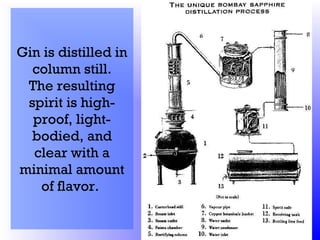
Gin is distilled in
column still.
The resulting
spirit is high-
proof, light-
bodied, and
clear with a
minimal amount
of flavor.
Gin: Methods of Production
3. Percolation: In this method alcohol vapor wafts through a
chamber in which the dried juniper berries and
botanicals are suspended. The vapor gently extracts
aromatic and flavoring oils and compounds from the
berries and spices as it travels through the chamber.
1. Mixing: Mixing the spirit base with juniper and botanical
extracts.
2. Steeping: Most of the gin available in the market is
produced by this method wherein juniper berries and
botanicals are steeped in the spirit and then redistilled.
Classification of Gin
1. London Dry Gin
2.Plymouth Gin
3.Old Tom Gin
4. Genever Gin
Famous Brands of Gin
Beefeater
Bombay Sapphire
Blue Riband
Gordon’s Gin
Seagram’s Gin
Tanqueray
Bol’s
Plymouth
Gin based cocktails
 Gin forms a very trendy base for
cocktails like Martini, Collins,
Gibsons, Pink Lady and Gimlet.
 Gin is popularly served with tonic
water and a slice of lime.
Gin
Gin

Gin

  • 1.
    GIN PRESENTED BYPRESENTED BY SAPUNCHALITHSAPUN CHALITHA F&B SUPERVISORF&B SUPERVISOR
  • 2.
     Gin isa white spirit flavored with juniper berries and botanicals( an assortment of herbs and spices ).  Its name is shortened version of “Genever” the Dutch word of Juniper. Juniper Berries
  • 3.
    Gin is madeprimarily from a mixture of malted barley, wheat, corn and rye. It is an un-aged spirit. The botanicals which are used to flavour gin are anise, coriander, cassia bark, cinnamon stick, orange peel etc.
  • 4.
    Gin is distilledin column still. The resulting spirit is high- proof, light- bodied, and clear with a minimal amount of flavor.
  • 5.
    Gin: Methods ofProduction 3. Percolation: In this method alcohol vapor wafts through a chamber in which the dried juniper berries and botanicals are suspended. The vapor gently extracts aromatic and flavoring oils and compounds from the berries and spices as it travels through the chamber. 1. Mixing: Mixing the spirit base with juniper and botanical extracts. 2. Steeping: Most of the gin available in the market is produced by this method wherein juniper berries and botanicals are steeped in the spirit and then redistilled.
  • 6.
    Classification of Gin 1.London Dry Gin 2.Plymouth Gin 3.Old Tom Gin 4. Genever Gin
  • 7.
    Famous Brands ofGin Beefeater Bombay Sapphire Blue Riband Gordon’s Gin Seagram’s Gin Tanqueray Bol’s Plymouth
  • 8.
    Gin based cocktails Gin forms a very trendy base for cocktails like Martini, Collins, Gibsons, Pink Lady and Gimlet.  Gin is popularly served with tonic water and a slice of lime.

Editor's Notes

  • #7 London Dry Gin is the dominant English style of Gin. As a style it lends itself particularly well to mixing. London Dry Gin is the dominant Gin style in the United Kingdom, former British colonies, the United States, and Spain. Plymouth Gin is relatively full-bodied (when compared to London Dry Gin). It is clear, slightly fruity, and very aromatic. Originally the local Gin style of the English Channel port of Plymouth, modern Plymouth Gin is nowadays made only by one distillery in Plymouth, Coates & Co., which also controls the right to the term Plymouth Gin. Old Tom Gin is the last remaining example of the original lightly sweetened gins that were so popular in 18th-century England. The name comes from what may be the first example of a beverage vending machine. In the 1700s some pubs in England would have a wooden plaque shaped like a black cat (an "Old Tom") mounted on the outside wall. Thirsty passersby would deposit a penny in the cat’s mouth and place their lips around a small tube between the cat’s paws. The bartender inside would then pour a shot of Gin through the tube and into the customer’s waiting mouth. Until fairly recently limited quantities of Old Tom-style Gin were still being made by a few British distillers, but they were, at best, curiosity items. Genever or Hollands is the Dutch style of Gin. Genever is distilled from a malted grain mash similar to that used for whisky. Oude ("old") Genever is the original style. It is straw-hued, relatively sweet and aromatic. Jonge ("young") Genever has a drier palate and lighter body. Some genevers are aged for one to three years in oak casks. Genevers tend to be lower proof than English gins (72-80 proof or 36-40% ABV is typical). They are usually served straight up and chilled. The classic accompaniment to a shot of Genever is a dried green herring. Genever is traditionally sold in a cylindrical stoneware crock. Genever-style gins are produced in Holland, Belgium, and Germany.