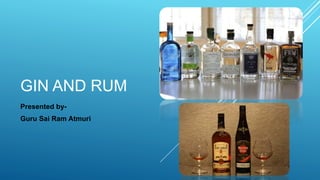
GIN AND RUM
Presented by-
Guru Sai Ram Atmuri
GIN AND ITS ORIGIN
 Gin is a spirit which derives its predominant flavour
from juniper berries.
 From its earliest origins in the Middle Ages, gin has
evolved over the course of a millennium from a
herbal medicine to an object of commerce in the
spirits industry.
 Gin was developed on the basis of the older
Jenever, and became popular in Great Britain when
William of Orange, leader of the Dutch Republic,
occupied the English and Scottish thrones with his
wife Mary.
PRODUCTION METHODS
 Pot distilled gin represents the earliest style of gin, and is
traditionally produced by pot distilling a fermented grain mash
(malt wine) from barley and or other grains, then redistilling it
with flavouring botanicals to extract the aromatic compounds.
 Column distilled gin evolved following the invention of the
Coffey still, and is produced by first distilling high proof (e.g.
96% ABV) neutral spirits from a fermented mash or wash using
a refluxing still such as a column still. The fermentable base for
this spirit may be derived from grain, sugar beets, grapes,
potatoes, sugar cane, plain sugar, or any other material of
agricultural origin.
 Compound gin is made by simply flavouring neutral spirits with
essences and/or other 'natural flavourings' without redistillation,
and is not as highly regarded as distilled gin.
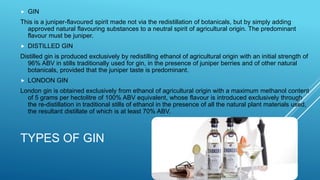
TYPES OF GIN
 GIN
This is a juniper-flavoured spirit made not via the redistillation of botanicals, but by simply adding
approved natural flavouring substances to a neutral spirit of agricultural origin. The predominant
flavour must be juniper.
 DISTILLED GIN
Distilled gin is produced exclusively by redistilling ethanol of agricultural origin with an initial strength of
96% ABV in stills traditionally used for gin, in the presence of juniper berries and of other natural
botanicals, provided that the juniper taste is predominant.
 LONDON GIN
London gin is obtained exclusively from ethanol of agricultural origin with a maximum methanol content
of 5 grams per hectolitre of 100% ABV equivalent, whose flavour is introduced exclusively through
the re-distillation in traditional stills of ethanol in the presence of all the natural plant materials used,
the resultant distillate of which is at least 70% ABV.
FAMOUS BRANDS
 Avation American Gin
 Bombay Sapphire
 Beefeater
 Blackwood’s
 Citadelle
 Cork dry gin
 Gilbey’s
 Strain
 Takka
RUM
Presented By-
GURU SAI RAM ATMURI
RUM AND ITS ORIGIN
 Rum is a distilled alcoholic beverage made from sugarcane
byproducts, such as molasses, or directly from sugarcane
juice, by a process of fermentation and distillation. The
distillate, a clear liquid, is then usually aged in oak barrels.
 Fermentation
 Sugarcane is harvested to make sugarcane juice and
molasses.
 Most rum produced is made from molasses. Within the
Caribbean, much of this molasses is from Brazil. A notable
exception is the French-speaking islands, where sugarcane
juice is the preferred base ingredient. In Brazil itself, the
distilled alcoholic beverage derived from cane juice is
distinguished from rum and called cachaça.
 Distillation
 As with all other aspects of rum production, no
standard method is used for distillation. While
some producers work in batches using pot
stills, most rum production is done using
column still distillation.
 Aging and blending
 Many countries require rum to be aged for at
least one year. This aging is commonly
performed in used bourbon casks, but may also
be performed in other types of wooden casks or
stainless steel tanks. The aging process
determines the color of the rum. When aged in
oak casks, it becomes dark, whereas rum aged
in stainless steel tanks remains virtually
colorless.
GRADES OF RUM
 Dark Rum
 Flavored Rum
 Gold Rum
 Light Rum
 Overproof Rum
 Premium Rum
 Spiced Rum
BRANDS OF
RUM
 Bacardi
 McDowell’s No. 1 Celebration
 Captain Morgan
 Havana Club
 Brugal
 Cacique
 Contessa
 Madira
 Montilla
 Appleton
THANK YOU

RUM AND GIN

  • 1.
    GIN AND RUM Presentedby- Guru Sai Ram Atmuri
  • 2.
    GIN AND ITSORIGIN  Gin is a spirit which derives its predominant flavour from juniper berries.  From its earliest origins in the Middle Ages, gin has evolved over the course of a millennium from a herbal medicine to an object of commerce in the spirits industry.  Gin was developed on the basis of the older Jenever, and became popular in Great Britain when William of Orange, leader of the Dutch Republic, occupied the English and Scottish thrones with his wife Mary.
  • 3.
    PRODUCTION METHODS  Potdistilled gin represents the earliest style of gin, and is traditionally produced by pot distilling a fermented grain mash (malt wine) from barley and or other grains, then redistilling it with flavouring botanicals to extract the aromatic compounds.  Column distilled gin evolved following the invention of the Coffey still, and is produced by first distilling high proof (e.g. 96% ABV) neutral spirits from a fermented mash or wash using a refluxing still such as a column still. The fermentable base for this spirit may be derived from grain, sugar beets, grapes, potatoes, sugar cane, plain sugar, or any other material of agricultural origin.  Compound gin is made by simply flavouring neutral spirits with essences and/or other 'natural flavourings' without redistillation, and is not as highly regarded as distilled gin.
  • 4.
    TYPES OF GIN GIN This is a juniper-flavoured spirit made not via the redistillation of botanicals, but by simply adding approved natural flavouring substances to a neutral spirit of agricultural origin. The predominant flavour must be juniper.  DISTILLED GIN Distilled gin is produced exclusively by redistilling ethanol of agricultural origin with an initial strength of 96% ABV in stills traditionally used for gin, in the presence of juniper berries and of other natural botanicals, provided that the juniper taste is predominant.  LONDON GIN London gin is obtained exclusively from ethanol of agricultural origin with a maximum methanol content of 5 grams per hectolitre of 100% ABV equivalent, whose flavour is introduced exclusively through the re-distillation in traditional stills of ethanol in the presence of all the natural plant materials used, the resultant distillate of which is at least 70% ABV.
  • 5.
    FAMOUS BRANDS  AvationAmerican Gin  Bombay Sapphire  Beefeater  Blackwood’s  Citadelle  Cork dry gin  Gilbey’s  Strain  Takka
  • 6.
  • 7.
    RUM AND ITSORIGIN  Rum is a distilled alcoholic beverage made from sugarcane byproducts, such as molasses, or directly from sugarcane juice, by a process of fermentation and distillation. The distillate, a clear liquid, is then usually aged in oak barrels.  Fermentation  Sugarcane is harvested to make sugarcane juice and molasses.  Most rum produced is made from molasses. Within the Caribbean, much of this molasses is from Brazil. A notable exception is the French-speaking islands, where sugarcane juice is the preferred base ingredient. In Brazil itself, the distilled alcoholic beverage derived from cane juice is distinguished from rum and called cachaça.
  • 8.
     Distillation  Aswith all other aspects of rum production, no standard method is used for distillation. While some producers work in batches using pot stills, most rum production is done using column still distillation.  Aging and blending  Many countries require rum to be aged for at least one year. This aging is commonly performed in used bourbon casks, but may also be performed in other types of wooden casks or stainless steel tanks. The aging process determines the color of the rum. When aged in oak casks, it becomes dark, whereas rum aged in stainless steel tanks remains virtually colorless.
  • 9.
    GRADES OF RUM Dark Rum  Flavored Rum  Gold Rum  Light Rum  Overproof Rum  Premium Rum  Spiced Rum
  • 10.
    BRANDS OF RUM  Bacardi McDowell’s No. 1 Celebration  Captain Morgan  Havana Club  Brugal  Cacique  Contessa  Madira  Montilla  Appleton
  • 11.