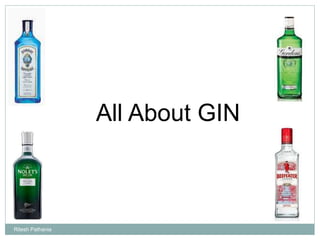
All About GIN
Ritesh Pathania
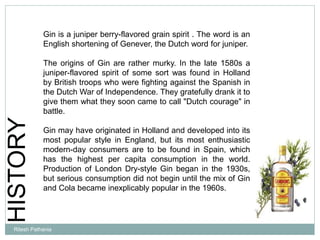
HISTORY Gin is a juniper berry-flavored grain spirit . The word is an
English shortening of Genever, the Dutch word for juniper.
The origins of Gin are rather murky. In the late 1580s a
juniper-flavored spirit of some sort was found in Holland
by British troops who were fighting against the Spanish in
the Dutch War of Independence. They gratefully drank it to
give them what they soon came to call "Dutch courage" in
battle.
Gin may have originated in Holland and developed into its
most popular style in England, but its most enthusiastic
modern-day consumers are to be found in Spain, which
has the highest per capita consumption in the world.
Production of London Dry-style Gin began in the 1930s,
but serious consumption did not begin until the mix of Gin
and Cola became inexplicably popular in the 1960s.
Ritesh Pathania
HISTORY Gin, on the other hand, did not require any aging, and
was relatively easy to make by mixing raw alcohol with
juniper berry extract and other flavourings and spices in a
large container such as a bathtub (thus the origin of the
term "Bathtub Gin").
Gin and its Lowlands cousin Genever (Jenever in
Belgium) are white spirits that are flavored with juniper
berries and so-called botanicals (a varied assortment of
herbs and spices). The spirit base of Gin is primarily grain
(usually wheat or rye), which results in a light-bodied
spirit.
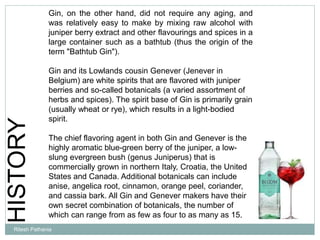
The chief flavoring agent in both Gin and Genever is the
highly aromatic blue-green berry of the juniper, a low-
slung evergreen bush (genus Juniperus) that is
commercially grown in northern Italy, Croatia, the United
States and Canada. Additional botanicals can include
anise, angelica root, cinnamon, orange peel, coriander,
and cassia bark. All Gin and Genever makers have their
own secret combination of botanicals, the number of
which can range from as few as four to as many as 15.
Ritesh Pathania
DISTILLATIONOF
GIN
Most Gin is initially distilled in efficient column stills. The
resulting spirit is high-proof, light-bodied, and clean with a
minimal amount of congeners (flavor compounds) and
flavoring agents. Genever is distilled in less-efficient pot
stills, which results in a lower-proof, more flavorful spirit.
Low-quality "compound" gins are made by simply mixing
the base spirit with juniper and botanical extracts. Mass-
market gins are produced by soaking juniper berries and
botanicals in the base spirit and then redistilling the
mixture.
Top-quality gins and genevers are flavored in a unique
manner. After one or more distillations the base spirit is
redistilled one last time. During this final distillation the
alcohol vapor wafts through a chamber in which the dried
juniper berries and botanicals are suspended. The vapor
gently extracts aromatic and flavoring oils and compounds
from the berries and spices as it travels through the
chamber on its way to the condenser. The resulting
flavored spirit has a noticeable degree of complexity.
.
Ritesh Pathania
Classificationsof
Gin
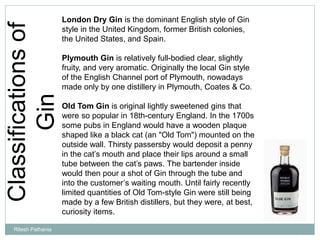
London Dry Gin is the dominant English style of Gin
style in the United Kingdom, former British colonies,
the United States, and Spain.
Plymouth Gin is relatively full-bodied clear, slightly
fruity, and very aromatic. Originally the local Gin style
of the English Channel port of Plymouth, nowadays
made only by one distillery in Plymouth, Coates & Co.
Old Tom Gin is original lightly sweetened gins that
were so popular in 18th-century England. In the 1700s
some pubs in England would have a wooden plaque
shaped like a black cat (an "Old Tom") mounted on the
outside wall. Thirsty passersby would deposit a penny
in the cat’s mouth and place their lips around a small
tube between the cat’s paws. The bartender inside
would then pour a shot of Gin through the tube and
into the customer’s waiting mouth. Until fairly recently
limited quantities of Old Tom-style Gin were still being
made by a few British distillers, but they were, at best,
curiosity items.
Ritesh Pathania
Genever or Hollands is the Dutch style of Gin.
Genever is distilled from a malted grain mash similar
to that used for whisky. Oude ("old") Genever is the
original style. It is straw-hued, relatively sweet and
aromatic. Jonge ("young") Genever has a drier
palate and lighter body.
Some genevers are aged for one to three years in
oak casks. Genevers tend to be lower proof than
English gins (72-80 proof or 36-40% ABV is typical).
They are usually served straight up and chilled. The
classic accompaniment to a shot of Genever is a
dried green herring. Genever is traditionally sold in a
cylindrical stoneware crock. Genever-style gins are
produced in Holland, Belgium, and Germany.
Ritesh Pathania
Classificationsof
Gin
GINRegions
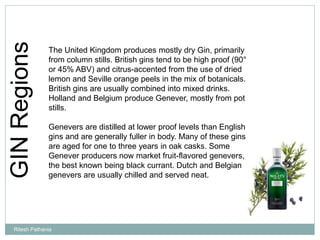
The United Kingdom produces mostly dry Gin, primarily
from column stills. British gins tend to be high proof (90°
or 45% ABV) and citrus-accented from the use of dried
lemon and Seville orange peels in the mix of botanicals.
British gins are usually combined into mixed drinks.
Holland and Belgium produce Genever, mostly from pot
stills.
Genevers are distilled at lower proof levels than English
gins and are generally fuller in body. Many of these gins
are aged for one to three years in oak casks. Some
Genever producers now market fruit-flavored genevers,
the best known being black currant. Dutch and Belgian
genevers are usually chilled and served neat.
Ritesh Pathania
GINRegions Germany produces a Genever-style Gin called
Dornkaat in the North Sea coast region of Frisia. This
spirit is lighter in body and more delicate in flavor than
both Dutch Genever and English dry Gin. German
Gin is usually served straight up and cold.
Spain produces a substantial amount of Gin, all of it
in the London Dry style from column stills. Most of it is
sold for mixing with cola.
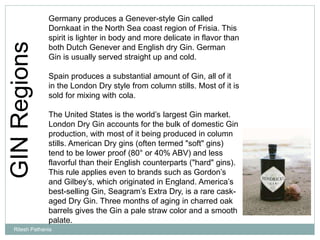
The United States is the world’s largest Gin market.
London Dry Gin accounts for the bulk of domestic Gin
production, with most of it being produced in column
stills. American Dry gins (often termed "soft" gins)
tend to be lower proof (80° or 40% ABV) and less
flavorful than their English counterparts ("hard" gins).
This rule applies even to brands such as Gordon’s
and Gilbey’s, which originated in England. America’s
best-selling Gin, Seagram’s Extra Dry, is a rare cask-
aged Dry Gin. Three months of aging in charred oak
barrels gives the Gin a pale straw color and a smooth
palate.
Ritesh Pathania
HOWTOSERVE
The age old mixer for gin is of course Schweppes
tonic. A gin and tonic is usually offered as a long drink
with a slice of lemon and plenty of ice, but equal
measures is a more sensible way of treating the gin.
Gin rubs along with any old mixer, though : orange
juice, bitter lemon, ginger beer.
Speciality gins can be served neat. Chill the bottle in
the freezer, and serve the measures in small glasses.
A taller, narrow-sided, stemmed glass- rather like a
short champagne flute– is traditional in the
Netherlands…
Ritesh Pathania
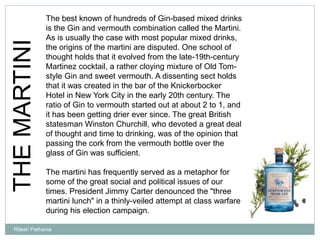
THEMARTINI The best known of hundreds of Gin-based mixed drinks
is the Gin and vermouth combination called the Martini.
As is usually the case with most popular mixed drinks,
the origins of the martini are disputed. One school of
thought holds that it evolved from the late-19th-century
Martinez cocktail, a rather cloying mixture of Old Tom-
style Gin and sweet vermouth. A dissenting sect holds
that it was created in the bar of the Knickerbocker
Hotel in New York City in the early 20th century. The
ratio of Gin to vermouth started out at about 2 to 1, and
it has been getting drier ever since. The great British
statesman Winston Churchill, who devoted a great deal
of thought and time to drinking, was of the opinion that
passing the cork from the vermouth bottle over the
glass of Gin was sufficient.
The martini has frequently served as a metaphor for
some of the great social and political issues of our
times. President Jimmy Carter denounced the "three
martini lunch" in a thinly-veiled attempt at class warfare
during his election campaign.
Ritesh Pathania
BrandsofGIN
Ritesh Pathania
 Gordon’s
 Gilbey’s
 Beefeaters
 Tanqueray
 Nicholson
 Booth’s
 White satin
 House of Lords
 Boodles
 Bols
 Bombay Sapphire
GINCocktails  Classic Martini
Gin, Dry Vermouth
 Gimlet
Gin, Lime Cordial
 Gin Fizz
Gin, Sweet & Sour, Egg White and Sparkling water
 Negroni
Campari, Gin, Sweet Vermouth and Sparkling water
 Singapore Sling
Gin, Sweet & Sour, Cherry heering, Sparkling Water
Ritesh Pathania

ALL ABOUT GIN

  • 1.
  • 2.
    HISTORY Gin isa juniper berry-flavored grain spirit . The word is an English shortening of Genever, the Dutch word for juniper. The origins of Gin are rather murky. In the late 1580s a juniper-flavored spirit of some sort was found in Holland by British troops who were fighting against the Spanish in the Dutch War of Independence. They gratefully drank it to give them what they soon came to call "Dutch courage" in battle. Gin may have originated in Holland and developed into its most popular style in England, but its most enthusiastic modern-day consumers are to be found in Spain, which has the highest per capita consumption in the world. Production of London Dry-style Gin began in the 1930s, but serious consumption did not begin until the mix of Gin and Cola became inexplicably popular in the 1960s. Ritesh Pathania
  • 3.
    HISTORY Gin, onthe other hand, did not require any aging, and was relatively easy to make by mixing raw alcohol with juniper berry extract and other flavourings and spices in a large container such as a bathtub (thus the origin of the term "Bathtub Gin"). Gin and its Lowlands cousin Genever (Jenever in Belgium) are white spirits that are flavored with juniper berries and so-called botanicals (a varied assortment of herbs and spices). The spirit base of Gin is primarily grain (usually wheat or rye), which results in a light-bodied spirit. The chief flavoring agent in both Gin and Genever is the highly aromatic blue-green berry of the juniper, a low- slung evergreen bush (genus Juniperus) that is commercially grown in northern Italy, Croatia, the United States and Canada. Additional botanicals can include anise, angelica root, cinnamon, orange peel, coriander, and cassia bark. All Gin and Genever makers have their own secret combination of botanicals, the number of which can range from as few as four to as many as 15. Ritesh Pathania
  • 4.
    DISTILLATIONOF GIN Most Gin isinitially distilled in efficient column stills. The resulting spirit is high-proof, light-bodied, and clean with a minimal amount of congeners (flavor compounds) and flavoring agents. Genever is distilled in less-efficient pot stills, which results in a lower-proof, more flavorful spirit. Low-quality "compound" gins are made by simply mixing the base spirit with juniper and botanical extracts. Mass- market gins are produced by soaking juniper berries and botanicals in the base spirit and then redistilling the mixture. Top-quality gins and genevers are flavored in a unique manner. After one or more distillations the base spirit is redistilled one last time. During this final distillation the alcohol vapor wafts through a chamber in which the dried juniper berries and botanicals are suspended. The vapor gently extracts aromatic and flavoring oils and compounds from the berries and spices as it travels through the chamber on its way to the condenser. The resulting flavored spirit has a noticeable degree of complexity. . Ritesh Pathania
  • 5.
    Classificationsof Gin London Dry Ginis the dominant English style of Gin style in the United Kingdom, former British colonies, the United States, and Spain. Plymouth Gin is relatively full-bodied clear, slightly fruity, and very aromatic. Originally the local Gin style of the English Channel port of Plymouth, nowadays made only by one distillery in Plymouth, Coates & Co. Old Tom Gin is original lightly sweetened gins that were so popular in 18th-century England. In the 1700s some pubs in England would have a wooden plaque shaped like a black cat (an "Old Tom") mounted on the outside wall. Thirsty passersby would deposit a penny in the cat’s mouth and place their lips around a small tube between the cat’s paws. The bartender inside would then pour a shot of Gin through the tube and into the customer’s waiting mouth. Until fairly recently limited quantities of Old Tom-style Gin were still being made by a few British distillers, but they were, at best, curiosity items. Ritesh Pathania
  • 6.
    Genever or Hollandsis the Dutch style of Gin. Genever is distilled from a malted grain mash similar to that used for whisky. Oude ("old") Genever is the original style. It is straw-hued, relatively sweet and aromatic. Jonge ("young") Genever has a drier palate and lighter body. Some genevers are aged for one to three years in oak casks. Genevers tend to be lower proof than English gins (72-80 proof or 36-40% ABV is typical). They are usually served straight up and chilled. The classic accompaniment to a shot of Genever is a dried green herring. Genever is traditionally sold in a cylindrical stoneware crock. Genever-style gins are produced in Holland, Belgium, and Germany. Ritesh Pathania Classificationsof Gin
  • 7.
    GINRegions The United Kingdomproduces mostly dry Gin, primarily from column stills. British gins tend to be high proof (90° or 45% ABV) and citrus-accented from the use of dried lemon and Seville orange peels in the mix of botanicals. British gins are usually combined into mixed drinks. Holland and Belgium produce Genever, mostly from pot stills. Genevers are distilled at lower proof levels than English gins and are generally fuller in body. Many of these gins are aged for one to three years in oak casks. Some Genever producers now market fruit-flavored genevers, the best known being black currant. Dutch and Belgian genevers are usually chilled and served neat. Ritesh Pathania
  • 8.
    GINRegions Germany producesa Genever-style Gin called Dornkaat in the North Sea coast region of Frisia. This spirit is lighter in body and more delicate in flavor than both Dutch Genever and English dry Gin. German Gin is usually served straight up and cold. Spain produces a substantial amount of Gin, all of it in the London Dry style from column stills. Most of it is sold for mixing with cola. The United States is the world’s largest Gin market. London Dry Gin accounts for the bulk of domestic Gin production, with most of it being produced in column stills. American Dry gins (often termed "soft" gins) tend to be lower proof (80° or 40% ABV) and less flavorful than their English counterparts ("hard" gins). This rule applies even to brands such as Gordon’s and Gilbey’s, which originated in England. America’s best-selling Gin, Seagram’s Extra Dry, is a rare cask- aged Dry Gin. Three months of aging in charred oak barrels gives the Gin a pale straw color and a smooth palate. Ritesh Pathania
  • 9.
    HOWTOSERVE The age oldmixer for gin is of course Schweppes tonic. A gin and tonic is usually offered as a long drink with a slice of lemon and plenty of ice, but equal measures is a more sensible way of treating the gin. Gin rubs along with any old mixer, though : orange juice, bitter lemon, ginger beer. Speciality gins can be served neat. Chill the bottle in the freezer, and serve the measures in small glasses. A taller, narrow-sided, stemmed glass- rather like a short champagne flute– is traditional in the Netherlands… Ritesh Pathania
  • 10.
    THEMARTINI The bestknown of hundreds of Gin-based mixed drinks is the Gin and vermouth combination called the Martini. As is usually the case with most popular mixed drinks, the origins of the martini are disputed. One school of thought holds that it evolved from the late-19th-century Martinez cocktail, a rather cloying mixture of Old Tom- style Gin and sweet vermouth. A dissenting sect holds that it was created in the bar of the Knickerbocker Hotel in New York City in the early 20th century. The ratio of Gin to vermouth started out at about 2 to 1, and it has been getting drier ever since. The great British statesman Winston Churchill, who devoted a great deal of thought and time to drinking, was of the opinion that passing the cork from the vermouth bottle over the glass of Gin was sufficient. The martini has frequently served as a metaphor for some of the great social and political issues of our times. President Jimmy Carter denounced the "three martini lunch" in a thinly-veiled attempt at class warfare during his election campaign. Ritesh Pathania
  • 11.
    BrandsofGIN Ritesh Pathania  Gordon’s Gilbey’s  Beefeaters  Tanqueray  Nicholson  Booth’s  White satin  House of Lords  Boodles  Bols  Bombay Sapphire
  • 12.
    GINCocktails  ClassicMartini Gin, Dry Vermouth  Gimlet Gin, Lime Cordial  Gin Fizz Gin, Sweet & Sour, Egg White and Sparkling water  Negroni Campari, Gin, Sweet Vermouth and Sparkling water  Singapore Sling Gin, Sweet & Sour, Cherry heering, Sparkling Water Ritesh Pathania