STUDY OF THE BOILER IN THERMAL
POWER STATION
AT
NTPC RAMAGUNDAM
BY ANGARI ABHINAY
14675A0310
Under the guidance of
Mr. Y.VIJAY KUMAR, M.Tech,
Professor
Department of Mechanical Engineering
J.B. INSTITUTE OF ENGINEERING AND TECHNOLOGY
(UGC AUTONOMOUS)
(Affiliated to Jawaharlal Nehru Technological University, Hyderabad, T.S)
Moinabad, Hyderabad-500075.
(2016-2017)
`
1
ABSTRACT
 Thermal power plants are major area for the generation of power.
 The combustion of coal is responsible for the generation of steam from
the water.
 In thermal powerplant boiler plays a major role in power production.
 In boiler water is converted in to steam using heat energy as
input source.
 The combustion of coal is responsible for the generation of steam
from the water. There are many mountings&accessories supporting
the efficient functioning of the boiler.
 This project deals with the study and applications of concepts and the
theories in the current industrial scenario by the study of boiler pressure
parts and firing systems.
2
ABOUT THE ORGANISATION
 NATIONAL THERMAL POWER CORPORATION, A public sector company, is the
major power utility generation over one fourth of the total thermal power of India. It was in
incorporated in the year 1975 to accelerate power development in the country. At present,
Govt. of India holds 89.5% of total equity shares of the company.
 “NTPC Ltd., is the sixth largest & second efficient power utility in the world”.
 As on date the capacity of NTPC 45,548MW through its
18coal based (40477MW)
7 gas based (4017.23MW) and
7 joint Venture Projects (1,054 MW).
 Ramagundam super thermal power station is the current largest power station in South India.
it is the first ISO 14001 certified "Super Thermal Power Station" in India.
 The NTPC at RSTPS generates 2600MW power through 3 units of 200 MW & 4 units of 500
MW used for domestic and industrial purpose in T.S & neighbor states.
3
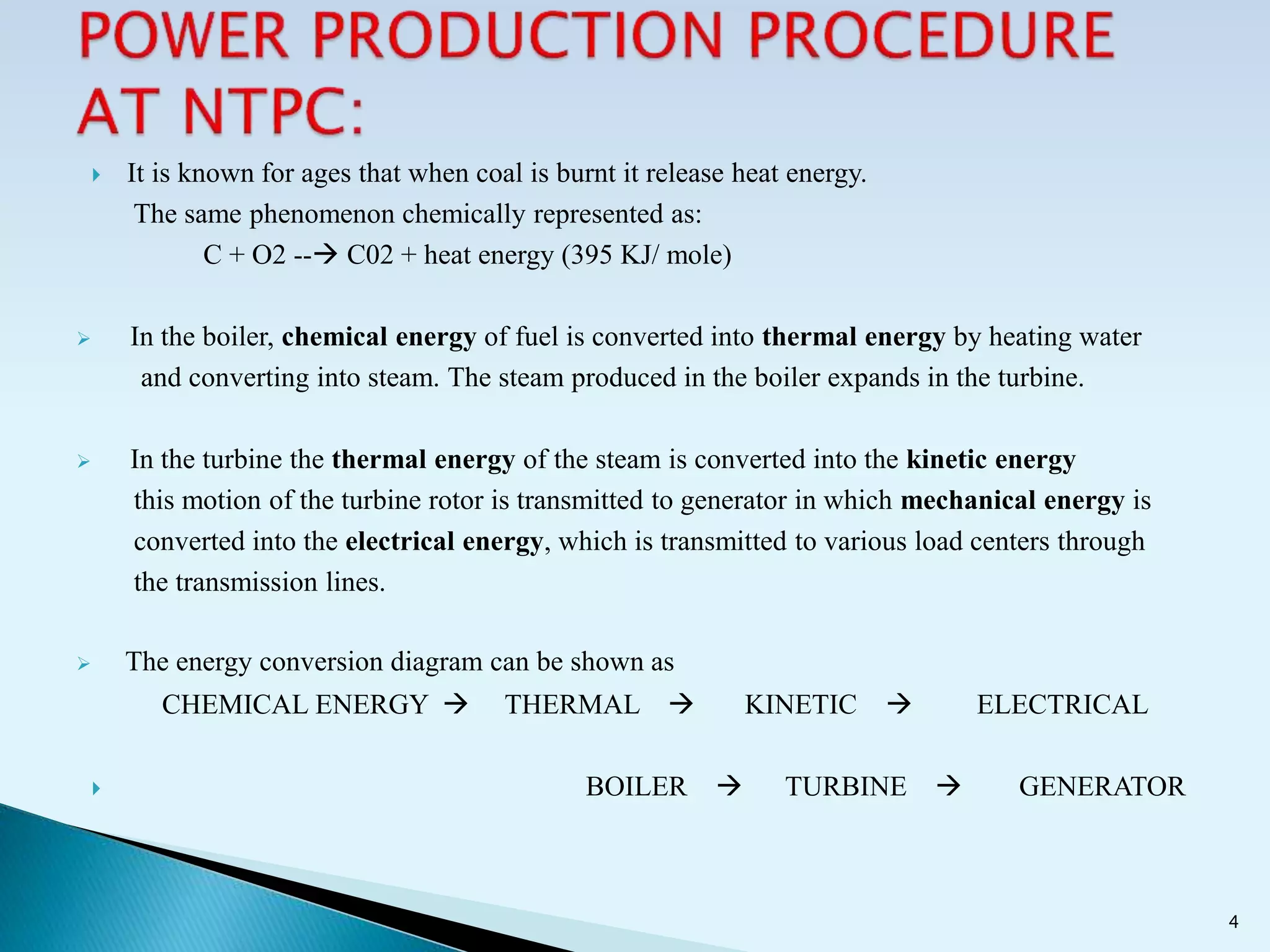
 It is known for ages that when coal is burnt it release heat energy.
The same phenomenon chemically represented as:
C + O2 -- C02 + heat energy (395 KJ/ mole)
 In the boiler, chemical energy of fuel is converted into thermal energy by heating water
and converting into steam. The steam produced in the boiler expands in the turbine.
 In the turbine the thermal energy of the steam is converted into the kinetic energy
this motion of the turbine rotor is transmitted to generator in which mechanical energy is
converted into the electrical energy, which is transmitted to various load centers through
the transmission lines.
 The energy conversion diagram can be shown as
CHEMICAL ENERGY  THERMAL  KINETIC  ELECTRICAL
 BOILER  TURBINE  GENERATOR
4
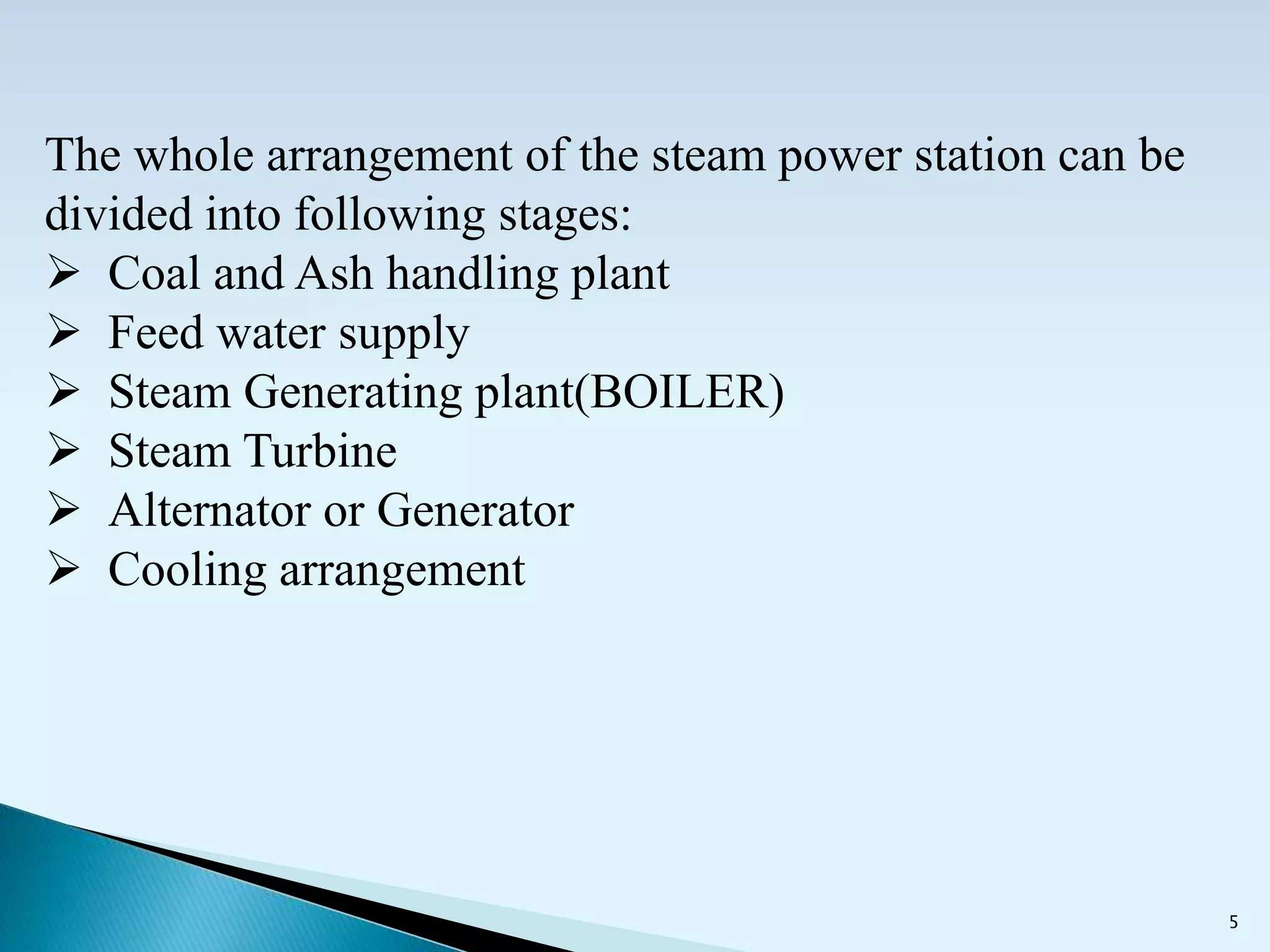
The whole arrangement of the steam power station can be
divided into following stages:
 Coal and Ash handling plant
 Feed water supply
 Steam Generating plant(BOILER)
 Steam Turbine
 Alternator or Generator
 Cooling arrangement
5
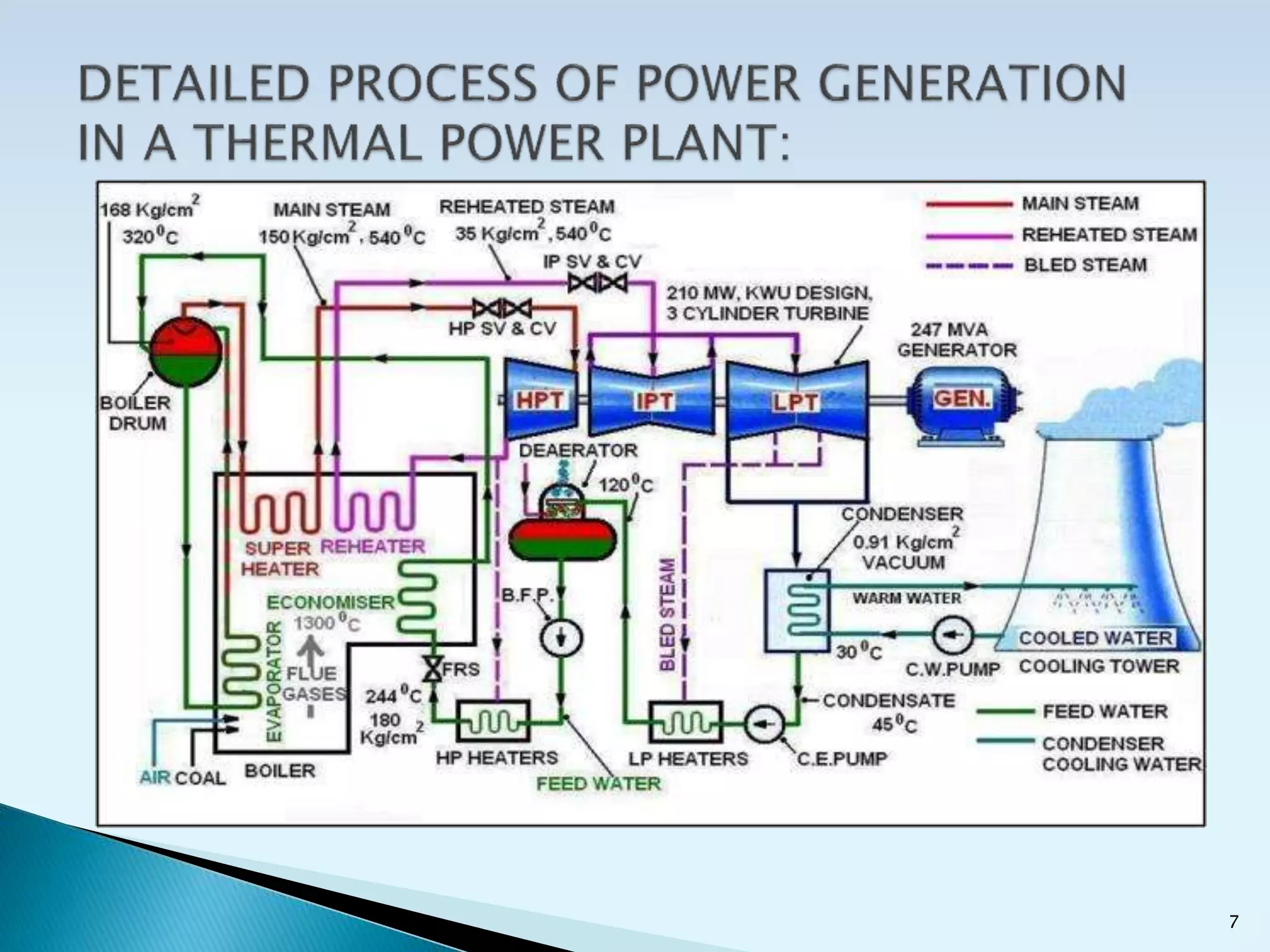
SCHEMATIC VIEW OF THERMAL POWER PLANT
6
7
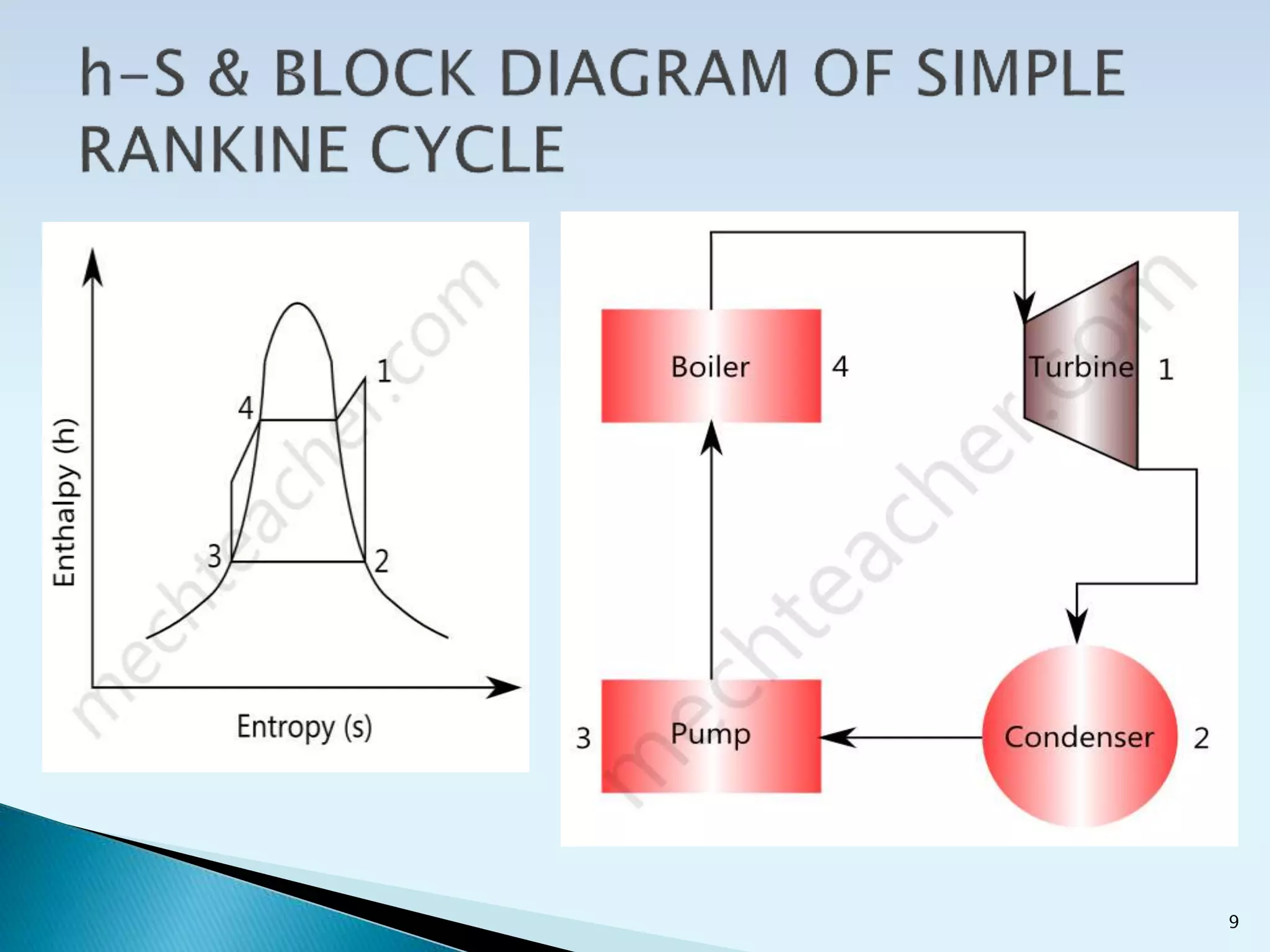
 The Rankine cycle is an idealized thermodynamic cycle of a heat
engine that converts heat into mechanical work. The heat is supplied
externally to a closed loop, which usually uses water as the working
fluid. The Rankine cycle, in the form of steam engines generates
about 90% of all electric power used throughout the world,
including virtually all solar thermal, biomass, coal and nuclear
power plants.
 Simple rankine cycle consists of the following process:·
• Process 1-2: Adiabatic expansion of steam (in turbine)
• Process 2-3: Constant pressure heat rejection (in condenser)
• Process 3-4: Isentropic compression (in pump)
• Process 4-1: Heating at constant pressure (in boiler)
All the above processes are reversible in nature.
8
·
9
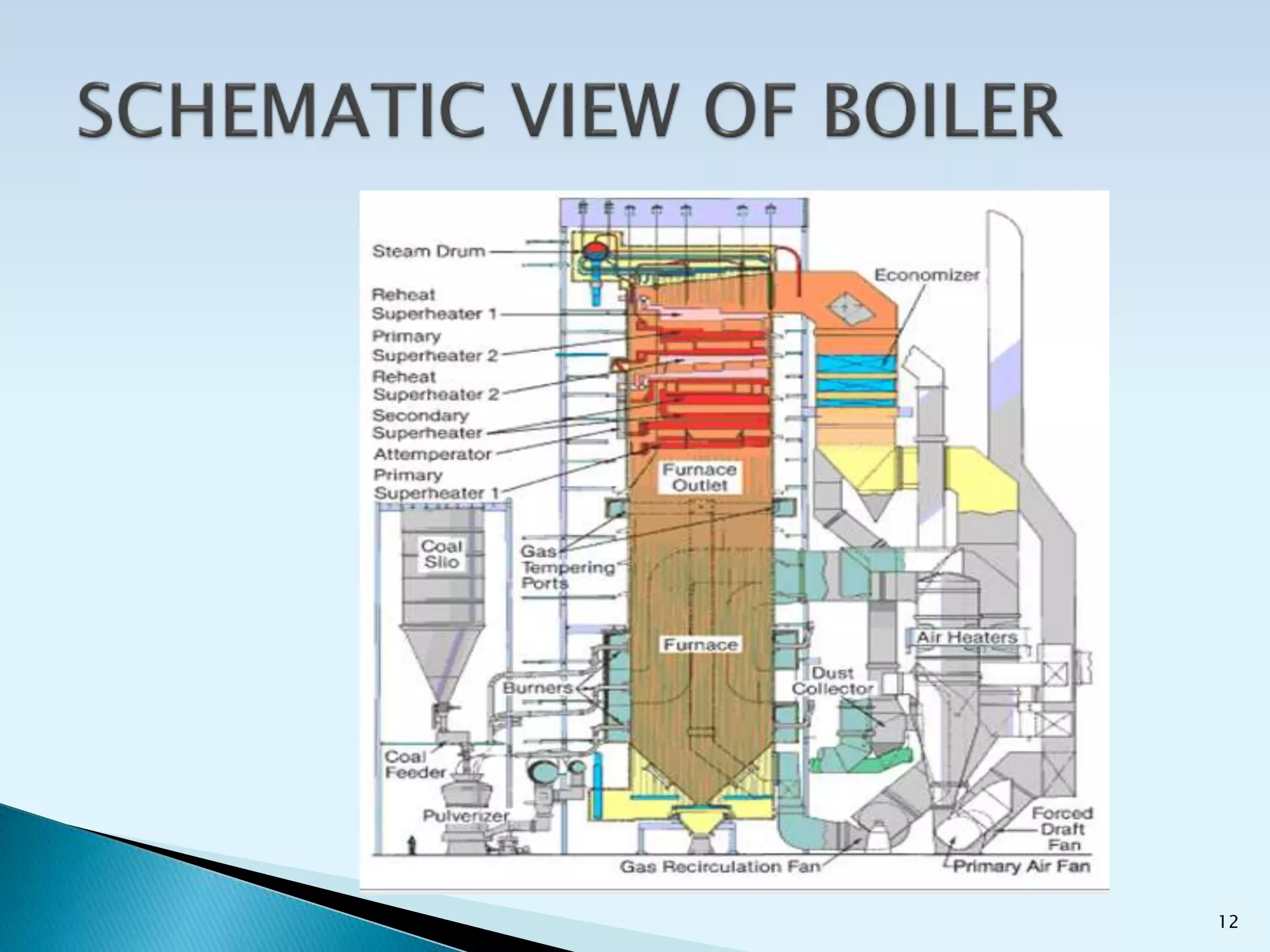
 Boiler or steam generator is the main part in the power generation process.
It is a closed vessel in which water is converted into steam with the help of
heat produced by the burning of coal in the presence of oxygen.
 The pulverized coal from mills enter furnace through feeders due to
primary air from PA fans.
 Now for the combustion of coal oxygen in atmospheric air is required and
this air is called secondary air. Secondary air is supplied by FD fans
(Forced Draft fans). This secondary air from FD fans is heated in
secondary air pre-heaters to improve combustion efficiency.
 The Boiler structure consists of large number of tubes extending the full
height of the structure and the heat produced raises the temperature of
water circulating in them resulting in steam called saturated steam, this sent
to boiler drum where steam is separated from water. The stem separated is
heated in super heater and passed to high pressure cylinder of turbine.
10
 As we know basically two types of boilers are used, they are: fire tube
& water tube boiler.
 In RSTPS high pressure water tube boilers are used. There features are
as follows:
 Forced, induced and balanced draft provisions which help to improve
the combustion efficiency.
 Less tolerance for water quality calls for water treatment.
 Higher thermal efficiency levels are possible.
 In water tube boiler 70% of heat is transferres by Radiation.this is a
faster way of heat transfer.
 The steam is generated at a pressure between 80 bar to 300 bar and
temperature of 450°C to 585°C with two super heaters in series. The
use of such stream is very suitable for power generation. It increases
thermal efficiency of the plant and reduces the moisture contents in low
pressure stages of expansion in the turbine.
11
12
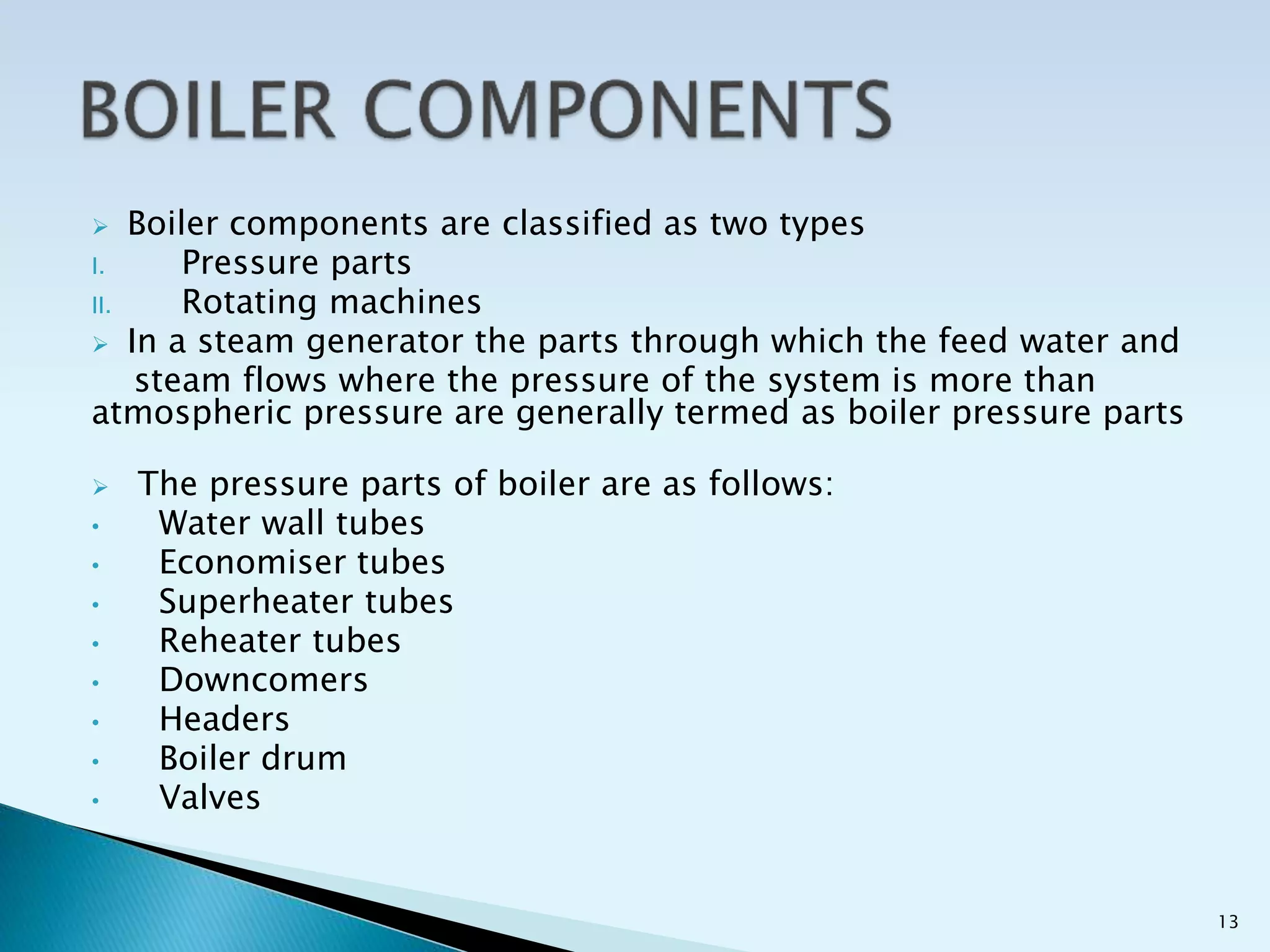
 Boiler components are classified as two types
I. Pressure parts
II. Rotating machines
 In a steam generator the parts through which the feed water and
steam flows where the pressure of the system is more than
atmospheric pressure are generally termed as boiler pressure parts
 The pressure parts of boiler are as follows:
• Water wall tubes
• Economiser tubes
• Superheater tubes
• Reheater tubes
• Downcomers
• Headers
• Boiler drum
• Valves
13
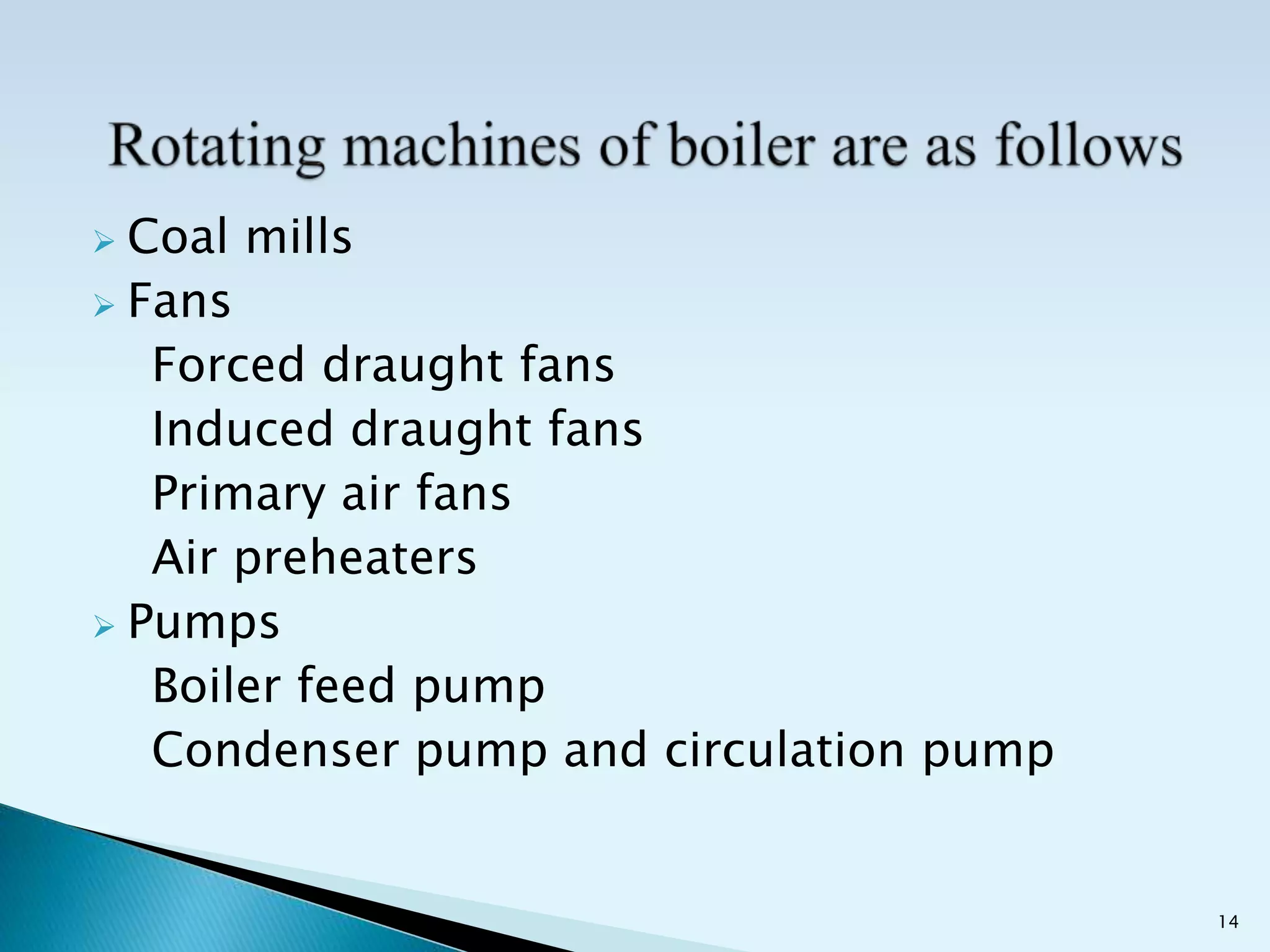
 Coal mills
 Fans
Forced draught fans
Induced draught fans
Primary air fans
Air preheaters
 Pumps
Boiler feed pump
Condenser pump and circulation pump
14
15
 Almost all modern power boilers are equipped with water walls .In large boilers
water walls completely cover the interior surfaces of the furnace. Water walls
serves as the only means of heating and evaporating the feed water supplied to the
boiler from the economiser
 Specifications
 Total number of tubes -- 1152
 Heating Surface -- 1160 sq.mts
 Material -- SA 210C
 Outer diameter -- 51mm
 Pitch -- 63.5mm
 Designed thi -- 5.1mm
 .
 The function of boiler drum is to separate the water from the steam generated in the furnace
walls and to reduce the dissolved solid contents of the steam to below the prescribed limit of
1 ppm. The drum is located on the upper front of boiler.
 Boiler drum is provided with welded stubs for connection of valves, various instruments,
down comers, return tubes, steam outlet tubes to primary super heaters, feed water tubes and
for the inlet of reagents and continuous drainage. The drum contains the diaphragms,
cyclones, scrubbers, steam separators, drilled tubes for feed water distribution, steam and
water sampling, system and the continuous blow down system.
 Specifications of a 500MW Boiler Drum
 Material -- SA-299
 Length -- 26 m
 Outer diameter -- 2.1 m
 Inner diameter -- 1.8 m
 Design pressure -- 204 MN/m2 (abs)
 Operating pressure -- 192.5 MN/m2 (abs)
 No. of cyclone separators -- 96
16
 1ST LEVEL IN THE BOILER DRUM
Boiler drum
↓ (through down comes)
Manifold
↓ (through three outlets)
Continuous circulation
↓
Boiler ring heads
↓
Water tubes
↓
Boiler drum
↓ (steam and water separate)
Steam enters LTSH
↓ (Attemperation)
Division panels
↓
Final super heaters
↓
High pressure turbine
17
From H.P turbine through cold reheater
↓
Boiler
↓ (attemperation)
1st stage of reheater
↓
Final stage of reheater
↓
I.P turbine
↓
L.P turbine
↓ (condenser)
Hot well
↓
Condensate extraction pump
↓
L.P heater
↓
Deaerator
↓
Boiler feed pump→ H. P heater→ Economizer
18
19
 Main steam flow -- 670,000 Kg/hr
 Main steam pressure -- 187 MN/m2 (abs)
 Main steam temperature -- 5400C
 Reheat steam flow -- 580,000 Kg/hr
 Reheat stem temperature -- 5400C
 Reheat steam pressure -- 45 MN/m2 (abs)
20
One of the most complex, critical, and vulnerable systems in
fossil power generation nts is the boiler pressure components.
Boiler pressure component failures have historically
contributed to the highest percentage of lost availability.
Failures have been related to :
 Poor original design
 Fabrication practices
 Fuel changes
 Operation
 Maintenance
 Chemical reactions
21
 Poor water quality. With increases in operating pressure, feedwater quality becomes
even more critical.
 Coal quality. Using a different type of coal for emission or economic reasons has
adversely affected the capability, operability, and reliability of boiler and boiler
auxiliaries
 Cycling operation. Many base-load-designed boilers have been placed into cycling
duty, which has a major impact on the boiler reliability as indicated by occurrences of
serious corrosion fatigue in water-touched circuitries, economizer inlet header shocking,
thick-wall header damages, and others.
 NOx emission. Deep staging combustion for NOx reduction has produced serious
waterwall fire corrosion for high sulphur-coal firing, especially in supercritical units.
 Age-ing. A large percentage of existing fossil-fired units are exceeding “design life”
without plans for retirement. These vintage units are carrying major loads in power
 The boiler tubes are under high pressure and/or high-temperature conditions. They are
subject to potential degradation by a variety of mechanical and thermal stresses and
environmental attack on both the fluid and fireside. Mechanical components can fail due
to creep, fatigue, erosion, and corrosion
22
 Most coal fired power station boilers use pulverized coal, and many of the larger
industrial water tube boilers also use this pulverized fuel. This technology is well
developed, and there are thousands of units around the world, accounting for well
over 90% of coal fired capacity.
 The coal is pulverized to a fine powder, so that less than 2% is +300 micro meter
(μm) and 70-75 % is below 75 microns.
 The pulverized coal is blown with part of the combustion.
 Air enters through 2 series of burner nozzles. Secondary and tertiary air may also
be added. Combustion takes place at temperatures from 1300-1700ºC, depending
largely on the coal grade. Particle residence time in the boiler is typically ₐ to 5
seconds, and the particles must be small enough for complete combustion to have
taken place during this time.This system has many advantages such as ability to fire
varying quality of coal, quick responses to changes in load, use of high pre-heat air
temperatures etc.
 One of the most popular systems for firing pulverized coal is the tangential firing
using four burners corner to corner to create a fireball at the center of the furnace.
23
24
 Fuel Firing system can be broadly classified into direct firing system and
indirect firing or intermediate bunker system. Both the systems can use any
type of mill.
 Direct Firing System:
n this type of firing system, controlled hot air from primary air pump carry
pulverized coal from mills which are operated depending on boiler loading and
coal stored in the bunker o coal burners of the combustion chambers.
 Indirect Firing System:
In this type of firing system, controlled hot air from primary air pump carry
pulverized coal from mills which are operated independent of boiler loading
and coal stored in the bunker to coal burners of the combustion chambers using
cyclone type separators.

25
There are four ways of firing the coal in furnace. They are:
 Vertical firing
In vertical firing, a number of rectangular fan shaped nozzles are set across the width of the furnace
in an arc immediately under the boiler setting.
 Front wall firing
Horizontal firing with the turbulent type of burner is set up usually in the front (front wall fired) o
r rear walls of the furnace.
 Impact firing
This is the arrangement with the type of burner used with slag tap furnaces where
ash is kept in a molten state on the furnace floor and tapped of as and when
necessary.
 Corner or tangential firing
Tangential firing is a method of firing a fuel to heat air, which is the most
Common one in thermal power stations. The flame envelope rotates ensuring
Thorough mixing within the furnace, providing complete combustion and uniform
heat distribution.
In RSTPS pilverised coal with tangential firing system is used.
26
27
 Power is an important infrastructure in developing countries. Power development in
India received a big boost with the dawn of National Thermal Power Corporation
Limited.
 RSTPS is wll equipped with control systems for monitoring boilers, turbines and
other machinery.
 Boiler feed pump control loop in RSTPS is manufactured by SIEMENS which
involves the measurement and maintenance of water level in the BFP through
pumps, controller, make-up valve, level transmitter and converters. Whose main
aim is to maintain the water level in the condenser so as to use the pressure and
heat of the water effectively to increase the efficiency of the system.
 The plant is effectively and efficiently managed by various departments.
 RSTPS has giving its importance in conserving coal and water by utilizing
advanced techniques to produce maximum energy without any wastage of input
sources.. NTPC Ramagundam is producing a qualitative power minimizing the
hazardous disposals.
28
29

Report on Boilers at NTPC Ramagunadam

  • 1.
    STUDY OF THEBOILER IN THERMAL POWER STATION AT NTPC RAMAGUNDAM BY ANGARI ABHINAY 14675A0310 Under the guidance of Mr. Y.VIJAY KUMAR, M.Tech, Professor Department of Mechanical Engineering J.B. INSTITUTE OF ENGINEERING AND TECHNOLOGY (UGC AUTONOMOUS) (Affiliated to Jawaharlal Nehru Technological University, Hyderabad, T.S) Moinabad, Hyderabad-500075. (2016-2017) ` 1
  • 2.
    ABSTRACT  Thermal powerplants are major area for the generation of power.  The combustion of coal is responsible for the generation of steam from the water.  In thermal powerplant boiler plays a major role in power production.  In boiler water is converted in to steam using heat energy as input source.  The combustion of coal is responsible for the generation of steam from the water. There are many mountings&accessories supporting the efficient functioning of the boiler.  This project deals with the study and applications of concepts and the theories in the current industrial scenario by the study of boiler pressure parts and firing systems. 2
  • 3.
    ABOUT THE ORGANISATION NATIONAL THERMAL POWER CORPORATION, A public sector company, is the major power utility generation over one fourth of the total thermal power of India. It was in incorporated in the year 1975 to accelerate power development in the country. At present, Govt. of India holds 89.5% of total equity shares of the company.  “NTPC Ltd., is the sixth largest & second efficient power utility in the world”.  As on date the capacity of NTPC 45,548MW through its 18coal based (40477MW) 7 gas based (4017.23MW) and 7 joint Venture Projects (1,054 MW).  Ramagundam super thermal power station is the current largest power station in South India. it is the first ISO 14001 certified "Super Thermal Power Station" in India.  The NTPC at RSTPS generates 2600MW power through 3 units of 200 MW & 4 units of 500 MW used for domestic and industrial purpose in T.S & neighbor states. 3
  • 4.
     It isknown for ages that when coal is burnt it release heat energy. The same phenomenon chemically represented as: C + O2 -- C02 + heat energy (395 KJ/ mole)  In the boiler, chemical energy of fuel is converted into thermal energy by heating water and converting into steam. The steam produced in the boiler expands in the turbine.  In the turbine the thermal energy of the steam is converted into the kinetic energy this motion of the turbine rotor is transmitted to generator in which mechanical energy is converted into the electrical energy, which is transmitted to various load centers through the transmission lines.  The energy conversion diagram can be shown as CHEMICAL ENERGY  THERMAL  KINETIC  ELECTRICAL  BOILER  TURBINE  GENERATOR 4
  • 5.
    The whole arrangementof the steam power station can be divided into following stages:  Coal and Ash handling plant  Feed water supply  Steam Generating plant(BOILER)  Steam Turbine  Alternator or Generator  Cooling arrangement 5
  • 6.
    SCHEMATIC VIEW OFTHERMAL POWER PLANT 6
  • 7.
  • 8.
     The Rankinecycle is an idealized thermodynamic cycle of a heat engine that converts heat into mechanical work. The heat is supplied externally to a closed loop, which usually uses water as the working fluid. The Rankine cycle, in the form of steam engines generates about 90% of all electric power used throughout the world, including virtually all solar thermal, biomass, coal and nuclear power plants.  Simple rankine cycle consists of the following process:· • Process 1-2: Adiabatic expansion of steam (in turbine) • Process 2-3: Constant pressure heat rejection (in condenser) • Process 3-4: Isentropic compression (in pump) • Process 4-1: Heating at constant pressure (in boiler) All the above processes are reversible in nature. 8
  • 9.
  • 10.
     Boiler orsteam generator is the main part in the power generation process. It is a closed vessel in which water is converted into steam with the help of heat produced by the burning of coal in the presence of oxygen.  The pulverized coal from mills enter furnace through feeders due to primary air from PA fans.  Now for the combustion of coal oxygen in atmospheric air is required and this air is called secondary air. Secondary air is supplied by FD fans (Forced Draft fans). This secondary air from FD fans is heated in secondary air pre-heaters to improve combustion efficiency.  The Boiler structure consists of large number of tubes extending the full height of the structure and the heat produced raises the temperature of water circulating in them resulting in steam called saturated steam, this sent to boiler drum where steam is separated from water. The stem separated is heated in super heater and passed to high pressure cylinder of turbine. 10
  • 11.
     As weknow basically two types of boilers are used, they are: fire tube & water tube boiler.  In RSTPS high pressure water tube boilers are used. There features are as follows:  Forced, induced and balanced draft provisions which help to improve the combustion efficiency.  Less tolerance for water quality calls for water treatment.  Higher thermal efficiency levels are possible.  In water tube boiler 70% of heat is transferres by Radiation.this is a faster way of heat transfer.  The steam is generated at a pressure between 80 bar to 300 bar and temperature of 450°C to 585°C with two super heaters in series. The use of such stream is very suitable for power generation. It increases thermal efficiency of the plant and reduces the moisture contents in low pressure stages of expansion in the turbine. 11
  • 12.
  • 13.
     Boiler componentsare classified as two types I. Pressure parts II. Rotating machines  In a steam generator the parts through which the feed water and steam flows where the pressure of the system is more than atmospheric pressure are generally termed as boiler pressure parts  The pressure parts of boiler are as follows: • Water wall tubes • Economiser tubes • Superheater tubes • Reheater tubes • Downcomers • Headers • Boiler drum • Valves 13
  • 14.
     Coal mills Fans Forced draught fans Induced draught fans Primary air fans Air preheaters  Pumps Boiler feed pump Condenser pump and circulation pump 14
  • 15.
    15  Almost allmodern power boilers are equipped with water walls .In large boilers water walls completely cover the interior surfaces of the furnace. Water walls serves as the only means of heating and evaporating the feed water supplied to the boiler from the economiser  Specifications  Total number of tubes -- 1152  Heating Surface -- 1160 sq.mts  Material -- SA 210C  Outer diameter -- 51mm  Pitch -- 63.5mm  Designed thi -- 5.1mm  .
  • 16.
     The functionof boiler drum is to separate the water from the steam generated in the furnace walls and to reduce the dissolved solid contents of the steam to below the prescribed limit of 1 ppm. The drum is located on the upper front of boiler.  Boiler drum is provided with welded stubs for connection of valves, various instruments, down comers, return tubes, steam outlet tubes to primary super heaters, feed water tubes and for the inlet of reagents and continuous drainage. The drum contains the diaphragms, cyclones, scrubbers, steam separators, drilled tubes for feed water distribution, steam and water sampling, system and the continuous blow down system.  Specifications of a 500MW Boiler Drum  Material -- SA-299  Length -- 26 m  Outer diameter -- 2.1 m  Inner diameter -- 1.8 m  Design pressure -- 204 MN/m2 (abs)  Operating pressure -- 192.5 MN/m2 (abs)  No. of cyclone separators -- 96 16
  • 17.
     1ST LEVELIN THE BOILER DRUM Boiler drum ↓ (through down comes) Manifold ↓ (through three outlets) Continuous circulation ↓ Boiler ring heads ↓ Water tubes ↓ Boiler drum ↓ (steam and water separate) Steam enters LTSH ↓ (Attemperation) Division panels ↓ Final super heaters ↓ High pressure turbine 17
  • 18.
    From H.P turbinethrough cold reheater ↓ Boiler ↓ (attemperation) 1st stage of reheater ↓ Final stage of reheater ↓ I.P turbine ↓ L.P turbine ↓ (condenser) Hot well ↓ Condensate extraction pump ↓ L.P heater ↓ Deaerator ↓ Boiler feed pump→ H. P heater→ Economizer 18
  • 19.
  • 20.
     Main steamflow -- 670,000 Kg/hr  Main steam pressure -- 187 MN/m2 (abs)  Main steam temperature -- 5400C  Reheat steam flow -- 580,000 Kg/hr  Reheat stem temperature -- 5400C  Reheat steam pressure -- 45 MN/m2 (abs) 20
  • 21.
    One of themost complex, critical, and vulnerable systems in fossil power generation nts is the boiler pressure components. Boiler pressure component failures have historically contributed to the highest percentage of lost availability. Failures have been related to :  Poor original design  Fabrication practices  Fuel changes  Operation  Maintenance  Chemical reactions 21
  • 22.
     Poor waterquality. With increases in operating pressure, feedwater quality becomes even more critical.  Coal quality. Using a different type of coal for emission or economic reasons has adversely affected the capability, operability, and reliability of boiler and boiler auxiliaries  Cycling operation. Many base-load-designed boilers have been placed into cycling duty, which has a major impact on the boiler reliability as indicated by occurrences of serious corrosion fatigue in water-touched circuitries, economizer inlet header shocking, thick-wall header damages, and others.  NOx emission. Deep staging combustion for NOx reduction has produced serious waterwall fire corrosion for high sulphur-coal firing, especially in supercritical units.  Age-ing. A large percentage of existing fossil-fired units are exceeding “design life” without plans for retirement. These vintage units are carrying major loads in power  The boiler tubes are under high pressure and/or high-temperature conditions. They are subject to potential degradation by a variety of mechanical and thermal stresses and environmental attack on both the fluid and fireside. Mechanical components can fail due to creep, fatigue, erosion, and corrosion 22
  • 23.
     Most coalfired power station boilers use pulverized coal, and many of the larger industrial water tube boilers also use this pulverized fuel. This technology is well developed, and there are thousands of units around the world, accounting for well over 90% of coal fired capacity.  The coal is pulverized to a fine powder, so that less than 2% is +300 micro meter (μm) and 70-75 % is below 75 microns.  The pulverized coal is blown with part of the combustion.  Air enters through 2 series of burner nozzles. Secondary and tertiary air may also be added. Combustion takes place at temperatures from 1300-1700ºC, depending largely on the coal grade. Particle residence time in the boiler is typically ₐ to 5 seconds, and the particles must be small enough for complete combustion to have taken place during this time.This system has many advantages such as ability to fire varying quality of coal, quick responses to changes in load, use of high pre-heat air temperatures etc.  One of the most popular systems for firing pulverized coal is the tangential firing using four burners corner to corner to create a fireball at the center of the furnace. 23
  • 24.
  • 25.
     Fuel Firingsystem can be broadly classified into direct firing system and indirect firing or intermediate bunker system. Both the systems can use any type of mill.  Direct Firing System: n this type of firing system, controlled hot air from primary air pump carry pulverized coal from mills which are operated depending on boiler loading and coal stored in the bunker o coal burners of the combustion chambers.  Indirect Firing System: In this type of firing system, controlled hot air from primary air pump carry pulverized coal from mills which are operated independent of boiler loading and coal stored in the bunker to coal burners of the combustion chambers using cyclone type separators.  25
  • 26.
    There are fourways of firing the coal in furnace. They are:  Vertical firing In vertical firing, a number of rectangular fan shaped nozzles are set across the width of the furnace in an arc immediately under the boiler setting.  Front wall firing Horizontal firing with the turbulent type of burner is set up usually in the front (front wall fired) o r rear walls of the furnace.  Impact firing This is the arrangement with the type of burner used with slag tap furnaces where ash is kept in a molten state on the furnace floor and tapped of as and when necessary.  Corner or tangential firing Tangential firing is a method of firing a fuel to heat air, which is the most Common one in thermal power stations. The flame envelope rotates ensuring Thorough mixing within the furnace, providing complete combustion and uniform heat distribution. In RSTPS pilverised coal with tangential firing system is used. 26
  • 27.
  • 28.
     Power isan important infrastructure in developing countries. Power development in India received a big boost with the dawn of National Thermal Power Corporation Limited.  RSTPS is wll equipped with control systems for monitoring boilers, turbines and other machinery.  Boiler feed pump control loop in RSTPS is manufactured by SIEMENS which involves the measurement and maintenance of water level in the BFP through pumps, controller, make-up valve, level transmitter and converters. Whose main aim is to maintain the water level in the condenser so as to use the pressure and heat of the water effectively to increase the efficiency of the system.  The plant is effectively and efficiently managed by various departments.  RSTPS has giving its importance in conserving coal and water by utilizing advanced techniques to produce maximum energy without any wastage of input sources.. NTPC Ramagundam is producing a qualitative power minimizing the hazardous disposals. 28
  • 29.