•Theories of
Learning and Early
Literacy
Defining Learning and Literacy
Learning
= the activity or process of gaining
knowledge or skill by studying, practicing,
being taught, or experiencing something
Literacy
=the ability to read and write
Definition of
Emergent
Literacy
Marie Clay
• was the first one who used the term
emergent literacy.
• A child acquires some knowledge about
language, reading and writing even before
attending any formal education.
Teale
• The early signs of reading and writing
demonstrated by young children, even
before they begin to take formal instruction
to reading and writing, and such early
signs and ways recognized by most
adults.
Sulzby
• Literacy as the reading and writing
behaviors of young children that precede
and develop into conventional literacy.
Mediation can be consciously employed by
the parents as they prepare their child for
formal schooling.
A literary-rich environment can provide
more literacy information to the child.
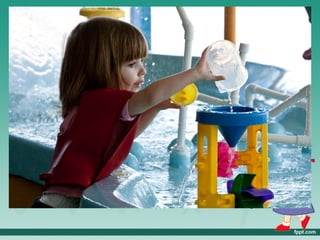
Emergent Literacy
• refers to competencies and literacy skills
in early childhood.
• Children are always in the process of
becoming literate, probably, since they are
just few months old.
Group Work!
Group 1: Construct your own concept
definition for emergent literacy:
Group 2, 3 & 5: Demonstrate or Perform one
of the three theories
2- Clay
3- Teale
5- Sulzby
Transitions on the Perspectives
of Emergent Literacy
1. Basic Literacy- reading and writing of
young learners to construct meaning for
themselves.
2. Socio-cultural Literacy- importance of
social interaction of children to construct
cultural.
3. Functional Literacy- the use of
technology for instruction and literacy and
the young learners' use of technology to
produce meaning.
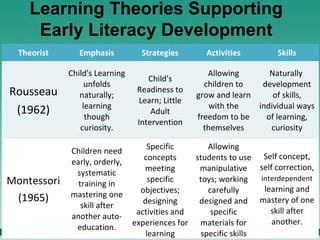
Learning Theories Supporting
Early Literacy Development
Theorist Emphasis Strategies Activities Skills
Rousseau
(1962)
Child's Learning
unfolds
naturally;
learning
though
curiosity.
Child's
Readiness to
Learn; Little
Adult
Intervention
Allowing
children to
grow and learn
with the
freedom to be
themselves
Naturally
development
of skills,
individual ways
of learning,
curiosity
Montessori
(1965)
Children need
early, orderly,
systematic
training in
mastering one
skill after
another auto-
education.
Specific
concepts
meeting
specific
objectives;
designing
activities and
experiences for
learning
Allowing
students to use
manipulative
toys; working
carefully
designed and
specific
materials for
specific skills
Self concept,
self correction,
interdependent
learning and
mastery of one
skill after
another.
Theorist Emphasis Strategies Activities Skills
Dewey
(1966)
Child-centered; is
built; is built
around the
interest of the
child; child learns
best through play
because of social
interaction
Allowing time for
play and
learning;
providing a
relaxed
atmosphere;
informal
activities for
learning
Manipulative
toys, arts, music,
story reading,
free and outdoor
play, snack, rest,
circle time,
informal reading
and writing.
Social skills,
emotional and
physical
development,
informal reading
and writing.
Piaget
(1969)
Acquiring
knowledge by
interacting with
the world ; active
participants in
their own
learning
Providing real life
setting and
materials;
opporutunity to
play, explore an
experiment and
to use their
curiousity to help
themselves
Natural problem
solving
situations,
playing,
exploring, and
experimenting
and cooperating
teachers and
peers in planning
evaluating
learning.
Active
construction of
his learning
problem- solving;
playing,
exploration
experimentation
and curiosity and
spontaneity
decision-making-
social interaction.
Theorist Emphasis Strategies Activities Skills
Froebel
(1974)
Emphasis on the
fullest benefits
of playing to
learn; requires
adult guidance
and direction
and a planned
environment
Providing
manipulative
materials to
learn concepts,
aloowing "circle
time" which is an
opportunity to
sing and to learn
new ideas thru
discussion
Teacher-
facilitated
activities, guided
play,
manipulative for
learning certain
concepts and
providing
opportunity for
circle time
singing.
Psychomotor
skills, shapes,
colors and size
recognition,
guided play,
singing,
obedience and
discipline.
Pestalozzi
(1979)
Natural learning
with informal
institution,
natural potential
of a child
develops
through senses.
Providing
informal
instruction,
manipulative
experiences and
learning about
them through
the use of
senses.
Informal
activities that
eventually lead
to learning,
manipulating
objects and
learning about
them through
touch and smell
Shapes, color
and size
recognition,
language skills
Theorist Emphasis Strategies Activities Skills
Vygotsky
(1961)
Learning takes
place when
child interacts
with peers and
adults in a
social setting as
they act upon
the
environment;
Children learn
by internalizing
activities
conducted in
the world
around them.
Providing
meaningful and
interactive
activities that
allow a child to
internalize,
exposing a
child to actively
interact with
others,
engaging in
functional and
interesting
learning
experience
Story reading,
story retelling,
direct listening-
thinking
activities,
shared book
experiences,
dialogues,
conversations,
social functions
of reading and
writing
activities,
communicative
functions of
language
Communicatio
n skills, reading
and writing
skills, oral
language skills,
social skills
internalization
of skills
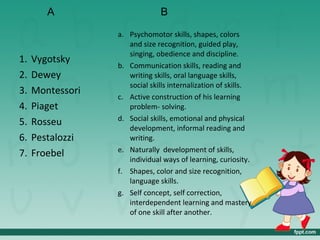
A B
1. Vygotsky
2. Dewey
3. Montessori
4. Piaget
5. Rosseu
6. Pestalozzi
7. Froebel
a. Psychomotor skills, shapes, colors
and size recognition, guided play,
singing, obedience and discipline.
b. Communication skills, reading and
writing skills, oral language skills,
social skills internalization of skills.
c. Active construction of his learning
problem- solving.
d. Social skills, emotional and physical
development, informal reading and
writing.
e. Naturally development of skills,
individual ways of learning, curiosity.
f. Shapes, color and size recognition,
language skills.
g. Self concept, self correction,
interdependent learning and mastery
of one skill after another.
The Constructivist Model
In constructivist model, skills are taught at the
point when they are likely to be useful to kids
as part of an authentic literacy task.
Literacy of the 20th century has paved the way to
new literacy studies which would gradually lead
to redefining literacy
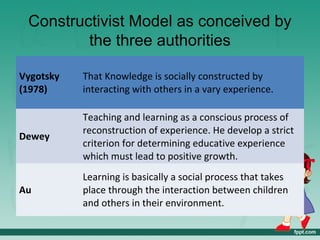
Constructivist Model as conceived by
the three authorities
Vygotsky
(1978)
That Knowledge is socially constructed by
interacting with others in a vary experience.
Dewey
Teaching and learning as a conscious process of
reconstruction of experience. He develop a strict
criterion for determining educative experience
which must lead to positive growth.
Au
Learning is basically a social process that takes
place through the interaction between children
and others in their environment.
DEWEY
AU
Vygotsky
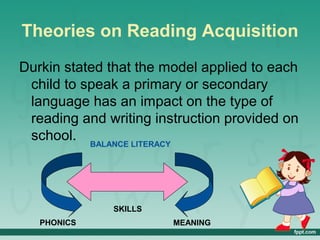
Theories on Reading Acquisition
Durkin stated that the model applied to each
child to speak a primary or secondary
language has an impact on the type of
reading and writing instruction provided on
school. BALANCE LITERACY
PHONICS
SKILLS
MEANING
A child must possess both aural skills and oral vocabulary
to read successfully.
A child is viewed as an active constructor of his own
reading as he employs his reading skills and strategies
which allow him to comprehend the text.
"Child's language learning begins in the pre-speech
communication between parents and infants.
Theories on Early Writing Development
The movement from
playing with drawing
and writing to
communicating
through written
messages is a
continuum that
reflects the basic
theories of emergent
literacy.
• Children develop their writing naturally
through play as they make markings on
papers, on walls or evrywhere, through
social interaction as they join in social
writing activities of adults like writing
notes, writing messages on greeting cards
and writing letters to family members.
• Children do a lot of hypothesis- testing,
experimenting, inventing to construct what
they want to mean through writing.
"Children's literacy development begins with
the continual process of learning to
communicate which involves nonverbal,
verbal, symbolic play and drawing."
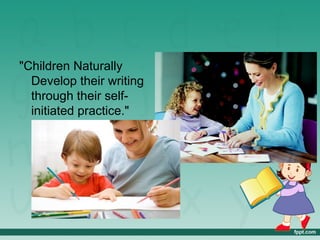
"Children Naturally
Develop their writing
through their self-
initiated practice."

Report dv2 1

  • 1.
  • 2.
    Defining Learning andLiteracy Learning = the activity or process of gaining knowledge or skill by studying, practicing, being taught, or experiencing something Literacy =the ability to read and write
  • 3.
  • 4.
    Marie Clay • wasthe first one who used the term emergent literacy. • A child acquires some knowledge about language, reading and writing even before attending any formal education.
  • 5.
    Teale • The earlysigns of reading and writing demonstrated by young children, even before they begin to take formal instruction to reading and writing, and such early signs and ways recognized by most adults.
  • 6.
    Sulzby • Literacy asthe reading and writing behaviors of young children that precede and develop into conventional literacy.
  • 7.
    Mediation can beconsciously employed by the parents as they prepare their child for formal schooling. A literary-rich environment can provide more literacy information to the child.
  • 8.
    Emergent Literacy • refersto competencies and literacy skills in early childhood. • Children are always in the process of becoming literate, probably, since they are just few months old.
  • 9.
    Group Work! Group 1:Construct your own concept definition for emergent literacy: Group 2, 3 & 5: Demonstrate or Perform one of the three theories 2- Clay 3- Teale 5- Sulzby
  • 12.
    Transitions on thePerspectives of Emergent Literacy 1. Basic Literacy- reading and writing of young learners to construct meaning for themselves. 2. Socio-cultural Literacy- importance of social interaction of children to construct cultural. 3. Functional Literacy- the use of technology for instruction and literacy and the young learners' use of technology to produce meaning.
  • 13.
    Learning Theories Supporting EarlyLiteracy Development Theorist Emphasis Strategies Activities Skills Rousseau (1962) Child's Learning unfolds naturally; learning though curiosity. Child's Readiness to Learn; Little Adult Intervention Allowing children to grow and learn with the freedom to be themselves Naturally development of skills, individual ways of learning, curiosity Montessori (1965) Children need early, orderly, systematic training in mastering one skill after another auto- education. Specific concepts meeting specific objectives; designing activities and experiences for learning Allowing students to use manipulative toys; working carefully designed and specific materials for specific skills Self concept, self correction, interdependent learning and mastery of one skill after another.
  • 14.
    Theorist Emphasis StrategiesActivities Skills Dewey (1966) Child-centered; is built; is built around the interest of the child; child learns best through play because of social interaction Allowing time for play and learning; providing a relaxed atmosphere; informal activities for learning Manipulative toys, arts, music, story reading, free and outdoor play, snack, rest, circle time, informal reading and writing. Social skills, emotional and physical development, informal reading and writing. Piaget (1969) Acquiring knowledge by interacting with the world ; active participants in their own learning Providing real life setting and materials; opporutunity to play, explore an experiment and to use their curiousity to help themselves Natural problem solving situations, playing, exploring, and experimenting and cooperating teachers and peers in planning evaluating learning. Active construction of his learning problem- solving; playing, exploration experimentation and curiosity and spontaneity decision-making- social interaction.
  • 15.
    Theorist Emphasis StrategiesActivities Skills Froebel (1974) Emphasis on the fullest benefits of playing to learn; requires adult guidance and direction and a planned environment Providing manipulative materials to learn concepts, aloowing "circle time" which is an opportunity to sing and to learn new ideas thru discussion Teacher- facilitated activities, guided play, manipulative for learning certain concepts and providing opportunity for circle time singing. Psychomotor skills, shapes, colors and size recognition, guided play, singing, obedience and discipline. Pestalozzi (1979) Natural learning with informal institution, natural potential of a child develops through senses. Providing informal instruction, manipulative experiences and learning about them through the use of senses. Informal activities that eventually lead to learning, manipulating objects and learning about them through touch and smell Shapes, color and size recognition, language skills
  • 16.
    Theorist Emphasis StrategiesActivities Skills Vygotsky (1961) Learning takes place when child interacts with peers and adults in a social setting as they act upon the environment; Children learn by internalizing activities conducted in the world around them. Providing meaningful and interactive activities that allow a child to internalize, exposing a child to actively interact with others, engaging in functional and interesting learning experience Story reading, story retelling, direct listening- thinking activities, shared book experiences, dialogues, conversations, social functions of reading and writing activities, communicative functions of language Communicatio n skills, reading and writing skills, oral language skills, social skills internalization of skills
  • 17.
    A B 1. Vygotsky 2.Dewey 3. Montessori 4. Piaget 5. Rosseu 6. Pestalozzi 7. Froebel a. Psychomotor skills, shapes, colors and size recognition, guided play, singing, obedience and discipline. b. Communication skills, reading and writing skills, oral language skills, social skills internalization of skills. c. Active construction of his learning problem- solving. d. Social skills, emotional and physical development, informal reading and writing. e. Naturally development of skills, individual ways of learning, curiosity. f. Shapes, color and size recognition, language skills. g. Self concept, self correction, interdependent learning and mastery of one skill after another.
  • 18.
    The Constructivist Model Inconstructivist model, skills are taught at the point when they are likely to be useful to kids as part of an authentic literacy task.
  • 19.
    Literacy of the20th century has paved the way to new literacy studies which would gradually lead to redefining literacy
  • 20.
    Constructivist Model asconceived by the three authorities Vygotsky (1978) That Knowledge is socially constructed by interacting with others in a vary experience. Dewey Teaching and learning as a conscious process of reconstruction of experience. He develop a strict criterion for determining educative experience which must lead to positive growth. Au Learning is basically a social process that takes place through the interaction between children and others in their environment.
  • 22.
  • 24.
  • 26.
  • 27.
    Theories on ReadingAcquisition Durkin stated that the model applied to each child to speak a primary or secondary language has an impact on the type of reading and writing instruction provided on school. BALANCE LITERACY PHONICS SKILLS MEANING
  • 29.
    A child mustpossess both aural skills and oral vocabulary to read successfully. A child is viewed as an active constructor of his own reading as he employs his reading skills and strategies which allow him to comprehend the text. "Child's language learning begins in the pre-speech communication between parents and infants.
  • 30.
    Theories on EarlyWriting Development The movement from playing with drawing and writing to communicating through written messages is a continuum that reflects the basic theories of emergent literacy.
  • 31.
    • Children developtheir writing naturally through play as they make markings on papers, on walls or evrywhere, through social interaction as they join in social writing activities of adults like writing notes, writing messages on greeting cards and writing letters to family members.
  • 32.
    • Children doa lot of hypothesis- testing, experimenting, inventing to construct what they want to mean through writing. "Children's literacy development begins with the continual process of learning to communicate which involves nonverbal, verbal, symbolic play and drawing."
  • 33.
    "Children Naturally Develop theirwriting through their self- initiated practice."