Prepared by:
Mrs. May-ridel P. Pasamata
MAED ECSD Instructor
• Adults often think of Mathematics as an
abstract discipline involving complex
algebraic formulas and geometric
calculations
• Yet, the foundation of math are grounded
in concrete experience such as:
• Exploration of objects
• Gradual understanding of their
properties and relationships
Cognitive Tasks
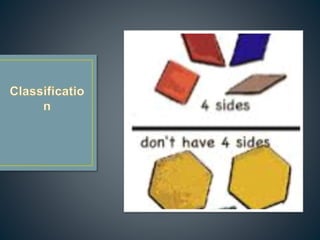
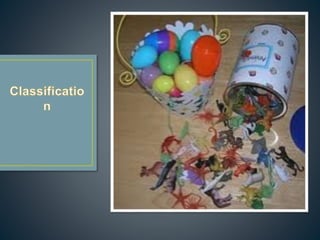
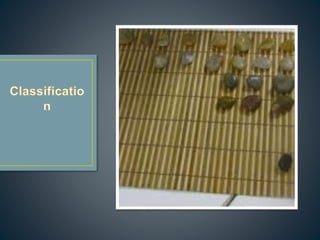
• Classification is the ability
to sort and group objects by
some common attribute or
property
• To classify, a child needs to
note similarities and
differences among objects
• Involves two simultaneous
processes:
1. Sorting
2. Grouping
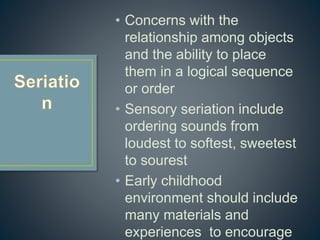
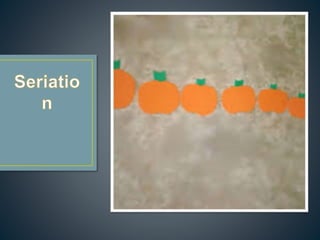
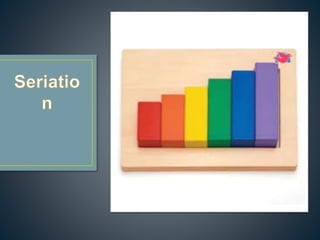
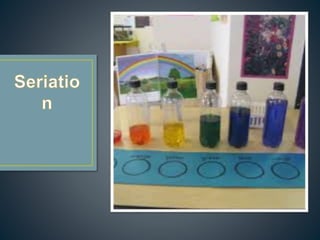
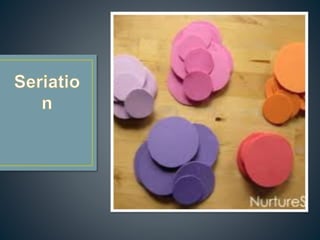
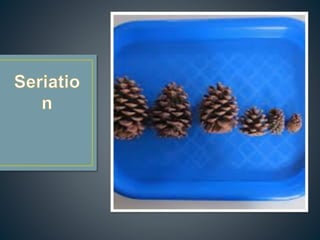
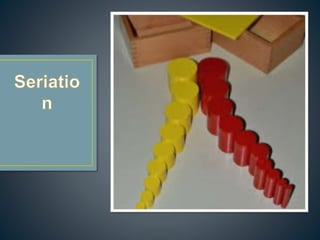
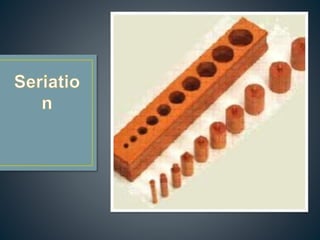
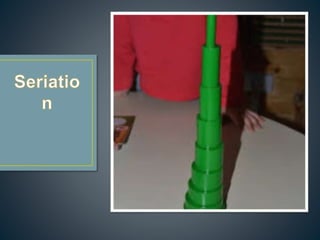
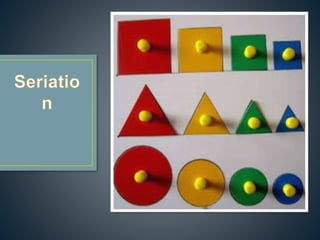
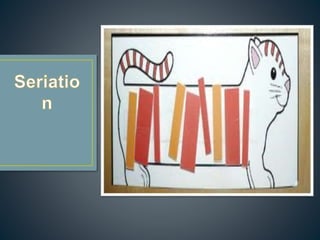
• Concerns with the
relationship among objects
and the ability to place
them in a logical sequence
or order
• Sensory seriation include
ordering sounds from
loudest to softest, sweetest
to sourest
• Early childhood
environment should include
many materials and
experiences to encourage
• Number is an
understanding of quantity,
an awareness that entails
increasingly more complex
concepts
• Earliest forms of number
understanding:
• gross comparison of
quantity
• identifying more or less
One-to-one
Correspondenc
e
One-to-one
Correspondenc
e
One-to-one
Correspondenc
e
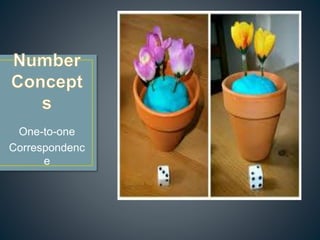
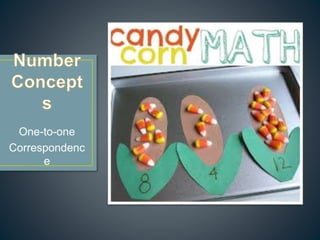
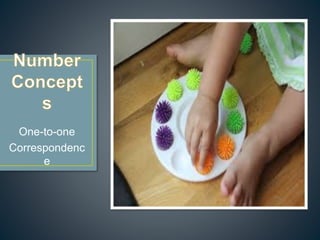
• One-to-one
Correspondence – A way in
which young preschoolers
begin to acquire an
understanding of number
concepts by matching items
to each other
• Rote counting – Reciting
Numbers from memory
without attaching meaning
to them in the context of
objects in a series
• Rational Counting –
distinguished from rote
counting in which the child
accurately attaches a
numeral name to a series of
objects being counted
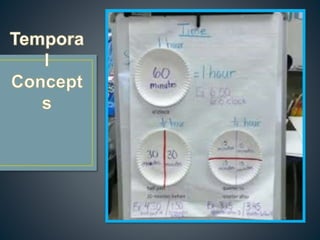
• Concerned with the child’s
gradual awareness of time
as continuum
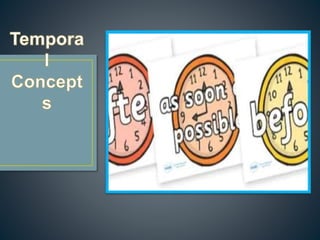
• Teach children the concept
of now, before and after
• Preschools’ experiences
sense of time are linked to
concrete experiences
• Temporal Sequencing –
ability to place a series of
events in order of
occurrence
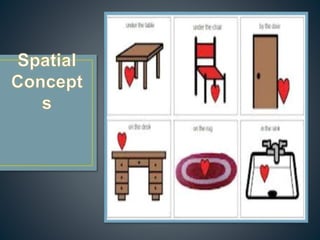
• Cognitive ability involving
an understanding of how
objects and people occupy,
move in, and use space
• Learn vocabularies like,
behind, on top of, toward
• Young children are continually involved in
mathematical learning which early
childhood environment and teachers must
encourage
• Math for young children is not abstract, it is
the provision of many materials that invite
the child to handle, explore, compare,
measure, combine, take apart, reconstruct,
and transform in an infinite variety of ways
• By acting on materials, children actively
construct knowledge and gradually come
to understand mathematical principles
• Central to this gradual understanding is the
ability to conserve, recognize that objects
remain the same in amount or number
despite perceptual changes
• Preschoolers rely very much on their
perceptions
• This reliance on observable rather than on
internal understanding that materials do
not change unless something is added or
taken away is a characteristic in the
preoperational period
• It is through many experiences in
arranging and transforming materials that
children gradually move to the concrete
operational period in which they are able to
conserve
• Thus, preschool children are not conservers, but
they need to have plenty of concrete experiences
to acquire this ability in their elementary years
• The early childhood classroom should contain
many materials that lend themselves to acquiring
math concepts
• The class may also contain a specific math
center where materials designed to encourage
and enhance math concepts
Teaching mathematics in the early years

Teaching mathematics in the early years

  • 1.
    Prepared by: Mrs. May-ridelP. Pasamata MAED ECSD Instructor
  • 2.
    • Adults oftenthink of Mathematics as an abstract discipline involving complex algebraic formulas and geometric calculations • Yet, the foundation of math are grounded in concrete experience such as: • Exploration of objects • Gradual understanding of their properties and relationships
  • 3.
  • 4.
    • Classification isthe ability to sort and group objects by some common attribute or property • To classify, a child needs to note similarities and differences among objects • Involves two simultaneous processes: 1. Sorting 2. Grouping
  • 8.
    • Concerns withthe relationship among objects and the ability to place them in a logical sequence or order • Sensory seriation include ordering sounds from loudest to softest, sweetest to sourest • Early childhood environment should include many materials and experiences to encourage
  • 19.
    • Number isan understanding of quantity, an awareness that entails increasingly more complex concepts • Earliest forms of number understanding: • gross comparison of quantity • identifying more or less
  • 20.
  • 21.
  • 22.
  • 23.
    • One-to-one Correspondence –A way in which young preschoolers begin to acquire an understanding of number concepts by matching items to each other • Rote counting – Reciting Numbers from memory without attaching meaning to them in the context of objects in a series
  • 24.
    • Rational Counting– distinguished from rote counting in which the child accurately attaches a numeral name to a series of objects being counted
  • 25.
    • Concerned withthe child’s gradual awareness of time as continuum • Teach children the concept of now, before and after • Preschools’ experiences sense of time are linked to concrete experiences • Temporal Sequencing – ability to place a series of events in order of occurrence
  • 28.
    • Cognitive abilityinvolving an understanding of how objects and people occupy, move in, and use space • Learn vocabularies like, behind, on top of, toward
  • 31.
    • Young childrenare continually involved in mathematical learning which early childhood environment and teachers must encourage • Math for young children is not abstract, it is the provision of many materials that invite the child to handle, explore, compare, measure, combine, take apart, reconstruct, and transform in an infinite variety of ways
  • 32.
    • By actingon materials, children actively construct knowledge and gradually come to understand mathematical principles • Central to this gradual understanding is the ability to conserve, recognize that objects remain the same in amount or number despite perceptual changes • Preschoolers rely very much on their perceptions
  • 33.
    • This relianceon observable rather than on internal understanding that materials do not change unless something is added or taken away is a characteristic in the preoperational period • It is through many experiences in arranging and transforming materials that children gradually move to the concrete operational period in which they are able to conserve
  • 34.
    • Thus, preschoolchildren are not conservers, but they need to have plenty of concrete experiences to acquire this ability in their elementary years • The early childhood classroom should contain many materials that lend themselves to acquiring math concepts • The class may also contain a specific math center where materials designed to encourage and enhance math concepts